Discounting is the most popular answer to a low average order value. It’s also one of the fastest ways to make a healthy-looking metric hide an unhealthy business.
AOV in marketing matters because it connects merchandising, pricing, conversion, and acquisition economics. But a higher number isn’t automatically progress. If the increase comes from deeper discounts, a few unusually large orders, or customers buying only during promotions, revenue may rise while margin and brand trust weaken.
For Shopify brands, the better question is simple: how can you build healthier baskets without training customers to wait for the next sale?
Why AOV in Marketing Is More Than a Growth Lever
Many ecommerce teams treat AOV as a revenue multiplier. Increase the average basket, and every acquisition campaign appears to work harder. That logic is directionally useful, but it misses the cost of how the basket gets bigger.
A sitewide discount can encourage a larger purchase today, especially when the offer requires a minimum spend. It can also teach customers that the regular price is negotiable. Once shoppers expect frequent markdowns, standard pricing feels less attractive, urgency fades between promotions, and the marketing team has to offer more to create the same immediate response.
The result is a familiar three-way tension:
- Margins are shrinking: Discounts reduce the revenue available to cover fulfilment, returns, acquisition, and operating costs.
- Conversion is insufficient: Paid traffic and owned audiences may reach the store, but standard offers don’t always give shoppers a compelling reason to act now.
- Brand perception is at risk: Repeated promotions can make a product feel less valuable and encourage customers to postpone purchases.
Practical rule: AOV is useful only when you know what caused it to increase.
A strong AOV strategy improves the basket through relevant products, clear value, and well-timed motivation. A weak one inflates the metric with broad couponing while leaving contribution profit under pressure.
That distinction changes how teams evaluate merchandising. Bundles, complementary products, premium variants, and minimum-spend rewards can all increase order value, but they don’t carry the same margin implications. Nor do they create the same customer expectations.
Treat AOV as a basket-health indicator, not a target to chase blindly. It should help answer whether customers understand your assortment, whether your pricing supports profitable buying decisions, and whether your promotional calendar is creating durable demand or only moving purchases forward from a future date.
What AOV in Marketing Actually Measures and Why It Matters
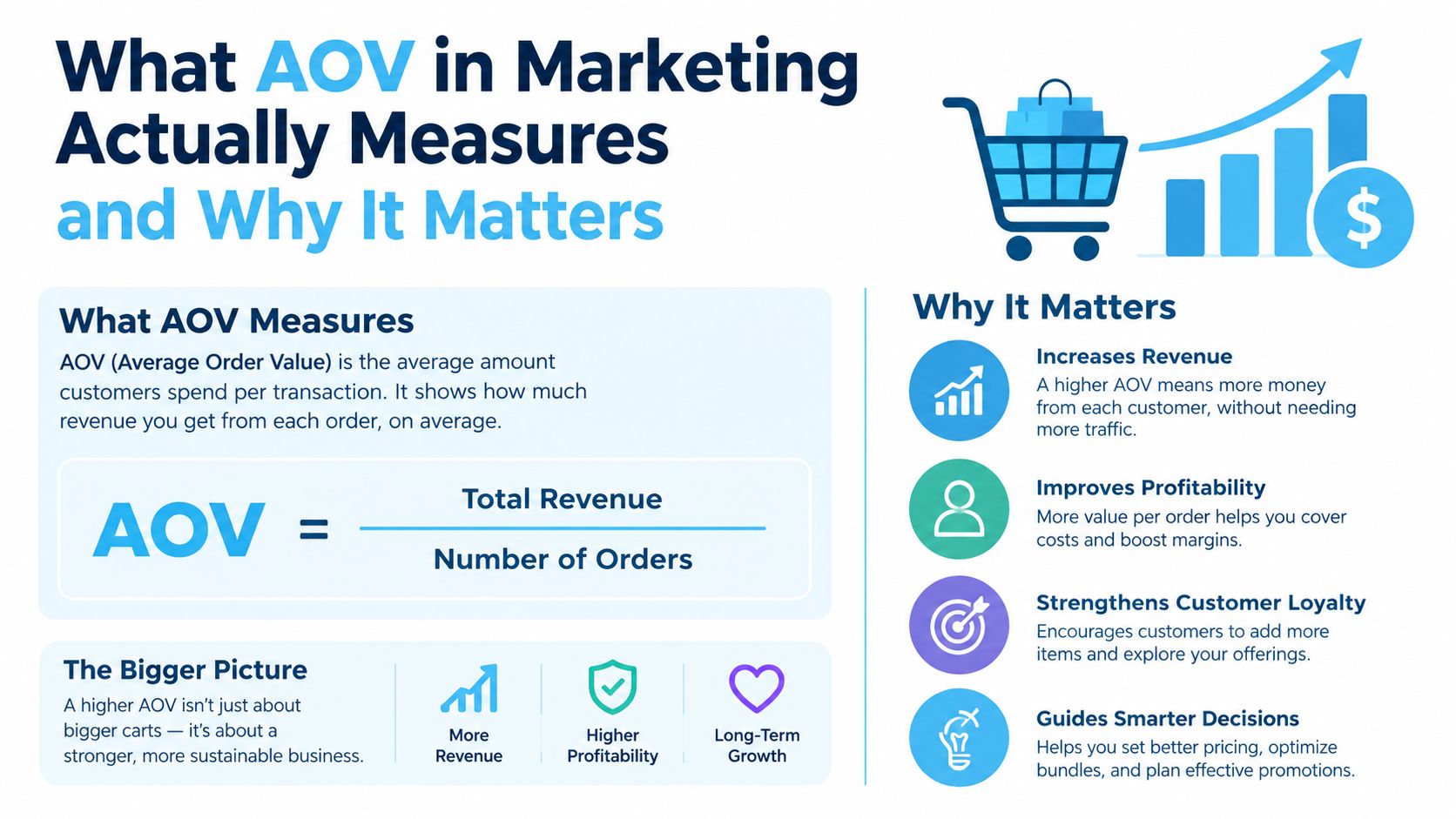
Average order value is the average revenue generated per transaction. The basic calculation is:
AOV = total revenue ÷ number of orders
That definition is simple, but the interpretation requires care. Recent global benchmarks place ecommerce AOV between approximately $144.57 and $172, depending on the dataset and measurement window, as reported in global ecommerce AOV benchmark coverage. One trendline records global AOV at $110.51 in 2020, $112.50 in 2021, $130.84 in 2022, $133.03 in 2023, and $144.57 in 2024. The 2024 figure represented an 8.7% year-over-year increase and the highest level in that series, while another benchmark reported a cross-industry global AOV of $172 in April 2026.
Those figures are useful for context, not as a universal target. Category economics vary sharply. In September 2024, online AOV reached $436 for luxury and jewelry, $253 for home and furniture, $211 for consumer goods, and $196 for fashion, accessories, and apparel. Food and beverage averaged $114, multi-brand retail $94, and pet care and veterinary services $83, according to industry-specific AOV benchmarks.
A $120 basket might signal strong performance in one category and weak merchandising in another. Product price, replenishment frequency, purchase intent, and product mix all shape the baseline. A practical AOV glossary from taap.bio is useful when aligning marketing, merchandising, and finance teams around the definition.
AOV and acquisition economics
Customer acquisition creates a fixed economic challenge. If a brand spends to bring a shopper to the store, increasing the revenue from that transaction can improve the order’s unit economics without requiring another visit from paid media.
That doesn’t mean every AOV increase is profitable. The relevant question is whether net contribution per order rises after discounts, fulfilment, payment costs, returns, and other variable expenses. A larger basket built from full-price complementary items is economically different from a larger basket created by a heavy coupon.
Device data adds another layer. In 2026 benchmarks, desktop AOV was $218 versus $159 on mobile, while regional averages ranged from $183 in the Americas to $128 in EMEA and $135 in APAC, according to device and regional AOV benchmarks. Shopify merchants should compare customers by device, region, category, and acquisition source before deciding what “good” looks like. A blended storewide average can conceal where basket-building already works and where the mobile experience needs a different approach.
For a concise business-focused explanation, see what AOV means in business.
Basket-Building Strategies That Protect Margins
The strongest AOV tactics increase relevance before they reduce price. A customer who adds a compatible refill, accessory, or complementary product has made the basket more useful. A customer who adds an unnecessary item only to qualify for a discount may produce a higher order total, but the behaviour may disappear when the offer does.
Cross-selling often has an advantage over simple upselling because it expands the use case rather than merely pushing the customer toward a more expensive version. Benchmark coverage reports potential average revenue or AOV lifts of roughly 10% to 30% from upsell and cross-sell programmes, with cross-selling described as substantially more effective than upselling in many retail contexts, as outlined in ecommerce AOV research on basket-building.
Use that distinction in the storefront:
- At the product page: Recommend items that complete the purchase, such as a case for a device or a matching care product for a garment.
- In the cart: Show one or two highly relevant additions, not a catalogue of unrelated products.
- At checkout: Use the remaining purchase intent for low-friction add-ons that don’t require extensive consideration.
- In email and SMS: Present combinations around a customer’s prior purchase rather than sending a generic “shop more” message.
A bundle should also solve a customer problem. A skincare routine, a travel set, or a replacement pack has a clear logic. The offer can make the decision easier without teaching the shopper that the underlying products are overpriced. For more detail on structuring these offers, see this guide to bundle pricing strategy.
Why discount-led AOV can mislead
Mean AOV is sensitive to outliers. A small number of very large orders can pull the average upward while most customers change their buying behaviour very little.
One 2026 benchmark analysis found discounted orders had a much higher mean order value than full-price orders, but nearly identical medians, $63.75 versus $61.96, as reported in AOV benchmark analysis of discount effects. That gap matters because the median describes the typical order more clearly when a few unusually large baskets distort the mean.
The same analysis reported that global ecommerce AOV rose only modestly during BFCM 2025, by about 3%, alongside a 4.8% increase in average selling price. That suggests headline AOV growth can reflect pricing and product mix, not necessarily better merchandising.
A higher average order value is not proof that customers see more value in your assortment. Check the median, items per order, discount rate, and contribution margin before celebrating.
The sustainable shift is from price reduction to basket justification. Give customers a credible reason to add another product, then use urgency only when the offer has a real limit and the terms are clear.
Implementing Quikly-Style Scarcity for Sustainable Uplift
A behaviour-driven promotion gives customers a reason to act now without making every shopper eligible for the same automatic markdown. In a Shopify store, that can mean an offer limited by quantity, time, or both, with the reward becoming less attractive as shoppers wait or as available claims are used.
This structure works differently from a generic countdown timer. A timer can create pressure without changing the underlying value proposition. A capped reward gives the customer a concrete decision: act while the preferred reward is available, or accept that waiting may reduce the benefit.
The distinction matters for margin protection. Discount data from 93,000 merchants shows a median ecommerce discount rate of 15%, an average of 19.5%, and a Cyber Week peak of 23%, according to 2026 ecommerce discount rate benchmarks. Repeating deep promotions at that intensity can make discounting a structural dependency rather than a temporary conversion lever.

Build the campaign around a profitable action
Start with the behaviour you want to encourage. If the goal is AOV, don’t reward any purchase equally. Attach the offer to a basket threshold, a product combination, or a quantity that makes commercial sense.
A practical setup looks like this:
- Choose the eligible basket: Use a minimum spend, a collection, or a bundle rather than a blanket sitewide code.
- Set a genuine limit: Cap the reward by available claims, an actual closing time, or both. Scarcity bias only works responsibly when the limitation is real.
- Protect the margin floor: Decide the maximum incentive before launch and exclude products where the discount would create an unacceptable contribution margin.
- Match the message to intent: Show the offer on relevant product and cart surfaces, then support it through Klaviyo email, SMS, or other owned channels.
- Make the experience recognisable: Style the campaign so the customer understands the offer as part of the store, not as an intrusive overlay.
A Shopify app such as Quikly can turn a promotion into a capped, time- or quantity-bound experience across the storefront, email, social, and SMS. The approach uses scarcity bias and loss aversion to reward earlier action, while allowing the merchant to control exposure and incentive depth. Further context on this approach is available in scarcity marketing guidance.
The campaign still needs honest language. Don’t manufacture a false deadline or imply that stock is disappearing when it isn’t. Real scarcity supports trust. Manufactured pressure creates the kind of promotional fatigue that eventually lowers response to every campaign.
Measuring Real AOV Impact Beyond the Vanity Metric
AOV should sit inside a measurement system, not at the top of one. The raw average tells you what orders were worth, but it doesn’t tell you whether the extra revenue came from additional units, higher prices, a different product mix, or a larger discount.
Start with a contribution view. For each test group, compare revenue per order with the variable costs that change when the basket changes. If AOV rises while net profit per order falls, the campaign has improved the headline metric and weakened the business.
Track the following together:
- AOV: The revenue value of the average transaction.
- Median order value: A clearer view of the typical order when a few large baskets distort the mean.
- Items per order: Evidence that customers are adding products rather than only buying a more expensive item.
- Discount cost per order: The incentive required to produce the basket.
- Contribution profit: The amount left after variable costs and discounts.
- Repeat purchase behaviour: A signal that customers valued the offer rather than responding only to temporary pressure.
Test the mechanism, not just the message
A cross-sell click doesn’t prove incremental value. The shopper may have purchased the recommended item anyway, or the placement may just redirect an existing choice. Compare an exposed group with a control group and evaluate completed orders, items per order, discount cost, and contribution profit.
Run the same discipline for scarcity campaigns. Test the capped offer against a standard promotion or no promotion, then examine the full distribution of order values. A positive result should include a healthier typical basket, not only an attractive mean.
Measurement rule: If the offer increases AOV but doesn’t improve contribution profit or customer quality, it needs a new mechanic, not a bigger budget.
Retention adds context. A customer who returns after a relevant bundle may have found genuine value. A customer who purchases only when a heavy promotion appears may be more expensive to retain and less responsive to regular pricing. Teams planning launches can also use SupaBird’s product launch advice to structure testing around timing, audience response, and post-launch evaluation rather than treating launch revenue as the only outcome.
Building a Long-Term AOV Strategy That Scales
A sustainable AOV programme begins with an audit of discount dependency. Pull recent orders and group them by promotion type, discount depth, product category, device, acquisition source, and customer status. Look for the uncomfortable pattern: promotions that generate larger baskets but leave less profit, or campaigns that convert first-time buyers who don’t return at regular prices.
Then replace broad incentives with deliberate mechanics.
Use merchandising before markdowns. Improve product pairings, build bundles around a clear use case, and make premium variants easy to compare. The customer should understand why the larger basket is useful.
Use segmentation before scale. A first-time visitor, an existing customer, and a high-intent cart builder don’t need the same offer. Shopify’s discount and cart infrastructure, theme customisation, and Klaviyo email or SMS integrations give teams the control to vary timing and eligibility. The right setup depends on the store and plan, including the differences between Shopify and Shopify Plus.
Use psychology with restraint. Scarcity can help a buyer overcome delay. Loss aversion can make a limited reward more salient. Commitment and consistency can support a customer who has already built a considered basket. None of these principles justifies false limits or constant pressure.
Benchmark your store against relevant peers rather than a generic global figure. For merchants focused on the UK market, UK AOV benchmarks for Shopify can provide useful comparison context, but internal cohort data should decide which targets are commercially realistic.
The best AOV strategy reduces the need to discount more aggressively over time. It helps customers buy a more complete solution, gives high-intent shoppers a reason to act, and preserves the value of the products outside promotional windows. That combination addresses margin pressure, conversion friction, and brand perception without pretending that revenue growth alone is enough.
Quikly helps Shopify merchants create time- and quantity-bound promotional experiences that encourage larger, earlier purchases without relying on blanket discounts. Visit Quikly to explore a more controlled way to improve AOV while protecting margin and brand value.
Topics: aov in marketing, average order value, ecommerce strategy, shopify growth, increase aov