Traffic is up. Your Shopify store is getting more sessions from Meta, Google, affiliates, maybe even a decent email program. But AOV hasn’t moved much, and every attempt to push it higher seems to fall into one of two bad options. Either you add generic related products that nobody clicks, or you run another discount that lifts conversion for a minute and chips away at margin.
That’s why a real cross-sell strategy matters. Not a widget. Not a popup. A strategy.
For Shopify brands, cross-selling can be a meaningful growth lever, but only when it’s built around relevance, timing, and margin discipline. Businesses that implement cross-selling effectively can generate 10% to 30% of total ecommerce revenue from it, and many see 20% growth in profits tied to those efforts, according to OpenSend’s cross-sell data roundup. The keyword there is effectively. Plenty of stores install the tech and still get mediocre results because the underlying logic is weak.
Beyond Related Products Why Your Store Needs a Real Strategy
A lot of Shopify stores treat cross-sells like a theme accessory. Add a “You may also like” block, pull in a few catalog items, and hope shoppers do the merchandising for you.
That approach usually fails for a simple reason. It asks the customer to do extra thinking.
If someone adds a protein powder to cart, a useful cross-sell might be a shaker bottle, a travel pack, or a subscription option for replenishment. If the store shows three unrelated bestsellers instead, the offer becomes noise. It doesn’t complete the purchase. It interrupts it.
Revenue without profit is a bad trade
The temptation is obvious. If a discount gets more add-on items into the cart, it can look like the strategy is working. But many brands are already dealing with shrinking margins and customers who expect a deal every time. Cross-selling only helps if it lifts order value without training shoppers to wait for the next promotion.
That’s the line many stores miss.
A smart cross-sell strategy for Shopify stores should answer four questions before you ever touch an app setting:
- What problem does the add-on solve for someone buying the main product?
- Where in the journey does it make sense to present that add-on?
- How much extra spend feels reasonable in that buying moment?
- Does the offer strengthen the brand experience or make the store feel pushy?
Practical rule: If the cross-sell makes the customer think harder, second-guess the cart, or hunt for relevance, it’s not helping.
Why generic recommendation blocks underperform
Most generic related product blocks are built around catalog similarity, not buying intent. They match by collection, vendor, tag, or broad behavior patterns. That can be fine for discovery. It’s weak for conversion.
Cross-selling works best when the recommendation is the next logical item in the customer’s decision path. That can mean:
| Main purchase | Strong cross-sell logic | Weak cross-sell logic |
|---|---|---|
| Skincare cleanser | Moisturizer that completes the regimen | Another cleanser in the same collection |
| Espresso machine | Descaler or milk pitcher | Unrelated kitchen appliance |
| Running shoes | Performance socks or insoles | A random hoodie because it’s popular |
This is why a cross-sell strategy for Shopify stores can’t be reduced to “show more products.” The goal isn’t more exposure. The goal is a more complete order, with higher contribution profit and less reliance on sitewide markdowns.
What a real strategy changes
Once a brand gets serious, the cross-sell stops being a merchandising afterthought and becomes part of the conversion system. Product pages help discovery. Cart offers help attachment. Post-purchase offers capture momentum without disrupting checkout.
That’s a different operating mindset. You’re no longer asking, “What else can we show?” You’re asking, “What’s the most relevant next item, in this moment, at a price and presentation that protects margin?”
That’s where results start to compound in the right direction.
The Foundation of a Smart Cross-Sell Product Pairing Logic
The strongest cross-sell programs start in your order history, not in your design editor.
If your pairing logic is weak, better placement won’t save it. The customer might see the offer. They still won’t want it.
Start with customer intent, not catalog adjacency
A common mistake is pairing products because they sit near each other in the catalog. Same collection. Same theme. Same season. That’s easy to configure, but it’s not how people buy.
Instead, look for products that complete a job. If a shopper buys a face serum, what reduces friction in using it well? If they buy a phone case, what protects, charges, or personalizes the device next? If they buy a weighted blanket, what improves setup, care, or storage?
That shift matters because personalization is the most critical factor in successful cross-selling. Around 80% of businesses report that personalization in cross-selling increases customer spending by approximately 34%, according to MBC Builder’s cross-selling statistics.
Build your pairing logic from three data layers
Don’t stop at “frequently bought together.” Use it as one signal among several.
-
Order history Look at what customers purchase together over time. Not just within the same session, but across first and second orders. Some products belong together immediately. Others naturally follow a few days later.
-
Use-case alignment Pair products that solve the next practical need. A yoga mat might pair with a strap or cleaning spray. A coffee grinder might pair with a scale. The best cross-sells reduce the chance that the customer needs to leave your store to finish the solution.
-
Behavioral context A returning customer shouldn’t see the same recommendation as a first-time buyer. Someone who already bought the accessory last month doesn’t need it again. A stronger ecommerce personalization software strategy proves beneficial, as relevance depends on what the shopper has already done.
The best cross-sell doesn’t feel like an add-on. It feels like the item the customer forgot to search for.
Use a simple filtering framework
Before approving any pairing, run it through this short screen:
- Relevance first: Does it clearly complement the main item?
- Non-competitive: Does it support the purchase, not replace it?
- Low-friction: Can the shopper understand the value immediately?
- Margin-aware: Does the item carry enough contribution to justify the placement?
A laptop sleeve beside a laptop works. A second laptop doesn’t.
Keep the recommendation set tight
Good cross-sell strategy is editing. Not abundance.
If a product can support six possible add-ons, choose the few that are most useful in that moment. Too many options create hesitation, especially on mobile and especially in-cart where the customer is already close to purchase.
This is also where merchants can over-automate. AI can surface patterns quickly, but it still needs business judgment. Some pairings are statistically common and still bad for brand experience. If a recommendation looks opportunistic instead of helpful, cut it.
Strategic Placement Where and When to Make the Offer
Placement changes the meaning of the offer.
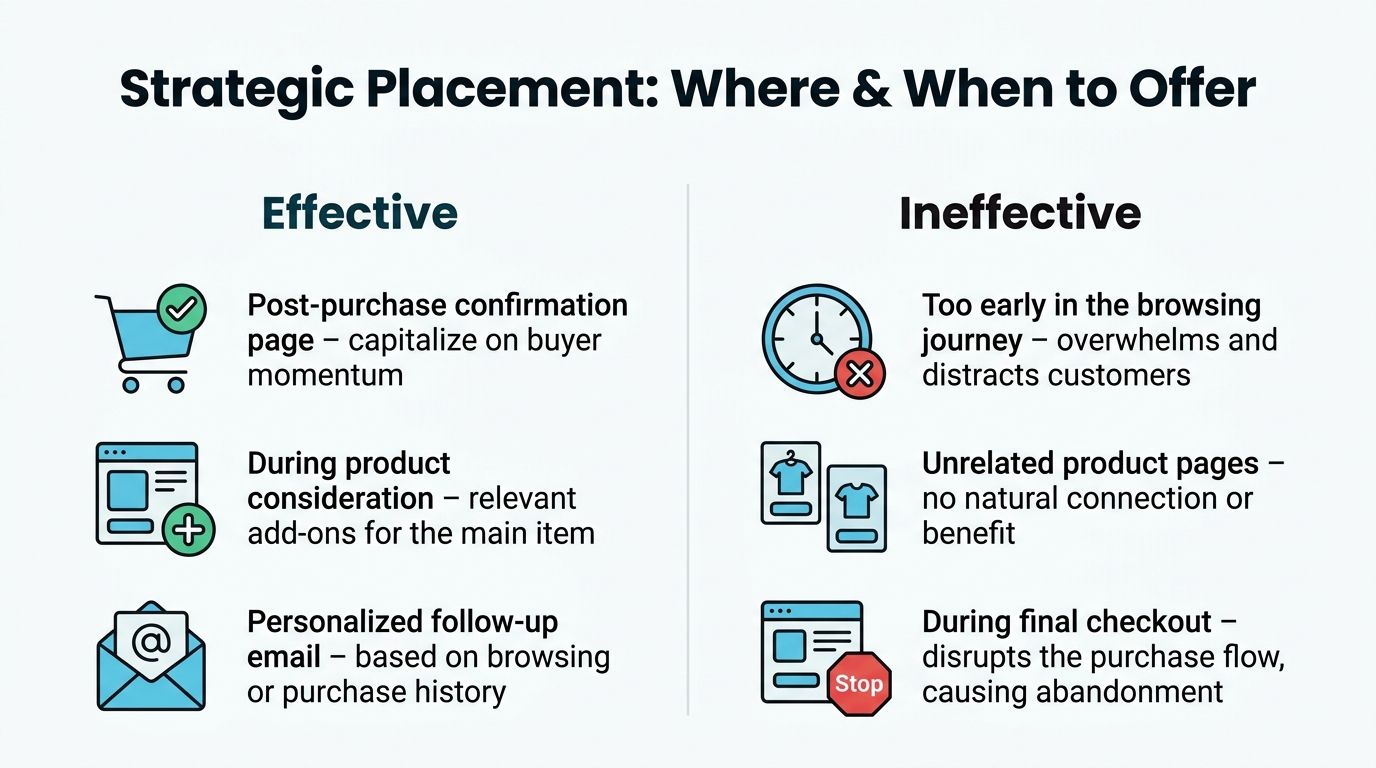
The same add-on can feel helpful on a product page, distracting in checkout, and perfectly timed after purchase. That’s why a cross-sell strategy for Shopify stores should be mapped to shopper mindset, not just available app placements.
Product page placement works for planned add-ons
The product page is where discovery happens. The shopper is still considering the main item, so related accessories and “complete the kit” recommendations can increase cart size without feeling invasive.
This is the best spot for offers that require a little context. Think skincare routines, camera accessories, or supplements that work as a stack. The customer has enough attention to evaluate the logic.
Use this placement when:
- The add-on improves the main product experience
- The relationship needs a quick explanation
- The shopper may want to add multiple items at once
What doesn’t work is clutter. If the page already has variant selectors, subscription options, reviews, and sticky add-to-cart behavior, adding a loud recommendation carousel can weaken the primary conversion path.
Cart and drawer placement works for easy decisions
The cart is a stronger place for simpler add-ons. Lower-friction, practical items typically perform best in this stage because the customer has already committed to the main purchase.
Think extra batteries, gift wrap, travel case, refill pack, or a protection item. These offers should be instantly legible and easy to add with one tap.
Shopify guidance and operator best practice both point in the same direction here. Keep recommendation volume restrained. Shopify’s own blog advises capping cart drawer recommendations at three items or fewer to avoid overload in the decision moment, as noted in Shopify’s cross-selling guide.
Operator note: The cart is not the place to ask the customer to browse again. It’s the place to offer one small, obvious improvement to the order they’ve already built.
Post-purchase is underused and often cleaner
A lot of stores over-focus on the cart and ignore the confirmation page. That’s a miss.
After purchase, the customer has already made the main decision. The payment anxiety is gone. If the add-on is relevant and easy to accept, post-purchase can create incremental revenue without threatening the original sale. For brands exploring that route, this breakdown of post-purchase upsell flows on Shopify is a useful tactical reference.
This placement tends to work well for replenishment items, accessories the customer may have skipped initially, or lower-cost extensions of the original purchase.
Mobile changes the rules
Most cross-sell advice still assumes desktop behavior, but 67% of cross-sell traffic originates from mobile, according to the mobile cross-sell UX discussion on YouTube. That’s why drawer carousels, intrusive pop-ups, and tiny add-on cards so often underperform. They ask mobile shoppers to scroll, close overlays, or parse too much information in a cramped space.
On mobile, the better pattern is simpler:
| Placement | What works on mobile | What fails on mobile |
|---|---|---|
| Product page | One relevant add-on with a clear benefit | Multi-card carousel below the fold |
| Cart drawer | Tap-to-add accessory with no extra navigation | Several competing offers with long copy |
| Post-purchase | One-click accessory or refill suggestion | Dense offer stack that feels like a second checkout |
If the experience requires precision taps, repeated scrolling, or modal stacking, it’s probably hurting more than helping.
The Margin Question Pricing and Presenting Your Offers
Most cross-sell advice gets the mechanics half right and the economics wrong.
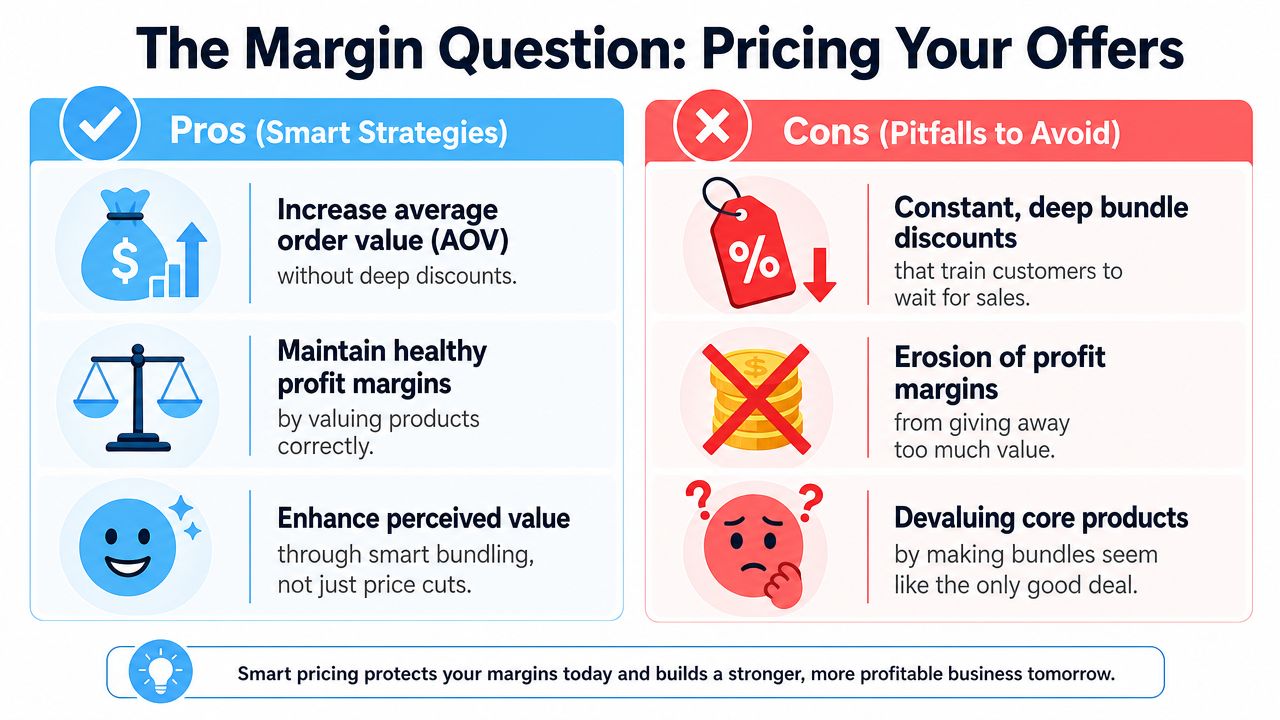
Yes, pricing matters. Yes, the add-on usually needs to feel smaller than the main purchase. But too many brands turn that into a lazy discount habit, and that’s where cross-selling stops helping profit.
The 25 percent rule is useful, but easy to misuse
A practical benchmark appears in Shopify cross-sell guidance and adjacent operator content. Cross-sell items should be priced at roughly 25% of the main purchase price to reduce sticker shock, as covered in Loopwork’s Shopify upsell and cross-sell article.
That’s a helpful pricing lens. It keeps the add-on from feeling like a second major decision.
But merchants often turn that rule into a recurring discount formula. Add this accessory for 10% off. Buy the bundle and save. Buy two and get a little more off. Repeated often enough, shoppers stop seeing the offer as a timely opportunity and start seeing it as the normal way to buy.
Predictable discounting teaches the wrong lesson
That’s the deeper margin problem. Most content focuses on what to cross-sell but ignores how recurring bundle discounts train people to wait. The trap is using tactics like the 25% rule as a predictable discount lever, which can erode margin and brand perception over time, as argued in Rebuy’s Shopify cross-selling tips.
The practical risk looks like this:
- Customers delay purchases because they assume another bundle offer is coming
- Core products lose perceived value because the discounted bundle starts to feel like the actual price
- Teams need deeper promotions over time to get the same response
Don’t let the cross-sell become the proof that your full-price offer isn’t worth buying.
Better presentation protects both margin and brand
Cross-sell pricing should communicate usefulness first, savings second.
That doesn’t mean never discounting. It means avoiding flat, repetitive mechanics that cheapen the catalog. In practice, stronger presentation often looks like:
- Complete-the-routine framing: Show why the add-on matters to the outcome
- Convenience framing: Emphasize that the customer can finish the solution now
- Limited availability framing: Use urgency carefully when inventory or timing supports it
- Smaller commitment framing: Keep the decision light, especially in-cart
A good cross-sell should feel like a smart addition. A bad one feels like a desperate markdown.
Price with contribution, not only conversion, in mind
Not every item belongs in a cross-sell slot just because it converts. Some products are too low-margin, too operationally messy, or too likely to create support issues.
Before scaling any offer, check the basics:
| Question | Why it matters |
|---|---|
| Does the add-on keep healthy gross profit after any incentive? | Revenue lift can hide weak contribution |
| Is it easy to explain in one line? | In-cart shoppers won’t read much |
| Does it increase fulfillment complexity? | Extra handling can erase the upside |
| Does it reinforce product value? | Brand erosion is expensive, even if it’s hard to see immediately |
That’s the core pricing conversation. More orders are good. Better orders are what move the business.
From Basic Bundles to Behavior-Driven Promotions
A shopper adds your hero product to cart, sees the same bundle offer you run every day, and pauses. Nothing about it feels urgent or specific to what they just did. At that point, another discount usually lowers margin more than it lifts profit.
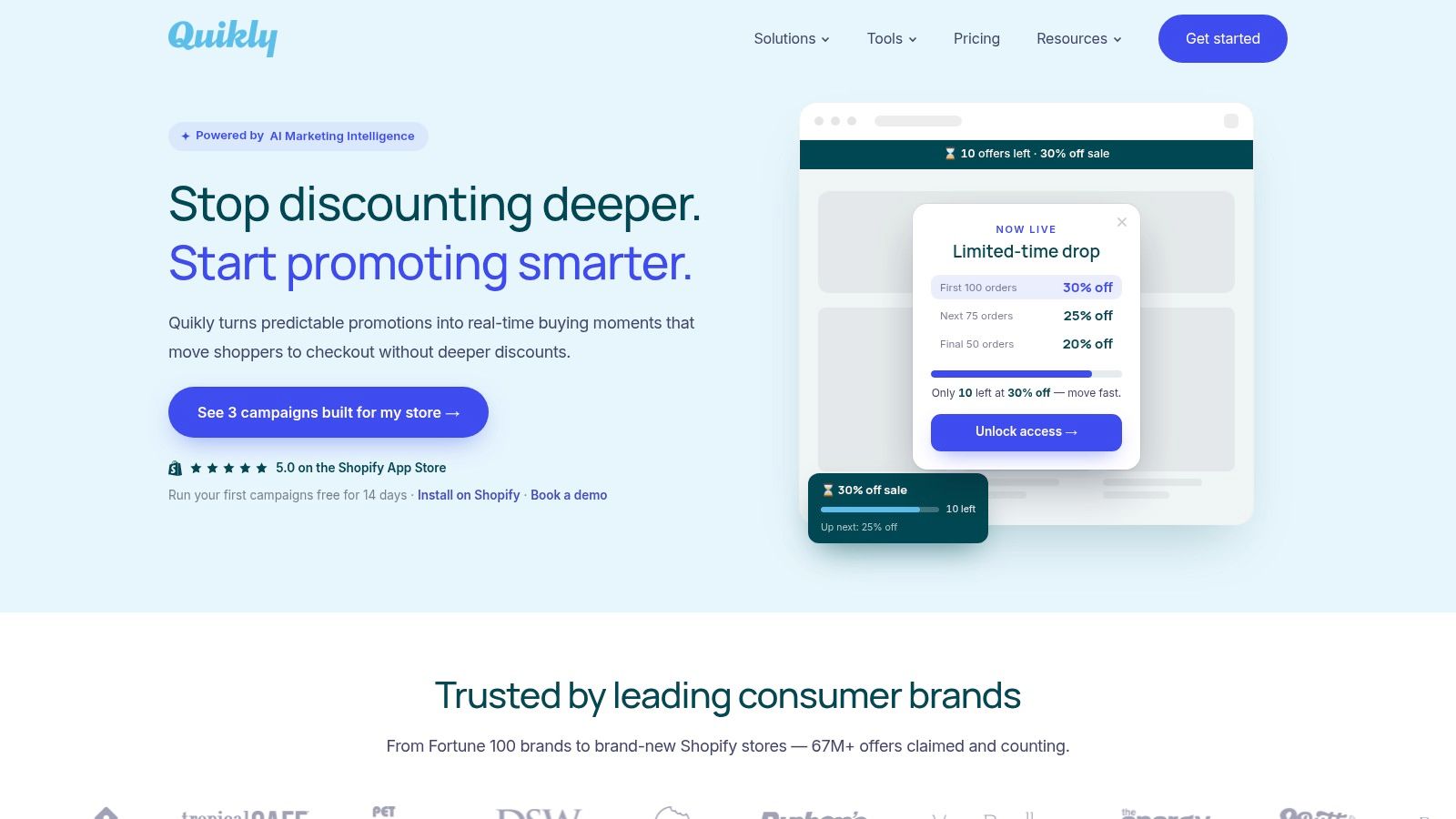
Behavior-driven promotions solve a different problem. They give the customer a reason to add the right product now, based on timing, context, and intent.
Why people act on some offers and ignore others
Static bundles are useful because they are easy to launch and easy to explain. They also become background noise fast. Once shoppers learn the pattern, the offer stops feeling like guidance and starts feeling like store-wide pricing behavior.
Behavioral psychology helps more than another blanket markdown in that situation.
Three principles show up often in strong cross-sell programs:
-
Scarcity bias Limited quantity or limited timing can increase response, but only when the limit is real. Fake urgency trains customers to distrust the offer.
-
Loss aversion Shoppers respond more strongly to missing a relevant benefit than to seeing a generic percent-off message. An add-on that prevents a bad outcome usually beats an arbitrary discount.
-
Commitment and consistency After choosing the primary product, customers are more open to an add-on that fits the decision already in motion. The best cross-sells feel like a logical extension of the purchase, not a new sale to evaluate from scratch.
The practical takeaway is simple. Relevance and timing usually outperform repetition. They also protect your pricing position better than teaching shoppers to wait for the same deal every time.
Move from blanket offers to triggered relevance
Behavior-driven cross-selling means showing fewer offers with tighter logic.
A shopper who adds a supplement starter kit might see the refill pouch, not three unrelated bestsellers. A customer who just bought a camera gets a post-purchase offer for the memory card they are likely to need, not a site-wide bundle they already ignored on the product page.
Useful triggers include:
- Cart-aware offers tied to the exact product or category just added
- Post-purchase offers based on what was just bought and what naturally comes next
- Audience-specific messaging shaped by lifecycle stage, reorder behavior, or product affinity
If your team is working on personalizing messages with segmentation, that discipline maps directly to cross-sell performance. The product, message, and trigger should change with the shopper’s behavior, not stay fixed because the app makes it easy.
The offer should create action, not just display value
Many bundle tools stop at merchandising. They put products together but do little to make the customer care right now.
Better promotions use structure carefully. A limited-time add-on, a capped gift with purchase, or a reward that favors immediate action can lift attachment without conditioning shoppers to expect a deeper discount next week. I have seen brands hurt themselves by overusing static bundle savings. Conversion looked healthy for a while, but contribution weakened and customers learned to hold out for the offer.
That is the trade-off. A promotion can increase take rate and still be the wrong move if it lowers gross profit, complicates operations, or cheapens the catalog. A strong bundle pricing strategy should be judged by what it adds to the order and what it preserves in the brand.
Basic bundles answer “what else can we sell?” Behavior-driven promotions answer “why does this customer have a good reason to add it now?”
That difference matters because profitable cross-sell strategy for Shopify stores depends on better order quality, not just bigger carts.
Measuring What Matters KPIs and A/B Testing Your Strategy
If you only track AOV, you can fool yourself fast.
AOV can rise while profit slips, attachment quality falls, or mobile shoppers get frustrated. A cross-sell strategy for Shopify stores needs a measurement model that shows whether the offer is improving the business, not just making the dashboard look busier.
The core KPIs to watch
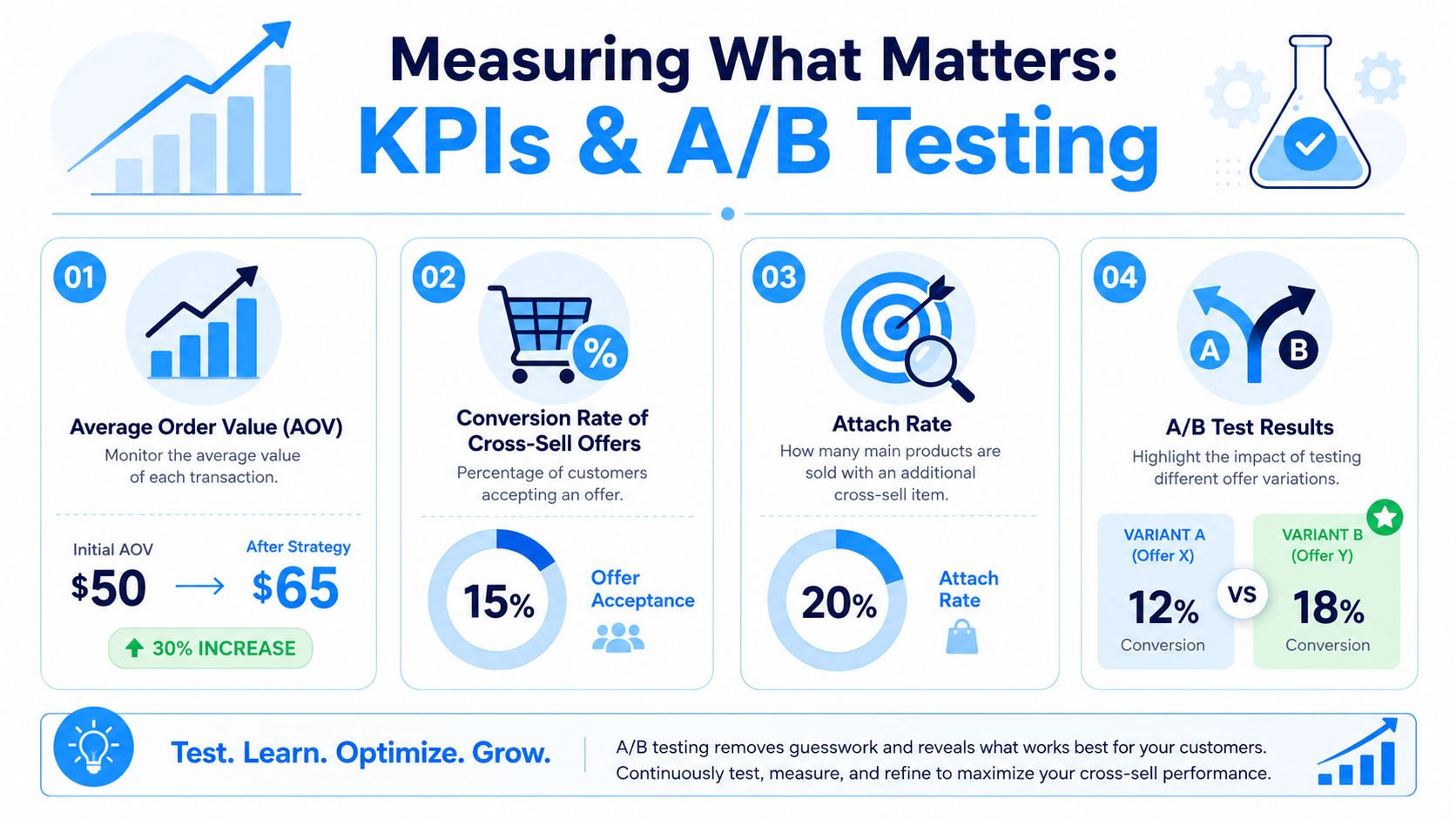
Best practices for Shopify cross-sells emphasize tracking attachment rate, AOV lift, and upsell conversion rate, while keeping recommendation sets to 2 to 3 highly relevant products and testing one variable at a time, according to Cartly’s guide to upselling and cross-selling.
Those are the core signals. In practice, I’d watch them this way:
-
Attachment rate How often does the main product get purchased with the add-on? This tells you whether the pairing itself is strong.
-
Recommendation click-through rate Are shoppers engaging with the offer at all? Low clicks usually point to weak placement, weak framing, or weak relevance.
-
AOV lift Useful, but only in context. If AOV rises because you pushed a deeper discount, that’s not necessarily a win.
-
Offer conversion rate Of the people who saw the recommendation, how many accepted it? This helps compare placements and presentations.
-
Profit impact This is the filter that matters most. Some add-ons create attractive topline lift while contributing very little after discounts, shipping, support, or returns.
How to run tests that actually teach you something
Many merchants “test” cross-sells by changing three things at once, then guessing why performance changed. That’s not testing. That’s theme roulette.
Use a cleaner process:
-
Pick one variable Test placement, product pairing, headline, or incentive. Not all of them together.
-
Keep the rest stable Same product set, same traffic mix, same time window where possible.
-
Segment your readout Mobile and desktop behavior can differ sharply. New and returning customers can too.
-
Write down the hypothesis first Example: “A single cart add-on will outperform three options because it reduces choice friction.”
If your team wants a more structured model for reading ecommerce performance faster, this faster ecommerce insights guide is a useful companion resource.
Measurement rule: If you can’t explain why a cross-sell won, you probably can’t scale it confidently.
Know when to cut an offer
Some offers don’t need optimization. They need removal.
If a cross-sell gets clicks but weak take rate, the pairing may be interesting but not persuasive. If it converts but drives support complaints, it may be operationally messy. If it works on desktop and fails on mobile, the UI may be the problem, not the product.
The job isn’t to keep every cross-sell alive. The job is to find the few that improve order value cleanly and repeatably.
A profitable cross-sell strategy doesn’t ask shoppers to buy more at any cost. It helps them buy better, in ways that protect margin and keep the store from sliding into predictable discounting. If you want a way to turn offers into time- and quantity-bound experiences that reward action instead of waiting, Quikly is worth a look.
Topics: cross-sell strategy, shopify cross-sell, increase aov, ecommerce strategy, shopify apps