You’ve probably seen this pattern in your own Shopify store.
Traffic goes up. Conversion softens. Someone suggests a stronger offer, so you add a discount, then another one, then a cart incentive on top. Orders come through, but margin gets thinner every time. AOV might rise for a while, yet the profit behind those sales starts looking a lot less impressive.
That’s the trap behind a lot of upsell advice. It focuses on getting the next item into the cart, not on whether the order is still worth having after the promotion does its damage. If customers only take the upsell when you shave price, you’re not building a better commercial engine. You’re teaching buyers to wait for a markdown.
There’s a better way to think about how to upsell without discounting. The goal isn’t to squeeze more items into every order. It’s to guide customers toward higher-value decisions that feel useful, timely, and credible, while keeping your margin and brand position intact.
The Hidden Cost of “More Sales”
Discount-led growth looks clean in a dashboard. It’s messier in a P&L.
A lot of brands chase more sales as if revenue alone answers the question. It doesn’t. If every lift in conversion depends on a price cut, each campaign chips away at gross margin, and the next promotion usually has to work harder than the last one. That’s how stores end up with promo fatigue, thinner contribution profit, and customers who won’t move without an incentive.
The hardest part is that the damage often hides inside otherwise healthy-looking numbers. You can still see spikes on campaign days. You can still report stronger order volume. But if the path to growth is “discount more to sell more,” you’re building a habit your customers notice fast.
Practical rule: If your upsell only works when the added item is cheaper than it should be, the offer probably isn’t strong enough on its own.
For Shopify merchants, this gets amplified by how easy it is to layer offers into the storefront. Theme app extensions, cart drawers, discount fields, post-purchase apps, SMS triggers, Klaviyo flows. The stack makes it simple to launch promotions. It also makes it easy to create a store experience that feels permanently on sale.
A healthier upsell strategy does three things differently:
- It adds value instead of subtracting price. The customer gets a better option, a more complete purchase, or a faster path to a desired outcome.
- It respects timing. The recommendation appears where the buyer is already making a decision, not in five popups and two follow-up nags.
- It protects perception. The offer feels curated and earned, not desperate.
That shift matters because margin erosion isn’t just a finance problem. It becomes a conversion problem and a brand problem. Buyers who expect markdowns delay decisions. Shoppers who see constant promos start questioning full price. Over time, your merchandising gets weaker because price starts doing the work your product positioning should have done.
Non-discount upselling fixes that by changing the conversation. Instead of asking, “How much do we need to give away to get this order?” you ask, “What would make this order better enough to justify the next step?”
The Psychology of a Profitable Upsell
A profitable upsell doesn’t feel like an upsell. It feels like a better choice.
That distinction matters because customers rarely object to paying more when the difference feels proportional, relevant, and easy to justify. The strongest non-discount offers work because they align with how people make decisions in the moment, not because they pressure someone into a bigger cart.
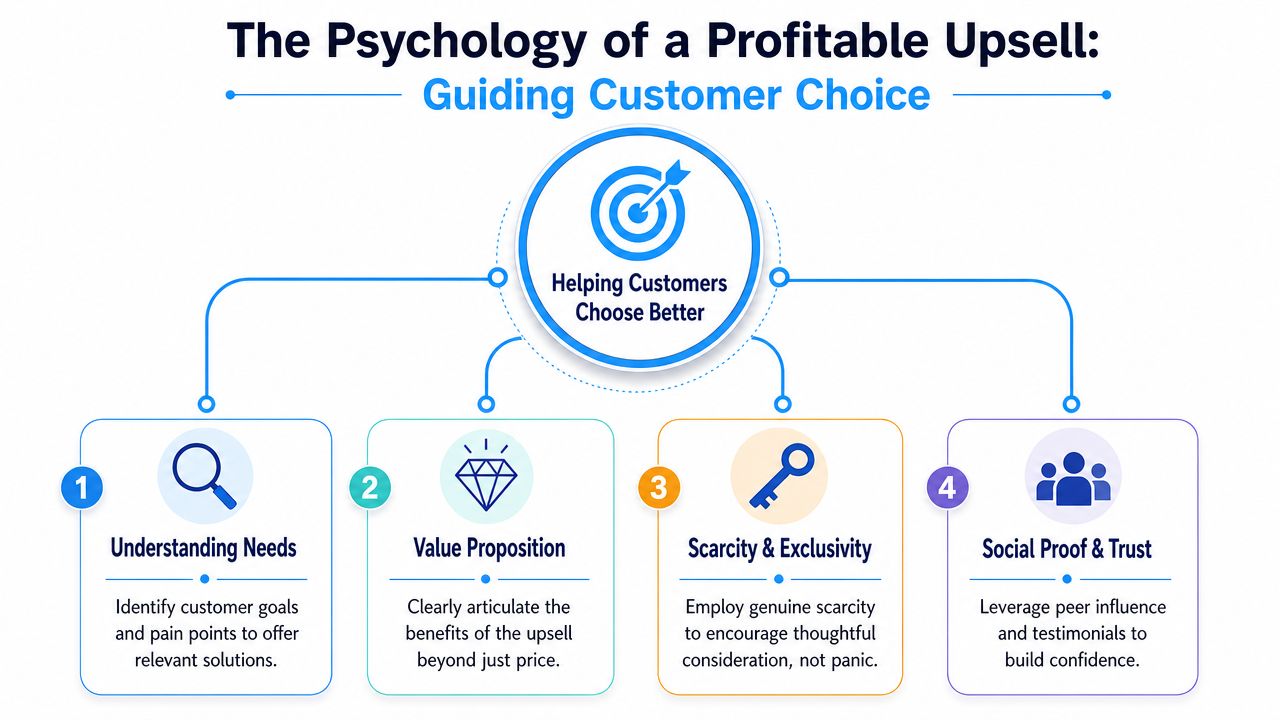
Why the price gap matters
The cleanest benchmark here is the upgrade range itself. Most successful upsells fall in the 10–25% price range above the original product, which makes the premium option feel like a modest step rather than a major leap, according to Xero’s guide to upselling techniques.
That pricing window works because it keeps the comparison manageable. A customer shopping a standard serum, bundle, or subscription doesn’t need to rethink the whole purchase. They just need to decide whether the added benefit is worth a relatively small increase.
That’s a different psychological frame from discounting. Discounts ask, “How cheap can this feel?” A good upsell asks, “How clearly can I show the extra value?”
The principles behind the tactic
Several behavioral cues make non-discount upsells perform better without cheapening the brand:
-
Commitment and consistency
Once a shopper has selected a product, they’ve already signaled intent. An upgrade that builds on that decision feels easier than starting over with a different product path. -
Loss aversion
Customers don’t want to miss out on useful benefits once they’ve seen them clearly. That’s why framing matters. “Get the version that includes X” often lands better than “Spend more.” -
Temporal discounting
Buyers favor benefits they can understand immediately. The add-on or upgrade has to improve this order now, not promise vague future value. -
Social proof
Confidence reduces friction. If a premium option is visibly popular or well reviewed, the shopper spends less energy questioning the move.
The upsell should remove uncertainty, not create another decision tree.
This is also where personalization becomes practical rather than ornamental. A lot of teams talk about personalization as if it means building a giant recommendation engine. Most stores don’t need that. They need cleaner relevance. If you’re trying to measure ROI of personalization tools, start by asking whether the recommendation helped a buyer make a better decision at full price or near full price. That’s the benchmark that matters.
What works and what usually fails
A profitable upsell tends to have three traits:
| Approach | What it feels like to the shopper | Margin impact |
|---|---|---|
| Relevant upgrade | Helpful, sensible, low friction | Stronger than discount-led upsells |
| Better-fit premium version | Confident choice with clearer value | Protected |
| Random extra item | Pushy, disconnected | Unreliable |
| Discounted add-on | Transactional, expected | Erodes over time |
The failure mode is usually obvious in hindsight. The recommendation is too far above the original item, too loosely connected to intent, or too vague about why it belongs in the cart. When that happens, teams often reach for a discount to force adoption. That covers up a merchandising problem instead of solving it.
Build Smarter Upsells with Bundles and Social Proof
Most bundle advice is too broad to be useful.
“Create bundles” sounds smart until you’re staring at a Shopify product catalog trying to decide whether to pair a cleanser with a toner, a jacket with a belt, or a mattress with a protector. The key question is simpler. What combination helps the customer complete a job they already came to the store to do?
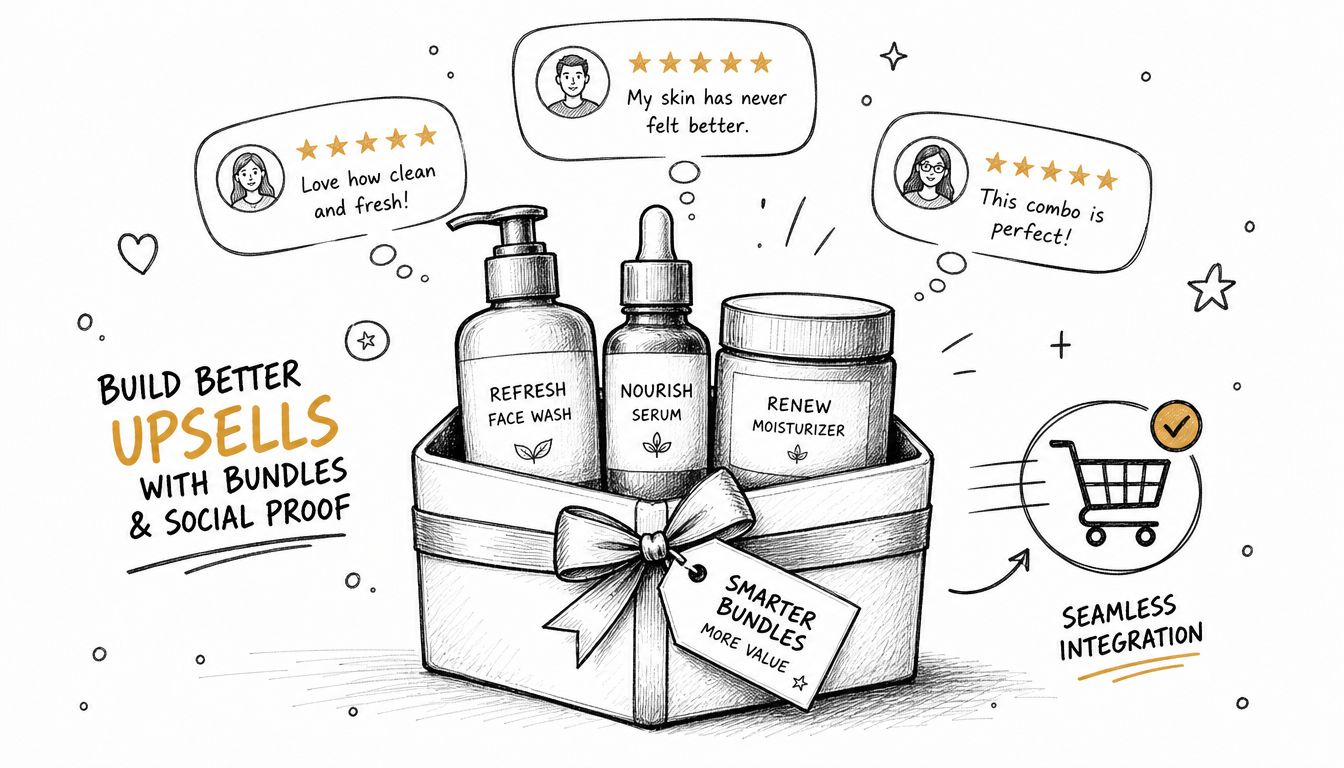
Build bundles around intent
The bundles that convert without discounts usually have a clear use case:
-
Routine bundles
Skincare is the classic example. A shopper buying a cleanser often needs the next logical step, not a random cross-sell. A “starter routine” or “night repair set” reduces decision fatigue. -
Compatibility bundles
In electronics or accessories, the best upsell often answers “what else do I need for this to work properly?” -
Outcome bundles
Apparel brands can frame this as “complete the look.” Home brands can frame it around room setup, care, or longevity.
On Shopify, these work well in the product page module beneath the core description, inside a cart drawer, or as a lightweight block near add-to-cart. If you want a useful reference point for structuring bundled offers, Quikly’s piece on bundle pricing strategy is worth reviewing for the merchandising angle.
Social proof makes the upsell safer
Customers don’t just need to understand the bundle. They need to trust it.
That’s why reviews belong inside the upsell itself, not buried elsewhere on the page. Products with 50+ verified reviews convert 4.6x better than those without reviews, according to Red Stag Fulfillment’s ecommerce conversion rate analysis. For upsells, that matters because the recommendation is asking the customer to expand commitment.
A few practical ways to use that:
- Show review count on the recommended item so the shopper sees that the add-on is widely validated.
- Surface a short benefit statement next to the review snippet, especially if the premium option solves a common hesitation.
- Keep the recommendation tight. One or two strong options feel curated. A carousel of eight feels like merchandising indecision.
A good bundle behaves like a store associate. It completes the purchase with context, not noise.
Add value through presentation, not markdowns
Packaging can also function as a non-discount upsell when it supports gifting, premium positioning, or special occasions. For brands exploring this route, these branded gift packaging solutions are a useful reminder that presentation itself can justify a higher basket without cutting price.
Many stores undersell themselves. They offer a basic item plus a coupon, when a more compelling move would be a better-composed set, stronger proof, and a cleaner placement. The customer spends more, but the order also feels more complete. That’s the kind of AOV growth that doesn’t come back to hurt you later.
Use Urgency to Drive Immediate Action
Urgency gets a bad reputation because so many brands fake it.
A countdown that resets every visit isn’t urgency. It’s decoration. Shoppers know the difference. Once they spot the trick, trust drops, and the upsell starts looking like pressure instead of guidance.
Real urgency works because it reflects a real condition. Limited inventory. A reward tied to immediate action. A time-bound shipping perk. Something the customer can understand without feeling manipulated.
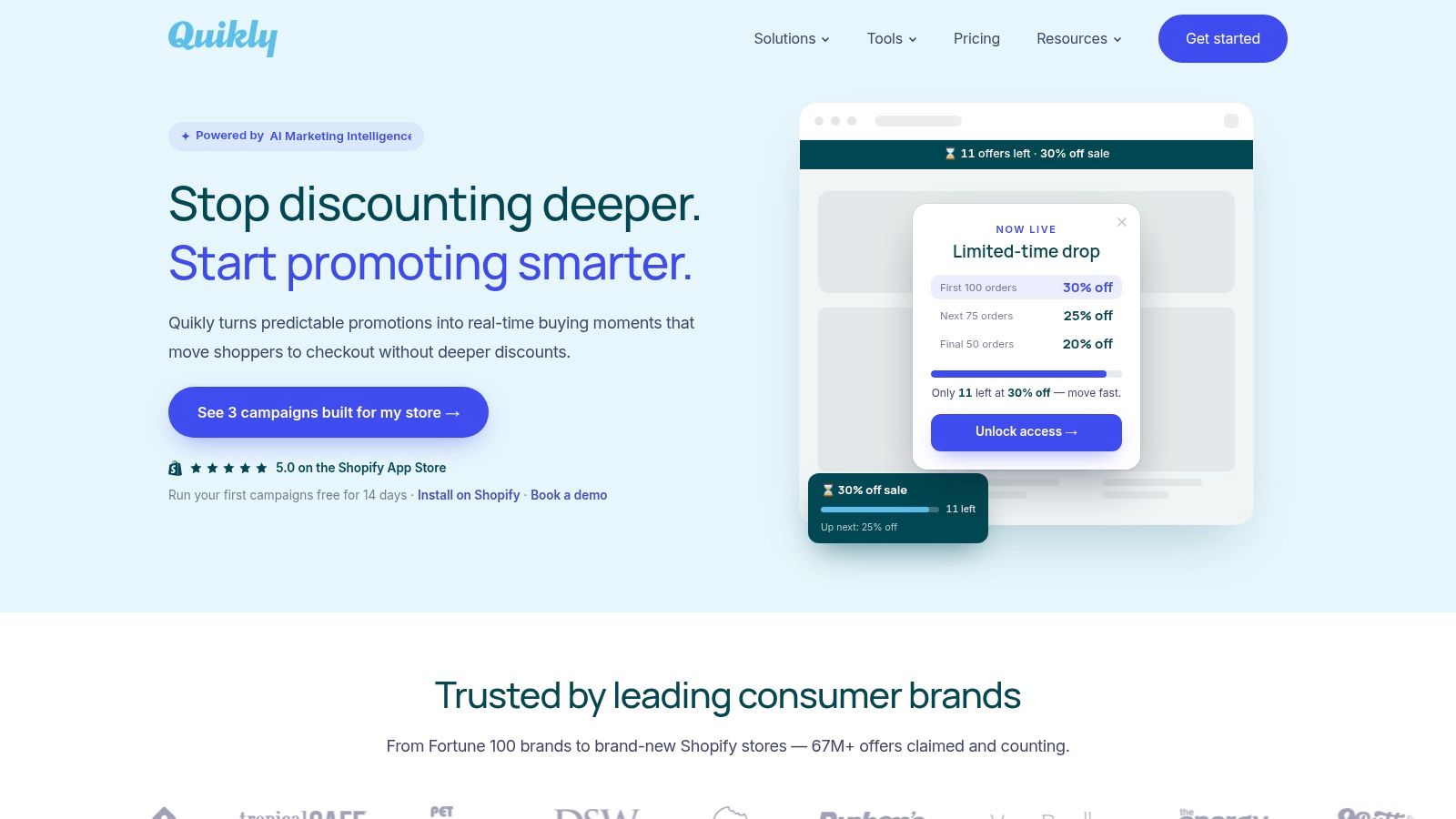
The difference between fake pressure and useful urgency
The strongest urgency-driven upsells do two things at once. They create a reason to decide now, and they preserve price integrity.
That’s why this tactic performs when it’s done correctly. Implementing urgency and scarcity tactics such as limited-time offers, low stock alerts, or real-time inventory visibility increases upsell take rates by up to 23% and makes shoppers 50% more likely to contemplate premium alternatives, according to Alexander Jarvis on upsell take rate in ecommerce.
Those gains don’t come from shouting louder. They come from reducing hesitation at the point where a shopper is already close to buying.
Where urgency belongs in the Shopify journey
Urgency is especially effective when it appears in moments where intent is already high:
| Placement | Good use of urgency | Bad use of urgency |
|---|---|---|
| Product page | Low stock on a popular premium variant | Generic evergreen timer |
| Cart drawer | Time-bound shipping upgrade | Random flashing coupon |
| Checkout-adjacent messaging | Limited reward for completing now | Repeated interruption |
| Post-add-to-cart | One relevant premium upgrade | Multiple stacked offers |
A lot of teams overdo this. They add urgency on the PDP, again in the cart, again in a popup, and again by SMS. The message might be technically consistent, but the experience feels needy. In practice, one strong urgency moment often outperforms a barrage of weaker ones because it keeps the decision clear.
For a deeper look at what effective urgency looks like, Quikly’s article on how to create urgency in sales is a helpful read.
Use incentives that protect the order
The best urgency offers aren’t always discounts. Shipping upgrades are a strong example because they reward commitment without marking down the product itself.
You can apply this in a straightforward way:
-
For high-intent carts
Offer an express shipping upgrade if the shopper completes checkout within a short window. -
For premium variants
Tie a limited-availability benefit to the higher-tier product, such as priority fulfillment or early access fulfillment. -
For bundle adoption
Make the complete set eligible for a time-bound perk that the single item doesn’t receive.
Urgency should sharpen a real decision. It shouldn’t try to manufacture one.
This is one of the clearest routes out of the discount cycle. You’re still motivating action now, which standard promotions often fail to do, but you’re doing it by rewarding behavior instead of lowering perceived value across the entire store.
Reward Loyalty Beyond the Next Purchase
Some of the best upsells don’t look like upsells at all. They look like access.
That matters because not every higher-value offer needs to be settled inside the product price. Sometimes the customer will spend more now because the purchase changes their relationship with the brand, not just the contents of the cart.
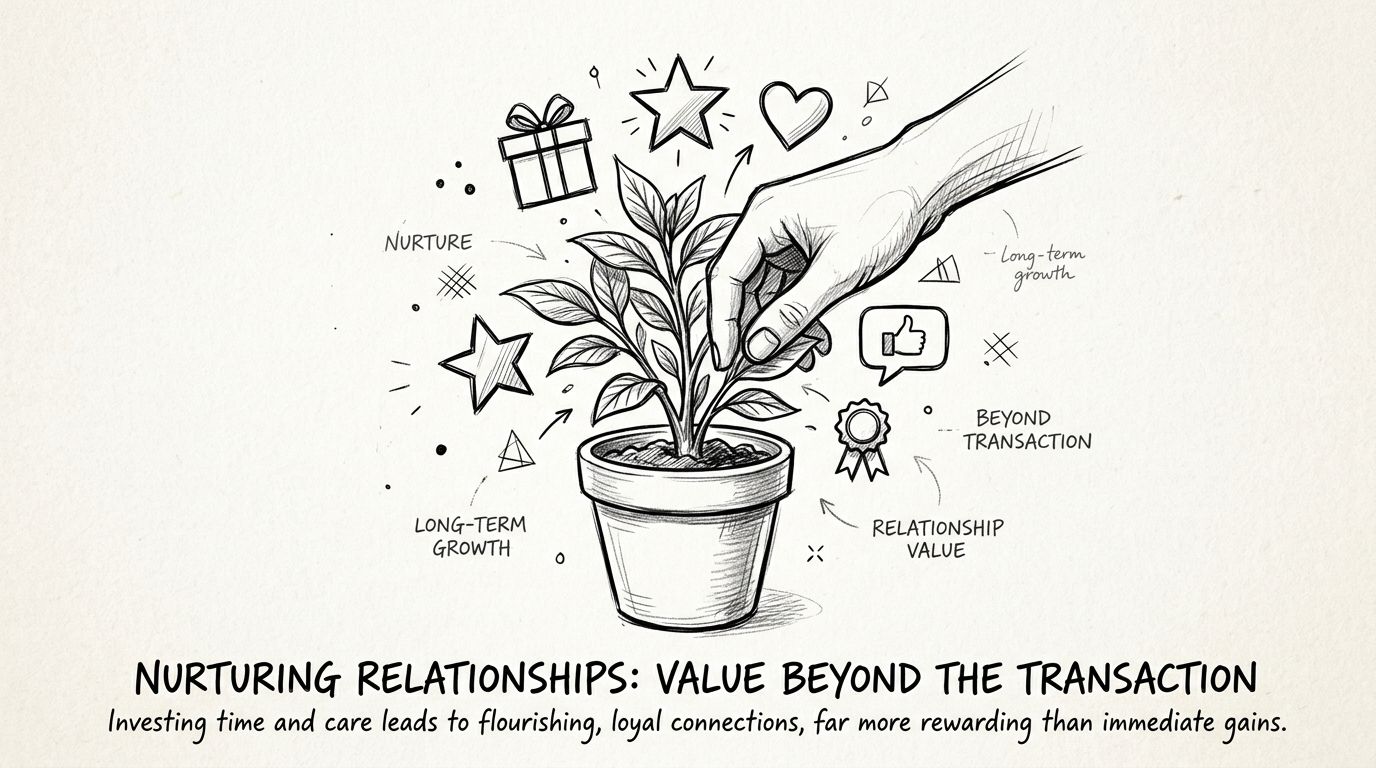
Offer status, not just savings
A discount is easy to understand, but it’s forgettable. Exclusive access has a different feel. It signals that the customer is getting closer to the brand, not just extracting a deal from it.
That can take several forms on Shopify:
- Early access to a new collection when the cart reaches a premium threshold
- VIP enrollment tied to a higher-value first purchase
- Priority access to limited releases
- Complimentary premium support or onboarding for a more complete order
These offers work best when the benefit is concrete and brand-aligned. “Join our VIP club” is too vague. “Get early access to next month’s drop when you complete this set today” is clear.
Non-discount value still needs a reason
LinkedIn’s guidance on non-discount upselling points toward a useful principle. Offer a bonus tied to a reason, not a generic incentive. That’s especially important for support and service teams, where the wrong script can make an upsell feel opportunistic.
A support agent helping with sizing, replenishment timing, or product fit can often recommend the higher-value option more credibly than a sales module can, but only if the offer solves the immediate concern. The loyalty angle strengthens that. You’re not saying, “Spend more because we want a bigger order.” You’re saying, “If you’re already buying at this level, here’s the added access that makes the decision better.”
For brands building a longer-term retention engine, Quikly’s guide to customer retention programs offers useful ideas on connecting first-order behavior to repeat purchase momentum.
The strongest loyalty upsell gives the customer a better future with the brand, not just a bigger receipt today.
That’s also why this tactic protects perception better than discounting. Repeated markdowns tell customers your product needs help. Earned access tells them your brand has value worth getting closer to.
Measuring What Matters and Getting Started
If you only track AOV, you can fool yourself fast.
AOV can rise while order quality falls. A larger basket funded by margin loss, heavier discounting, or low-intent add-ons isn’t a win. The cleaner way to judge a non-discount upsell program is to look at both commercial efficiency and customer behavior.
Start with a short scorecard:
-
Upsell take rate Which offers are being accepted, and at what stage of the funnel?
-
Profit per order
Did the bigger basket preserve enough margin to matter? -
Attach quality
Are customers accepting relevant upgrades, or just the cheapest add-on available? -
Repeat behavior
Do shoppers come back at full price, or only when a promotion appears?
One tactic worth testing early is a shipping-based incentive. Time-bound shipping upgrades for high-value carts can convert hesitation into action while protecting gross margins, and urgency triggers on sales outperform site-wide discounts in profitability, as discussed in Quikly’s analysis of ecommerce conversion strategies. It’s a good first test because it pushes action now without retraining customers to expect lower product prices.
A simple testing sequence
Run this in order so you don’t muddy the results:
-
Replace one discount-led upsell with a value-led upgrade
Keep the placement the same. Change the offer, not everything at once. -
Test one urgency layer
Add a genuine time or quantity condition only where intent is already high. -
Review margin before scaling
Don’t promote the winner because it lifted AOV. Promote it because it improved the economics of the order.
The point isn’t to stop promoting. It’s to stop using blunt promotions when a smarter upsell can do the job better. That’s how you grow without training your customers to wait for the next markdown.
Quikly helps Shopify brands turn urgency and scarcity into behavior-driven promotions that move customers to act now, without relying on deeper blanket discounts. If you want a cleaner way to lift conversion and AOV while protecting margin and brand perception, see how Quikly works.
Topics: how to upsell without discounting, increase aov, shopify upsell, ecommerce strategy, profit margins