A new order lands, and for a moment it feels like the funnel did its job. Then the second thought hits. Could that customer have added one more item, upgraded to the better version, or bought the accessory they’ll probably need anyway?
That tension sits at the center of post-purchase upsell Shopify strategy. You want higher average order value, but you don’t want to train customers to expect another discount after every checkout. You want more profit, not just a prettier revenue screenshot. And you definitely don’t want to turn the thank-you page into another noisy sales surface.
Used well, post-purchase upsells solve a real commercial problem. Used lazily, they create a different one. They chip away at margin, feel generic, and make the brand look overeager right after a customer has already said yes.
The Post-Sale Dilemma for Shopify Brands
Most Shopify brands know the feeling. Acquisition costs keep climbing, conversion is never quite where you want it, and blanket promotions stop pulling their weight after customers get used to them. So the appeal of a post-purchase upsell is obvious. The sale is already secured, payment details are already in place, and the customer is still engaged.
That’s why the timing matters so much. The post-purchase window sits immediately after checkout completion, on the thank-you or order confirmation page, when buyers are still in a high-engagement shopping mindset and can accept an offer with a single click without re-entering payment or shipping details, as outlined in Bogos’ post-purchase upsell overview.
Why this moment is powerful and risky
The opportunity is real, but so is the downside.
A smart offer feels like service. A weak offer feels like one more attempt to squeeze the customer. That distinction matters more than most app install pages admit. If the product is irrelevant, the price feels opportunistic, or the creative looks bolted on, the customer notices.
A post-purchase offer should feel like finishing the order, not reopening the sale.
That’s also why it helps to understand the broader Shopify operating context before touching upsell logic. If you’re still sorting through platform basics, checkout flow, and app dependencies, Rebus’s Shopify 2026 guide gives useful context for how these pieces fit together.
Revenue isn’t the same as profit
The mistake I see most often is treating any AOV increase as a win. It isn’t.
If you only grow order value by giving away too much margin, attaching a low-quality add-on, or normalizing post-checkout discounts that customers learn to wait for, you haven’t improved the business. You’ve just moved numbers around.
A strong post-purchase strategy has to clear three tests:
- It protects margin: The added item should carry healthy contribution after discount, shipping, and fulfillment.
- It fits the original purchase: The customer should immediately understand why this product belongs with what they just bought.
- It preserves brand trust: The offer should look exclusive and intentional, not like a desperate second chance banner.
That’s the primary challenge. Not how to add an offer after checkout, but how to do it without damaging the economics or the brand.
What Makes a Post-Purchase Upsell Profitable Not Just Popular
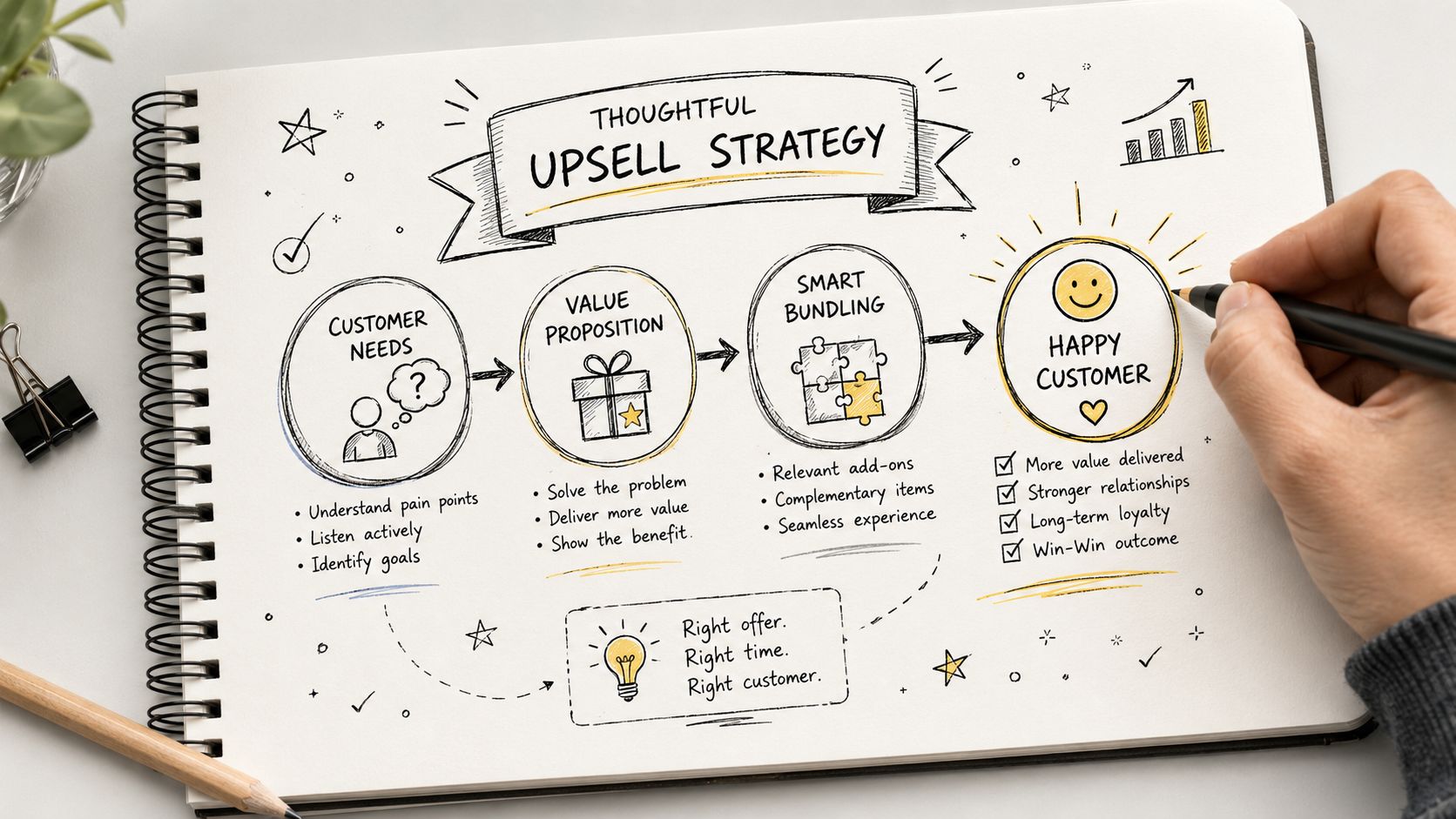
A post-purchase upsell is an offer shown after a customer completes checkout, typically as a one-click addition to the order. That definition is simple. The harder part is separating offers that generate profit from offers that only generate activity.
Here’s the useful benchmark. Well-targeted, one-click post-purchase offers on Shopify typically see acceptance rates between 8% and 15% and drive 10% to 20% AOV growth when product relevance and pricing are strong, according to Parah Group’s Shopify upsell benchmarks.
Why customers say yes after checkout
This isn’t magic. It’s buyer psychology.
Once someone has completed a purchase, commitment and consistency kick in. They’ve already made a decision, trusted the store, and mentally stepped into ownership. A relevant add-on feels easier to accept because it aligns with the action they just took.
There’s also temporal discounting at work. The immediate convenience of adding something now often outweighs the minor effort of buying it later. If the product solves a problem the customer expects to have soon, the post-purchase offer removes a future task.
Popular offers often fail the margin test
An upsell can get clicks and still be a weak business decision. That’s the trap.
Consider these two versions of the same idea:
| Offer type | What it looks like | Likely outcome |
|---|---|---|
| Popular but shallow | A broad discount on a loosely related item | More curiosity, weaker unit economics |
| Profitable and strategic | A tightly matched add-on with clear utility | Better fit, stronger margin quality |
The distinction is less about design and more about discipline. If an item is expensive to ship, frequently returned, or dependent on extra support, it may inflate revenue while reducing contribution.
Practical rule: If the upsell only works when the discount is aggressive, the product probably doesn’t belong in the post-purchase slot.
Profit-first criteria for offer selection
Before building flows, vet each candidate offer against a short filter:
- Complementarity: Does it make the original purchase work better, last longer, or feel more complete?
- Perceived ease: Can the customer understand the value in a few seconds?
- Margin tolerance: Can you still like the economics after discount and fulfillment?
- Brand fit: Would this feel consistent with your packaging, pricing, and positioning?
If you’re trying to raise order value more broadly, this AOV guide for Shopify merchants is a useful companion because post-purchase upsells work best when they sit inside a wider profit model, not as a standalone trick.
Implementing Your First Shopify Post-Purchase Funnel
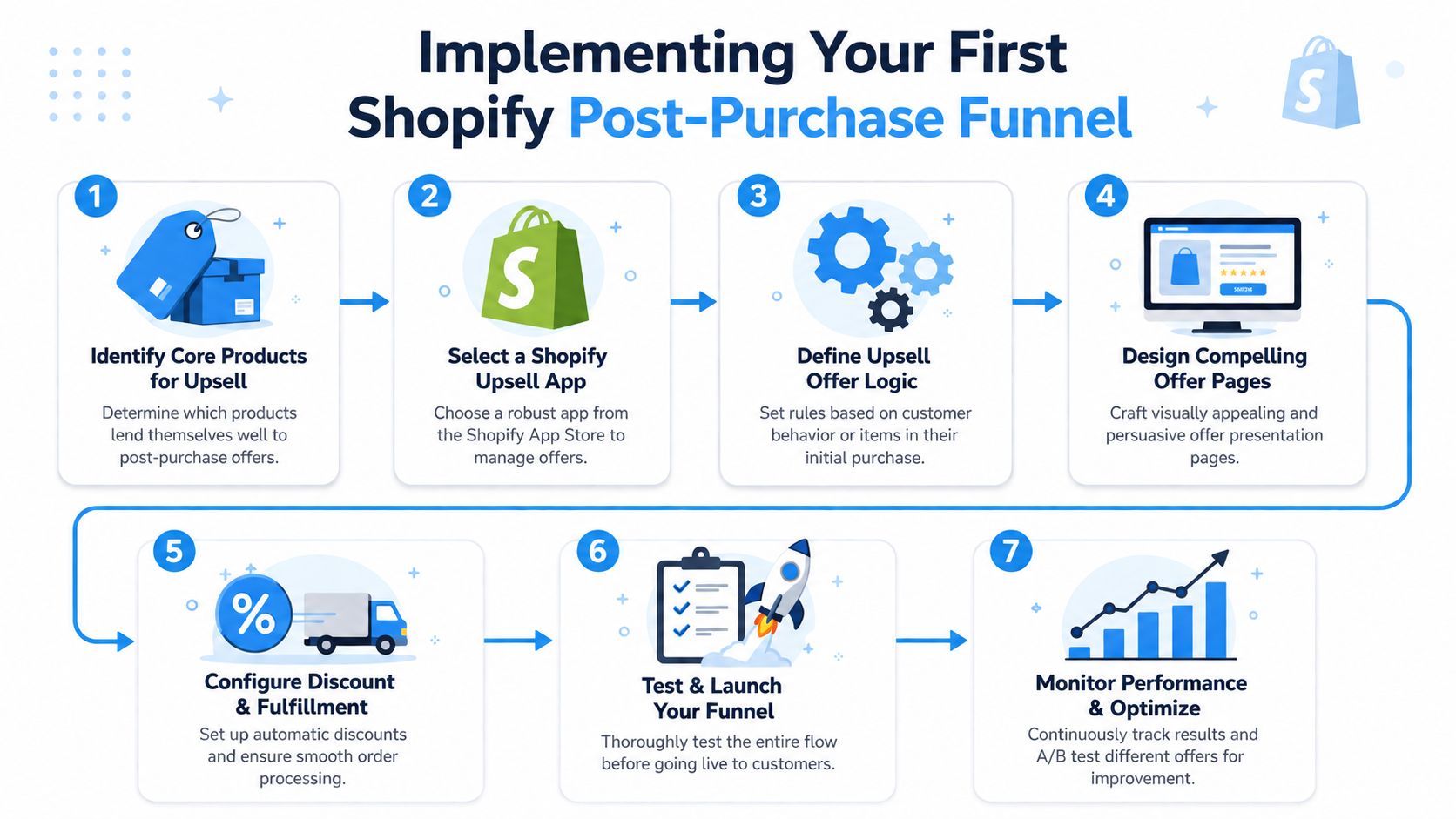
The first version of a post-purchase funnel doesn’t need to be fancy. It needs to be technically sound, easy to accept, and narrow enough to measure. Most stores get into trouble when they try to launch too many products, too many rules, and too many creative variations at once.
Start with one product path
Pick one high-volume product or collection and map one logical next offer.
For example, if a customer buys a supplement, the post-purchase offer might be a travel pack or a complementary SKU. If they buy cookware, the add-on could be care supplies or a utensil that improves first use. Keep the first funnel simple enough that you can tell whether the concept works.
Build the flow in order
A clean setup usually follows this sequence:
-
Choose the trigger product
Start with a SKU that has consistent sales and a clear companion item. -
Select the app or extension layer
In Shopify, most merchants use a post-purchase app or checkout extension-compatible tool rather than custom development. -
Define one-click offer logic
The offer should attach cleanly to the existing order without forcing the customer back through checkout. -
Write concise copy
Lead with utility, not hype. Explain why this item belongs with what they just bought. -
Set fulfillment rules
Make sure warehouse and customer service teams understand how the item is appended to the order. -
Test the full flow
Test on desktop and mobile, and test edge cases like shipping methods and discount interactions.
A deeper look at post-checkout touchpoints and retention mechanics is worth reviewing in this post-purchase engagement guide.
Know the technical limits before launch
This part gets skipped too often.
Shopify’s developer documentation explicitly states that post-purchase offers aren’t surfaced on orders involving duties or multiple currencies, which creates real constraints for international deployment, as summarized in Qikify’s Shopify post-purchase guideline.
That means your clean domestic funnel may not appear for a meaningful share of global orders. If you sell heavily across borders, don’t assume every customer sees the same post-purchase experience.
Test the live experience on the same order types your customers actually place, not just the easiest domestic scenario.
What to watch in the first week
Don’t obsess over visual polish first. Watch operational fit.
Use a short review checklist:
- Acceptance quality: Are customers accepting the offer, or skipping it instantly?
- Support friction: Are customers confused about what was added to their order?
- Return behavior: Does the upsell create regret or look like a natural extension of the purchase?
- Fulfillment flow: Can your team handle appended items without manual cleanup?
That first funnel should teach you where the offer belongs, how much copy is enough, and whether the economics hold up outside a test environment.
Designing Upsell Offers Customers Actually Want
The fastest way to ruin a post-purchase upsell Shopify program is to choose products based on what you want to move, not what the customer is likely to value next. The thank-you page is not a clearance rack.
The best offers feel obvious in hindsight. They complete the purchase, reduce future hassle, or improve the outcome the customer already paid for.
Product selection matters more than clever copy
Shopify post-purchase upsell offers show 8% to 15% acceptance rates for one-click offers, with 10% to 25% AOV growth when timing and relevance are optimized, according to AppStoreResearch’s Shopify post-purchase analysis.
The phrase to focus on is “timing and relevance.” Timing gets the customer’s attention. Relevance earns the yes.
Here are the offer types that usually make the most sense:
- Complementary add-ons: Cleaning kits, refills, cases, replacement parts, care products.
- Second units: Another of the same item, especially when replenishment or gifting makes sense.
- Lower-ticket extras: Small, high-margin items that feel easy to add without reopening the buying decision.
What good relevance looks like
A few examples make the difference clear:
| Original purchase | Weak post-purchase offer | Strong post-purchase offer |
|---|---|---|
| Camera | Unrelated phone accessory | Lens cleaning kit or memory card |
| Skincare serum | Different category impulse item | Matching moisturizer or travel size |
| Bedding set | Random clearance SKU | Pillowcases or fabric care product |
The customer should be able to say, “Yes, that goes with what I just bought.”
Price for impulse, not negotiation
Many brands lose profit. They try to force a premium product into a low-consideration moment, then discount it hard enough to get movement.
A better approach is to keep the offer easy to approve. Independent merchant analysis summarized in the verified data also notes that pricing clarity matters, and that direct phrasing such as adding a product “now for a post-purchase price” tends to outperform more complicated bundle logic.
If the customer needs to compare options, calculate savings, or rethink the original purchase, the upsell is already too heavy.
For broader thinking on merchandising and order value design, AOV strategies for merchants from Toki is a useful read.
Creative and UX rules that raise acceptance without cheapening the brand
The offer page has one job. Make the decision easy.
A few practical rules help:
- Use one hero product: Don’t present a grid. One decision beats several weak ones.
- State the benefit fast: Explain what problem the add-on solves.
- Keep pricing plain: No stacked conditions, mystery math, or cluttered savings language.
- Match your storefront design: The page should feel native to the brand, not imported from an app template.
- Respect mobile: Buttons, images, and copy need to work on a small screen.
If you want more examples by product type, this collection of Shopify upsell ideas is helpful for pressure-testing which offers feel additive.
One assumption worth dropping
A lot of merchants think the best post-purchase offer is the one with the highest theoretical revenue per acceptance. Usually it isn’t.
The better offer is often the one customers can say yes to without friction and without feeling they just got sold twice. That keeps the experience clean, supports future repeat purchase behavior, and protects the value perception you worked hard to create before checkout.
Going Beyond Basic Upsells with Behavioral Promotions
Static post-purchase offers work. They also get predictable fast.
When every customer sees the same generic add-on at the same discount, the offer stops feeling special. Over time, that hurts response quality and chips away at brand perception. Customers start to read the promotion as routine, not exclusive.
Why behavioral framing works better than flat discounting
The strongest post-purchase offers align with how people naturally make decisions.
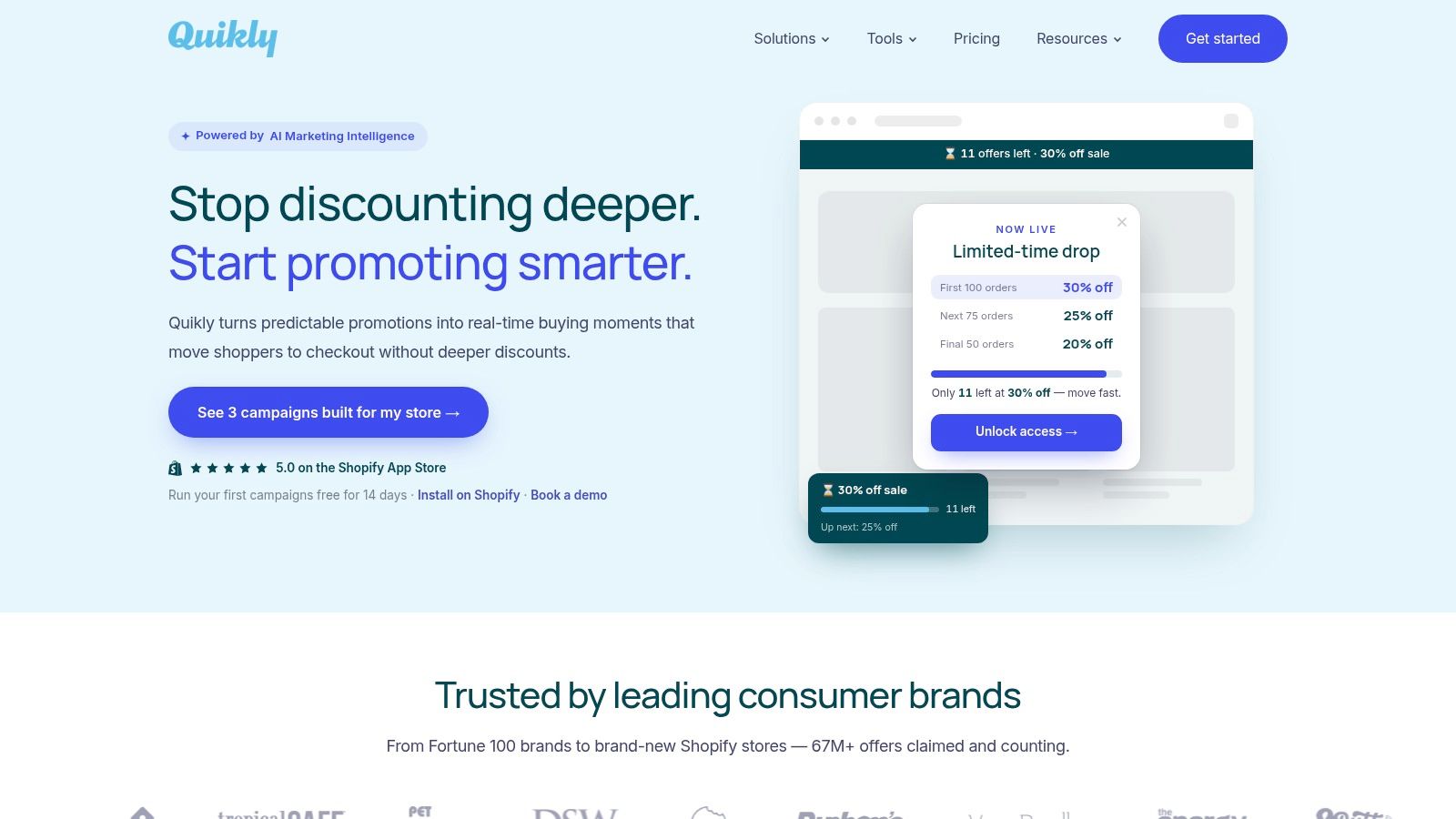
Scarcity bias matters because a limited reward feels more valuable than an always-available one. Loss aversion matters because shoppers are more motivated to avoid missing a valid opportunity than to respond to a generic markdown. Commitment and consistency still matter here too, but now the offer feels like an earned extension of the purchase instead of a standard coupon.
That distinction is important for brand health. A controlled, limited offer can create urgency without making the whole store feel permanently on sale.
Exclusivity has to be real
Many brands undermine themselves by labeling an offer “exclusive,” then making the same pricing available elsewhere on the site or through a code in email.
Best practice is tighter than that. To avoid brand perception erosion and promo fatigue, post-purchase offers should be completely exclusive, with no discount code providing the same deal elsewhere and no return path to the offer through the storefront, and merchants should track the 90-day repeat purchase rate of accepters versus decliners to make sure the upsell creates incremental demand rather than merely shifting it, according to Flux Agency’s Shopify Plus post-purchase guidance.
A post-purchase offer stops being special the moment the customer discovers they could have gotten it anyway.
What this changes in practice
A behavior-driven promotion is different from a basic “add this for less” card. It changes the shape of the experience:
- The reward is constrained: Time-limited or quantity-limited access creates a reason to act now.
- The exposure is controlled: Not every customer needs to see the same incentive.
- The framing supports the brand: The promotion feels intentional, not automatic.
- The analysis goes beyond take rate: You care about repeat purchase behavior and margin quality, not just acceptance.
This is the better path for brands that are already feeling the cost of promo fatigue. If you keep solving every conversion problem with another flat discount, customers learn the pattern. When the offer instead feels earned, limited, and relevant, it can motivate action without training shoppers to wait for the next markdown.
Turn a Tactic into a Sustainable Growth Engine
Post-purchase upsells work best when you stop thinking about them as a checkout trick. They’re a merchandising and customer experience discipline. That shift matters because it changes what you optimize for.
If you only chase the immediate add-on sale, you’ll fill the slot with whatever gets the fastest yes. If you care about margin, retention, and brand perception, you’ll choose offers differently. You’ll prefer the accessory over the clearance item, the useful refill over the random impulse product, and the exclusive experience over the routine discount.
The durable version of this strategy
A sustainable program usually has these traits:
- It starts narrow: One strong product path beats a messy catalog-wide rollout.
- It respects economics: The item earns its place after discount, fulfillment, and support costs.
- It feels brand-right: The offer looks and reads like part of the store.
- It’s measured past the first click: Acceptance matters, but customer quality matters more.
That last point often gets overlooked. If you care about lifetime value, the post-purchase window should support the relationship, not just the receipt. Teams thinking about retention economics more broadly may also get value from this perspective on optimizing B2B customer retention, because the same principle applies. Short-term conversion gains only matter if they improve the customer base over time.
The next move to make this week
Take your top-selling Shopify product and write down three possible post-purchase offers.
One should be a complementary add-on. One should be a second unit. One should be a small, high-margin extra that improves the original purchase experience. Then ask one question for each: would this feel helpful to the customer immediately after checkout, or would it feel like one more sales move?
That answer will tell you more than any app dashboard.
If your team wants to make post-purchase and promotional moments feel more urgent without defaulting to deeper, margin-eroding discounts, Quikly is worth a close look. It helps Shopify brands run on-brand urgency and scarcity promotions that reward shoppers for acting now, not waiting, with mechanics refined across more than 60 million consumer interactions.
Topics: post-purchase upsell shopify, shopify upsell, increase aov, ecommerce strategy, shopify plus