The most popular advice about web site personalization is to collect more data and tailor more of the store. That’s an expensive starting point if the result is merely a better-targeted discount. More relevant promotions can still reduce profit when you reward shoppers who would have bought anyway.
For Shopify merchants, the better question is what to change without unnecessarily changing what customers pay. Start with useful signals, make the experience easier to shop, and judge the result by net margin and brand trust, not conversion lift alone.
What Website Personalization Means for Shopify Stores
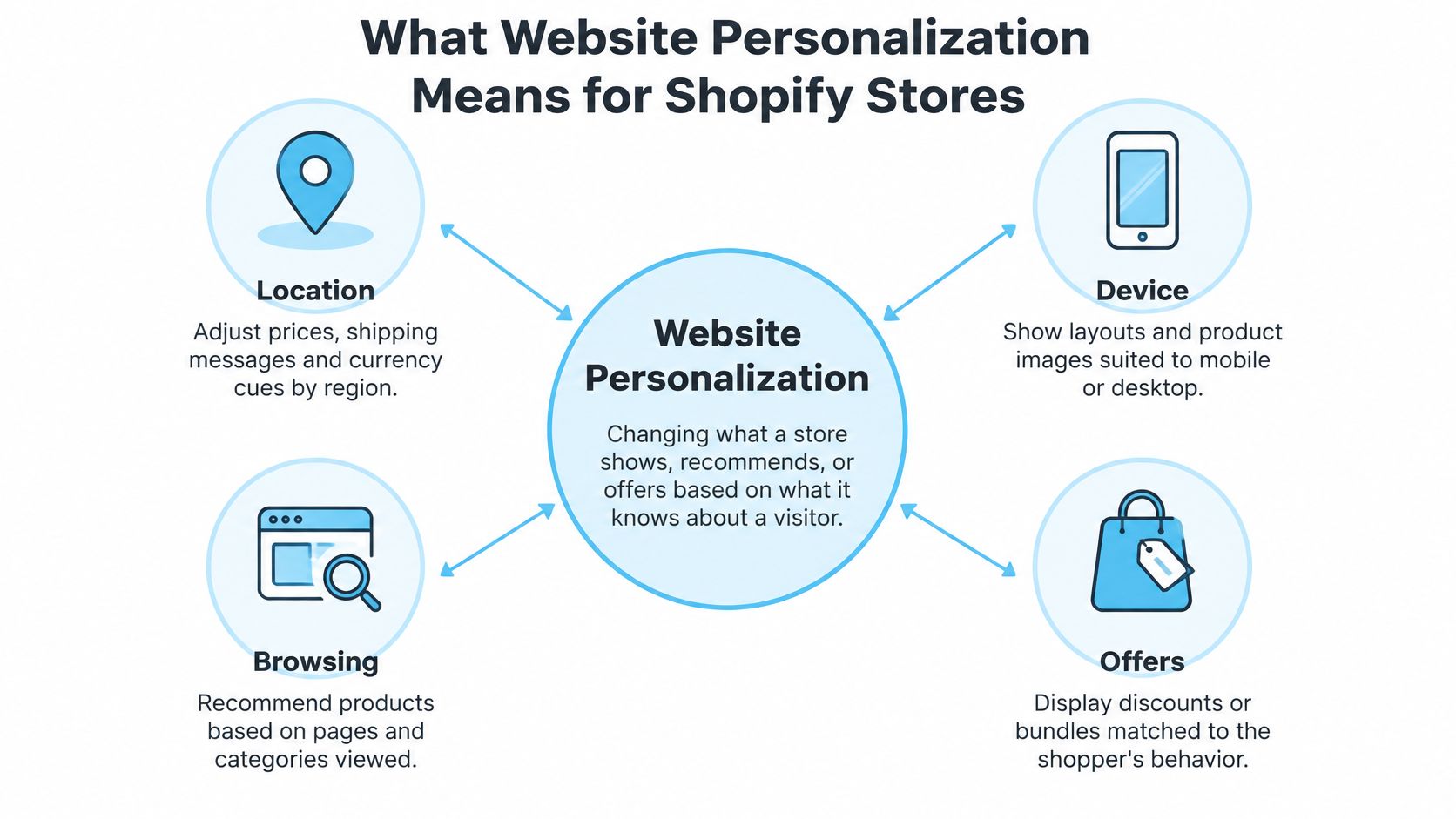
Website personalization means using a visitor signal to adjust what a store shows, recommends, or offers. Signals can include location, device, browsing behavior, purchase history, or lifecycle stage. The value depends on whether a change helps someone shop, not merely whether it raises conversion.
A shop clerk who remembers a customer’s last purchase can suggest a compatible product. A clerk who repeats the same promotion to everyone offers less useful help. Neither interaction requires a lower price.
Identification and decisioning do different jobs
Identification connects interactions to the same visitor or account. Decisioning uses available information to choose a product, message, or offer. Cookies can preserve session and cart information across page requests. The broader history of cookies and web personalization provides context for how personalization has developed.
Shopify customer accounts and order history, as well as storefront session signals, can inform decisions where available and permitted. Apps and theme customizations determine how those inputs shape page content and placement.
Keep the two jobs distinct when diagnosing a weak experience. Without reliable identification, a recommendation engine may fail to recognize a returning customer. A complete customer record is no help if the rules still surface irrelevant products.
Planning rule: Define the signal, the decision it will trigger, and the benefit to the shopper before choosing a tool.
A greeting with someone’s first name rarely makes a journey more useful on its own. Sitewide discounts and repeated countdowns also do little to tailor the experience, while potentially weakening margin and trust.
For planning, define personalization as using a reliable visitor signal to make the next shopping decision more relevant. Judge that decision by its effect on customer usefulness, net margin, and brand trust, not conversion alone.
Which Personalization Tactics Protect Margin
Start by separating tactics that change discovery from tactics that change price. Product recommendations and search merchandising can improve relevance without issuing a reward. Behavioral triggers require more discipline because teams often attach a discount before identifying the reason a shopper hesitated.
The following launch-effort and margin-risk labels are planning judgments, not measured performance benchmarks. Your theme, catalog, and existing integrations will affect the work involved.
Website personalization tactics by signal, placement and margin risk
| Tactic | Signal used | Where it appears | Launch effort | Margin risk |
|---|---|---|---|---|
| On-site product recommendations | Viewed category, purchase history | Product pages, cart, post-purchase | Medium | Low |
| Dynamic banners and landing pages | Traffic source, returning status | Homepage, collection pages | Low | Low |
| Behavioral triggers | Cart idle, exit intent, browse depth | Cart drawer, product pages | Medium | Medium when tied to a discount |
| Search-based merchandising | Search query, filters | Search results, collections | Medium | Low |
| Lifecycle messaging | First visit, repeat buyer, lapsed buyer | Homepage, account, email handoff | Medium | Low |
| Time- and quantity-bound offers | Campaign participation, cart value | Storefront, email, SMS | Medium | Controlled when each reward is capped |
Recommendations should solve a product-selection problem. Suggest a compatible accessory or an appropriate next purchase rather than filling a carousel with unrelated inventory. A deliberate product recommendation strategy starts with the shopper’s task and the economics of the suggested products.
Dynamic banners should preserve context. A visitor arriving from an SMS campaign should recognize the same campaign identity and reward logic on the landing page, rather than having to work out whether the message still applies.
Behavioral triggers should diagnose friction before subsidizing a purchase. An idle cart might call for delivery information or a sizing explanation. It shouldn’t automatically trigger a price cut.
Search merchandising should respect expressed intent. Prioritize relevant, available products and useful filters rather than allowing promotional priorities to overwhelm the query.
Lifecycle messaging should acknowledge where the customer is in the relationship. A repeat buyer needs a different next step from someone still learning what the brand sells.
Time- and quantity-bound offers need enforceable limits. Cap each reward’s availability and budget the possible redemption cost before launch.
Bigger discounts aren’t the default repair
Repeated markdowns can teach customers that waiting is sensible. Temporal discounting helps explain why an immediate benefit matters, but a predictable future sale can still be attractive enough to postpone today’s purchase. Loss aversion can reinforce that hesitation when buying now feels like losing the savings available later.
A relevant recommendation offers a different route. Commitment and consistency provide a useful design principle: help shoppers continue the product interest they’ve already expressed instead of interrupting them with an unrelated deal. These principles are hypotheses to test, not guarantees of behavior.
Search deserves particular attention: visitors using site search represent 24% of the customer base, generate 44% of site revenue, and convert at 2.5 times the rate of non-searchers, according to Constructor data cited by Shopify. That makes search a useful intent signal, but it doesn’t prove searchers need an incentive.
Compare an unrestricted sitewide code with a capped reward available only after repeated interest in a product. The latter limits exposure, but it can still subsidize purchases that would have happened anyway.
A smaller eligible audience controls discount exposure. Only a holdout test tells you whether that discount was necessary.
Ask this before approving any promotion: Would this shopper have bought without it?
Conversion, Order Value and Retention Gains to Expect
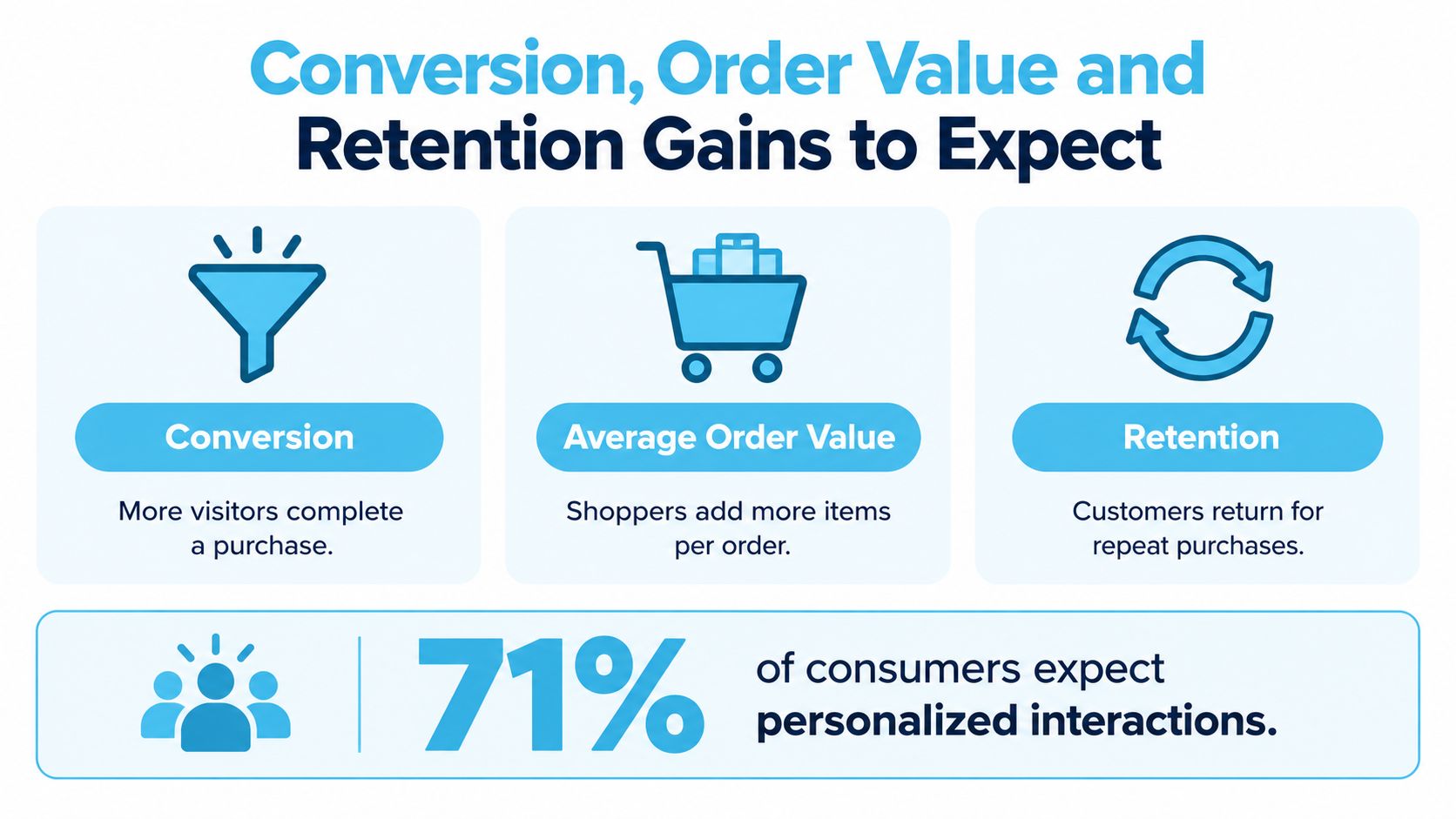
Conversion, average order value, and retention are the main commercial outcomes worth pursuing. They require different interventions, and none should be treated as an automatic consequence of installing personalization software.
Conversion can improve when shoppers find a relevant product at the moment they’re deciding. Order value can improve when cart recommendations add something useful, while retention can improve when follow-up messages match the customer’s purchase cycle.
Reported personalization returns and what drives them
The figures below come from McKinsey’s research on personalization, which reported 71% expecting personalized interactions, 76% influenced in brand consideration, 78% more likely to repurchase, a typical 10% to 15% revenue lift within a 5% to 25% range, and 40% more personalization revenue among top performers versus average performers.
| Outcome | Reported figure | What drives it |
|---|---|---|
| Consumers expecting personalized interactions | 71% | Relevance is part of the baseline experience |
| Consumers influenced in brand consideration | 76% | Personalized communications shape consideration |
| Consumers more likely to repurchase | 78% | Lifecycle-matched messaging supports retention |
| Typical revenue lift | 10% to 15% (range 5% to 25%) | Relevance at the decision point |
| Top performers versus average | 40% more personalization revenue | Execution capability and measurement |
The mechanisms in the final column are practical interpretations for implementation. The consumer responses aren’t measured conversion or retention gains for your store, and revenue from personalization activities isn’t the same as total company revenue.
Match the intervention to the outcome
For conversion, remove a specific discovery obstacle. A category-relevant product block is more defensible than swapping the homepage just because the visitor belongs to a segment.
For average order value, recommend products that work together. Watch whether customers add profitable items or merely substitute a discounted bundle for a purchase they already intended to make.
For retention, use purchase timing and product relevance rather than sending every previous customer the same comeback promotion. Suppress messages that don’t fit, especially recommendations for products the customer has just bought.
Stores with thin product data, unreliable segmentation, or no measurement should plan conservatively rather than budget around the upper end of reported results. The research describes commercial potential across different implementations, not a guaranteed return from any app or tactic.
Which Data Signals Shoppers Accept and How to Ask
Customers can want relevance and distrust the data collection behind it. That’s a design constraint, not an inconsistency to dismiss.
In its global study of more than 23,000 consumers, Qualtrics found that 64% preferred experiences designed around them, 53% were highly concerned about personal-data privacy, and only 33% trusted companies to use their information responsibly; reported comfort was 45% for purchase history, 42% for website visits, 17% for social-media posts, and 12% for financial information, according to the Qualtrics XM Institute personalization and privacy report.
Data signals and shopper comfort levels
| Data signal | Shopper comfort | How to use it |
|---|---|---|
| Purchase history | 45% | Reorder prompts and post-purchase recommendations |
| Website visits | 42% | Viewed-category recommendations and product discovery |
| Social-media posts | 17% | Avoid as a personalization input |
| Financial information | 12% | Avoid as a personalization input |
Even the more accepted signals don’t have universal approval. Don’t read relative comfort as blanket permission to collect, retain, or combine data.
Purchase history can support a reorder reminder or help exclude products someone already owns. Website visits can support discovery within a category the shopper has deliberately explored.
Make the value exchange visible
Cart contents weren’t measured in that study. Treat them separately as information shoppers can see in their own basket, and explain the immediate benefit: suggesting a compatible item, clarifying eligibility, or showing progress toward an applicable offer.
Anonymous visitors don’t need a persistent profile to receive useful content. A referral source or current product can provide enough context for a relevant landing page or recommendation, subject to the consent requirements that apply to the implementation.
A disciplined first-party data activation approach connects each input to a clear customer benefit. It also defines when that input should stop influencing the experience.
Use these consent and control practices:
- Show why a recommendation appeared. Explain that it relates to a viewed category or previous purchase. Avoid implying knowledge the shopper didn’t knowingly provide.
- Let shoppers correct their preferences. Provide a way to change interests, dismiss unsuitable recommendations, and manage relevant permissions. Don’t keep treating an accidental click as a durable preference.
- Keep sensitive attributes out of the logic. Don’t infer financial circumstances or personal vulnerabilities to decide who sees a reward.
Urgency experiences can follow the same discipline. Current products, visible cart contents, stated preferences, and campaign participation can provide understandable eligibility signals without requiring opaque profiling.
The operational test is straightforward: could customer support explain why the shopper saw that experience? If the answer requires describing an elaborate inferred profile, simplify the rule.
Building Personalization on a Shopify Store
Begin with the data your store already has. Review customer records, order history, and available session events before adding another tracking layer.
Check the conditions under which each signal exists. An authenticated customer, an anonymous visitor, and someone arriving from an email campaign won’t necessarily expose the same information to your theme or apps.
Assign each layer a clear owner
Use theme sections and app blocks for placement where your setup supports them. Some presentation changes can be configured without custom code, while customer-tag conditions implemented in Liquid require theme logic; returning-visitor recognition may require additional session handling.
Apps can own recommendation logic and decisioning. Avoid letting several apps independently decide which promotion appears in the same cart drawer.
Email and SMS integrations, including Klaviyo, should pass campaign context into the storefront experience. Maintain a shared definition of eligibility and redemption rules instead of recreating the offer differently in each channel.
| Build decision | What to settle before launch |
|---|---|
| Reliable signal | Which events or customer fields are available and permitted? |
| Placement | Which theme section, product block, or cart surface changes? |
| Decision owner | Which app or theme rule chooses the content? |
| Review owner | Who checks performance and broken experiences each week? |
| Fallback | What appears when the signal or app is unavailable? |
Build within your plan and performance limits
Shopify Plus merchants have additional checkout customization options, while standard Shopify merchants should plan around their available theme and app capabilities. Verify the exact extension point before designing an experience that depends on it.
Check every added script against mobile loading and interaction performance. A relevant product block isn’t useful if shoppers struggle to reach or use it.
- Test missing data. Confirm that anonymous and unrecognized visitors receive a sensible default.
- Check offer conflicts. Review discount combinations, cart eligibility, and campaign exclusions.
- Inspect mobile behavior. Look for layout shifts, delayed content, and promotional blocks that obscure buying controls.
Build a single placement first. Expand only after its holdout test is interpretable and the implementation works reliably.
How to Measure Personalization Lift Without Fooling Yourself
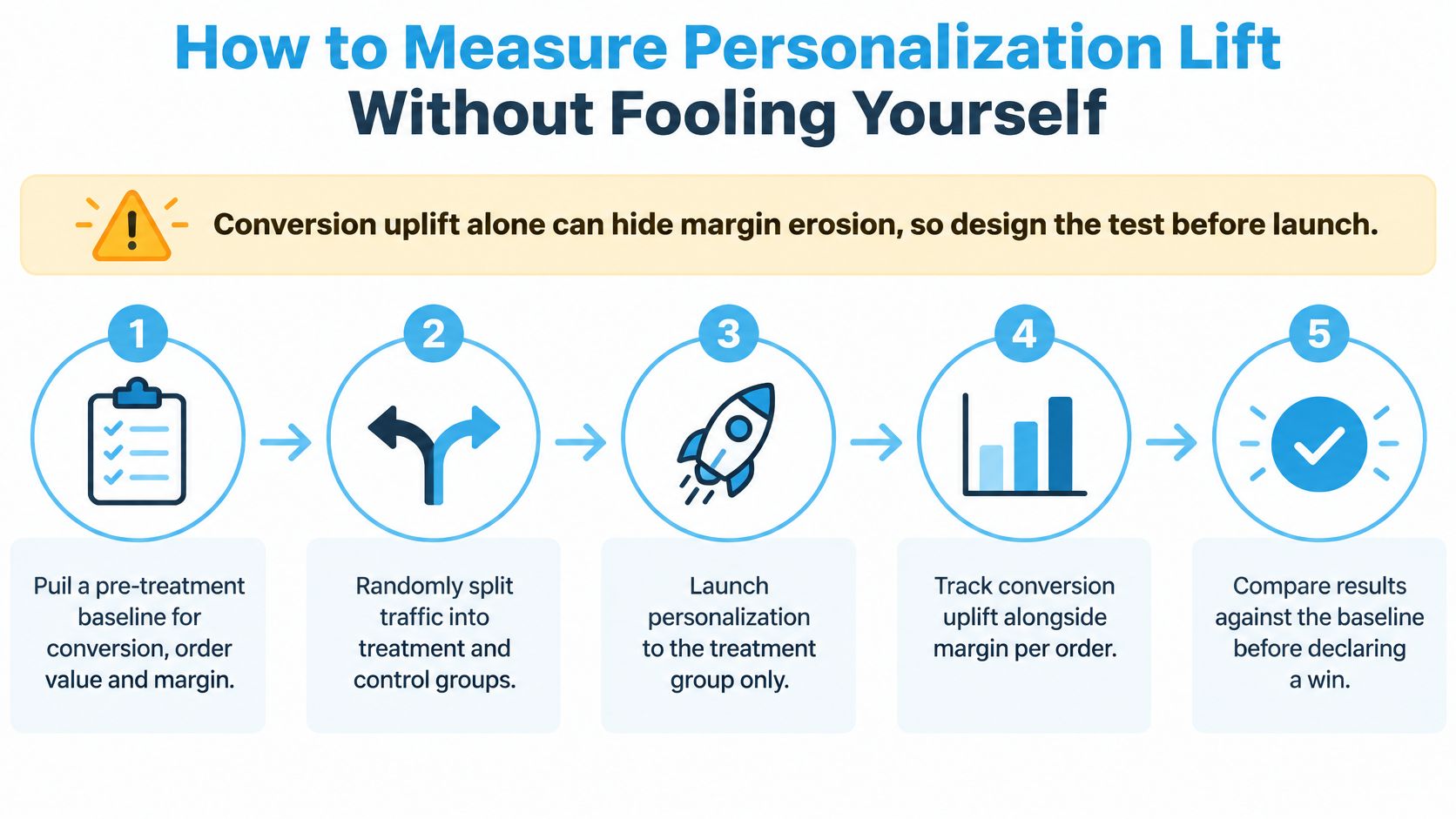
A higher conversion rate does not prove personalization paid off. Judge the test by incremental net margin and customer response, not a green conversion dashboard. Set the test design and accounting before launch so you can tell whether added orders justify discounts, product costs, and other variable costs.
A before-and-after comparison cannot isolate personalization. Traffic mix, stock availability, and campaign activity can all change the result. Use a randomized holdout to compare visitors who see the personalized experience with those who see the standard one.
A procedure for an interpretable test
- Pull a pre-treatment baseline. Review conversion, order value, and margin by major traffic source and product category over a representative trading period. Flag unusual promotions and stock constraints.
- Randomly assign eligible visitors to the personalized experience or a holdout group. Keep assignments consistent so returning shoppers do not switch between experiences.
- Hold offer economics constant. Test presentation, recommendations, or eligibility messaging without changing the reward value at the same time. Otherwise, you cannot identify what caused a difference.
- For urgency tests, compare personalized with generic creative and urgency-enabled with standard promotion. This factorial design can separate relevance from promotional timing, as long as the underlying reward economics remain comparable.
- Set the test duration before launch. Base it on expected traffic and the effect you need to detect. Do not stop early because an initial result looks favorable.
- Review confidence intervals and segment results, not only the overall result. A small, high-intent group can drive a gain that does not extend to the broader audience.
A single retailer experiment reported a 7.5% relative lift in overall conversion across 184,375 users and 37,125 products, according to this account of the controlled recommendation experiment. The randomized comparison offers evidence for that implementation and sample. It does not establish that the same lift will occur for another store, audience, or recommendation setup.
Metrics that show real personalization lift
| Metric | What it reveals | Watch for |
|---|---|---|
| Conversion rate | Whether more visitors buy | Can rise while margin falls |
| Revenue per visitor | Combined effect of conversion and order value | Can hide which segment drives the gain |
| Average order value | Basket growth from recommendations | Can fall if rewards bring in smaller orders |
| Signup rate | Email or SMS list growth | Cheap signups from low-intent visitors |
| Discount cost per order | Margin cost of each reward | Rising cost may mean the lift is being bought |
| Net margin per session | The commercial result of the test | Harder to instrument, so plan for it first |
Agree on a net-margin definition with your finance team. Include discounts, product costs, and variable costs relevant to the decision, then apply the same calculation to both groups.
The Ecommerce Personalization Benchmark Report reports a 45% average conversion-rate increase across categories. Its examples show a roughly 38% relative lift for fashion, from 1.29% to 1.78%, and a roughly 44% relative lift for brand sites, from 1.04% to 1.50%. These category results are useful reference points, not a forecast for an individual Shopify store.
Decision standard: Roll out personalization when incremental profit improves without an unacceptable cost to customer experience or brand trust.
Use incrementality testing to separate additional purchases from shifted orders. Check complaints, preference corrections, and confusion about offers alongside commercial results. A conversion gain is not a win if shoppers feel watched, misled, or pressured into a purchase.
Choose Your First Personalization Test
Choose a tactic whose signal you already track reliably. On-site recommendations for recognized returning visitors or search-based merchandising are sensible candidates because the customer’s expressed interest can guide the experience without requiring a discount.
Use the holdout design above and make net margin per session the primary metric. Keep the scope narrow enough that a result will lead to a clear decision about whether to retain, change, or remove the placement.
Add urgency only when relevance isn’t enough
For merchants testing behavior-driven offers, Quikly is a Shopify app option alongside recommendation apps, search tools, and theme-based personalization. It applies time limits, quantity limits, or both to rewards, making earlier participation more valuable than waiting.
Brands can run a single reward or descending reward tiers across the storefront, email, social, and SMS. Campaign styling can match the store, so the experience belongs within the shopping journey rather than appearing as a disconnected overlay.
| Approach | What the shopper needs to understand |
|---|---|
| Flat discount | The price reduction and its applicable terms |
| Capped reward | Eligibility, remaining availability, and the genuine deadline |
| Descending reward tiers | How the available reward changes as shoppers claim |
Scarcity bias is relevant when availability is truly limited. The operational requirement is honesty: enforce the cap, explain the terms, and don’t restart an expired opportunity just to maintain pressure.
A flat discount without a meaningful constraint gives shoppers little reason to act sooner. A capped offer can provide that reason, but the test still needs to establish whether it improves profit rather than merely accelerating purchases.
Treat vendor case studies as context, not a forecast for your store. Begin with the smallest useful experiment, preserve the standard experience for comparison, and expand only when both the economics and the customer response justify it.
Behavior-driven promotions can add a clear reason to act to an already relevant shopping experience. Visit Quikly to explore capped, on-brand offers, and bring a specific placement, eligibility signal, and margin target to your first test.
Topics: web site personalization, Shopify personalization, ecommerce personalization, average order value, personalized shopping