More product recommendations don’t automatically create more revenue. Irrelevant suggestions distract shoppers, repeated promotions teach them to wait, and rankings built only around clicks can push low-margin products while making the order less profitable.
A strong product recommendation strategy helps a shopper make a decision, not browse indefinitely. Salesforce shopping data reported that recommendation clicks represented 7% of traffic but drove 26% of revenue and 24% of orders, with those shoppers 4.6 times more likely to convert. The same data showed a 10.3% higher average order value overall, rising to 15.2% on tablets. The underlying recommendation statistics and context are summarized by Clerk.
For Shopify brands, the practical question isn’t whether to add another carousel. It’s which recommendation matches the shopper’s intent, the product’s margin, the available data, and a genuine reason to act now. The nine strategies below are prioritized by the decision each one helps resolve, along with the implementation effort and the risks of fatigue, irrelevance, and margin erosion.
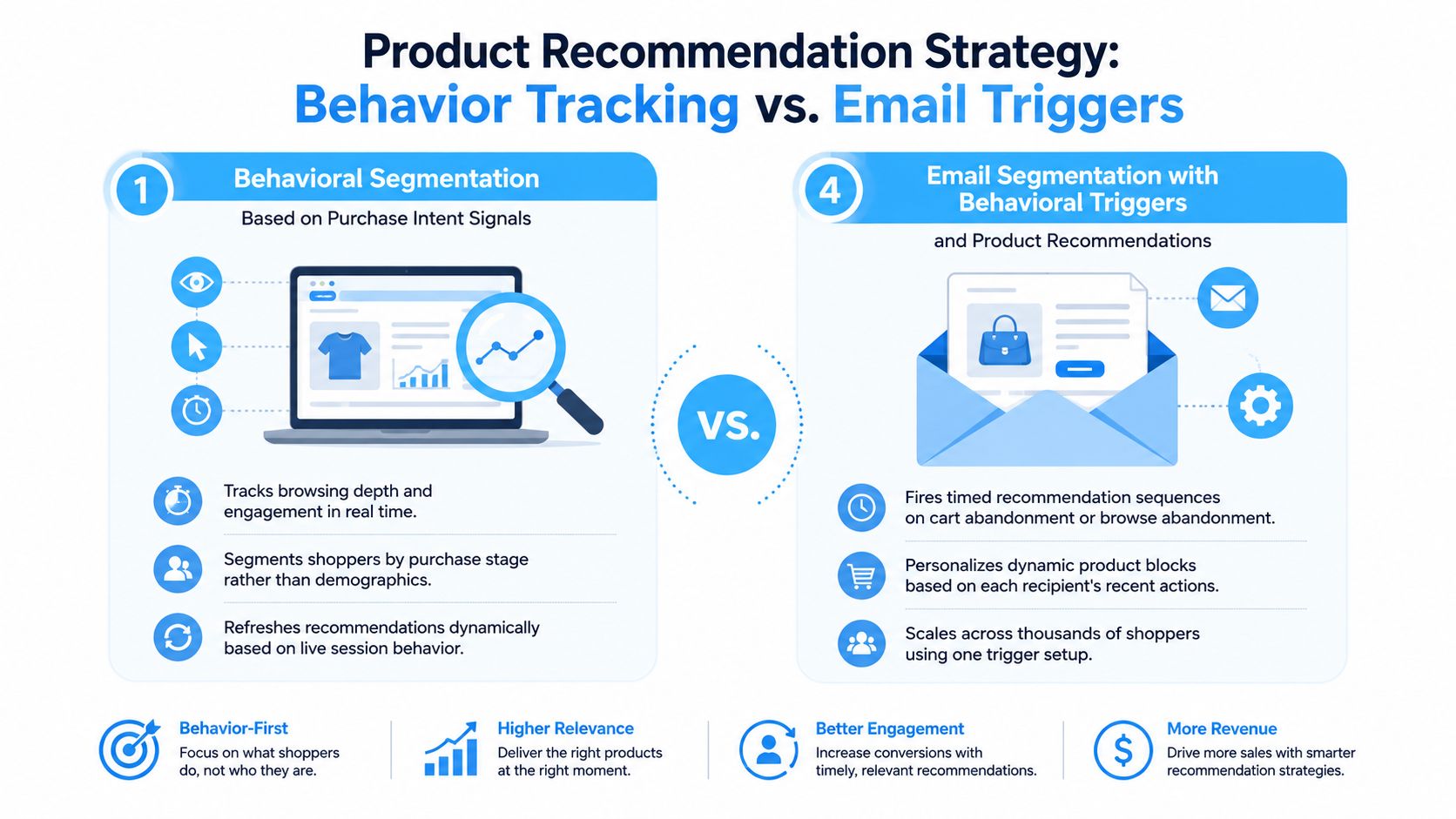
1. Behavioral Segmentation Based on Purchase Intent Signals
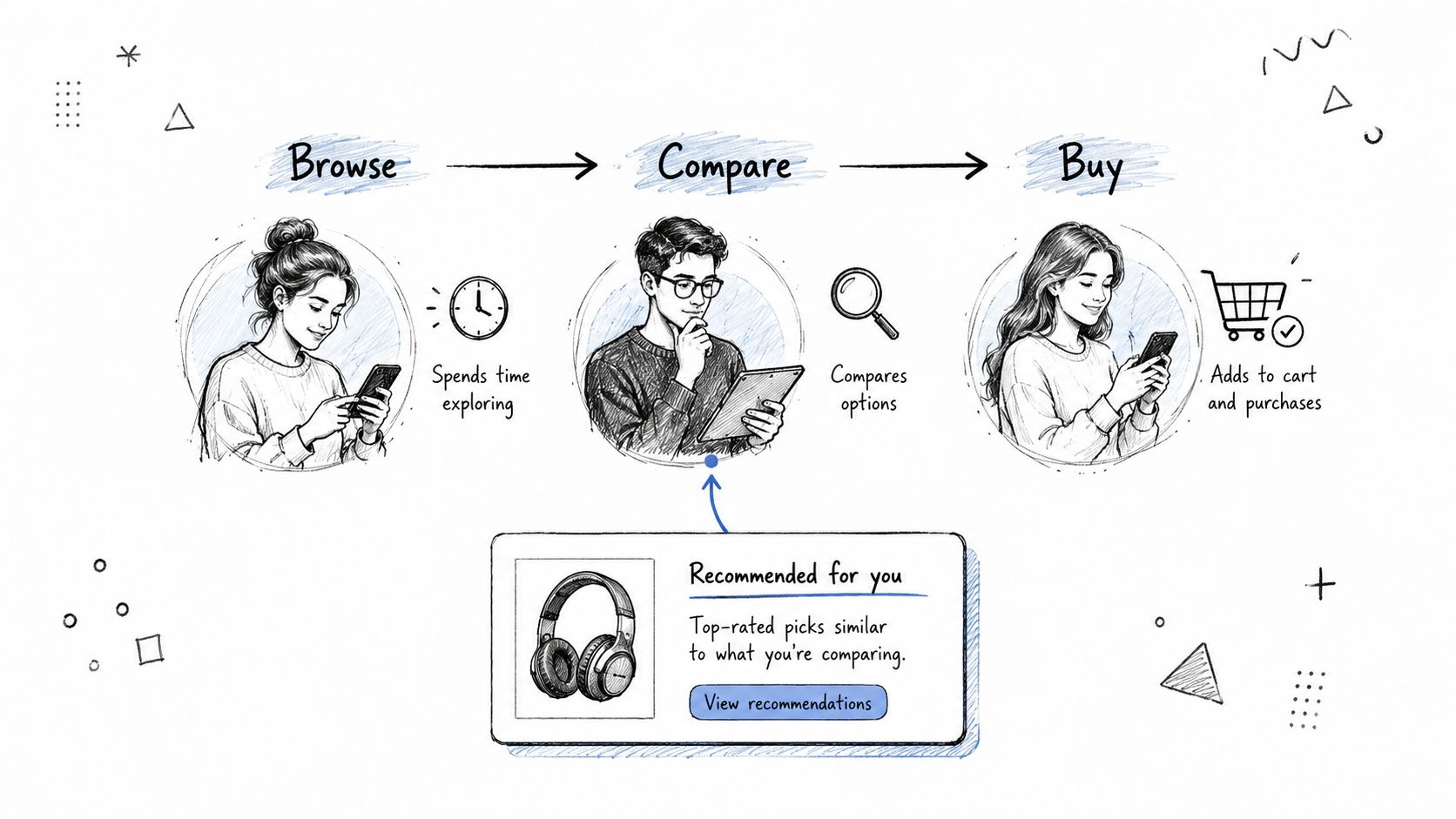
A shopper who just arrived on your Shopify store needs orientation. Someone who has compared variants, read reviews, and added an item to the cart needs reassurance or a useful next step. Treating both visitors the same wastes the strongest signals your storefront already collects.
Build segments from observable behavior first. Time on a product page, scroll depth, search terms, filter use, cart additions, cart value, viewed categories, and previous purchases can all shape recommendations without requiring an elaborate demographic profile. A visitor who has spent meaningful time comparing running shoes might see “frequently bought with” accessories, while a casual browser gets bestsellers or a curated collection.
Match the recommendation to the moment
Use different logic for different levels of readiness:
- Early browsing: Show bestsellers, popular entry products, or a short collection that reduces choice overload.
- Active comparison: Surface similar products, premium variants, reviews, and clear differences between options.
- Cart consideration: Recommend complementary items that help complete the purchase, not unrelated products.
- Repeat buying: Prioritize replenishment, accessories, and premium products connected to the customer’s purchase history.
A new visitor might receive a bundle recommendation, while a loyal repeat buyer who routinely purchases higher-value items sees a premium variant. That isn’t personalization for its own sake. It aligns the recommendation with the decision the shopper is already trying to make.
Practical rule: Start with signals you can verify. If a recommendation would make sense only because an algorithm inferred an attitude or demographic trait, validate it with behavior or zero-party data first.
Test thresholds rather than assuming one trigger fits every category. Audit recommendation accuracy regularly, because a suggestion that feels wrong can damage trust faster than showing no suggestion at all.
2. Scarcity-Driven Recommendation Urgency
Most recommendation engines treat availability as a background detail. That misses a chance to connect a relevant product with a real reason to decide now.
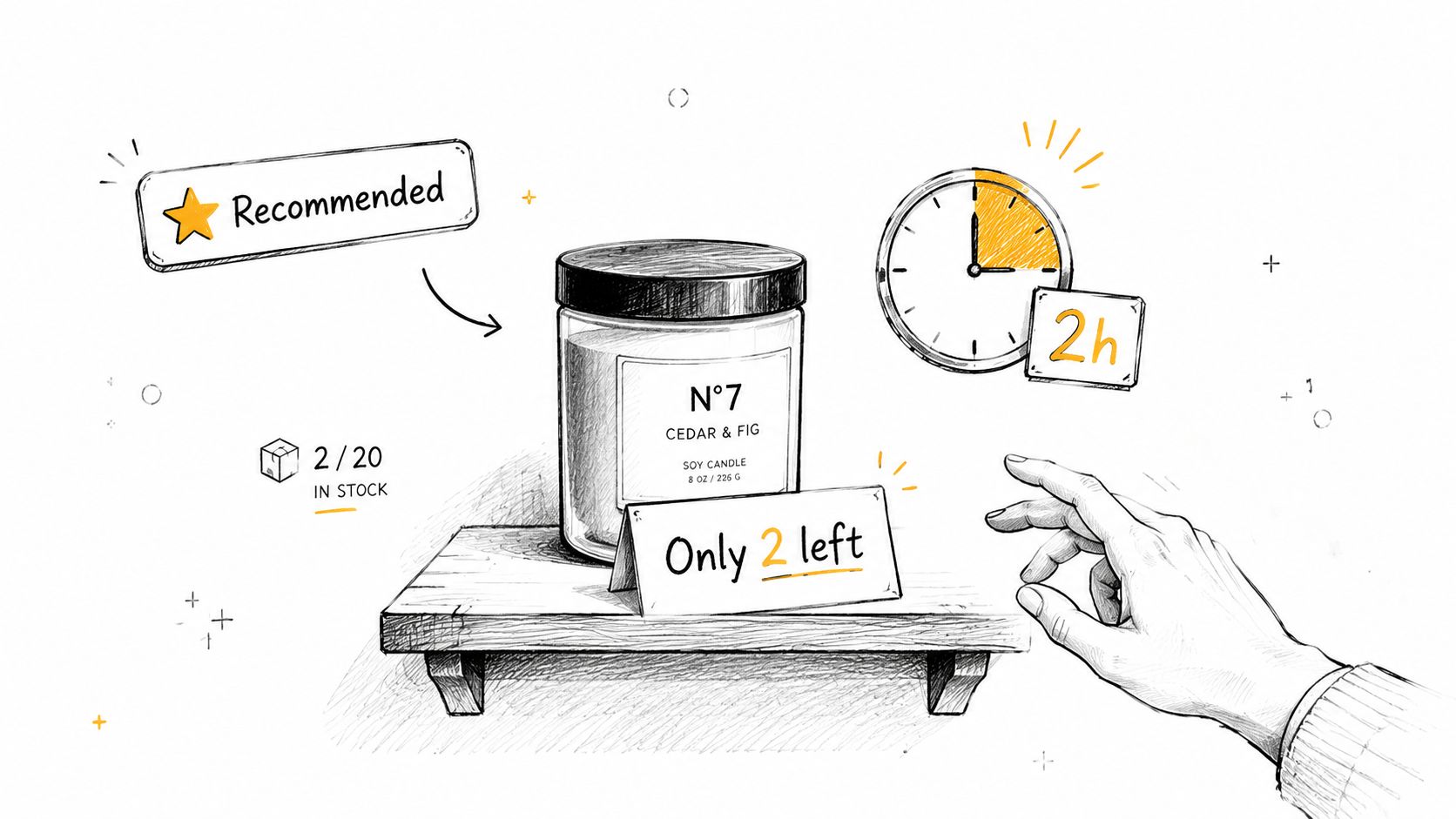
Scarcity-driven recommendations work when the constraint is genuine. A fashion store can show that a recommended jacket has limited availability in a shopper’s selected size. A beauty brand can attach a time-bound offer to a gift set. An electronics merchant can identify an accessory bundle with limited promotional availability. In each case, the recommendation becomes a decision prompt rather than another passive suggestion.
Research on consumer behavior found positive effects for both scarcity and urgency. One study reported a scarcity effect of β = 0.26, p < .001, while urgency-based marketing showed an effect of β = 0.19, p = .003 on faster purchasing decisions and impulse buying. The consumer behavior research explains these scarcity and urgency findings.
Use urgency without manufacturing pressure
Inventory and promotion systems must agree. If Shopify recommends an item that is unavailable, shoppers quickly learn to ignore the module. The message should also explain why the constraint exists, such as a limited edition, seasonal supply, or a capped offer, instead of relying on an unexplained countdown.
Keep the experience proportionate to the product. A short window can make sense for a campaign that closes soon. An arbitrary timer that resets on every visit creates suspicion and can weaken brand perception.
For a deeper treatment of this approach, see scarcity marketing for ecommerce promotions.
The implementation effort is moderate because inventory synchronization, offer rules, and storefront messaging need to work together. The payoff is a recommendation that supports action without forcing a blanket discount across the entire catalog.
3. Collaborative Filtering With Margin-Aware Ranking
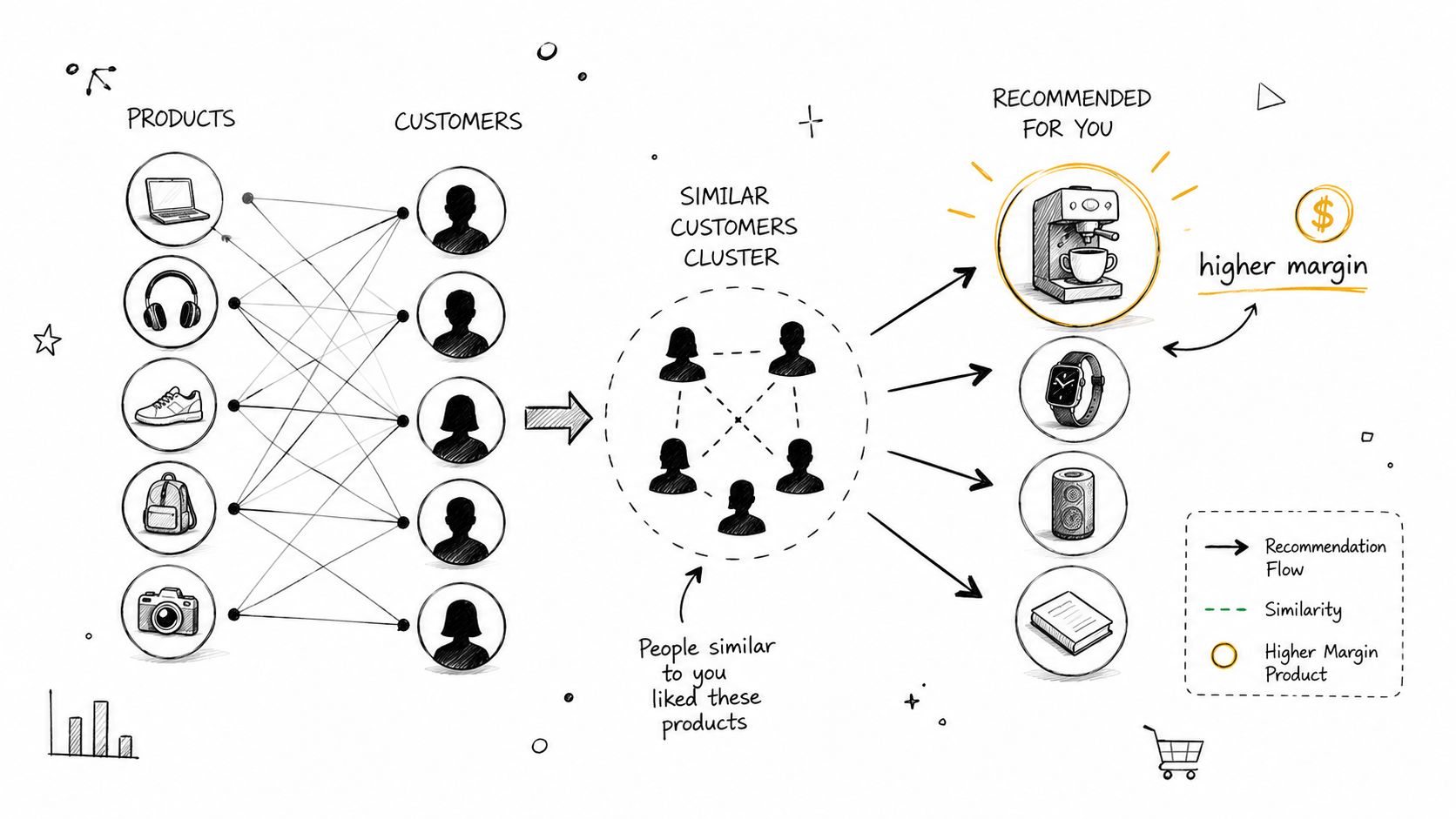
Collaborative filtering answers a useful question: what did shoppers with similar behavior buy, view, or add next? The standard version often stops at purchase likelihood or click-through rate. A stronger product recommendation strategy adds profitability to the ranking.
Suppose customers who buy a particular dress frequently purchase a licensed accessory and a higher-margin in-house belt. Both may be relevant, but the store doesn’t need to rank them equally. A margin-aware system can keep the recommendation credible while giving the healthier contribution product a better position.
Protect relevance before chasing margin
Margin-aware ranking should guide the order of recommendations, not override customer intent. A high-margin product that doesn’t solve the shopper’s problem won’t become attractive because it earns more. The system should first establish relevance, then use contribution margin, inventory needs, and basket economics as ranking inputs.
Practical applications include:
- Apparel: Place an in-house accessory ahead of a comparable licensed item when both fit the shopper’s style.
- Supplements: Surface a relevant bundle alongside individual products, provided the bundle offers a clear use-case benefit.
- Furniture: Recommend setup services or delivery protection when similar buyers selected them.
Measure contribution in actual currency, not margin percentage alone. A product with a higher percentage margin may contribute less profit than a larger basket item. Also watch cannibalization. If a premium recommendation replaces a complementary item that would have been purchased alongside the original product, the ranking may look better while the order becomes less profitable.
The market is moving toward recommendation infrastructure as a core personalization layer. One market report estimated the global ecommerce product recommendation engine market at USD 5.76 billion in 2024, with a projected 15.25% CAGR through its forecast period. The market report provides that estimate and projection.
For smaller Shopify stores, manual rules may be enough to start. Larger catalogs can combine collaborative filtering with product attributes and contextual signals, but clean product data and ongoing model review are more important than buying the most complex system.
4. Email Segmentation With Behavioral Triggers and Product Recommendations
Email recommendations should answer the shopper’s current decision, not repeat a generic “you may also like” block. The strongest segment is often defined by the event that interrupted purchase intent.
Start with the unfinished action. A browse-abandonment email can return the exact running shoes viewed, then add a few comparable options or relevant reviews. A cart flow should keep the abandoned product central and show a compatible accessory. After a coffee maker purchase, filters and coffee fit the next-use case. Each trigger supports a different job, so each needs its own ranking and message.
Match the recommendation to the Shopify event
Configure Shopify events and Klaviyo segments around these decisions:
- Category browsing without purchase: Return products from the viewed category rather than the general catalog.
- Product-page engagement: Reintroduce the item, then address hesitation with reviews, comparisons, or complementary products.
- Cart abandonment: Keep the cart item first and add something that completes or improves its use.
- Post-purchase: Suggest consumables, accessories, or a natural next product.
Timing should follow the decision’s urgency. A cart recovery message usually belongs closer to the cart event than a broad browse reminder. Test timing against the buying cycle, product price, and customer expectations.
Use zero-party signals when available. Wishlist activity, reviews read, selected filters, and stated preferences can sharpen ranking beyond purchase history. Keep the set focused. Too many choices recreate the hesitation the email is meant to resolve.
Implementation requires coordination across Klaviyo, Shopify events, inventory, and the recommendation engine. They must share exposure and purchase status. Otherwise, an email may recommend a product the customer already bought or an item that is unavailable. Measure incremental revenue, contribution margin, and unsubscribe behavior by trigger. A high click rate is not enough if discounts train shoppers to wait or the recommendation replaces a higher-margin basket addition.
5. Frequency Capping and Recommendation Fatigue Management
Relevance has a limit. A product shown on the product page, in a Klaviyo email, through SMS, and in a retargeting ad can shift from useful guidance to unwanted pressure. That change affects conversion, margin, and brand perception.
Set exposure rules around the shopper’s decision, not only the channel. A shared record across the storefront, email, SMS, and paid media should track which products appeared, when they appeared, and whether the shopper purchased. Shopify events and customer identity must connect these records, or one channel will repeat an item another channel already showed.
Use fallback logic that protects the recommendation experience:
- After an exposure cap: Replace the item with a related alternative, a different price point, or a complementary product.
- After a purchase: Suppress the purchased product and rank accessories, replenishment, or the next logical product.
- During high-intent events: Let cart recovery or post-purchase messages exceed ordinary caps when the recommendation directly resolves an active decision.
- Across channels: If an email featured a product, decide whether the next SMS should repeat it or present another option.
The trade-off is straightforward. A tighter cap can reduce clicks from repeated promotion, but it also protects attention and lowers the risk of margin-eroding discounts. A looser cap may capture late deciders, while making the brand feel intrusive. Set different rules for high-margin products, limited inventory, replenishment items, and products that require comparison.
Measure revenue, contribution margin, conversion, unsubscribes, and SMS opt-outs by exposure frequency. Compare first exposure with repeated exposure. If performance falls after repetition, reduce the cap or vary the recommendation and message rather than sending the same product again. These measures show whether exposure creates incremental demand or merely shifts an existing purchase between channels.
The frequency capping best practices for ecommerce campaigns can help structure suppression rules.
This setup takes more coordination than adding another widget. It requires shared exposure, purchase, inventory, and identity data. The payoff is less promotional noise, stronger trust, and fewer moments when customers feel followed instead of helped.
6. Contextualized Recommendations Based on Shopping Occasion and Season
Seasonal recommendations should answer a specific shopper decision: buy now, prepare early, or choose a product for someone else. The same winter coat may serve advance planning in July, active need in September, or gift shopping near a holiday. Recommendation logic should change with that context, not just rotate products by calendar date.
A useful setup starts with the occasion, then checks whether behavior supports it. A fashion store might move from transitional accessories to outerwear as temperatures change. A jewelry brand could present gift bundles around Valentine’s Day, Mother’s Day, or Christmas. A beauty store might feature sun protection in spring and summer, then moisturizing products during colder periods.
Use these signals together:
- Seasonal browsing: Current interest can indicate planning ahead, even without a previous purchase.
- Gift intent: Gift wrapping, a gift message, a different shipping address, or an occasion selection can justify gift-focused recommendations.
- Regional relevance: Location can guide weather and seasonal choices when the data was appropriately collected and used.
- Inventory readiness: Do not give prominent placement to seasonal products if supply cannot support expected demand.
This strategy usually needs more merchandising coordination than a generic recommendation block. Product tags, collection structure, stock rules, creative, and email or SMS timing must agree. Shopify theme customization can support simple seasonal modules. Larger catalogs may require an app or an external recommendation layer, increasing implementation effort and data dependencies.
Measure seasonal conversion, add-to-cart rate, sell-through, contribution margin, and returns against comparable non-seasonal placements. A relevant occasion can improve conversion, but aggressive seasonal presentation can narrow discovery, create promotion fatigue, or leave discounted inventory after demand passes. Keep the recommendation specific, while offering a clear route to broader browsing when the occasion or season does not fit.
7. Ascending Average Order Value Through Cross-Sell and Upsell Sequencing
Cross-sell and upsell recommendations address different shopper decisions. Cross-sells add products needed to complete a use case. Upsells help the shopper choose a higher-specification version of the product already under review. Treating them as interchangeable can raise clicks while weakening relevance and margin.
A phone entering the cart can trigger a compatible case and screen protector. During product evaluation, a premium model or larger storage option may be more appropriate. A beauty store can pair a moisturizer with a serum or mask, then present a larger size or premium formula once the customer has accepted the routine.
Match the recommendation to the decision stage
Build the sequence around shopper intent:
- Discovery: Introduce complementary categories and products needed for a complete use.
- Product evaluation: Show upgrades with clear feature or quality differences.
- Cart review: Add practical accessories that prevent an incomplete purchase.
- Post-purchase: Recommend compatible additions without reopening the original choice.
Each placement needs a reason the shopper can understand. “Complete the setup” suits a camera and memory card. “Complete the look” suits a dress and matching shoes. A discount does not make an unrelated recommendation relevant.
Bundles can reduce choice friction when the products naturally belong together. They also change the economics. Compare incremental contribution profit from the bundle with profit from separate purchases before applying a discount. The promotions analysis discusses discount frequency, price perception, and margin pressure in this analysis.
On Shopify, start with rules based on product type, compatibility, margin, and cart value. Then test recommendation position, attach rate, conversion, average order value, contribution margin, and returns by recommendation type. Implementation effort rises when the catalog needs detailed product relationships or custom sequencing, so begin with high-volume products where the decision logic is clear.
A returned upsell often signals weak qualification or an unclear product promise. Improve the explanation or eligibility rule before adding more placement or discounting.
8. First-Party Data Collection for Privacy-Resilient Recommendations
Personalization fails when a store collects more data than it can explain, maintain, or use responsibly. Shopify merchants can build a stronger base with first-party data, gathered from customer actions and information shoppers choose to provide. The trade-off is clear: collection requires consent and careful qualification, while weak or outdated signals can make recommendations feel intrusive or irrelevant.
Ask for information at a useful moment. A short signup question, product quiz, preference center, or search filter should improve the shopping experience immediately. Explain the benefit in plain language, such as receiving better product matches or more relevant content. Avoid requesting sensitive details unless the recommendation depends on them.
A coffee search for “sustainable” indicates a different need from “strongest.” A fragrance-free skincare filter expresses a concrete preference. A cart containing premium products shows current session intent, even when the store has little customer history.
Use signals according to their decision value:
- Search queries: Strong evidence of immediate intent.
- Current-session activity: Clicks, viewed products, cart additions, and engagement with product details.
- Stated preferences: Use case, material, taste, skin concern, size, or style.
- Purchase history: Useful for replenishment and compatible products, but less reliable for the shopper’s current mission.
The priority is not collecting everything. It is recording only signals that can change ranking, eligibility, or message timing, then giving customers a way to review or withdraw their choices.
A systematic review reports potential gains in satisfaction, loyalty, and conversion, while also identifying privacy concerns, algorithmic bias, and data-quality limitations. The review discusses personalization benefits and its limitations around privacy, bias, and data quality.
On Shopify, begin with consent-aware fields and rules before funding a complex model. Hybrid recommenders and in-session logic can handle sparse profiles, provided cold starts and sensitive assumptions are addressed. First-party data activation for ecommerce personalization explains how to turn these signals into usable recommendation inputs. Measure consent rate, signal coverage, recommendation engagement, conversion, margin, and opt-outs.
9. Binding Recommendations to Earned Urgency and Participation Mechanics
Urgency should be earned by relevance and participation, not attached to every recommendation as a generic discount. A quiz answer, product reveal, or qualifying add-on can give the shopper a concrete reason to continue, while protecting the brand from constant promotion.
Start with the shopper’s decision. A skincare store can ask about routine and skin concerns, then show a suitable product and a time-limited benefit. A fashion brand may tie a restrained reveal experience to selected products. A complementary-product store can offer a benefit on a second item only after the customer adds a relevant first item.
Each mechanic has a different operating cost. A short quiz requires question design, answer mapping, and enough product attributes to produce credible results. A reveal is simpler to launch, but can feel decorative if it does not improve product selection. A qualifying add-on requires clear cart logic and margin review, especially when the incentive applies to a lower-margin item.
Set the rules before adding creative:
- Simple participation: Keep the path short and make the reward attainable.
- Relevant reward: Tie the benefit to the recommended product or bundle.
- Genuine constraint: Use a real time or quantity limit that Shopify can enforce.
- Brand fit: Luxury presentation should stay restrained; playful brands can use more interaction.
- Clear measurement: Compare participation, recommendation engagement, incremental orders, profit, and repeat use. A high reveal rate is not enough.
Promotion fatigue is a design risk. If every recommendation triggers a reward, shoppers may delay purchase, wait for incentives, or see the product as less valuable. Cap eligibility, vary the mechanic, and reserve urgency for recommendations with a clear decision benefit.
Discounts also require a profit check. Revenue lift alone can hide margin erosion. The discount-effectiveness analysis explains why incremental profit matters more than revenue lift alone.
Participation cannot rescue an irrelevant product. Use it only after the recommendation fits the shopper, then test whether the mechanic improves completed orders and profit without weakening brand perception.
10. In-Session Recommendation Adjustments in Real Time
Real-time ranking should change the next product shown, not rewrite the entire storefront after one click. For Shopify teams, the practical question is which live signals improve selection without creating unstable merchandising or pushing shoppers toward unnecessary discounts.
Use the current session as a decision trail:
- Search-led ranking: Let the active query reorder recommendations and surface products that match the shopper’s stated need. A search for sustainable materials, for example, should favor items with verified sustainability attributes.
- Cart-aware exclusions: Hide products already in the cart and replace them with compatible complements. This avoids wasting recommendation space on an item the shopper has already chosen.
- Session-based price context: Compare the prices and features the shopper has considered. A premium upgrade can be relevant after repeated interest in higher-tier products, but it should not appear as an automatic push to increase order value.
- Sequential ranking: Give recent, high-intent actions more weight than an isolated click, while retaining proven fallback products when the session contains little evidence.
- Stock and availability checks: Remove unavailable recommendations before rendering the module. A relevant product that cannot be purchased damages trust and wastes attention.
The trade-off is speed versus control. Simple rules are easier for a small ecommerce team to inspect, test, and adjust. More complex ranking may improve relevance across a large catalog, but it needs cleaner event data, reliable product attributes, and monitoring for margin erosion. Measure recommendation clicks, add-to-cart rate, completed orders, incremental profit, and changes in average order value. Also check whether repeated upgrades or price-led suggestions make the brand feel overly promotional.
First-party data activation can support these signals, but this section should stay focused on in-session decisions rather than repeating consent or preference-center guidance. Keep the logic understandable: Shopify should be able to show which event changed the ranking and which fallback applied when evidence was weak. Learn more about first-party data activation.
The technology market is expanding. A separate industry summary cited a broader recommender-systems market of USD 6.4 billion in 2022 and a projected 26.4% CAGR from 2023 to 2030. The industry summary provides that market estimate and projection. Treat that growth as evidence of maturing infrastructure, not proof that every Shopify store needs the most advanced system.
10-Point Product Recommendation Strategy Comparison
| Strategy | Implementation complexity | Resource requirements | Expected outcomes | Ideal use cases | Key advantages |
|---|---|---|---|---|---|
| Behavioral Segmentation Based on Purchase Intent Signals | Medium–High (real-time tracking & dynamic segments) | Analytics integration, tracking engineers, clean customer data | Higher relevance and conversion; reduced recommendation fatigue | Stores with complex shopper journeys or frequent comparison behavior | Timely, stage-aware recommendations that match decision readiness |
| Scarcity-Driven Recommendation Urgency | Medium (inventory sync + timers) | Real-time inventory, accurate sync, UI countdown components | Accelerated purchase timing; reduced abandonment; AOV lift | Limited-stock items, launches, time-bound offers | Authentic urgency that drives immediate decisions without deep discounts |
| Collaborative Filtering with Margin-Aware Ranking | High (modeling + margin integration) | Transaction history, data science, margin data feeds | Balanced conversion growth and improved profitability | Large catalogs with varied margins and strong purchase history | Personalization that prioritizes relevance and margin simultaneously |
| Email Segmentation with Behavioral Triggers and Product Recommendations | Medium (automation + dynamic content) | Email platform integration, Shopify sync, templating & testing | Higher open/click rates; better recovery of carts and browse interest | Email-focused merchants; cart/browse abandonment recovery | Timed, scalable personalization aligned to recent customer actions |
| Frequency Capping and Recommendation Fatigue Management | High (cross-channel coordination) | Unified cross-channel tracking, orchestration logic, reporting | Improved long-term engagement; preserved trust and recommendation value | Omnichannel retailers and high-frequency ad environments | Prevents overexposure and keeps recommendations fresh and credible |
| Contextualized Recommendations Based on Shopping Occasion and Season | Medium (tagging + calendar logic) | Seasonal tagging, manual curation, planning resources | Higher seasonal conversion; better gift/occasion performance | Seasonal/gift-driven categories and holiday campaigns | Temporal relevance that makes recommendations feel natural and timely |
| Ascending AOV Through Cross-Sell and Upsell Sequencing | Medium (journey-stage sequencing) | Product relationship mapping, A/B testing, analytics | Increased AOV and higher-margin sales without heavy discounting | Stores with complementary products or tiered SKUs | Sequenced offers that expand cart breadth then lift order value |
| Real-Time Recommendation Personalization Using First-Party Data Signals | Medium (session-level personalization) | First-party data capture, real-time session tracking, preference center | Highly accurate, privacy-compliant personalization; future-proofing | Privacy-sensitive stores and brands collecting first-party signals | Immediate, customer-controlled personalization without third-party cookies |
| Binding Recommendations to Earned Urgency and Participation Mechanics | High (interactive mechanics & rewards) | UX/design, backend mechanics, campaign orchestration, analytics | Increased engagement and commitment; motivated conversions | Brands using gamification or experiential promotions | Earned offers that boost commitment and feel less like discounts |
Build the Recommendation System Your Margins Can Support
The best rollout starts with relevance, not software complexity. Establish the first-party and intent signals your Shopify store can reliably collect. Then map recommendations to page purpose and shopper stage, so homepage discovery, product-page comparison, cart completion, email recovery, and post-purchase replenishment each have a distinct job.
Next, protect the experience from repetition. Coordinate Shopify, Klaviyo, SMS, paid media, and storefront exposure so customers aren’t shown the same product until the suggestion becomes noise. Add inventory suppression and fallback logic before scaling personalized modules. A recommendation that points to an unavailable item or repeats a recently purchased product undermines trust regardless of how advanced the underlying engine is.
Only after relevance and coordination are working should you test margin-aware ranking and earned urgency. Use the ranking to improve profit contribution without sacrificing fit. Use time- or quantity-bound mechanics when there is a genuine reason to act, not as a permanent layer over every product.
Your measurement framework should include more than clicks. Track recommendation-attributed conversion, average order value, gross profit per session, engagement, return behavior, unsubscribe rates, and fatigue signals. Incremental profit deserves special attention because a campaign can raise revenue while reducing the money left after product and operating costs. Industry promotion analytics illustrate the problem: a 20% discount on a product with a 50% gross margin reduced profitability to 37.5%, a 25% decline in profitability. The promotion analytics benchmark explains the margin effect of that discount.
Quikly can fit the earned-urgency layer for Shopify brands that want promotional experiences bound by time, quantity, or both across the storefront, email, social, and SMS. Its experiences are styled to match the store rather than presented as a generic overlay, and its mechanics have been refined across more than 60 million consumer interactions. For implementation context, Jordan Craig reported a roughly 20% lift in profit, with incremental lift visible immediately on activation, an approved result that matters because it focuses on profit rather than revenue alone.
Start with one decision point, such as cart completion or a high-intent product page. Establish a control, define the profit metric, cap exposure, and review the result alongside returns and customer fatigue. A strong product recommendation strategy helps the right shopper make a confident decision without teaching the entire customer base to wait for a deeper discount.
Quikly helps Shopify brands turn relevant recommendations into time- or quantity-bound promotional experiences that reward shoppers who act instead of training everyone to wait. Use it across your storefront, email, social, and SMS, with on-brand mechanics designed around genuine urgency. Visit Quikly to see how the approach can fit your recommendation strategy.
Topics: product recommendation strategy, Shopify recommendations, ecommerce personalization, product recommendations, conversion strategy