A Shopify team can have purchase history, browse events, email engagement, loyalty status, support tickets, and consent records flowing into its CRM every day, yet still make the next customer decision with almost none of that context. The campaign calendar remains broad, the same discount reaches recent buyers and lapsed subscribers, and paid media retargets people who already converted.
That gap is where first-party data activation earns its place. The work isn’t collecting another field or buying a larger data platform. It’s connecting owned customer signals to a timely action that improves conversion, protects margin, or prevents an unnecessary message. For Shopify brands, the strongest starting point is usually a smaller stack, clearer identity rules, and promotions that respond to intent instead of training customers to wait.
What First-Party Data Activation Actually Means
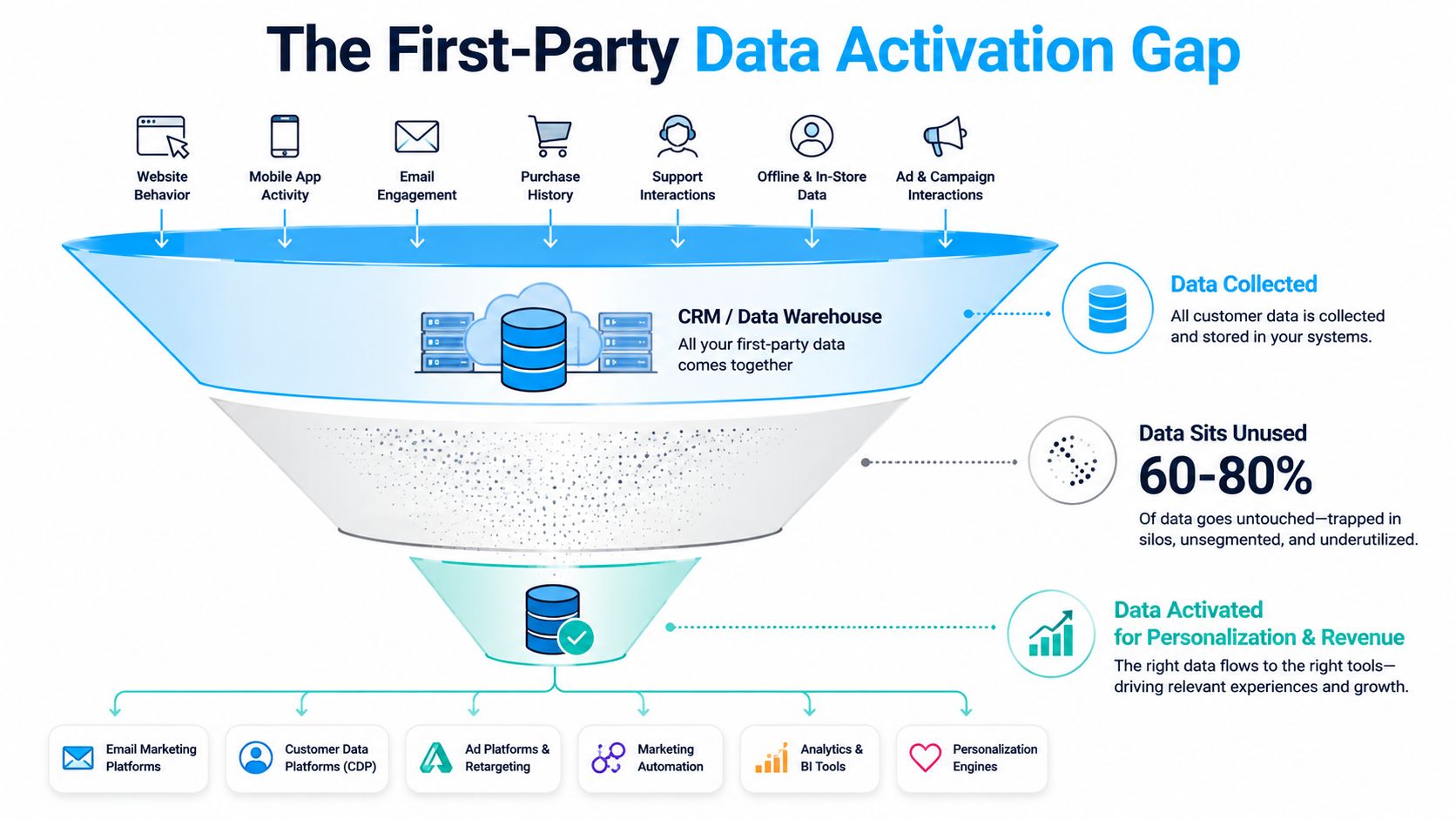
Most ecommerce teams are good at collection. Shopify records orders, pixels capture browsing events, Klaviyo stores engagement, and loyalty tools add another layer of customer context. The problem starts afterward. Data sits in a CRM, ESP, or warehouse while campaigns continue to treat shoppers as broad audience labels.
Boston Consulting Group reported in March 2021 that only about 30% of companies were creating a single customer view across channels, while just 1% to 2% were using data to deliver a full cross-channel experience. In the same Asia-Pacific study, 77% of connected brands said their first-party data was mostly or fully embedded in marketing campaigns. Those findings capture the operational gap clearly: ownership doesn’t create value until a team can use the signal consistently. BCG’s analysis of first-party data provides the historical context.
The three tests for activation
A useful definition is practical rather than academic. Data is activated only when it passes three tests:
- Owned: The brand collected the information through its own customer relationship, with the appropriate consent.
- Connected: The record is tied to a decision, such as an audience exclusion, lifecycle message, offer, or site experience.
- Timely: The action occurs while the session, purchase cycle, or lifecycle window still matters.
A webhook sending an order into BigQuery is plumbing. A customer profile refreshing in Klaviyo is useful infrastructure. Activation happens when that order suppresses a retargeting ad, skips a replenishment reminder, or changes the next promotion before the customer receives an irrelevant message.
The same principle applies to an anonymous browse session. If the session can’t be linked to a known customer through a permitted identifier, the team may still use the event for contextual behavior, but it shouldn’t pretend that an accurate individual profile exists.
Practical rule: If the data changes no customer-facing or measurement outcome, call it collected data, not activated data.
The Activation Use Cases That Move Revenue First
Not every activation project deserves equal engineering time. A Shopify team usually gets more dependable value from suppression and lifecycle messaging than from a large personalization rebuild, because the first two use cases are deterministic and easier to connect to dollars.
Start with owned channels. Cart and browse abandonment flows can use product views, checkout state, and purchase suppression in Klaviyo or an SMS platform. Win-back programs can respond to a customer’s lapse window, while loyalty messages can recognize tier progression or a meaningful repeat purchase. These actions use a relationship the brand already owns, so they don’t require a complicated media identity graph before producing a testable outcome.
Suppression belongs near the top of the list. Excluding recent purchasers from prospecting, removing converters from retargeting, and preventing high-value customers from receiving unnecessary discount codes can reduce waste without asking the brand to discount more aggressively. The relevant question isn’t “How much personalization can we build?” It’s “Which known customer should not receive this message, and what costly mistake does that prevent?”
A practical ranking
| Use Case | Data Required | Typical Lift | Effort |
|---|---|---|---|
| Purchase and converter suppression | Customer ID, order status, consent | Reduced wasted spend and irrelevant messaging | Low |
| Cart and browse lifecycle messaging | Product event, email or SMS consent, purchase status | Faster recovery of existing intent | Low |
| Win-back flows | Last purchase date, category, order value | More relevant reactivation | Low to medium |
| Loyalty and profile progression | Tier, purchase history, declared preferences | Stronger retention experience | Medium |
| On-site personalization | Identity, browsing, catalog, recommendation logic | Potentially higher relevance | Medium to high |
| Predictive scoring and AI | Clean historical events, stable identity, measurement | Better prioritization if the inputs hold | High |
Personalization should come later, after suppression and lifecycle programs run cleanly. Teams often justify recommendation blocks with session duration or engagement because those metrics are available, while the margin impact remains unclear. A focused customer segmentation framework can help translate audience definitions into actions instead of adding another passive taxonomy.
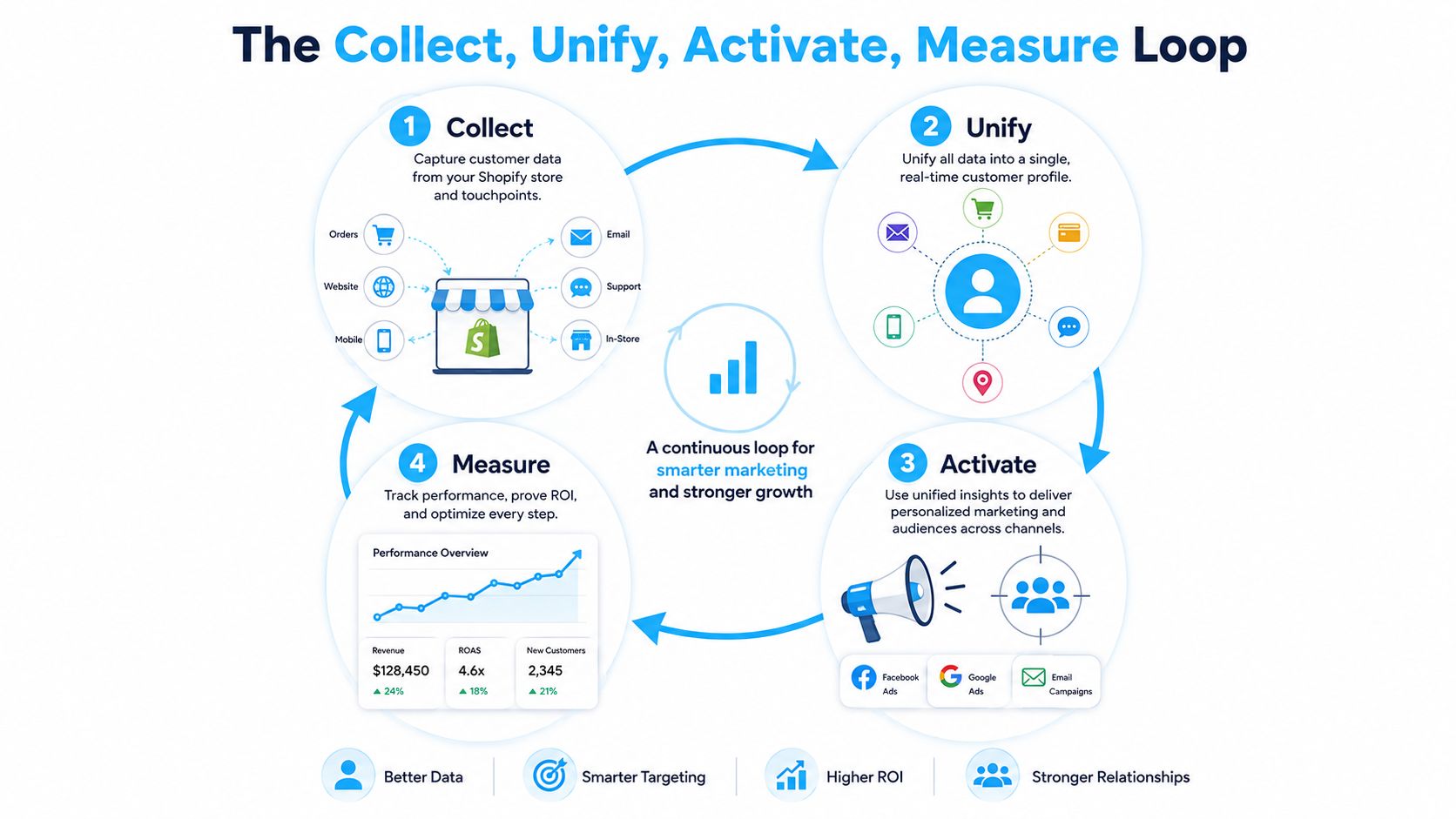
The Collect, Unify, Activate, Measure Loop
A first-party data program works as a loop, not a one-way export. Each step supplies the condition for the next, and a weak identity layer can make otherwise accurate events unusable.
Collect signals with purpose
On Shopify, the event layer should cover web pixels, checkout events, post-purchase behavior, and server-side order webhooks. Include orders, refunds, fulfillments, subscription changes, email and SMS engagement, loyalty events, and review submissions where those events support an actual use case. Store consent with the record, not in a separate document that downstream tools can’t evaluate.
Use a shared event schema for events such as add_to_cart, checkout_started, and purchase. Consistent names and properties make it possible to compare events across Shopify, analytics, Klaviyo, paid media, and a warehouse.
Unify around the shopper
Unification means resolving anonymous sessions, logged-in activity, and historical orders into a usable customer view. A Shopify customer record, Klaviyo profile, or lightweight system such as Segment or RudderStack can serve as the working identity layer, with a warehouse supporting analysis where needed.
Email, phone, and customer ID can act as deterministic join keys when collected and used lawfully. Normalize casing and phone formats before matching. Record the source and timestamp of each identity link, because an unexplained match is a governance problem as well as a technical one.
The goal isn’t one giant event table that looks impressive in a warehouse. It’s a reliable customer profile that answers, “What should happen next, and is this person eligible to receive it?”
Activate, then measure the action
Push segments, triggers, and exclusions into Klaviyo flows, SMS platforms, Meta and Google audiences, on-site experiences, and promotional systems. A segment with no destination is an analysis artifact. A destination with no suppression rule can create avoidable waste.
Measurement should connect the action to the eligible audience. Track the activation rate, revenue per activated record, and incremental margin. In one 2026 benchmark, the median first-party data activation rate was 34%, meaning roughly two-thirds of collected data was never activated. The benchmark’s discussion of activation rates reinforces why the loop needs feedback rather than another warehouse project.
Feed conversion, suppression, opt-out, and margin outcomes back into the data layer. If a CDP or router can’t demonstrate a measurable action at each stage, it may be adding architecture without adding operating value.
A Shopify-Native Activation Stack You Can Ship
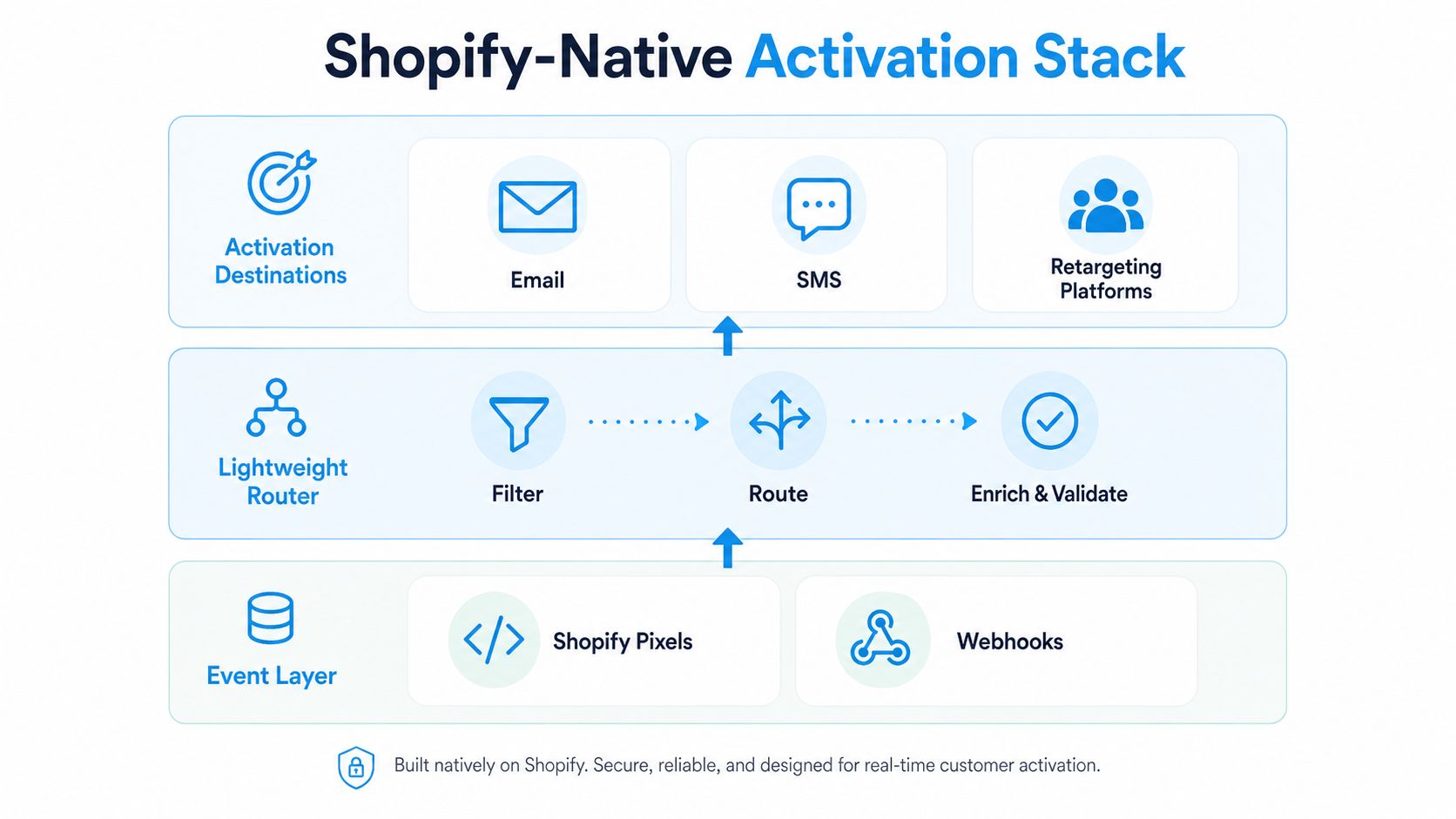
A small Shopify team doesn’t need to begin with a six-month CDP migration. It needs a dependable event contract, a clear identity rule, and a limited set of destinations that can act on the records.
Build the event layer first
Start by documenting the Shopify events that matter to the first campaign. Shopify web pixels can capture browser-side behavior, while customer events and server-side webhooks provide a more controlled path for orders, refunds, and fulfillment changes. A tag manager plan should define the event name, required properties, customer identifier, consent state, and destination for each event.
Don’t begin with every possible interaction. add_to_cart, checkout_started, purchase, refund, and subscription status often provide enough coverage for a first suppression and lifecycle test.
Make identity and consent explicit
Use email, phone, or Shopify customer ID as the preferred join keys, with normalization rules applied before records move downstream. If a customer ID is missing, keep the event in an anonymous or unresolved state rather than forcing a weak match. A fallback can use a consented email or phone value when available, but the system should preserve uncertainty.
Consent belongs at the theme and collection layer. Every destination needs an opt-out path, and suppression must propagate to email, SMS, Meta, and Google audiences. Server-side tagging can improve control because the brand processes events on infrastructure it controls before eligible data reaches third parties, but it doesn’t remove the need for valid consent or clear data-use policies.
Route only what each destination needs
Klaviyo or Attentive can handle owned lifecycle messaging. Meta’s Conversions API and Google enhanced conversions can support paid measurement and audience workflows when the required permissions and identifiers are present. A behavior-driven promotion can sit downstream of the router, receiving only the qualified segment, eligibility rule, and timing context it needs.
The practical build order is simple:
- Write the tag plan: Define events, properties, consent, and ownership.
- Add server events: Prioritize orders, refunds, fulfillment, and subscription changes.
- Implement identity stitching: Normalize identifiers and document fallback behavior.
- Connect destinations: Start with one owned channel and one suppression destination.
- Test failure paths: Check duplicate events, opt-outs, missing IDs, refunds, and delayed updates.
Review the broader Shopify app ecosystem only after the use case and event contract are clear. Adding apps before those decisions usually creates more duplicate profiles, not more activation.
Measuring Activation Without Getting Lost in Dashboards
More dashboards don’t automatically produce better decisions. Shopify teams can spend hours reviewing blended ROAS, attributed revenue, sessions, and event counts while leaving the underlying audience logic unchanged.
A better measurement model asks whether a known record received a useful next action and whether that action improved economics. The metric should match the decision the team can make.
Use metrics tied to action
| Metric | Why It Matters | Where It Lives |
|---|---|---|
| Activated audience rate | Shows how much eligible data actually triggered an action | Warehouse or audience platform |
| Suppression lift | Reveals spend or message waste avoided through exclusions | Paid media and campaign reporting |
| Promotional margin per activated customer | Prevents revenue growth from hiding discount cost | Shopify, finance, and promotion reporting |
| Incrementality on holdout cohorts | Separates causal impact from correlation | Experiment or warehouse layer |
An activation rate can expose idle data. Suppression lift can show the value of a rule that never creates a visible click. Promotional margin per activated customer keeps the team from declaring victory because orders rose while profit per order fell. Incrementality is the protection against claiming every conversion that followed a message.
For a useful perspective on the financial side, review this guide on how to improve contribution margin with data. The central operating discipline is the same: connect customer information to economic decisions, not just reporting volume.
A focused weekly review
A practical review can fit into one hour:
- First segment: Check event freshness, identity match failures, consent mismatches, and destination delivery.
- Second segment: Review activated audience rate, suppression outcomes, and revenue per activated record.
- Third segment: Compare treatment and holdout groups, then identify one rule to refine.
- Final segment: Decide whether to scale, pause, or simplify the next activation.
Event volume is a health signal. It isn’t a business result.
Privacy, Governance, and When Not to Activate
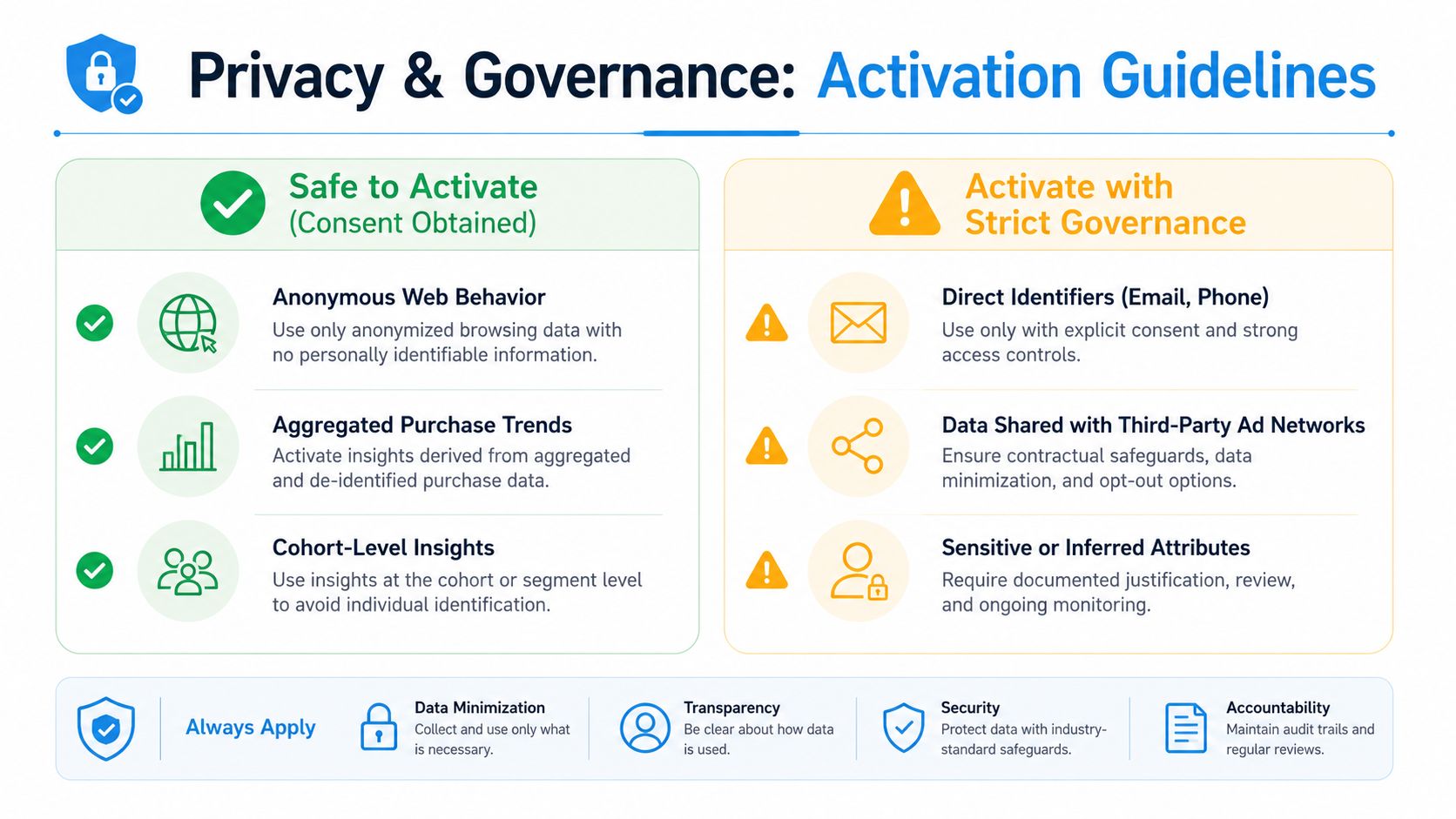
First-party data gives a brand more control than rented audience data, but activation can still reduce control once records leave Shopify and enter ad platforms, SaaS tools, or other processors. The decision isn’t whether a record exists. It’s whether the destination, purpose, consent, retention, and customer expectation line up.
Purchase history, declared preferences, loyalty status, and site behavior tied to an identified customer can support useful activation when the brand has captured the required consent and communicated the purpose clearly. Direct identifiers such as email and phone require stricter handling, particularly when they are sent to advertising destinations.
Some signals should remain out of promotional activation. Financial distress inferences, health-related attributes, and records stitched from questionable third-party lists create disproportionate risk. If the data lineage is unclear, don’t solve the uncertainty with a more advanced matching system.
Governance that operators can maintain
Capture consent at the theme and form layer, store the consent state beside the profile, and sync suppression lists to Meta, Google, email, and SMS systems. Maintain regional rules for EU and California users, document retention expectations, and create a deletion path that removes or anonymizes records across the systems that received them.
Zero-party data deserves a separate treatment because customers intentionally provide it rather than merely generating observed behavior. The guide to what zero-party data means is useful when deciding whether a declared preference should inform messaging or personalization.
Before activating a new destination, ask:
- Purpose: Can the team explain the customer benefit and business decision?
- Permission: Does the consent state cover this channel and use?
- Lineage: Can the team identify where each field came from?
- Minimization: Is every field necessary for the action?
- Control: Can the brand honor opt-outs and deletion requests?
- Alternatives: Can a simple rule deliver the same outcome without exporting the data?
Skip the CDP overhead when a simple Shopify or Klaviyo rule solves the problem. Complexity is justified by a measurable decision, not by the appearance of maturity.
Turning Activated Data Into Smarter Promotions
The most useful connection between activation and promotions is eligibility. A customer’s segment should determine who sees the offer, why they qualify, when it appears, and what the brand refuses to give away.
A recent purchaser shouldn’t receive a win-back code. A high-intent cart abandoner may need a reason to act now, not a deeper discount that becomes the new reference price. A loyal customer may respond better to early access or a bonus reward than to the same coupon offered to every visitor.
Design the promotion around behavior
Consider a three-segment launch:
- VIP cohort: Give qualified loyal customers early access or bonus entries, rewarding their relationship without automatically reducing the product price.
- Cart abandoners: Use browse history and cart state to serve a time-boxed incentive while intent remains visible, then suppress the offer after purchase.
- Win-back audience: Calibrate the reactivation offer to prior category and order-value behavior, with an exclusion for recent purchasers and active subscribers.
This structure uses first-party data to control exposure rather than broadcasting a sale. It also supports urgency without relying on an endlessly extended discount. Research on scarcity promotion found that urgent time pressure and competitive pressure can increase arousal, narrow attention, and make impulsive buying more likely through that behavioral pathway. The Marketing Science research on scarcity promotion explains why a relevant decision window can behave differently from a passive sale banner.
Countdown timers and expiring offers have a similar mechanism. A 2025 study reported that these urgency cues influence online buying decisions through impulse buying by compressing the decision window. The study of time-scarcity marketing promotions supports using time limits as part of a complete offer experience, not as decoration.
Protect the economics
Promotion design needs a margin guardrail. Research published in 2019 on stacked discounts found that an offer can increase top-line sales while reducing profitability when discount costs outweigh the demand lift. The paper on stacked discount economics makes the point directly: more orders don’t automatically mean a healthier business.
Duration also matters. A 2019 study on promotion duration found that profit contribution progressively diminishes over time, with the marginal return eventually reaching the point where another increment becomes negative. The study on promotion duration and profit decay gives operators a practical reason to stop extending offers by default.
For teams evaluating the broader discipline, this overview of personalization at scale explained offers useful context. The implementation checklist is more important than the label:
- Choose one segment: Start with a group whose eligibility is deterministic.
- Define the exclusion rules: Remove purchasers, opted-out customers, and anyone already receiving a conflicting offer.
- Set a margin floor: Decide the maximum reward before launch.
- Specify the decision window: Set the opening and closing conditions rather than extending automatically.
- Create a holdout: Reserve a comparable group for incremental measurement.
- Review the outcome: Evaluate activated-customer margin, not only orders or attributed revenue.
A promotion engine such as Quikly can turn qualified first-party segments into on-brand, time- or quantity-bound promotional experiences across storefront, email, social, and SMS, so the reward is tied to action rather than offered indefinitely. That approach gives Shopify teams another way to respond to intent while protecting perceived value.
The next sprint doesn’t need a warehouse rebuild. Pick one owned signal, one audience, one exclusion rule, and one margin-aware promotion. Then measure whether the action created incremental profit instead of moving demand forward.
Quikly helps Shopify teams turn activated customer signals into behavior-driven promotional experiences, with rewards limited by time, quantity, or both rather than repeated blanket discounts. Visit Quikly to see how a qualified audience can receive an on-brand offer that gives customers a reason to act now while your team keeps tighter control of margin and brand perception.
Topics: first-party data activation, ecommerce data, shopify marketing, cdp, promotions