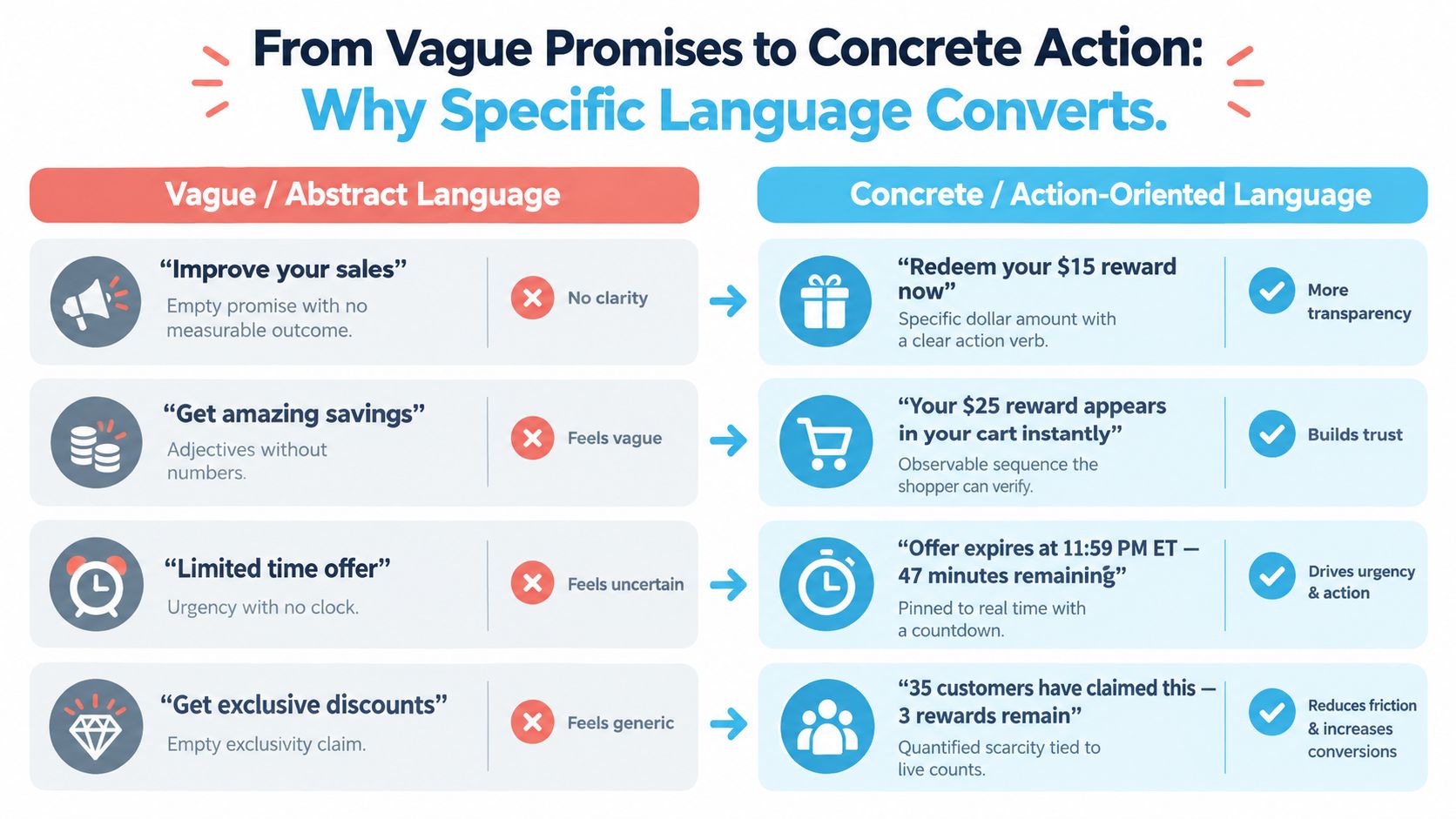
Concrete ecommerce language names what the shopper gets, what they must do, and when the offer ends. “Redeem your $15 reward now” is concrete; “Get amazing savings” makes the shopper guess.
Vague copy makes shoppers work too hard. A product page can sound persuasive while leaving basic questions unanswered: Which product qualifies? How much is the saving? Does the discount apply automatically? When does it end?
Concrete language replaces broad promises with details a shopper can see and verify. The examples below move through the Shopify buyer journey, from product discovery and offer comprehension to checkout confidence, using product descriptions, CTAs, email, SMS, headlines, and microcopy.
Specificity can reduce friction without demanding a deeper discount. It also protects trust, provided the number, deadline, inventory count, and promotional condition match the mechanics behind the claim. Scarcity that isn’t real, inflated comparison pricing, and deadlines that reset without explanation don’t create clarity. They create skepticism.
1. Action-Oriented and Observable Language Over Abstract Messaging
“Get amazing savings” asks the shopper to interpret the offer. “Redeem your $15 reward now” gives them an action, a value, and a clear next step.
That difference matters at the moment of product discovery, when attention is limited and the buyer is deciding whether to continue. Concrete verbs such as claim, activate, redeem, add, and confirm show the shopper what to do. Observable sequences show what happens afterward.
Practical rule: If a shopper can’t explain the offer to a friend without guessing, the copy is still too vague.
Compare these rewrites:
- “Redeem your $15 reward now” instead of “Get amazing savings.”
- “Your $25 reward appears in your cart instantly” instead of “Get exclusive discounts.”
- “35 customers have claimed this, 3 rewards remain” instead of “Limited time offer.”
- “Confirm your email and receive your offer within 60 seconds” instead of “Get instant benefits.”
Each version answers a different question. The first names the action. The second explains the delivery mechanism. The third combines current availability with social proof. The fourth describes the exchange between the shopper and the brand.
Quikly can use the same logic in a descending-tier offer. A storefront might show “Claim Tier 1: $30 off” while the highest reward is available, then step down as shoppers act. The message isn’t just “buy now.” It explains what acting now changes.
Use numbers alongside verbs, keep constraints in the main sentence, and write in the present tense when describing live availability. Shopify merchants can also adapt the sequence across a product page, Klaviyo email, SMS message, and cart so the shopper sees one consistent offer.
For more guidance on brand copy for Shopify, focus on the sequence a buyer must follow, not only the benefit you want to advertise.
2. Quantifiable Details Over Qualitative Adjectives
Words such as huge, amazing, special, and massive express the brand’s opinion. They don’t help a shopper calculate value. A concrete offer replaces the adjective with a dollar amount, percentage, quantity, or time measure.
At the offer-comprehension stage, that precision lets shoppers decide whether the promotion matters to them. “$20 off your next purchase” is immediately comparable with the product price. “Save big on your order” isn’t.
Consider these alternatives:
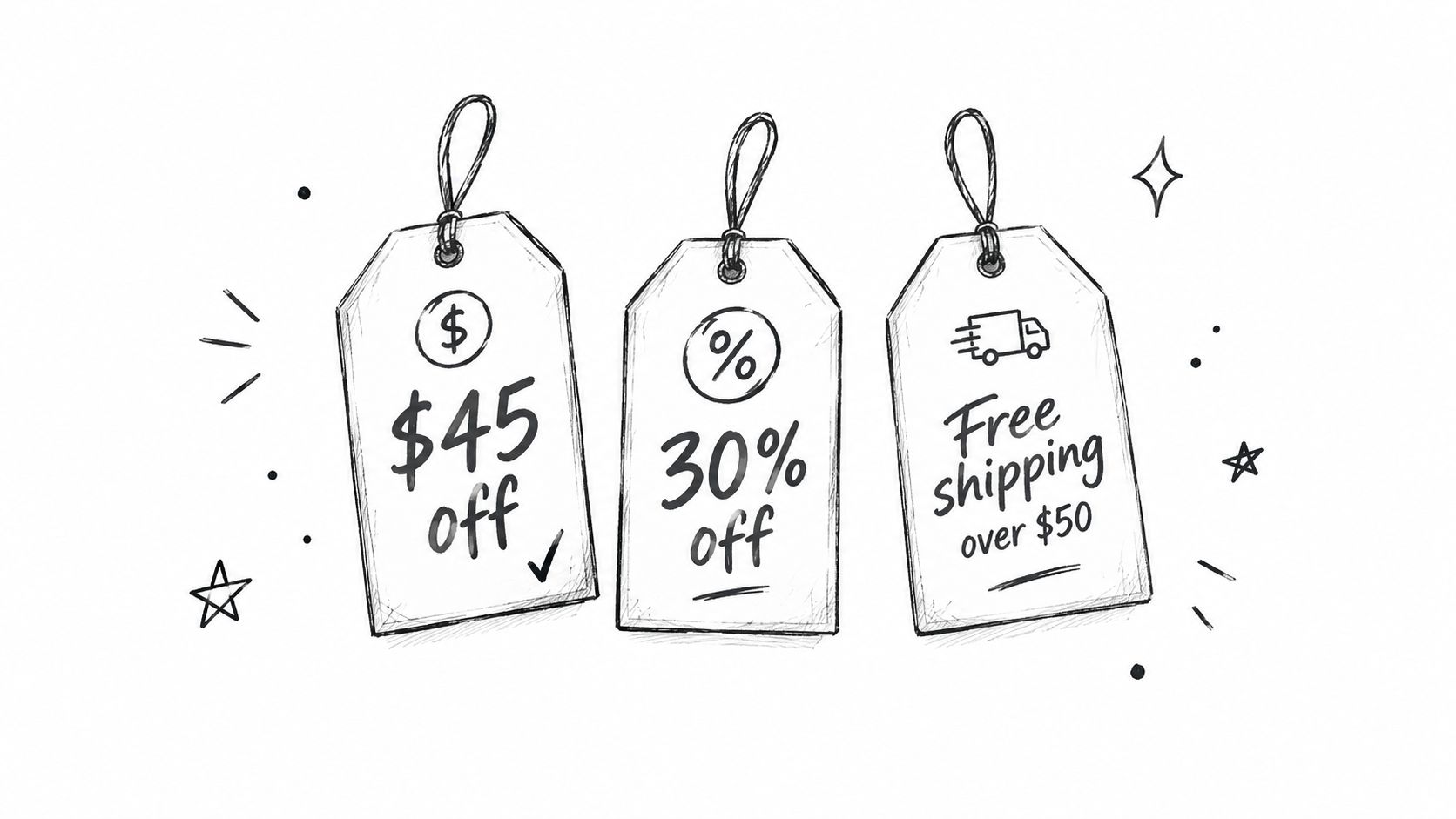
- “$20 off your next purchase” instead of “Save big on your order.”
- “Only 47 rewards left” instead of “Extremely limited availability.”
- “Valid until 11:59 PM EST tonight” instead of “Expires soon.”
- “Free shipping on orders over $50” instead of “Get special shipping rates.”
The unit matters. Use dollars for a monetary reward, percentage for a percentage discount, items for inventory or reward quantity, and a precise time and timezone for a deadline. “Within 3 hours” describes a window. “At 6 PM ET” identifies its endpoint.
A Quikly tier might read “Tier 1: $40 off, 12 left”, followed by “Tier 2: $30 off.” The shopper can understand both the value and the cost of waiting. That is more useful than calling the promotion “exclusive” and hiding the actual mechanics below the CTA.
Don’t use precise numbers merely to make a claim look credible. Verify them against Shopify’s discount settings, inventory, and shipping rules. A specific falsehood damages trust faster than a broad claim because shoppers can test it.
3. Specific Time Windows Over Relative Urgency Framing
“Act fast” doesn’t tell a shopper how fast. “Offer expires at 11:59 PM ET on December 15” gives them a deadline they can understand and verify.
Specific time windows are most useful when purchase intent already exists. They turn a vague prompt into a decision boundary. Behavioral economics research describes temporal discounting as the tendency to place greater weight on immediate outcomes than delayed ones, which helps explain why a real, near-term deadline can change behavior. The deadline still has to be genuine.
Use language such as:
- “Offer expires at 11:59 PM ET on December 15” instead of “Limited time only.”
- “47 minutes remaining, claim now” instead of “Hurry, this won’t last.”
- “Valid for the next 3 hours” instead of “Act fast.”
- “Only available to the first 200 shoppers today” instead of “While supplies last.”
Time language should match the shopper’s location and the campaign configuration. Include the timezone when it matters, state whether the reward expires or resets, and make sure the discount stops working when the copy says it will.
A Quikly experience might display “This reward resets at midnight, 17 claimed so far” alongside a live countdown. The countdown is useful because it reflects a real offer mechanic, not because motion automatically creates urgency. A timer that reaches zero and immediately starts over teaches shoppers to ignore it.
For Shopify stores testing countdown mechanics, this guide to countdown timers for Shopify is a relevant starting point. Keep the copy specific in email and SMS too. “Claim before 6 PM ET” is stronger operationally than “Ends tonight,” especially when a subscriber receives the message late in the day.
The trade-off is simple. A real deadline can focus a decision. Repeated or artificial urgency creates promo fatigue and makes the brand’s future deadlines less believable.
4. Product-Specific Features Over Generic Benefits Claims
A shopper can’t evaluate “special savings on our most popular category” until the copy names the category, the products, and the condition. Product-specific language lets visitors self-qualify without opening multiple collection pages or searching the terms.
This is especially important on collection pages and paid landing pages, where the buyer is deciding whether the offer applies to the product in front of them. Use the object, the reward, and the qualifying condition together:
- “$40 off all leather boots” instead of “Huge savings on accessories.”
- “Free shipping on orders over $100 with any winter coat purchase” instead of “Special shipping rates available.”
- “$15 off when you buy two beauty products from the Skincare collection” instead of “Bonus discounts on selected items.”
- “Bundle any three items from Activewear for $60, valued at $95” instead of “Save on our most popular category.”
The more specific the offer, the more important inventory and margin checks become. A reward tied to a best-selling sofa may create demand, but it can also put pressure on stock or contribution margin. Tie the reward to collections that can support the volume, and name excluded SKUs before shoppers reach checkout.
Quikly campaigns can make the product and changing reward visible together: “Tier 1: $35 off this best-selling sofa, 25 available”, followed by “Tier 2: $25 off.” The shopper understands both what qualifies and what may be lost by waiting.
Use product imagery beside the copy, but don’t make the image carry the conditions. A shopper should be able to tell from the text which products, collections, or SKUs count. This is concrete language doing its job, reducing the need for interpretation before the add-to-cart decision.
5. Numbered Constraints Over Implied Scarcity
“Limited availability” signals scarcity without showing its scale. “12 rewards left” gives the shopper a number that can be evaluated.
Numbered constraints work best when they describe a real cap on an offer, not a decorative badge. At the product and cart stages, current counts can also combine two behavioral cues: scarcity bias, because availability is limited, and social proof, because other shoppers have already claimed the reward.
Examples include:
- “12 rewards left” instead of “Limited availability.”
- “487 customers claimed this, only 13 remain” instead of “Very popular.”
- “1 of 50 available” instead of “Exclusive offer.”
- “200 total, 156 claimed in the last 2 hours” instead of “Selling fast.”
Show enough context for the number to mean something. “8 left” could refer to products, discount codes, or rewards. Label the unit and, when relevant, show the original capacity as well as the current count.
Numbers create confidence only when the shopper can understand what they count.
A Quikly descending tier could display “Tier 1: $50 off, 25 total, 18 claimed, 23 minutes left.” Once that quantity is exhausted, the experience can move to “Tier 2: $35 off.” The value change is visible, so the reward doesn’t pretend to be unlimited while changing behind the scenes.
For merchants evaluating this approach, scarcity marketing guidance should be read alongside the operational requirements. Counters need to update in real time, and the promotion must stop or change when the threshold is reached. If the count never moves, shoppers may see the constraint as a fake prop.
Combining quantity and time can create a stronger decision boundary, but restraint matters. A real inventory limit plus a real deadline is clear. Several unrelated counters competing for attention feels like pressure rather than useful information.
6. Clear Conditions Over Buried Fine Print
A discount isn’t concrete if the shopper only discovers its conditions after adding products to the cart. State the exchange directly: “Get [reward] when you [condition].”
That structure is useful in offer banners, product-page CTAs, email, SMS, and checkout microcopy. It answers the question that creates most avoidable friction: What must I do for this reward to apply?
- “$15 off your order over $50, full-price items only, not sale merchandise” instead of “See terms.”
- “Free shipping on orders over $100, US addresses only” instead of “Restrictions apply.”
- “Add your email and claim $25 off your first purchase” instead of “Sign up for exclusive offers.”
- “Stack this $10 reward with up to 2 other promotions, excluding clearance” instead of “Full terms available upon request.”
The wording should include minimum purchase amounts, collection restrictions, customer eligibility, exclusions, stacking rules, and geographic limits. Keep the main message readable, but don’t hide a material condition behind a generic terms link.
A Quikly campaign might say: “Claim $40 off Furniture when you spend $200+ in that category, excludes custom orders, valid for 48 hours.” The shopper can act without opening several pages to reconstruct the rules. That lowers the risk of a disappointing cart experience and reduces support questions caused by an offer that sounded broader than it was.
Test the message by removing every secondary link. Could a shopper execute the offer with only the information shown? If not, the copy needs another revision or the promotion itself needs simpler mechanics.
Clear conditions may reduce the number of shoppers who qualify, but that isn’t necessarily a weakness. It filters out confusion before checkout and protects margin by preventing accidental over-discounting.
7. Real Comparison Over Perceived Value Claims
“Unbelievable value” is a conclusion. A real comparison gives the shopper the inputs needed to reach one.
At the product and checkout stages, show current prices and actual alternatives. Before-and-after amounts make the offer easier to verify and reduce the buyer’s fear that the discount is based on an inflated reference price.
Use examples such as:
- “Normally $79, today $49 with this reward” instead of “Save up to 75!”
- “Add any three items regularly priced $25+ and pay $60 total” instead of “Huge bundle savings.”
- “Sofa, $799, plus Ottoman, $299, plus Throw, $45. Total $1,143. Yours for $899 with this reward” instead of “Unbelievable value.”
- “First-time customer discount: pay the sale price, already $20 off, plus an additional $10 with this code” instead of “Extra savings on sale items.”
The comparison should reflect a real current price, a genuine suggested retail price, or a price the customer could reasonably have paid. Don’t create a strikethrough amount merely to make the saving look larger. That may improve a single click while weakening trust and training buyers to question every future promotion.
Shopify merchants can pull current product prices from inventory and calculate bundle totals from the included SKUs. For a Quikly tier, “Buy any jacket regularly priced at $150 or more and add $30 boots free” is more credible when the jacket’s current price is shown and the qualifying products are named.
A useful test is straightforward: could the shopper verify the comparison by opening the individual product pages? If the answer is no, replace the claim with a simpler, supportable description.
8. Attribution and Earned Mechanics Over Blanket Availability
A blanket discount tells every visitor the same thing, regardless of why they arrived or what they have already done. An attributed offer explains who qualifies or what action earns the reward.
This approach is useful in email, SMS, referral flows, and repeat-purchase journeys. It supports commitment and consistency, because a shopper who subscribes, refers a friend, or adds qualifying products has a clear action connected to the reward. It can also support loss aversion when a shopper understands what they would give up by abandoning the action.
Compare:
- “SMS subscribers: get $35 off this $200+ order” instead of “Save $35 on all orders.”
- “First-purchase customers: claim $20 off when you spend $50+” instead of “New customer discount.”
- “Repeat customers: free shipping on your next order when you buy 2+ items” instead of “Free shipping for all.”
- “Refer a friend and both of you get $15 off your next purchase” instead of “Referral program available.”
The copy should explain why the shopper is seeing the offer. “As an email subscriber, here’s your exclusive reward” feels more coherent than a generic discount appearing without context.
Quikly can connect customer data from Shopify and related marketing systems so email subscribers, SMS subscribers, and repeat customers receive different offer tiers in parallel. That gives the merchant a way to control exposure rather than reducing the price for every visitor.
Use customer tags and Klaviyo segments carefully. Check conversion, average order value, margin, and signup quality, not only redemption volume. A segment that claims more rewards may still be unprofitable if its offer is too generous.
For the measurement side, attribution modeling guidance can help teams distinguish the channel that introduced an offer from the action that completed the purchase.
8-Point Concrete Language Comparison
| Strategy | Implementation complexity | Resource requirements | Expected outcomes | Ideal use cases | Key advantages |
|---|---|---|---|---|---|
| Action-Oriented & Observable Language Over Abstract Messaging | Low–Medium (copy + verification) | Copywriting, offer-mechanics alignment, minimal engineering | Clear expectations, higher trust and conversion, less friction | CTAs, checkout prompts, onboarding flows | Transparency, immediacy, verifiability |
| Quantifiable Details Over Qualitative Adjectives | Low (copy changes + accurate figures) | Pricing/inventory data, precise copy | Reduced skepticism, easier comparison, conversion lift | Price discounts, promo banners, product pages | Precision, credibility, easier evaluation |
| Specific Time Windows Over Relative Urgency Framing | Medium (countdowns, timezone handling) | Real-time clocks/timers, engineering to enforce deadlines | Measurable urgency, reduced promo fatigue, short-term conversion spikes | Flash sales, limited-time promos, timed events | Measurable urgency, credibility |
| Product-Specific Features Over Generic Benefits Claims | Medium (merchandising coordination) | Inventory data, product images, marketing–merch coordination | Higher qualified conversions, fewer checkout surprises | Category-targeted campaigns, bundles, product launches | Relevance, self-qualification, AOV control |
| Numbered Constraints Over Implied Scarcity | Medium–High (live counters, sync) | Live-update mechanics, inventory sync, engineering | Stronger scarcity effects, social proof, conversion lift | Limited-stock offers, tiered rewards, timed inventory sales | Transparent scarcity, visible social proof |
| Clear Conditions Over Buried Fine Print | Low–Medium (copy + policy alignment) | Clear copy, legal/merch input | Fewer support tickets, reduced cart abandonment, higher trust | Complex rewards, stacked promotions, threshold offers | Reduced surprises, compliance, customer clarity |
| Real Comparison Over Perceived Value Claims | Medium (pricing integration) | Current pricing data, bundle calculators, product feeds | Protected credibility, less buyer’s remorse, trusted value claims | High-ticket items, bundles, value-driven shoppers | Accurate value framing, margin protection |
| Attribution and Earned Mechanics Over Blanket Availability | High (segmentation & tracking) | Customer data, CRM/email/SMS integration, audience segmentation | Higher conversion among targets, margin protection, better CLV | Loyalty programs, acquisition offers, segmented campaigns | Personalization, earned commitment, controlled exposure |
Make Every Claim Easy to See and Verify
Across these examples of concrete language, the same pattern keeps returning. Strong copy identifies the action, object, value, constraint, condition, and next step. It gives the shopper enough information to decide without forcing them to hunt through a product page, terms link, cart, or support article.
Apply that standard across the full Shopify journey. On a product page, replace “premium comfort” with the material, fit, dimensions, or included components that a buyer can assess. In a CTA, replace “Shop the offer” with the exact product or reward. In email and SMS, state the customer segment, amount, qualifying purchase, and deadline. In checkout microcopy, explain when the code applies and which items are excluded.
A practical editing pass looks like this:
- Underline abstract words such as amazing, exclusive, special, soon, and popular.
- Replace each word with an observable detail, such as a product name, dollar amount, quantity, deadline, or condition.
- Verify every number against Shopify pricing, discount, inventory, and shipping settings.
- Confirm that the promotion enforces the promise when the counter reaches zero or the deadline passes.
- Read the message as a shopper who has seen no other campaign context.
Concrete language isn’t an instruction to add detail everywhere. Over-specific wording can feel unnatural, overload a short message, or reduce adaptability across audiences. The right level of specificity depends on the decision the shopper is making. A checkout message needs a condition and a next step. A product headline may need only the product and its clearest differentiator.
The commercial goal is also broader than conversion. A sale at an unhealthy margin isn’t a good promotion, and a discount that trains customers to wait can weaken future demand. Research on concrete language in business communication connects specific, detailed wording with claims that are easier to verify, while behavioral research indicates that concrete language can be more persuasive in some product categories and for shoppers with lower brand attachment. The practical lesson is to test clarity and economics together.
That matters because urgency can backfire when it feels manufactured. A 2024 experiment in Computers in Human Behavior found that limited-time and limited-quantity scarcity cues made participants associate online vendors with lower benevolence, while limited-time cues also triggered frustration-related negative emotions. The same study reported no significant increase in perceived task load or time pressure, which separates emotional distrust from simple cognitive overload. Read the experiment on scarcity cues and online shopping perceptions.
Behavior-driven experiences such as Quikly can apply real time or quantity limits across a storefront, email, social, and SMS without relying on blanket discounting. Rewards can be single offers or descending tiers, with the customer seeing what is available and what changes as others claim it. The mechanic gives concrete language something real to describe.
For teams revising landing pages, founder landing page advice from Chicago Brandstarters is a useful reminder that clarity starts with the page’s primary decision, not with decorative claims. Make the offer easy to understand, make the conditions visible, and make the economics worth defending.
Then review the promotion after launch. Did shoppers understand the offer? Did the reward apply correctly? Did average order value and margin hold up? Did the campaign create a reason to act now without making the brand look desperate? Those answers will tell you more than a higher click rate on a vague headline.
Quikly helps Shopify merchants turn concrete promotional language into time- and quantity-bound experiences, with rewards that can change as shoppers act across storefront, email, social, and SMS. If you want to replace blanket discounting with clearer offer mechanics, visit Quikly to explore the platform.
Topics: examples of concrete language, ecommerce copywriting, conversion copywriting, Shopify marketing, product descriptions