You’re staring at a Slack thread where customer acquisition cost is rising, attribution is getting harder to trust, and the proposed answer is simple: send more SMS. Meanwhile, the email calendar is already full, the next promotion needs a deeper discount, and the finance team is asking why last month’s revenue came with less margin.
That’s the operating problem behind effective email and SMS marketing. These channels can protect retention and recover demand, but only when they work as one customer journey. Email gives the brand room to explain, educate, bundle, and build preference. SMS creates speed when a shopper has a short window to act. Sending both messages independently usually produces duplication, fatigue, and unnecessary cost.
For Shopify brands, the practical question isn’t which channel wins. It’s which message belongs on which channel, at which point in the journey, for which customer, and at what margin.
Why Email and SMS Marketing Matter Together Right Now
Paid acquisition has become less forgiving. Rising media costs, privacy-related attribution gaps, and inconsistent visibility into the path from click to purchase have pushed retention and lifecycle revenue closer to the center of Shopify growth. The marketing team can’t treat email and SMS as back-office channels while acquisition carries the entire burden of demand creation.
A connected program gives one customer experience two different delivery mechanisms. Email handles the product story, education, comparison, bundle logic, and visual merchandising. SMS handles the short decision window, such as a cart reminder, back-in-stock notice, delivery update, or strictly time-bound offer.
The distinction matters because shoppers often use both channels without treating them as substitutes. Research cited by Mailjet’s email and SMS comparison found that 39% of consumers prefer email for promotions versus 21% for SMS, while order confirmations are preferred by 37% for email versus 23% for SMS. The same source reports that 97% of UK SMS subscribers also engaged with brand email in 2025, which points to orchestration rather than replacement.
Operating principle: Choose the channel according to the job the message must perform, not according to which campaign calendar has an empty slot.
A Shopify store needs a shared view of consent, purchase history, browsing behavior, and recent engagement. Klaviyo, Braze, and other lifecycle tools can coordinate eligibility, but the strategy still has to decide when a second message adds value and when it repeats the first.
That coordination supports a broader system for consistent sales, where lifecycle messaging, promotion, and customer data work from the same commercial logic. A useful starting point is Quikly’s email and SMS service guidance, especially when the promotion needs to appear consistently across owned channels.
Email still scales well, but the benchmark depends heavily on the category and measurement method. Brevo reports a 20.73% average email open rate, rising to 33.87% when Apple Mail Privacy Protection is included, while automation and transactional email average 30.63% opens and 7.39% click-through rate in its benchmark data (Brevo email benchmarks). Those differences make a blanket “send more” strategy particularly weak. Relevance, list quality, triggered timing, and channel coordination do more work than volume alone.
How Email and SMS Differ in Practice
Email and SMS differ in economics and constraints before a marketer writes a subject line or chooses a creative treatment. Email offers room and flexibility, but inbox timing is less immediate, and deliverability determines whether the message gets a chance. SMS reaches attention quickly, yet each send carries a direct cost. A poorly chosen message can also accelerate opt-outs, weaken future reach, and erode brand equity.
Email suits a higher-consideration purchase. A merchant can explain materials, show several products, compare sizes, recommend a bundle, and answer objections in one message. That context can support larger baskets, although it requires more creative work and may not produce an immediate action.
SMS has little room for persuasion by volume. It works when the recipient already understands the product or event and needs a concise reason to act now. Industry data cited by Ringly’s SMS marketing benchmarks places SMS visibility at roughly 98%, with an average response rate around 45%. The same source says 87% of business texts are seen within 15 minutes, 23% within one minute, and 82% of consumers reply to a business text within 15 minutes. For channel-specific tactics, see this guide to SMS marketing best practices.
| Dimension | SMS | |
|---|---|---|
| Primary strength | Detail, education, bundles, visual merchandising | Speed, reminders, urgent action |
| Creative space | Flexible, supports long-form content and multiple products | Constrained, one clear message and CTA |
| Delivery risk | Inbox placement, authentication, reputation, Apple MPP measurement effects | Consent, carrier filtering, local timing, opt-out risk |
| Cost structure | Low marginal send cost, with creative and list-quality costs | Paid per message, so broad sends affect margin directly |
| Fatigue pattern | Repeated sends weaken engagement and deliverability over time | Repeated sends can trigger rapid churn and unsubscribe behavior |
| Best use | Welcome education, product launches, replenishment, content, post-purchase guidance | Cart urgency, back-in-stock, shipping updates, short offer windows |
Email performance starts with deliverability. ActiveCampaign describes above 89% deliverability as a good benchmark, 95% or higher as excellent, and below 80% as poor (ActiveCampaign email benchmarks). Authentication, list hygiene, and reputation therefore control revenue upstream, rather than serving as technical housekeeping.
SMS is the accelerator, not the entire engine. Use it to shorten a decision window, then let email carry the explanation where explanation improves the purchase.
The cost asymmetry changes planning. An email broadcast can waste design time and degrade the list, while an SMS broadcast also creates a visible send expense. The comparison should not stop at open rate. Measure incremental revenue and margin per eligible recipient, adjusted for opt-outs, cannibalization, and the next purchase that may no longer happen at full price. A fast conversion that trains customers to wait for frequent SMS offers can look successful in the report while weakening future margin.
Segmentation That Earns Its Keep
A segment deserves to exist when it changes the message, offer, cadence, or suppression rule. Splitting a list by geography may help with currency or delivery timing, but it won’t necessarily improve the commercial decision. The useful segments answer a sharper question: what does this shopper need to see next?
Start with lifecycle stage
Prospects need proof, product context, and a low-friction first decision. First-time buyers need onboarding and confidence after the order. Repeat customers may respond to complementary products, replenishment, or early access. Lapsed customers need a reason to reconsider, but that reason shouldn’t automatically be a deeper discount.
Add behavior signals
A shopper browsing skincare shouldn’t receive the same hero product as someone repeatedly viewing footwear. Cart value can determine whether an SMS recovery is financially sensible. Repeat category interest can trigger education or recommendations, while discount affinity can determine whether a promotion protects margin or just gives away a purchase that was already likely.
That last signal deserves more attention. A customer trained to wait for a 15% code may ignore a 5% nudge, and those figures are strategic examples rather than benchmark claims. SMS makes the training cycle more expensive because every additional attempt consumes a paid message and a scarce attention slot.
Separate engagement from value
A high-value customer who hasn’t opened recently needs a different reactivation path from a low-value subscriber who clicks every campaign. Useful engagement groups can include recent email openers, SMS clickers, mixed-channel engagers, and dormant contacts. Value groups can use AOV bands, predicted LTV, or VIP status, provided the business can explain what action each group changes.
For a practical example of turning these ideas into usable audience logic, see this customer segmentation example. The important test is whether the segment changes the hero product, incentive ladder, or contact policy.
Keep the operating model small enough to execute. More than roughly eight active segments per channel often leaves a team with too many audiences and not enough distinct creative, so the result becomes superficial personalization. A smaller set of meaningful groups usually gives the merchandising, CRM, and creative teams enough focus to make each message materially different.
Sequencing Channels Across the Customer Journey
A customer journey should have one owner for each decision, even when both channels participate. Email and SMS can support the same outcome, but they shouldn’t repeat the same proposition at the same time.
Entry and welcome
Use the first touch to establish preference and context. A welcome email can introduce the product range, explain the brand, and make the next action clear. If the subscriber doesn’t engage, an SMS follow-up may be appropriate only when the person has explicitly opted in and the text adds urgency or a concise reminder rather than copying the email.
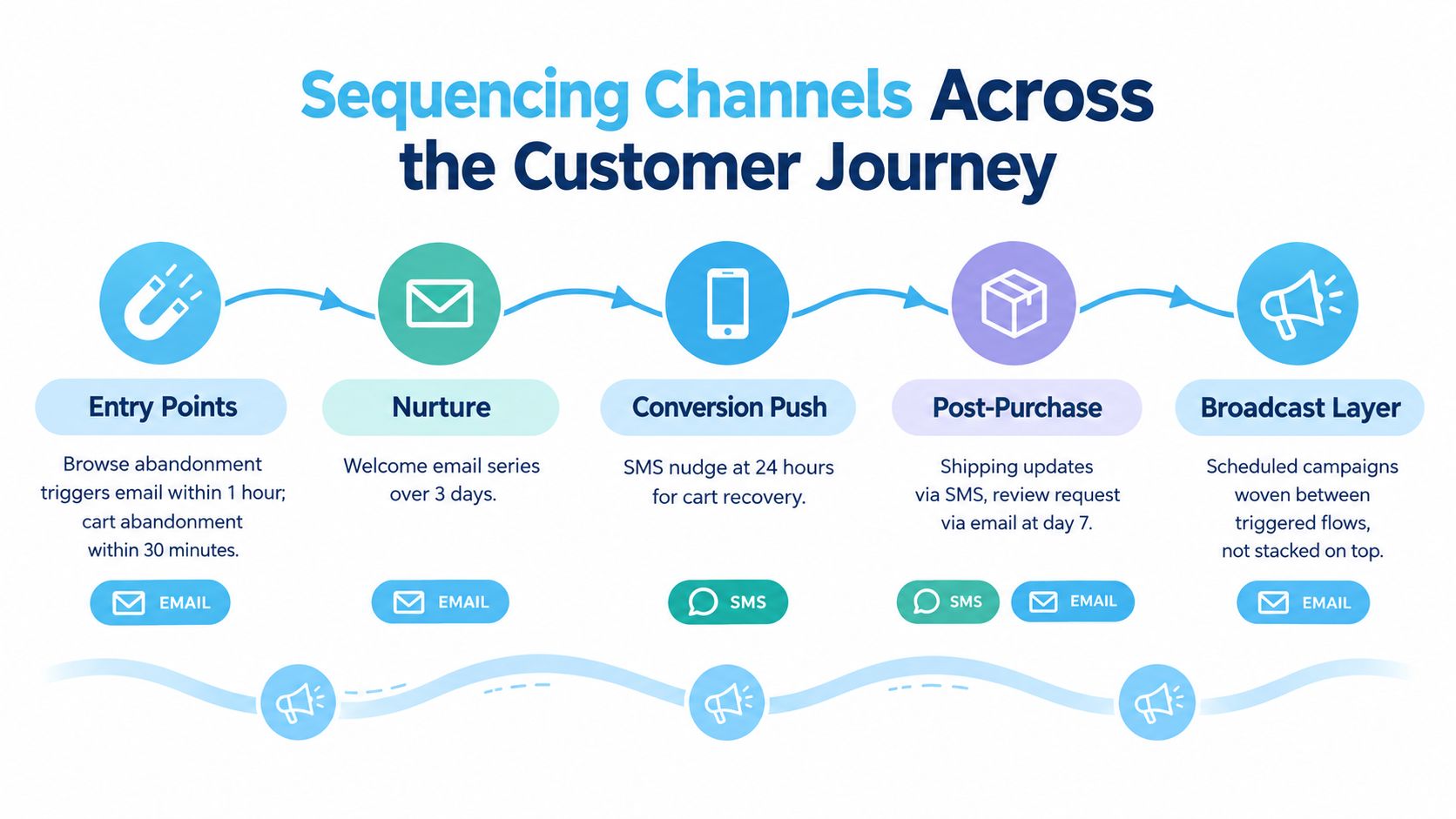
For abandonment, email can provide product details, reviews, delivery information, and alternatives. SMS can enter later as a short-window prompt when the cart value justifies the message cost. The infographic below illustrates one possible structure, but timing should follow your consent rules, product economics, and customer behavior.
Post-purchase and reactivation
SMS has a strong role in shipping updates and other immediate service messages. Email should carry the review request, product care guidance, loyalty explanation, and recommendations that benefit from detail. A win-back journey can reverse that order when the customer needs a richer reason to return before receiving a concise final prompt.
Use shared suppression logic across flows. If the shopper purchases, cancel cart recovery immediately. If the person clicks the email and reaches the product page, don’t send an SMS that pretends they haven’t engaged. If a high-value first order has already converted at healthy margin, suppress unnecessary promotional SMS and protect the post-purchase experience.
| Journey point | Email role | SMS role |
|---|---|---|
| Signup | Welcome story, product education, preference capture | Concise confirmation or opted-in follow-up |
| Browse | Category context and recommendations | Usually suppressed unless the event has a clear time limit |
| Cart | Details, reassurance, alternatives | Short recovery prompt when value supports the cost |
| Post-purchase | Care, loyalty, review, cross-sell | Shipping and service updates |
| Win-back | Relevance, newness, product explanation | Final urgency or a tightly controlled incentive |
The broadcast calendar must sit on top of these flows, not override them. A campaign promoting the same product should suppress contacts currently receiving a triggered message, or change the creative so the broadcast performs a different job.
Frequency Governance as a Margin Lever
More messages can produce more attributed orders while making the program less profitable. The extra order may have happened anyway, the discount may have replaced a future full-price purchase, and the customer may unsubscribe after receiving a message that added no new information.
SMS fatigue is particularly unforgiving. Klaviyo notes that sending more than 10 to 15 SMS messages per month can increase opt-outs, while consumers show less interest in receiving helpful articles by text than transactional updates (Klaviyo SMS marketing report). Treat that as a governance warning, not a universal quota. Product category, consent language, customer preference, and event density still matter.
| Dimension | Reactive Sending | Governed Approach |
|---|---|---|
| Campaign selection | Send because the calendar says so | Send when the message has incremental value |
| Channel use | Email and SMS fire independently | One channel leads, the other supports selectively |
| Daily exposure | Multiple promotions can stack | One promotional message per day across channels |
| SMS policy | Broad sends to every eligible contact | Monthly ceiling with exceptions for service and true urgency |
| Suppression | Flow logic is isolated | Purchase, click, conversion, and recent-send suppression is shared |
| Optimization | Open and click volume | Revenue per recipient, margin, opt-outs, and incremental lift |
A practical governance model includes a shared contact log, a channel-specific ceiling, and a fatigue score. Increase the score when a subscriber ignores several sends, clicks without buying repeatedly, or opts out of one channel. Decrease exposure before the list teaches you the lesson through unsubscribes.
Margin rule: A message earns its place when its incremental contribution exceeds its send cost, discount cost, and the value of the attention it consumes.
Keep one-promotion-per-day as the default across email and SMS, then make deliberate exceptions for launches, drops, and service events. A launch can justify coordinated touchpoints if each one has a different job. It shouldn’t justify sending the same offer twice because two teams own two calendars.
Compliance and Consent Without the Headache
Consent is a data field, not a vague assumption that someone gave a phone number at checkout. The collection experience must state what the subscriber is agreeing to, how messages will be used, and how to stop them. Email and SMS permissions should remain distinct because permission for one channel doesn’t automatically authorize the other.
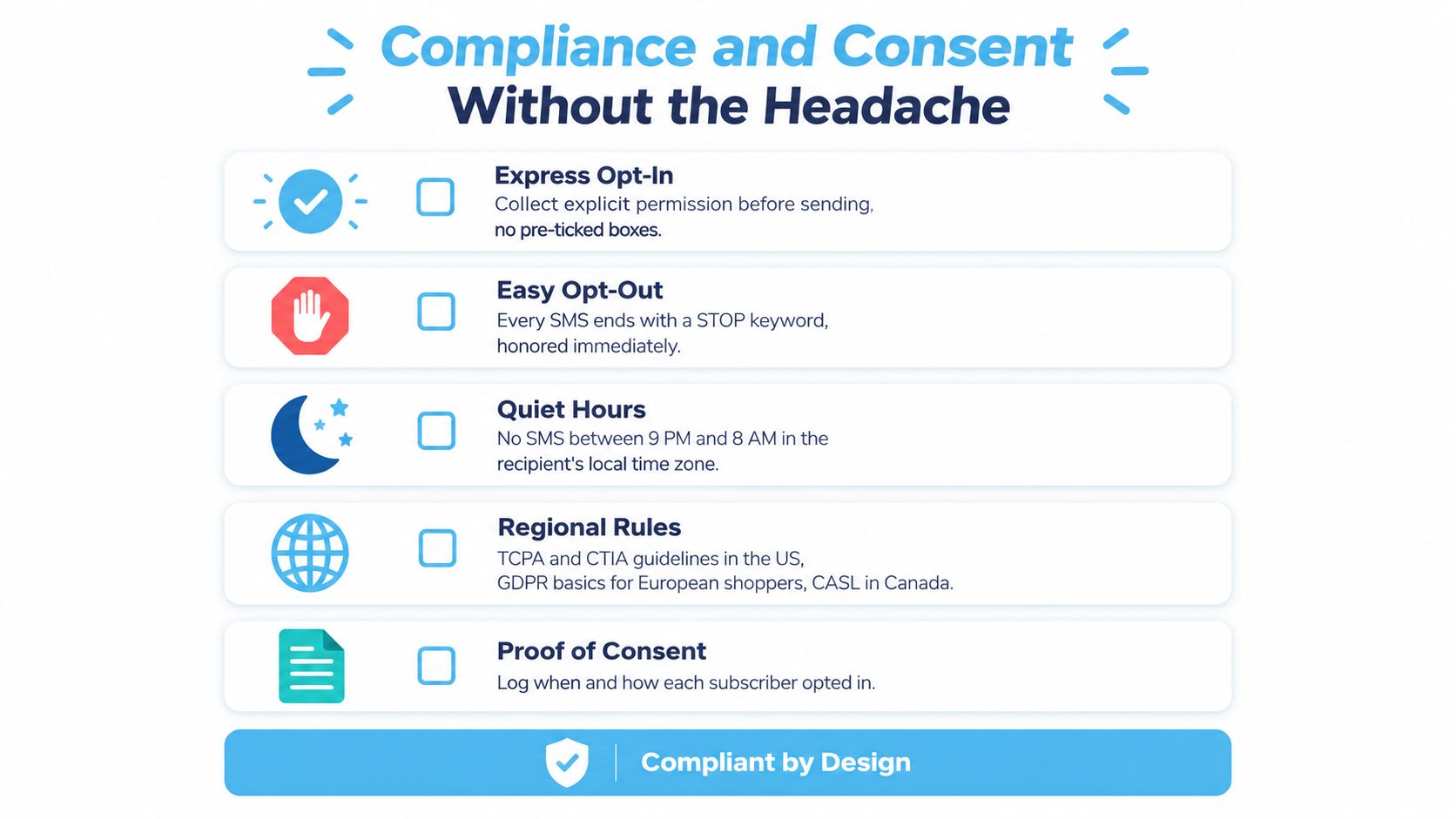
For US SMS programs, teams commonly work within TCPA requirements and CTIA guidelines. European programs need to account for GDPR principles, while Canadian sends may fall under CASL. The exact legal obligation depends on the audience, message type, sender, and jurisdiction, so legal review should sit alongside implementation rather than after launch.
Collect permission clearly
Use an unchecked consent box where appropriate, identify the brand, explain message frequency in plain language, disclose standard message and data rates, and link to the relevant terms and privacy policy. Double opt-in can provide an additional confirmation step for SMS, especially when the acquisition source creates uncertainty about whether the phone number belongs to the person submitting it.
Quiet hours need local-time logic. The recipient’s time zone should determine when promotional SMS is eligible, not the marketer’s headquarters.
Make stopping immediate
Every promotional SMS needs a clear opt-out path, including keywords such as STOP or UNSUBSCRIBE where supported by the messaging provider. The suppression must propagate through every sending system, not just the application that received the reply. Email unsubscribes also need to update the shared customer profile so a person doesn’t stop email and continue receiving an identical campaign through another connected workflow.
Before activating a Shopify form, audit these records:
- Permission language: Store the exact disclosure shown at collection.
- Source and timestamp: Record where and when the subscriber opted in.
- Channel status: Keep email and SMS consent fields separate.
- Suppression history: Log opt-outs and prevent re-enrollment without fresh permission.
- Vendor access: Know which platform sends each message and where consent data synchronizes.
Compliance protects more than legal exposure. Clear permission creates a better audience, reduces surprise, and makes frequency decisions easier because the subscriber understood the relationship before the first campaign arrived.
Urgency and Scarcity That Lift Conversion
A promotion should give shoppers a clear reason to act now without asking the brand to manufacture pressure. The end condition, timing, and customer benefit must be easy to understand. A permanent countdown, an unsupported stock claim, or a weekly “sale” with identical terms erodes trust and teaches customers to wait.
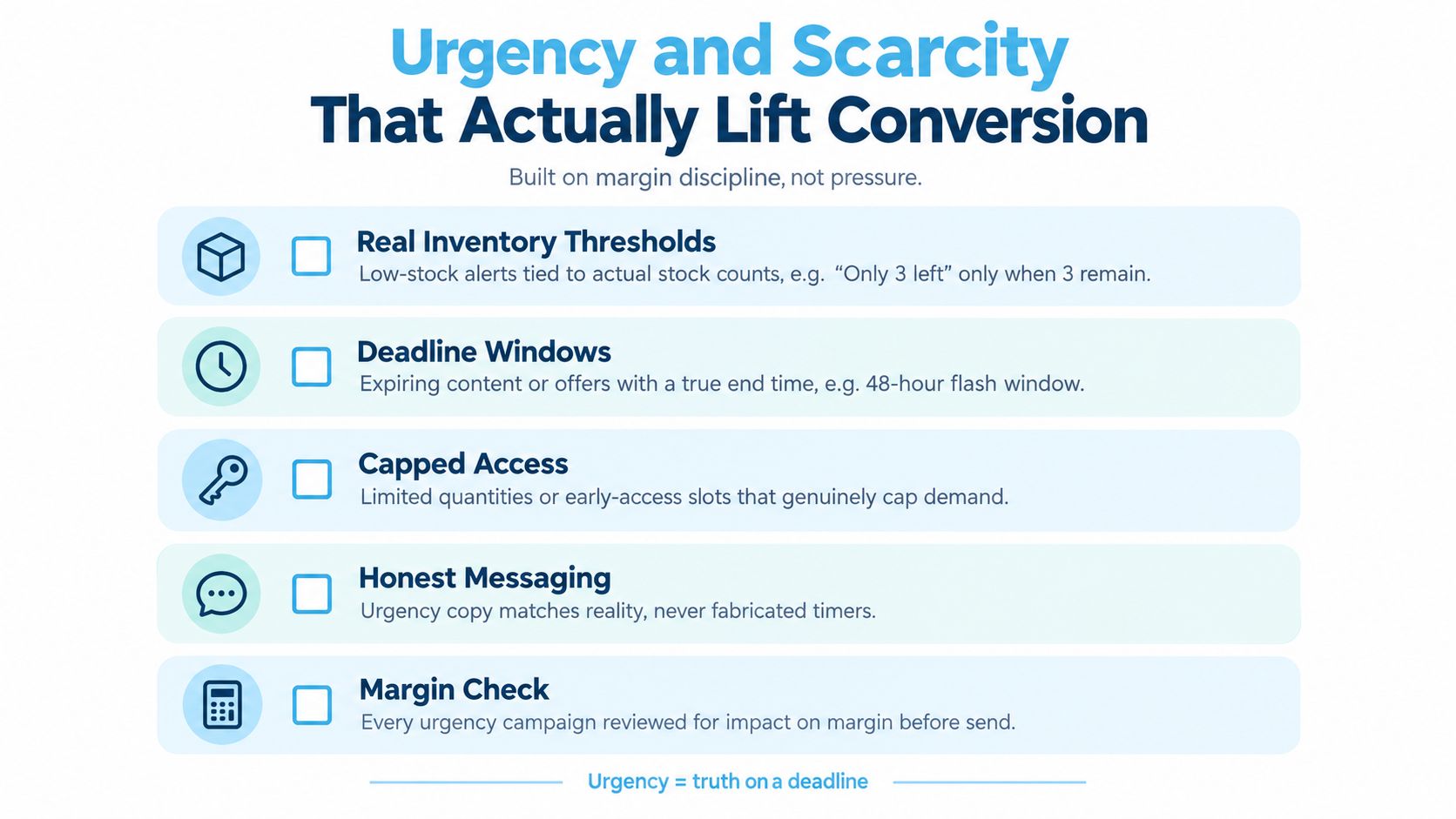
Credible mechanisms include low-stock thresholds tied to real inventory, a firm deadline for a pre-order or limited offer, and a capped-access product drop. These structures apply scarcity bias and temporal discounting while keeping the promotion grounded in operational reality.
Email can explain the offer, the reason for the window, and the terms that protect margin. SMS should deliver the short decision point only when the recipient has consented and the timing fits the customer journey. It should not duplicate a long email. State what changed, what remains available, and where the customer can act.
Test the promotion against reality
Use these questions before launch:
- Inventory: Does the stated stock limit match available units?
- Deadline: Will the offer close or change at the stated time?
- Access: Is the audience or quantity meaningfully capped?
- Message: Does the copy explain the mechanism without exaggeration?
- Margin: Does the reward improve contribution compared with a blanket discount?
The strongest margin outcome often comes from offer design rather than a larger markdown. Bundles can increase basket value. Free-shipping thresholds can encourage a larger order. Tiered gifts can reward higher spend without lowering the price of every item.
Quikly is one option for Shopify merchants that want to create time- or quantity-bound promotions across the storefront, email, social, and SMS. Its campaigns can use a single reward or descending tiers and match the store’s branding. The company describes its mechanics as refined across more than 60 million consumer interactions. The practical distinction is behavioral: customers receive a defined reason to act now instead of a flat offer that makes waiting feel safe. Sequence that urgency carefully, because a short-term conversion gain is not worthwhile if it costs margin or weakens brand trust.
Measurement, Optimization, and Your Next Move
Open rate is a diagnostic signal, not the commercial outcome. Apple Mail Privacy Protection makes reported opens harder to interpret, so the combined program should prioritize revenue per recipient, AOV, opt-out rate, and time-to-purchase. Measure those by channel, flow, segment, and offer type.
Separate triggered flows from promotional broadcasts. A welcome flow can have a different job from a flash campaign, and a shipping message shouldn’t compete with a product launch in the same report. Email often provides the longer narrative and a useful attribution anchor, while SMS acts as a short-window accelerator. The report should show whether the second message created incremental action or merely captured credit for an order already in motion.
| Metric | SMS | |
|---|---|---|
| Revenue per recipient | Compare campaigns, flows, segments, and holdouts | Include send cost and incremental incentive cost |
| AOV | Evaluate bundles, education, and cross-sell | Evaluate concise offers and urgency-led carts |
| Opt-out rate | Monitor list health and deliverability risk | Monitor fatigue and consent quality closely |
| Click-to-purchase | Track the path from content to product action | Track CTA clarity and short-window intent |
| Time-to-purchase | Measure delayed conversion after the send | Measure speed from message to order |
| Incremental lift | Use holdouts where practical | Test whether SMS adds value after email |
Deliverability belongs in the same operating review. Brevo’s ecommerce benchmark reports an email open rate of 15.50% without Apple Mail Privacy Protection and 30.02% including it, alongside a 2.15% click-through rate and 0.46% unsubscribe rate (Brevo ecommerce benchmark data). The spread reinforces why clicks, conversions, and list health deserve more weight than opens alone.
Validate acquisition data before it enters the lifecycle system. An Email Validation API can help teams identify risky or invalid email records before those addresses dilute deliverability and distort segment reporting.
Your week-one operating plan is straightforward:
- Export the last 30 days of email and SMS sends.
- Rank each campaign and flow by revenue per recipient, AOV, opt-outs, and time-to-purchase.
- Separate triggered performance from promotional performance.
- Retire or redesign the bottom-performing campaigns instead of adding another broadcast.
- Build one new triggered flow for a real behavioral segment, such as high-value cart abandoners or replenishment-ready customers.
- Add suppression rules so the new flow doesn’t duplicate an existing email or SMS touch.
The next improvement should make the program more selective, not just louder. A coordinated journey can turn urgency into a reason to act while preserving the margin and brand trust that the next order depends on.
Quikly helps Shopify brands run on-brand urgency and scarcity promotions across storefront, email, and SMS, using time- or quantity-bound rewards instead of relying only on deeper flat discounts. Visit Quikly to see how its promotional experiences can fit into a governed email and SMS marketing program.
Topics: email and sms marketing, sms marketing, email automation, shopify marketing, urgency promotions