A Shopify store can collect email addresses all day and still struggle to generate profitable revenue from them. The list grows, the dashboard looks healthy, and yet subscribers ignore the welcome flow, wait for the next discount, or unsubscribe because every message feels like another promotion.
That happens when email sign up is treated as a conversion event instead of the beginning of a commercial relationship. The form, offer, consent language, welcome email, and follow-up cadence all shape whether a new subscriber becomes a buyer or just adds cost to an already crowded acquisition system.
Why Email Sign Up Still Matters for Shopify Brands
A common Shopify growth pattern starts with a familiar trade-off. A brand increases paid traffic, adds a larger discount to improve conversion, and promotes the same offer across every channel. Orders may rise, but margin gets thinner and customers learn that waiting usually pays. The email list grows, yet the brand hasn’t necessarily built a more valuable audience.
Email sign up matters because it creates a permission-based connection that the brand can continue to use without buying every impression. Email developed from experimental network messaging into a mainstream communication channel, with the first network email sent by Ray Tomlinson in 1971. By 2024, the worldwide number of email users was projected to exceed 4.4 billion, with more than 4.9 billion projected by the end of 2028, according to MailStore’s history of email.
That reach doesn’t make every subscriber valuable. It makes subscriber quality worth managing carefully. The Direct Marketing Association’s 2023 Consumer Email Tracker found that email ranked first for brand messages about discounts, offers, and sales, with 64% of consumers selecting it as their preferred channel in that category. It also ranked first for new products and services at 53%, and for advice, information, and reviews at 44%, based on responses from more than 2,000 consumers in the Consumer Email Tracker report.
Practical rule: A subscriber is an asset only when the brand gives that person a reason to keep paying attention.
That means a Shopify email sign up should support more than immediate list growth. It should help the brand reduce dependence on paid traffic, protect margin from repetitive discounts, and create a clear path from permission to first purchase. This guide to building an email list is useful background, but the operational question is sharper: will the person who signs up still find the next message relevant?
Designing the Value Exchange Behind the Signup
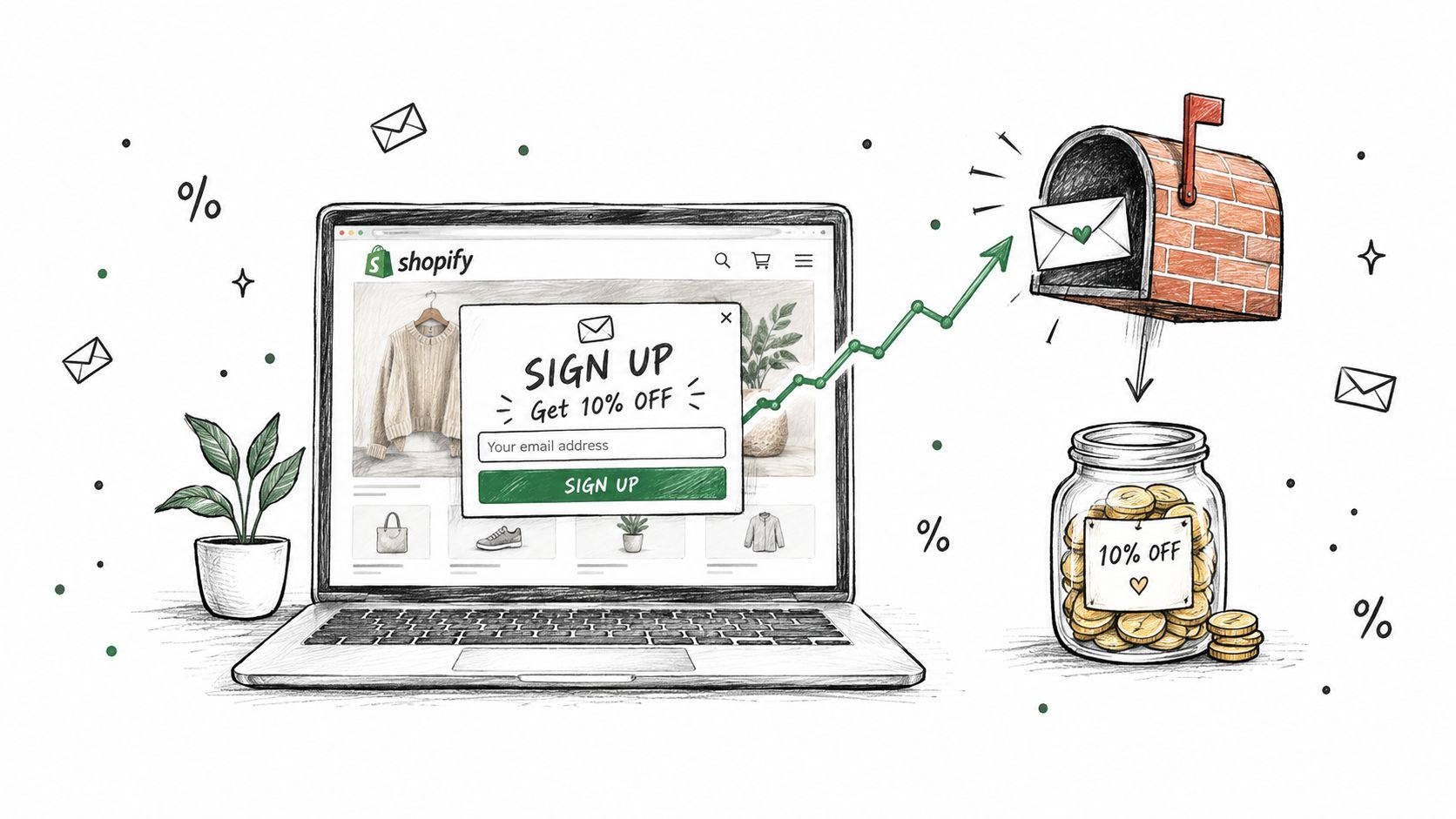
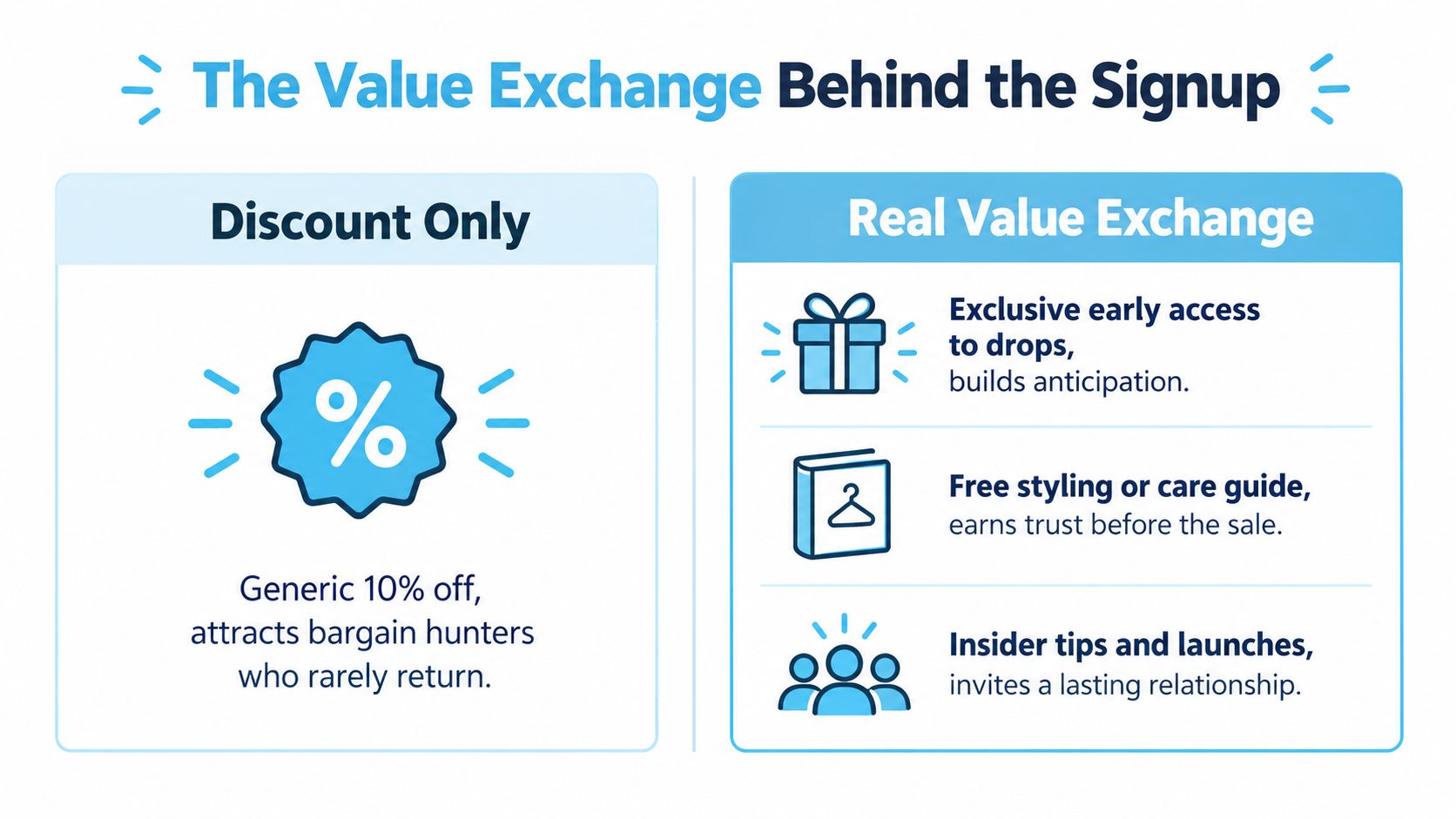
A discount is easy to understand, but it can send the wrong signal. “Sign up for 10% off” tells shoppers that the email address is worth a price reduction, not that the brand will provide useful access, guidance, or product discovery. For a margin-conscious store, that distinction matters.
Start by defining the promise in one sentence:
- Early access: Give subscribers a reason to anticipate a launch or limited release.
- Useful guidance: Offer a care guide, styling recommendations, buying advice, or product education.
- Relevant discovery: Promise updates about categories, restocks, or products that match declared interests.
- Time-bound reward: Make the benefit available for a clearly stated period or fixed allocation.
The strongest offer usually matches the page context. An embedded form on a product page can promise restock or product-specific updates. A homepage banner can introduce early access. A checkout opt-in can focus on post-purchase education and future product information rather than another immediate discount.
Timing changes the perceived value. A form that appears before a shopper has understood the product interrupts exploration. A form shown after meaningful engagement can feel like an invitation. Shopify theme customization and app settings give merchants control over placement, but the best trigger depends on intent, device, page type, and the strength of the promise.
Scarcity can help when it describes a real constraint. A reward capped by a stated number of claims or a closing time makes the promotional opportunity scarce. It shouldn’t imply that inventory is disappearing when the product remains widely available. Research on digital scarcity found that perceived scarcity can increase a shopper’s intention to seek an equivalent product from another retailer, as described in this academic study of scarcity and alternative retailers.
The form should repeat the same promise as the landing experience and the welcome email. If the signup says “early access” but the first message delivers a generic blanket discount, the brand has created a trust gap before the relationship has started. This practical guide to reward-based email capture offers a useful way to think about incentives as an exchange rather than a bribe.
Form Fields, Conversion Rates, and Quality Trade-offs
Every added field increases effort and the amount of information a shopper must share. At the first promotional interaction, email should usually be the only required field, particularly on mobile. Name, birthday, size, location, and product preferences can wait until the brand has delivered useful value. For a practical guide to structure and field choices, see this guide to lead capture forms.
Omnisend’s analysis of 1.24 billion popup displays reported average signup-form conversion of approximately 2.1%. Forms with one to three fields converted at about 2.1% to 2.2%, while conversion fell to roughly 1.5% with four fields and 1.4% with five or more fields, according to Omnisend’s analysis of email signup form performance.
Treat those figures as directional benchmarks, not targets. Traffic intent, device mix, incentive strength, placement, and form format all affect the outcome. A product-page visitor who is comparing variants has a different subscription motive from a casual homepage visitor. A field that improves segmentation can still reduce list growth, shrink the pool available for future campaigns, or increase acquisition cost per qualified subscriber.
What to measure after the form submit
Form-view-to-submit rate shows whether the presentation persuaded someone to register. It says little about address quality, inbox placement, or contribution to margin.
Track the later stages separately:
- Qualified subscriber growth: Exclude invalid, duplicated, and clearly unengaged records from the analysis.
- Welcome-flow engagement: Check whether the promised message reaches the inbox and earns attention.
- Purchase behavior: Compare first-purchase rate, revenue per subscriber, and average order value.
- Promotion economics: Include discount cost and margin, not registrations alone.
Klaviyo’s reported median submission rates were 2.85% for multi-step forms and 2.27% for single-step forms. The cited difference was not statistically significant, as summarized in this CRO primer for founders. That result supports testing a two-stage experience, not copying it without checking subscriber quality and deliverability.
Test email-only against email plus one optional field while holding the offer, placement, timing, and traffic allocation steady. A 30-day email marketing experiment can provide a planning structure. Judge the form by incremental contribution to profitable, engaged subscribers, rather than by the top-line signup count.
Progressive Signup and Preference Collection
The shortest form isn’t always the best form. It may produce more immediate submissions, but it can leave the brand with no information about what each subscriber wants to receive. A progressive signup approach separates permission from enrichment.
The first interaction asks for an email address and explains the marketing purpose. The confirmation or welcome flow then invites the subscriber to select interests, preferred frequency, product category, size, or other information that improves relevance. Each request arrives after the brand has delivered the initial value.
A practical progressive flow
- Capture the email: Keep the first commitment small and make the reward or content promise explicit.
- Confirm the relationship: Use the welcome experience to explain what the subscriber will receive and how often.
- Request preferences: Offer optional choices, such as categories, fit, content interests, or preferred cadence.
- Apply the data: Use the answers to shape segments, product recommendations, and campaign frequency.
This approach addresses a real consumer expectation. A 2025 industry report cited research showing that 90% of respondents wanted to customize the frequency and type of messages they receive. Another survey found that 91% were more likely to shop with brands that used voluntarily shared data to provide relevant offers, while nearly 40% of surveyed senders used double opt-in and more than 47% did not, according to the report on subscription fatigue and email preferences.
The value isn’t limited to personalization. Relevant preference data can reduce irrelevant sends, protect engagement, and help a brand avoid relying on blanket promotions. A subscriber interested in product education shouldn’t receive the same sequence as someone waiting for a specific category launch.
A two-step form can work well for a time-bound reward, but don’t hide the second request. Tell shoppers what happens after they submit, and make optional fields genuinely optional. Voluntary answers tend to create a clearer consent relationship than a long first form that demands information before the shopper understands the benefit.
Compliance, Trust Signals, and Inbox Expectations
A promotional email signup has to make the commercial relationship clear. The form should identify what the subscriber is joining, explain the expected message type or cadence, and link to understandable privacy information. “Get updates” is weaker than a specific promise such as product launches, relevant recommendations, or limited promotional access.
Under the U.S. CAN-SPAM Act, commercial email must include a clear and conspicuous opt-out explanation and a return email address or another internet-based mechanism for submitting the request. The sender must honor an opt-out within 10 business days, and the process can’t require a fee, extra personally identifying information, or more than replying by email or visiting a single webpage, according to the FTC’s CAN-SPAM compliance guide.
That requirement applies when the welcome email includes a discount or reward. A compliant flow should deliver the promised benefit, identify the sender accurately, provide an accessible unsubscribe path, and distinguish promotional messages from transactional messages where relevant.
Trust starts before the first send
Set expectations at the form itself. State whether the subscriber will receive frequent promotions, occasional launches, educational content, or a mix. Give people a way to change preferences rather than forcing the choice between receiving everything and unsubscribing entirely.
Frequency deserves particular attention. Baymard’s ecommerce usability research reports that 59% of users cite receiving too many newsletters and emails as the top reason they unsubscribe or decline to sign up, as documented in its research on newsletter frequency. A narrowly defined signup reward can create urgency without promising an endless stream of discounts.
Measuring Signup Quality Beyond Conversion Rate
A submitted form is the start of measurement, not the finish line. The welcome email can arrive late, land in spam, fail to deliver the incentive, or train a subscriber to wait for discounts. Shopify merchants should connect signup reporting to the email platform, the welcome flow, and purchase data.
Litmus identifies a 3% to 10% signup conversion-rate benchmark for ecommerce acquisition forms, alongside a 50% welcome-email open-rate benchmark and a 5% to 10% click-through-rate benchmark for the welcome sequence, as reported in its ecommerce email marketing guide. Use these as diagnostic reference points, not promises.
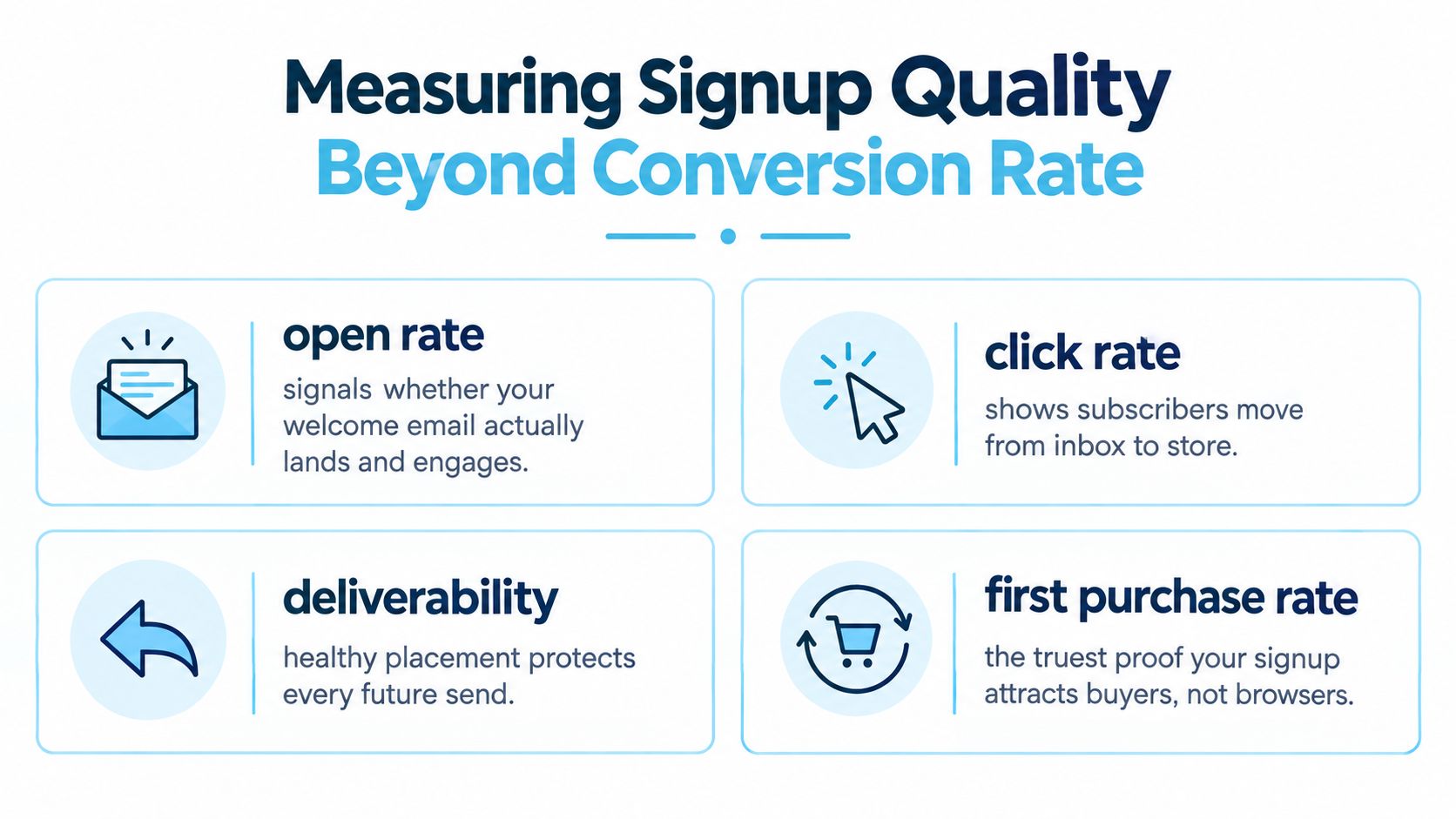
A practical dashboard should connect each stage:
- Form conversion: Shows whether the offer and placement earn the initial commitment.
- Welcome opens and clicks: Indicates whether the message reaches subscribers and moves them toward the store.
- Reward redemption: Reveals whether the incentive attracted genuine intent or passive registrations.
- First purchase and margin: Shows whether the signup creates profitable customer action.
- Unsubscribes and complaints: Identifies fatigue, unclear expectations, or poor targeting.
- Delivery and inbox placement: Protects the value of every future send.
Deliverability benchmarks can appear contradictory because measurement definitions differ. One 2025 benchmark reported 98% overall delivery and 99.2% B2C delivery, while another estimated that 16.9% of messages never reached the inbox and 10.5% went to spam, as summarized in this email marketing research report. Treat those figures as evidence that merchants need consistent internal definitions, authenticated sending, bounce monitoring, complaint tracking, and clean list practices.
Urgency-led acquisition deserves the same discipline. A reward that is limited by time or quantity may increase action, but the brand still needs to confirm that the message arrives, the offer works, and the subscriber remains engaged afterward. The profitable email sign up is the one that produces a confirmed, relevant subscriber who can buy without requiring a deeper discount every time.
Quikly helps Shopify brands create on-brand promotional experiences with rewards limited by time, quantity, or both, while collecting email signups as part of the customer action. Visit Quikly to see how behavior-driven promotions can improve signup quality without turning every acquisition campaign into a larger blanket discount.
Topics: email sign up, ecommerce email, Shopify marketing, conversion optimization, email marketing