Most advice about rules of thumb in ecommerce has the same flaw. It treats a shortcut like a law, then acts surprised when margin slips, conversion stalls, or customers learn to wait for the next sale.
A rule of thumb is useful because it speeds up decisions. It is not useful when it replaces thinking. The phrase itself has been documented in English since the 17th century, including a 1658 reference in James Durham’s sermon and a 1692 reference in Sir William Hope’s fencing manual, both pointing to practical approximation rather than exact method, as summarized in the history of the phrase rule of thumb. That original meaning still fits Shopify marketing. You need fast heuristics, but you also need to know where they break.
The best examples of rule of thumb help merchants make better promotional calls under pressure. Which audience should get the offer first. How many reward tiers are enough. When urgency is real. How much discount depth is too much. How to move a shopper from mild interest to committed action without defaulting to another blunt sitewide markdown.
If you’re trying to balance conversion against brand and margin, these eight rules hold up better than the usual popup-and-pray playbook. They’re practical filters for resource allocation, campaign structure, scarcity, pricing, commitment, timing, and social proof. They also map closely to how buyers decide. That matters if you’re still figuring out how small businesses find customers, because traffic alone rarely fixes a weak promotion.
1. The 70-20-10 Rule for Promotional Strategy
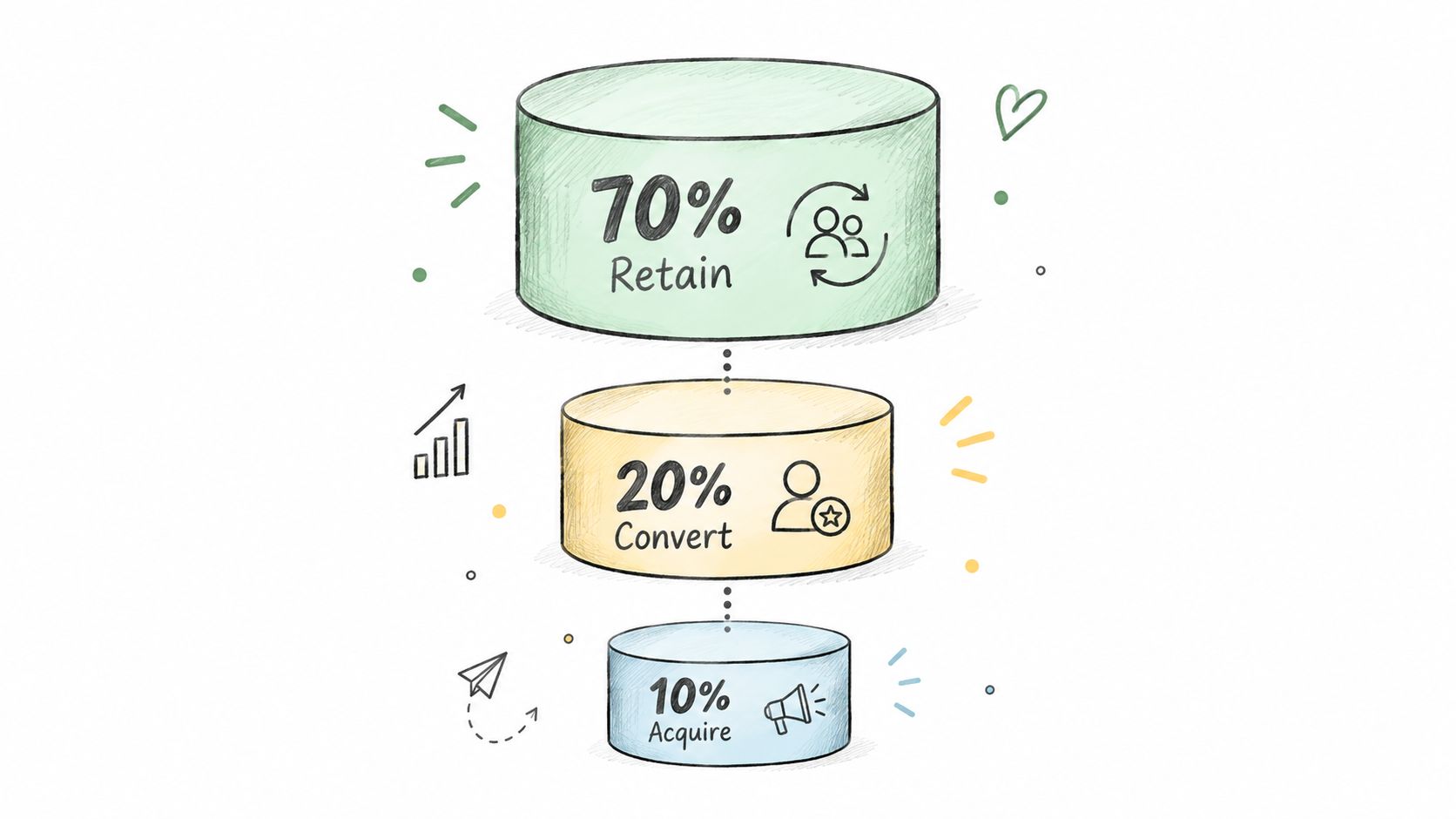
A good promotional budget often starts with a simple split. Put most of the effort into people who already know you, some into warm prospects, and the smallest share into cold acquisition tied to a live offer.
For Shopify brands, that usually means retention first. Past buyers, email subscribers, SMS subscribers, repeat visitors, and cart abandoners already carry intent. They don’t need the same incentive depth as a stranger seeing your brand for the first time on paid social.
Where this rule helps
This heuristic is useful because it fights a common bad habit. Teams overfund traffic and underwork conversion. They spend to get people in the door, then hand everyone the same generic code.
That approach wastes margin twice. First, on acquisition cost. Second, on blanket discounting.
Practical rule: If a shopper already gave you attention, don’t start by paying to reacquire that attention somewhere else.
A healthier sequence looks like this:
- Retention first: Launch the offer to past purchasers and subscribers through Klaviyo, SMS, and onsite messaging.
- Warm traffic next: Show the promotion to returning visitors, cart abandoners, and product viewers.
- Cold acquisition last: Expand into paid social or prospecting once you know the offer converts without forcing deeper discounts.
A skincare brand on Shopify might start with a time-limited email offer to past purchasers of a hero serum, then open the same campaign to returning product-page visitors, then finally run paid traffic into that experience if the economics hold. That order protects margin because the highest-intent audience sees the offer first.
Where it breaks down
This isn’t a hard formula. A young store with a tiny list may need to lean harder on acquisition. A mature brand with strong repeat purchase behavior may push even more effort into retention.
What matters is the logic behind the split. Existing intent is cheaper to convert than cold interest. Behavior-driven promotions work especially well here because they reward people who act now, instead of giving the same deal to everyone who happens to arrive.
2. The Rule of Three for Campaign Design
More options do not make a promotion smarter. They usually make it slower.
The rule of three works because shoppers can compare a small set of choices fast, then act before doubt creeps in. On Shopify, that matters most when the offer needs to create urgency without training customers to wait for a bigger sitewide discount.
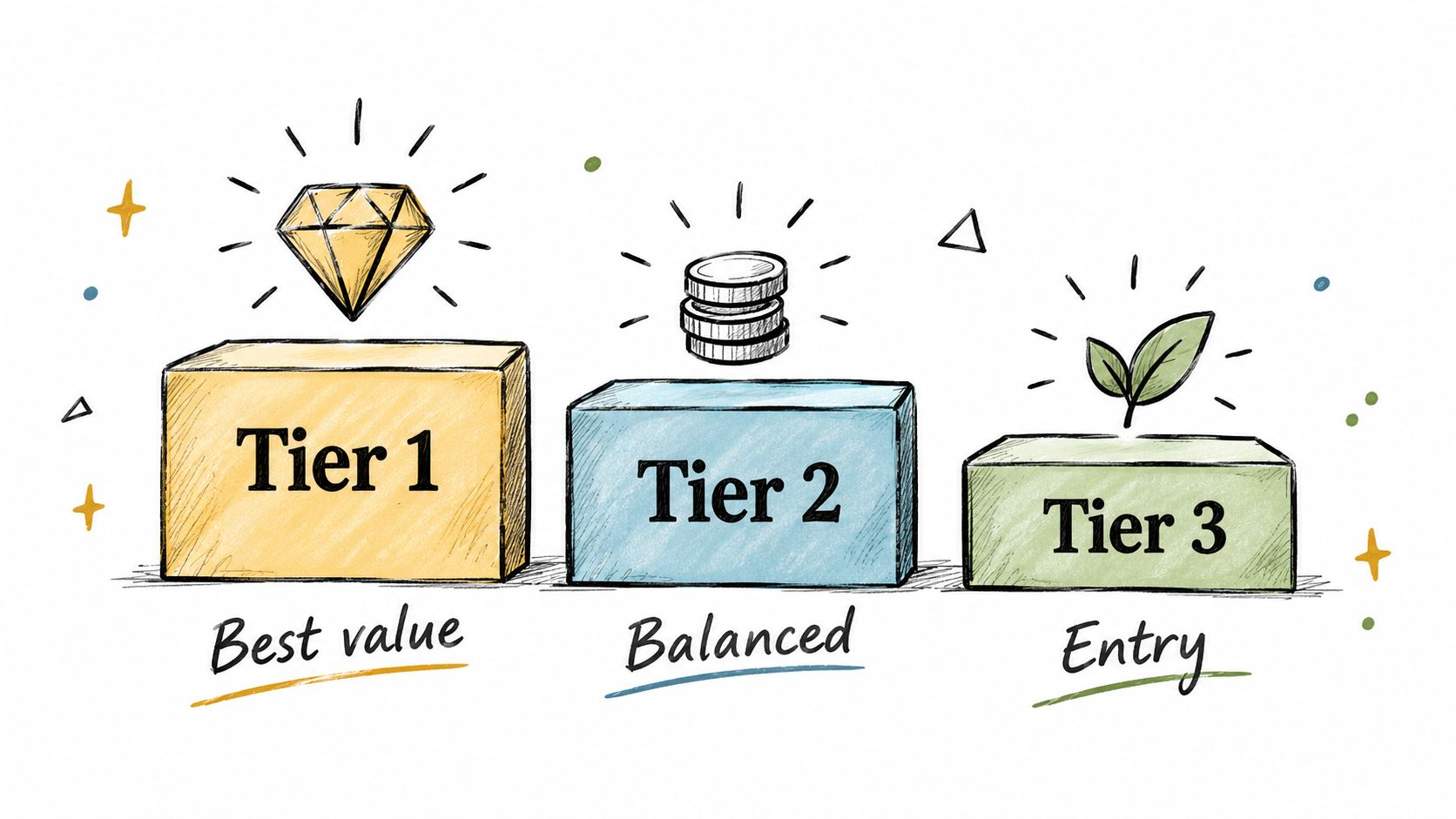
A practical version looks like this. Set one strong reward for early action, one solid fallback for shoppers who hesitate, and one final option that still converts without giving away too much margin. Three steps are usually enough to show a real consequence for waiting.
Here is what that can look like in an actual campaign flow:
Tier 1: Best reward for the first claim window or first group of shoppers.
Tier 2: A smaller reward once the first window closes.
Tier 3: A light incentive or access-based offer for late buyers.
That structure does two jobs at once. It helps the customer understand the decision quickly. It also makes urgency visible, because the value gets weaker over time instead of living in a vague “ends soon” banner.
I have seen this work better than a flat 20% off code, especially for brands that cannot afford to discount every cart at the same depth. The trade-off is setup discipline. The minute a team adds too many exclusions, product carveouts, or backup codes, the clean three-step frame turns into support tickets and abandoned carts.
Three also helps outside the discount itself.
Use it in the message architecture. One campaign can carry three reasons to act now: a shrinking reward, limited availability, and a short claim window. A product page can carry three layers of persuasion: core value, proof, and deadline. That keeps the shopper focused on one decision path instead of asking them to decode a pile of competing badges, popups, and promo bars.
Where this rule breaks is pretty predictable. Stores with low traffic may not have enough volume to make stepped tiers feel real. Luxury brands can also cheapen the experience if every promotion starts to look like a countdown ladder. In those cases, keep the rule but change the expression. Use three access levels, three gift thresholds, or three launch windows instead of deeper discounts.
The test is simple. If a shopper cannot explain the offer in one sentence, the campaign is too busy. Three is not magic. It is just a useful ceiling for how much promotional complexity most customers will process before they leave.
3. The 80/20 Rule in Customer and Revenue Focus
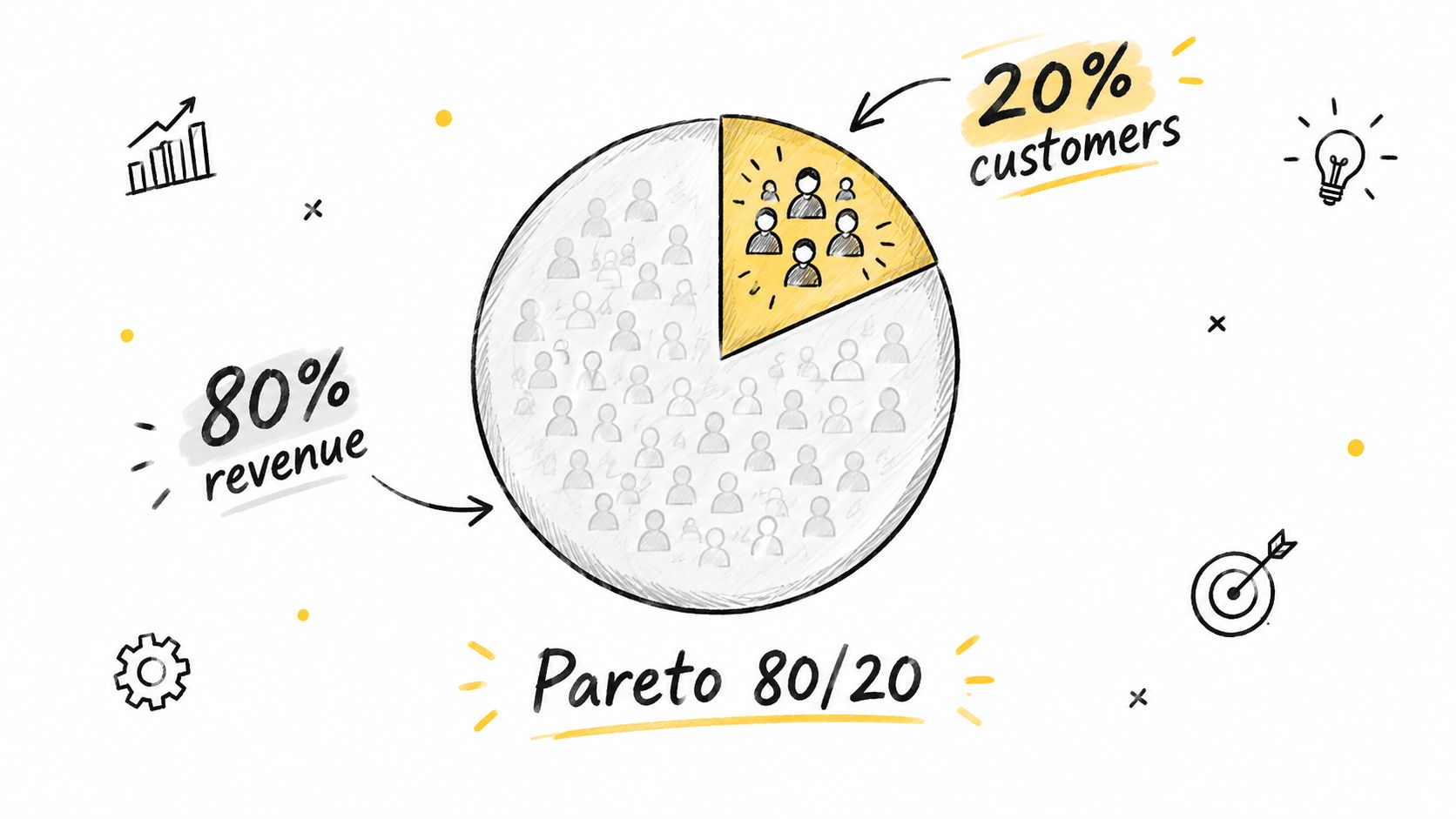
The 80/20 rule is one of the most familiar examples of rule of thumb because it keeps showing up in real operating decisions. In ecommerce, a small share of customers, traffic sources, or products often drives a disproportionate share of revenue.
You don’t need to treat that ratio as exact for it to be useful. The point is concentration. Your best customers are not evenly distributed, and your best conversion opportunities usually aren’t either.
Use it to stop wasting discounts
Open your Shopify analytics and look for concentration in three places. Revenue by customer cohort, revenue by product, and conversion by source.
If repeat buyers carry the business, don’t hand your best discount to low-intent traffic first. If direct, email, and referral traffic convert far better than everything else, don’t build your whole promotion around broad reach and then complain about rising acquisition costs.
Segmentation matters. Quikly-style urgency campaigns tend to work best when they start with the audience already most likely to respond. A high-intent email segment, a group of recent cart abandoners, or shoppers landing on a known top-converting collection page can justify a stronger experience than generic sitewide traffic.
For brands that need a clearer segmentation model, these customer segmentation examples for ecommerce campaigns are the right place to tighten the audience before touching discount depth.
What this rule misses
The 80/20 rule can become lazy thinking if it turns into “only care about VIPs.” That’s not the lesson. The lesson is to identify concentration, then decide how promotions should reflect it.
- Protect your strongest audience: Use urgency and exclusivity before deeper markdowns.
- Protect your strongest products: Don’t default to discounting hero SKUs that already convert.
- Protect your strongest channels: Put the best offer presentation where intent is already high.
A home goods brand might learn that returning visitors to its best-selling bedding collection convert cleanly with a constrained offer, while first-time social traffic needs education more than discount depth. Same store, different economics. That’s the right use of the rule.
4. The Scarcity Principle as a Decision Accelerant
More discount is usually the lazy answer. Scarcity often does the job with less margin loss, but only if the constraint is real.
On Shopify, scarcity works best as a decision accelerant, not as a rescue tactic for a weak product, a cold audience, or an everyday sitewide sale. A shopper who already wants the item may need a reason to stop browsing and commit now. Scarcity provides that reason when the limit is visible, believable, and enforced.
Research on ecommerce scarcity cues links limited quantity and limited time messaging with stronger purchase intention and higher perceived value, as covered in this research on scarcity cues in ecommerce. The practical takeaway is narrower than many teams assume. The words matter less than the operational truth behind them.
A few promotion setups usually earn trust:
- A fixed number of claims for a product drop
- Early access reserved for email or SMS subscribers
- A deadline that closes the offer
- Inventory-based messaging tied to real stock levels
Quantity limits usually outperform generic countdown pressure. That lines up with findings in this meta-analysis on product scarcity effects. For a merchant, that means “200 claims available” is often stronger than “sale ends tonight” if both are true.
Here is the trade-off. Scarcity can raise conversion rate without training customers to wait for deeper markdowns. It can also hurt trust fast if the limit looks manufactured. Reset the timer, keep the “limited” offer running for three more days, or show fake low-stock warnings on every SKU, and shoppers learn the pattern.
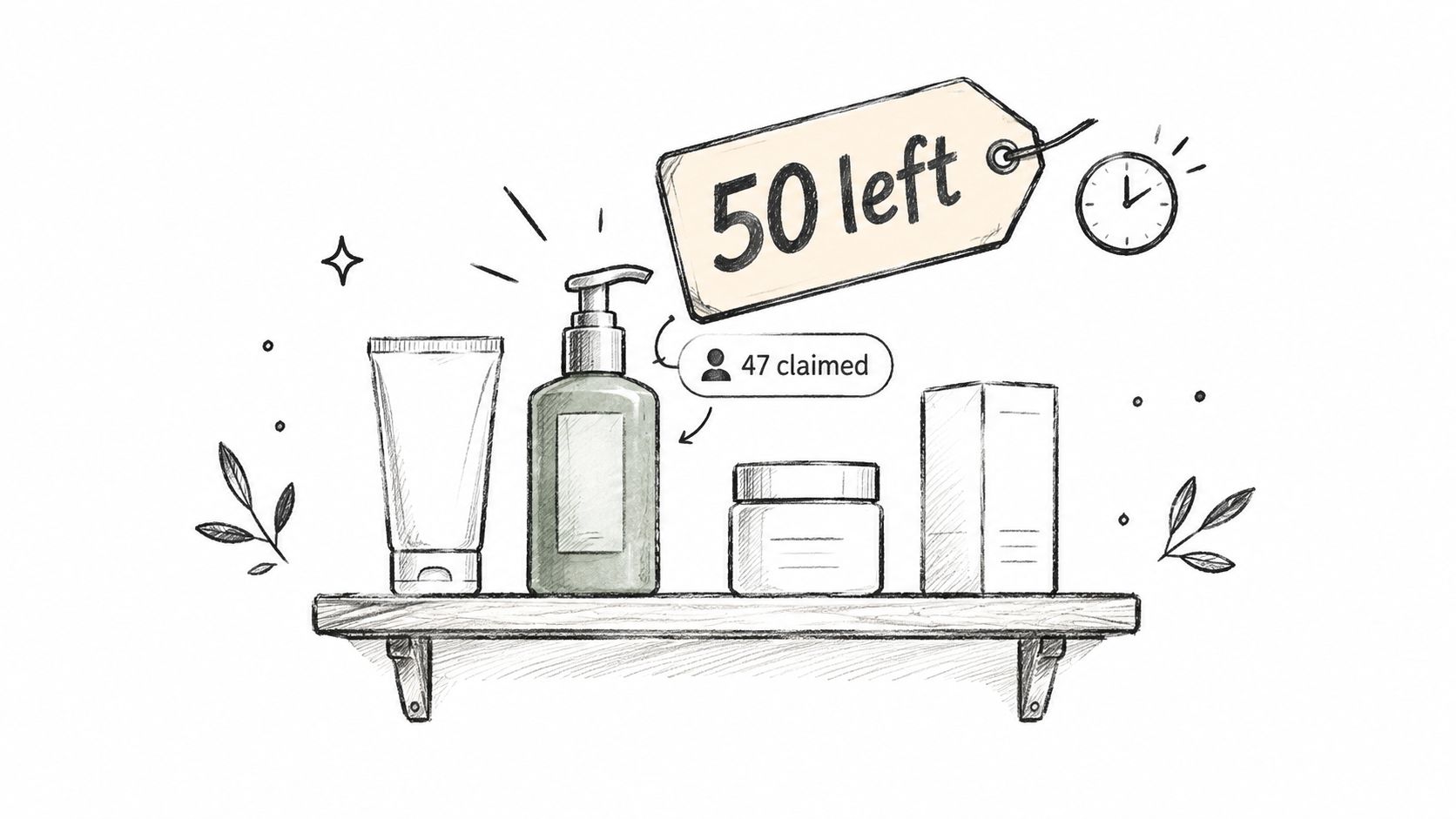
One clean use case is a product launch with healthy demand but tight inventory. Give subscribers first access for a short window. Show remaining claims or units in real time. End the campaign when the inventory threshold is hit. That approach creates urgency without cutting price across the whole catalog.
One bad use case is a permanent countdown bar on a collection that restocks every week.
If you want examples of how to set this up cleanly, this scarcity marketing guide for Shopify brands breaks down the mechanics.
Use scarcity where shopper intent already exists and margin is worth protecting. If the offer only works after adding fake pressure, the problem usually is not urgency. It is the offer itself.
5. The 10% Rule for Discount Depth and Margin Protection
A lot of promotional damage starts with a simple assumption. If a small discount works, a bigger one must work better.
Sometimes it does in the short term. It also trains customers faster, cuts into contribution margin faster, and resets price expectations faster. That’s why a practical rule of thumb is to keep the default transaction-level discount shallow unless there’s a specific reason to go deeper.
Why a shallow offer often performs better than expected
A modest incentive combined with urgency, exclusivity, or a bonus can do more for a Shopify store than an automatic sitewide cut. A shopper doesn’t evaluate discount depth in a vacuum. They react to context.
A subscriber-only offer with a firm close, limited claims, and easy redemption often feels more valuable than a larger always-on markdown that anyone can get next week. The first feels earned. The second feels routine.
Many brands misread performance. They judge the promotion by gross conversion lift and ignore what happened to margin, average order value, and future customer behavior. That’s a mistake.
- Use shallow discounts as the default: Keep the first move conservative.
- Add non-discount value: Free shipping, early access, or a bonus item can carry weight without repricing the whole store.
- Reserve deep cuts for special cases: Clearance, stale inventory, or a targeted win-back can justify more aggression.
Margin check: If the offer only works when the discount gets uncomfortable, the problem may be the audience, the product framing, or the timing, not the incentive size.
When to break your own rule
Some categories need a stronger entry incentive. Some inventory needs to move. Some retention moments justify going deeper for a narrow segment.
The point isn’t moral purity around discounting. The point is control. If your store keeps reaching for bigger and broader discounts because standard promotions don’t create enough urgency, the issue usually isn’t that customers need more markdown. It’s that they need a better reason to act now.
6. The Commitment and Consistency Principle in Offer Progression
Big discounts often get used to fix a sequencing problem.
A shopper who has not taken any prior action usually needs more trust, more clarity, or less friction. If the first ask is “buy now,” the store ends up paying for that jump with margin. Offer progression solves that by earning small commitments first, then attaching the next incentive to the next action.
On Shopify, that usually means the promotion is not a single event. It is a chain of related choices. Subscribe for early access. Save the product. Claim a private code. Finish checkout before the claim expires. Each step is small enough to feel reasonable, and each one makes the final purchase feel more consistent with what the shopper already started.
A simple way to apply it is to stop treating every visitor the same:
A cold visitor may get early access in exchange for email or SMS. A returning product viewer may get a reserved bonus or a limited-time bundle. A recent buyer may get first access to a refill, new drop, or loyalty-only offer. The reward changes because the commitment level is different.
That structure does two useful things at once. It reduces the need for broad markdowns, and it makes the offer feel earned instead of public and permanent.
It also has limits. Too many steps will hurt conversion. If a shopper has to opt in, confirm, click back to the site, copy a code, and hunt for the eligible product, the progression turns into work. Premium positioning does not excuse clumsy execution.
The test is simple. Every step should answer one practical question:
What small action can this shopper take now that makes the next action easier?
For many stores, the best progression looks like this in practice:
- New visitor: email capture tied to early access or a narrow first-order perk
- Engaged subscriber: product-specific reminder or claim-based offer
- Cart or checkout abandoner: a tighter incentive, often with non-discount value first
- Recent customer: post-purchase access, replenishment timing, or a bounce-back tied to the category they bought
The trade-off is control versus reach. Sitewide discounts reach everyone fast, but they train customers to wait. Progressive offers convert fewer people at the top of the funnel, but the economics are usually cleaner and the brand takes less damage.
That matters more in categories where repeat behavior drives profit. Apparel, beauty, supplements, and specialty goods do not just need the first order. They need the second and third without teaching customers that every purchase comes with a bigger coupon if they hesitate.
Keep the progression visible to the shopper and manageable for the team. One clear trigger, one clear reward, one clear next step is usually enough.
7. The Rule of Temporal Discounting in Urgency Windows
Time changes perceived value. A reward available now is usually more motivating than the same reward available much later.
That principle is why urgency windows matter. A shopper who ignores a month-long promotion may act on a short, credible window tied to a real endpoint.
Shorter windows create cleaner decisions
A recent review defines scarcity claims as written statements or visual icons indicating quantity or time limits, and notes that those claims can shorten consumer search behavior and increase urgency to buy, according to this review of quantity and time limit scarcity claims. That lines up with what operators see every day. Decision pressure rises when delay has a cost.
For Shopify stores, the practical question isn’t “should we use urgency?” It’s “what window fits the channel and the audience?”
Email often needs more breathing room than SMS. A warm subscriber list may respond well to a same-day or next-day deadline. A mobile-first launch aimed at highly engaged customers can work in a much tighter window.
What honest timing looks like
The endpoint has to mean something. If the offer says it ends tonight, it should end tonight. Resetting deadlines teaches customers to wait, and once that habit sets in, urgency loses credibility.
Microsoft’s experimentation guidance offers a useful benchmark for why small timing and performance changes deserve attention. It notes that a 10 millisecond server performance improvement at Bing was estimated to more than pay for an engineer’s fully loaded annual cost, and also gives an example where every 100 millisecond speedup improved revenue by 0.6%, as described in Microsoft’s experimentation rules of thumb. Different problem, same operating lesson. Small frictions and small timing shifts can matter a lot at scale.
A weak deadline is just decoration. A real deadline changes behavior.
In practice, urgency windows work best when the message, timer, and claim logic all agree. If your email says the reward ends tonight, your storefront and checkout experience should say the same thing.
8. The Social Proof Multiplier in Campaign Visibility
Social proof becomes much stronger when it isn’t abstract. “People love this” is weak. “Shoppers are claiming this right now” is useful.
That’s why visible participation matters in promotions. Real-time depletion, active claim counts, and proof that other customers are moving can push an uncertain shopper into action without requiring a bigger discount.
Make participation visible
A campaign that shows remaining claims does more than signal scarcity. It signals momentum. The customer sees that other shoppers considered the offer credible enough to act on it.
This works especially well when paired with quantity-bound rewards. “Only a few left” means more when the shopper can see the claims progressing. It also helps the promotion feel fair. Early action earns the better outcome.
For a stronger grounding in the psychology behind this, Quikly’s take on social proof marketing for ecommerce is worth reading, especially if you’re thinking about how proof should appear across onsite, email, and SMS.
A useful scenario is a product launch where the homepage hero, campaign landing page, and follow-up email all reflect the same live promotion state. That consistency matters more than flashy design.
The trust trade-off
Visible proof can backfire if it looks fake or stale. A claim counter stuck at zero weakens the offer. So does obviously inflated activity.
Research on discount fatigue is helpful here in a different way. It recommends cooldown periods of 48–72 hours before showing another exit offer to the same visitor, 72–96 hours after an unredeemed offer, and limiting lifetime exit-intent offers to 1–3 per visitor, as outlined in this analysis of discount fatigue and exit-offer frequency. The broader point is discipline. Repetition changes customer behavior, and not always in your favor.
If you’re thinking through channel consistency and trust signals together, this piece on how social proof boosts Shopify sales is a useful companion read.
8-Point Comparison of Rules of Thumb
| Strategy | Implementation complexity | Resource requirements | Expected outcomes | Ideal use cases | Key advantages |
|---|---|---|---|---|---|
| The 70-20-10 Rule for Promotional Strategy | Medium, requires segmentation and ongoing allocation decisions | Moderate, CRM/analytics, email/SMS, campaign management | Better retention, higher LTV, reduced inefficient acquisition spend | Ecommerce shops prioritizing retention and margin control | Protects margins by focusing on warm/high-intent audiences |
| The Rule of Three for Campaign Design | Low, simple design and copy discipline | Low, creative assets and basic testing | Increased memorability, reduced choice paralysis | Pricing tiers, landing pages, concise offer messaging | Simplifies decisions; improves persuasiveness and visual balance |
| The 80/20 Rule (Pareto Principle) | Medium, analytics to identify the vital 20% | Moderate, data infrastructure, targeted campaign tooling | Concentrated revenue gains and improved ROI on spend | Prioritizing customers, channels, or products with highest return | Reveals high-return segments; enables ruthless prioritization |
| The Scarcity Principle as a Decision Accelerant | Low–Medium, honest limits and visible depletion required | Low, inventory/time controls, UI for counters | Accelerated purchases, higher AOV, preserved pricing power | Flash sales, limited-quantity launches, access-restricted offers | Creates genuine urgency without deep discounts; reduces wait behavior |
| The 10% Rule for Discount Depth and Margin Protection | Low, policy and team discipline | Low, pricing rules, promo mechanics | Maintains margins, prevents discount conditioning | Regular promotions, email/SMS offers, retention campaigns | Protects margin and brand value; pairs with non-discount perks |
| The Commitment and Consistency Principle in Offer Progression | High, multi-step flows and cross-channel integration | High, automation, UX, content, CRM integrations | More list growth, higher engagement, progressive conversion lift | Onboarding funnels, progressive rewards, lifecycle campaigns | Builds commitment and loyalty; converts via small, consistent steps |
| The Rule of Temporal Discounting in Urgency Windows | Low–Medium, timing strategy and strict endpoint enforcement | Low, timers, scheduling, channel coordination | Faster decisions, predictable traffic/revenue spikes | Short flash sales, timed email/SMS windows, descending offers | Compresses decision-making; creates effective time-based urgency |
| The Social Proof Multiplier in Campaign Visibility | Medium, real-time activity display and authenticity controls | Moderate, real-time feeds, UI components, initial seeding | Increased trust, momentum effects, higher conversion rates | New product launches, homepage promotions, social campaigns | Amplifies credibility and scarcity; reduces hesitation via visible demand |
Use the Heuristic, Then Check the Economics
The best examples of rule of thumb don’t eliminate judgment. They give you a faster place to start.
That’s the right way to use them in a Shopify store. Start with a heuristic, then pressure-test it against your economics, your audience behavior, and the kind of brand you’re trying to build. A rule that improves conversion while weakening margin or training customers to delay purchase isn’t helping. It’s just moving the problem.
A simple application sequence works well.
First, identify the audience with the clearest existing intent. That could be past buyers, engaged subscribers, cart abandoners, or returning visitors on a high-intent collection page. If you don’t know where that intent sits, don’t solve the problem by increasing discount depth.
Second, choose one behavioral mechanism. Scarcity, commitment and consistency, temporal discounting, and social proof all work for different reasons. Don’t stack all of them just because you can. Pick the one that matches the situation.
Third, set a real constraint. Quantity cap, access gate, or firm deadline. The moment the constraint becomes fake, the promotion starts damaging trust.
Fourth, keep the offer easy to understand. A lot of smart-looking campaigns fail. If a shopper needs to decode conditions, compare too many tiers, or wonder whether the timer is real, you’ve added friction at the exact point where you wanted urgency.
Then check the economics together. Not one metric at a time. Look at profit, conversion, average order value, and list growth as a bundle. Current finance explainers still repeat rules like the 4% retirement withdrawal rate, 100-minus-age allocation, and 3–6 months of emergency savings as planning shortcuts rather than guarantees, which is a useful reminder from this rule of thumb overview in finance. Heuristics are starting points. Their limits matter as much as their convenience.
The phrase itself came into English as a practical approximation, often tied to rough thumb-based measurement and methods based on experience rather than exact science, as discussed in this background on the origin and meaning of rule of thumb. That’s still the right mindset for promotional strategy. Use the shortcut, but don’t confuse it with certainty.
For Shopify teams trying to avoid another cycle of broader promos and thinner margins, behavior-driven promotional experiences are often the better path. They create a reason to act now without teaching shoppers to wait for the next sitewide code. Quikly is one way to run that kind of structure, especially when you want urgency and scarcity mechanics that stay on-brand and don’t rely on ever-deeper blanket discounts.
Quikly helps Shopify brands turn familiar rules of thumb like scarcity, urgency windows, and descending rewards into promotions customers respond to. If you want a cleaner alternative to flat discounting, and a way to test these heuristics without eroding margin or trust, visit Quikly.
Topics: examples of rule of thumb, marketing rules, Shopify marketing, pricing strategy, conversion optimization