A Shopify merchant can watch traffic arrive, carts fill, and orders come through while profit gets thinner. The usual response is familiar: extend the code, increase the percentage, add a banner, and hope the next promotion creates the urgency the last one failed to produce.
That approach treats every shopper the same, including customers who would’ve bought without an incentive. Better ecommerce website offers start with a different question: what behavior needs to change, and what’s the cheapest credible reward for changing it? The answer might be a larger basket, an earlier purchase, a first order, a repeat order, or a decision before limited inventory disappears.
Why Flat Discounts Stop Paying Off
A sitewide code can make the dashboard look healthier while making each order less valuable. Conversion rises, revenue moves, and the team calls the promotion a win. Yet the same code may reward customers who were already ready to buy, teach existing buyers to wait for the next sale, and reduce contribution across every discounted order.
The expectation problem is measurable. One consumer survey found that 91% of Americans delay purchases to wait for a discount, 61% wait a month or longer, and 51% have abandoned an online cart hoping to receive a discount email later. Shoppers in the same survey needed at least 26% off on average before a deal felt worth waiting for. The survey data and its implications for discount behavior shows how promotions influence purchase timing, not just price.
Three failure modes recur:
- You discount full-price demand. A returning customer who planned to purchase today receives the same reduction as a hesitant visitor.
- You condition delay. Predictable codes turn “buy now” into “wait for the next email.”
- You compress contribution. Product, fulfillment, payment, shipping, returns, and promotional costs can absorb the extra revenue.
A simple break-even check
Take a product with a 45% margin before discount. A 15% sitewide code leaves 30 percentage points of selling price before other costs. In a simplified model, preserving the original contribution requires roughly 1.4 times the original volume, not merely a 20% revenue lift.
| Discount Depth | New Conversion Needed | Net Margin After Discount |
|---|---|---|
| 0% | Baseline volume | 45% |
| 15% | Roughly 1.4x baseline volume | 30% |
The illustration excludes fulfillment, payment, returns, and acquisition costs, so it gives the discount favorable treatment. A margin-focused ecommerce analysis recommends measuring revenue per recipient with a 10% holdout group and a seven-day post-campaign tail. That view captures promotional cost that headline revenue can hide. The promotional pricing analysis outlines this structure for estimating incremental return.
Practical rule: Don’t ask which discount percentage sounds persuasive. Ask which behavior you are buying, how many customers need the incentive, and whether the resulting contribution pays for it.
Low conversion rates make small improvements valuable, but they also make careless discounting expensive. Adobe reports global ecommerce conversion at 2.58% and the U.S. average at 2.57%. Dynamic Yield reports a global average of 2.72%, with category performance ranging from 5.39% in Beauty & Personal Care to 0.72% in Luxury & Jewelry. Dynamic Yield’s conversion benchmark supports testing by device, channel, region, and category instead of treating a sitewide average as a strategy.
The better frame is simple: offer design is behavior design. A percentage-off code is one mechanic, not the default answer.
Mapping Offer Types to the Behavior You Want
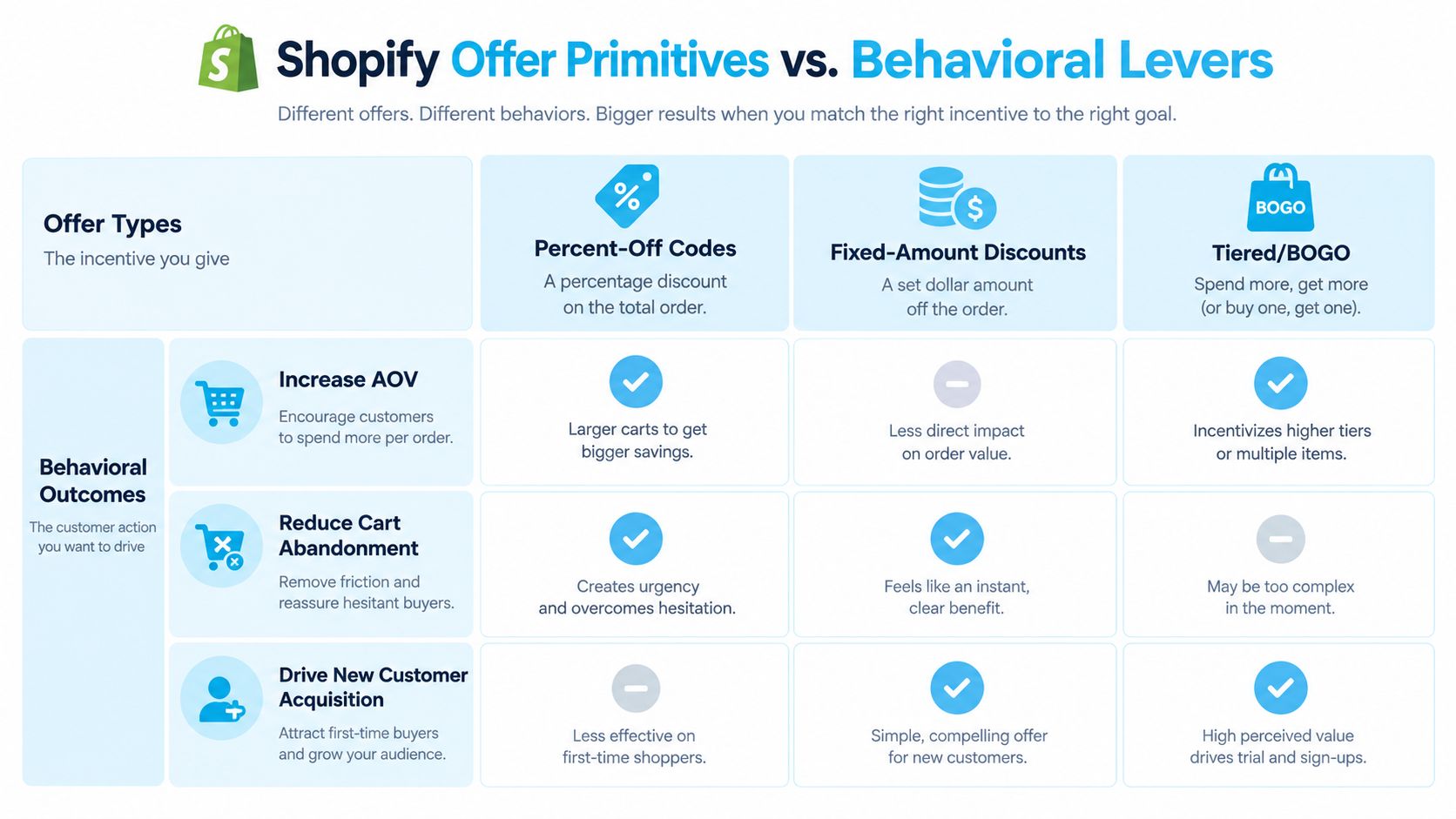
Shopify gives merchants plenty of promotional building blocks. The mistake isn’t having too few options. It’s choosing an offer before identifying the action that would make the order more valuable.
Start with the target behavior, then select the mechanic.
If the goal is cart expansion
Use tiered spend thresholds, bundle pricing, or buy-more-save-more ladders. A threshold such as “free shipping above the next sensible cart value” gives the shopper a reason to add another product without discounting the first product automatically. BOGO can work when the second unit has strong utility and predictable economics, while bundles are better when products naturally belong together.
A fixed-amount discount can also support basket growth when the qualification threshold is above the current order value. “Save a fixed amount above the threshold” feels concrete, but the threshold must reflect product pricing and shipping economics.
If the goal is first purchase conversion
Use a targeted percent-off code, fixed-amount welcome offer, gift with purchase, or subscription-first-order incentive. These mechanics reduce perceived risk for a new visitor, especially when paired with clear returns, reviews, delivery information, and a focused landing page.
Don’t apply the same welcome offer to existing customers. Shopify customer segments, Klaviyo flows, and SMS automations can separate first-time visitors, known subscribers, past buyers, and lapsed customers before the reward appears.
If the goal is repeat purchase or retention
A loyalty point multiplier, replenishment incentive, subscription-first-order reward, or post-purchase gift usually fits better than a broad public code. The offer should reinforce the next desired action, such as reordering a consumable, joining a subscription, or trying an adjacent product.
If the goal is inventory liquidation
Use a product-specific markdown, bundle, BOGO structure, or gift with purchase tied to the stock you need to move. A sitewide sale spends margin on products that may not need help. A targeted offer lets the team protect high-demand items while creating a reason to consider slower inventory.
The decision rule is straightforward:
- Raise AOV: choose thresholds, bundles, or quantity ladders.
- Reduce first-order hesitation: choose a controlled welcome reward.
- Increase repeat purchase: choose loyalty, replenishment, or subscription mechanics.
- Move selected inventory: attach the incentive to specific products.
- Capture permission: use a value exchange for email or SMS, not a generic popup-and-pray discount.
A useful offer earns its cost by changing the order, timing, or relationship. If it only lowers the price, it needs a much stronger margin case.
Turning a Flat Discount Into a Behavior-Driven Mechanic
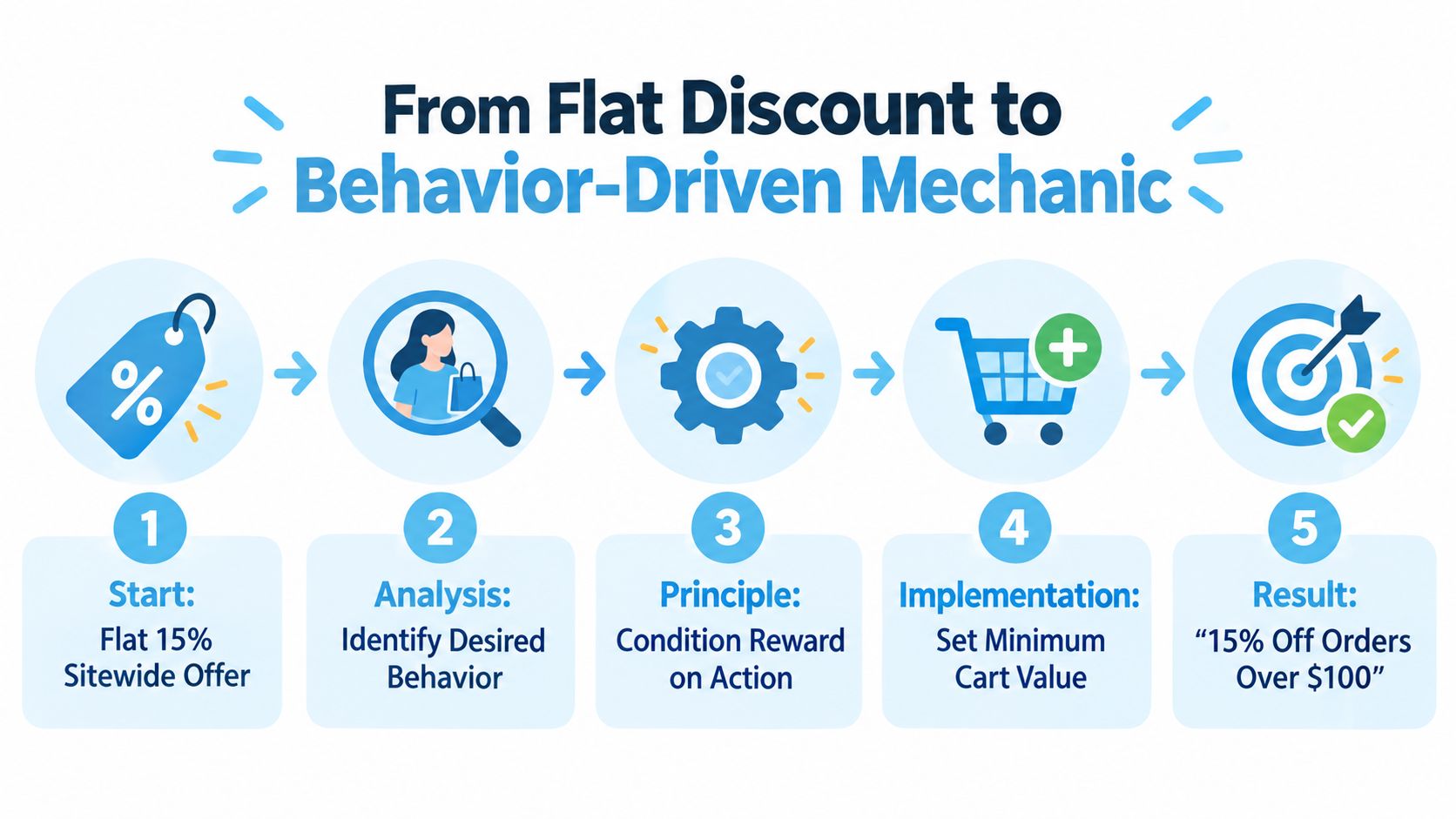
Suppose the current campaign says, “15% off everything.” It gives the shopper no reason to increase the basket, act early, choose a particular product, or return later. The reward is available regardless of behavior.
A behavior-driven version could use three spend thresholds:
- $75, free shipping
- $125, a sample
- $200, a gift
The values here are a worked structure, not a universal recommendation. The merchant should set them from actual average order value, product costs, shipping rates, gift costs, and inventory priorities. The architecture changes the question from “How much can I save?” to “What would make the next threshold worthwhile?”
Build the worksheet before the campaign
For each offer, record:
- Selling price and product cost.
- Fulfillment and packaging cost.
- Payment fee.
- Shipping subsidy.
- Expected return exposure.
- Gift, sample, or discount cost.
- Target order value.
- Incremental orders required for the offer to pay back.
Hidden costs beyond COGS, including payment fees, shipping subsidies, returns, discount allocations, packaging, storage, and fraud losses, can erode gross margins by 18 to 35 percentage points. Payment processing fees alone typically account for 2.9% to 3.5% of margin erosion. The margin-focused profitability whitepaper makes the operational point clearly: the headline discount is only one line in the cost model.
Add a real constraint
A threshold offer can become more compelling when the reward has a genuine time or quantity boundary. A merchant might release a limited number of gifts, close the offer at a defined time, or use descending reward tiers as claims are consumed. Shopify discount infrastructure, Shopify Plus capabilities, draft orders, and specialized discounting apps can support different parts of this setup, but the implementation must preserve one source of truth across the storefront, cart, checkout, Klaviyo, SMS, and paid traffic.
Claim caps often communicate scarcity more credibly than a permanent timer because the shopper can understand what is finite. A descending structure might begin with a stronger reward for early claimants and then step down as the allocation is used. The mechanic rewards action without making the full catalog permanently cheaper.
Let price-sensitive shoppers self-select
Bundle ladders are another practical replacement for a blanket markdown:
- 2 items, 5% off
- 3 items, 10% off
- 4 items, 15% off
The shopper earns the deeper discount by increasing quantity. Full-price buyers who need one item aren’t automatically moved into the deepest tier, while value-seeking buyers have a clear path to a larger order. The merchant should still check whether each tier covers variable costs and whether the bundle makes sense operationally.
A good mechanic makes the shopper’s action part of the qualification.
Designing an A/B Test Plan That Attributes Lift to the Offer
Offer testing produces weak answers when the team changes the promotion, audience, landing page, email timing, and creative in one experiment. A winning variant shows a difference, but not which variable caused it.
Write one testable hypothesis:
If we change [offer shape] for [segment], then [KPI] will move because [behavioral reason].
For example, a Shopify brand could compare a cart threshold with a flat code for new visitors. The threshold should encourage basket expansion, while the flat code may subsidize a single-item order. Choose revenue per visitor or contribution per visitor as the primary KPI, then use conversion rate and AOV as supporting measures.
Set the test architecture
Use a stable assignment method. Cart-level offers can become contaminated when the same shopper sees different rewards across sessions, devices, or email clicks. Apply user-level hashing where identity is available, or cookie-stable bucketing for anonymous traffic, and keep each shopper in the same group throughout the test.
A clean holdout helps estimate incremental demand. Reserve an eligible control group and measure revenue per recipient through a post-campaign tail, since redemptions can continue after the visible campaign ends. The incrementality testing framework provides a practical structure for separating observed sales from sales the offer caused.
Change variables in a deliberate order
- Offer framing and threshold. Test how shoppers qualify for the reward, such as free shipping above a threshold versus a fixed amount off.
- Mechanic type. Compare a bundle, tier ladder, gift, or capped reward after the value proposition is clear.
- Creative and copy. Refine placement, wording, product imagery, and reminder timing after isolating the commercial structure.
Keep traffic sources, email timing, audience rules, and landing pages consistent where possible. Shopify Analytics can establish the baseline, while Shoplift, Intelligents, or Convert can support experiment management and analysis. Set the minimum detectable effect and required sample size before launch, not after early results appear.
Run the test through a complete weekday cycle and avoid declaring a winner from a short burst of unusually high-intent traffic. Record the hypothesis, audience, allocation, dates, exclusions, mechanics, results, and decision in a shared test log. This record makes the next offer test easier to interpret and prevents a temporary conversion spike from being mistaken for profitable lift.
Measuring Margin, Not Just Conversion
Conversion rate answers one question, whether more sessions became orders. It doesn’t answer whether the promotion created profitable demand, increased basket value enough to offset its cost, or transferred margin to customers who would’ve purchased anyway.
A Shopify operator needs a dashboard that places contribution beside conversion:
| Metric | Why It Matters | How to Calculate | Review Threshold |
|---|---|---|---|
| Contribution margin per order | Shows what each order contributes after variable costs | Net revenue minus product, fulfillment, shipping subsidy, payment, return, and offer costs | Must stay above the brand’s approved floor |
| Revenue per visitor | Captures both conversion and order value | Attributed revenue divided by eligible visitors | Compare variant with control |
| Redemption cost as a percent of revenue | Shows the actual burden of the incentive | Total discount, gift, or shipping cost divided by offer-attributed revenue | Keep below the campaign’s planned ceiling |
| Incremental AOV | Tests whether the offer expands the basket | Variant AOV minus pre-offer or control AOV | Positive when basket growth is the objective |
| Incremental orders | Separates caused demand from total demand | Exposed outcome minus holdout outcome, adjusted for audience size | Must justify the promotional cost |
A 12% conversion lift from a 20% off coupon can still destroy margin if the added orders carry lower contribution and bring higher fulfillment, payment, return, or acquisition costs. Those figures are a hypothetical illustration, not a benchmark. The principle is the important part: conversion is necessary, but it isn’t sufficient.
Calculate the incremental result
Compare an exposed cohort with a clean holdout that qualifies for the same campaign but doesn’t receive the offer. Measure orders, revenue, AOV, contribution, redemption, and repeat behavior after the campaign window. Last-click attribution tends to over-credit promotions because shoppers who were already close to purchase often click the final email or code reminder.
Add operating guardrails inside Intelligems or a similar margin engine:
- Contribution floor: stop or suppress an offer when projected contribution falls below the approved minimum.
- Discount ceiling: prevent a segment from receiving a reward deeper than its economics allow.
- Redemption throttle: reduce exposure when claims exceed the forecast.
- Product exclusions: protect scarce, high-demand, or low-margin SKUs.
- Channel consistency: ensure paid, email, SMS, and onsite messaging don’t create conflicting promises.
A margin review should happen at the offer and segment level, not only at the campaign total. This guide to ecommerce margins provides a useful lens for keeping profitability in the same operating conversation as growth.
The Psychology Behind Scarcity and Urgency That Actually Works
A shopper adds a product to cart, sees a genuine shipping cutoff, and completes the order that evening. Another shopper sees the same countdown reset on every visit and learns to wait. Scarcity and urgency change behavior only when they represent a constraint the brand can substantiate.
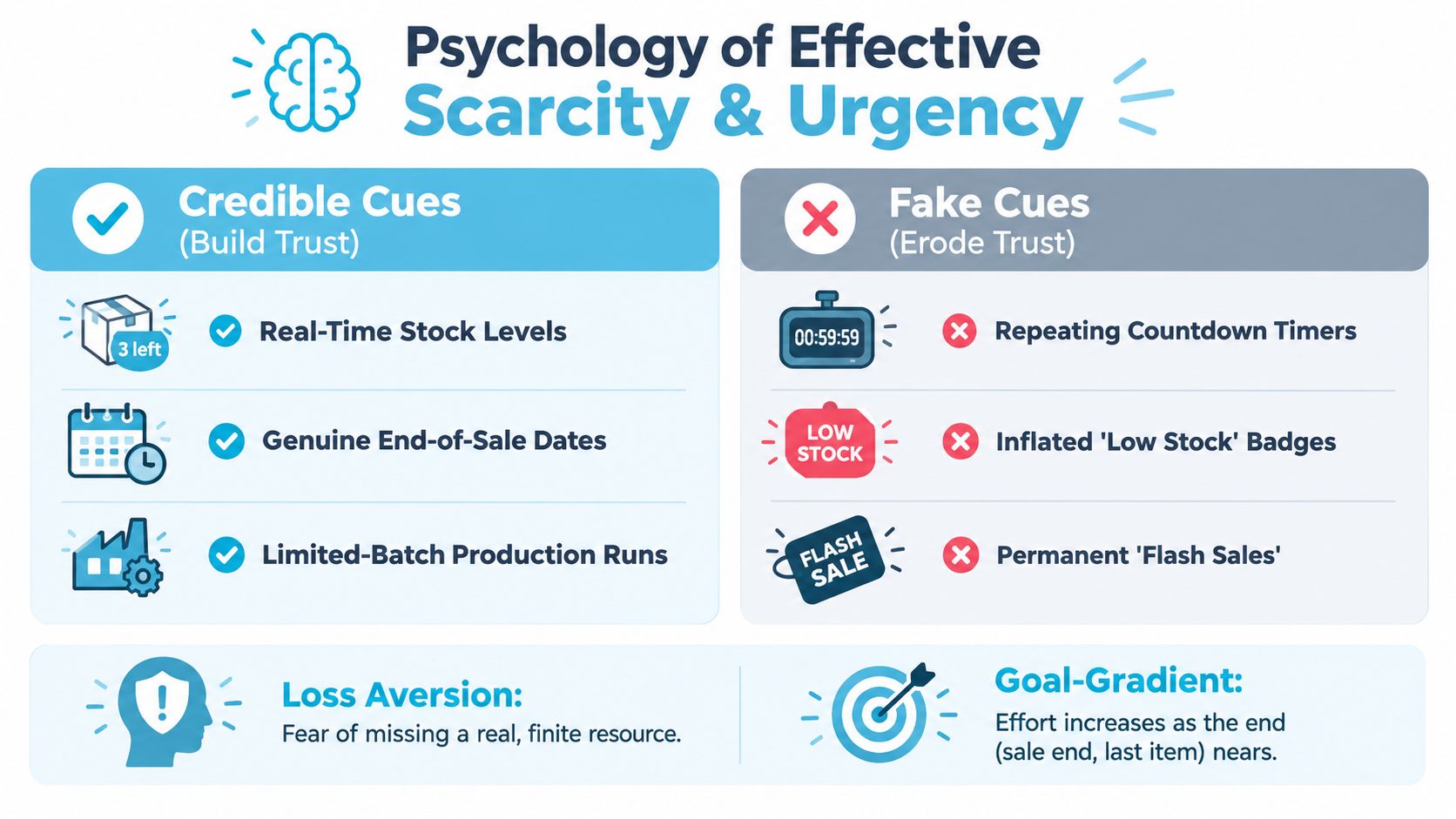
Loss aversion can prompt action to avoid losing a real opportunity. The goal-gradient effect can increase effort as a shopper approaches a defined endpoint, such as a free-shipping threshold or the final available reward. Commitment and consistency become relevant after someone has built a cart, selected a bundle, or joined a waitlist. A well-matched offer helps existing intent reach a decision without requiring a deeper discount.
A journal study found that scarcity and urgency cues increased impulse buying, perceived product value, and purchase intention, with the effects moderated by anxiety, product involvement, and trust. The journal research on scarcity and urgency supports careful targeting rather than indiscriminate pressure. The practical implication for a Shopify brand is straightforward: build the cue around a real operating limit, then test whether it improves contribution and incremental orders, not only clicks or checkout starts. See these scarcity marketing principles and implementation examples before configuring the mechanic.
Cues that shoppers can verify
- Real stock levels: Show availability only when the displayed level matches sellable inventory.
- Genuine end dates: Tie the deadline to a campaign close, fulfillment cutoff, or production window the team will honor.
- Limited-batch production: Explain why the quantity is limited and what happens when the batch sells out.
- Claim-capped rewards: State the allocation and update it consistently as customers claim it.
Synthetic urgency trains shoppers to wait. A timer that resets, a “flash sale” that never ends, or a low-stock message shown across every product weakens the cue. It also lowers the brand’s full-price reference point, making future margin protection harder.
Trust is the operating constraint. Research cited a relationship between perceived manipulative scarcity and higher long-term churn, while also reinforcing the roles of trust, involvement, and anxiety in how shoppers respond. Use pressure carefully for premium or high-consideration products, where artificial urgency can reduce confidence instead of increasing conversion.
Audit every offer page with three questions:
- Is the constraint truthful?
- Can the shopper verify it in the cart, product page, or message sequence?
- Does it come from an operating reality, or is it decorative pressure?
Behavior-driven promotions should make earlier action more valuable while protecting the contribution the order needs to generate. The mechanic earns its place when the deadline is credible, the customer understands it, and the brand can keep the promise.
Building an Offer System Instead of Running More Sales
A promotion calendar encourages teams to ask what sale comes next. An offer system asks which customer, product, lifecycle stage, and behavior deserve attention next.
Build a library of mechanics rather than a library of percentages. A welcome offer can exchange value for a first purchase or permission to communicate. A mid-funnel offer can encourage a shopper with an active cart to reach a useful threshold. A winback offer can reward a returning customer without exposing every current buyer to the same markdown.
The system should include three operating layers:
- Segment rules: Define eligibility for new visitors, subscribers, recent buyers, lapsed customers, and high-value cohorts.
- Mechanic rules: Match thresholds, gifts, bundles, loyalty rewards, or capped claims to the behavior that matters.
- Retirement rules: Remove offers when their cost per incremental order exceeds their contribution value.
Don’t let one mechanic run indefinitely. Rotate the structure based on its intended use, not because the creative feels old. A store that constantly repeats a “limited” offer eventually teaches shoppers that the deadline has no meaning.
Review the economics every quarter
Review each offer with actual redemption, contribution per order, incremental AOV, repeat purchase behavior, and holdout performance. Retire offers that attract orders but fail to create profitable incremental demand. Keep the mechanics that help customers buy more relevant products, commit earlier, or return for a next purchase.
Brands that also sell through community channels may find a local seller marketplace useful for reaching nearby demand without forcing the same ecommerce promotion onto every storefront visitor. The channel can complement a Shopify offer system when the audience and operational model fit.
The aim is fewer promotional moments with more impact per moment. Offers should be engineered around behavior, guarded by contribution economics, and delivered through the channel where the customer is already showing intent.
Quikly creates on-brand promotional experiences for Shopify stores that cap rewards by time, quantity, or both, and can run them across storefronts, email, SMS, social, and paid traffic. Use Quikly to turn a flat discount into a controlled mechanic that rewards shoppers who act without making every customer wait for the next sale.
Topics: ecommerce website offers, ecommerce promotions, conversion optimization, shopify marketing, offer strategy