Your team launches a promotion, and the sales notifications roll in. It feels like a win. Then finance closes the loop, and the picture changes. Orders moved, but margin got squeezed, bestsellers were discounted when they didn’t need to be, and loyal customers learned the same lesson they always learn from predictable offers: wait.
That cycle is wearing out Shopify brands. Acquisition is expensive, conversion still isn’t where it needs to be, and repeated markdowns chip away at brand perception every time they go live. Promotions aren’t the problem. Flat, easy-to-ignore, easy-to-abuse promotions are.
The better approach is to design incentives around behavior, not just price. Reward the action you want, contain the cost, and make urgency real enough that shoppers act now instead of filing your offer under “next sale.” If you’re trying to improve conversion without giving away the store, these are the sales promotion ideas that protect margin and still move demand. For a broader look at making spend work harder, this guide on marketing ROI strategies is a useful companion.
1. Earned Incentives and Behavioral Unlocks
A shopper adds one item to cart, hesitates, and starts to drift. A flat 15% off code might close the sale, but it also gives away margin on an order that may have converted anyway. An earned incentive changes the decision. It gives the shopper a reason to take one more profitable step.
That distinction matters. The reward is tied to behavior you want more of, not traffic you were already paying to bring in.
On Shopify, the best triggers map to clear commercial goals. A wellness brand can offer a reward after email signup or loyalty enrollment. A beauty brand can make a cart-level benefit available when the shopper adds a second product. An apparel store can show “reach a higher cart value to qualify for free shipping, then a better reward after that” so the offer lifts basket size instead of cutting straight into revenue.
Make the reward feel achievable
The psychology here is simple. Shoppers respond when the next step feels close, useful, and worth it. If the threshold feels arbitrary or out of reach, conversion drops because the offer starts to feel like work.
Good threshold promotions usually include three parts: a believable first target, a visible cart progress indicator, and product suggestions that fit the buying moment. The last part gets overlooked. A denim shopper adding a belt or second tee makes sense. A skincare shopper adding moisturizer after cleanser makes sense. Random filler products do not. For more examples of how retailers structure these offers, see these retail sales promotion ideas.
Practical rule: If the add-on feels random, shoppers read the promotion as manipulation. If it feels useful, they read it as guidance.
This also protects brand perception. The message is not “our products are cheaper today.” The message is “there is extra value if you build a better order.” That is a stronger long-term habit to train, especially for brands trying to avoid teaching repeat customers to wait for markdowns.
I usually advise teams to set the first threshold close enough to feel attainable, then make the next step visible before the shopper leaves cart. That plays directly into the scarcity principle in buyer behavior, but with a softer mechanic. The customer sees progress, understands the payoff, and makes a small commitment to avoid missing it.
For Shopify teams, execution is often the hard part. Cart logic, discount rules, and on-site messaging have to stay aligned or the promotion becomes confusing fast. That’s why operators often use behavior-driven tooling instead of stitching it together by hand. Quikly is one route, and so are other incentives other than discounts to add to marketing when the goal is to reward action without defaulting to another percentage-off offer.
2. Quantity-Capped Incentives for Real Scarcity
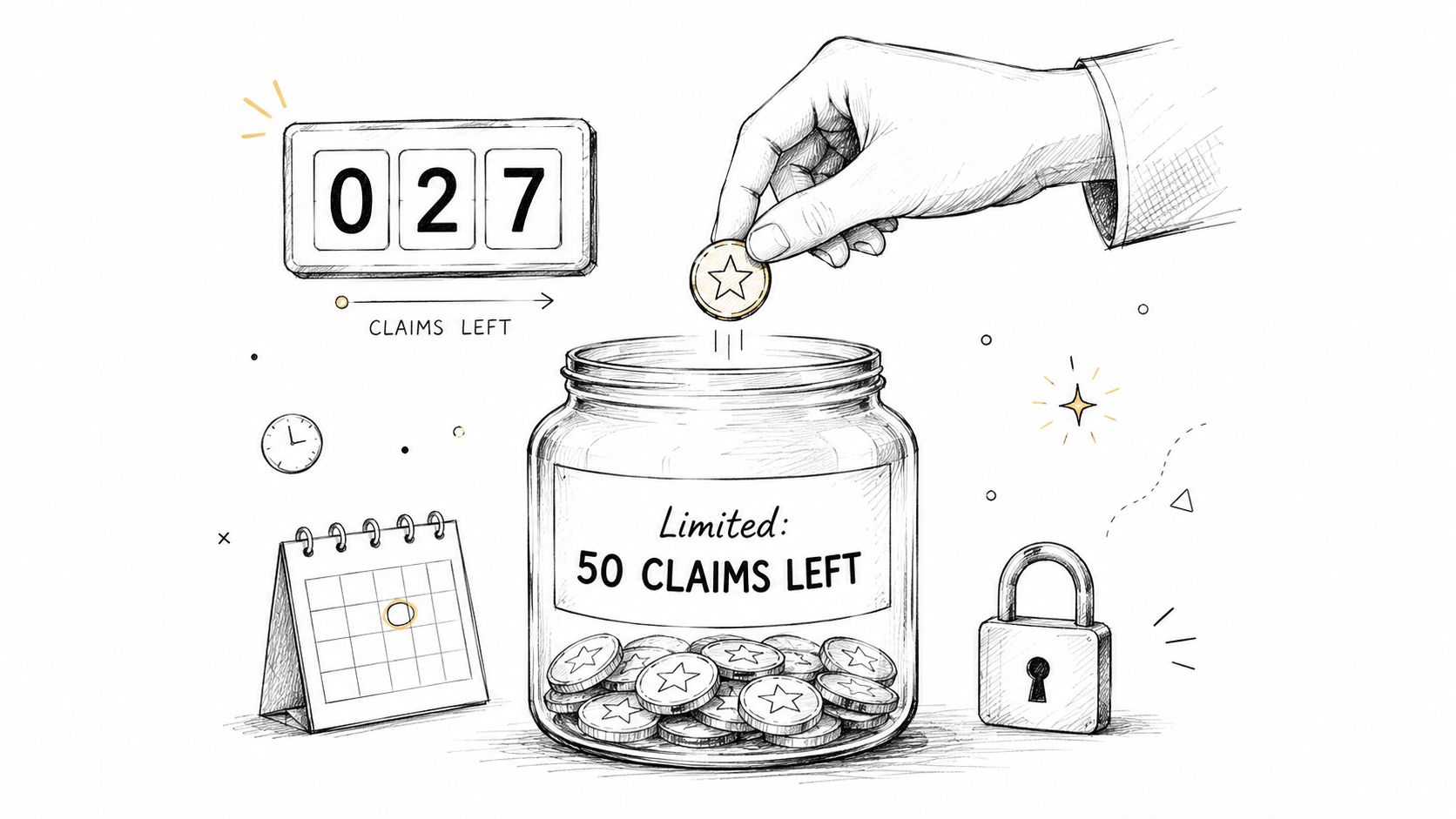
Most urgency fails because shoppers can smell when it’s fake. A timer that resets. A “limited” deal that returns next weekend. A banner that says stock is low while the offer runs all month. Quantity caps solve that because they create an actual boundary.
A luxury skincare brand can offer an exclusive serum as a value-add for the first group of qualifying orders. A DTC apparel brand can limit early access to a new drop for a fixed pool of subscribers. A hardware brand can cap code redemptions so the offer doesn’t spread endlessly through coupon sites and cheapen the line.
Scarcity works when the limit is believable
Scarcity bias is simple. People move faster when they know availability is finite. But the cap has to be real, visible, and enforced. If your Shopify store tells shoppers there are limited claims left, the count can’t refresh or reopen under the same terms a day later.
Real scarcity builds trust. Fake scarcity burns it.
The other advantage is operational. A cap limits your exposure. You know the maximum number of redemptions, which makes margin planning cleaner than an open-ended promotion that can get copied, stacked, or shared beyond your target audience.
Use the claim pace as feedback. If the offer closes quickly, demand and message are aligned. If it stalls, the issue is usually the proposition, the audience, or the page context, not just the incentive. If you want a sharper framework for designing this well, Quikly has a useful breakdown of the scarcity principle in marketing.
3. Tiered Discounts That Step Down Over Time
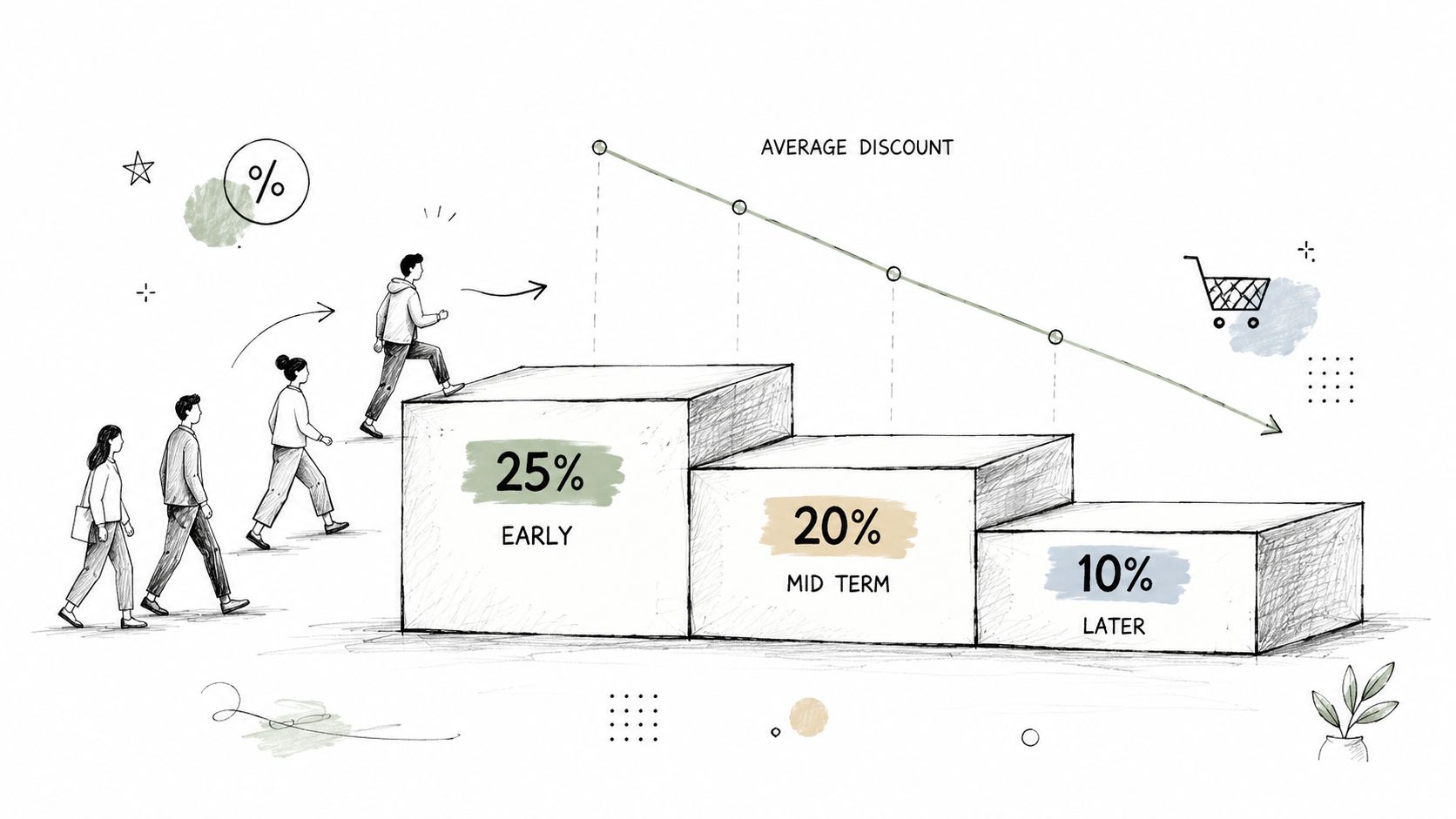
If you want urgency without making the whole campaign expensive, start high and step down. Early claimers get the strongest reward. Later shoppers still get something, just not the same economics.
This works because it flips the usual customer calculation. Instead of waiting for a better sale, shoppers know the best version is available first. An athleisure brand can open a new collection promo with the best reward reserved for the earliest claimers, then reduce the incentive for later tiers. A beauty subscription brand can use the same structure to pace acquisition while keeping cost of goods under control.
The average discount gets lighter as volume grows
That is the core margin advantage. Your offer becomes cheaper at scale instead of more expensive at scale. You also give email and SMS a natural sequence. First message announces the best tier. Follow-up messages communicate that the stronger tier is gone and a smaller one is still live.
This mechanic also plays well with social proof. If shoppers can see that claims are moving, they understand why waiting costs them. That’s loss aversion doing useful work. They aren’t just chasing a discount. They’re trying not to miss the best version of the offer.
For Shopify operators, the challenge is automation. The storefront has to switch tiers cleanly, and the messaging has to stay consistent across the PDP, cart, email, and landing pages. Manual swaps introduce errors fast. If you run this format, watch where shoppers drop between tiers. That tells you whether your first step was compelling, your later steps were still attractive enough, or the value collapsed too sharply.
4. Short Time-Window Promotions That Actually End
Friday afternoon, revenue is soft, and someone suggests a 48-hour sale. That can work. It only protects margin if the window is real, the reason is clear, and the offer disappears on schedule.
The failure mode is familiar. A store runs the same weekend promo again and again, customers catch the pattern, and the temporary price becomes the expected price. Once that happens, the clock stops influencing behavior. You’re just discounting on a calendar.
Keep the window short and the purpose specific
Short promotions need a defined job. Clear seasonal inventory before the next drop. Give early buyers access to a new product. Reactivate a segment that has gone quiet. “We need a sales bump this week” is not a strong enough reason, because shoppers can feel when an offer exists for the brand’s convenience rather than their benefit.
A fashion brand might run a weekend-only bundle during a season change, where the bundle solves a merchandising problem as much as a conversion problem. A subscription brand can open access to a new tier for a brief launch period, then close enrollment. In both cases, the mechanics matter less than the follow-through. If the same terms reappear a few days later, customers learn to wait.
Operational note: End times need enforcement across the site, email, SMS, paid ads, and support scripts. If one channel keeps showing expired terms, credibility drops fast.
One behavioral detail is worth testing. NetSuite’s sale promotion guidance notes that precise discounts such as 14.5% can feel more event-based than a round number like 15%. That small shift can make the offer read as temporary instead of evergreen.
If you want urgency without training customers to hold out for another markdown, this guide on creating urgency without discounts gets the framing right. Strong short-window campaigns use timing with intent. They do not use urgency as a substitute for offer quality.
5. Social Proof and Visible Claim Momentum
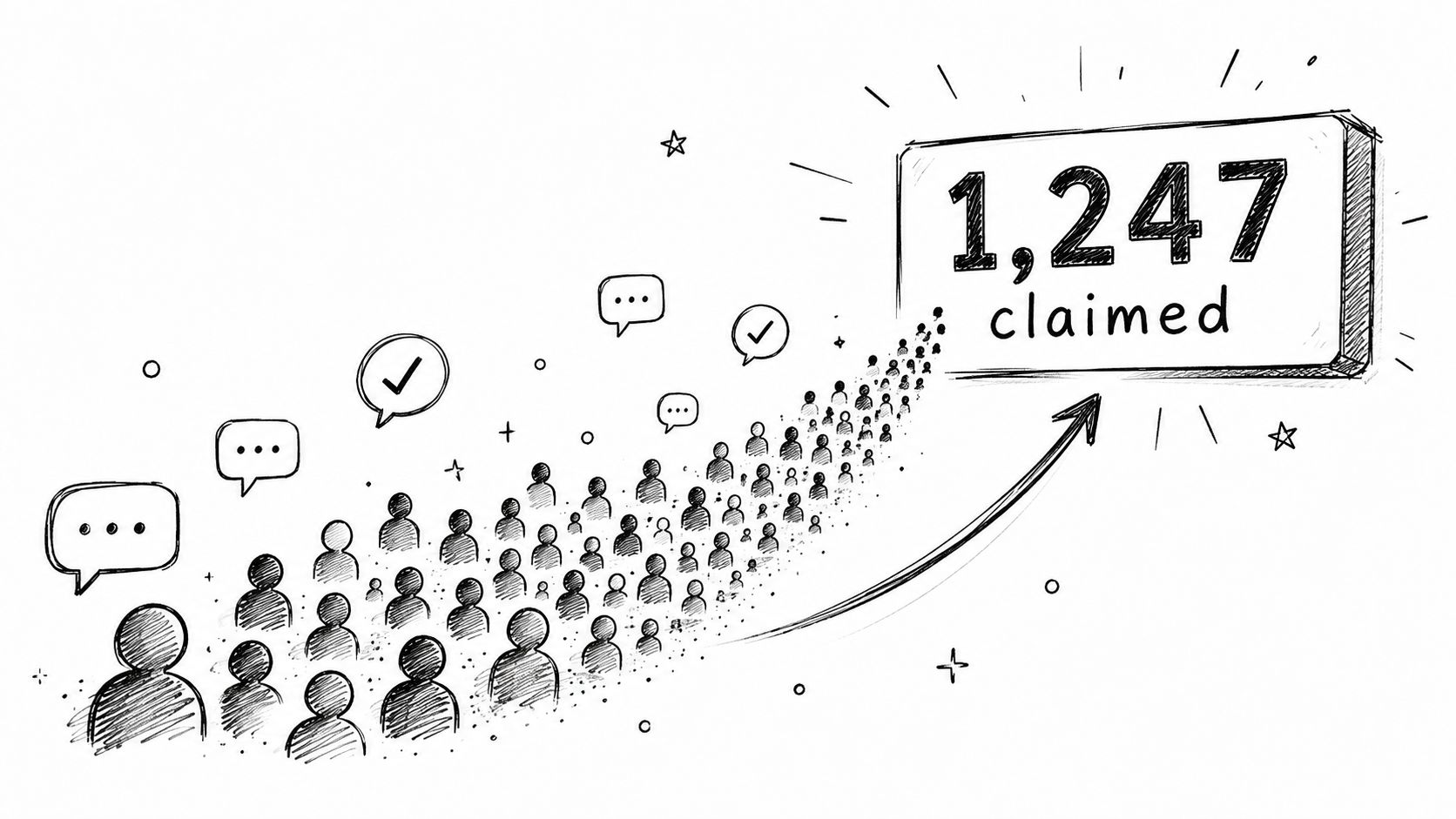
People hesitate less when they can see that other shoppers are moving. That’s not hype. It’s basic social proof. If a customer is on the fence, visible participation reduces the feeling that they’re taking a risk alone.
This can be as simple as showing live claim momentum on an offer, or signaling that a reward pool is being actively claimed. For a limited-edition drop, visible participation helps reassure shoppers that the release is wanted. For a membership push, showing that other customers are joining the promotion can make the offer feel more credible than a static coupon field ever will.
Show momentum, not noise
The key is accuracy. If the count is fabricated or disconnected from actual behavior, the tactic backfires. The best versions update credibly and support the wider story of the campaign.
A wellness brand, for example, can surface participation on an early-access bundle. A home goods brand can highlight that a capped reward is being claimed across the day, then use email or SMS to announce milestones and reactivate interest.
- Use milestones carefully: “A new claim tier just opened” works better than shouting volume without context.
- Pair proof with scarcity: Momentum matters more when shoppers understand there is still something meaningful to miss.
- Shift the framing when uptake is slow: If participation is still building, emphasize remaining availability instead of pretending the crowd is already there.
This is one place where behavior-driven promotional experiences have an edge over generic storefront add-ons. The proof isn’t bolted on after the fact. It’s connected directly to claim activity, which makes the social signal feel earned.
6. Attribute-Based Targeting Instead of One Offer for Everyone
The fastest way to waste margin is to give the same incentive to people with very different intent. Returning customers who already know the brand are not the same as first-time visitors. Highly engaged subscribers are not the same as cold paid traffic. High-value shoppers don’t need to be bribed the same way new visitors do.
Margin-protecting promotions increasingly move away from mass discounting and toward precision promotions that use customer data to personalize incentives, replace broad markdowns with alternatives like loyalty rewards or early access, and suppress discounts for loyal customers who would pay full price, as explained in this piece on precision promotions.
Match the incentive to the segment
On Shopify, the easiest split is usually first-time versus returning. From there, you can segment by loyalty status, recent engagement, geography, or product affinity. A first-time visitor might see an introductory reward tied to completing a purchase. A repeat buyer might get early access, bonus points, or a bundle offer instead of another price cut.
That distinction protects both margin and brand perception. Loyal customers don’t need to discover that strangers got a stronger discount for no reason. They need to feel recognized in a way that doesn’t cheapen what they already buy.
Treat personalization as cost control, not just conversion optimization.
This is also where bundling helps. If you need to stimulate demand without slashing the hero SKU, pair a slower-moving product with a popular one. You move inventory, preserve the apparent value of the bestseller, and avoid teaching your best segment that every purchase comes with a blanket markdown attached.
7. Multi-Channel Sequencing Instead of a Simultaneous Blast
A lot of promotions underperform because the team sends everything everywhere at once. Email, SMS, homepage hero, paid social, paid search, push, affiliates. It creates a spike, but it also removes your ability to learn, adjust, or pace demand.
A staggered rollout gives you control. Start with the audience most likely to respond profitably, then widen distribution if the economics still make sense.
Sequence channels by intent and cost
For most Shopify brands, owned channels should go first. Email to your most engaged segment is usually the cleanest read on whether the offer has real pull. SMS can follow if the response supports it. Then you decide whether the promotion deserves homepage placement, organic social amplification, or paid support.
This doesn’t just help margin. It protects operations. If fulfillment gets slammed from a same-hour omnichannel blast, the customer experience suffers and the promo can end up costing more than the sales are worth.
A simple rollout for a seasonal accessory bundle might look like this:
- Start with engaged email subscribers: They already know the brand, so you can test message and offer quality with lower acquisition cost.
- Expand to SMS for urgency: If the first wave moves, SMS is useful for compressing decision time.
- Promote onsite after validation: Homepage banners and cart messaging make more sense once you know the offer converts.
- Use paid only if the margin still holds: Paid traffic can scale a promo quickly, but it can also magnify a weak offer and make the economics worse.
The hidden benefit is creative learning. Messaging that works in email often needs tightening before it works on social or paid. Sequencing gives the team room to improve instead of committing to one version everywhere.
8. Frequency Caps and Cooldown Periods
A promotion stops feeling special once the same customer can use it whenever they want. Over time, shoppers stop reading the offer as a reason to buy now and start reading it as your default price. That shift hurts margin first, then brand perception.
Frequency caps fix that by setting clear redemption limits. One claim per customer in 30 days. One bounce-back offer per quarter. No stackable codes on core products. Cooldown periods do the same job from another angle. They create space between incentives so customers are not trained to wait for the next one.
The goal is control. Promotions should change behavior, not rewrite your pricing.
Strong operators set these rules before the campaign launches, not after redemptions spike. A simple guardrail can do a lot of work. Keep deeper discounts off hero SKUs. Exclude customers who redeemed in the last campaign. Match the cooldown to the buying cycle, so a replenishment product gets a different cadence than a high-consideration apparel purchase. That keeps the offer relevant without rewarding the same behavior on repeat.
The trade-off is reach. Caps and cooldowns will reduce total redemptions. In many cases, that is the point. Fewer claims from better-fit customers beats a larger pile of low-quality orders that train your list to wait for discounts.
This approach also improves targeting decisions. A beauty brand can hold upgrade offers until the customer is near the expected replenishment window. A membership brand can limit premium-access perks to a fixed cadence. A fashion brand can reserve stronger incentives for lapsed shoppers instead of giving the same discount to habitual redeemers every month.
Product-level targeting matters here too. Targeted markdowns on aging inventory protect margin better than broad storewide sales because they solve a specific merchandising problem without cutting price across the entire catalog. If last season’s coats need help, promote those. Leave full-price bestsellers alone.
Offer structure matters as much as offer timing. BOGO can outperform a straight percentage-off deal when unit economics support it. A 50% discount on a single item and a BOGO deal on the same item cost the exact same in margin terms, but BOGO often creates stronger perceived value. Customers focus on getting more product, while you avoid teaching them that the item’s list price is always up for negotiation.
8 Margin-Protecting Promotion Strategies Compared
| Strategy | Implementation complexity | Resource requirements | Expected outcomes | Ideal use cases | Key advantages |
|---|---|---|---|---|---|
| Earned Incentives & Behavioral Unlocks: Reward Action, Not Just Purchases | High, custom flows, in-cart UI, tracking | Engineering, UX, promotion app (e.g., Quikly), cross-channel setup | Higher AOV, more signups, protected margin vs blanket discounts | Brands focused on AOV, signups, and upsells (fashion, beauty) | Conditions rewards on beneficial actions, natural upsells, margin preservation |
| Quantity-Capped Incentives: Real Scarcity Over Fake Urgency | Medium, real-time counters and closure logic | Inventory/claim tracking, dev or app, monitoring | Genuine urgency, controlled promo exposure, reduced margin erosion | Limited releases, high-value items, early-access offers | True scarcity, limits total payout, builds trust through transparency |
| Tiered Discounts That Step Down as Claims Increase | High, multi-tier claim logic, real-time updates | Promotion automation, dev or specialized app, monitoring | Declining average discount with scale, early adoption spikes | Product launches, high-volume campaigns, referral drives | Protects margin at scale, rewards early claimers, predictable cost |
| Time-Window Urgency: Short, Non-Repeating Promotional Windows | Low–Medium, scheduling and coordination | Marketing ops, email/SMS timing, clear comms, monitoring | Concentrated traffic, reduced “wait for sale” behavior, margin protection | Flash sales, limited-time launches, weekend events | Clear finality, operational simplicity, easy A/B testing of timing |
| Social Proof and Participation Mechanics: Visible Claim Momentum | Medium, real-time display and accuracy needs | Analytics, dev integration, initial seeding, content | Higher conversion from herd behavior, improved trust | Limited drops, new products needing validation, momentum builds | Drives conversion via peer validation, marketing content from real claims |
| Attribute-Based Targeting: Personalized Incentives for Segments | High, segmentation, dynamic offer delivery | CDP/CRM, personalization tooling, data privacy controls | Better conversion per discount dollar, preserved margins | Data-mature brands, loyalty programs, differentiated audiences | Right-sized offers by segment, improved efficiency and lifetime value |
| Multi-Channel Sequencing: Staggered Promotion Rollout Across Touchpoints | Medium, coordinated timeline and attribution | Cross-channel teams, campaign calendar, analytics | Phased demand, learnings between waves, controlled volume | Omni-channel launches, major campaigns, resource-constrained rollouts | Spreads demand, enables optimization, reduces operational strain |
| Frequency Capping and Cooldown Periods: Controlling Promotional Dependency | Medium–High, identity enforcement and cooldown logic | Customer identity systems, CRM, cross-channel enforcement | Reduced promo dependency, predictable cadence, margin protection | Subscription/membership brands, repeat-purchase categories | Prevents habitual discounting, trains purchases outside promotions |
From Discounts to Experiences
Protecting margin doesn’t mean turning promotions off. It means refusing to run lazy ones.
The common thread across these sales promotion ideas that protect margin is that they ask a better question. Not “how much should we discount?” but “what action is worth rewarding?” That shift changes everything. Once the reward is tied to a behavior, reaching a threshold, claiming early, joining a list, buying within a true window, adding a complementary item, responding as an at-risk segment, the promotion starts working for the business instead of just working against margin.
Behavioral psychology helps explain why this works. Scarcity bias pushes action when availability is limited. Loss aversion makes early access and descending tiers compelling because waiting has a visible cost. Social proof reassures hesitant shoppers when they can see authentic participation. Commitment and consistency matter when a customer has already joined, claimed, or progressed toward a reward. Temporal discounting matters too. A reward that feels immediate and attainable will often beat a larger but vague future benefit.
For Shopify brands, the practical takeaway is simple. Promotions should be structured with guardrails, purpose, and a clear cost ceiling. If you’re discounting core products, define your limits before launch. If you’re using time pressure, make sure the window closes. If you’re using segmentation, reserve stronger incentives for shoppers who need them. If you’re trying to grow average order value, earn that lift with thresholds, bundles, and useful add-ons instead of defaulting to storewide markdowns.
It also helps to measure the right outcomes. Margin-friendly promotions aren’t only about top-line revenue. Watch average transaction value, uptake, basket composition, and whether promotional orders are meaningfully stronger than non-promotional ones. Those are the signals that tell you the incentive is changing behavior in a healthy way, not just buying volume you paid too much for.
Quikly fits naturally. Not as another discount widget, and not as a generic timer layered on top of the storefront. The stronger use case is turning an ordinary offer into an experience shoppers engage with, using quantity limits, time limits, descending tiers, and earned rewards that feel native to the brand. That approach has been refined across more than 60 million consumer interactions, and Jordan Craig saw roughly a 20% lift in profit with incremental lift visible immediately on activation.
Brands don’t need more promotions. They need better mechanics. When your offer rewards the shopper who acts, not the one who waits, you get a healthier mix of conversion, margin protection, and brand integrity.
Quikly helps Shopify brands turn standard promotions into urgency and scarcity experiences that shoppers respond to. If your current playbook relies on flat discounts, repetitive timers, or broad blasts that keep pressuring margin, take a look at Quikly to see how quantity-capped, time-bound, and descending-tier offers can create immediate action without making your store feel perpetually on sale.
Topics: sales promotion ideas, protect margin, ecommerce promotions, shopify marketing, conversion optimization