Traffic is expensive. Conversion is stubborn. And when the numbers don’t work, the default move in Shopify is still the same: add a discount, send another campaign, hope the volume makes up for the margin hit.
It usually doesn’t.
If you want to know how to create urgency without discounts, start by dropping the idea that urgency is a gimmick. Used well, urgency is a margin tool. It gives shoppers a reason to act now without teaching them to wait for your next markdown.
The Discounting Dilemma Why Urgency Matters Now
A lot of brands aren’t dealing with a traffic problem. They’re dealing with a decision problem. People land on the site, browse, maybe add to cart, then leave because nothing tells them why buying today is smarter than buying later.
Discounting seems like the obvious fix. It creates movement fast. It also rewires the business in ways frequently underestimated.
For a product with a 30% gross margin, a 20% discount reduces the margin to 10%, effectively cutting profitability by two-thirds, according to Reyo’s ecommerce discount strategy breakdown. That’s the part too many promo calendars ignore. What looks like a manageable offer on the storefront can wreck contribution margin on the backend.
That pressure compounds. The more often a store discounts, the more customers learn the pattern. They stop responding to the product and start responding to the calendar. Conversion becomes dependent on markdowns, margins get tighter, and the next campaign often needs a deeper cut to perform.
If this cycle feels familiar, it’s because it is. The downstream brand damage is real, and these five brand consequences of heavy discounting emerge subtly before they show up in a dashboard.
What merchants are actually fighting
- Shrinking margin because “small” discounts hit profitability harder than they appear to.
- Weak conversion because paid traffic arrives with intent, then finds no compelling reason to act now.
- Brand erosion because constant sales lower perceived value and train shoppers to hold out for the next one.
Practical rule: If your promotion teaches customers patience instead of action, it isn’t helping your business.
Urgency fixes a different problem than discounting does. A discount changes the price. Urgency changes the timing of the decision. That distinction matters if you care about revenue quality, not just order count.
The Psychology Behind the Buy Now Button
Urgency works when it aligns with how people already make decisions. It fails when brands treat it like decoration.
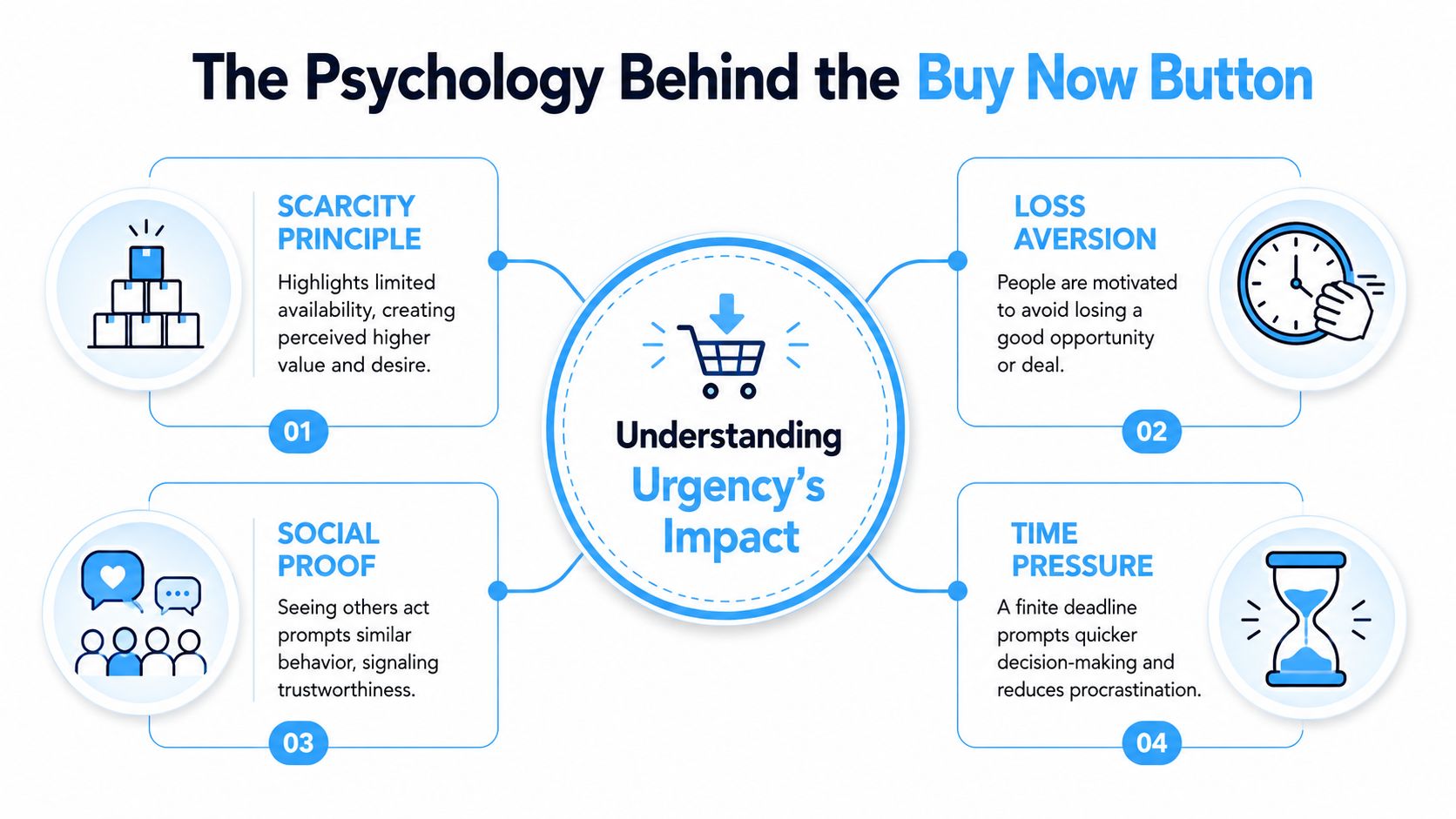
The mechanics are straightforward. People hesitate when the future feels open-ended. They act faster when availability is limited, when time is constrained, and when other shoppers signal that the choice is safe. That’s why urgency isn’t just a timer in the corner of the page. It’s a set of behavioral cues that reduce delay.
Scarcity works when it’s specific
Scarcity bias kicks in when shoppers believe access is limited. That can mean quantity scarcity, time scarcity, or both. “Only 3 left” works differently from “Don’t miss out” because one is concrete and the other is fluff.
For Shopify stores, the strongest version is tied to real inventory, real release windows, or real caps on who can claim a reward.
Loss aversion is stronger than gain framing
People hate missing a worthwhile opportunity more than they enjoy receiving a generic benefit. That’s why “first buyers receive an exclusive bonus” often lands better than another blanket discount.
The shopper isn’t just thinking about price. They’re thinking about losing access, losing priority, or losing a better version of the offer by waiting.
The best urgency answers a buyer’s silent question: why now, not later?
Social proof reduces hesitation
When a customer sees that other people are buying, viewing, or claiming something, the decision feels less risky. Social proof doesn’t replace product value, but it helps resolve uncertainty.
That matters because many product page exits aren’t objections. They’re delays.
According to Quikly’s analysis of urgency tactics, layering time scarcity, quantity scarcity, and social proof across the shopper journey has been shown to increase purchase conversion by 15–20% while preserving average order value margins.
Time pressure fights procrastination
A lot of abandoned carts aren’t rejection. They’re postponement. Time pressure narrows the window and makes the decision feel current instead of optional.
That’s where many stores get this wrong. They use generic countdowns with no context. A deadline with no reason feels fake. A deadline tied to a launch, a bonus window, a tiered release, or a limited allocation feels credible.
For a deeper operator-level breakdown of these behaviors, this overview of urgency marketing psychology is worth reading.
Actionable Urgency Tactics for Shopify Stores
The practical question isn’t whether urgency works. It’s how to build it into a Shopify store without making the site feel cheap, noisy, or dishonest.
According to CXL’s work on ecommerce urgency, 68% of online shoppers abandon purchases due to perceived lack of urgency, and time-sensitive bonuses instead of discounts increase conversion rates by 32% on average.
That tells you where to focus. Don’t start by cutting price. Start by giving shoppers a real reason to move.
Use low stock messaging only when inventory is real
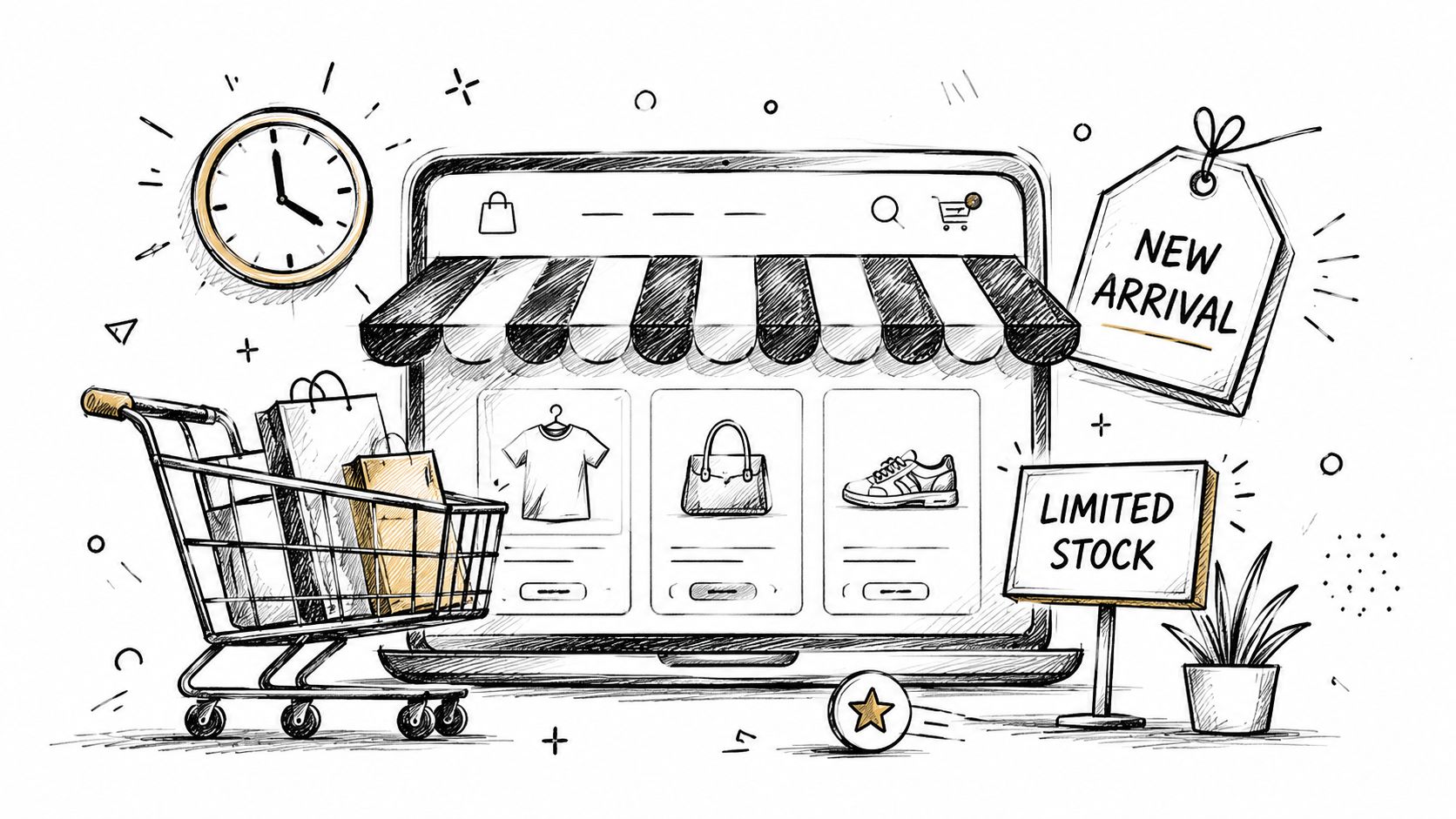
Low stock alerts are still one of the cleanest urgency patterns in ecommerce because they’re easy for shoppers to understand and easy for brands to justify, if the data is real.
Good product page copy looks like this:
- Variant-specific stock: “Only 4 left in size M”
- Current-price framing: “Only 3 units left at this release allocation”
- Popular SKU context: “Black / Large is selling fastest”
Keep it close to the add-to-cart button. Don’t bury it in a tab or scatter five different warning messages across the page.
What doesn’t work is fake scarcity. If every product always has “only 2 left,” customers catch on.
Replace discounts with bonus windows
A bonus window gives people a reason to buy now without lowering the product’s perceived value. The offer becomes about access, not price.
This works especially well for:
- Launches: “Orders placed today receive the limited launch bonus”
- Bundles: “First buyers get the travel pouch included”
- Seasonal drops: “This weekend’s orders include the exclusive colorway add-on”
The copy should be plain. Don’t write like an infomercial. State what the bonus is, who gets it, and when it ends.
Operator note: Bonuses protect the shelf price. That matters more than many teams realize when they’re trying to rebuild pricing power later.
Build short shopping windows around real events
Static “shop now” messaging rarely changes behavior. Time-bound windows do, especially when they’re tied to a product drop, restock, holiday, creator collaboration, or campaign moment already happening in the business.
Examples that fit Shopify well:
| Use case | UX pattern | Starter copy |
|---|---|---|
| New collection | Banner plus product page module | “This collection is available for the next 48 hours” |
| Restock | Email, SMS, and hero bar | “Restock access is open now” |
| Content-driven launch | Landing page plus cart messaging | “Bonus available during the live release window” |
If you use a timer, give it context. This guide to Shopify countdown timer strategy is useful because the timer itself isn’t the point. The event behind it is.
Add tiered rewards instead of one flat offer
A flat offer says everyone gets the same thing whenever they show up. Tiered urgency rewards early action.
Examples:
- First wave: “First buyers receive the full gift set.”
- Second wave: “Next group receives the mini version.”
- Final wave: “After that, the core product remains available on its own.”
This structure changes the shopping psychology. The product still holds price, but the experience rewards speed.
It also gives your email and SMS teams a cleaner story to tell over time. The message evolves as tiers move, instead of repeating the same generic promo line.
If you’re looking at conversational support during these campaigns, it helps to understand how AI chatbots transform Shopify stores. Fast answers on sizing, shipping, or availability can keep urgency from collapsing into confusion.
Use real-time activity nudges carefully
Activity nudges work best when they support an already credible offer. They’re not magic by themselves.
Useful examples include:
- Viewing activity: “Shoppers are viewing this item right now”
- Purchase feed: “Someone just bought this color”
- Velocity signal: “Sold repeatedly in the last 24 hours”
These cues reduce hesitation because they show motion. They also help on products that need a confidence nudge but don’t have heavy review volume yet.
The trap is overuse. If every page is flashing, sliding, pinging, and counting, none of it feels trustworthy.
Reserve the cart with a real timer
Cart reservation timers can be effective when inventory is constrained or a campaign has a real participation limit. They work because they make the shopper’s temporary hold visible.
The key is honesty. If you say an item is reserved for a defined period, the timer needs to correspond to an actual hold or claim window. Otherwise, it becomes theater.
Good placement is inside cart or checkout-adjacent messaging, not as a random sitewide widget. The closer the message is to an active buying step, the more useful it feels.
Implementing Urgency The Smart Way with Quikly
A manual urgency campaign usually looks fine in planning and starts breaking the moment traffic hits.
The problems are operational, not creative. Inventory has to stay accurate. Participation rules have to hold up under load. Messaging across the storefront, email, SMS, and ads has to reflect the same offer state. If any of that drifts, shoppers notice, support volume rises, and the campaign starts to feel like a gimmick.
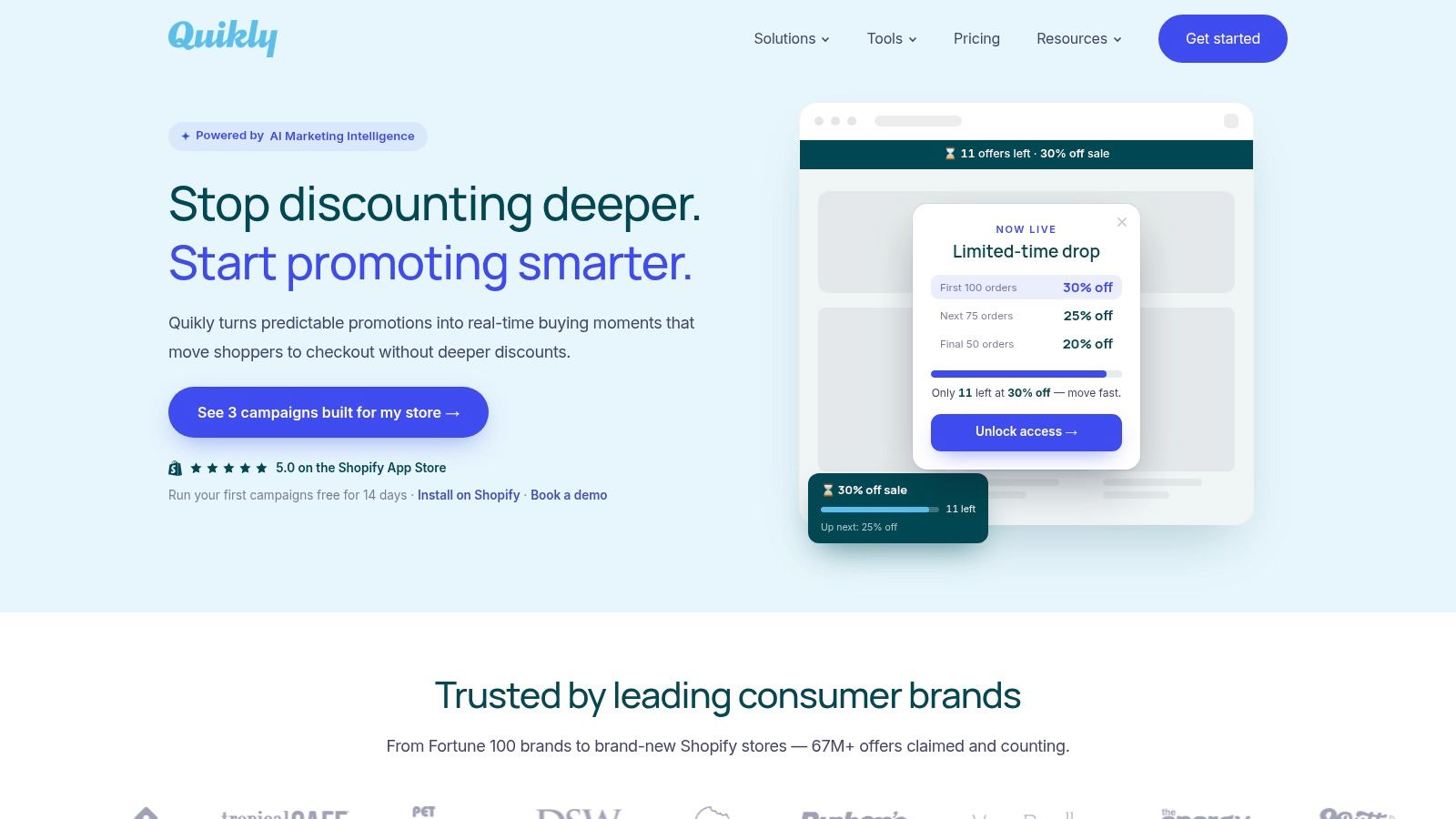
That is why strong urgency programs work best as infrastructure, not decoration. The logic behind the experience needs to be real and enforceable. A shopper should be able to see why acting now matters, what the participation window is, and what changes once the limit is reached.
On Shopify, that usually means using a system that can coordinate four pieces at once:
- Eligibility rules so only qualified shoppers can participate
- Inventory or participation caps so the campaign ends when it should
- Channel synchronization so onsite, email, SMS, and paid traffic all show the same state
- Brand control so the experience feels native to the store, not like a generic popup dropped on top
In this realm, a platform like Quikly is useful as an execution layer, not just a widget. It handles the hard part of urgency marketing. Enforcing rules consistently while keeping the customer experience clear.
That distinction matters. Plenty of tools can display urgency. Fewer can support urgency that protects margin.
The practical advantage is simple. Teams can create campaigns that reward early action without defaulting to a storewide markdown. That helps preserve price integrity, which is the whole point. Once shoppers learn that waiting gets them the same discount later, urgency stops working and margin erodes fast.
A system like Quikly is best suited to campaigns with real mechanics behind them, such as limited participation drops, first-access offers, time-bound claims, or reward structures that change based on response speed. Those formats give shoppers a fair reason to act now. They also give operators tighter control over exposure than a blanket promo code pushed to the entire list.
For lean ecommerce teams, that control is not a nice-to-have. It reduces the usual launch scramble of patching together theme edits, manual list pulls, and one-off campaign logic. More important, it makes urgency repeatable. You can run it again without retraining customers to expect another broad discount.
Used well, Quikly supports the strategy behind this article. Urgency is not a cheap trick. It is a margin-preservation tool.
Measuring Success and A/B Testing Ideas
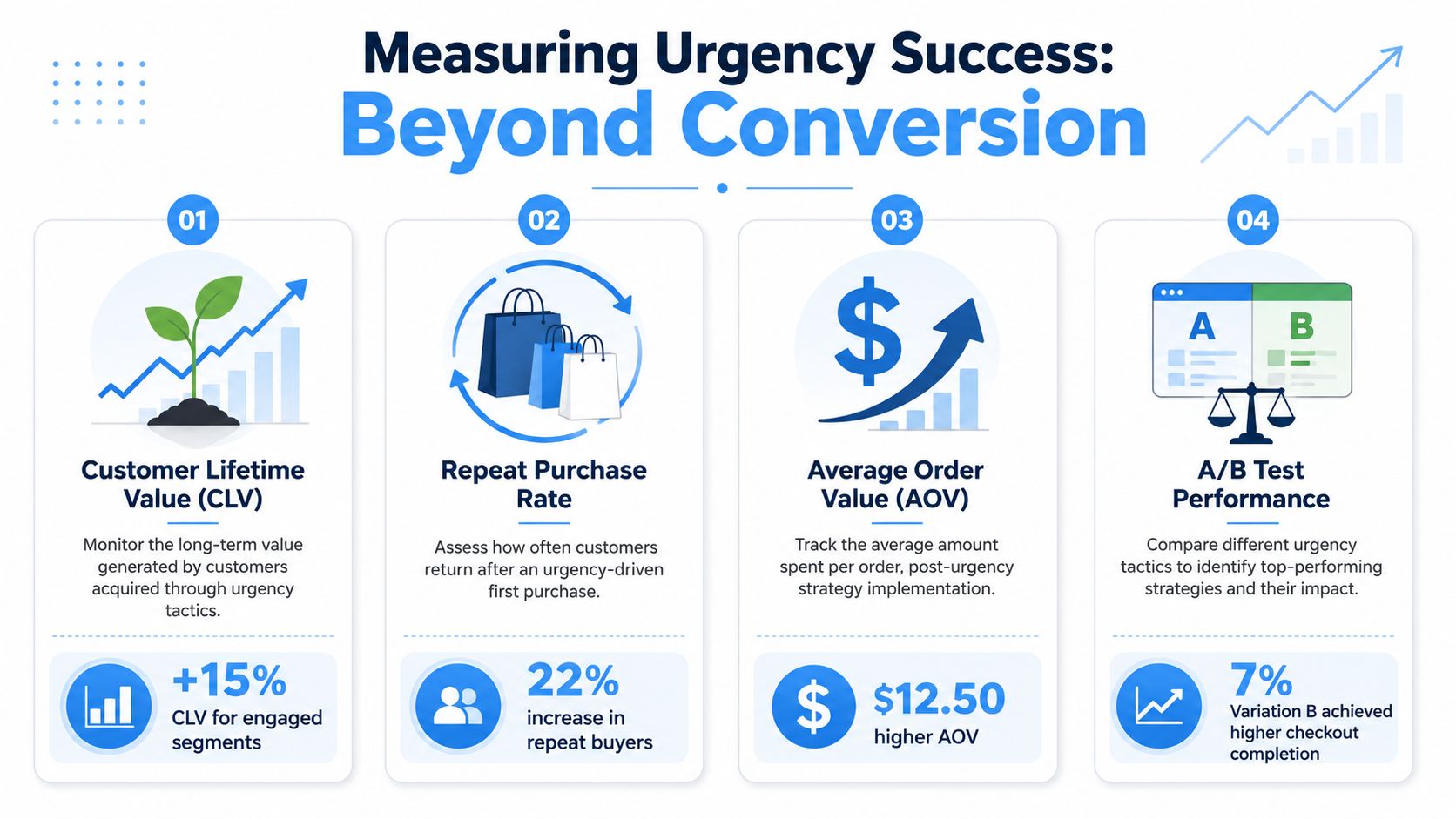
A non-discount urgency campaign can raise conversion and still be a bad promotion. If margin drops, average order value weakens, or the customers you acquire never come back, the campaign didn’t really work.
That’s why measurement needs to move past top-line conversion. The more useful question is whether the campaign created profitable demand without damaging future behavior.
The metrics that matter
Start with a short scorecard your ecommerce and retention teams can both use:
- Profit per campaign: Track contribution, not just revenue.
- Average order value: Make sure urgency isn’t pushing shoppers into smaller carts.
- Email and SMS signup growth: Useful if the campaign includes gated access or early participation.
- Repeat purchase behavior: Compare urgency-acquired customers with discount-acquired customers over time.
- Customer support friction: Watch for confusion around terms, timing, and redemption.
A qualitative review matters too. Read support tickets, on-site survey comments, and post-purchase feedback. If customers describe the campaign as clear and fair, you’re likely on the right track. If they describe it as confusing or fake, fix that first.
Smart A/B tests for Shopify teams
Don’t test ten things at once. Pick one variable, hold the rest steady, and measure both conversion and quality of revenue.
A strong testing queue looks like this:
| Test | Version A | Version B | What you’re learning |
|---|---|---|---|
| Scarcity type | Time-bound window | Quantity-bound allocation | Which constraint your category responds to better |
| Offer framing | Bonus for early buyers | Flat discount | Whether urgency can replace markdown pressure |
| Proof placement | Social proof near ATC | Social proof below product details | Where confidence cues help most |
| Reward structure | Single reward | Descending tiers | Whether progressive urgency improves action |
| Cart messaging | No reservation copy | Reservation timer with rationale | Whether protected checkout time reduces drop-off |
Track the second order, not just the first one. The cheapest first conversion often produces the weakest customer later.
What good results usually look like
The cleanest outcome is simple. More shoppers act during the campaign window, fewer need a price cut to do it, and the business keeps more of the order value.
If you see conversion improve but support issues spike, the implementation needs work. If AOV falls or customer quality declines, the urgency mechanic may be attracting the wrong behavior. The goal isn’t pressure. The goal is a faster, clearer decision.
Common Pitfalls and How to Maintain Trust
Urgency fails when brands confuse pressure with clarity.
Customers will accept real limits. They won’t forgive fake ones for long. According to Brad Harker’s analysis on authentic urgency, 76% of consumers trust authentic scarcity more than promotional discounts, and in 2025, Shopify merchants using time-and-quantity-bound promotions reported a 29% average margin improvement over peers relying on discounts. The trust piece matters as much as the margin piece.
What to stop doing
Some patterns hurt more than they help:
- Resetting countdown timers: If the clock restarts on refresh, shoppers learn the whole thing is fake.
- Using scarcity without a reason: “Ending soon” means nothing if there’s no event, cap, or deadline behind it.
- Stacking too many urgency cues: Low stock, countdown, popup, sticky bar, and purchase feed all at once makes the page feel desperate.
- Hiding terms: If the reward rules are confusing, support tickets and refund requests will tell you quickly.
What to do instead
Use urgency the same way you’d use pricing. Deliberately.
- Tie urgency to something operationally true: inventory, release windows, allocation limits, or a clearly stated bonus period
- Keep copy plain: shoppers should understand the offer in one pass
- Match the visual tone to the brand: urgency can look premium if the design is restrained
- Leave some pages quiet: not every SKU, collection, or campaign needs the same level of pressure
For apparel brands in particular, urgency works best when the product presentation is already strong. If the merchandising is weak, no countdown will save it. These visual strategies for apparel brands are a useful complement because urgency performs better when fit, style, and product confidence are already doing their job.
Authentic urgency respects the customer. Fake urgency underestimates them.
The brands that do this well don’t shout louder. They make the decision easier, the window clearer, and the reward for acting sooner more obvious.
If your team wants to drive faster decisions without giving away margin, Quikly is built for that. It helps Shopify brands run time-and-quantity-bound promotional experiences that feel on-brand, reward action instead of waiting, and turn urgency into a repeatable growth tool rather than another discount habit.
Topics: create urgency, scarcity marketing, ecommerce conversion, shopify marketing, promotional strategy