You can feel the pressure in most Shopify stores right now. Traffic is expensive, repeat promotions are getting easier for customers to ignore, and the old answer still shows up in planning meetings anyway: run another sale, add another code, send another reminder.
That playbook still produces revenue. It just produces more collateral damage than many teams want to admit. Predictable discounts compress margin, train shoppers to delay purchase, and make the brand look interchangeable with every other store doing the same thing on the same weekend.
Real time personalization matters because it changes the decision from “What promotion should we blast?” to “What experience should this shopper get right now?” That’s a much better question. It moves the conversation away from generic urgency and toward relevance, timing, and profitable action.
For Shopify brands, that shift is bigger than swapping one app for another. It affects how you capture behavior, how you interpret intent, and what kind of promotional system you put in front of a visitor when purchase intent is forming.
The End of Predictable Promotions
Most merchants already know what bad personalization looks like. It’s the product grid that barely changes. It’s the “welcome back” banner that says nothing useful. It’s the same sitewide discount offered to a first-time visitor, a loyal customer, and a shopper hovering over checkout with different reasons for hesitation.
What’s less obvious is how much damage comes from predictable promotions rather than from a lack of promotions. If your store trains customers to expect the same discount pattern, they stop responding to the message and start gaming the calendar. The sale still works on some orders, but it works by giving away margin you may not have needed to give away.
Why the old promo cadence breaks down
A lot of Shopify teams are stuck between two bad options.
| Situation | Common response | What usually happens |
|---|---|---|
| Acquisition costs rise | Push harder on discounts | Conversion may move, margin weakens |
| Conversion stalls | Add urgency widgets everywhere | Shoppers tune them out |
| Inventory needs movement | Launch broader campaigns | High-intent and low-intent visitors get treated the same |
That’s why real time personalization deserves a more serious definition than “show recommended products.” In practice, it means adapting the experience during the live session based on what the shopper is doing now, not what they did in some stale segment built days earlier.
Practical rule: If the experience doesn’t change while the customer is still browsing, it isn’t real time personalization in any meaningful ecommerce sense.
The distinction matters because timing changes behavior. A shopper who just searched, filtered, added to cart, removed an item, or hesitated on shipping is giving you much stronger intent signals than a static audience segment ever will. Treating all of that with a generic discount wastes information you already have.
Relevance beats repetition
The strongest use of real time personalization isn’t cosmetic. It’s operational. It lets a Shopify store respond to in-session behavior with content, incentives, and friction reduction that match the moment.
That could mean changing merchandising, adjusting message hierarchy, surfacing social proof, or triggering an engagement-based offer only when the behavior supports it. The point isn’t to make every page feel “personalized.” The point is to make the next action easier and more compelling without defaulting to blanket discounting.
That’s where the old model falls apart. It assumes more pressure creates more conversion. In many stores, better timing and better mechanics do more for profitability than another percentage-off campaign ever will.
What Real Time Personalization Actually Means for Shopify
Think of the difference between a strong in-store associate and a flyer taped to the front window. The flyer says the same thing to everyone. The associate notices what a shopper is looking at, what they pick up twice, what they compare, and when they start to drift away. Then they respond in the moment.
That’s the right mental model for real time personalization on Shopify.
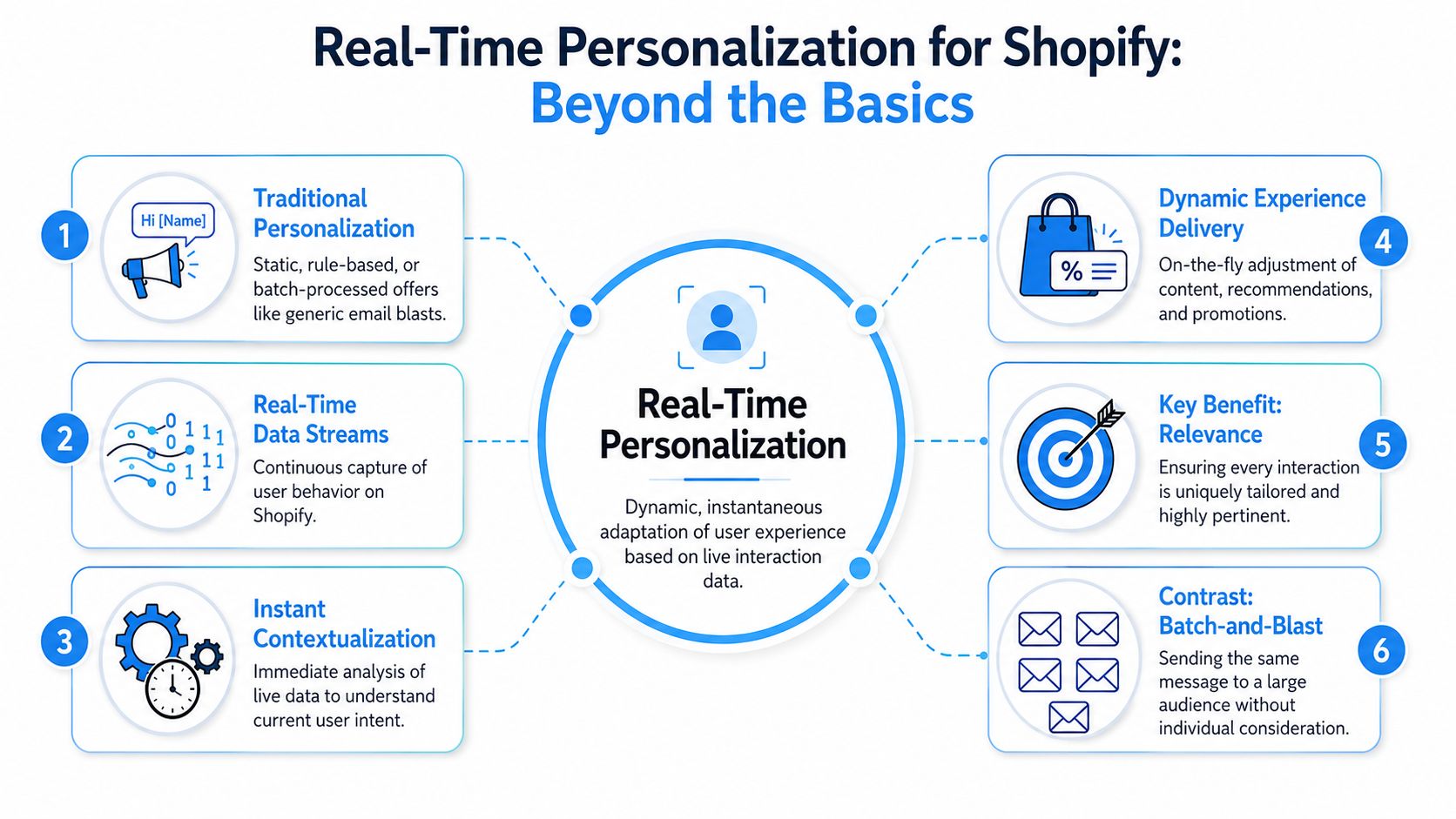
It’s not just merge tags and scheduled segments
A lot of brands are still calling basic customization “personalization.” First name insertion in email. Product recommendations refreshed on a schedule. Segments that update overnight. Those tactics can still be useful, but they don’t react to live intent.
Real time systems do. According to Envive’s analysis of real-time personalization impact, real-time personalization delivers 20% higher conversion rates than batch processing, with companies excelling at it seeing 40% more revenue than competitors who rely on delayed, scheduled updates. The same analysis notes that real-time AI engines respond within milliseconds to signals like clicks or cart additions, which is exactly when purchase intent is most valuable.
For a Shopify operator, that means the store experience can change while the shopper is still deciding. Not after the session. Not in tomorrow’s campaign. During the visit.
What that looks like in a Shopify store
Real time personalization usually shows up through a combination of signals and responses:
- Live behavioral signals like product views, search activity, cart changes, and dwell time.
- Context from the profile such as previous purchases, channel history, or lifecycle stage.
- On-site changes including dynamic content blocks, customized merchandising, or promotional logic that only appears when the behavior supports it.
A generic blast assumes everyone needs the same nudge. Real time personalization assumes the next best action depends on what the shopper just did.
This matters even more on Shopify because the app ecosystem makes it easy to bolt on point solutions without ever fixing the customer experience. You can have a recommendations app, a popup app, an email platform, and a review tool all running at once and still deliver an experience that feels disconnected.
If you’re still weighing platform flexibility against implementation complexity, this Shopify vs WooCommerce comparison is a useful read because it frames the operational trade-offs that affect how quickly teams can activate personalization ideas.
Why it’s a business strategy, not a feature
Merchants often look for a single personalization tool. That’s usually the wrong frame. Real time personalization is a strategy for using current behavior to decide what to show, when to show it, and whether the experience should persuade, reassure, or accelerate.
The stores that get value from it don’t just personalize product recommendations. They personalize the decision environment. That’s the difference between adapting the page and effectively influencing the purchase.
The Core Architecture of Real Time Personalization
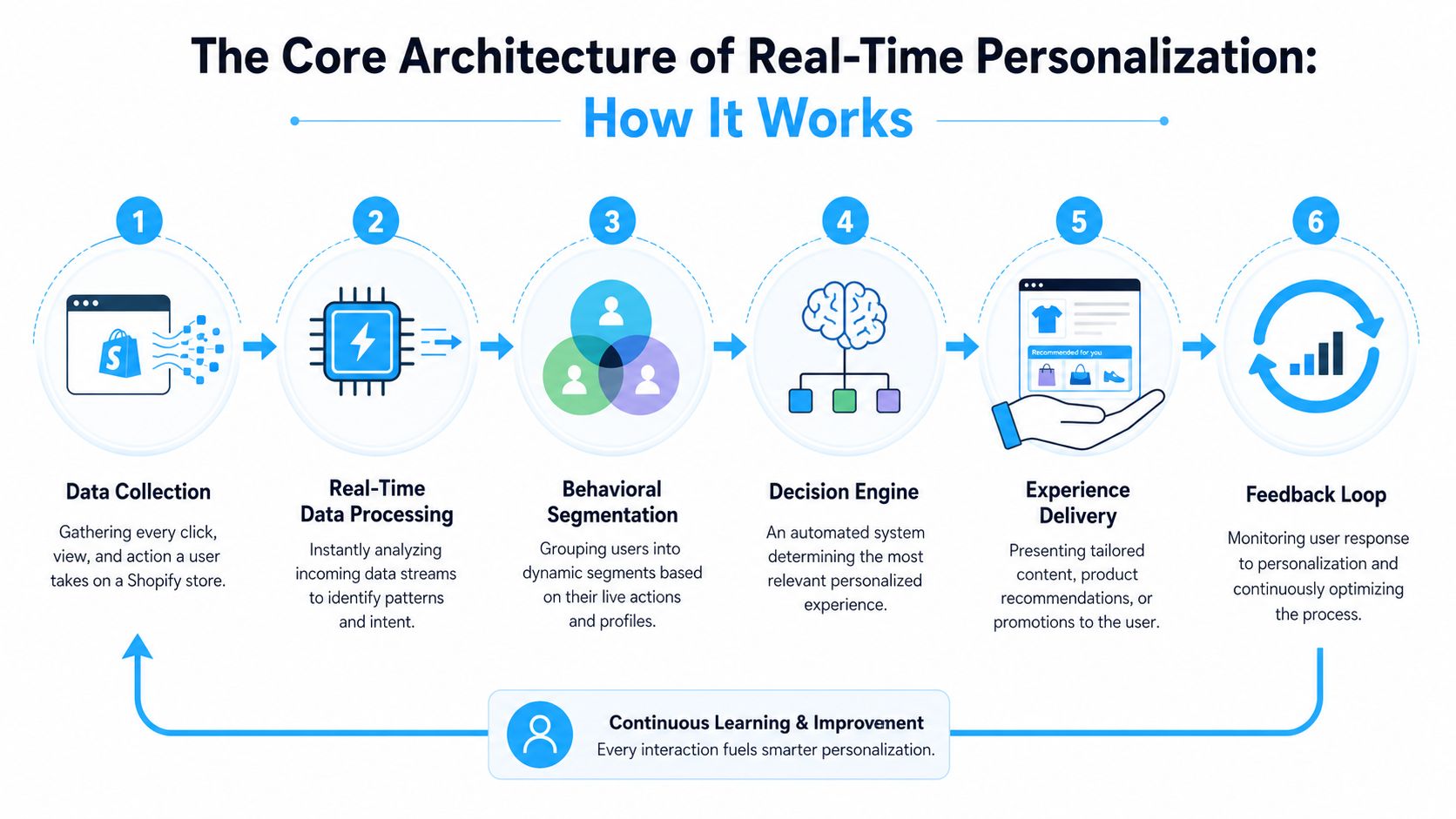
Under the hood, real time personalization is less mysterious than it sounds. The system has to do three jobs well. Capture behavior, interpret it quickly, and return something useful to the storefront before the moment passes.
If one of those breaks, the experience turns into laggy decoration or stale targeting.
The three components that matter
Bloomreach describes a capable system as a hyper-fast feedback loop that captures events, enriches them, and calculates a personalization outcome within 100 milliseconds of the user action through three core parts: an event stream, a real-time processing engine, and an API layer that returns the experience to the site. Their breakdown of what real-time personalization requires is one of the clearest practical summaries available.
For Shopify teams, that architecture usually maps to something like this:
-
Event capture
Every click, view, add-to-cart action, and search needs to be recorded as it happens. If you only rely on batch exports or delayed syncs, you lose the “right now” context that makes personalization useful.
-
Real-time decisioning
The incoming behavior gets combined with product data, inventory context, and customer history. Based on this, the system decides what matters. Is the shopper browsing casually, comparing, stalling, or showing purchase intent?
-
Experience delivery
The decision has to come back to the storefront fast enough to feel native. That response might update content blocks, reorder products, trigger a message, or swap in a promotional treatment.
Where most setups fail
The hard part usually isn’t the algorithm. It’s the plumbing.
Many teams have web behavior in one tool, CRM data in another, email engagement in a third, and Shopify order history sitting in platform reports. The result is a personalization stack that looks impressive in a demo and fragmented in production.
A good way to evaluate your own readiness is to ask a simple operational question: can your store respond differently to a shopper who just abandoned a bundle build, visited from SMS, and has purchased twice before, while that session is still live? If the answer is no, you probably have a data flow problem before you have a personalization problem.
What this means for Shopify implementation
You don’t need to become an infrastructure company to use real time personalization well. But you do need a clean view of how data moves across your stack.
A practical architecture review should cover:
- Shopify event quality. Are key storefront actions being captured reliably and in real time?
- Profile unification. Can your systems connect on-site behavior with customer history and channel activity?
- Delivery speed. Can the storefront render the personalized response without delay?
- Fallback logic. If the live decision layer fails, does the customer see a sane default experience?
If you want a non-technical overview of tools that support this layer in ecommerce, Quikly’s guide to ecommerce personalization software is a solid starting point.
The same pattern shows up beyond ecommerce. In connected TV, for example, personalized TV advertising for SMBs depends on the same basic principle: detect context, choose the right creative treatment, and deliver it quickly enough that the message still fits the moment.
Systems don’t fail because the concept is wrong. They fail because the data arrives late, arrives incomplete, or can’t be activated in session.
The Personalization Trap Protecting Margins and Brand
Personalization has a branding problem. It gets treated like an automatic good, as if any increase in relevance is positive by definition. In practice, some forms of personalization make a weak promotional strategy even worse.
The most common mistake is personalizing the discount instead of personalizing the experience around the decision.
Why discount personalization can backfire
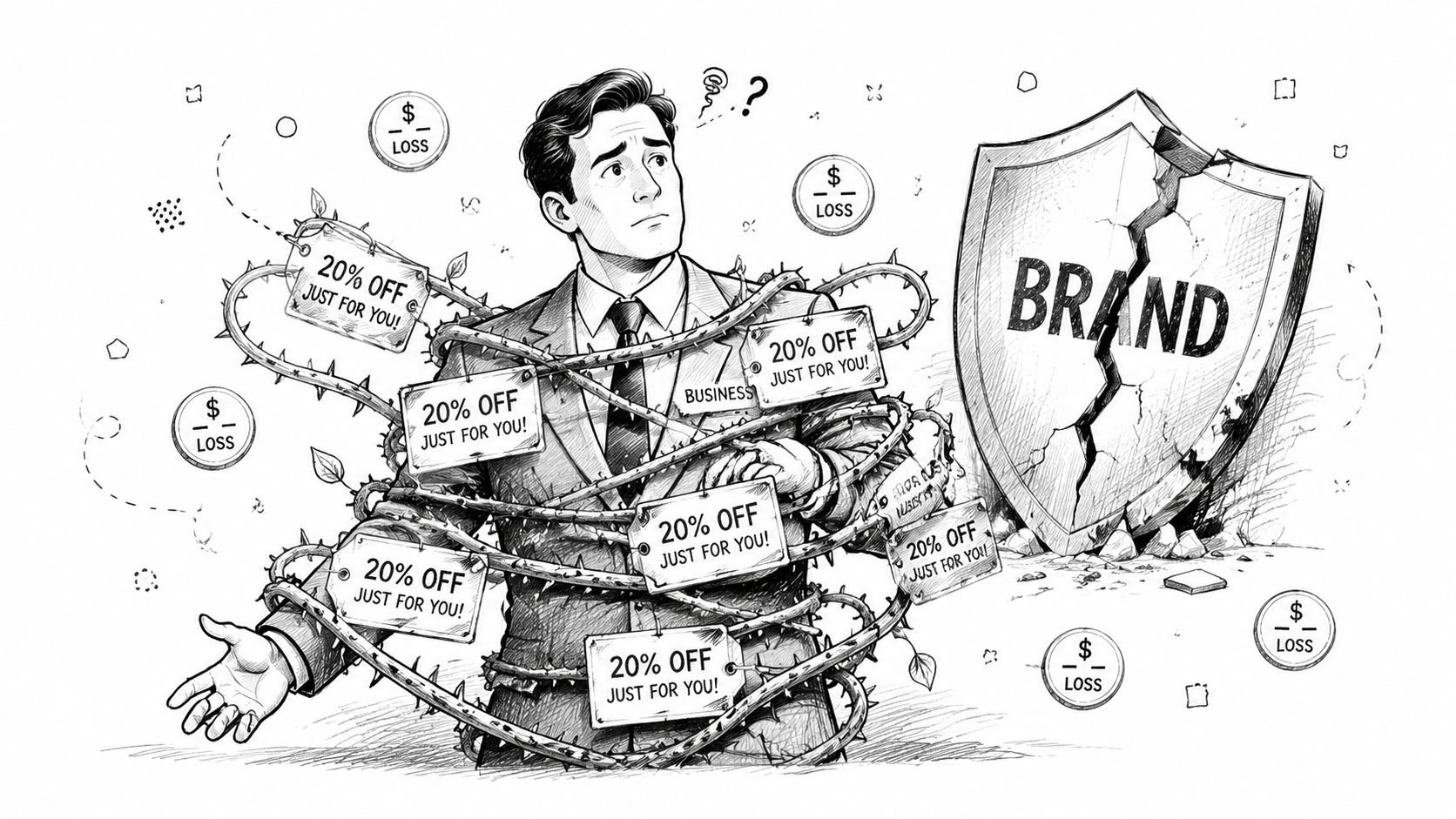
If every real-time trigger ends with “offer a deeper deal,” you haven’t escaped the discount cycle. You’ve automated it.
Tinybird identifies the financial risk in its discussion of real-time personalization and margin erosion: brands using it often default to deeper discounts, shrinking margins by 15-20%, and 65% of consumers wait for sales due to predictable discount patterns. That is the trap. More precise timing doesn’t help if the action itself keeps teaching customers to hold out for a better offer.
The sameness problem
A lot of supposedly personalized ecommerce experiences still feel identical:
- Different visitors, same incentive. One shopper gets free shipping. Another gets a modest discount. The structure is still generic.
- Recommendation-heavy, decision-light. The store shows more products but doesn’t reduce hesitation.
- Urgency without credibility. Timers and overlays appear everywhere, so customers stop believing any of them.
Better targeting won’t save a weak offer structure. It just helps you deliver the weak structure more efficiently.
Zero-party and first-party understanding become more useful than another rule set. If you know what the customer is trying to accomplish, not just what page they viewed, you can design an experience that matches intent instead of bribing every hesitation. Quikly’s overview of what zero-party data means in ecommerce is helpful here because it sharpens the difference between inferred interest and information customers intentionally provide.
What to personalize instead
The better question isn’t “How do we make the discount more relevant?” It’s “What kind of interaction will move this shopper toward purchase without lowering brand value?”
That might mean earned access, controlled reward exposure, scarcity tied to a real condition, or a promotional structure that asks the shopper to engage rather than passively receive another code. Those mechanics change how the customer experiences value. That’s far more defensible than making the markdown slightly smarter.
Shifting to Behavior-Driven Promotional Experiences
A shopper adds two full-price items, hesitates at checkout, and opens the cart again ten minutes later. Many Shopify stores answer that moment with the same move they use everywhere else: a discount. That may recover the sale, but it also gives away margin in the exact place where a better promotional structure could have closed the order without training the customer to wait for a code.
Behavior-driven promotional experiences solve a different problem than product recommendations. They decide how value is introduced, when it appears, and which actions deserve a reward. That matters because promotional personalization has a direct effect on margin protection, not just conversion rate.
Start with behavior, not segments
Insider points out in its review of real-time personalization software challenges that disconnected systems make true real-time execution hard for many ecommerce teams. On Shopify, that usually shows up in predictable ways: broad audience rules, weak timing, and incentives that fire too early because the store cannot read intent with enough precision.
The useful shift is operational, not theoretical. Ask what behavior the store should reward.
A visitor who returns to the cart twice in one session may need confidence, not a markdown. A shopper who completes a quiz or selector has shown effort and intent, which makes earned access a better fit than an automatic coupon. A customer who builds a bundle and pauses may respond to progress toward a reward because it protects price integrity better than a sitewide offer.
That distinction changes the economics. Product personalization helps shoppers find something to buy. Promotional personalization determines how much margin you keep when they are close to buying it.
What this looks like on Shopify
On Shopify, the strongest behavior-driven experiences usually sit near the product page, mini-cart, cart, or post-add-to-cart flow. Those are the moments where hesitation becomes visible and where the wrong promotion can create avoidable leakage.
Examples include:
- Engagement-based rewards tied to a meaningful action instead of instant discounts
- Credible scarcity connected to inventory, timed participation, or limited access
- Controlled exposure so high-intent shoppers see an incentive only after they signal need
- Progress mechanics that encourage completion without dropping base price for everyone
- On-brand presentation that feels native to the store, not like a generic popup layered on top
These mechanics work because they change the frame of the offer. Scarcity raises perceived value when the condition is real. Loss aversion increases response when a shopper has earned progress they do not want to lose. Commitment matters when someone has already invested attention, configured a product, or built a cart.
The most profitable personalized promotion often is not the biggest incentive. It is the one shown to the right shopper at the right threshold, with the least damage to margin.
Where Quikly fits
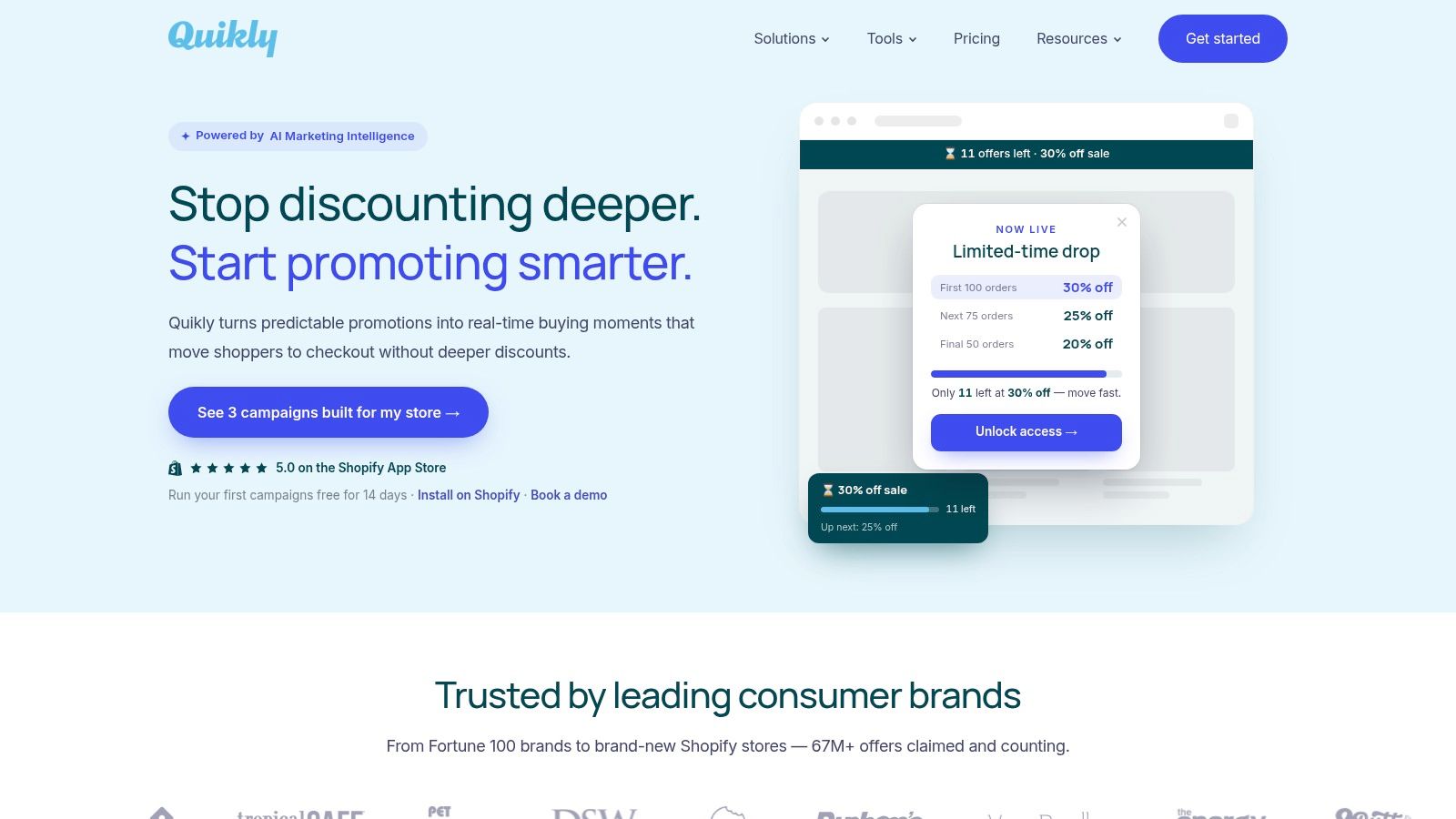
Quikly is relevant here because its model centers on psychology-based promotional mechanics such as urgency, earned rewards, and live behavioral triggers. The point is not another recommendation layer. The point is to personalize the promotional experience itself, so the store can respond to behavior with more control than a blanket discount strategy allows.
For Shopify teams, that is often the more practical path. Recommendation models can improve relevance, but they do not solve offer overexposure, weak promotional timing, or margin erosion from giving incentives to shoppers who were likely to buy anyway.
A better operating model for teams
The operating model is straightforward, but it requires discipline. Teams need clear trigger rules, limits on who sees which offer, and a scorecard that includes contribution, not just response.
| Focus area | Weak approach | Stronger approach |
|---|---|---|
| Triggering | Static segments | Live behavioral triggers |
| Incentives | Blanket discounts | Earned or conditional rewards |
| Urgency | Repetitive countdowns | Real participation and scarcity |
| Measurement | Clicks and redemptions | Profitability and purchase quality |
This is also where teams should align on measurement before launch. A useful benchmark comes from the broader set of ecommerce performance metrics that tie marketing activity to profit, not just engagement. If the personalized promotion lifts conversion but lowers order quality or conditions shoppers to wait for incentives, the program needs adjustment.
Done well, behavior-driven promotional experiences give Shopify brands more than a conversion bump. They create a tighter connection between intent, incentive, and margin.
Measuring Personalization by Profit Not Just Clicks
If your personalization program is judged mainly by click-through rate, you’ll keep building experiences that attract interaction and damage economics. The metric shapes the tactic. Teams that optimize for clicks often end up overexposing offers, overusing discounts, or rewarding behavior that doesn’t improve the business.
A more useful standard is simple: did the personalized experience create a better order without weakening margin or brand position?
The metrics that matter more
MessageGears makes the case that effective personalization depends on a centralized first-party profile, and notes that 76% of consumers report frustration when messaging doesn’t reflect their full behavior across channels in its guide to real-time personalization with centralized profiles. That’s important, but the merchant-side lesson is broader. Better data should improve decision quality, not just message precision.
For Shopify brands, the scorecard should include:
- Gross margin impact. Did the personalized treatment improve orders without unnecessary discount leakage?
- Offer dependency. Are shoppers converting because the experience is more relevant, or because you conditioned them to wait for incentives?
- Average order quality. Did the behavior improve cart composition, not just order count?
- Customer progression. Are new visitors moving toward healthier repeat behavior?
- Brand consistency. Does the experience feel intentional and on-brand across site, email, SMS, and CRM touchpoints?
If your team needs a cleaner framework for this, Quikly’s overview of ecommerce performance metrics is worth reviewing alongside your current conversion reporting.
A practical audit for your store
Often, teams don’t need more dashboards first. They need better questions.
Try reviewing your current promotional setup against these prompts:
- Which actions trigger offers today? If the answer is mostly calendar dates or broad segments, your system is still schedule-led.
- What are you personalizing? Product lists, discounts, messages, or the full purchase experience?
- Would the customer buy without the incentive? If maybe, you may be giving margin away to a shopper who already had intent.
- Does the experience improve with more data? If not, your infrastructure may be collecting signals you never operationalize.
The strongest personalization programs don’t just know more about customers. They make better economic decisions with what they know.
Real time personalization is worth pursuing on Shopify. But it’s most valuable when it protects the business from lazy promotional habits, not when it accelerates them. The stores that benefit most won’t be the ones with the most automated messages. They’ll be the ones that use live behavior to create more relevant, more persuasive, and more profitable buying moments.
If your current promotions are lifting revenue while weakening margin or training customers to wait, it may be time to personalize the experience instead of just the offer. Quikly gives Shopify brands a way to do that with behavior-driven promotional mechanics built to increase purchase conversion without sacrificing margin or brand perception.
Topics: real time personalization, shopify personalization, ecommerce conversion, promotional strategy, margin protection