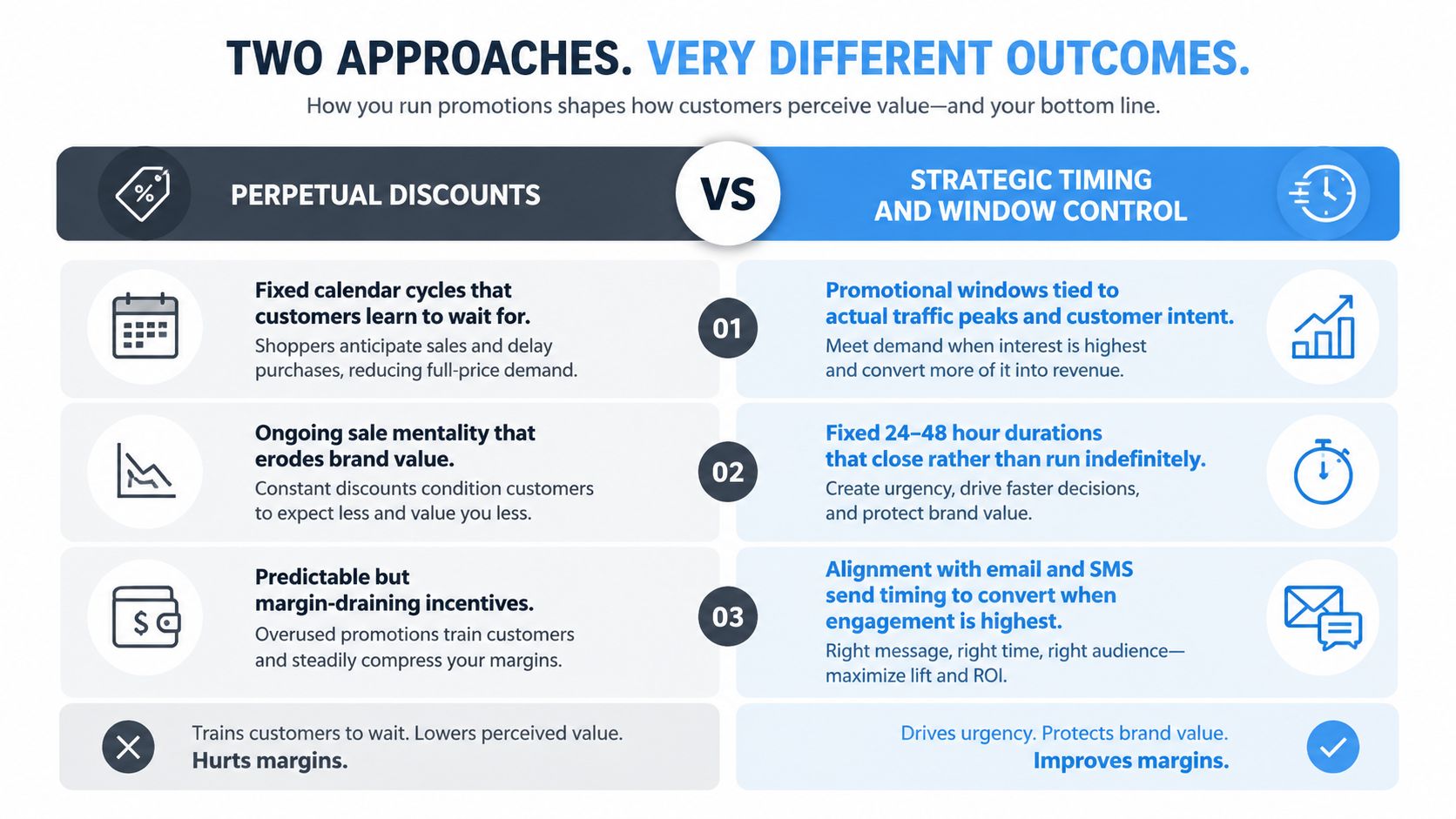
The sale habit costs more than margin. A deeper discount can rescue a slow day, but repeated markdowns teach shoppers to delay the purchase, wait for the next campaign, and question the value of the regular price. A large survey of 1,000 U.S. adults found that 91% delay purchases for discounts, 61% are willing to wait a month or longer, and 51% have abandoned an online cart hoping for a discount email. The same survey found shoppers said they needed at least 26% off on average before waiting felt worthwhile, according to the survey reference provided by CouponFollow.
That creates three problems for Shopify brands. Margins shrink, conversion remains insufficient when a promotion isn’t running, and brand perception weakens as customers learn that patience gets rewarded. Alternatives to discounting solve the same purchase hesitation through scarcity, participation, access, experience, or added value instead of relying on a permanently lower price.
The eight mechanics below are practical ways to create action without making deeper discounts your default. For each one, evaluate more than revenue. Track conversion rate, average order value, incentive cost, gross profit, list growth, and repeat behavior so you can tell the difference between profitable conversion and expensive demand pulled forward.
1. Scarcity-driven participation with capped rewards
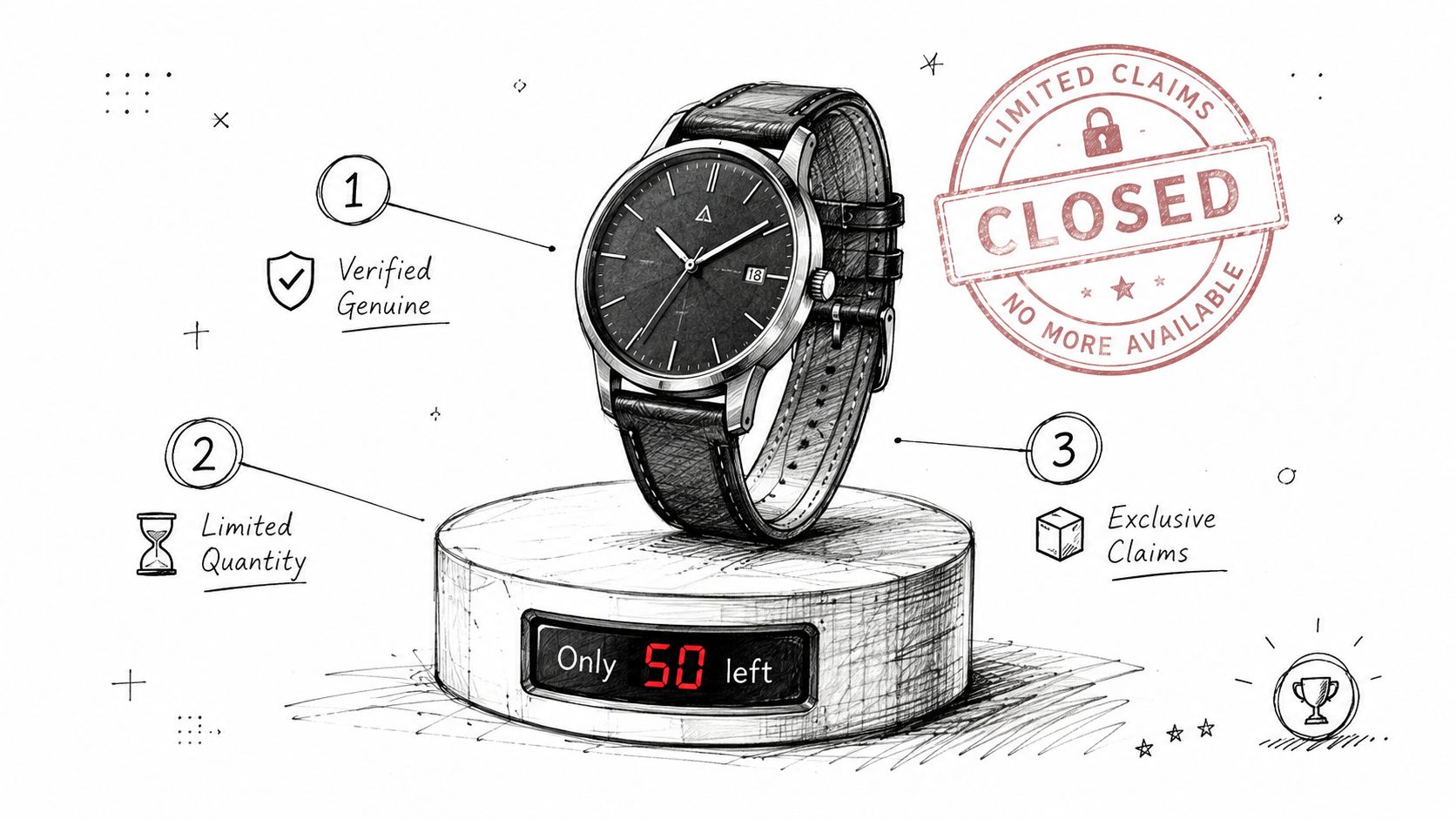
A reward available to everyone, indefinitely, gives shoppers no reason to act today. A reward that closes when its real quantity or time limit is exhausted creates a decision window.
Capped rewards work because they make access conditional on action. The cap might apply to the first group of shoppers each day, or the offer might remain open for a defined window and then disappear. The important distinction is consequence. A countdown with no operational endpoint is decoration. A reward that closes when the cap is reached gives scarcity meaning.
This mechanism draws on scarcity bias and loss aversion. People often respond more urgently to the possibility of losing access than to the prospect of receiving a lower price. Research on scarcity targeting found that a scarcity nudge was about 2.3 times more effective than a costly discount before carts were created, while a price incentive became 11.4 times more effective in the late shopping stage. The result is clear: scarcity can outperform price earlier in the journey, but the right mechanic depends on intent and timing. See the research on scarcity-based cart targeting.
Shopify execution
Build the offer around a real operational limit. An apparel brand might reward the first group of shoppers each day, refresh the cap tomorrow, and close the campaign when the allocation is claimed. A beauty brand might offer a tiered gift that changes after each claim band. A membership business could limit the number of first-purchase rewards available during an acquisition push.
Use Shopify theme blocks or an on-brand promotional experience to show the cap, the current claim state, and the closing condition. Connect the campaign to Klaviyo email or SMS so traffic arrives while the offer is active rather than relying on passive discovery.
Practical rule: Set the cap tightly enough that at least some campaign windows close before the scheduled end. If every campaign expires untouched, customers learn that the scarcity isn’t meaningful.
Measure conversion during the window, incentive cost per order, gross profit per visitor, and the share of purchases made before the cap is reached. For a deeper treatment of genuine scarcity, read how scarcity marketing changes ecommerce urgency.
2. Earned incentives tied to customer actions
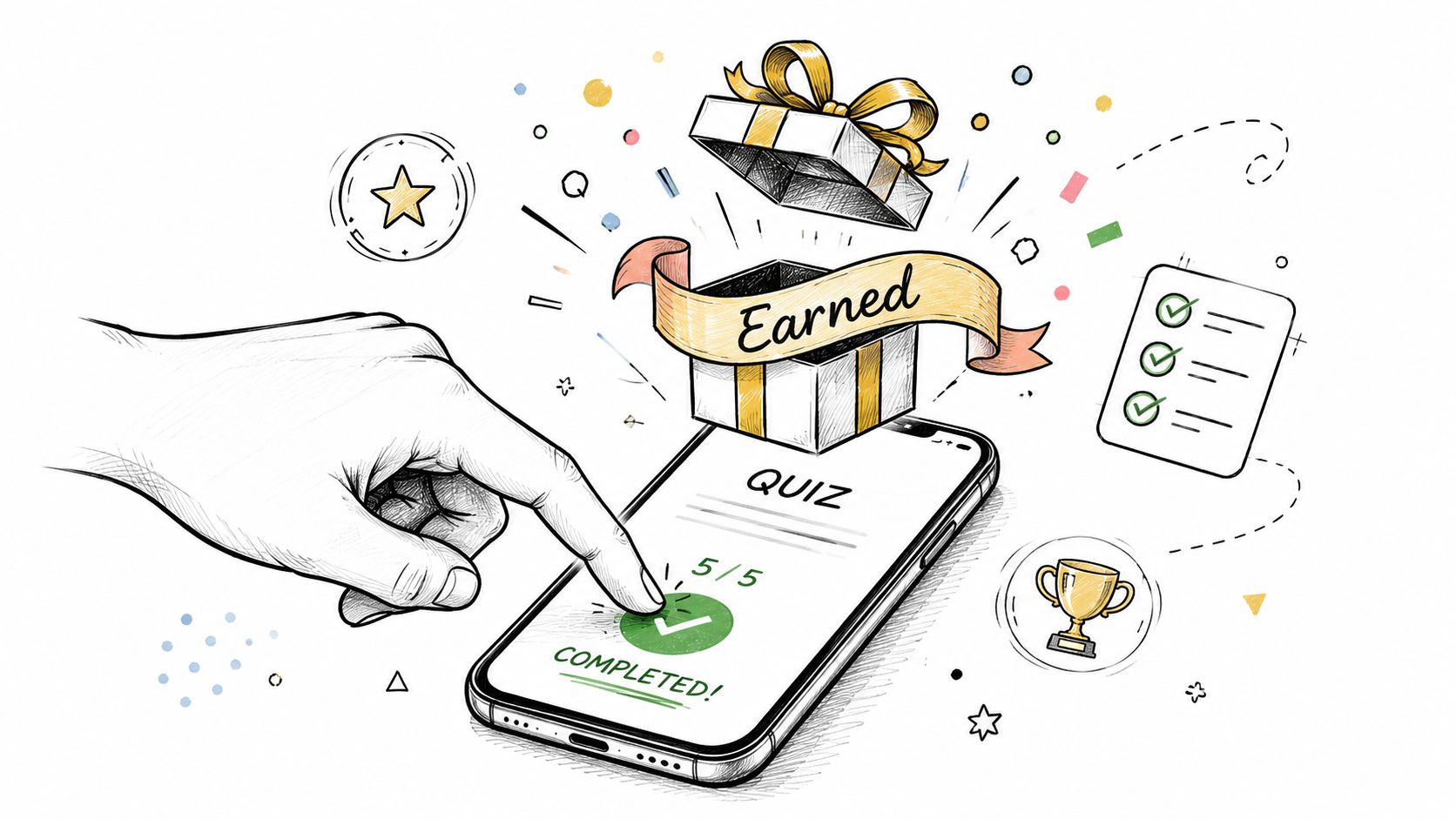
A blanket discount rewards the purchase alone. An earned incentive rewards an action that can improve the relationship, such as joining an email or SMS list, completing a product quiz, referring a friend, or reaching a minimum order value.
The customer receives a reason to participate before buying, and the brand receives something more useful than a one-time transaction. A skincare store could offer a reward after a shopper completes a skin-type quiz and opts into SMS. A fashion retailer could make the incentive conditional on both subscription and a minimum order value. A subscription box could offer a gift with the first purchase after SMS enrollment, then use the onboarding answers to segment future messages.
The psychology matters. The reward feels less like a price correction and more like a result of participation. That distinction can protect perceived value, provided the action feels relevant rather than punitive. A quiz that improves recommendations earns attention. A form that exists only to block a discount creates friction.
Make the exchange useful
Show the reward before the action, explain what the shopper gets, and keep the requested information proportionate. Don’t ask for a long survey when one preference would improve the product recommendation.
In Shopify, connect quiz answers to customer profiles and pass the relevant fields into Klaviyo or SMS segments. A shopper who identifies sensitive skin should receive product education and suitable recommendations, not a generic batch of promotional messages. A referred customer should enter a different follow-up sequence from someone who joined through a homepage form.
Track list growth, incentive cost, first-order gross profit, quiz completion, opt-out rate, and repeat purchase behavior. The right question isn’t whether the earned reward converts. It’s whether the acquired customer remains more valuable than a customer attracted by a broad, unconditional offer.
For practical guidance on connecting participation to list growth, explore reward-based email capture for ecommerce.
3. Descending tiers that reward early action
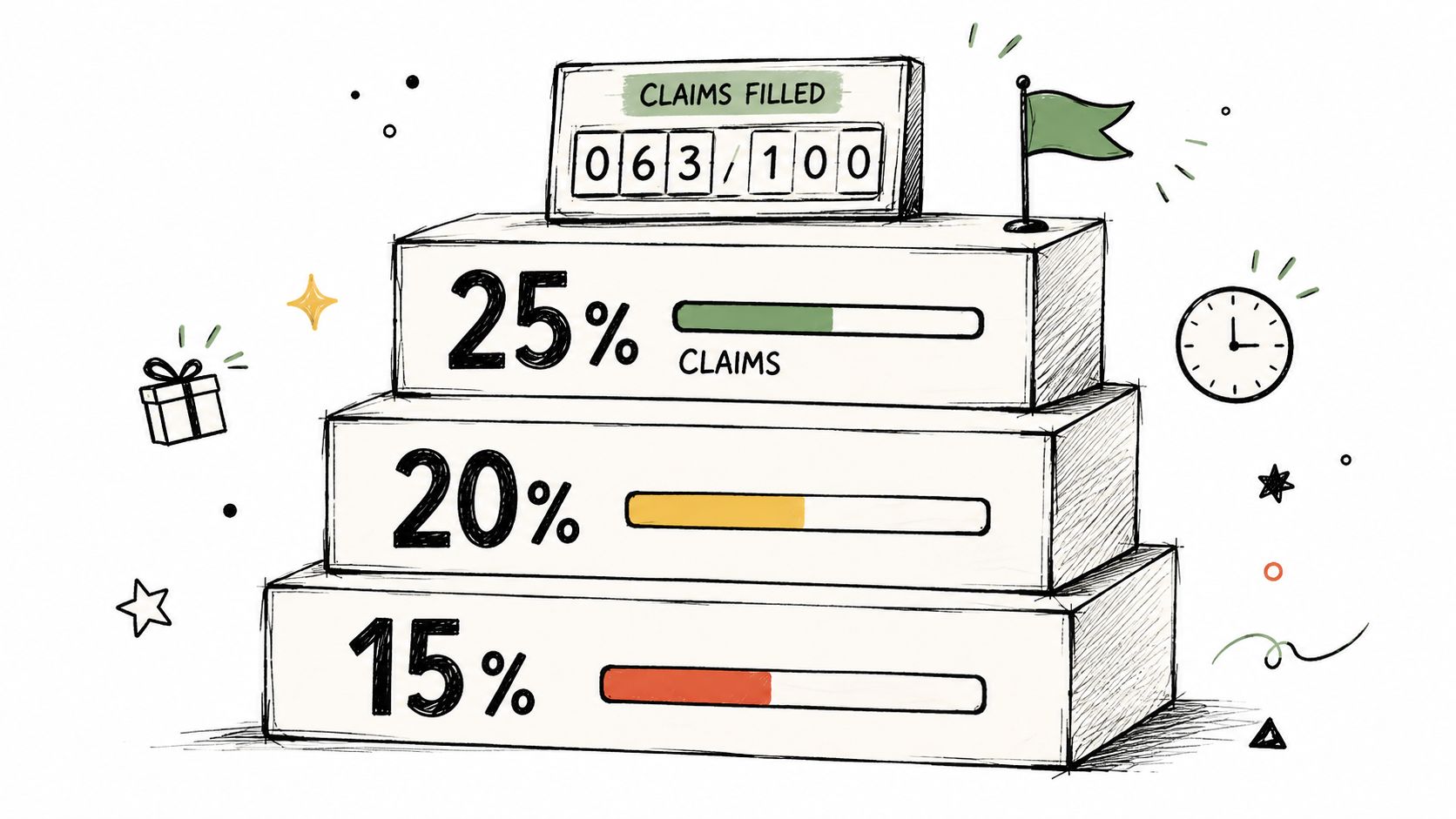
A descending-tier promotion gives the strongest reward to early participants, then steps down as more shoppers claim it. The structure creates urgency without requiring the deepest incentive for every order.
For example, a campaign can begin with a stronger reward for the first claim group, move to a lighter reward for the next group, and finish with a modest final tier. Each tier needs a clear cap and a visible status. Shoppers understand that waiting may still leave them with access, but not necessarily the best version of the offer.
This combines scarcity bias with temporal discounting. The best reward is more valuable because it’s available now. Unlike a flat discount that gives identical treatment to early and late shoppers, descending tiers make timing part of the value exchange.
Protecting average incentive depth
A home goods brand can use a short first tier around a high-traffic email send, then keep a lighter tier open for shoppers who arrive later. A Shopify Plus merchant can apply the same structure across a product launch or promotional cycle. An apparel brand can activate the campaign during a traffic spike, capture high-intent visitors early, and avoid giving the top reward to every subsequent buyer.
Set tier caps from historical traffic and conversion patterns, not arbitrary optimism. If the first tier fills immediately, demand was underestimated. If it remains open for the entire campaign, the first tier may be too large or the traffic source too weak.
- Show the current tier: Display the reward shoppers can claim now, not only the original headline offer.
- Keep a final tier: A lighter closing reward captures late demand without restarting the campaign.
- Communicate changes: Use homepage messaging, email, and SMS to explain when the campaign moves down.
- Measure margin by tier: Compare conversion, average order value, and gross profit across each reward level.
4. Social proof and participation visibility
A promotion feels different when shoppers can see that other people are participating. Showing real claim activity, remaining rewards, or campaign progress adds context to an otherwise static offer.
A beauty brand might display the number of rewards already claimed and update it during the campaign. A Shopify store could show progress through the current tier, including how many rewards remain. An SMS message can tell engaged subscribers that a tier is close to ending, provided the information reflects actual campaign state.
This works through social proof and scarcity perception. The shopper isn’t only evaluating the product. They’re also seeing evidence that other customers are acting now. That can reduce skepticism and shorten the decision window.
Accuracy is the entire point
Never fabricate participation counts. Low activity shouldn’t be disguised as a large crowd. Early in a campaign, a message focused on joining the event may be more credible than a conspicuous raw number that signals weak momentum.
Use a progress bar when the cap is finite, but make the labels understandable on mobile. A customer should know whether the displayed number refers to claims, orders, or remaining rewards. If the promotion uses descending tiers, show both the current tier and the next transition.
Participation visibility only creates trust when the numbers describe something real. Manufactured momentum turns a conversion tactic into a credibility problem.
Connect updates to campaign messages rather than sending constant alerts. Klaviyo and SMS flows can handle launch, approaching-tier, and closing messages. On the storefront, update the state often enough to feel current without making the interface flicker.
Track conversion velocity, time from landing to purchase, interaction with progress elements, and gross profit per campaign visitor. Also review customer support questions. Confusion about claim counts or eligibility is a sign that the promotion needs clearer copy, not a stronger discount.
5. Strategic timing and window control
A promotion doesn’t need to follow the calendar. It needs to meet shoppers when intent is already present.
Many brands run the same offer every Friday, every holiday, or whenever revenue feels soft. That schedule creates predictability, and predictability gives customers permission to wait. Strategic timing ties a bounded promotion to a meaningful traffic or intent signal, such as an email send, an SMS launch, a product-category spike, or a cart-abandonment sequence.
A store might send a campaign on Tuesday morning and keep the window open through the following browsing wave. An apparel brand could promote one category at a time rather than placing the entire catalog on sale. A Shopify Plus team could activate a campaign around a real traffic surge, then return to full-price merchandising when the window ends.
Match the window to the signal
Review Shopify analytics and campaign reporting to identify when visitors already show purchase intent. Look for product views, add-to-cart activity, email clicks, and returning sessions. The promotion should amplify an existing opportunity, not compensate for an acquisition problem or an unclear product page.
Use a clear end date and make the closing condition visible. If the window changes without explanation, shoppers may treat the deadline as theatre. A promotion that ends when its time or quantity limit is reached teaches customers to act within the window, not to wait for a larger sale.
- After email or SMS: Activate while engagement is fresh and measure conversion against the same audience’s ordinary campaigns.
- After a traffic spike: Target visitors already showing interest instead of discounting all site traffic.
- By category: Keep the rest of the catalog at regular price to protect price integrity.
- Between events: Maintain full-price merchandising so promotions retain meaning.
Read how campaign scheduling can align urgency with demand. Measure incremental gross profit, conversion by traffic source, revenue from full-price orders outside the window, and repeat purchase after the event.
6. Incentive variety across channels and audiences
Not every shopper needs the same reason to buy. A warm SMS subscriber, a first-time visitor from a paid ad, and a repeat customer who already knows the product have different levels of intent and different expectations.
Channel-specific and audience-specific incentives let the brand spend value where it can change behavior. Email subscribers might receive early access. SMS subscribers might get a faster-moving reward. First-time visitors could receive free shipping or a gift with purchase, while repeat customers receive product access, loyalty points, or a private preview instead of a deeper discount.
This is a practical application of relevance and commitment and consistency. A customer who has already joined the brand’s communication channel or purchased before may respond to access and recognition. A cold visitor may need stronger product proof before any incentive matters.
Build a value ladder, not a discount ladder
Shopify customer data can support segments based on acquisition source, purchase history, engagement, and order value. Keep the logic simple enough for the team to maintain. A complicated matrix that produces inconsistent eligibility will create support issues and weaken trust.
Test free shipping, gifts, points multipliers, early access, and exclusive products against pure price reductions. Non-discount rewards can preserve the headline price, but they still carry a cost. Free shipping affects fulfillment economics, gifts consume inventory, and points create future obligations.
Track incentive cost by segment, average order value, gross profit, opt-outs, and repeat behavior. Don’t judge every audience by the same conversion target. The useful comparison is whether the reward changed behavior at a lower total cost while preserving the customer’s view of the brand.
7. Engagement-based promotional mechanics
A passive discount sits in the background and waits for checkout. An engagement-based mechanic asks the shopper to do something, such as answer a product question, reveal a reward, reach a tier, or participate in a short game.
The action can make the reward feel earned and make the promotion more memorable. A beauty brand could use a short preference interaction before revealing a suitable reward. A fashion store might pair a scratch-style reveal with style questions. A subscription business could provide additional value after SMS enrollment or a referral action.
The endowment effect helps explain the appeal. After people invest attention or effort, they can place greater value on the outcome. That doesn’t mean every interactive campaign will lift conversion. It means the interaction has a job beyond decoration, it should help the customer choose, understand, or earn something relevant.
Remove friction before adding play
Keep the experience fast, mobile-first, and easy to understand. If a customer has to wait for an interaction to load or complete a long form, the mechanic becomes an obstacle. Ask for one useful piece of information, such as a product preference or communication choice, and use it in the follow-up.
Avoid generic gamification that clashes with the brand. A luxury store may benefit from an access reveal or private preview rather than a bright wheel. A playful snack brand can use a more overt game. The mechanic should feel like an extension of the merchandising, not a template placed over it.
- Use one clear action: Multiple gates make the reward feel withheld.
- Explain the outcome: Customers should know what participation can reveal.
- Design for thumb use: Test the full interaction on smaller mobile screens.
- Measure behavior quality: Review completion, conversion, order value, list growth, and repeat engagement.
The best interactive promotions generate useful customer signals and a reason to continue the conversation. The worst ones create a moment of novelty without improving the buying decision.
8. Limited experiences instead of perpetual discounts
Promotion language shapes what customers believe the event means. “Get a discount” sounds interchangeable with every other campaign. A bounded event, such as an early-access window, tier event, or customer appreciation moment, gives the promotion a specific reason to exist and reduces the expectation of an always-available deal.
This is narrative positioning and expectation-setting. Shoppers see a special occasion with a beginning and an end, rather than a permanent correction to the regular price. A direct-to-consumer brand could name a campaign a limited tier event. A Shopify store might frame a reward around customer appreciation. A luxury apparel brand could offer subscribers an exclusive preview window.
The mechanics must support the framing. A named event that runs every week, never closes, and offers the same reward becomes another routine sale. Strong copy cannot compensate for an offer with no boundaries.
Give the event a real reason
Connect the promotion to a product launch, seasonal moment, community milestone, or customer recognition. Use the event name in email subject lines, SMS messages, social posts, and follow-up communications. Customers should recognize its limits wherever they encounter it.
Vary the format without making the brand sound frantic. A tier event, preview window, and appreciation day can each communicate different value. The consistent message is that the opportunity is specific, intentional, and temporary.
A promotion earns premium treatment when the brand can explain why it exists and when it ends.
Set up the campaign in Shopify with a distinct landing page, scheduled start and end times, and a reward rule that closes when the event closes. Then measure conversion rate, average order value, incentive cost, gross profit, engagement by channel, and the share of orders placed without an incentive between events. That final measure shows whether the campaign builds demand or trains customers to wait. If each event pulls shoppers away from full-price behavior, revenue may rise while margins and brand perception weaken.
Quikly can support on-brand, time- or quantity-bound promotional experiences across a Shopify storefront, email, social, and SMS. Its campaigns can use a single reward or descending tiers, with mechanics refined across more than 60 million consumer interactions with leading brands. The operational distinction is clear: shoppers receive a reason to act now, instead of seeing a discount they can claim whenever they choose.
8 Alternatives to Discounting, Comparison
| Promotion Tactic | Implementation complexity | Resource requirements | Expected outcomes | Ideal use cases | Key advantages |
|---|---|---|---|---|---|
| Scarcity-Driven Participation: Capped Rewards | Medium, needs cap logic and real-time UI | Moderate dev/integration; email/SMS coordination | Short-term spike in conversions; lowers expectation of perpetual discounts | High-traffic launches, limited-stock items, flash windows | Genuine scarcity, margin protection, reduced promo fatigue |
| Earned Incentives: Rewards for Actions | Medium, conditional flows and data capture | CRM/automation integration; quiz/gamification assets | Growth of higher-quality contact lists; improved engagement/LTV | Email/SMS capture, onboarding, referral programs | Builds first-party data, attracts engaged customers, reduces pure discounting |
| Descending Tier Mechanics: Step-Down Rewards | High, tier logic, auto-step and visibility | Real-time UI, careful traffic planning, dev resources | Early high-intent conversions; controlled margin erosion; extended campaign life | High-volume campaigns, coordinated traffic spikes | Encourages early action, protects margin, clear consumer logic |
| Social Proof & Participation Visibility | Medium, live counts and accurate data feeds | Analytics, real-time updates, UI design | Faster decision-making, increased trust and conversion velocity | Promotions with measurable claims, social-driven campaigns | Leverages social proof, makes scarcity concrete, builds legitimacy |
| Strategic Timing & Window Control | Medium, scheduling and cross-channel coordination | Traffic analysis, campaign ops, automation tools | Higher conversion efficiency; reduces discount conditioning | Post-email sends, peak dayparts, cart abandonment recovery | Aligns offers with intent, limits duration, preserves margin |
| Incentive Variety Across Channels & Audiences | High, segmentation and multi-offer logic | Segmentation tools, creative assets, CRM sync | Lower average discount depth; better conversion per segment | Omnichannel campaigns, loyalty and high-LTV targeting | Tailored rewards, protects margin, increases relevance |
| Engagement-Based Mechanics: Interactive Rewards | High, gamification UX and mobile optimization | Design/dev, UX testing, analytics capture | Higher AOV, stronger brand affinity, more shareability | Brand-building promotions, viral/social campaigns, data capture | Creates perceived value, generates behavioral data, boosts engagement |
| Positioning Promotions as Limited Experiences | Low–Medium, narrative + disciplined execution | Marketing creative, coordinated messaging, calendar planning | Higher open/click rates; preserved brand equity; less habituation | Premium brands, email/SMS events, customer appreciation moments | Frames promotions as special events, increases exclusivity, protects brand perception |
Build promotions customers act on, not wait for
The right alternative to discounting isn’t the tactic with the flashiest conversion spike. It’s the mechanic that improves profitable conversion without making the next purchase harder to win.
Start with one high-intent traffic moment. Choose a product launch, an engaged email send, a cart-recovery sequence, or a period when shoppers are already demonstrating interest. Define the promotion’s real boundary before writing the copy. That boundary might be a claim cap, a closing time, a descending tier, or a specific customer action.
Then select one primary behavioral mechanism. Scarcity is useful when access is limited. Earned incentives make sense when email, SMS, referrals, or preference data have lasting value. Social proof helps when real participation exists. Access and non-discount rewards are often better for repeat customers who already understand the product. Don’t combine every device in one campaign. When the message contains too many conditions, shoppers spend their attention decoding the offer instead of deciding.
Measurement should include the economics behind the sale. Track conversion rate, average order value, incentive cost, gross profit, list growth, and repeat behavior. Add campaign timing, traffic source, claim velocity, and full-price purchasing between events. Revenue alone can make an expensive promotion look successful, especially when the campaign pulls forward orders that might have happened later.
The evidence supports a more disciplined approach. Consumers often delay purchases because they expect discounts, and deeper promotions can damage post-promotion brand preference when shoppers perceive them as untrustworthy. A separate study of personalized pricing reported a 25% increase in repeat purchase likelihood, compared with 15% for demand-based pricing and 10% for time-based pricing, while also emphasizing fairness, transparency, and trust as constraints. Read the study on personalized pricing and repeat purchase behavior. Personalization isn’t a license to show arbitrary prices. It works only when the value exchange is clear and defensible.
Quikly is one relevant Shopify option for turning a standard promotion into a participation-based experience bounded by time, quantity, or both. It supports storefront, email, social, and SMS campaigns and keeps the presentation aligned with the store’s brand. For a small team, that can make it practical to test urgency without building a separate promotional system or defaulting to another blanket markdown.
Choose one campaign, establish the cap or window, and compare its gross profit and repeat behavior with your usual discount. The goal isn’t to eliminate every incentive. It’s to stop rewarding patience as your primary growth strategy.
Quikly helps Shopify brands create on-brand urgency and scarcity promotions capped by time, quantity, or both, with rewards that encourage shoppers to act rather than wait. Visit Quikly to see how a behavior-driven promotional experience can support conversion, list growth, and margin discipline.
Topics: alternatives to discounting, Shopify promotions, DTC marketing, ecommerce conversion, promotional strategy