January 1 arrives with a familiar Shopify problem. December traffic has trained shoppers to wait for a deal, post-holiday demand feels uneven, and the easiest answer is often a sitewide code that cuts margin before anyone has proved they need the discount.
That approach can produce orders, but it also teaches customers to delay purchase until the next markdown. The better sales for New Year Day playbook treats urgency as the variable to design, not discount depth. You’ll see how to structure the offer, sequence email and SMS, build the Shopify storefront experience, and measure whether January demand was incremental.
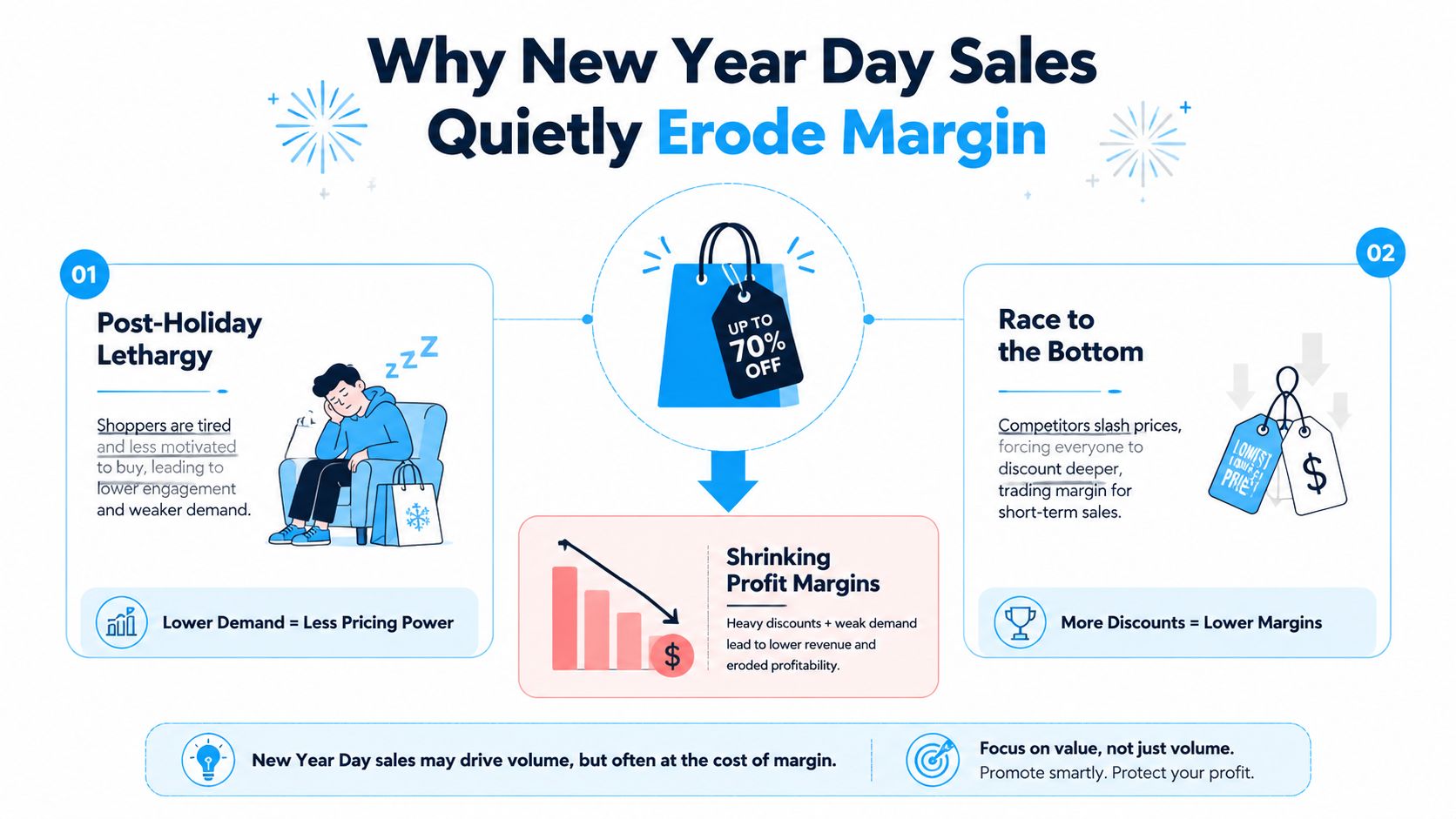
Why New Year Day Sales Quietly Erode Margin
The standard January 1 campaign is easy to recognize. A Shopify brand adds a banner, creates a discount code, sends one email, and announces a broad markdown across the catalog. When the first hours look slow, the team often responds by extending the offer or deepening the discount.
That reaction ignores the shape of post-holiday demand. January can deliver a meaningful rebound, but the shopper mindset is different from December. In the United States, retail sales and food-services spending rose 3.8% in January after falling 2.5% in December, while total retail sales were 13.0% higher than a year earlier, according to January retail spending coverage from The Daily Economy. The demand exists, but shoppers are also resting after heavy holiday spending, comparing prices, and looking for value.
The reporting trap
Revenue often hides the cost of the tactic. A discount-led campaign can show a healthy order count while average discount, contribution margin, and full-price demand deteriorate. Brand perception damage is even harder to see because customers who learn to wait may return later, but only when the next promotion appears.
The January CNBC/NRF Retail Monitor reported total retail sales excluding autos and gasoline down 1.07% month over month but up 5.44% year over year, a pattern captured in the NRF January retail monitor release. That’s why January performance should be judged by efficient intent capture, not by comparing every result with December’s peak.
Operator’s rule: A January sale should create a reason to act now, not teach the customer that waiting produces a better price.
The alternative is an urgency-led offer with controlled exposure. Limit the reward by time, quantity, or both. Give the strongest incentive to shoppers who commit early, then protect the rest of the catalog and the rest of the month from unnecessary markdowns. For a deeper look at how heavy discounting affects customer behavior and brand value, see the consequences of heavy discounting.
Designing the Offer Around Urgency, Not Discount Depth
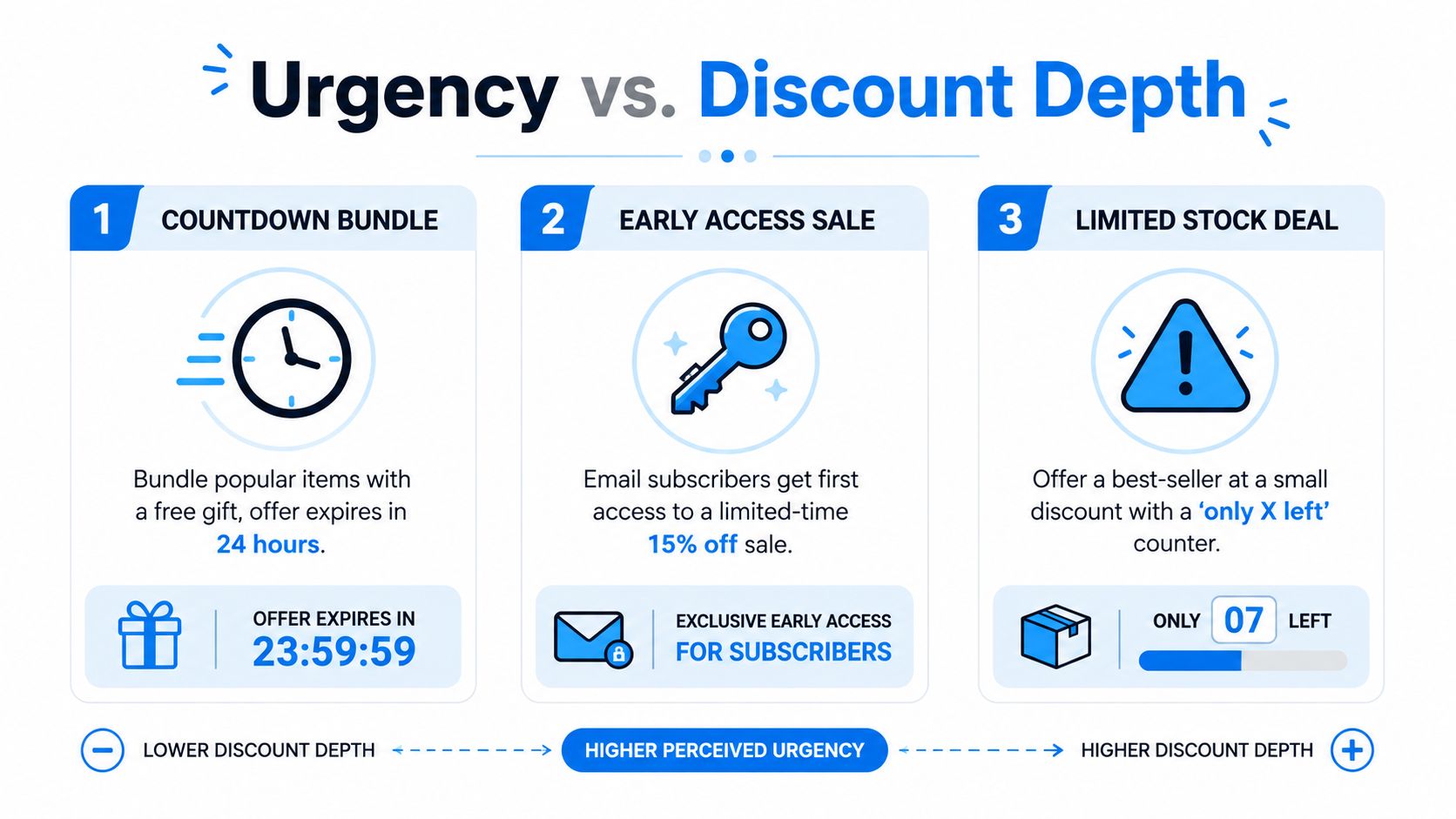
A New Year offer needs a clear answer to one question: why should this shopper buy now rather than return later? A generic percentage answers only what the shopper saves. It doesn’t create a meaningful decision window.
Three structures work particularly well for January 1 campaigns.
Capped quantity rewards
Set a fixed number of rewards and make the claim limit visible. A merchant could offer 25% off to the first 200 customers, then close the reward when those claims are gone.
This uses scarcity bias, the tendency to value an opportunity more when access appears limited. It also activates loss aversion. A shopper who has already selected a product may feel the cost of missing the reward more strongly than the benefit of receiving another generic code later.
The whiteboard version is simple:
- Audience: All storefront visitors, with VIPs notified first.
- Reward: 25% off eligible products.
- Constraint: First 200 verified claims.
- Fallback: The product remains available at its normal price after the reward closes.
This structure suits a brand with a popular hero product, limited inventory, or a strict margin floor.
Descending reward tiers
A tier ladder lets the earliest buyers receive the strongest incentive without applying that incentive to every order. One workable structure is 30% off for the first 100 claims, 20% off for the next 300, and 10% off until the timer closes.
The psychology combines scarcity with temporal discounting. People tend to value an immediate benefit more than a future one, and a visible step-down gives them a concrete cost for delay. The ladder also supports commitment and consistency. Once a visitor chooses a product and starts the claim process, a clear expiring reward gives that initial intent a reason to become a completed order.
Use this model when you have enough inventory to serve several groups but don’t want the first tier to define the campaign’s entire economics. It can also support a fresh category, such as fitness equipment, planners, or travel essentials, categories commonly associated with January resolutions in DHL’s ecommerce marketing calendar.
Hybrid time and claim limits
A hybrid offer closes when either the clock runs out or the claim ceiling is reached. For example, the first tier could remain open until a fixed afternoon deadline or until its allocated claims disappear, whichever happens first.
This format works when demand is difficult to forecast. A claim limit protects margin during a sudden surge, while the time limit prevents the campaign from lingering after urgency has faded. It also gives marketing teams a clean message for email, SMS, and social: the reward has two real conditions, and both are visible.
Choose based on inventory reality:
- Leftover seasonal stock: Use a capped quantity reward tied to the products you need to move.
- VIP appreciation: Give subscribers early access to a stronger first tier, then open a milder public tier.
- New resolution-driven category: Use descending tiers so early adopters get a reason to try the category without forcing a broad markdown.
For more offer-structure examples, this guide to limited-time offers is useful when you’re deciding how much urgency the promotion can credibly carry.
Channel Timing From Late December to Mid January
Treating January 1 as a single-day blast creates two avoidable problems. You reach planners too late, and you spend too much on people who haven’t shown enough intent to justify a short retargeting window.
New Year’s Day demand can begin shifting in November, and one holiday engagement analysis says the peak period lasts about 1.5 months, as described in Taboola’s data-backed holiday peak analysis. Use that longer intent window for awareness, but keep high-intent retargeting tighter.
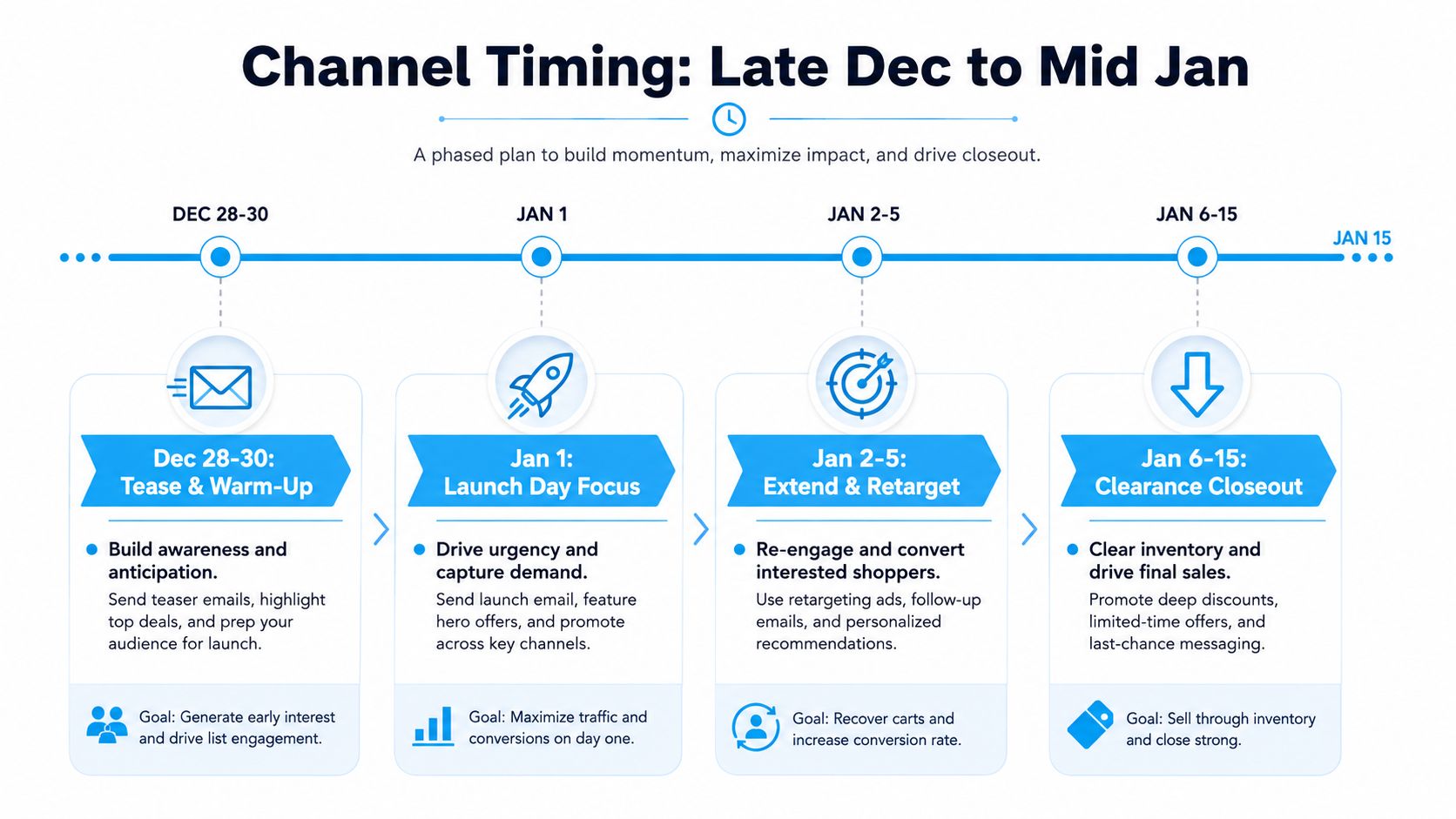
Seven to fourteen days before launch
Start warming social audiences and owned lists with the problem your product solves in January. Fitness brands can show the routine or equipment setup. Planning brands can demonstrate how the product reduces friction. Home brands can frame the campaign around a room refresh rather than a price event.
Don’t reveal every condition immediately. Build recognition first, then introduce the reward mechanics closer to launch. This gives the audience time to form intent without letting the promotion become background noise.
Forty-eight hours before January 1
Send VIP early access through Klaviyo and SMS to subscribers, recent customers, and high-intent visitors. The source guidance supports beginning holiday promotions 24 to 48 hours before public launch for VIP segments, while broader awareness and retargeting can begin 2 to 4 weeks ahead. Keep the VIP message specific: explain the claim limit, eligible products, access time, and what happens when the first tier closes.
SMS should go only to subscribers who have consented to promotional messaging. Use it for access or a meaningful status update, not repeated reminders that restate the email.
January 1 through January 5
Launch the public storefront in the morning, then retarget visitors who viewed products, started checkout, or claimed but didn’t complete their purchase. Shorten high-intent retargeting windows to 7 to 14 days, as recommended in the same holiday peak planning guidance, so the message reflects a real decision cycle.
Email should reflect behavior. A product viewer needs product reassurance and reward status. A claimant needs checkout clarity. A subscriber who never visited needs a concise introduction rather than a false impression that they missed something.
January 6 through mid-January
Send a reminder wave to engaged non-buyers only. If the offer is still open, show the current tier or remaining time. If it has closed, don’t pretend otherwise. Move the message toward a final clearance or category-specific reason to shop, rather than extending the original offer indefinitely.
A campaign scheduling workflow can help coordinate these launches and closeouts across storefront, email, social, and SMS without requiring the team to manually change each channel.
Storefront Setup, Creative, and On-Brand Execution
The offer should appear where the shopper is making a decision. A homepage hero can introduce the campaign, but it shouldn’t carry the entire conversion burden.
Use a dedicated landing page when the assortment is curated. Place the reward and its conditions above the fold, then repeat the key terms near the product grid. On product pages, show eligibility beside the price or add-to-cart area. In cart, use the space for a progress message or relevant bundle suggestion, not a second competing promotion.
Build the experience into the theme
A New Year campaign feels credible when it uses the store’s typography, color system, photography, and voice. Avoid bolting a generic overlay onto a carefully designed Shopify theme. The message should explain the reward, claim condition, eligible products, and closing rule in plain language.
For merchants producing new campaign assets quickly, a resource on unlimited design from Moonb can help the team create coordinated hero art, product tiles, email graphics, and SMS-linked landing visuals without making the January promotion look assembled at the last minute.
Shopify theme customization gives most merchants enough control for placement, styling, and product merchandising. Shopify Plus teams may have broader options for checkout and operational customization, but the core principle is the same: don’t make the customer decode the promotion across multiple screens.
Connect the campaign to lifecycle messaging
Your Klaviyo setup should recognize at least three states:
- Claimed: Confirm the reward, explain the redemption path, and remove uncertainty around checkout.
- Unclaimed: Remind engaged visitors about the active condition without sending the same message to everyone.
- Expired: Acknowledge that the reward closed and route the customer toward full-price products, a lower tier, or a separate category offer.
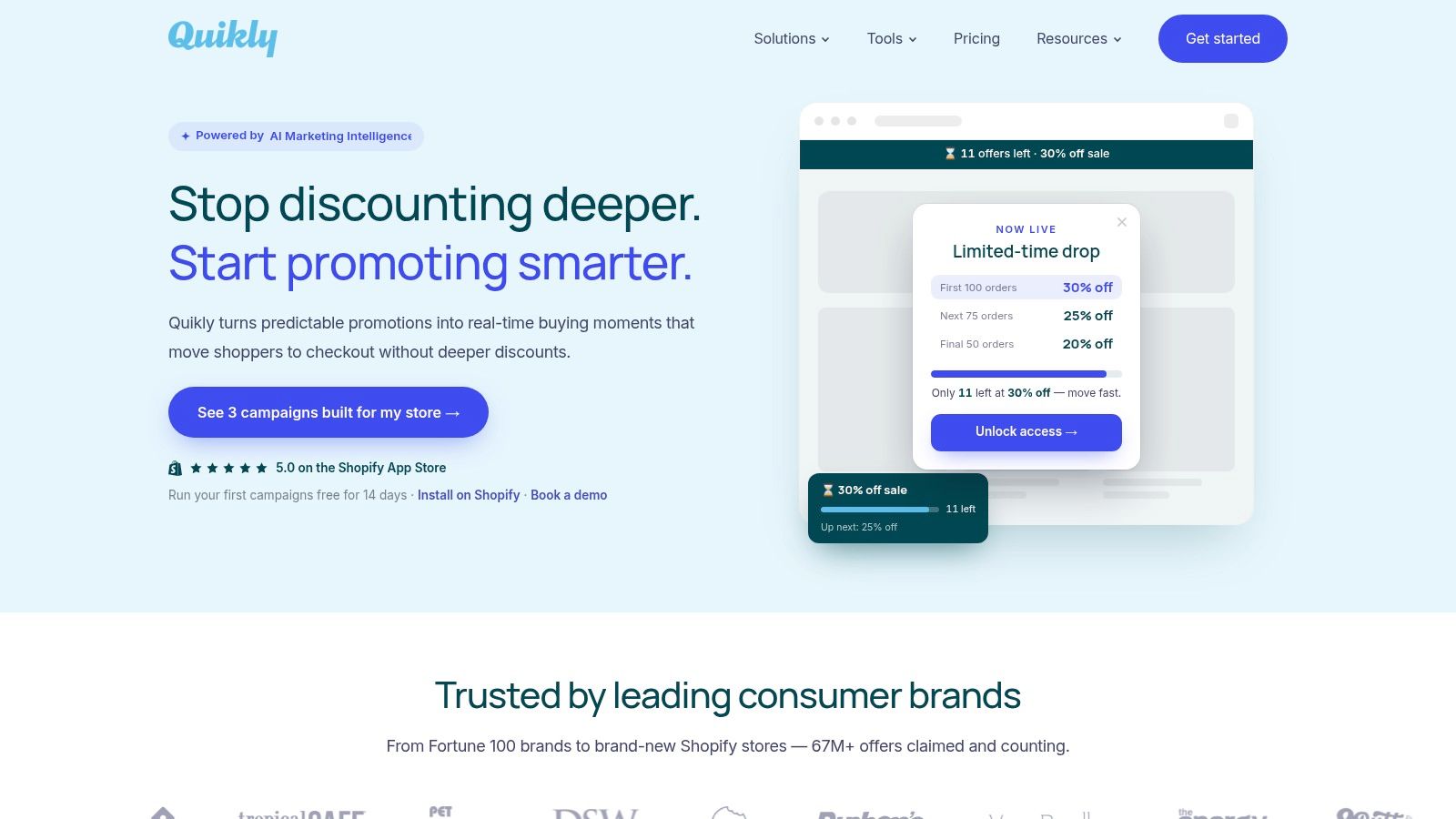
Quikly can support capped and descending rewards, time and quantity conditions, and storefront experiences styled to match the store. It can also connect the promotional experience across storefront, email, social, and SMS, which is useful for a small Shopify team that needs one campaign logic rather than separate manual rules.
Before launch, QA the entire path:
- Mobile rendering: Check the hero, reward status, product grid, and claim flow on a real phone.
- Sold-out fallback: Confirm what appears when the reward or featured product is unavailable.
- Visitor state: Verify the difference between first-time visitors, returning visitors, subscribers, and customers.
- Discount application: Test the cart, checkout, exclusions, and stacking rules.
- Expiry behavior: Confirm that the storefront and messages stop promising a closed reward.
Two January 1 Campaigns Compared
Campaign A is the familiar 40% sitewide code. The team promotes it broadly, sends traffic to the homepage, and watches sessions rise. Orders come through, revenue looks healthy, and the dashboard may suggest a successful launch.
The margin view is less comfortable. The same discount applies to shoppers who needed no incentive, returning customers who were already close to purchase, and products that didn’t need help moving. The campaign also creates a broad expectation that the brand’s normal price is negotiable. When the code is extended because the first wave slows, urgency disappears and waiting becomes rational.
Campaign B uses a descending reward capped by time and claim count. VIP subscribers receive early access, then the public sees the active tier on January 1. The strongest reward goes to early claimants, the next tier carries a lighter discount, and the offer closes when its real condition is met.
The second campaign may produce a smaller traffic spike. That isn’t automatically a weakness. Its reporting should separate claim rate, tier distribution, conversion by audience, average discount, and contribution margin. A smaller high-intent audience can be healthier if it buys with less subsidy and leaves the brand’s standard price intact for everyone else.
The useful comparison isn’t “Which campaign made more revenue?” It’s “Which campaign created profitable decisions without making the next purchase depend on another code?”
The same audience logic can later support seasonal lifecycle work. For example, a team planning post-holiday retention can review Valentine’s Day SMS automation flows to think through consent, segmentation, and event-based messaging without carrying January’s exact offer into the next holiday.
Testing and KPI Tracking That Actually Tells You Something
Don’t compare January 1 with December’s peak and call the difference campaign performance. December contains a different shopping context, different gift deadlines, and different purchase missions. A better baseline is the prior non-promo January, or a holdout segment exposed to the same storefront conditions without the urgency reward.
Track the economics beside the conversion rate. Broad ecommerce conversion benchmarks in 2026 cluster between 1.70% and 2.96%, while Shopify-specific averages are often closer to 1.4%, with top performers exceeding 3.2% and 4.7%, according to the benchmark context summarized in NRF’s January retail monitor coverage. Use those figures as directional context, not a promise that every category should reach the same result.
| KPI | Realistic Range | Why It Matters |
|---|---|---|
| Conversion rate | 1.4% to 3% for many Shopify stores | Shows whether the offer improves decision-making against a realistic January baseline. |
| Average discount depth | Track against your normal promotional level | Reveals whether added orders required deeper subsidy. |
| Claimed versus expired rewards | Compare campaign states | Shows whether scarcity was credible and whether the claim limit was set sensibly. |
| Average order value | Compare with the same audience baseline | Indicates whether bundles, tiers, or product selection raised basket quality. |
| Email and SMS capture | Track engaged non-buyers | Measures whether the campaign created a permissioned audience for later conversion. |
The table’s conversion range is a practical benchmark, not an invented target. For a merchant with a high-consideration product, a lower rate may be economically sound if the average discount and refund burden stay controlled.
Before launch, test the subject line, claim threshold, hero creative, and order of information. Use one meaningful variable per test where possible. A/B testing best practices from Figr can help keep the experiment interpretable instead of turning every campaign into a bundle of untracked changes.
Within 72 hours of closing, answer four questions:
- Incrementality: Did the offer create purchases from the holdout or shift existing intent?
- Margin: Which audience and tier produced the strongest contribution after discounting?
- Behavior: Did customers buy the promoted category, or did the reward pull demand from full-price products?
- Retention: Did engaged non-buyers become useful email or SMS prospects?
One Decision to Make Before the Calendar Turns
New Year’s Day is a margin problem dressed up as a conversion problem. The shopper may need a reason to decide, but that reason doesn’t have to be a deeper discount applied to the entire site. A capped reward, descending tier, or time-and-quantity offer can concentrate the strongest incentive on the people most willing to act now.
Make one decision before the calendar turns: choose the offer structure and write down its economic guardrails. Specify which audience receives early access, which products qualify, how many claims the strongest tier allows, when the offer closes, and which KPI can invalidate the campaign.
If you’re clearing seasonal inventory, choose the products and claim ceiling first. If you’re launching a resolution-driven category, protect the brand by starting with a controlled early tier instead of a permanent sitewide code. Then build the storefront and Klaviyo logic around that decision, rather than improvising the promotion after traffic arrives.
Quikly lets Shopify brands run time- and quantity-bound promotional experiences, including capped rewards and descending tiers, while styling the campaign to match the storefront. Visit Quikly to see how an urgency-led New Year campaign can capture post-holiday intent without defaulting to deeper blanket discounts.
Topics: new year day sales, shopify promotions, dtc marketing, ecommerce urgency, conversion strategy