A promotion can lift orders this week while weakening the economics and customer behavior your Shopify store needs next month. That’s the central problem behind the disadvantages of sales promotion. Revenue and conversion matter, but they don’t tell you whether the promotion protected profit, attracted valuable customers, preserved full-price demand, or created inventory and operational problems.
A flat discount also gives shoppers little reason to act immediately. If the same offer returns next week, waiting becomes rational. The eight risks below are connected: deeper discounts compress margin, repeated promotions train customers to delay purchases, demand becomes harder to forecast, and the brand gradually competes on price instead of value. The answer isn’t to eliminate promotions. It’s to replace predictable, margin-heavy discounting with offers that give high-intent shoppers a reason to decide now.
For useful context on promotion mechanics across ecommerce, see this overview of Amazon promotions. The same commercial question applies to Shopify merchants: did the promotion create durable demand, or did it move an order forward at a higher cost?
1. Margin Erosion from Discount Escalation
A discount can look efficient in a revenue report while becoming less efficient in the profit report. Once customers learn to expect a particular discount, the brand often has to repeat it or make the offer more generous to create the same sense of value. That turns a temporary sales tactic into a permanent pricing habit.
The pressure is especially obvious in categories where shoppers compare prices quickly. A fashion store that starts with occasional 15% offers may move toward 20% or 25% promotions as customers become less responsive. An electronics retailer can end up competing on discount depth even when the product, service, and delivery experience are stronger differentiators.
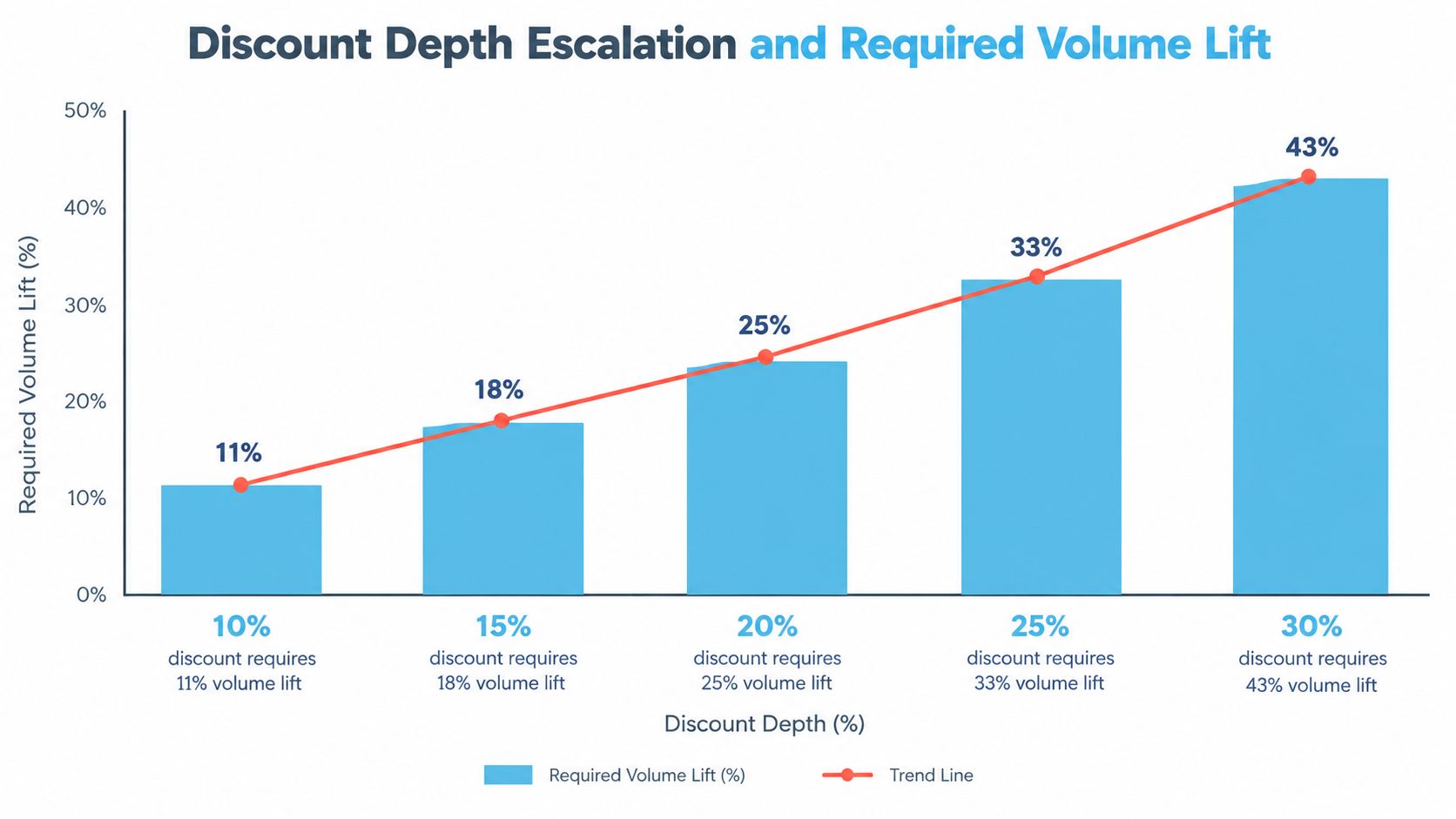
The required volume lift also rises quickly as the discount gets deeper. A 30% discount needs roughly 43% more volume to maintain the same revenue, and that calculation says nothing about fulfilment costs, payment fees, returns, or customer support. The figure is illustrated in this discount volume chart.
Measure profit before chasing conversion
A promotion deserves scrutiny when average discount depth rises over time, even if conversion remains stable. Compare each campaign against contribution profit, full-price demand before and after the offer, return rates, and the margin of the specific products sold.
Practical rule: If a promotion needs a deeper discount to produce the same commercial response, treat that as a warning about customer training, not as a reason to discount again.
Keep margin-critical products outside blanket campaigns. Use inventory, bundle composition, access, or a limited claim window to create urgency without teaching shoppers that your standard price is negotiable. This guide to alternatives to discounting offers a useful way to think beyond percentage-off offers. For the pricing foundation, review how to price products for growth and connect the decision to profit rather than top-line volume.
2. Brand Perception and Perceived Value Decline
Constant promotions tell customers that your listed price is provisional. If every email, SMS message, and Shopify storefront visit includes an offer, shoppers start to see the discount as the actual price and the original price as an anchor designed to be crossed out.
That shift is costly for premium brands. A product positioned at a high price communicates materials, design, service, or status. Repeated markdowns weaken that signal because customers can’t tell whether the product is valuable or merely overpriced until a sale appears. A luxury handbag with a sale sticker communicates something different from the same handbag presented as a considered, full-price purchase.
The research is consistent on the risk. A study of fashion brands reports that excessive discounting can erode brand value and trust, particularly for premium labels, while frequent discounting can create a lasting expectation of lower prices and reduce willingness to buy at full price (research on promotions and brand value).
Protect the reason customers choose you
A brand audit should ask whether customers would still describe the product as worth buying without an incentive. Review promotional email volume, the share of homepage real estate devoted to offers, and the language customers use in reviews and support conversations. Don’t rely only on click-through rate. A discount can increase engagement while reducing perceived value.
Reserve major promotions for clear commercial moments, such as a product launch, a controlled inventory event, or a defined seasonal window. A time-bound offer can create movement without making the store look permanently reduced.
Premium positioning also requires consistency across the Shopify theme, product pages, email templates, packaging, and post-purchase messaging. Brand value protection is a useful reference for keeping promotional activity compatible with the value customers should associate with the brand.
3. Customer Training Toward Wait-and-See Behavior
Frequent promotions can turn urgency into a calendar signal. If customers expect a Memorial Day sale each year or a discount every Friday, they have a reason to postpone a purchase they might otherwise make today. The immediate conversion may look healthy, while future full-price demand weakens.
The pattern can fade quickly. A four-year study covering 560 Dutch supermarket categories found promotional effects that rarely persisted, fading in roughly 10 weeks on average, with almost no long-term category impact, as described in this analysis of short-run promotional lift. Treat weekly revenue as evidence of durable demand only when full-price purchases remain stable after the offer ends.
Promotion exposure can also increase price sensitivity. In an analysis of more than 2,100 comments, 53% of coded reasons for waiting referred to a sale date shoppers could already predict (research on pricing expectations and promotion habits). That behavior reduces the margin available from future orders and gives every campaign a larger job to perform.
Make promotions unpredictable without losing control
In Shopify Analytics, use the Customer cohort analysis report and track the dashboard metric full-price conversion rate by day. Break results out by customer cohort and days since the last promotion. Connect Shopify orders with Klaviyo to compare customers who purchase without a code against customers who return only after a promotional message.
Keep product education, new collection announcements, reviews, and replenishment messages in the communication mix. If promotional sends dominate engagement, the store is training customers to wait for a price trigger instead of responding to product value.
Make promotions unpredictable. Tie offers to real conditions, such as limited quantity, short windows, or descending tiers, so customers act on intent rather than calendar expectations. Set an end point and record full-price conversion after the offer closes. This guide to creating urgency without discounts outlines ways to create timely action without establishing a fixed weekly markdown habit.
4. Inventory Distortion and Forecasting Difficulty
Promotions create demand spikes that don’t necessarily represent normal customer interest. A campaign can sell through a product quickly, but some of those orders may have been pulled forward from future weeks. Other customers may have waited for the promotion instead of buying at the regular price.
That makes inventory planning harder. An apparel brand may buy heavily ahead of a seasonal event, then face weak demand outside the campaign. A beauty business may see a promotional surge, deplete popular stock, and over-order the next cycle to avoid a stockout. If the offer underperforms, the brand may run another markdown to clear the inventory it purchased for an artificial spike.
Forecasting becomes especially unreliable when teams treat historical promotional lift as baseline demand. Demand may not scale in a straight line with discount depth, and a prior campaign may have benefited from unusual traffic, timing, creative, or competitor activity. The result is a widening gap between planned inventory and organic customer behavior.
Separate baseline demand from promotional demand
Build two views in your Shopify reporting or planning model. The first should estimate demand during regular pricing. The second should isolate orders, units, returns, and margin generated during promotional windows. Compare the two instead of rolling every campaign peak into the next forecast.
Inventory should constrain a promotion, not justify one. Use an offer when stock and fulfilment capacity are healthy, not simply because the warehouse needs activity.
Watch days of inventory before, during, and after a campaign. Review whether the promotion changed the mix of products sold, increased returns, or moved customers toward lower-margin SKUs. These signals tell you whether the campaign created useful demand or merely shifted the timing and composition of orders.
5. Acquisition Cost Inflation Among Discount-Dependent Customers
A promotional acquisition campaign can reduce the apparent cost of bringing in an order while increasing the cost of acquiring a valuable customer. Deal-seeking shoppers may respond to the offer, but their relationship is often with the discount rather than with the brand.
That creates a difficult retention profile. The customer may buy when your offer is strongest, ignore regular-price communication, and switch to another store when a competitor promotes a similar product. The brand then pays to acquire the customer, gives away margin on the first order, and spends again to create a second purchase.
The mistake is treating every new customer as equally valuable. A Shopify store should compare customer value by acquisition source, first-order discount, product purchased, repeat timing, and full-price behavior. A customer acquired through product education, organic search, or a partnership may behave differently from one acquired through a broad coupon placement.
Segment for value, not volume
Use cohort reporting to compare promotional and non-promotional acquisitions. In Klaviyo, build segments around first-order discount, acquisition campaign, repeat purchase, and engagement with non-promotional emails. The question is not merely how many customers entered the database. It’s how many become profitable customers without requiring another deep incentive.
- Track contribution by cohort: Include discount cost, returns, fulfilment, and subsequent orders rather than stopping at first-order revenue.
- Separate deal response from brand interest: A customer who clicks only codes and sale announcements shouldn’t define your broader audience strategy.
- Diversify acquisition: Content, SEO, brand advertising, partnerships, and product-led landing pages can attract intent without making price the first message.
- Use promotions selectively: Put incentives in front of high-intent shoppers who need a reason to act, rather than using discounts to manufacture demand from low-intent traffic.
A promotion can support acquisition, but it shouldn’t become the identity of the acquisition channel. Otherwise, the business optimizes for inexpensive orders instead of durable customer economics.
6. Competitive Escalation and Industry-Wide Margin Compression
Discounting changes the rules for the whole category. When one online retailer promotes a comparable product, competitors face pressure to match the price, buy more visibility, or add a stronger incentive. Shoppers can compare product pages, marketplaces, paid ads, and email offers with little friction, so one campaign can quickly become a market expectation.
That expectation resets the reference price. A promotion that once felt occasional becomes familiar, while a deeper offer starts to look necessary. Each matched discount removes margin that could fund product development, customer support, acquisition, and campaign capacity. Smaller brands have less room to absorb this escalation, but larger retailers can also train customers to wait for the next event.
Category-wide promotion changes buying behavior as well. Customers may delay a purchase until several retailers enter the same promotional cycle, turning timing into a competitive weapon. Brands then compete for short-term conversion while weakening their ability to sell at full price.
Compete on the decision, not only the price
In Shopify, monitor competitor offers weekly with a shared tracking sheet. Record campaign timing, discount depth, product coverage, visibility, and basic mechanics. Flag any category where 3+ competitors run overlapping campaigns in the same month. Use that signal to assess whether matching the market would damage your economics.
Compete through product expertise, service, delivery, bundles, access, or participation-based offers. These choices give customers another reason to select your brand without automatically increasing discount depth. A controlled urgency offer can create a reason to act when its deadline, quantity limit, and reward are real, clearly explained, and tied to available stock or participation.
Matching every competitor offer may protect short-term visibility while reducing long-term pricing power. Decide which products and customers justify the margin before entering the fight.
A stronger product page, clearer guarantee, better reviews, or early-action reward may outperform a broader price cut. Review campaign performance by contribution margin and full-price follow-up, then stop offers that win attention but invite another round of matching.
7. Reduced Customer Data Quality and Targeting Precision
More signups don’t automatically mean better customer data. A promotion can attract people who want the incentive but have little interest in the brand, product range, or future communication. Their behavior can add noise to the signals your marketing stack uses for segmentation and recommendations.
Promotional purchase data is also easy to misread. A shopper who buys a product at a deep discount may not be willing to buy that product at full price. If the store treats that order as a standard preference, it may recommend the wrong product, predict the wrong price sensitivity, or send the wrong message.
A 2025 study summarizes prior evidence that frequent monetary promotions can reduce brand loyalty, increase price sensitivity, lower price expectations, and weaken perceived quality. Newer coverage discussed in the same area reports shoppers feeling overwhelmed by prolonged sales periods, with one report stating that one in four avoid such periods entirely (research on promotion fatigue and financial stress).
Keep promotional signals separate
Tag promotional acquisition and promotional orders in Shopify. In Klaviyo, compare engagement, unsubscribe behavior, product interest, and repeat purchases across promotional and non-promotional cohorts. Don’t let a flash-sale audience define recommendations for customers who bought at full price.
Capture useful zero-party data through preference centres, product finders, and post-purchase questions. Ask what the customer was shopping for, which categories interest them, and how they prefer to hear from the brand. This information can improve targeting more than another discount field.
When analysing campaign performance, isolate the effect of price from the effect of urgency, creative, channel, product, and timing. A customer’s decision to claim a reward is not the same signal as a customer’s long-term willingness to pay.
8. Operational Overhead and Launch Velocity Degradation
Frequent promotions consume more team capacity than the discount code suggests. Each campaign can require creative production, theme changes, product exclusions, code testing, inventory checks, email setup, SMS scheduling, approval, customer support preparation, and post-campaign analysis.
A Shopify store with a small marketing team can spend its best working time making the next sale function correctly. Developers adjust cart logic, designers replace banners, marketers revise Klaviyo flows, and operators investigate whether a code worked with subscriptions or existing discounts. The business stays busy while larger priorities wait.
The opportunity cost is serious. Teams that repeatedly launch short promotions have less room for product education, customer experience improvements, conversion research, new acquisition channels, and strategic creative. Reactive execution also makes it difficult to plan beyond the next campaign window.
Audit the work behind every offer
Track hours across creative, implementation, approvals, testing, customer support, and reporting. Then list the initiatives that were delayed because the team was preparing or cleaning up a promotion. This turns operational drag into a commercial decision rather than a vague feeling of overload.
- Reduce campaign frequency: Fewer, better-defined events can create clearer customer expectations than a constant stream of small offers.
- Create reusable systems: Standard Shopify discount rules, email templates, SMS workflows, and QA checklists reduce avoidable manual work.
- Set approval thresholds: Not every offer needs the same level of review, especially when products, exclusions, and fulfilment conditions are unchanged.
- Review the full workload: Include post-campaign refunds, exchanges, support tickets, and reporting time when calculating campaign cost.
Automation helps, but it doesn’t fix a weak promotional strategy. If the team still needs to create a new discount to generate movement, the store has automated the treadmill rather than leaving it.
8-Point Comparison of Sales Promotion Disadvantages
| Item | Implementation complexity | Resource requirements | Expected outcomes | Ideal use cases | Key advantages |
|---|---|---|---|---|---|
| Margin Erosion from Discount Escalation | Low to run; high long-term management complexity | Ongoing promotional spend; margin analytics & pricing controls | Short-term conversion lift; progressive margin compression and entrenched discount expectations | Temporary clearance or short-term traffic boosts only | Immediate revenue and traffic uplift |
| Brand Perception and Perceived Value Decline | Low to execute; very hard to reverse once entrenched | Brand marketing, research, and repositioning investment | Loss of premium positioning; reduced full-price sales and trust erosion | When deliberately repositioning to a value-first or discount-led brand | Broad reach to price-sensitive shoppers |
| Customer Training Toward Wait-and-See Behavior | Low to create; medium effort required to break patterns | Email/SMS segmentation, timing/behavioral analytics | Delayed purchases, lower off-promotion conversion, more lumpy revenue | Predictable seasonal events where customers expect timing (used sparingly) | Predictable promotional windows and traffic spikes when managed |
| Inventory Distortion and Forecasting Difficulty | Low to trigger promotions; high complexity for inventory management | Supply-chain coordination, forecasting tools, working capital | Spiky demand, overstocking, dead stock and forced markdowns | End-of-season clearance or targeted stock liquidation | Rapid clearing of excess inventory |
| Acquisition Cost Inflation Among Discount-Dependent Customers | Easy to attract deal-seekers; harder to build long-term value | Cohort analytics, diversified acquisition channels, retention programs | Lower LTV, higher churn, inflated effective CAC for high-value customers | Short-term list growth or volume-driven acquisition experiments | Low short-term CAC per order and fast list growth |
| Competitive Escalation and Industry-Wide Margin Compression | Low to match competitors; high strategic difficulty to exit the arms race | Competitive monitoring, differentiation investment, pricing strategy | Category-wide margin erosion and commoditization; advantage to deep-pocketed players | Defensive parity in highly transparent, price-competitive categories | Maintains short-term market share parity |
| Reduced Customer Data Quality and Targeting Precision | Medium: requires data segmentation and governance to mitigate | Data tooling, zero-party data capture, separate modeling for promo vs baseline | Noisy behavioral signals, degraded personalization and skewed predictive models | Promotional audience capture paired with intentional additional data collection | Quickly scales data and reveals price-sensitivity signals |
| Operational Overhead and Launch Velocity Degradation | High recurring operational burden for frequent promotions | Creative, development, legal/compliance, campaign ops and analysis time | Slower product launches, higher execution risk, reduced strategic bandwidth | Large seasonal campaigns with dedicated ops teams | Repeatable tactical revenue when processes are mature and automated |
Replace Discount Reflex with Controlled Urgency
The disadvantages of sales promotion rarely appear as one isolated failure. Margin erosion makes the next campaign harder to justify. Repeated campaigns teach customers to wait. Waiting weakens full-price conversion and distorts inventory signals. The business then uses more promotions to clear stock, attract volume, and respond to competitors, while the data becomes increasingly focused on discount response.
The operational cost grows alongside the financial cost. Teams spend time producing campaigns that may shift demand rather than create it, acquire customers who are less loyal to the brand, and maintain a promotional calendar that makes full-price communication less effective. A promotion can still be successful, but success needs a broader definition than orders, revenue, or conversion rate.
Start with an audit of your current system. Review average discount depth, promotional cadence, full-price conversion, customer value by acquisition cohort, inventory variance, return behavior, and hours spent launching each campaign. Look for direction over time. Rising discount depth, longer purchase delays, weaker non-promotional engagement, and increasing campaign workload point to a structural problem.
The alternative isn’t artificial pressure. It’s a clear reason to act while the customer’s intent is high. A time-bound or quantity-bound offer can make early action more valuable without automatically increasing the percentage taken off the product. The reward can stay familiar while the availability, claim window, or participation mechanic changes.
That distinction matters on Shopify. A flat discount says the shopper can buy whenever the price feels right. A controlled urgency offer says the current opportunity has a defined condition. The condition might be a limited number of rewards, a closing window, or a descending tier that changes as shoppers claim it. It should be real, visible, and easy to understand.
Quikly provides a Shopify-native way to turn an existing reward into a participation-based experience across the storefront, email, social, and SMS. Campaigns can be styled to match the store, so the offer works as part of the brand experience rather than as an overlay that interrupts it. Teams can also use controlled exposure and campaign analysis to compare conversion and discount impact instead of judging every promotion by top-line revenue alone.
The strongest promotion isn’t necessarily the biggest one. It’s the offer that helps a high-intent shopper decide now, protects the value of the product, gives the team a manageable campaign to run, and leaves the business with healthier customer behavior after the offer closes.
If predictable discounts are eroding your Shopify store’s margin or teaching customers to wait, Quikly helps turn rewards into time- or quantity-bound promotional experiences across your storefront, email, social, and SMS. Review your latest campaigns against profit, full-price demand, cohort value, inventory variance, and team hours, then explore whether controlled urgency can create action without deeper discounting.
Topics: disadvantages of sales promotion, sales promotion drawbacks, Shopify promotions, urgency marketing, discount strategy