Most Shopify brands start with the same first-time buyer offer: 10% or 15% off the first order. It’s easy to install, easy to explain, and easy to regret when shoppers learn to wait for the next code.
The better question isn’t “What percentage should we offer?” It’s what behavior should the offer change? A strong first-time buyer offer shortens the path from discovery to purchase while protecting average order value, repeat demand, and brand perception. The mechanics matter more than the headline discount.
Why Your Default 10% Welcome Code Is Probably the Wrong Starting Point
A flat welcome code is usually the wrong default for a Shopify store. It gives every first-time visitor the same reward, regardless of whether they’re browsing a product page, comparing gifts, returning after an ad click, or already close to checkout.
That structure creates three problems. First, it can train shoppers to wait for promotions. Second, it reduces the value of orders that might have happened without the discount. Third, it optimizes for code redemption instead of the behavior that matters, a faster first purchase with acceptable economics.
Benchmark data puts 10% to 15% off in a practical testing range for email and SMS signup offers, with reported signup rates of about 2.4% for 10% off and 2.6% to 2.9% for 15% off. The difference is modest, while the margin cost rises immediately with the deeper offer. The welcome-offer benchmark data also reports average email popup conversion at about 2.1%, with 1.5% to 3% considered average and above 3% to 5% considered strong.
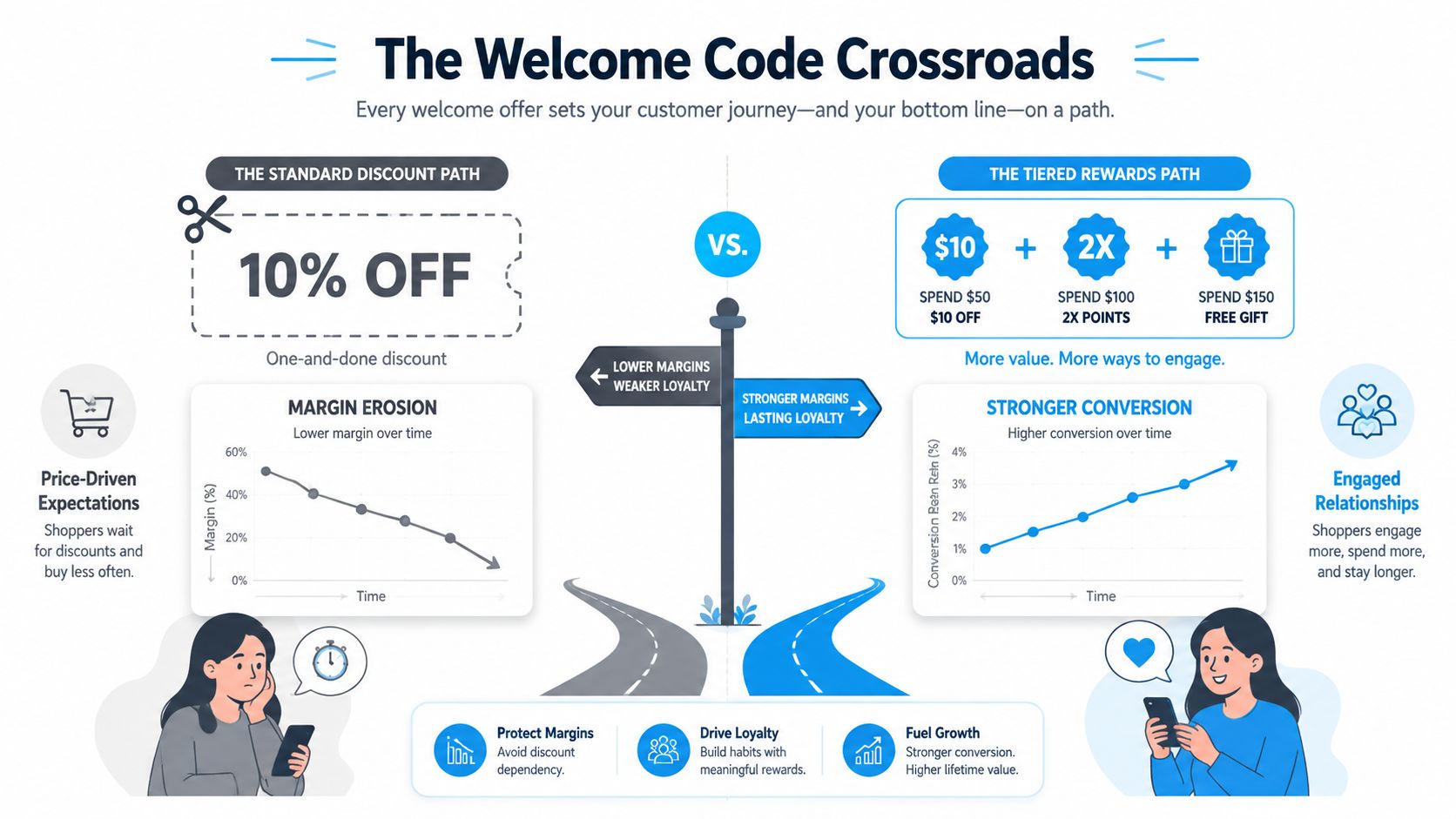
The issue isn’t that percentage discounts never work. They work when the shopper’s main objection is price and when the resulting order remains profitable. They fail when the actual objection is shipping, uncertainty about product fit, weak trust, or a lack of reason to buy now.
Operator rule: Treat the first-time offer as a behavior design problem, not a discount-size problem.
A better default accounts for first-order AOV, category mix, gross margin, and the brand’s repeat-purchase window. A consumables brand may use a threshold that encourages a fuller basket. An apparel brand may need reassurance or free shipping. A premium brand may protect perception with early access or a bonus item instead of a permanent percentage code.
For a deeper look at alternatives, see ways to reduce reliance on discounts. The point is simple: the offer should make the next action easier, not make the product look cheaper.
The Mechanics Behind Offers That Actually Move First-Time Buyers
A first-time buyer offer has several independent controls. Shopify merchants often treat them as one setting, the discount field, but each control changes conversion and margin differently.
Start with the reward type
Percentage discounts are predictable and easy to implement with Shopify discount codes. Fixed-value rewards can work better when your product prices are tightly grouped. Free shipping is often stronger when delivery cost drives abandonment, while a bonus product can increase perceived value without reducing the product’s listed price.
Early access is the margin-preserving option for launches, restocks, and limited inventory. It rewards identity and timing rather than price, although it usually appeals to a narrower group.
Set eligibility before writing copy
Define who qualifies and how the store recognizes them. Email capture, SMS opt-in, guest checkout status, first session, returning visitor behavior, and cart value can all play a role.
Shopify can identify customers through email and account data, but eligibility becomes messy when a shopper moves between devices or channels. A new account shouldn’t automatically grant another reward if the same email has already redeemed an offer. State this clearly in the terms and keep the rule consistent across the storefront, Klaviyo, SMS, and paid media.
Tighter eligibility protects margin but can reduce volume. Broad eligibility raises reach but increases leakage to shoppers who were already likely to buy.
Control stacking and expiry
Decide whether the offer works with sale SKUs, bundles, subscriptions, or automatic discounts. If a first-order code stacks with a sale collection and subscribe-and-save, the combined economics can become unacceptable quickly.
Expiry also needs a deliberate choice. A static seven-day code creates a clear deadline but can encourage shoppers to wait. A dynamic 24-hour or session-bound offer creates a shorter decision window, but only works if the shopper understands when the window starts and ends.
Match the disclosure surface to intent
A welcome bar is visible without interrupting browsing. An exit overlay captures attention when a shopper is leaving. A cart drawer message can connect the reward to the next purchase action. A checkout banner can clarify eligibility, but it arrives too late to solve discovery or product-fit objections.
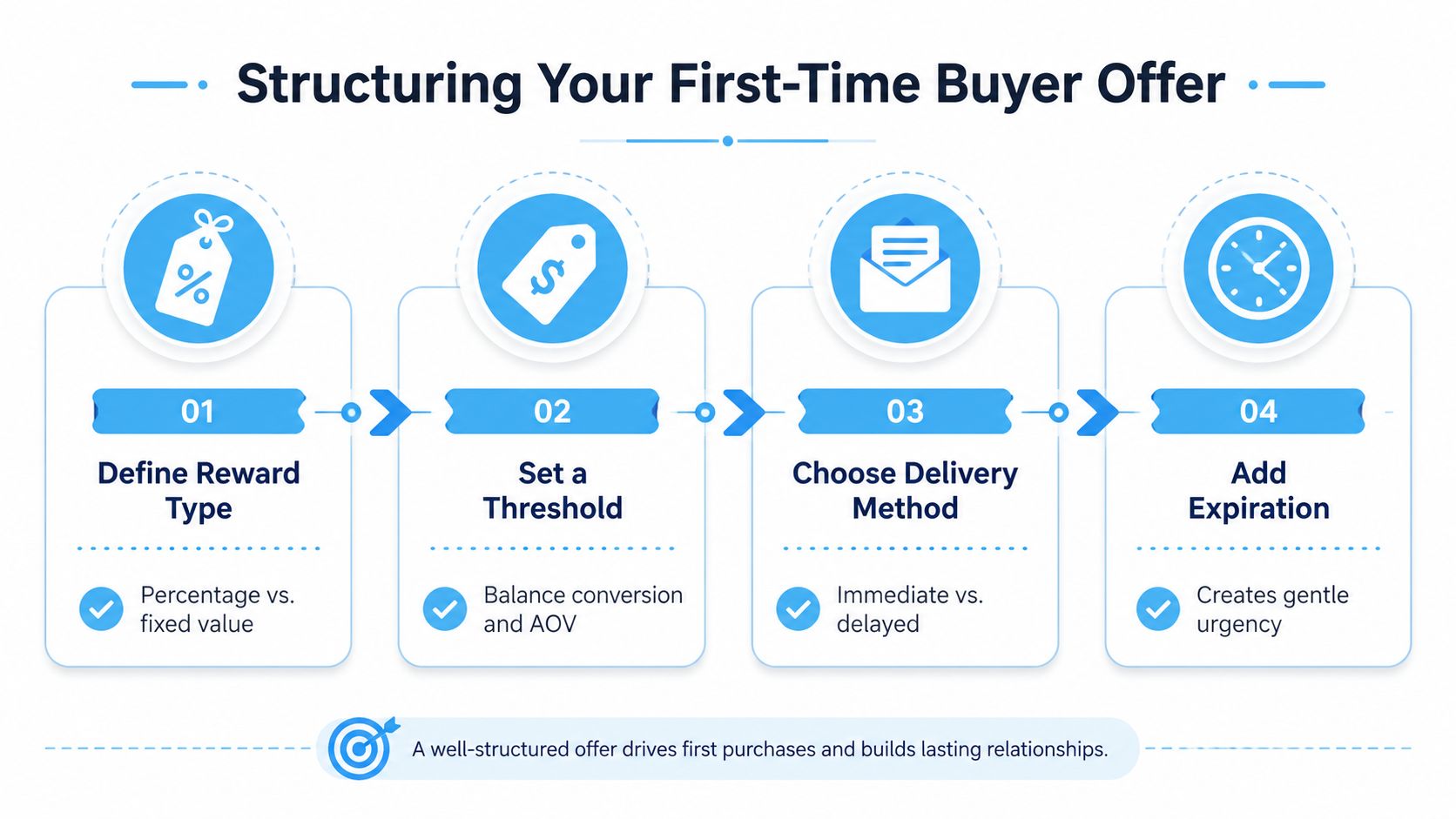
Build the offer in this order: reward, eligibility, stacking, expiry, and surface. Then connect redemption to Shopify’s cart and discount infrastructure so the customer doesn’t have to copy a code across several screens.
Offer Formats and the Trade-Offs Most Guides Skip
The standard first-time buyer offer usually falls into one of four formats. None is universally superior. The right choice depends on what stops the shopper and what your margin can absorb.
A flat discount is the easiest starting point. It works best when price is the clear objection and the first order has enough contribution margin to support it. It breaks quickly in low-AOV categories. A 15% discount on a $32 order removes $4.80 before shipping and fulfillment, which can leave little room to acquire the customer profitably. This is simple arithmetic, not a performance claim.
Free shipping can be more efficient when shipping cost creates the hesitation. A threshold separates shoppers who would’ve purchased anyway from those who need a nudge to add another product. The threshold should sit above the current basket pattern, not below it, otherwise the brand pays shipping without changing behavior.
Tiered rewards make the shopper participate. A reward ladder can connect an early action or basket threshold to a sequence of rewards, such as free shipping first, a bonus product next, and a stronger benefit at a higher threshold. Three modest steps can give shoppers several reasons to continue instead of presenting one expensive discount immediately.
Gated early access suits launches, restocks, and products with genuine inventory constraints. It creates scarcity around a real event, not a timer that resets every time the page loads. The reward is access, which can preserve price integrity while still giving first-time visitors a concrete reason to act.
| Offer Format | Typical First-Order Lift | Margin Impact | Best For |
|---|---|---|---|
| Flat discount | Test against a no-offer control | Direct reduction in product revenue | Clear price objections |
| Free shipping threshold | Test by basket value | Fulfillment cost above the threshold | Brands with add-on potential |
| Tiered reward | Test by unlock completion | Controlled cost by reward tier | Higher-AOV and multi-product stores |
| Gated early access | Test against standard availability | Usually lighter direct discount cost | Drops, restocks, and limited inventory |
Free-shipping offers tend to produce roughly 40% to 45% redemption, according to the welcome-offer benchmark data, but redemption alone isn’t success. Compare contribution margin, first-order conversion, and repeat purchase behavior before scaling any format.
Time matters too. One ecommerce dataset reports 75% of conversions within 24 hours of the initial ad click and 90% by day 12, with average time to first purchase typically two to three days. The time-to-first-purchase analysis supports a short response path: capture the shopper, explain the reward, and make redemption immediate.
Running the Offer Across Site, Email, SMS, and Social
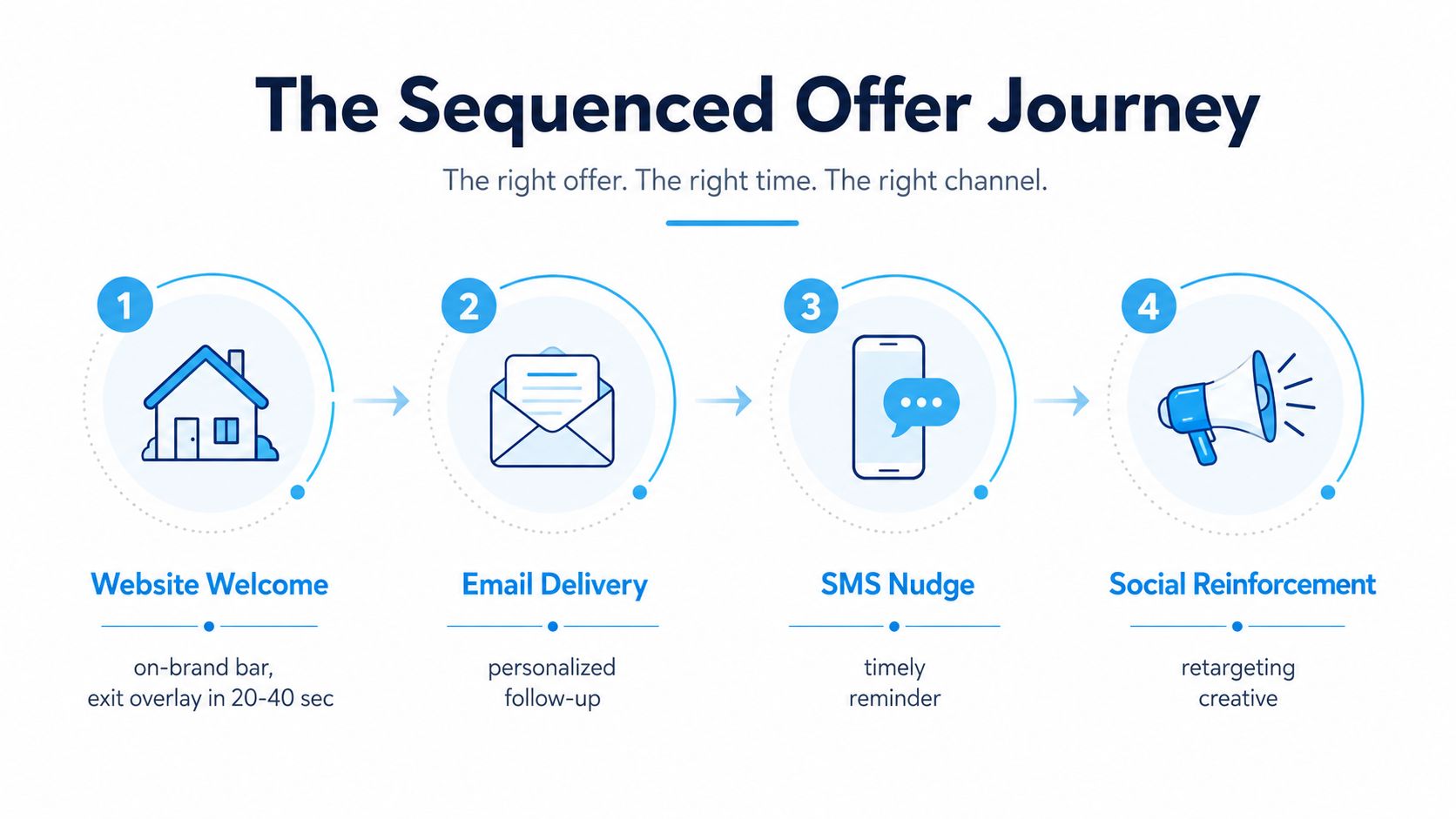
Treat the offer as one sequenced journey. Four disconnected placements create duplicated discounts, conflicting deadlines, and messages that reach the same shopper after redemption.
The site earns the first response
Start with an on-brand welcome bar and an exit overlay. The overlay should appear after meaningful browsing, not on every pageview. A practical trigger is an exit signal around 20 to 40 seconds into the visit, with the offer connected to the page or collection the shopper viewed.
Use a two-step exchange. First explain why the visitor should share an email address. Then reveal the reward. The first screen earns permission, while the second screen delivers something concrete.
Send the email within 60 seconds of signup. The message should contain the reward, the expiry rule, the redemption action, and a direct path back to the viewed product. Delayed delivery wastes the highest-intent window. Conversion timing guidance notes that first-time visitor conversion is commonly only 1% to 5%, and can average as low as 1% to 2%, so every extra step matters.
SMS and paid social should reinforce, not restart
SMS belongs after explicit opt-in. Send one reminder at roughly the two-hour post-browse mark, ideally after a browse-abandon signal, and suppress it if the customer has purchased or redeemed.
Paid social can retarget warm traffic with the offer in the creative itself. Keep the message visible in the ad rather than burying it in the caption, and keep it within the seven-day attribution window. The site, email, SMS, and ad should share one eligibility rule and one offer state.
For implementation ideas around overlays, bars, and conversion surfaces, review ECORN’s conversion tools. For SMS sequencing, SMS marketing best practices can help teams avoid turning a single welcome reward into repeated promotional pressure.
Copy and Creative That Rewards Action Without Feeling Pressured
Urgency should explain why acting now creates a better outcome. It shouldn’t make the shopper feel trapped by a theatrical deadline.
Limited-time promotions can accelerate decisions by using scarcity perception, fear of missing out, decision fatigue, and loss aversion. The research on limited-time discounts describes how a shorter decision window can reduce price sensitivity, particularly for deal-oriented shoppers and hedonic products. That doesn’t make every countdown credible. A timer that resets destroys trust.
Use reward-based language. Replace “Last chance!” with “Welcome to the brand. Your first order includes this reward through tomorrow.” Name the benefit, the window, and the eligibility rule. The shopper should know exactly what they can receive and why the offer exists.

Creative hierarchy matters. Show the product first, the reward second, and the brand mark third. A large percentage-off graphic primes discount behavior before the shopper has understood the product.
A tiered experience can make the action itself engaging. For example, a first-time visitor might reveal free shipping, then access a bonus product or early access by completing the purchase within the stated window. The offer remains clear, but the shopper has a reason to act rather than just having a code to save.
Social proof can support the decision when it addresses product confidence, not just popularity. Guidance on social proof in advertising campaigns is useful when choosing reviews, creator content, customer images, or product-use evidence for the creative.
Continuous discounting creates a separate problem. A 2025 paper on discount fatigue reports that 48.6% of respondents preferred deeper discounts, while 33.8% felt all percentage discounts were the same. Repetition compresses differentiation and can push brands toward larger markdowns just to regain attention.
Testing and Measuring What First-Time Buyer Offers Really Earn
Signup rate is an input, not the scorecard. A popup can collect addresses efficiently while producing weak customers, expensive orders, and poor repeat demand.
Track the full economic path:
- First-order conversion rate: Measure purchase behavior among eligible visitors, not only form completion.
- Incremental AOV: Compare the offer group with a no-offer control to see whether the reward changes basket size.
- 60-day repeat purchase rate: Check whether the first order starts a relationship or captures a discount seeker.
- Margin per acquired customer: Subtract the redeemed reward and fulfillment cost from the customer’s first-order contribution.
- Redemption behavior: Separate customers who claimed the offer from customers who used it.
Test the mechanic, not just the percentage. Keep audience, creative, placement, and product exposure consistent while comparing a flat discount, a tiered reward, and free shipping. A holdout of roughly 10% of traffic can help estimate true lift from shoppers who would have purchased without the offer.
| Mechanic | First-Order Conversion Lift | AOV Impact | 60-Day Repeat Rate | Margin per Customer |
|---|---|---|---|---|
| Flat discount | Measure against control | Record change versus control | Compare by redeemed and non-redeemed cohorts | Deduct discount cost |
| Tiered reward | Measure by completed tier | Track threshold progression | Compare by reward level | Include each reward’s cost |
| Free shipping | Measure by threshold | Track add-on behavior | Compare shipping-led cohorts | Include actual fulfillment cost |
| Early access | Measure by event cohort | Track launch basket size | Compare access recipients | Include inventory and service cost |
Don’t accept a conversion lift that damages customer quality. The testing target in this framework is a 15% to 30% conversion lift, margin erosion under four points, and no measurable repeat-rate damage across the following two purchase cycles. Those are operating criteria, not guaranteed outcomes.
Use incrementality testing for promotions to separate customers persuaded by the offer from customers who only used a discount they were already willing to redeem.
A Practical First Move for Next Week
The highest-impact variable is offer structure and eligibility logic, not the discount percentage. A 12% flat code with no timing window, no friction, and no channel sequencing can underperform a 10% offer restricted to first-time shoppers, active for 48 hours, and delivered at the moment of intent.
Start with the last 90 days of first-order data. Sort customers by acquisition source, then compare AOV and repeat-purchase rate between customers who redeemed a welcome code and customers who didn’t. If the code cohort shows weaker 60-day repurchase, the offer is subsidizing one-time buyers instead of funding future LTV.
Ship one clean change during week one:
- Replace the static site-wide popup with a first-order-only tiered offer.
- Surface it on product detail pages and in the cart, where product intent is visible.
- Time-box the reward to 48 hours from the first session.
- Send email and SMS follow-up at the 24-hour mark, with suppression after purchase or redemption.
- Hold out part of the traffic so you can read incremental lift instead of raw redemption.
Don’t change the copy, audience, placement, and reward all at once. One change gives you one hypothesis and one clean read. Once the result is clear, expand the sequence across paid social, Klaviyo, and Shopify’s discount infrastructure.
Quikly gives Shopify brands a way to run time- and quantity-bound promotional experiences, including first-to-purchase and first-to-claim mechanics, instead of defaulting to a static code. If you want to test urgency that rewards action while protecting margin and brand value, visit Quikly and evaluate the offer structure against your current welcome flow.
Topics: first time buyer offers, ecommerce welcome offers, Shopify promotions, conversion optimization, urgency marketing