Adding email, social, SMS, and paid media to a Shopify promotion doesn’t automatically create a stronger campaign. It can create four versions of the same interruption, delivered to the same customer, with the same discount and the same deadline.
That approach creates familiar problems: shrinking margins, weak conversion urgency, and a brand customers learn to wait on. A practical multi channel promotion strategy treats coordination as the advantage. One offer needs distinct channel jobs, shared customer signals, clear stop rules, and a margin decision before the first asset is published.
Why Most Multi Channel Promotion Plans Underperform
The popular advice says to add more channels. The better advice is to give existing channels less redundant work.
A Shopify brand often launches a promotion by placing the same offer in an email, a Meta ad, an Instagram post, an SMS message, and a storefront banner at roughly the same time. The result looks coordinated in a calendar, but the customer experiences repetition. Email announces the discount, social repeats it, SMS repeats it again, and the site displays the same creative after the shopper has already purchased.
That isn’t incremental reach. It’s channel stacking.
The market is large enough to show why this matters. Multichannel marketing was estimated at $181.77 billion in 2024, rose to $192.91 billion in 2025, and is projected to reach $349.74 billion by 2035, a 6.13% CAGR, according to multichannel marketing market data and coordination benchmarks. Yet only 14% of organizations say they run coordinated campaigns across every channel, while just 5% describe their strategy as very well integrated, according to the same source.
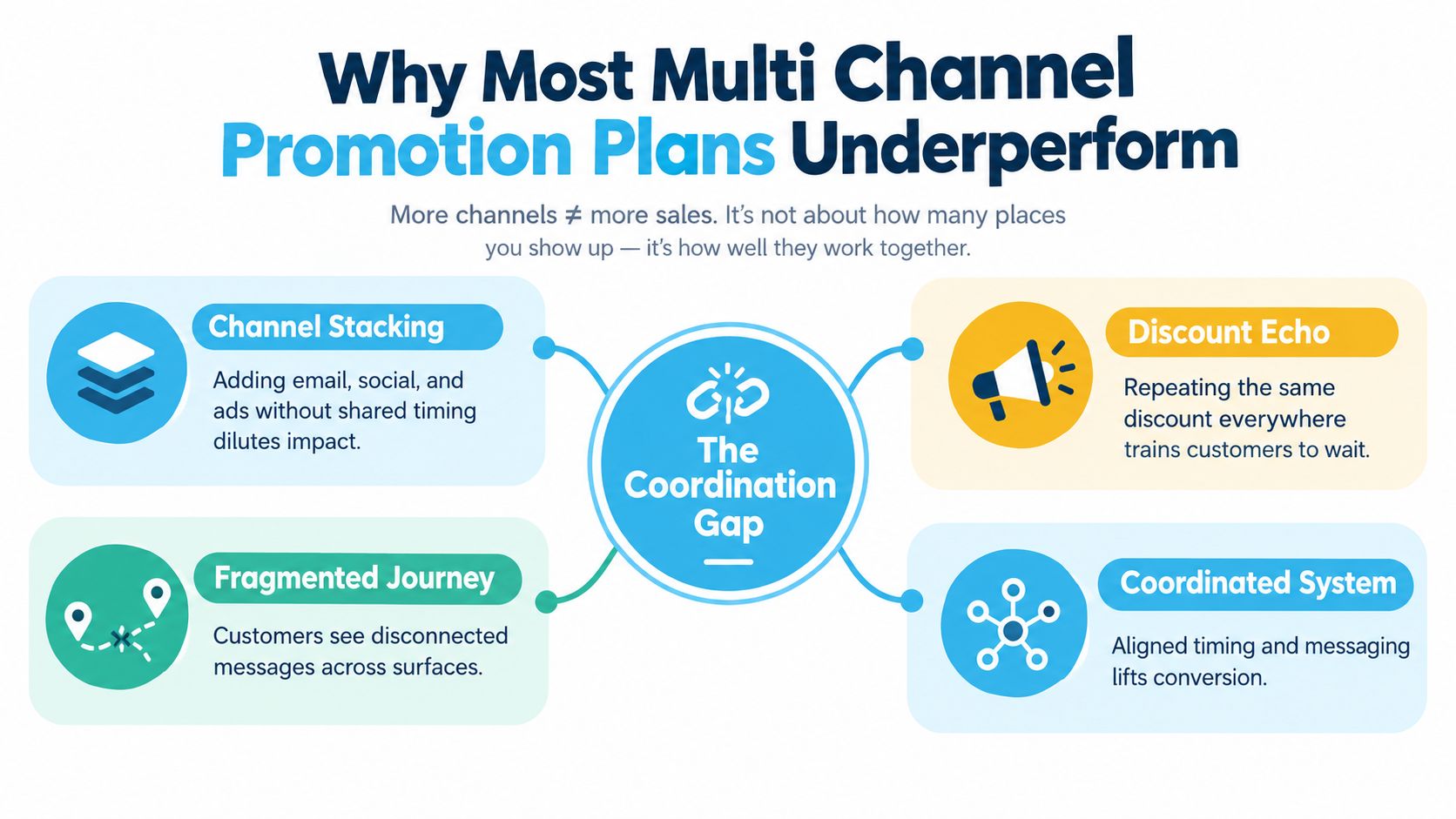
The coordination gap
Four failure modes appear repeatedly:
- Offer duplication: Customers see the same discount everywhere and learn that waiting carries little risk.
- Creative fatigue: One banner gets resized for every surface, so the campaign feels recycled rather than relevant.
- Attribution confusion: Email, SMS, retargeting, and direct traffic can all claim the same order, hiding the actual contribution.
- Margin erosion: A blanket offer reaches customers who would have bought at full price.
Campaigns using three or more channels have been benchmarked at a 287% higher purchase rate than single-channel efforts, while campaigns using six or more channels have been associated with a 12% higher brand recall rate, as summarized by multi-channel campaign performance benchmarks. The point isn’t to chase a channel count. It’s to coordinate the journey those channels create.
A useful multi channel approach for e-commerce starts with distinct responsibilities. Storefront merchandising should help the shopper understand the offer. Email should provide context to an identified audience. Social should create discovery and consideration. SMS should close a high-intent moment, not become another broadcast list.
For the difference between connected channel execution and separate channel activity, see this comparison of omnichannel and multichannel marketing. The operating model that replaces channel stacking is simple: one offer, distinct roles, explicit stop rules, and margin discipline.
Setting Goals and Audience Segments Before Channels
Start with the commercial job, not the channel list. “Drive revenue” is too broad to control a promotion. A better objective identifies the customer behavior and the economic constraint attached to it.
A Shopify apparel brand might choose to reactivate lapsed purchasers, increase the basket around a hero SKU, or move aging inventory without teaching full-price customers to wait. Those objectives require different audiences, different offer intensity, and different channel pressure.
Set one primary metric and several guardrails. The primary metric might be incremental orders from lapsed customers or contribution margin per order. Guardrails should expose damage, such as discount cost, fulfillment expense, average order value, unsubscribe activity, or full-price sales displaced by the promotion.
Practical rule: A campaign that lifts conversion while damaging contribution margin has not necessarily succeeded. Your dashboard should make that failure visible.
Define segments before creative work begins. If the team writes one offer first and decides who receives it later, channel roles become impossible to assign. Export the audiences into the systems that will activate them, such as Shopify, Klaviyo, Meta, and your SMS platform, then document exclusions.
Consider this working segmentation model:
| Segment | Goal | Message Angle | Offer Intensity |
|---|---|---|---|
| VIP repeat buyers | Protect loyalty and increase basket size | Early access, newness, recognition | Light or access-based |
| Active subscribers | Convert existing intent | Product value, convenience, deadline | Moderate |
| Lapsed 90-day purchasers | Restart the relationship | What’s new, useful reason to return | Stronger, but controlled |
| Cold social traffic | Create first purchase confidence | Product proof, creator context, clear entry point | Limited introductory incentive |
The same promotion can exist across all four groups without looking identical. VIP customers may receive access before the public launch. Cold traffic may need proof before price. Lapsed buyers may respond to a reason to return, while subscribers may need a reminder that connects the offer to products they’ve viewed.
This discipline also prevents over-discounting. Customers with strong purchase intent don’t need the same incentive as anonymous visitors. Segmentation becomes a margin control, not just a personalization exercise.
Coordinating Creative and Messaging Across Surfaces
Coordination doesn’t mean publishing identical copy everywhere. It means every asset supports the same commercial promise while respecting the way people use each surface.
Write the promotion as one sentence first. Add one supporting promise. For example, the spine might communicate a limited offer on a specific collection, supported by a clear product benefit or delivery reason. That sentence becomes the reference point for the storefront, email, social, and SMS team.
Give every channel a job
The storefront owns clarity. Its hero banner, collection sorting, product page messaging, and cart drawer should answer what qualifies, when the offer ends, and which products matter. It shouldn’t force the customer to decode a social caption.
Email owns depth and relevance. A warm audience can receive product context, customer proof, recommendations, and an explanation of why the promotion exists. The message can vary by segment, but the core offer and eligibility rules must remain stable.
Social owns discovery and emotional framing. Use platform-native video, creator content, product demonstrations, or customer reactions instead of exporting the storefront banner into an ad placement. Social may introduce the product before the customer has shown direct intent.
SMS owns the high-intent nudge. Keep it direct, compliant, and tied to a real event, such as a cart signal, an early-access window, or a genuine final deadline. It shouldn’t repeat the full email.
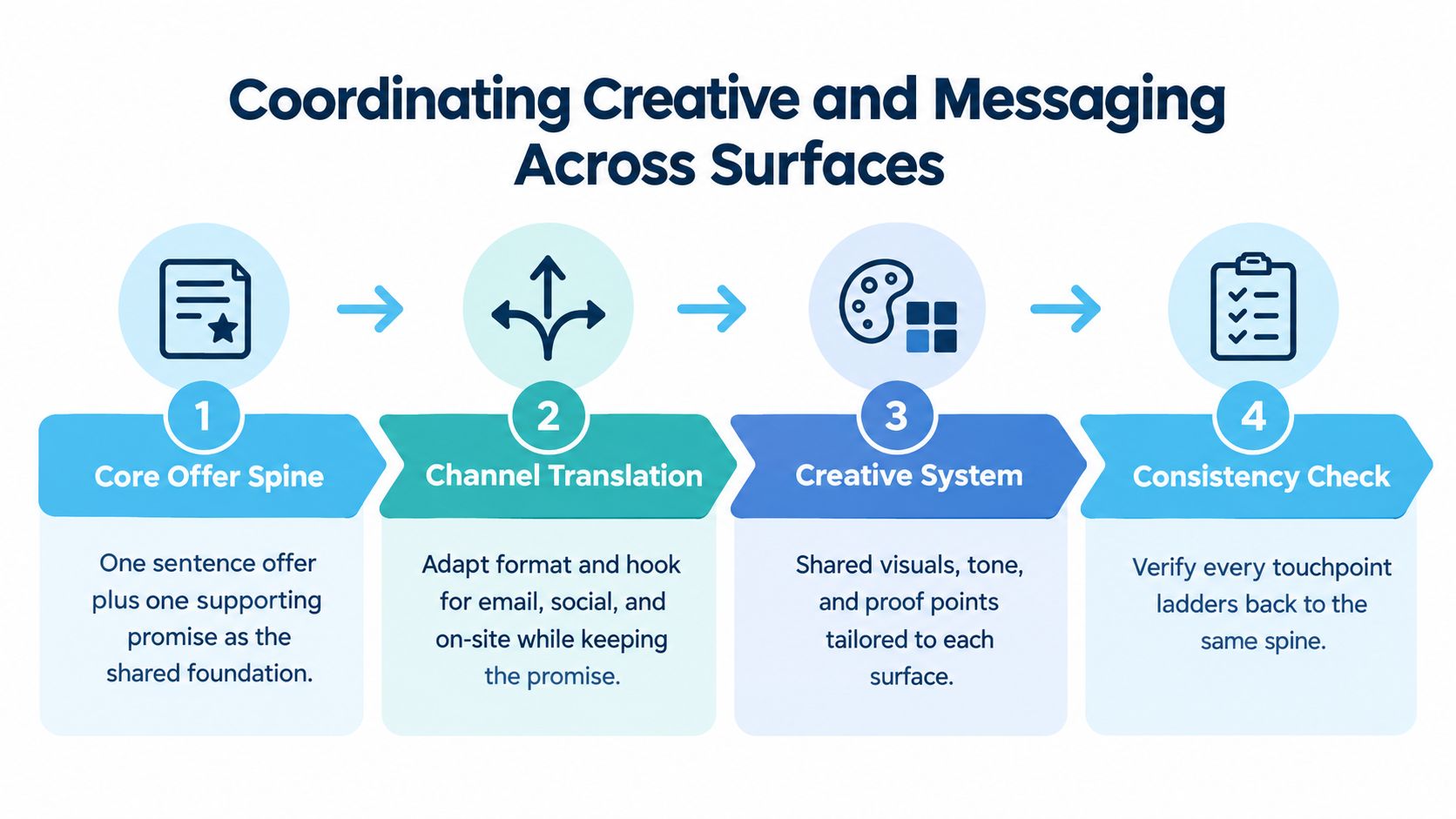
Adapt the execution, preserve the spine
Adaptation has practical limits. SMS needs compressed language and careful attention to consent and opt-out requirements. Email can carry more detail, but subject lines should lead with the customer-relevant benefit rather than an internal campaign name. Social needs a visual hook in the opening frame. On-site creative needs a hierarchy that works for a fast scan.
Identical copy creates two problems. It tires the audience, and it prevents the team from learning what each channel contributes. A coordinated narrative with divergent execution gives customers a consistent story without making every touchpoint feel like a duplicate.
Before launch, run a consistency check across:
- Offer terms: SKU eligibility, discount logic, and expiry.
- Proof points: Reviews, product benefits, availability, and delivery claims.
- Visual system: Color, typography, product treatment, and brand tone.
- Audience logic: Who receives the asset, who is suppressed, and what event changes their status.
The test is straightforward. If a customer enters through a social video, visits a product page, receives an email, and later sees an SMS reminder, the journey should feel connected. It shouldn’t feel like four teams are competing for the same order.
Channel Specific Tactics for Storefront Email Social and SMS
Each surface should have an owner, a job, and a definition of done. Treating every channel as interchangeable makes reporting easier only because it removes useful information.
Storefront
The storefront carries the campaign’s operational truth. Update the hero banner, collection sorting, product badges, cart drawer, and any qualifying-message logic so the shopper can understand the offer without searching through an email.
Merchandise for the objective. If the goal is to lift the basket around a hero SKU, place compatible products nearby. If the goal is aging inventory, don’t bury those products below new arrivals. Keep the promotion visible without applying it to every product by default.
Email can support an announcement, a behavior-based reminder, and a final message. The sequence should respond to actions, not fill a calendar. Suppress purchasers, support contacts, and customers who have already received the intended reward.
Klaviyo is useful when Shopify events, browse behavior, cart activity, and subscription status need to shape the next send. For planning the relationship between email and SMS service, define which event moves a customer from one channel to another.
Social and paid media
Social should create demand or recover consideration. Split audiences by lifecycle stage so cold traffic doesn’t receive the same creative as a recent product viewer. Retargeting can focus on product proof or a deadline, while prospecting can focus on discovery and use cases.
Paid media can support the campaign when the landing page, offer logic, and exclusions are ready. This practical guide to growing ecommerce sales with ads is useful context for paid execution, but acquisition creative still needs to match your margin rules.
SMS
SMS is scarce attention. Use it for a high-intent moment, a confirmation, back-in-stock relevance during the promotion, or a true last-call message. Keep the copy short, identify the brand, include the required opt-out path, and suppress customers after conversion.
| Channel | Primary Job | Key Metric | Cadence | Creative Format |
|---|---|---|---|---|
| Storefront | Explain and merchandise the offer | Conversion and contribution margin | Live during the offer window | Hero, collection, product, cart |
| Educate and personalize | Revenue per recipient and assisted conversion | Behavior-based sequence | Editorial email and product modules | |
| Social | Create discovery and consideration | Qualified traffic and incremental lift | Controlled by audience and creative fatigue | Video, creator, carousel, retargeting |
| SMS | Close intent | Incremental orders and opt-out rate | Sparse, event-triggered | Short text with direct action |
Timing Frequency and the Promotion Calendar
A promotion calendar should describe a sequence, not a set of dates copied from the last campaign. Build backward from the actual offer window and decide what customer signal earns the next touch.
Use four phases:
- Teaser period: Build anticipation without revealing every detail.
- Launch spike: Concentrate the strongest creative when the offer opens.
- Mid-promotion reinforcement: Re-engage non-converters with a new angle, product proof, or availability update.
- Defined end: Close at the stated deadline without an orphan extension.
The end matters. Reopening an expired offer teaches customers that deadlines are negotiable, which weakens future urgency and trains waiting behavior.
Frequency needs to be managed at the segment level. If an engaged subscriber receives an email, sees several paid impressions, and receives an SMS in the same period, channel-level reports may show healthy activity while the customer experiences pressure. Set a quiet window of 48 to 72 hours between major promotional sends to the same segment, based on the operating plan, and make exceptions only for meaningful behavior such as active cart abandonment.
Use signals instead of fixed schedules
Social spend can increase after email engagement indicates that the creative is resonating. SMS can move forward when cart activity shows a genuine risk of abandonment. A VIP audience can receive early access while cold traffic waits for the public release.
Document blackout periods around product launches, brand moments, and major organic content. A promotion that interrupts a launch may capture a sale while reducing the impact of the higher-value moment.
Campaign scheduling guidance can help with the calendar mechanics, but the strategic decision remains yours. Every send should answer three questions:
- Why now: What event or phase makes this message relevant?
- Why this channel: What can this surface do better than the others?
- Why stop: What purchase, opt-out, expiry, or support event ends the sequence?
Measuring Lift Margin and Iteration Loops
Last-click revenue is especially unreliable in a coordinated promotion. Email, SMS, retargeting, and direct traffic often arrive after earlier touchpoints have already created intent, so the final click can take credit for a sale it didn’t create alone.
Measure the system against the job assigned to each channel. Storefront should be evaluated on conversion and contribution margin. Email and SMS should include assisted conversions, but neither should receive automatic credit for every order from an exposed subscriber. Social should be judged on qualified traffic, audience progression, and incremental contribution rather than only immediate checkout revenue.
A practical measurement sheet includes:
- Incremental lift: Compare exposed customers with a holdout or matched cohort where possible.
- Blended efficiency: Review blended MER alongside channel-level reporting.
- Contribution margin per order: Subtract discount and fulfillment costs from the order economics.
- Assisted conversions: Record touchpoints that helped move the customer before the final conversion.
- Segment health: Identify audiences that over-received messages or required unnecessary incentive depth.
Discount depth needs its own analysis. A promotion analytics guide describes 0% to 10% discounts as producing a modest lift with manageable margin impact, 10% to 20% as creating stronger conversion improvement with meaningful compression, 20% to 30% as producing sharp short-term volume gains with heavy margin pressure, and 30% or more as generating the highest immediate spike while creating severe unit-economic and brand-conditioning risk, as detailed in discount depth, margin, and channel-mix guidance.
Run the retro within five days of closing. Record what worked, which assets duplicated effort, which segments received too much pressure, and where margin leaked. Keep the notes attached to the next promotion brief, not buried in a dashboard nobody revisits.
Using Real Scarcity and Urgency to Protect Margin
Discounts aren’t automatically the margin problem. Unearned urgency is often worse because it teaches customers that every promotion is temporary while giving them no reason to believe the deadline.
Fake scarcity includes timers that reset on refresh, stock counts that don’t change, and “ending soon” overlays that remain after the campaign has been extended. These tactics may produce short-term clicks, but they weaken trust and make future urgency less credible.
Real scarcity has a verifiable constraint:
- Limited inventory: The available quantity is tied to specific SKUs and decreases as purchases occur.
- Time-boxed bundles: The bundle exists only during a stated window.
- Tiered early access: VIP customers receive an earlier opportunity, while the public offer opens later.
- Genuine waitlists: Customers can join before a real cutoff, after which the offer or access changes.
Scarcity means limited quantity. Urgency means limited time. Both can accelerate decisions when the limitation is genuine, while fake scarcity destroys trust, as explained in this ecommerce scarcity principle guide. The underlying behavioral mechanics are familiar: loss aversion makes a disappearing opportunity feel more valuable, while temporal discounting makes an immediate, credible reward more compelling than an uncertain future one.
Match the signal to the channel
The storefront can show live availability or a real qualifying threshold. Email can offer an early-access window to a defined segment. Social can build anticipation around the event and demonstrate the product. SMS can deliver the final reminder only when the deadline is real and the recipient remains eligible.
Quikly provides one way to turn that urgency into a participatory promotion across a Shopify storefront, email, social, and SMS. Customers can access rewards through actions such as sharing, referrals, or milestone purchases, with availability capped by quantity, time, or both. The experiences can remain on-brand, and the mechanics have been refined across more than 60 million consumer interactions, according to the publisher’s product information.
The guardrails matter more than the novelty. Cap participation, expire rewards fairly, suppress customers after conversion, and document the margin impact before launch. A promotion should end when its mechanic ends, not when engagement happens to soften.
That framework addresses the three pressures together. Controlled urgency can improve conversion without automatically deepening the discount, protects margin through capped exposure, and gives customers a reason to act without training them to wait for the next blanket sale.
Quikly helps Shopify brands run on-brand urgency and scarcity promotions across the storefront, email, social, and SMS, with rewards tied to real time, quantity, or customer actions. Visit Quikly to see how a coordinated promotion can replace repetitive discounting with a controlled experience and clearer stop rules.
Topics: multi channel promotion strategy, Shopify promotions, email and SMS marketing, conversion optimization, promotion planning