Margins are getting squeezed from both ends. Brands keep reaching for bigger blanket discounts, but that habit doesn’t solve weak conversion, and it usually makes the brand harder to price later.
Behavioral economics marketing gives Shopify teams a cleaner way to move shoppers. Instead of teaching people to wait for the next sale, it uses loss aversion, scarcity, and choice architecture to make the current offer feel worth acting on now.
Why Flat Discounts Are Failing Shopify Brands
Flat discounts are easy to launch and hard to unwind. They can pull forward demand, but they also train shoppers to watch for the next markdown, which is why the same offer often needs to get deeper just to hold attention.
That’s the margin problem most merchants feel but don’t always name. A discount that “worked” last quarter can become the baseline expectation by the next campaign cycle, and once buyers learn that pattern, your full-price intent gets weaker.
Behavioral economics is useful here because it changes the frame. A shopper who thinks, “I might lose this reward if I wait,” behaves differently from one who thinks, “There’s always another sale coming.”
That distinction matters for Shopify brands because the store experience is already full of decision points, product page, cart drawer, checkout, email, SMS, and post-purchase flows. When every touchpoint says the same thing, people start ignoring it. When the offer structure matches how people decide, conversion pressure rises without automatically deepening the discount.
For a useful side-by-side on what heavy discounting does to brand value, see this breakdown of the consequences of heavy discounting.
What Behavioral Economics Marketing Actually Means for Ecommerce
Behavioral economics marketing is the practice of designing offers around how people choose, not how a spreadsheet assumes they choose. It starts from a simple premise, people don’t evaluate every promotion as a clean math problem, they respond to biases, reference points, and the emotional weight of waiting.
In ecommerce, that means every screen is part of the decision environment. The product page sets the reference price, the cart sets urgency, the email sets the frame, and the checkout either reduces friction or adds it back.
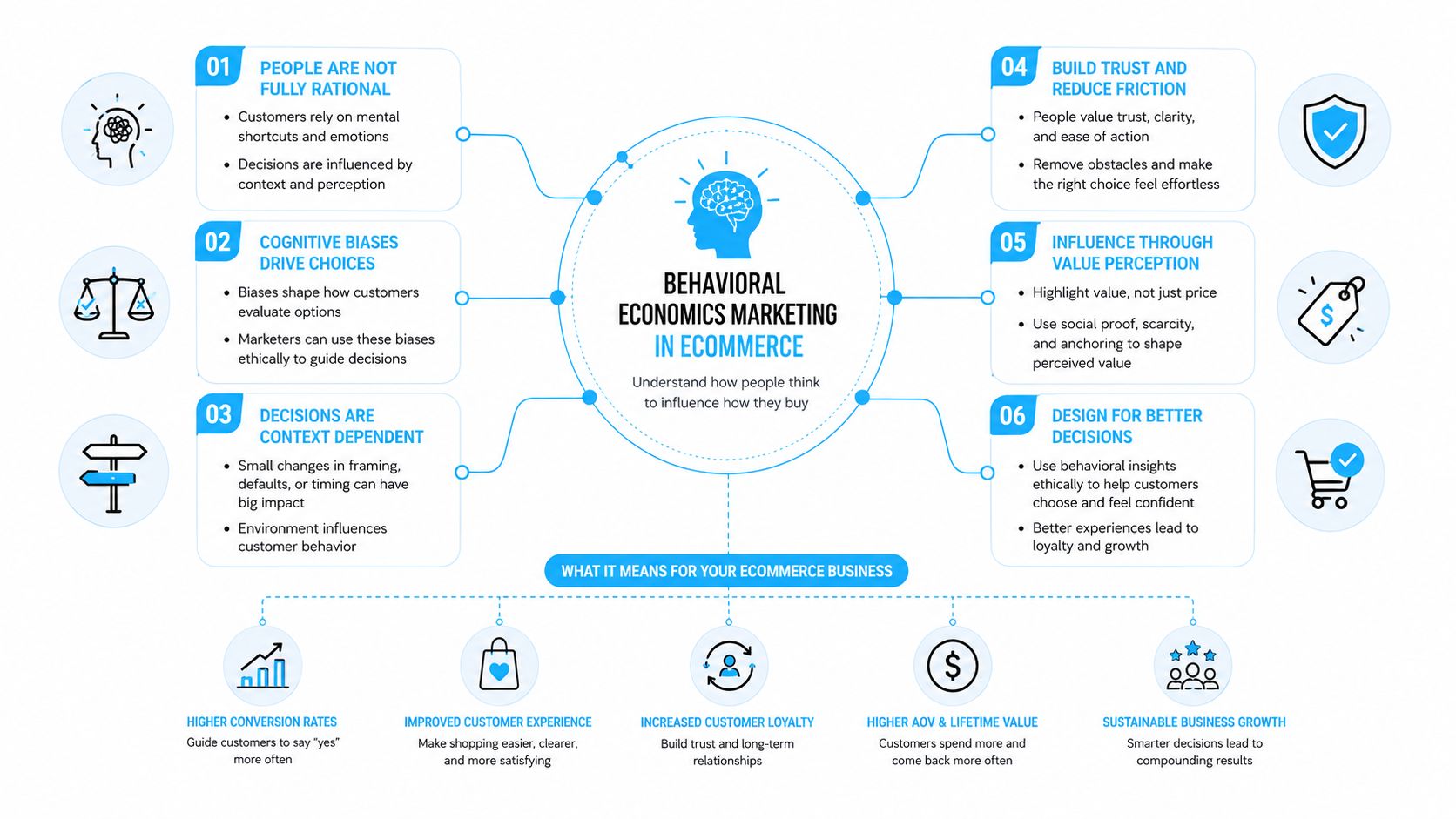
A useful way to think about it is this, a rational-actor promo says, “Here’s the discount, decide whenever.” A behavioral offer says, “This reward has structure, and your timing changes the outcome.”
Practical rule: if the promotion still works when the shopper sees it next week, it probably isn’t creating urgency, it’s just lowering price.
That’s why the work isn’t about manipulation. It’s about reducing hesitation, simplifying choice, and making the action path feel natural. For a broader primer on the design side of this work, these behavioral design principles are worth keeping nearby when you’re mapping out offers in Shopify, Klaviyo, or SMS.
Core Behavioral Principles and the Ecommerce Tactics That Use Them
The best promotions don’t rely on one psychological lever. They combine a few that push in the same direction, so shoppers feel both the value and the reason to act now.
Default, anchor, and choice structure
McKinsey’s guidance on behavioral economics is useful here because it gets operational fast, presenting one option as the default increases the chance it gets chosen, and reducing choice overload improves decisions because too many options suppress action. In a Shopify store, that can mean pre-selecting the lowest-friction path or making the preferred offer the first thing people see. Boocoo’s CRO advice is helpful for thinking about how those choices show up in a live storefront, especially when the issue is friction rather than traffic.
Default vs Behavior-Driven Promotion Tactics
| Principle | Default Approach | Behavior-Driven Alternative | Margin Impact |
|---|---|---|---|
| Loss aversion | “Save 20%” | “Claim before it’s gone” | Less dependence on deeper discounts |
| Scarcity | Fake countdown timer | Real quantity-capped reward | Protects trust and reduces gimmick risk |
| Social proof | Static review count | Live claim activity or recent participation | Can lift urgency without lowering price |
| Anchoring | One flat price cut | Tiered reward structure | Sets a stronger reference point |
| Salience | Generic sitewide banner | On-brand promotional experience | Keeps the offer from feeling bolted on |
| Present bias | Future coupon code | Immediate, earned incentive | Makes action feel worthwhile now |
Loss aversion and scarcity
Loss aversion is why “don’t miss out” framing works better than a generic percentage-off headline. People feel the pain of losing something more strongly than the pleasure of getting the same-value gain later, which is why a capped reward can outperform a simple save message. The shopper isn’t just evaluating value, they’re evaluating what disappears if they wait.
Scarcity works when it’s real. The most useful version is tied to actual inventory, capacity, or time, not a script that resets every time the page reloads.
Social proof, salience, and present bias
Social proof doesn’t need to be loud to be effective. Real participation signals, recent claims, or live activity can make an offer feel active without turning the page into a mess of badges.
Salience is easier to miss. If the promotion looks like a generic overlay, many shoppers will dismiss it the same way they dismiss cluttered banners. If it feels like part of the store, it gets processed as part of the brand, not as a distraction.
Present bias is the reason deferred coupons often underperform. Shoppers care more about what helps them right now than what they have to remember later, so immediate, earned incentives usually create cleaner action than “use this code next time.”
How Urgency and Scarcity Promotions Operationalize These Principles
A flat discount tells shoppers to buy whenever. A behavior-driven offer tells them the timing matters because the reward is limited by claim volume, time, or both. That shifts the decision from passive comparison to active participation.
That’s the practical value of urgency and scarcity mechanics in ecommerce. They let a brand reward action without making every campaign a margin giveaway, and they create a stronger reason to buy now than “we’re on sale again.”
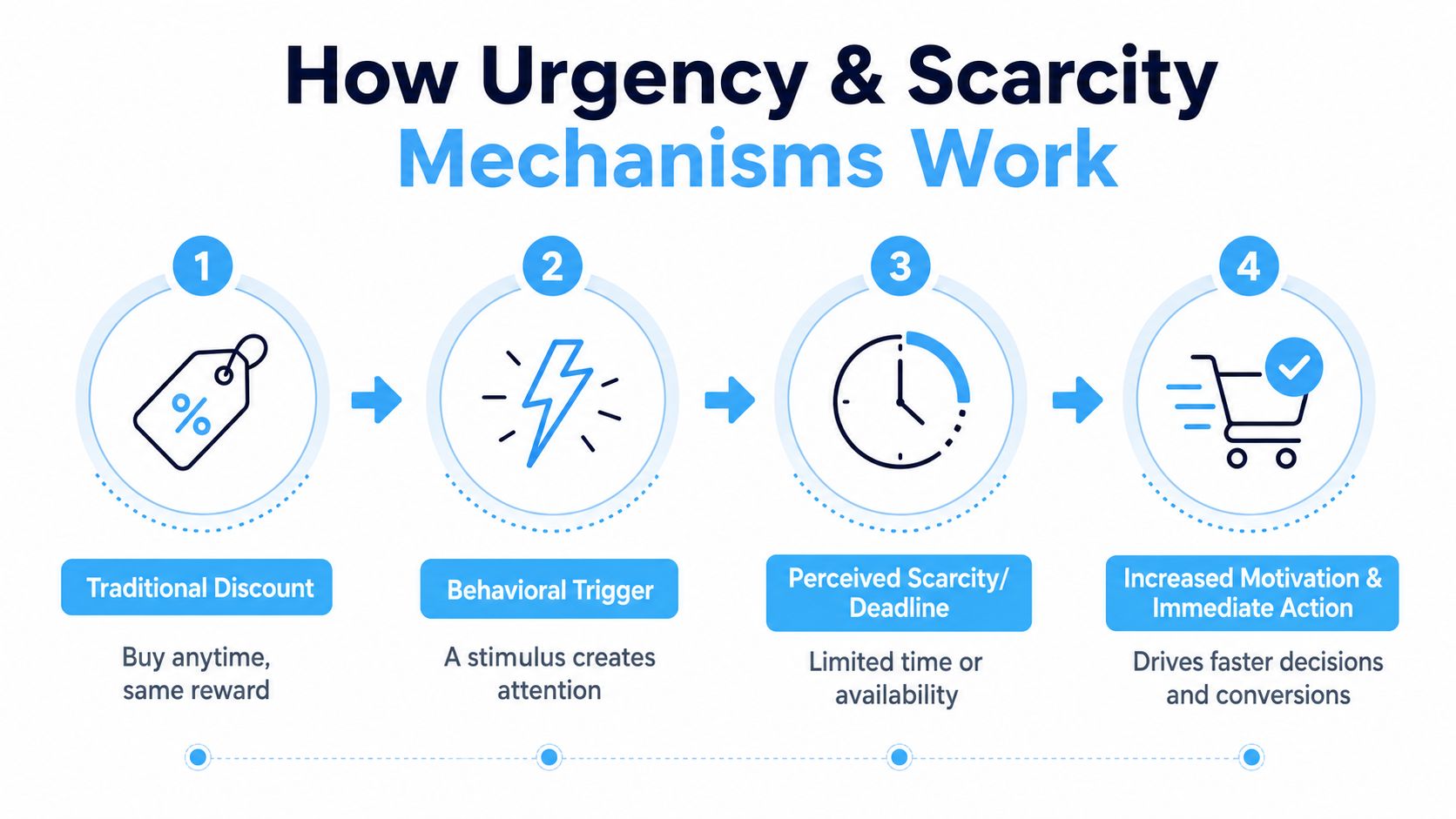
A few brands use single-reward drops. Others use descending tiers, where the reward steps down as shoppers claim. Both approaches reward the people who act early instead of the people who wait for the deepest cut.
Quikly fits that model because it turns a promotion into a time and quantity-bound experience that shoppers participate in across storefront, email, social, and SMS. The appeal isn’t just urgency. It’s that the mechanic can be styled to match the store, so it reads as part of the shopping experience rather than a popup bolted on top.
The commercial logic is straightforward. Quikly says mechanics refined across more than 60 million consumer interactions, and it has been used to create fully on-brand promotional experiences. In one case, Jordan Craig saw roughly a 20% lift in profit, with incremental lift visible immediately on activation. That’s the kind of result merchants care about, not because it’s flashy, but because it speaks to margin protection as much as conversion.
A useful test is whether the promotion rewards speed or just discounts everyone equally. If everyone gets the same deal no matter when they act, the campaign is probably teaching patience, not urgency.
For teams comparing the role of scarcity mechanics to broader promo strategy, this scarcity marketing guide gives a helpful frame for when urgency is doing real work.
Campaign Design Patterns and A/B Test Ideas
Good behavioral campaigns don’t start with the mechanic. They start with a question, what action do you want shoppers to take faster, and what kind of reward structure gets that action without training them to wait?
Three patterns that map well to Shopify
Descending tier rewards work when you want participation to create momentum. The first group gets the strongest offer, then each tier steps down as claims accumulate. That structure makes the offer feel alive, and it naturally rewards early action.
Time-bound flash offers work better for launches, restocks, or seasonal inventory where the window itself is part of the story. The key is that the timer reflects an actual boundary, not a recycled graphic.
Email and SMS activation work best when the message doesn’t just announce a code. It invites people into a live experience, which is much more compelling than another generic promo blast that lands in the same inbox as ten others.
For teams that want a testing mindset around offer design, A/B testing strategies for startups is a useful companion reference, especially if you’re deciding what to measure beyond raw clicks.
What to test
- Quantity-capped reward versus flat percentage discount: test whether a capped claim path improves urgency without forcing a deeper markdown.
- Descending tier versus static offer: test whether a moving reward creates better participation and cleaner margin than one fixed code.
- Behavior-driven email versus standard promo code blast: test whether a live mechanic improves response quality, not just open-to-click behavior.
What to measure
Conversion rate matters, but it’s not enough. Track margin per order, average order value, repeat purchase rate, and the percentage of customers who buy without a discount in the 30 days after a campaign.
That last metric is the one many teams skip. If a campaign produces a spike but conditions shoppers to wait, it may have sold this week at the expense of the next one. If it trains action, the lift should show up in how people behave after the promotion ends.
Common Pitfalls and When Behavioral Tactics Backfire
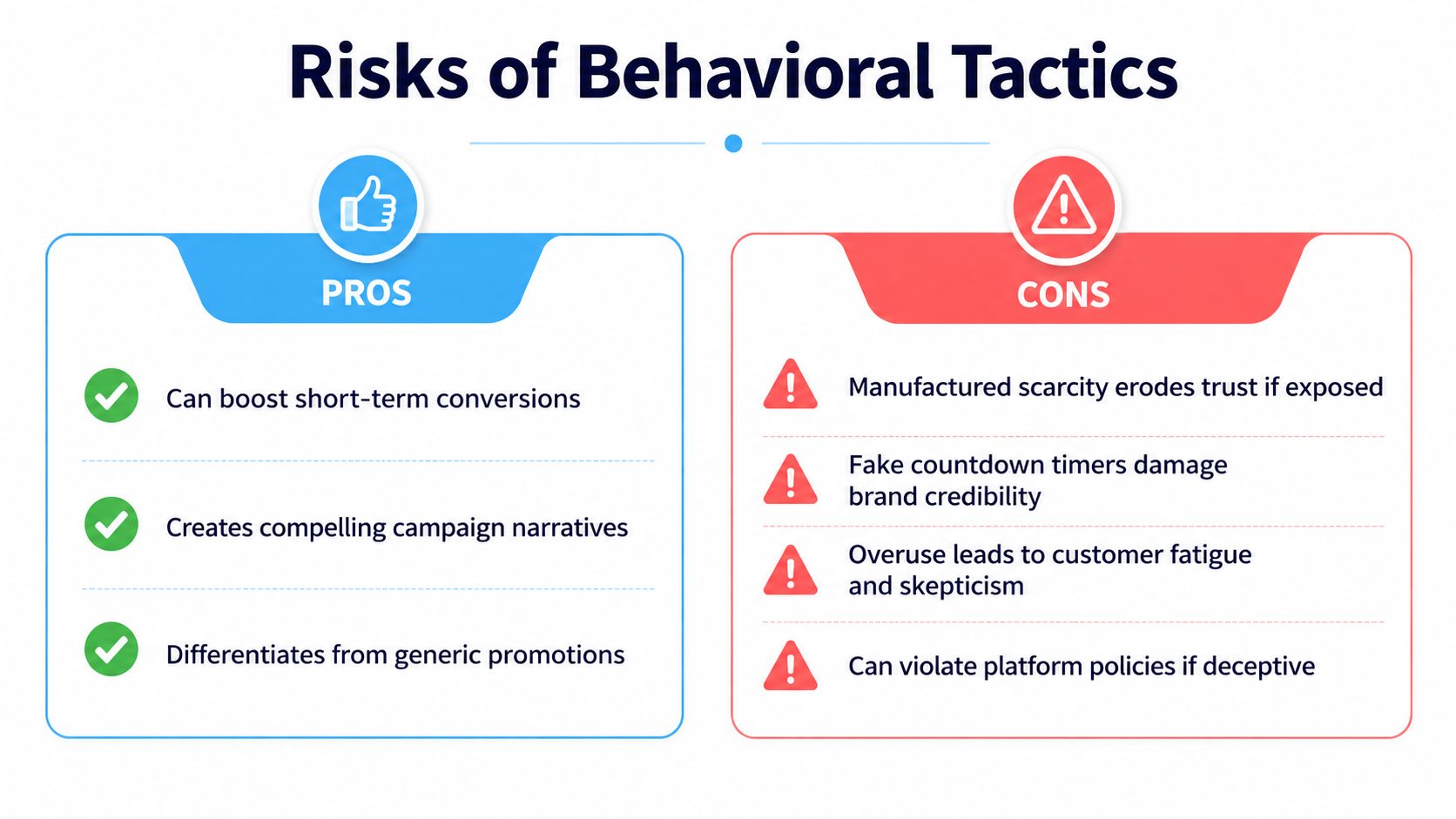
Behavioral mechanics work best when they’re real. The minute a shopper senses manufactured urgency, the tactic starts burning trust instead of creating it.
Fake countdown timers are the obvious version of that problem. So are scarcity messages that reset every day, even when nothing is limited. Once people catch the pattern, they stop believing the offer structure, and the whole brand pays for one bad mechanic.
Too many options can stop the sale
Choice overload is another trap. The jam study often gets cited because a display with 6 varieties produced 30% purchase conversion, while a display with 24 varieties produced only 3% conversion Forbes summary of the jam study. More choice looked richer, but it made action harder.
That pattern shows up in ecommerce too. Too many promo paths, too many discounts, and too many popups can make the customer do nothing. The merchant thinks they’re adding options, but they’re often adding hesitation.
Behavioral interventions can also backfire when the audience is skeptical or the execution is sloppy. The more predictable the mechanic, the easier it is for shoppers to game it, wait it out, or ignore it entirely. Some marketers also overestimate classic nudges and underweight mental availability, which is why testing matters more than theory alone.
The ethical guardrails are simple. Tie scarcity to real limits. Be transparent about the mechanic. Make opt-out easy. Keep consumer welfare in view instead of chasing the fastest possible click.
Building a Behavior-Driven Promotion Practice
Behavior-driven promotions work best when they become part of the calendar, not a one-off trick. Over time, they can stabilize margins because you stop defaulting to blanket discounts for every launch, every lull, and every slow weekend.
They also change how shoppers relate to the brand. When offers feel earned and time-bound, conversion gets help from natural decision patterns instead of brute-force price cuts, and the store feels more deliberate than promotional noise.
The cleanest next step is an audit. Pull up the current promotion calendar, mark every campaign that relies on a flat discount, and replace one of them with a behavior-driven alternative that uses real urgency, real scarcity, or a clearer choice structure.
That shift doesn’t add complexity for its own sake. It removes the promos that erode value and replaces them with promotions that ask shoppers to act now for a reason that feels believable.
If you want to run promotions that reward action instead of training patience, Quikly is built for that kind of Shopify experience. It helps brands turn ordinary offers into time and quantity-bound promotions that fit the store, support margin, and give shoppers a real reason to buy now.
Topics: behavioral economics marketing, ecommerce psychology, scarcity marketing, conversion optimization, Shopify promotions