Most Shopify merchants don’t install a shopify urgency app because they love timers. They install one because conversion is lagging, paid traffic is expensive, and the default answer in ecommerce has become “discount more.” That path works for a while, then margins thin out, customers learn to wait, and the brand starts paying for its own promotion habit.
The better question isn’t how to add urgency everywhere. It’s how to create real urgency without turning every campaign into a markdown that weakens the next one. The stores that do this well keep the offer credible, keep the shopper’s decision easy, and avoid training the market to expect a sale before it buys.
The Hidden Cost of Standard Urgency Tactics
The biggest mistake with urgency is treating it like decoration. A blinking timer, a generic low-stock label, or a blanket discount can create motion, but motion isn’t the same as durable demand. If the shopper can feel that the clock resets whenever the page reloads, the message stops being urgency and starts looking like pressure.
That distinction matters because many brands are already trapped in promo fatigue. They run more promotions to make up for weaker response, then deepen the discount to get the same result, and the loop gets harder to escape. The short-term lift looks good, but the long-term cost shows up in margin erosion and weaker brand perception.
Practical rule: if the offer wouldn’t survive a screenshot in a customer group chat, it’s probably too flimsy to build trust.
Why discounts can train delay
Consumers get smart fast. If your store runs the same kind of markdown every few weeks, buyers learn to wait, especially on non-urgent purchases. That’s why urgency should align with something real, such as stock, time, or a limited claim window, rather than trying to manufacture pressure for its own sake.
Independent ecommerce guidance compiled in 2026 says countdown timers can lift conversions by 8–32%, that 60% of consumers have made a purchase decision because of FOMO, and that flash sales can produce 35% higher transaction rates than standard promotional pricing, all when the urgency is authentic and tied to a real offer. Those are useful numbers because they point to the underlying behavior, not just the UI. A timer can help, but only when it reflects a real deadline buyers can trust, as discussed in Quikly’s FOMO marketing guide.
The trade-off is simple. If you overuse urgency, you may raise response today and weaken response next month. If you reserve it for moments that deserve it, you protect both conversion and perceived value.
How Shopify Urgency Apps Work
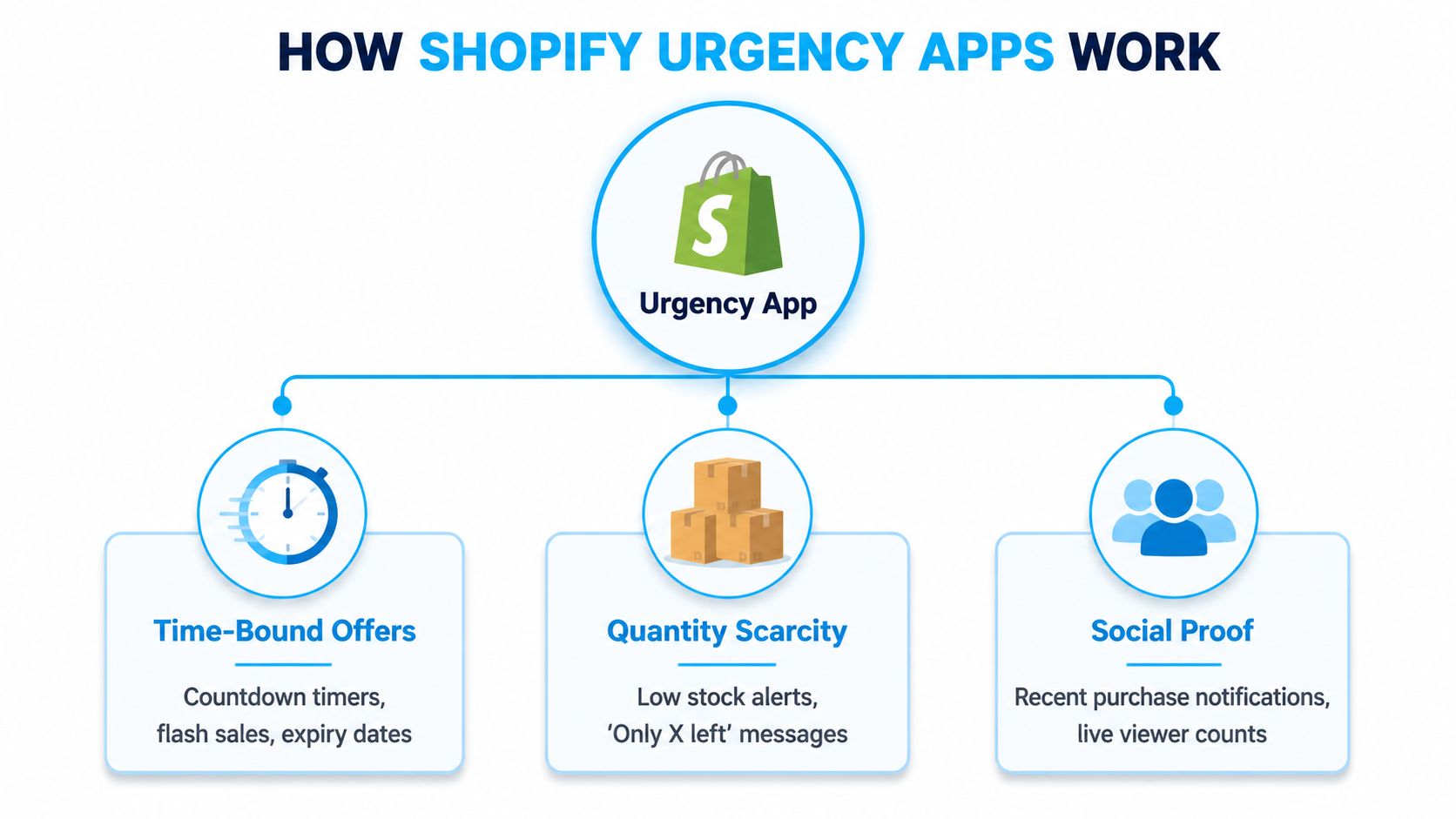
A good Shopify urgency app does more than place a banner on top of the storefront. It connects promotional signals to a real event, such as a time window, inventory state, or live activity signal, then presents that information in the storefront where shoppers can see it quickly. That is the difference between a cosmetic overlay and an operational promotion.
Three mechanics merchants use
Time-bound offers are the simplest to read. A countdown timer, a flash sale, or an expiring bonus gives shoppers a clear closing point, which can reduce hesitation when the deadline is genuine.
Quantity scarcity works in a different way. Low-stock counters, “only a few left” messages, and inventory-linked alerts make availability the focus, not just the price. One live low-stock counter app supports real Shopify inventory and Manual stock mode for launches, preorders, drops, and custom products, which is useful when scarcity itself is part of the offer.
Social proof adds another layer. Recent purchases and live viewer counts tell shoppers they are not the only ones paying attention. One urgency app refreshes visitor counts every 10 seconds to keep the signal close to real time, which matters because stale activity looks fake fast.
Under the hood, Shopify also creates a technical requirement merchants cannot ignore. Shopify’s app platform requires urgency apps that synchronize data with Shopify to maintain accurate and correct transfer of data across Shopify admin, the app, and connected systems, and as of March 13, 2024 all apps must use the latest Shopify App Bridge by including app-bridge.js before other scripts. That matters because inventory states, timed offer states, and visitor signals need low-latency handling if the merchant and shopper are meant to see the same logic.
For a broader practical overview of conversion tools, conversion rate tactics for Shopify is worth comparing with this guide to Shopify marketing apps against your current stack.
A strong urgency setup does not feel louder. It feels more believable.
The Psychology Behind Scarcity and FOMO
Urgency works because shoppers do not evaluate every purchase from zero. They rely on shortcuts. Scarcity bias makes limited items feel more valuable. Loss aversion makes missing out feel heavier than waiting. Temporal discounting makes future benefits feel smaller than immediate ones, which is why a real deadline can move a shopper who has been hesitating for days.
The practical test is simpler. Which tactic triggers those instincts without making the shopper feel manipulated? Countdown timers can do that when the deadline is real. Low-stock alerts can do that when inventory reflects actual stock. Social proof can do that when the signals are current and not inflated.
Authentic urgency versus manufactured pressure
A timer that resets on every visit creates skepticism. A stock message that never changes throughout the day creates the same reaction. The shopper may still click, but the brand has taught them not to trust the next message.
A real offer behaves differently. The shopper sees the condition, understands the boundary, and can decide quickly. Urgency works best when the reason to act is visible and specific, not vaguely dramatic.
The job is to reduce hesitation, not to corner the customer.
That line matters because it marks the difference between persuasion and pressure. When urgency is tied to a genuine shipping cutoff, a launch window, or a visible inventory constraint, it reads as useful information. When it is only a decorative clock, it reads as a tactic.
For a useful frame on how FOMO works in practice, Quikly’s perspective on FOMO marketing is a practical reference because it treats urgency as behavior, not just display.
Evaluating Core Features and Trust Signals
The most useful urgency tools don’t ask whether they can create tension. They ask whether the tension is true, timely, and consistent across the storefront. That’s where merchants should evaluate features. A live signal that lags behind reality is worse than no signal at all because it damages trust.
A simple way to judge urgency features
| Feature | Trust Impact | Best Use Case |
|---|---|---|
| Dynamic social proof | Strong when the signal is current | High-traffic product pages, launches, flash sales |
| Live low-stock counter | Strong when tied to real inventory | Drops, launches, limited editions, preorder windows |
| Countdown timer | Moderate to strong when the deadline is real | Shipping cutoffs, expiring offers, scheduled campaigns |
| Manual stock mode | Strong when launches need controlled scarcity | Preorders, custom products, planned releases |
A dynamic visitor count only helps if it feels current. That’s why short refresh intervals matter, as noted earlier with the 10-second update cadence. Once the displayed activity lags behind actual behavior, shoppers stop reading it as evidence and start reading it as theater.
What to favor for first-time buyers
First-time visitors usually respond best to signals that clarify rather than overwhelm. A real deadline, a clean stock message, or one live proof point can be enough. Too many urgency cues on one page can make the store look frantic, especially if the buyer is still learning whether they trust the brand.
Returning customers are different. They already know the product, so tighter scarcity signals can work better because the brand-risk barrier is lower. That doesn’t mean piling on every cue available. It means choosing the least noisy signal that still reflects the truth of the offer.
For a practical comparison of app categories and stack choices, this Shopify marketing apps guide is a useful sanity check before you add more software.
Moving Beyond Popups to Behavior-Driven Promotions
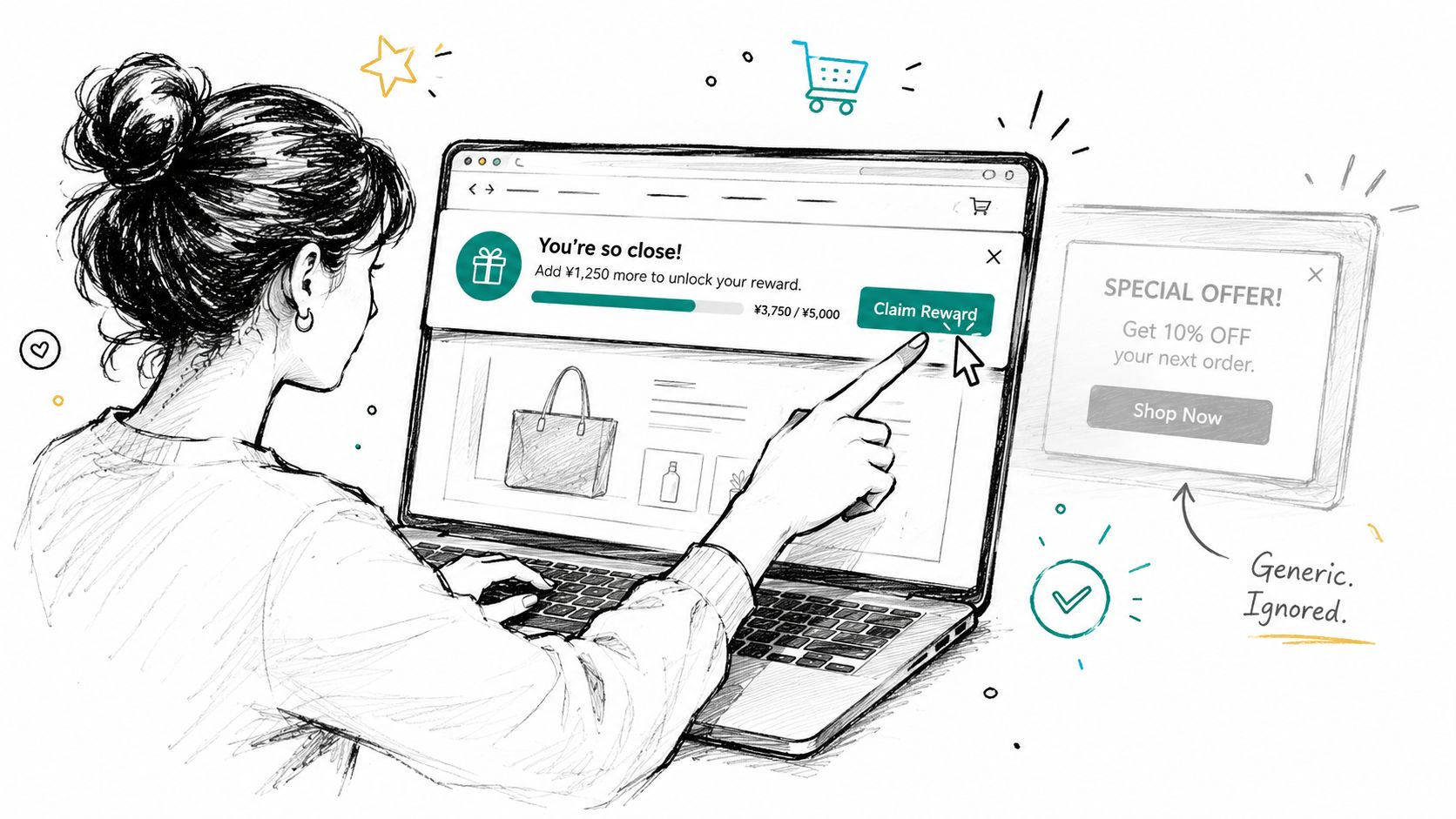
Standard urgency apps usually place pressure on the shopper. Behavior-driven promotions do something more useful, they reward action. That shift matters because a flat discount tells everyone the same thing, while an earned offer makes the customer participate in the outcome.
Quikly sits in that camp. It runs urgency and scarcity promotions as time- and quantity-bound experiences that shoppers actively enter, with campaigns that can appear across the storefront, email, social, and SMS. The important part isn’t the channel list. It’s the structure, where the people who act first get the better outcome, and the campaign stays on-brand instead of looking like an overlay stapled onto the store.
A small team can launch one fast, but the more meaningful point is commercial. If the offer is capped or steps down as claims are taken, you can create urgency without relying on a deeper blanket discount for everyone. That’s how some brands reduce the habit of selling more by discounting harder.
What changes when shoppers participate
A passive promo says, “We’re discounting this, take it or leave it.” A behavior-driven promo says, “Act early if you want the stronger reward.” That difference changes how customers experience the campaign.
It also changes the brand’s posture. Instead of teaching people to wait for the next markdown, the store rewards decisive behavior while keeping the promotion tied to a real mechanic. Quikly’s approach is refined across more than 60 million consumer interactions, and the reason that matters is simple, it’s been shaped around actual buying behavior rather than abstract theory.
For operators, margins and brand perception start working together instead of against each other. You’re not asking for a louder discount. You’re asking for a better promotion structure.
Measuring Impact and Avoiding Common Pitfalls
Conversion only matters if the order is worth taking. A campaign can raise order volume and still hurt the business if it cuts too far into margin or teaches shoppers to wait for the next offer. The central question is whether urgency creates incremental profit without weakening pricing power or the brand’s position.
What to watch beyond conversion rate
Start with profit, not just orders. Then check average order value, discount depth, and whether the campaign pulled demand forward or created new demand. If the promotion only works after the discount gets deeper, the store is already sliding into a weak pattern.
Repeat behavior is the warning sign. If every launch needs a stronger timer, a bigger markdown, or more stacked banners, the store is training the audience to ignore normal offers. That is the discount-more-to-sell-more loop, and it erodes long-term performance because shoppers begin to treat urgency as background noise.
A quick practical test helps here. If a customer misses the offer and immediately expects a better one next week, the message is too predictable.
For a broader measurement framework, Silva Marketing’s 2026 CRO guide is a useful companion because it keeps attention on the conversion system, not one isolated tactic.
How to test without fooling yourself
Compare one real urgency signal against a quieter control, then keep the creative and audience the same. If the urgent version wins, check whether it did so with acceptable margin. If it only wins because the discount was pushed harder, the campaign is leaking profit instead of building it.
The same standard applies to app stacks. Fewer well-chosen signals usually beat a page crowded with overlapping cues. For a closer look at tracking and attribution discipline in ecommerce, Quikly’s analytics article is a useful reference when you are deciding which metrics deserve attention.
Building a Sustainable Promotion Strategy
The future of ecommerce promotions isn’t louder pressure. It’s better alignment between how people decide and how brands present the offer. The stores that win long term are the ones that protect margin, keep the experience credible, and use urgency only where urgency is real.
That means auditing every current promotion. Look for flat discounts that have become routine, timers that no longer feel tied to a real deadline, and messages that crowd the page without adding clarity. Then decide where a behavior-driven mechanic would do the job better.
If you want a useful outside lens on channel-specific promo planning, Online Brand Growth’s Amazon promotion insights are a reminder that promotion strategy has to fit the marketplace and the buyer’s expectation, not just the merchant’s need to move inventory.
Quikly gives Shopify brands a way to run urgency promotions that reward early action instead of training customers to wait. If you want a promotion structure that protects margin while still pushing people to buy now, visit Quikly and review how capped and descending offers can fit your store.
Topics: shopify urgency app, urgency tactics, scarcity marketing, conversion optimization, shopify promotions