Most brands still treat fear of missing out marketing like a gimmick. They bolt on a countdown timer, slap a discount on the homepage, and hope urgency does the rest. That usually just teaches shoppers to wait for the next sale.
The better version is quieter and harder to fake. It respects how people already decide, gives them a real reason to act now, and protects margin instead of burning it to create motion. If you run Shopify promotions, that distinction matters because the easiest way to manufacture urgency is often the fastest way to erode brand value.
Why Fear of Missing Out Marketing Is More Than Countdown Timers
A ticking clock is not the strategy. It is only the visible edge of a deeper behavior, and if the offer underneath is weak, shoppers learn to ignore the clock. Fear of missing out marketing works when it creates a real, bounded opportunity instead of a theatrical deadline.
The research points in the same direction. A global GWI report described one quarter of all global internet users as “FOMO Networkers,” and it also found that the share of people spending more than 10 hours online per day rose from 2.8% in late 2012 to 5.4% in the report period (GWI report). In the U.S., independent summaries report that 69% of Americans have felt FOMO at least once, and 56% of social media users feared missing updates or news when offline. That is not a narrow behavior. It is part of how connected shoppers already behave.
What that means for a Shopify brand
The goal is not to make people anxious. The goal is to reduce the delay between intent and action. When a shopper already wants the product, loss aversion and scarcity bias can move them faster than another generic discount ever will.
The better question is whether waiting carries a real cost. That cost can be access, time, quantity, or participation. If you want a clean primer on how social validation fits into that decision, what is social proof in marketing is a helpful companion read, and this overview of consumer psychology behind urgency shows why people act once the window feels real.
Practical rule: if the offer would still feel legitimate after a screenshot, it is probably useful. If it only works because shoppers cannot verify it, it is probably just noise.
That is the trade-off for ecommerce brands. Deeper discounts can force action, but they also train people to hold out. Fear of missing out marketing gives you a different lever, one that can drive immediate response without turning every campaign into a margin haircut.
The Behavioral Science Behind Urgency and Scarcity
Urgency works because it compresses the decision window. People don’t need to love the offer, they just need to believe waiting carries a real downside. That’s where the psychology matters more than the creative treatment.
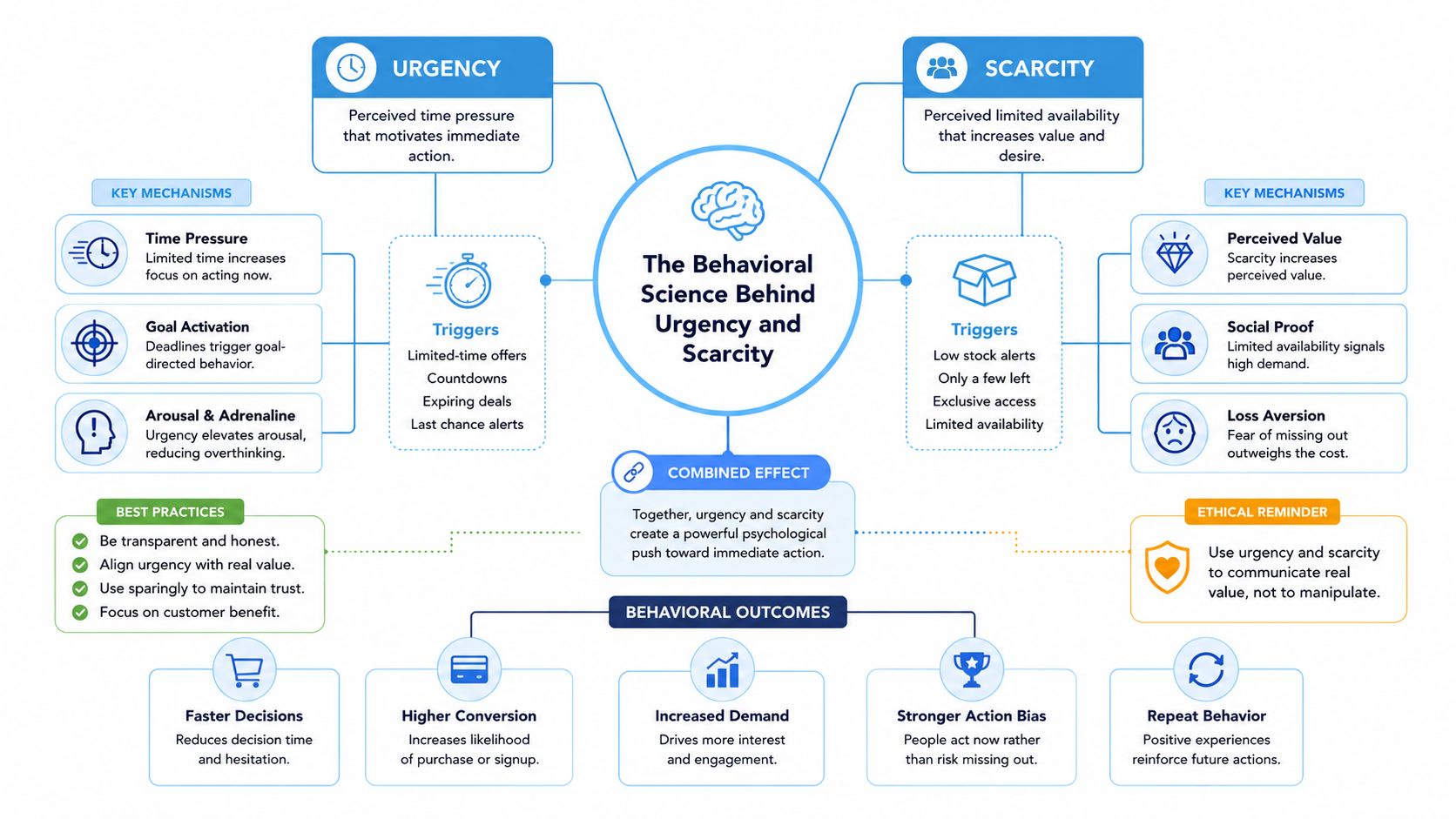
The four mechanisms that matter
Loss aversion is the simplest one. People feel the pain of losing access more sharply than they feel the pleasure of waiting for a slightly better deal. That’s why “only 3 left” often beats “in stock” on a product page, because the shopper can picture the loss.
Scarcity bias follows a similar path. When availability looks constrained, the item seems more valuable, even if nothing about the product itself changed. Limited-edition drops and capped-release products work because scarcity signals desirability, not just shortage.
Social proof reduces uncertainty. When shoppers see real activity from other buyers, they don’t just infer popularity, they infer safety. A purchase from a peer makes the decision feel less risky, which is why reviews, recent-purchase cues, and visible demand can move holdouts who were already close.
Temporal discounting explains why time windows matter so much. People value future rewards less than immediate ones, so a long promotional runway often dilutes urgency. A short, clearly bounded window makes action easier because the shopper doesn’t have to keep the offer mentally active for days.
The same logic shows up in the practical guidance around FOMO messaging. A 2023 summary of FOMO research reported that 60% of people make purchases because of FOMO, mostly within 24 hours, while another source found that 51% of U.S. adults have made a FOMO-driven purchase or investment (TrustPulse summary). That doesn’t mean everyone is impulsive. It means the right constraint can convert an already-present intention before the shopper defers it.
A useful filter for every campaign
The variable is not just incentive size. It’s the perceived probability of missing the offer if the shopper waits. That’s why credible scarcity can outperform a broader markdown, and why fake urgency usually underperforms once customers get used to it.
Operator takeaway: when the deadline or quantity changes the decision structure, urgency helps. When it only decorates the page, it doesn’t.
For a deeper behavioral breakdown, the internal guide on consumer psychology and urgency is worth reading alongside this one.
FOMO Tactics That Protect Margins Instead of Eroding Them
The worst FOMO campaigns are cosmetic. They use urgency language without changing the offer structure, so shoppers get the stress but not the reason to move. The better campaigns tie the message to something operationally real, time, stock, or access.
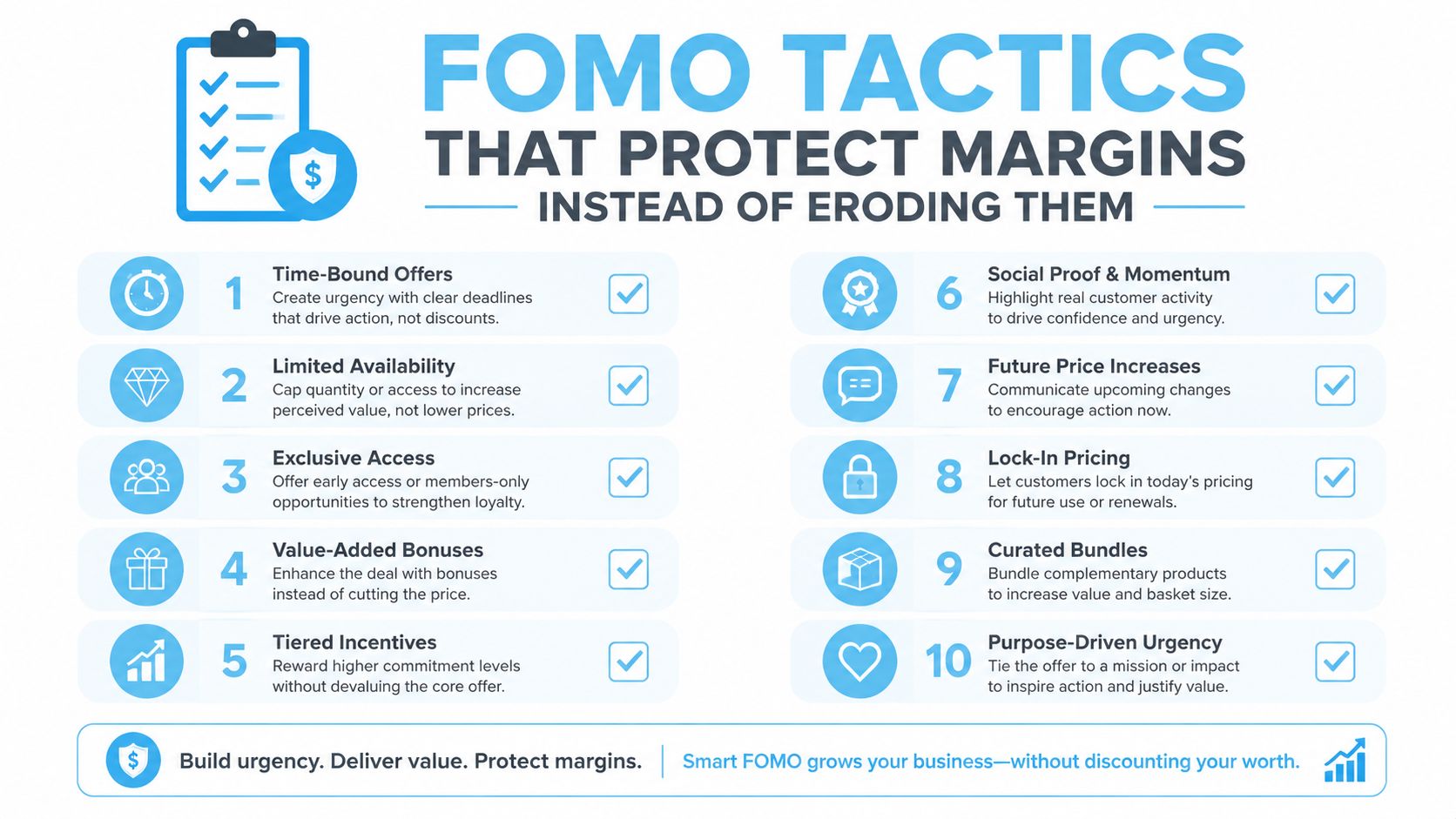
What to use instead of deeper discounting
Limited-quantity drops are the cleanest place to start. If inventory is constrained, show that constraint plainly on the product page and in lifecycle channels. This leans on scarcity bias without lowering the price for everyone who arrives later.
Time-bound offers work best when the window is specific and believable. The technical review in the brief notes that successful limited-time offers often run on a 24- to 72-hour window with exact start and end times, distributed consistently across channels (technical review). That structure matters because the offer logic, storefront copy, email, and SMS all have to say the same thing.
Descending-tier rewards are useful when you want early action without giving your best margin to everyone. Early claimers get the strongest reward, and the benefit steps down as the campaign progresses. The mechanism is simple, people who act first get the better deal, people who wait still have a reason to buy, and the average discount stays lighter than a blanket sale.
Exclusive access windows are another strong fit for Shopify brands with an engaged list. Email subscribers, loyalty members, or VIP customers get first access before the public launch. That turns the list into a participation layer, not just another coupon channel.
Keep the offer logic consistent
A campaign loses credibility when the storefront says one thing and email says another. The strongest results usually come from aligning product page copy, cart messaging, SMS timing, and post-click pages so the shopper never has to wonder whether the constraint is real.
If you want a practical channel-level view, the internal guide on Shopify urgency tactics is a good companion. For retention-oriented sequencing, the resource on automation flows that lift retention is useful context too.
One platform option in this space is Quikly, which lets Shopify brands run time- and quantity-bound promotional experiences as a single reward or a descending tier, styled to match the store. That matters because it turns the offer into an experience shoppers participate in rather than a blunt discount they ignore.
When the shopper can verify the constraint, hesitation drops. When the constraint is fake, the campaign just adds friction.
Margin protection comes from limiting the reward intelligently, not from making the headline louder. That’s how you create urgency without normalizing deeper markdowns.
Campaign Examples That Show Behavior-Driven Promotions in Action
The best way to understand behavior-driven promotions is to compare them with a flat sale. One creates a reason to act now. The other mostly trains people to wait for the next sitewide markdown.
A clothing drop with tiered rewards
A Shopify apparel brand can run a descending-tier campaign where the first 100 shoppers get 20% off, the next 200 get 15% off, and everyone after gets 10% off. The behavioral trigger is obvious, early action gets a better outcome. The margin effect is better than a blanket sale because you only give the deepest reward to the earliest buyers, not the entire audience.
This kind of structure also changes shopper behavior inside the campaign window. The early tiers create a visible race without turning the whole promotion into a clearance event. It feels like participation, not passive couponing.
A beauty launch with capped inventory
A beauty brand can cap a flash sale at 500 units and show remaining stock in real time. That setup activates scarcity bias and loss aversion together, because shoppers can see the offer closing in front of them. The result is a harder stop than a vague “while supplies last” message, which is easy to dismiss.
The margin protection is straightforward. The brand can use a special price on a finite quantity without extending the same discount across the full catalog. That keeps the promotional cost bounded.
Subscriber-only early access
A third pattern is an exclusive early-access window for email subscribers before the public launch. The trigger here is participation and exclusivity, not just bargain hunting. People who opted into the list feel like they’re inside the experience, and that shifts the relationship from transactional to membership-oriented.
For planning perspective, the 2026 Shopify marketing playbook offers useful context on how brands are structuring these kinds of campaigns across channels.
Operational insight: the better the campaign feels like access, the less you have to pay for attention.
That’s the difference versus blanket discounting. You’re not buying urgency with a deeper markdown. You’re using structure to make action feel timely and meaningful.
When FOMO Marketing Backfires and How to Avoid Brand Damage
Urgency can help a shopper decide. It can also make a brand look needy, manipulative, or cheap if the execution is sloppy. The line between the two is thinner than many admit.
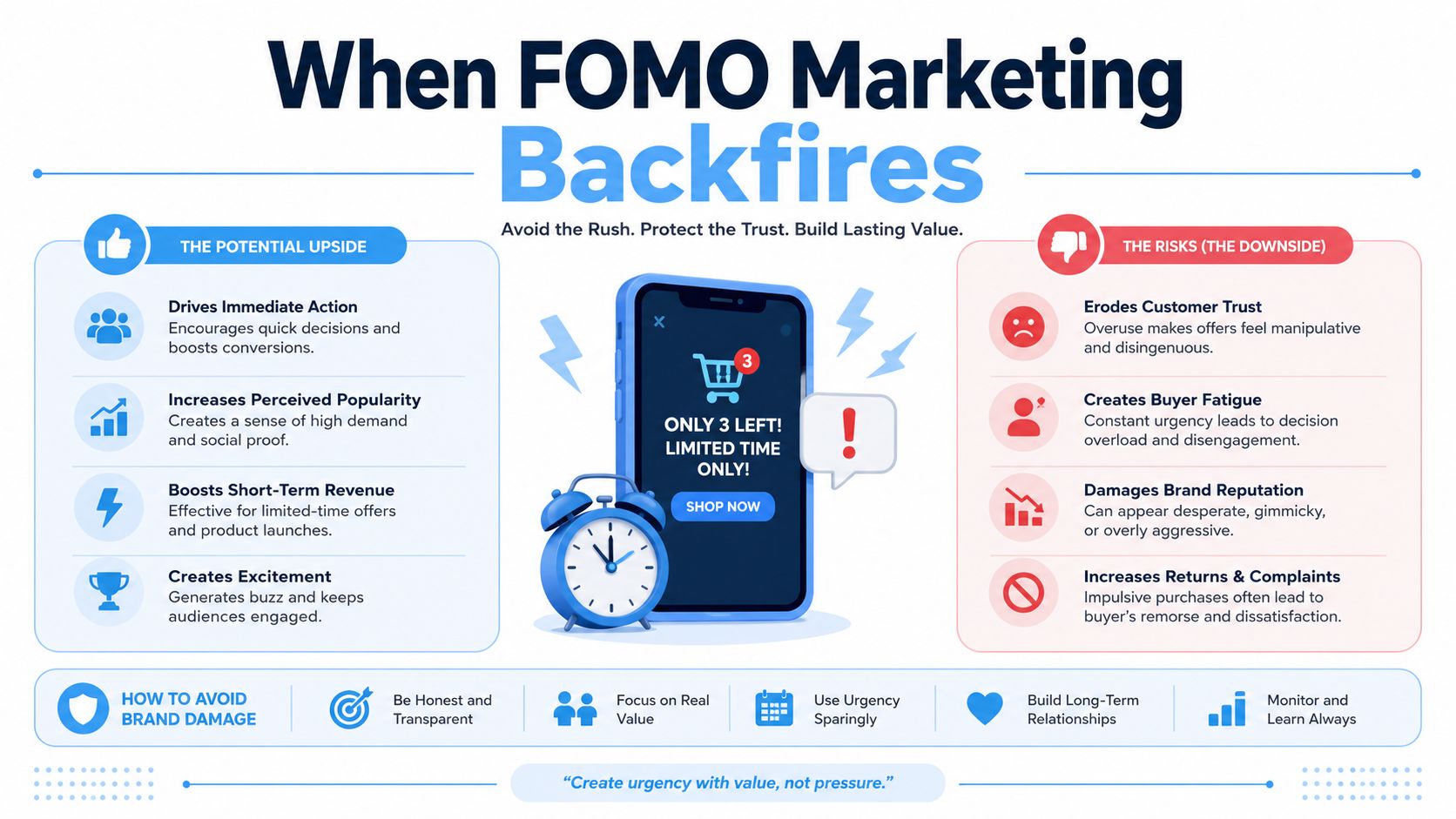
Three ways campaigns lose trust
Fake scarcity is the fastest way to burn credibility. If the product never runs out, or the timer keeps resetting, shoppers notice. Once they do, every future urgency cue gets discounted.
Aggressive countdown pressure can create anxiety instead of excitement. A timer that dominates the page, email, and SMS all at once can feel less like an invitation and more like a shove. That’s especially risky if the shopper isn’t close to buying yet.
Exclusionary framing can alienate customers who miss the window. A brand can make the offer feel like a closed club in a way that looks more punitive than participatory. That might work once, but it can make the next launch feel less welcoming.
The research makes the downside clear. A study discussed by the University of Portsmouth reports that FOMO and intense brand passion can push consumers toward compulsive buying, with downstream effects including stress, debt, and anxiety (University of Portsmouth). That’s not just a consumer-well-being issue. It also explains why overly aggressive urgency can leave a long memory in the brand relationship.
A cleaner way to evaluate the tactic
Ask whether the offer feels fair, transparent, and brand-safe. If the shopper can understand the constraint without feeling tricked, the campaign has a chance. If the only reason it works is that people can’t verify the terms, it’s probably a short-term conversion win with a long-term cost.
The internal article on FOMO psychology is useful if you want to sanity-check the boundary between motivation and pressure.
There’s a better question than, “How do I make people feel rushed?” The better question is, “How do I create a limited opportunity that still feels like participation?”
Implementation Checklist and Measurement Framework
A good campaign starts with the constraint, not the creative. Decide whether the urgency comes from time, quantity, or access, and make that constraint real enough that your team can explain it without hedging. If the logic is fuzzy internally, it’ll be worse externally.
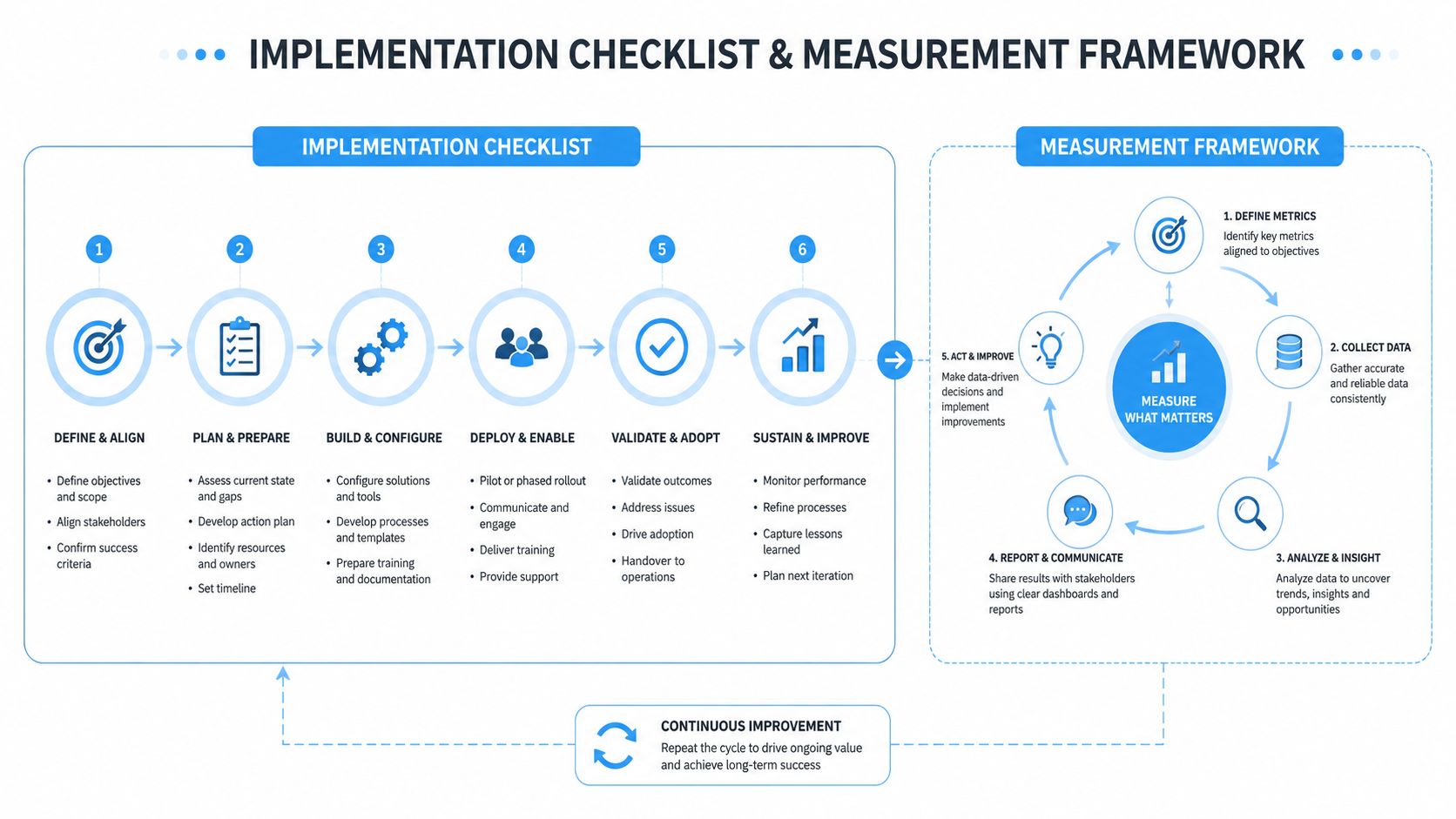
A practical launch checklist
-
Define the scarcity rule. Choose a real time window or a real quantity limit. Don’t layer on both unless the offer can support both.
-
Align the channels. Email, SMS, homepage, product page, and cart messaging should all describe the same opportunity in the same language.
-
Confirm the technical setup. In Shopify, that means making sure discount logic, inventory visibility, and campaign timing are working before launch.
-
Style the experience on brand. The promotion should feel like part of the store, not a bolt-on interruption.
-
Write the decision cue. Make the reason to act now obvious in one sentence. Shoppers don’t need a manifesto.
-
Test against a flat discount control. That comparison tells you whether the urgency structure is doing the work or whether the offer itself is carrying everything.
What to measure beyond conversion
Conversion rate matters, but it’s not the only number that tells the truth. Watch margin impact, average order value, and the quality of the response across email and SMS. If the campaign gets a lift but trains customers to wait for deeper markdowns later, the short-term win is too expensive.
The other signal is behavioral. Are shoppers responding earlier in the campaign window, or are they waiting until the final hour every time? If the action keeps clustering only at the end, the urgency is probably real. If it’s flat or random, the offer may not be credible enough.
Measurement rule: the best FOMO campaign is the one that improves response without forcing you to widen the discount next time.
Shopify teams don’t need more promo volume. They need cleaner promotional mechanics that convert intent faster without giving away value unnecessarily.
Rethinking Promotions as Participation Experiences
The old playbook treats every promotion like a coupon blast. That’s useful for short spikes, but it eventually pushes margins down, trains delay, and weakens the brand’s pricing story. Fear of missing out marketing works better when it turns the offer into something shoppers participate in, not something they passively receive.
That’s the shift. The marketing variable is not only the incentive size, it’s also the perceived probability of missing the offer if the shopper waits. Brands that understand that can stop leaning on deeper discounts and start designing promotions that reward action, protect margin, and feel fair.
If you want to build urgency without defaulting to deeper discounts, Quikly gives Shopify teams a way to run time- and quantity-bound promotional experiences that shoppers participate in. It’s built for the kind of FOMO marketing that protects margin and feels on-brand, not like a generic popup bolted on top. Visit Quikly if you’re ready to audit one flat discount and replace it with a tighter, more credible offer.
Topics: fear of missing out marketing, FOMO marketing, urgency tactics, scarcity marketing, Shopify promotions