The most popular advice in retail psychology is also the advice that creates the most expensive habit: if conversion falls, offer a deeper discount.
That reflex can produce a short-term lift, but it also teaches customers to delay, weakens the reference price, and makes every future promotion work harder. A Shopify store can’t solve a margin problem indefinitely with another code, popup, or extended sale.
Customer psychology in retail gives operators a better question: what’s making the shopper decide now, and does that mechanism protect the value of the product? Scarcity, social proof, loss aversion, and choice architecture can improve the buying experience, but only when the storefront supports the message.
Why Default Shopify Promotions Stop Working
A weaker conversion rate does not automatically call for a larger discount. Yet many Shopify teams respond by cutting a deeper code, extending the sale, or placing another popup over the product page. That response can create margin bleed, the gap between the cost of the discount and the incremental profit generated by the extra orders. If the added orders do not cover that gap, optimization is only moving revenue around.
Blanket percentage-off offers also reset the shopper’s reference price. After repeated promotions, customers begin treating the markdown as the actual price and the original price as a reason to wait. A consumer survey found that 91% of Americans delay purchases to wait for a discount, while 61% are willing to wait a month or longer. The survey also found that 51% have abandoned an online cart hoping for a discount email, and shoppers said they need at least 26% off on average before waiting feels worthwhile. Read the underlying consumer survey.
The cost shows up in three operating areas:
- Contribution margin: Price promotions typically reduce retailer category margins, so extra volume can produce less profit per order. Review the promotion and margin trade-off.
- Acquisition quality: Discount-led campaigns can attract shoppers whose main connection to the brand is the deal. Paid acquisition may look efficient during the promotion while full-price repeat behavior remains weak.
- Brand equity: Frequent markdowns flatten the product signal. If every visit includes a discount, craftsmanship, convenience, and design have less room to support the listed price.
Operator’s rule: A promotion should change the buying decision without changing what customers believe the product is worth.
A psychology-informed promotion treats the offer as a UX choice, not a panic button. A store can use genuine inventory constraints, observed customer behavior, earned rewards, or simpler choices instead of giving every visitor the same price reduction. Teams reducing discount dependence can review alternatives to discounting while planning the next Shopify campaign.
| Tactic | Margin Impact | Repeat Purchase Behavior | Brand Perception |
|---|---|---|---|
| Sitewide percentage discount | Reduces revenue per order immediately | Can train shoppers to wait | Makes the markdown feel like the reference price |
| Repeated popup code | Adds incentive cost without resolving hesitation | Encourages code-seeking behavior | Can make the store feel transactional |
| Real quantity-limited reward | Controls cost through a defined cap | Rewards timely action rather than waiting | Can reinforce demand and selectivity |
| Cart threshold incentive | Protects the base product price while encouraging basket growth | Builds a habit around reaching a useful goal | Keeps value attached to the product and experience |
Apply the same discipline to acquisition creative. Resources such as growth templates for TikTok can connect the ad promise to the storefront experience, but the landing page still needs a credible reason to act now. Better traffic will not repair an offer that trains shoppers to postpone.
The Four Biases That Drive Most Buy Decisions
A shopper arrives from an ad on a Shopify product page. The product fits, reviews reduce uncertainty, a stock message suggests other people are interested, and the visitor moves toward the cart. At that point, the decision usually isn’t a clean comparison of price and utility. Several mental shortcuts are operating at once.
Scarcity changes the cost of waiting
Scarcity bias makes a constrained product feel more valuable or more urgent. The constraint might be real inventory, a genuine closing window, or credible evidence that demand is high. In a Shopify theme, scarcity usually belongs near the product title, variant selector, or add-to-cart button, where it answers the question, “Can I safely wait?”
Use “low stock in this size” only when the inventory data supports it. A vague “selling fast” badge with no operational basis may create pressure once, but it gives repeat visitors a reason to distrust future messages.
Social proof lowers uncertainty
Social proof lets shoppers borrow confidence from the observed behavior of similar buyers. Reviews, recent purchase activity, customer photos, and product-specific ratings work best beside the decision they support, not buried on a separate page.
For a new visitor, a review block under the variant selector can answer fit or quality concerns. A recent-purchase indicator near the add-to-cart area can reinforce demand, but it must reflect actual store activity. The more specific the proof is to the product, the less it feels like decorative marketing.
Loss aversion protects an earned benefit
Loss aversion describes how giving up a benefit can feel more painful than gaining an equivalent benefit feels pleasurable. In a cart drawer, “You’ve unlocked free shipping” may carry more motivational weight than “Get free shipping with your order,” because the shopper now has something to preserve.
Earned incentives outperform automatic codes. A progress bar, gift threshold, or reserved reward gives the shopper a reason to complete the behavior that created the benefit.
Choice architecture reduces decision friction
Choice architecture shapes behavior through the number, order, and framing of available options. A product page with too many variants, bundles, badges, and competing calls to action forces the shopper to solve the interface before evaluating the product.
Keep the primary path obvious. Feature one recommended bundle, explain the difference between options in plain language, and move secondary offers below the main purchase decision. Practical guidance on designing for user emotion is useful when reviewing whether the storefront feels reassuring or exhausting.
These biases aren’t tricks layered onto a page. They’re already part of the buyer’s decision process, and the UX either supports them or creates friction. Shopify teams looking for the behavioral foundations can also review behavioral economics in marketing.
What Scarcity Research Actually Says
A countdown timer isn’t scarcity by itself. Scarcity works when the shopper believes that waiting changes the outcome, either because the product may become unavailable or because the current opportunity may close.
Research on the buy-now-or-wait decision describes a trade-off among product value, delivery delay, the probability of receiving the item, and the size of a possible discount. That model explains why urgency works best when it changes the shopper’s calculation of delay, not when it merely decorates the page with a clock. Review the retail and operations research on waiting behavior.
Demand signals matter more than visual pressure
A 2023 meta-analysis found that scarcity raises purchase likelihood most when it signals excessive demand, rather than restricted supply. It also found stronger effects for variety products and enduring luxuries, while reporting no significant difference between limited-time and limited-quantity cues in their effect on the scarcity and purchase relationship. Read the 2023 scarcity meta-analysis.
That finding changes how a Shopify operator should choose between a timer and a stock cap. The question isn’t which widget is universally superior. It’s whether the category gives the cue credibility and whether the experience makes the constraint understandable.
A limited quantity can fit an apparel drop, a seasonal color, or a curated bundle with a fixed supply. A time window can fit a launch reward or a scheduled offer that ends. A replenishable product creates a different expectation, especially when shoppers know the item will return.
Scarcity should communicate a real change in availability, access, or reward. It shouldn’t simulate one.
Before adding urgency, check three conditions:
- True: The inventory, deadline, or reward cap exists in the underlying system.
- Recent: The signal reflects current demand or current campaign conditions.
- Category-appropriate: The shopper understands why waiting carries a meaningful cost.
If any answer is no, improve the offer or the product explanation instead of adding pressure. A useful primer on the scarcity principle can sharpen the distinction between limited access and empty urgency.
From Blanket Discounts to Earned Incentives
The strongest promotion often asks the customer to do something before it gives something back. That exchange creates a clearer path to purchase than an offer that applies automatically to every visitor.
Commitment and consistency help explain why. Selecting a bundle, adding one more item to reach a cart threshold, or claiming an available reward marks progress toward a defined outcome. Once shoppers have invested effort, abandoning the cart can feel like giving up progress already made. The incentive works through the behavior it encourages, not only through its stated value.
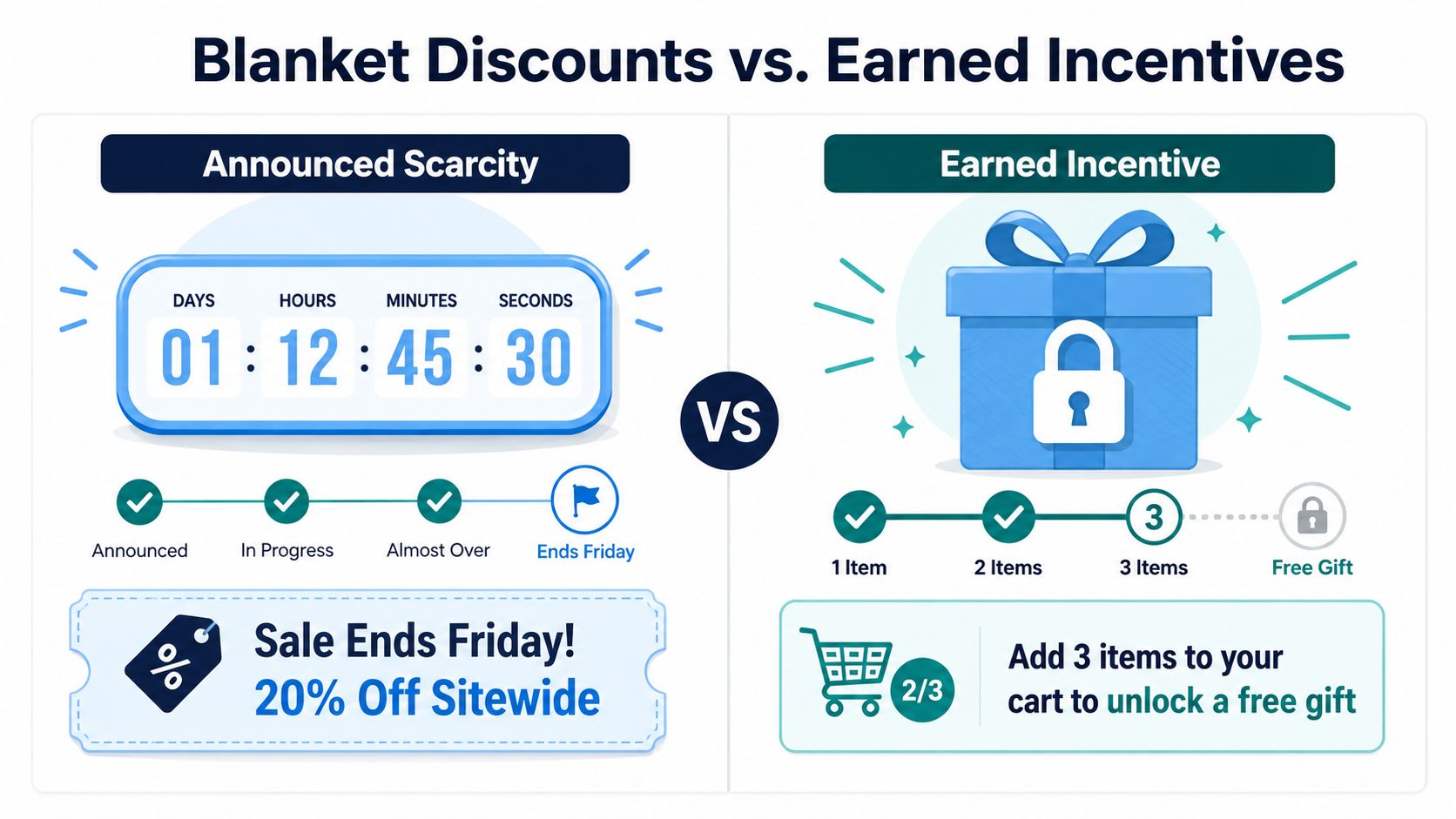
Threshold design determines whether that mechanism helps or frustrates. Set the target close enough to feel attainable, then make the remaining progress visible in the cart. A free-shipping threshold can prompt a useful add-on, while a gift-with-purchase threshold can guide customers toward selected products or a higher-value basket. The merchant controls eligibility, reward cost, and the products that count.
Progress should be explicit. A cart message such as “Add one item to receive the travel-size set” gives the shopper a concrete next action. Avoid vague claims about savings that require mental arithmetic. The customer should understand what they have done, what remains, and what they receive after completing the condition.
The reward also needs a credible boundary. Announced scarcity can support an earned incentive when the deadline, allocation, or access rule is real and honored. “Sale ends Friday” creates a customer expectation. A timer that resets after expiration breaks that expectation and weakens future urgency messages.
Costless incentives preserve room to sell
The strongest incentive is not always the one with the largest nominal value. Costless incentives create a perceived gain at a lower merchant cost than a direct price reduction. Useful accessories, priority access, curated samples, digital guides, and free shipping above a threshold can all support the offer without giving every shopper the same markdown.
Check the economics before publishing it. Calculate reward cost, expected basket change, fulfillment expense, and contribution margin after the reward. If customers claim the benefit without changing their basket or timing, the incentive has become a new cost line.
Price expectations affect how shoppers interpret the exchange. The 2024 consumer survey on price expectations and regret found that shoppers may feel uneasy buying at full price when they expect a sale, and may regret a purchase when the product is discounted soon afterward. See the survey findings on price expectations and regret. An earned reward gives the customer a reason to act without making every purchase depend on a sitewide markdown.
Putting the Principles to Work in a Shopify Store
A promotion becomes useful when the bias, the UX component, and the measurement plan line up. Two Shopify patterns show how a small team can build that connection without covering the storefront in competing messages.
A capped reward on a hero collection
Start with a collection that already receives qualified traffic. Offer a bundle or gift to the first defined group of orders, and show the remaining availability only when the store can update it from actual order data.
The theme implementation can use a collection banner, a product-page block, and a cart message. Shopify’s product and inventory data can support the availability condition, while a lightweight promotion app can handle reward eligibility. If the store displays a live order or claim ticker, connect it to real transactions rather than simulated activity.
Copy should explain the customer’s opportunity without pretending everyone is competing for a prize:
- Reward: “Early orders receive the travel-size set.”
- Constraint: “Available while the allocated bundle remains.”
- Status: “Updated from confirmed claims.”
Record product-page views, add-to-cart rate, reward claims, completed orders, average order value, gross margin per order, and repeat purchase behavior. The key question is whether the capped reward shifts timing and basket quality, not whether the banner earns attention.
A tiered incentive in the cart drawer
A cart drawer can turn an abstract promotion into visible progress. Set a free-shipping or gift threshold, then show the remaining amount as the shopper adds items. The progress bar belongs next to the subtotal and should update immediately after every cart change.
Shopify’s cart functions and theme blocks can manage the calculation. Klaviyo or an SMS integration can continue the experience after an email or phone capture, but don’t make the customer hunt through a popup to understand the offer. If the reward depends on account state, explain what happens before login or checkout, and don’t remove a benefit unexpectedly.
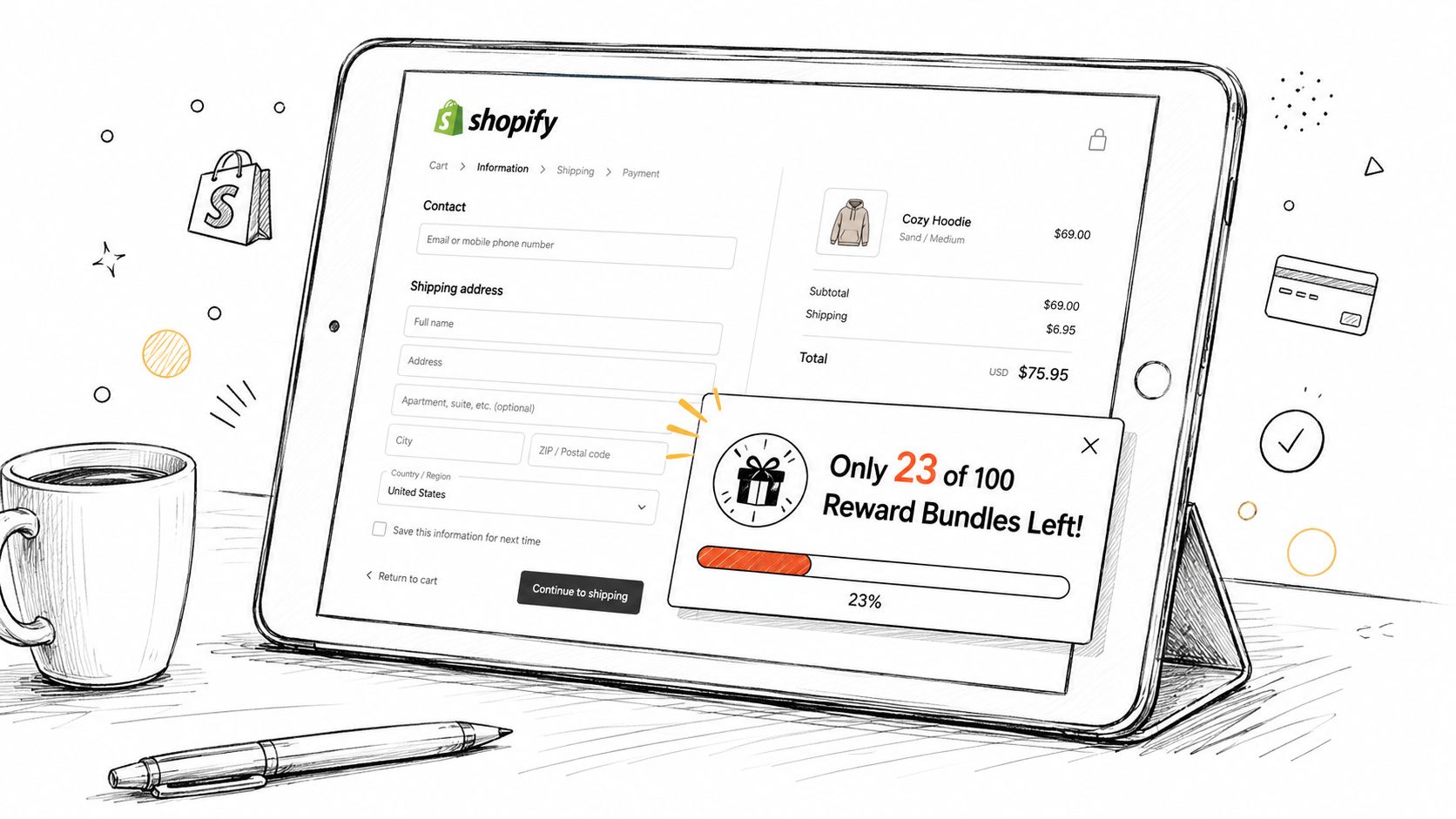
Useful copy makes the next action concrete: “Add one qualifying item to keep free shipping.” Avoid “Don’t miss out” unless the customer can see exactly what they’ll lose and why.
Track threshold exposure, cart additions after exposure, reward acquisitions, checkout starts, completed orders, average order value, discount or reward cost, and margin per visitor. The cart drawer should reduce uncertainty, not add another decision layer.
For brands that need a controlled urgency or scarcity experience across storefront, email, social, and SMS, Quikly can run capped rewards or descending tiers that are styled to match the store. Its mechanics have been refined across more than 60 million consumer interactions within the publisher’s product description, so the relevant evaluation remains the same, margin and behavior, not the presence of a particular interface.
Measuring Uplift Without Chasing Conversions
Conversion rate is easy to celebrate and easy to misuse. A campaign can increase completed orders while reducing the economic value of every visitor, especially when a discount attracts shoppers who would have purchased at the original price.
A small Shopify team can run a practical weekly measurement loop by pairing each conversion metric with the cost or quality metric that gives it meaning.
Three pairs that prevent bad reads
| KPI Pair | What it measures | How to read it |
|---|---|---|
| Conversion rate and gross margin per visitor | Whether more orders create more economic value | Keep the promotion only when margin per visitor improves, not when conversion rises alone |
| Average order value and discount depth as a percentage of revenue | Whether basket growth offsets incentive cost | Look for a larger basket without allowing the reward cost to consume the additional contribution |
| Redemptions and claim rate | Whether the incentive influenced behavior or was taken passively | A high redemption rate with little change in claims or purchase timing may indicate an expensive default benefit |
Use the store’s own baseline instead of generic ecommerce benchmarks. Shopify Analytics can provide order, sales, discount, and product views, while Google Analytics 4 can help compare landing pages, device groups, and event paths. Keep the comparison consistent, especially across traffic source and device mix.
A pre-post read is a starting point, not proof. Compare a stable period before launch with the campaign period, then use a holdout group when the audience and promotion setup allow it. Don’t treat a single-day spike as a reliable result. Traffic composition, payday timing, creative changes, and stock movement can all distort a short window.
The cleanest weekly process is simple:
- Record the baseline: Capture conversion, margin per visitor, average order value, incentive cost, and product availability before launch.
- Define the exposure: Separate visitors who saw the promotion from visitors who couldn’t see it or were held out.
- Check behavior: Review claim rate, add-to-cart rate, checkout starts, and time to purchase.
- Check economics: Calculate contribution after the reward, discount, shipping, and fulfillment costs.
- Set the decision: Continue, revise, or stop based on margin movement and customer quality.
A promotion earns another week only when the added behavior pays for the incentive.
Rethinking the Next Promotion You Ship
Before a promotion goes live, ask whether it rewards a behavior that compounds. A referral, a larger basket, a repeat purchase, or an early decision can create value beyond the current order. Waiting for the next sitewide code creates a different habit, one that makes future conversion more expensive.
Next, identify the principle you’re using. If the campaign relies on scarcity, the inventory or deadline must be real. If it uses social proof, the activity must come from actual customers. If it uses loss aversion, the shopper must have earned something concrete. If it uses choice architecture, the cart and product page must make the preferred path easier to understand.
Then decide how you’ll read margin within 14 days. Set a kill criterion before launch. If conversion improves but contribution margin compresses, the campaign isn’t a success that needs more traffic. It’s a signal to reduce the reward, change the qualifying behavior, or stop the experience.
Start with one product line and one thin incentive. Record a stable baseline, run the test for two weeks, and judge the result by margin movement, basket quality, and purchase timing rather than conversion rate alone. The strongest promotion doesn’t persuade every visitor to buy at any cost. It gives the right shopper a credible reason to act while leaving the brand’s value intact.
Quikly helps Shopify brands run on-brand promotional experiences built around real time limits, quantity caps, and earned rewards instead of automatic markdowns. Visit Quikly to see how a controlled urgency campaign can support conversion while protecting margin and customer expectations.
Topics: customer psychology, retail psychology, behavioral marketing, Shopify promotions, scarcity marketing