A shopper sees your product on Instagram, clicks through from an SMS reminder later that day, adds it to a cart on mobile, and finishes the order on a laptop. Your store treats those interactions as separate events. The email platform sends a first-purchase offer after checkout, the SMS campaign promotes an item that has just sold out, and the social ad still shows an old price. You’ve created a multichannel presence, but the customer experiences a disconnected brand.
That distinction sits at the center of the omnichannel vs multichannel decision for Shopify brands. Shoppers already move between social, email, SMS, websites, marketplaces, and physical stores. The commercial question is whether your team needs simple channel coverage, selective integration, or a fully connected customer journey.
The answer affects conversion, margin, and brand perception at the same time. This guide defines both models, compares them against operational criteria, explains where each one fits, and outlines a practical path toward connected promotions without turning every campaign into a blanket discount.
Introduction Why the Channel Debate Matters Now
A Shopify brand can launch on several channels quickly. Shopify handles the storefront and checkout, an app adds reviews or loyalty, Klaviyo manages email and SMS, and social platforms generate discovery. Each tool can perform its own job well while the overall customer journey remains fragmented.
That fragmentation becomes expensive during promotions. A customer sees an offer in a social post, lands on a product page with different terms, and receives an email that fails to recognize an abandoned cart or completed purchase. The brand may still record revenue, but the team can’t easily tell whether the promotion created incremental demand, shifted an existing order, or trained customers to wait for the next markdown.
Customer behavior makes this more urgent. A widely cited retail survey found that 73% of shoppers engage across multiple channels during one journey, based on a sample of about 46,000 shoppers (Helo’s overview of omnichannel marketing statistics). Another source reports that 73% of consumers use multiple channels and interact with about 6 touchpoints on average before purchasing (Ringly’s omnichannel retail statistics). The exact path varies, but the operating implication is clear. Your customer may move between channels even when your systems don’t.
For Shopify operators, the practical benefits of coordinated journeys are worth reviewing in this guide to omnichannel marketing benefits, particularly when retention matters as much as acquisition. A related look at digital customer experience management is useful for identifying where a shopper loses context between discovery, checkout, fulfillment, and support.
The rest of the decision comes down to maturity. Multichannel can be the right starting point when your team needs speed and channel-specific testing. Omnichannel becomes valuable when shared identity, inventory, fulfillment, and offer logic can remove enough friction to justify their operational cost.
What Multichannel and Omnichannel Actually Mean
Multichannel marketing means selling or communicating through multiple channels that largely operate independently. Your Shopify store, Instagram account, email program, SMS list, retail location, or marketplace may each have its own audience rules, campaign calendar, data, and promotional logic.
Omnichannel marketing connects those touchpoints so the customer’s actions in one place inform what happens next. Search, product discovery, purchase, fulfillment, service, and aftersales become parts of one journey rather than isolated channel events.
A simple distinction helps:
- Multichannel is presence. The brand shows up in several places.
- Omnichannel is coordination. The channels share enough context to make the experience continuous.
- Selective omnichannel is prioritization. The brand integrates the journeys where connection creates value, while allowing other channels to remain independent.
The difference isn’t whether you use email and SMS together. It’s whether a purchase suppresses the right messages, whether an offer is visible wherever the customer encounters it, and whether inventory and fulfillment information remain trustworthy across touchpoints.
Omnichannel integration is a maturity continuum
Research frames omnichannel integration as a continuum from “Unconnected” to “Complete.” It includes vertical integration, connecting different stages of the journey, and horizontal integration, coordinating activities within the same stage (Journal of Retailing and Consumer Services research on omnichannel integration).
For a Shopify merchant, vertical integration might connect a paid social visit to a product view, cart event, checkout, delivery update, and return. Horizontal integration might make email, SMS, and paid retargeting recognize the same promotion and suppress one another when the customer converts.
Omnichannel doesn’t replace multichannel infrastructure. It builds connected execution on top of the channels you already operate. That matters because a brand can add channels before it has the data quality, inventory discipline, or team ownership required to connect them responsibly.
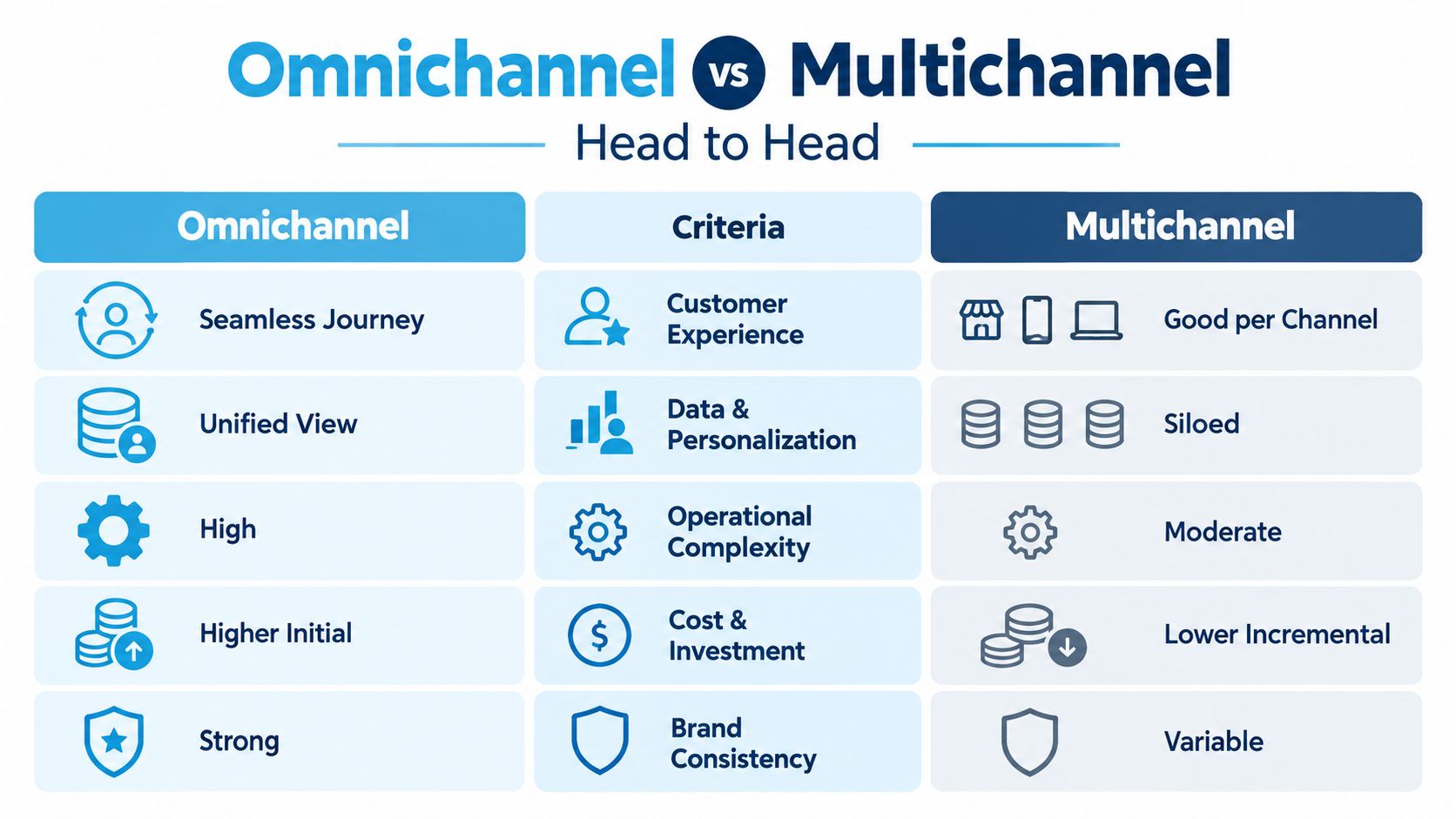
Omnichannel vs Multichannel Head to Head Comparison
The cleanest comparison starts with the shopper outcome, not the software stack. A multichannel setup can launch quickly and give each team freedom to test. An omnichannel setup can preserve context as customers change devices, channels, or fulfillment methods, but only if the underlying systems agree.
| Criteria | Multichannel | Omnichannel |
|---|---|---|
| Customer journey | Each channel supports its own interaction | The journey carries context across channels |
| Customer identity | Profiles may remain separated by platform | A unified view connects recognized interactions |
| Inventory and fulfillment | Availability and status can differ by channel | Shared visibility supports coordinated promises |
| Pricing and promotions | Channel-specific offers are easier to run | Offers and eligibility require governance |
| Measurement | Teams optimize channel activity and revenue | Teams evaluate cross-channel conversion and retention |
Customer experience and journey continuity
Multichannel works when the customer can complete the journey inside one channel or doesn’t need continuity. It becomes weak when a shopper starts on social, researches on your site, asks a support question, and expects the next interaction to reflect that history.
Omnichannel reduces repeated steps. A customer can discover on social, receive a relevant follow-up through email or SMS, complete checkout on a different device, and receive fulfillment communication that matches the original promise.
Data and identity
Multichannel reporting often tells you that email, SMS, paid search, or social generated activity. That’s useful for allocation, but it can’t fully explain how those touchpoints worked together.
Omnichannel reporting asks whether the coordinated journey increased repeat purchase, cross-channel conversion, or customer lifetime value. Academic research also shows that customers compare information across channels, with interaction choices shaped by sequencing and individual journey patterns rather than one isolated touchpoint (research on omnichannel customer journeys).
The differentiator is integration, not channel count. More touchpoints create more opportunities to lose context unless identity, inventory, offers, and fulfillment carry forward.
Inventory, fulfillment, and measurement
A multichannel promotion can send traffic to a product that a store has sold out of or that the warehouse can’t ship within the advertised window. Omnichannel can coordinate stock and fulfillment options, including buy online, pick up in store, but it requires reliable inventory data and clear ownership.
For measurement, an independent Forrester benchmark of six Singapore retailers found omnichannel and digital store capability scores ranging from 37 to 69 out of 100, with a 56-point average across categories such as online experience, consistency, pickup, and in-store experience (Forrester benchmark from Valtech). The spread reinforces an operational point. Having several channels isn’t the same as making them work together.
A channel strategy may also include discovery partners or a programmatic meme ad network, but paid reach only helps if the landing page, offer, and post-click experience preserve the same customer context.
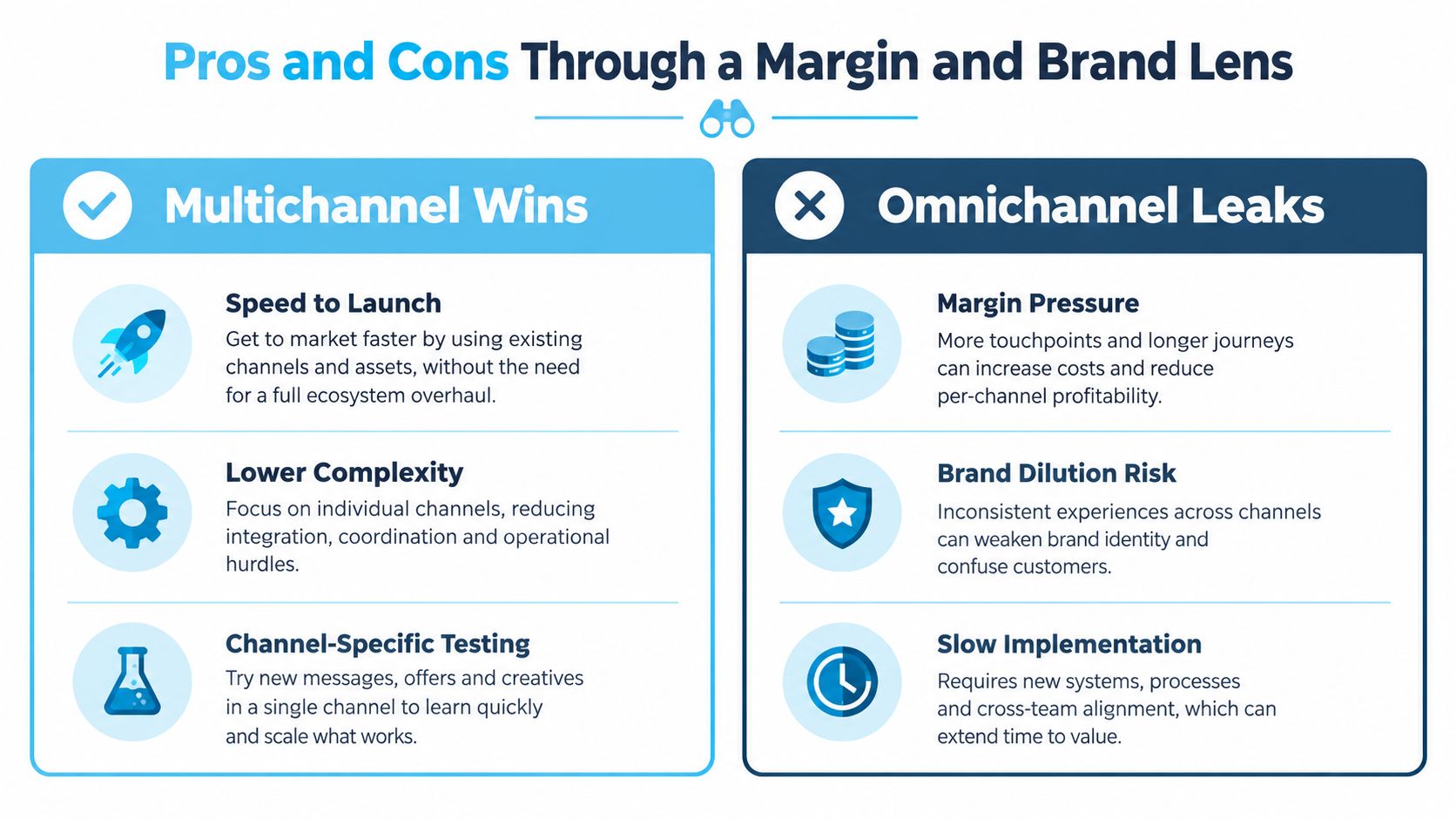
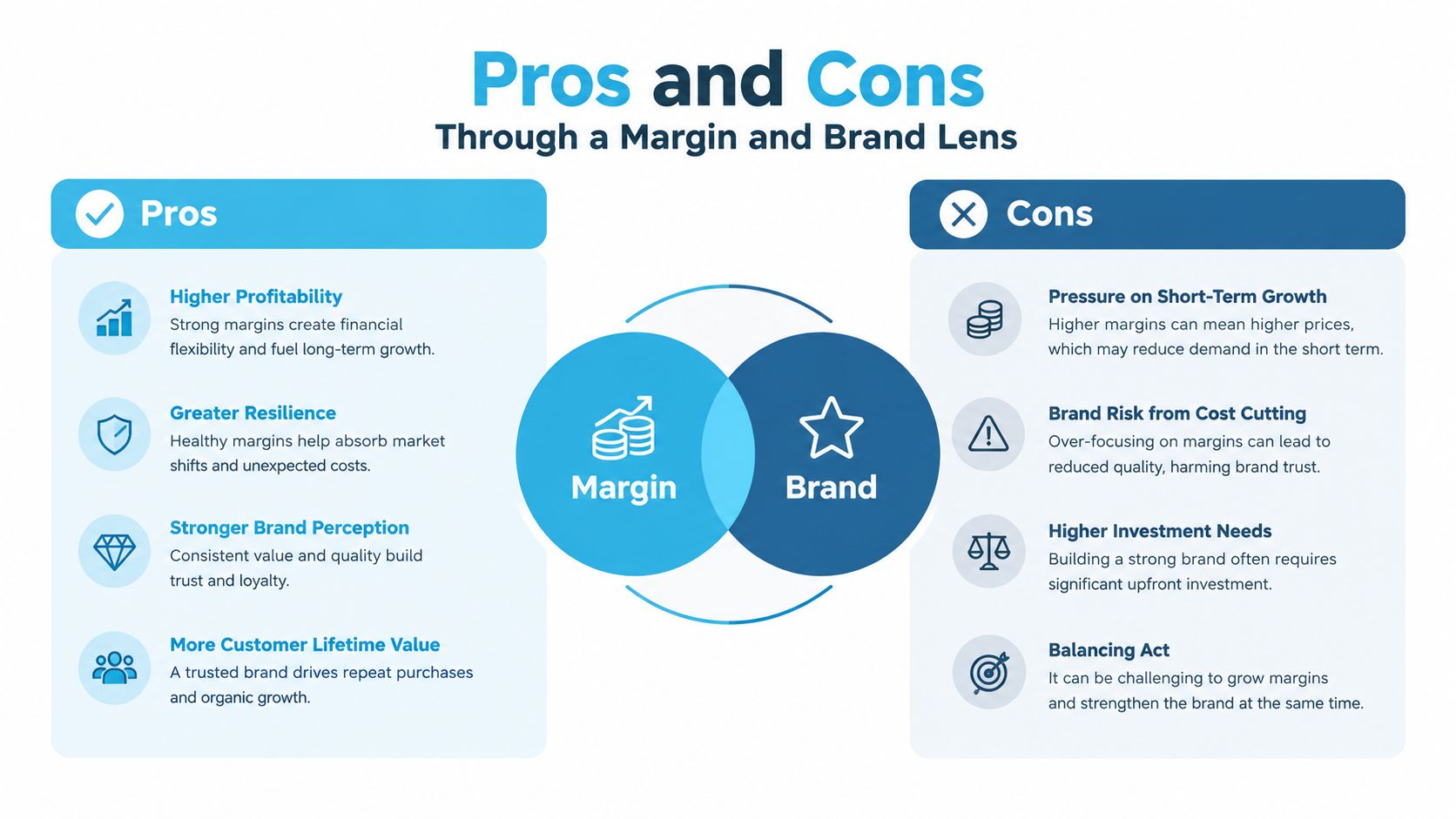
Pros and Cons Through a Margin and Brand Lens
The usual multichannel versus omnichannel comparison treats more conversion as automatically positive. A Shopify operator can’t afford that shortcut. A sale with a deep discount, expensive fulfillment path, or confused post-purchase experience may look good in a channel report while weakening contribution margin and future demand.
Multichannel has real advantages. A small team can launch an Instagram test without redesigning its entire data model. Email can promote a product to a known audience while paid social tests creative for new shoppers. Channel-specific pricing can also support distinct merchandising goals, provided customers won’t encounter contradictory promises during the same journey.
The leaks appear when independence becomes inconsistency:
- Inventory leakage: A campaign continues after stock changes because the channel doesn’t receive a reliable update.
- Offer leakage: A customer sees different terms in social, email, and the storefront, which creates hesitation or support tickets.
- Timing leakage: A post-purchase message treats a buyer like a prospect, while an abandoned-cart message arrives after checkout.
- Margin leakage: Teams stack discounts because they can’t see which incentive already influenced the customer.
Research on Indian omnichannel consumers found that omnichannel capabilities positively influence retention, with consumer agency and cross-channel integration mediating the effect. The same research notes that retailer uncertainty can weaken the relationship, while customer satisfaction strengthens it (study of omnichannel capabilities and retention). The lesson isn’t to integrate everything immediately. It’s to connect the parts of the journey that affect repeat buying and customer confidence.
Omnichannel offers stronger continuity and can support retention, order value, and lifetime value. Widely cited outcomes report that strong omnichannel engagement retains 89% of customers, compared with 33% for weak strategies, while omnichannel shoppers spend 16% more per order and have 30% higher lifetime value than single-channel buyers (Ringly’s cited omnichannel outcomes).
The trade-off is governance. Shared pricing, promotions, attribution, and inventory can limit local experimentation. A team that relies on frequent channel-specific discounts may discover that integration exposes conflicts it previously ignored.
That’s why selective omnichannel often works better than an all-or-nothing rollout. Unify identity, suppression rules, offer eligibility, and fulfillment status first. Keep channel role, creative, cadence, and some merchandising differences distinct.
For a practical perspective on turning engagement into action without defaulting to deeper discounts, see customer engagement in ecommerce.
Real World Use Cases for Retailers and Ecommerce Brands
The right model changes as the business adds channels, volume, fulfillment complexity, and promotional pressure. Customer intent is already multi-touch. The constraint is whether your operation can keep those interactions accurate.
A lean Shopify DTC brand with two or three channels
Start with multichannel if your store relies mainly on Shopify, one social channel, and email or SMS. Give each channel a clear job. Social can handle discovery and education, while email or SMS can handle conversion and follow-up.
The risk of forcing full omnichannel too early is operational overhead. You may spend time reconciling systems instead of improving product pages, checkout friction, or creative. Connect basic purchase suppression and promotion terms first, then expand integration when repeated customer journeys expose a clear gap.
A growing brand adding retail or pop-ups
Selective omnichannel becomes more useful when a DTC brand adds pop-ups, wholesale, or a permanent retail presence. Inventory visibility, pickup promises, returns, and customer records now affect whether online and offline experiences reinforce each other.
Keep channel roles differentiated. A store associate may drive product education, the website may support broader assortment, and SMS may communicate pickup or replenishment. The shared layer should cover identity, inventory, fulfillment, and service context, not force identical merchandising everywhere.
A Shopify Plus brand with complex fulfillment
A high-volume Shopify Plus operation with multiple warehouses, regions, or delivery options has a stronger case for deeper integration. A customer doesn’t care which system owns the order. They care whether the promised product is available, whether the delivery update is accurate, and whether support can see what happened.
If those systems remain separate, omnichannel messaging can make the problem worse by spreading incorrect information faster. Integrate the operational source of truth before adding elaborate personalization.
A brand dependent on frequent promotions
Frequent promotions need the most careful governance. Blanket discounts across every channel can convert some shoppers while reducing margin and teaching loyal customers to wait. Separate channel offers may protect short-term testing freedom, but conflicting terms can damage trust.
A better structure gives each channel a role while keeping the customer’s eligibility and deadline understandable. Scarcity bias can make a time- or quantity-bound reward more motivating than an always-available markdown. Loss aversion also matters, because shoppers may act to avoid missing a clearly defined reward, not because the discount is larger.
Implementation Considerations and Metrics That Prove Integration
Connected execution starts with operational facts. Before building complex journeys, verify that your systems can answer four questions consistently.
- Who is this customer? Email, SMS, guest checkout, loyalty, and support records should connect where permission and identity make that appropriate.
- What can the customer buy? Inventory availability should reflect the relevant selling and fulfillment locations.
- Which offer applies? Eligibility, exclusions, expiration, and redemption rules need one clear logic.
- What happens after purchase? Fulfillment, pickup, returns, service, and suppression events should update the next interaction.
Shopify’s app ecosystem can fill important gaps, but every added app creates another integration decision. Theme customization affects how offers and eligibility appear on the storefront. Shopify discount and cart infrastructure determines what can be enforced at checkout. Klaviyo can coordinate email and SMS flows, but the quality of those flows depends on the events and customer properties entering the account.
Shopify and Shopify Plus also differ in available operational depth, so don’t promise an omnichannel experience your plan, fulfillment stack, or retail systems can’t support. Start with one journey, such as browse to cart to purchase, and make every handoff accurate before expanding to pickup, returns, or store-assisted selling.
The measurement model must change with the operating model. Channel revenue alone can reward duplicated credit and over-messaging. Track measures that show whether the customer moved through a better-connected journey:
- Channel consistency: Do customers encounter matching product, price, terms, and availability?
- Cross-channel conversion rate: Do interactions across channels lead to a completed purchase?
- Repeat purchase rate: Do coordinated experiences bring customers back?
- Customer lifetime value by channel mix: Are customers who use several connected touchpoints more valuable after costs?
- Fulfillment and pickup reliability: Can the brand deliver the promise made during acquisition?
Teams building around owned customer relationships can also review first-party data activation before adding more channels. Better data only matters when it changes eligibility, timing, suppression, or service in a way the customer can feel.
How to Choose the Right Model for Your Store
Use four questions to choose the maturity level that fits your store now:
| Business condition | Recommended model | First priority |
|---|---|---|
| Limited team bandwidth, simple fulfillment, early channel testing | Multichannel | Establish reliable channel roles and basic reporting |
| Several active channels, recurring cross-channel journeys, manageable operations | Selective omnichannel | Connect identity, offer rules, suppression, and inventory where friction is highest |
| Complex fulfillment, retail locations, large customer base, strong data maturity | Full omnichannel | Coordinate the journey from discovery through service and retention |
Choose multichannel when the immediate problem is reach and your team still needs to learn which channels deserve investment. Choose selective omnichannel when customers already move between channels and your main losses come from inconsistent offers, stale inventory, or irrelevant follow-up.
Full omnichannel makes sense when the organization can govern shared data, pricing, fulfillment, and measurement. It isn’t a badge of sophistication. It’s an operating commitment that needs ownership across marketing, ecommerce, retail, operations, and customer service.
Promotions deserve the same maturity test. A flat discount tells shoppers they can buy whenever they want. A behavior-driven experience can give customers a clear reason to act now through a reward limited by time, quantity, or both. That approach uses scarcity bias and temporal discounting to align the incentive with immediate action, while helping the brand avoid making the deepest discount the permanent center of its value proposition.
Audit one complete journey before adding another channel. Follow a real shopper from discovery to checkout, fulfillment, support, and repeat purchase, then document every point where the message, price, inventory, identity, or timing changes.
Quikly gives Shopify brands behavior-driven promotional experiences that can run across storefront, email, social, and SMS, with rewards bounded by time, quantity, or both instead of relying only on automatic discounts. Visit Quikly to see how connected urgency can support conversion while keeping promotion rules and brand presentation under control.
Topics: omnichannel vs multichannel, omnichannel retail strategy, multichannel ecommerce, Shopify marketing, retail customer experience