Most Shopify brands try to fix weak email engagement by sending more often. A flat open rate triggers another campaign, then a discount, then a reminder about the discount. The list gets busier, but the customer relationship gets weaker.
That approach creates three problems at once. Revenue per send declines as subscribers tune out, discount-heavy flows compress margin, and constant promotions teach shoppers to wait for the next markdown. Better engagement comes from making each message more relevant, more credible, and more useful, not from filling every available inbox slot.
Email performance also needs context. Across 3.6 million campaigns, the average email open rate in 2025 was 43.46%, while the average click-to-open rate was 6.81%, up from 5.63% in 2024, according to MailerLite’s email benchmark analysis. The gap matters because opening an email and acting on it are different behavioral decisions.
Why More Email Engagement Is Not the Same as More Email
The popular advice is simple, increase frequency until revenue moves. In practice, that often confuses volume with attention. A subscriber can receive more emails without becoming more interested in the brand, and a campaign can produce opens without generating profitable clicks.
The margin problem appears first. Blanket discounts may create a short-term conversion, but they also reduce the money left after the order is placed. If every weak campaign receives a deeper offer, your team eventually pays customers to act on demand they might have converted without a discount.
Brand perception takes longer to measure, but it matters just as much. A store that constantly advertises sales can train buyers to delay full-price purchases. That delay weakens urgency, reduces the perceived value of the product, and makes future promotions work harder.
Practical rule: Judge an email by the quality of the customer decision it creates, not by the number of messages you manage to send.
The real trade-off
A send-heavy program may look productive in a weekly report. An engagement-led program asks harder questions, such as whether the recipient has shown interest in the product, whether the offer matches the customer’s lifecycle, and whether the expected margin justifies the incentive.
| Metric | Send-Heavy Program | Engagement-Led Program |
|---|---|---|
| Audience | Broad list, often with limited exclusions | Behavioral and lifecycle segments |
| Offer strategy | Frequent discounts and repeated reminders | Relevance, value, and selective urgency |
| Short-term result | More opportunities to generate clicks | Fewer wasted impressions |
| Margin effect | Discounts can become the default conversion tool | Incentives are used where they can change behavior |
| Brand effect | Customers may learn to wait for sales | Customers receive reasons to act that fit the context |
| Management focus | Campaign count and open volume | Click quality, revenue per recipient, and list health |
Inbox placement also belongs in this conversation. When subscribers ignore or delete messages, complain, or disengage, mailbox providers receive weaker signals about the value of future sends. Litmus reports that 76% of teams deployed email within three days in 2026, compared with 62% in 2024, but faster production doesn’t automatically create stronger performance or better attention. The Litmus State of Email reports also reflect a market where AI summaries, privacy changes, and stricter treatment of cold senders make inbox competition more complicated.
The practical answer is a smaller set of sharper messages. Protect the list, reserve discounts for situations where they can change a decision, and optimize for profitable engagement across a quarter rather than for a single promotional spike.
Building Segments That Actually Lift Engagement
Shopify gives you enough behavioral data to move beyond generic personas. The useful question isn’t whether someone is “a busy parent” or “a deal seeker.” It’s what the customer has done, what they may need next, and what message is justified by that behavior.
Start with four operating groups:
- Active subscribers: People who open or click regularly. Send product education, launches, replenishment reminders, and relevant cross-sells without assuming every message needs a discount.
- At-risk customers: Previous buyers whose activity has slowed. Acknowledge the lapse with a useful reason to return, not an automatic markdown.
- Recent purchasers: Customers who bought recently. Focus on onboarding, usage guidance, complementary products, and the next logical purchase.
- Browse abandoners: Visitors who viewed a product or collection but didn’t buy. Use the specific product affinity as the basis for the message, rather than sending a storewide offer.
You can build these audiences from Shopify orders, checkout activity, customer tags, product views, and events passed into Klaviyo or another email platform. The segmentation principles in this guide to email segmentation for small business are useful for turning broad subscriber groups into practical campaign audiences.
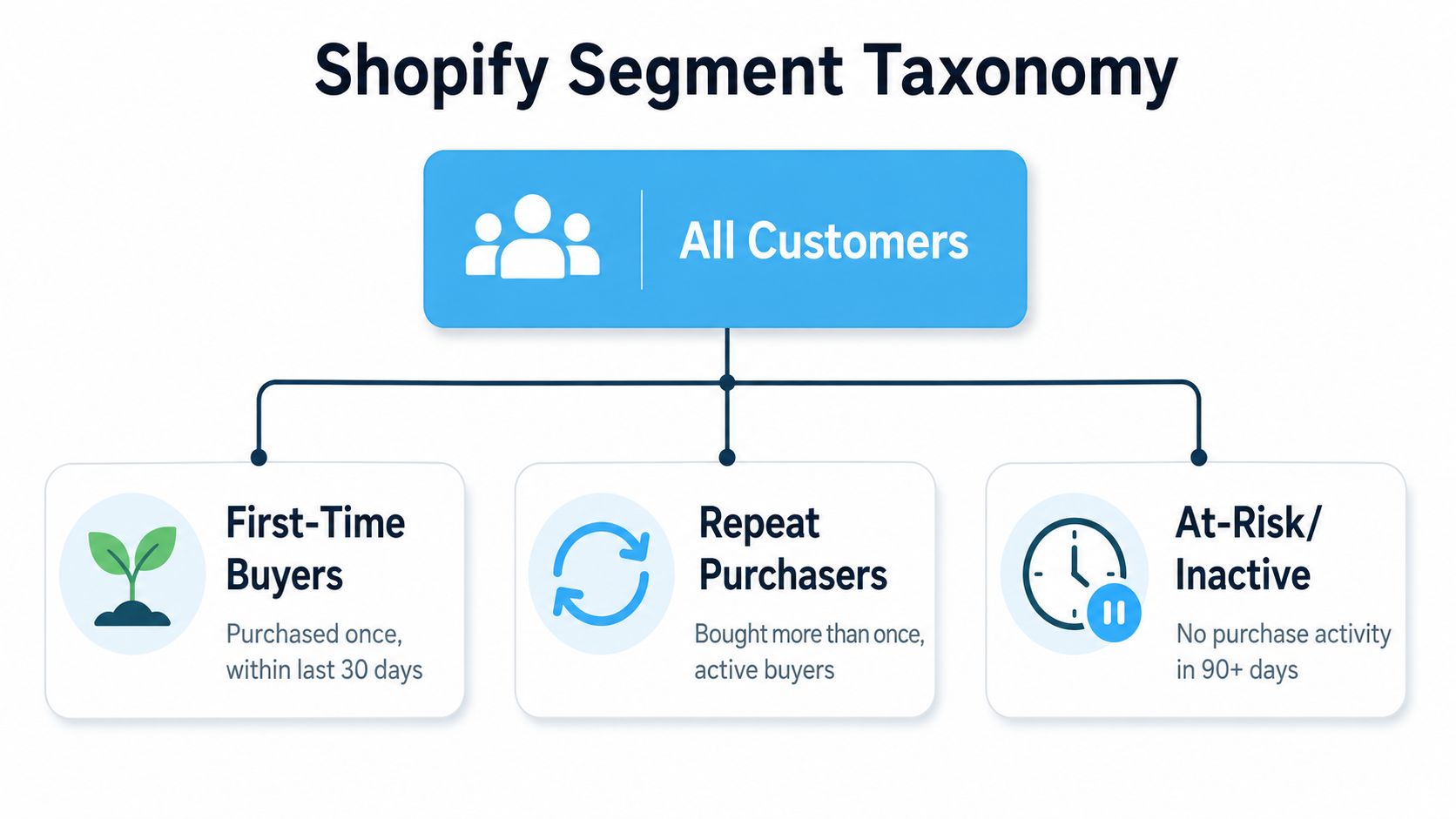
Use purchase recency as a working model
A simple recency split can immediately improve message quality:
- Bought within 30 days: Thank the customer, reinforce product value, and introduce the next use case or complementary item.
- Bought 31 to 90 days ago: Prompt a repeat purchase, replenishment, or category expansion based on the original order.
- Bought 91 days or more ago: Treat the customer as a reactivation audience. Lead with a reason to return, and make the incentive conditional rather than automatic.
Those cohorts shouldn’t receive the same newsletter with three different subject lines. Their relationship with the store is different, so the promise, content block, and call to action should differ too.
For more practical models, see Quikly’s customer segmentation examples. Keep the segment logic understandable enough that your team can explain why a customer received a message. If nobody can describe the rule, the audience probably isn’t ready for a campaign.
Writing Subject Lines, Preheaders, and Personalization That Earn the Open
A subject line is a promise. It earns the open when the reader understands why the email matters and trusts that the body will deliver on that reason.
Indiana University recommends keeping subject lines short, placing the most important content early, avoiding unnecessary identity restatement, and using the preheader to support rather than repeat the subject line in its subject line guidance. One benchmark source reports that 64% of recipients decide whether to open based on the subject line, while 33% open based on the subject line alone, and that subject lines under 70 characters receive the highest open rates, as outlined by Salesgenie’s subject line statistics.
Don’t use those figures as permission to write clickbait. An open that leads to disappointment can increase immediate opens while lowering clicks, trust, and future responsiveness.
Build the message as one connected promise
For a cart-abandonment email, a weak version might say:
- Subject: Still thinking about it?
- Preheader: Complete your purchase today.
A stronger version makes the product and benefit explicit:
- Subject: Your linen overshirt is still in your cart
- Preheader: See the fit details before you decide
The second version uses known behavior, names the item, and reduces uncertainty. It doesn’t need fake urgency.
For a launch email, replace a vague announcement with a concrete reason to care:
- Subject: The new cedar scent is here
- Preheader: Meet the limited seasonal release
Personalization can go beyond a first name. A last-purchased product, loyalty tier, or viewed category can make the message feel specific when the data is accurate and the use is restrained. Industry-referenced research reports that personalized emails have a 29% higher open rate and a 41% higher click-through rate than non-personalized emails, while personalized subject lines are 26% more likely to be opened, according to Instapage’s personalization statistics.
Use personalization to improve relevance, not to display how much data you have. Test the subject line, preheader, and body promise together, then confirm that the landing page shows exactly what the inbox message described. More examples are available in Quikly’s guide to catchy email subject lines.
Timing, Frequency, and Creative Layout Decisions
Timing hacks are less valuable than a repeatable operating system. For engaged cohorts, a defensible starting point is 3 to 4 sends per week. For colder audiences, start with 1 to 2 sends per week and reduce exposure further when engagement or complaint signals deteriorate.
A practical baseline is Tuesday and Thursday between 9 and 11 a.m. local time, but treat that as a testable default rather than a universal rule. The right window depends on when your customers browse, when your product is useful, and when your team can respond if a campaign creates demand.
A usable cadence by lifecycle
| Lifecycle Stage | Weekly Sends | Best Send Window | Recommended Layout |
|---|---|---|---|
| Active subscribers | 3 to 4 | Tuesday or Thursday, 9 to 11 a.m. local time | Modular content with one primary CTA |
| Recent purchasers | 1 to 2 | Based on product use or replenishment context | Single-focus educational or cross-sell layout |
| At-risk customers | 1 to 2 | Test a different day-part from active buyers | Short, direct reactivation layout |
| Cold subscribers | 1 or fewer | Test only after a clear reason to return | Minimal copy, one action, strong preference link |
Cap frequency at the customer level, not only at the campaign level. A subscriber who qualifies for a launch, browse abandonment, cart reminder, and weekly promotion on the same day doesn’t experience four strategies. They experience one crowded inbox.
Use sunset rules for people who repeatedly ignore messages. Before removing them from active sends, give them a clear preference or re-engagement path. This protects list quality and keeps your reporting tied to people who may still choose the brand.
Match layout to the decision
A single-product drop should make the product visible immediately, explain what is new, and place the primary CTA near the first meaningful description. A browse-abandonment email needs more context, such as the viewed product, relevant proof, fit or use information, and a low-friction return path.
On mobile, avoid forcing the reader through a large hero image before they can understand the offer. Keep the first screen useful, repeat the CTA below the fold when the email requires more explanation, and test single-column layouts against modular designs.
Run a six-week testing cadence. Hold the audience and offer steady while testing send time, then day-part, then layout. Change one major variable at a time so your ESP data remains interpretable.
Using Scarcity and Urgency Without Training Customers to Wait
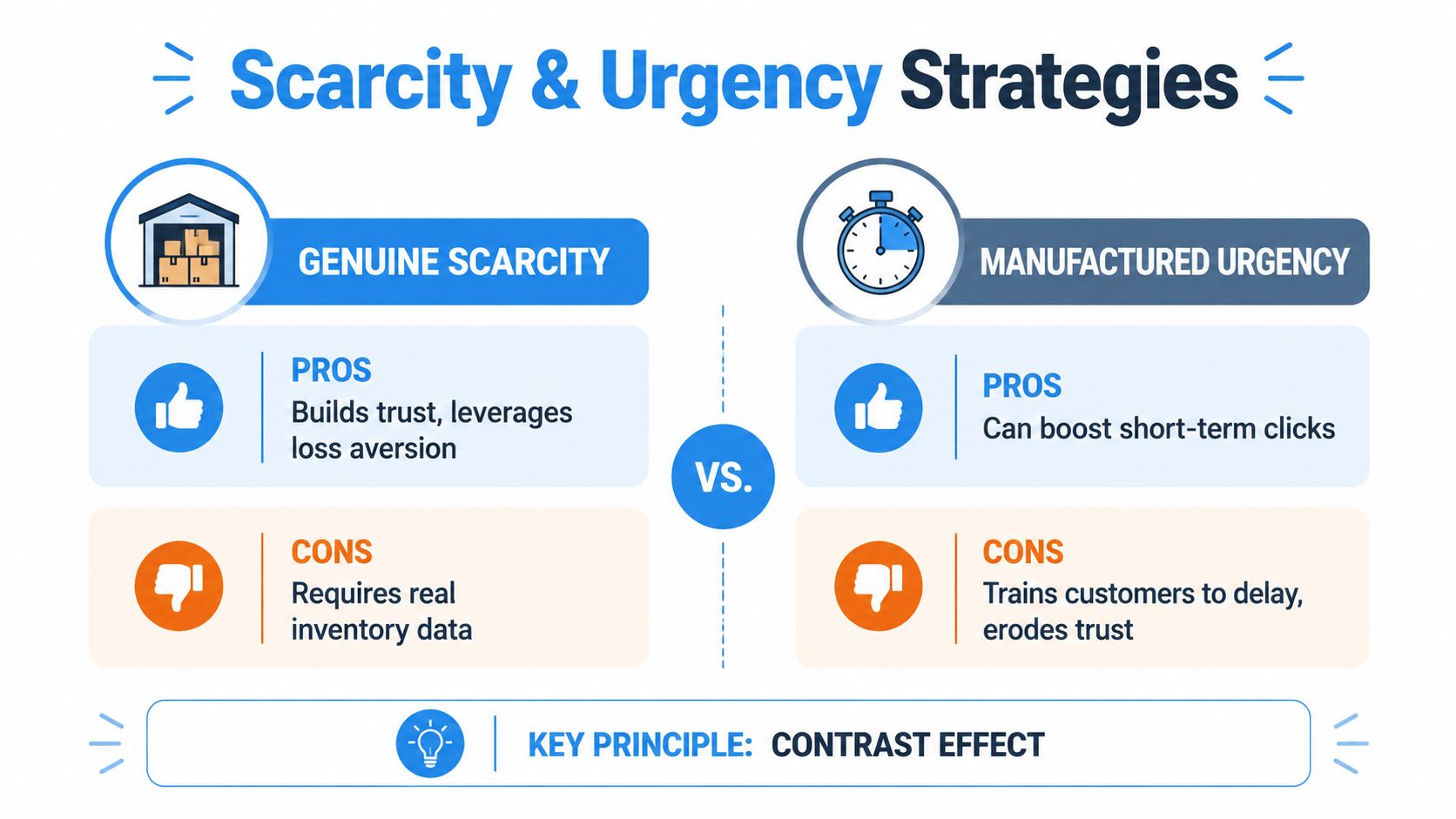
Scarcity works because people assign greater value to opportunities they may lose. Loss aversion makes the possibility of missing a desired product feel more motivating than an equivalent gain, while temporal discounting makes a reward available now feel more valuable than an identical reward available later.
That doesn’t make every countdown credible. A limited-edition colorway with a real inventory constraint can justify a time-sensitive email. A replenishable product that stays available indefinitely shouldn’t display a recurring deadline just to force clicks. Customers notice repeated false endings, and the brand pays for that skepticism later.
Earn the urgency
A promotion has earned urgency when the customer can understand why the opportunity changes over time. That may be limited inventory, a real event deadline, a seasonal release, or a reward that becomes less favorable as participation increases.
The contrast effect also matters. A clearly defined early reward can make the cost of waiting visible without requiring a deeper blanket discount. This differs from sending the same coupon to the entire list and hoping the recipient feels enough pressure to use it.
Use a decision checklist before adding urgency:
- Inventory: Can your Shopify inventory or fulfillment process support the scarcity claim?
- Deadline: Is the closing time tied to a real operational or promotional event?
- Audience: Has this customer shown behavior that makes the offer relevant?
- Reward: Does acting earlier produce a meaningful difference?
- Aftermath: Will the message still feel honest if the customer doesn’t buy now?
Rotate three types of offers. Use time-bound offers for real deadlines, behavior-triggered offers for actions such as returning to a viewed product, and value-led offers when education or product utility is enough to move the decision.
A behavior-driven promotion gives customers something to participate in rather than another passive overlay or generic discount. Quikly’s scarcity marketing guide explores that distinction in more detail.
The margin test is straightforward. If urgency only works when the discount gets deeper, the campaign may be compensating for weak relevance. If a precise, credible incentive changes behavior without becoming the brand’s permanent price signal, it has a stronger chance of protecting both conversion and perception.
Testing and Measuring What Actually Moves Engagement
Start every test with one decision. Are you trying to improve the open, the click after the open, or the purchase? A subject line test and a creative test answer different questions, so combining them in one uncontrolled send makes the result difficult to use.
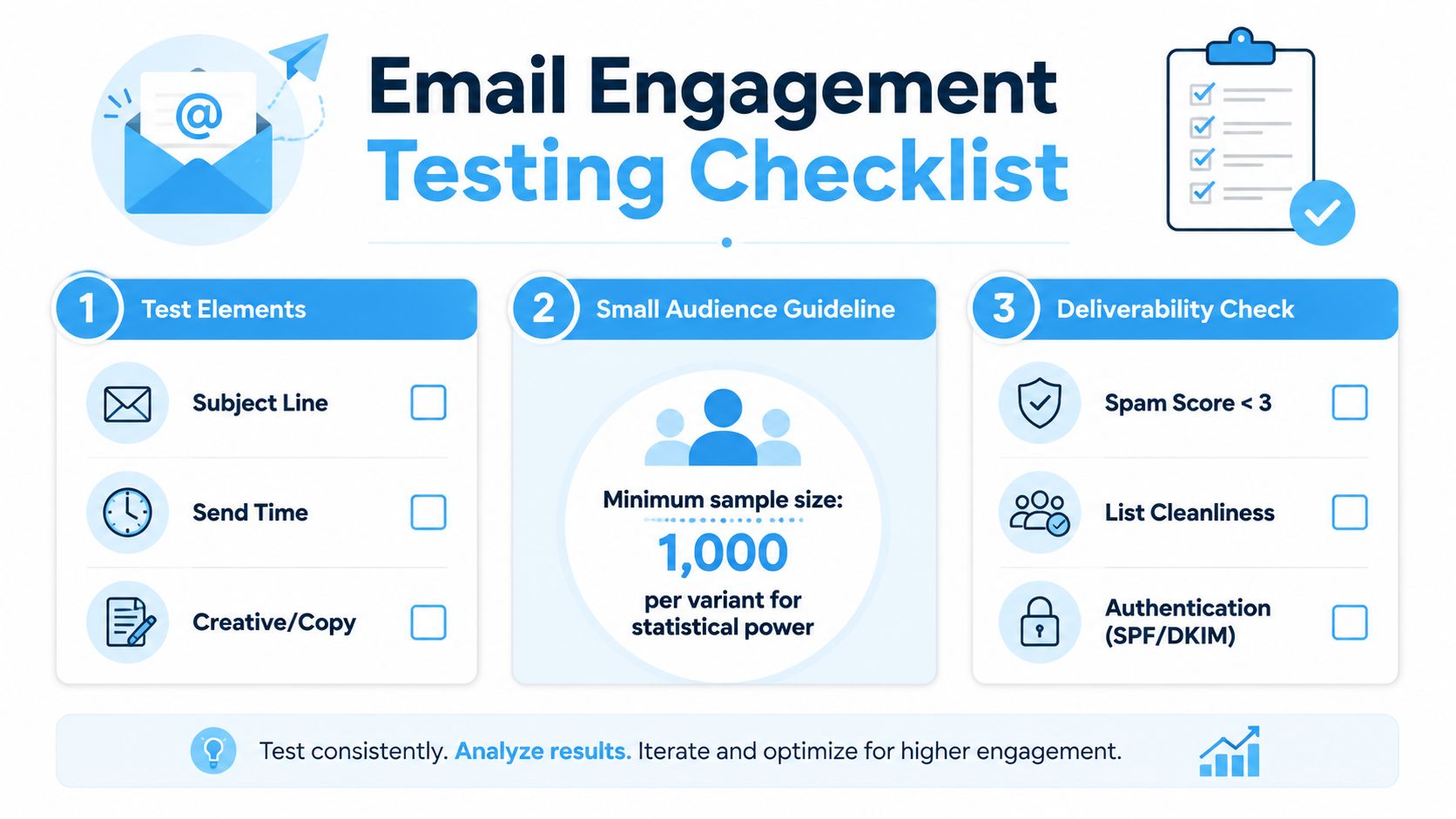
For small Shopify audiences, sample size limits certainty. The infographic’s testing checklist uses 1,000 recipients per variant as a minimum guideline for statistical power, but treat that as a planning reference, not a guarantee that every result will be conclusive. If your audience is smaller, prioritize larger directional differences, repeat the test across comparable sends, and avoid declaring a winner from a single unusual campaign.
Use a three-metric scorecard
Salesforce defines open rate as unique opens divided by delivered emails in its email marketing benchmarks. Klaviyo also warns that Apple Mail Privacy Protection can inflate opens and recommends filtering Apple privacy opens when testing subject lines, so open rate should be treated as directional rather than definitive.
Track one metric in each category:
- Engagement: Click-to-open rate, which shows whether the content earned action after the inbox decision.
- Revenue: Revenue per recipient, which keeps the test connected to commercial performance.
- Brand health: Unsubscribe rate or complaint rate by cohort, which shows whether the campaign damaged the relationship.
Before another promotion, test a non-discount subject line against a discount-led version, compare a product-specific segment with a broad audience, and test a single CTA against a multi-link layout. Review sender reputation, spam complaints, authentication, and inbox placement before blaming the copy. A campaign can’t rescue a deliverability problem.
A 30-Day Email Engagement Playbook for Shopify Brands
A month is long enough to establish better operating habits without turning the project into a platform rebuild. Keep the rollout narrow, document each decision, and give every week one metric and one stop-or-ship rule.
Week one focuses on list health
Audit active, at-risk, and cold subscribers. Create a re-engagement path for inactive contacts, make preference changes easy, and establish sunset rules for people who continue to ignore messages.
Watch click-to-open rate for the engaged cohort. Ship the next campaign only if the audience definition is clean and the message has one clear purpose.
Week two builds Shopify-native segments
Create audiences for VIP or high-AOV customers, recent purchasers, lapsed buyers, browse abandoners, and post-purchase customers. Use order history, checkout activity, product affinity, and engagement events instead of relying on broad demographic assumptions.
Watch revenue per recipient by segment. If one audience receives the same offer as every other audience, rewrite the campaign before expanding it.
Week three repairs the inbox promise
Rewrite subject lines and preheaders around specific products, use cases, or customer actions. Choose one important flow for each priority segment, such as post-purchase education for recent buyers or a targeted return message for lapsed customers.
Watch click-to-open rate alongside unsubscribe rate. If opens rise while clicks remain weak, the subject line may be promising more than the email delivers.
Week four tests earned urgency
Choose a real inventory signal or genuine deadline. Test behavior-driven urgency against a standard message, keep the audience definition stable, and avoid adding a deeper discount just because the first result is inconclusive.
Watch profit per recipient and review brand-health signals by cohort. A campaign that increases orders while weakening margin or driving broad unsubscribes isn’t automatically a win.
The operating principle is simple: email engagement is a trade-off between revenue per send and brand perception. A smaller, better-targeted program can create healthier demand than a larger promotional calendar, especially when each message gives customers a credible reason to act now.
Quikly helps Shopify brands turn CRM and email campaigns into behavior-driven promotional experiences where rewards can be limited by time, quantity, or both, rather than relying on blanket discounts. If you want to test urgency that protects relevance and margin, visit Quikly and see how the approach fits your email program.
Topics: email engagement, email marketing, Shopify marketing, email personalization, urgency marketing