A Shopify merchant launches another 20% off sitewide campaign because the last promotion didn’t hold. Revenue needs support, paid traffic is already running, and the margin report looks thinner than it did last quarter. The offer goes live, but the conversion lift feels weaker, so the team starts discussing a deeper discount or another campaign before the current one has even finished.
That cycle is the core Shopify discount app problem. The software can execute almost any rule you configure, but it can’t decide whether a percentage-off promotion is still commercially sensible. The better question isn’t which app has the longest feature list. It’s which promotional structure can create urgency, protect contribution margin, and keep shoppers from treating the sale price as the price.
The Promotion That Stopped Working
The first sitewide discount usually feels harmless. A merchant offers 20% off, sees more orders, and accepts the lower contribution because the campaign appears to create momentum. The second campaign uses the same structure, perhaps with a different creative angle, but shoppers respond less decisively. By the third campaign, the discount is no longer an event. It’s become the price customers expect.
That progression is common because a flat discount gives buyers no reason to act now. It gives them a reason to buy eventually, after they’ve compared alternatives, checked their inbox, or waited to see whether a better offer appears. The merchant pays for the discount immediately, while the customer gets flexibility.
Promotional benchmarks make the tradeoff clear. A 2026 ecommerce analysis estimated average promotional discounts at 15% to 25%, holiday discounts at 20% to 30%, clearance discounts at 30% to 60%, and Black Friday discounts at 20% to 40%. The same analysis estimated that every 10% discount can reduce margin by about 5 to 15 percentage points. Those figures come from ecommerce discount and margin benchmarks.
Operator rule: If the team needs a deeper discount every time traffic or conversion softens, the promotion is compensating for weak urgency, not creating healthy demand.
A blanket markdown also changes the buyer’s reference point. After repeated 20% off campaigns, the original price starts to look inflated, while the discounted price feels normal. The store may still report revenue, orders, and conversion, but those metrics can hide a less attractive customer relationship: shoppers visit when there’s a sale and delay full-price purchases.
The rest of the decision should start upstream from the app. First establish what the business can afford to give away, then choose the mechanic that makes the offer feel timely, relevant, and worth acting on.
What a Shopify Discount App Does
A promotion fails when the store can execute the offer but cannot control its economic structure. A Shopify discount app provides the rules and delivery layer inside the commerce stack. Shopify supports discount codes and automatic discounts based on percentage reductions, fixed amounts, and buy-X-get-Y conditions. Advanced implementations use Shopify Functions to create and manage native discounts through the GraphQL Admin API, with settings handled in Shopify admin through an app interface or UI extensions, as described in Shopify’s discount development documentation.
The category has two connected jobs:
- Native discount execution: Codes and automatic discounts apply an offer during shopping and checkout.
- Extended promotion logic: Third-party apps add BOGO campaigns, tiered pricing, bundles, VIP access, segment-specific offers, cart conditions, and scheduled campaigns.
Shopify raised the limit for automatic app-based discounts from 5 to 25. Each discount can also have its own start and end dates. Merchants can coordinate more campaigns across audiences, markets, and timing rules, but that flexibility creates an operating problem. Document eligibility and stacking behavior before activating several offers, or conflicting rules can produce unintended discounts.
A discount app can execute a 15% code, add a free-gift condition, or apply a quantity break. It cannot decide whether 15% protects margin, whether a customer should receive the offer, or whether repeated promotions will teach shoppers to wait. Those decisions require a promotional structure, not another feature.
The Shopify App Store is crowded. One industry summary reports more than 13,000 apps, while another 2026 roundup reports more than 17,600 apps and 11,352 partners, including 7,003 new apps launched in the previous 12 months. A tracking report identified 917 apps in Shopify’s Discounts category across 122 app categories, showing that discount tooling is a mature, competitive part of the ecosystem. The category scale is documented in Shopify discount app marketplace data.
Use this practical overview of Shopify discount apps to compare technical options. Choose the app only after defining the offer’s audience, trigger, limits, and margin tolerance. The app executes the mechanic. The promotional structure determines whether it converts without weakening price perception.
How Flat Discounts Erode Margin
Flat discounting becomes expensive faster than campaign dashboards make clear. Consider a $60 product with a 60% gross margin. Before discounting, the gross contribution is $36 per unit, assuming the stated margin is calculated against the selling price.
The table shows how deeper discounts change the required conversion lift. The conversion column gives the multiplier needed to generate the same total contribution dollars as full-price sales. The final column applies a 1.5x conversion improvement to the same unit economics.
| Discount Depth | Discounted Price | Unit Contribution after discount | Conversion Lift Needed to Hold Contribution $ | Net Contribution if Conversion Lifts 1.5x |
|---|---|---|---|---|
| 0% | $60 | $36 | 1.00x | $54 |
| 10% | $54 | $30 | 1.20x | $45 |
| 20% | $48 | $24 | 1.50x | $36 |
| 30% | $42 | $18 | 2.00x | $27 |
These calculations use the supplied $60 price and 60% gross-margin assumption. A separate analysis found that a 10% blanket discount raised conversion from 1.8% to 2.4%, while average order value fell from $95 to $86, as reported in Shopify discount and margin analysis.
At 10% off, conversion must rise by 20% just to preserve contribution dollars per traffic unit. At 20% off, it must rise by half again. At 30% off, conversion needs to double. More orders do not automatically repair the economics because each order contributes less.
Recent independent coverage provides another warning. Across 93,000 merchants, the reported 2026 ecommerce discount median was 15%, while the average was 19.5%. The same analysis estimated that a 1-point increase in average discount depth can reduce contribution by about 1.7 points at 60% gross margin. See the research on average ecommerce discount rates.
Use this Shopify profit margin guide to examine contribution economics before choosing an app or offer. The operating rule is simple: approve a discount only when the expected conversion lift, order value, and customer quality justify the contribution given up. A campaign can lift revenue while weakening profit, price expectations, and future full-price demand.
When Discounting Starts Hurting the Brand
Revenue reports rarely show reference-price erosion directly. Customers don’t send a notification saying the brand’s full price now feels unfair. Instead, the change appears gradually in weaker full-price conversion, lower willingness to buy between campaigns, and a growing dependence on promotional traffic.
Repeated discounting creates that reference-price problem. If a shopper repeatedly sees the same product at 20% off, the original price loses credibility in the shopper’s mental accounting. The sale price becomes the expected price, and paying full price starts to feel like accepting a penalty.
A recent retail margin analysis warns that repeated promotions can create reference-price erosion and broad margin compression, meaning the same discount may become less effective over time while profitability deteriorates. The mechanism is described in research on promotional discounting and margin erosion.
Promo fatigue changes who responds
The email list and paid audience also become harder to move. Customers who receive a continuous stream of offers can learn to ignore promotional messages until the discount becomes unusually deep. That forces the merchant to spend more attention, creative effort, and paid media budget to achieve an outcome that earlier campaigns produced with less pressure.
Consumer fatigue is measurable in the available 2025 reporting. One independent report found a 13% year-over-year decline in the importance consumers placed on price, along with 30% fewer shoppers saying deal-hunting was very important. Another study reported that 20.7% of shoppers stopped buying from a brand over misleading offers, while 10.6% abandoned brands they felt had been cheapened by aggressive markdowns. The findings are covered in reporting on consumer discount burnout.
A useful way to document the pattern internally is to track each campaign against the customer’s full-price behavior, not only the campaign’s immediate result:
| Quarter | Discount Offered | Full-Price Conversion | Brand Perception Index |
|---|---|---|---|
| Early cycle | Initial promotion | Establish baseline | Establish baseline |
| Middle cycle | Repeated percentage offer | Compare against baseline | Compare against baseline |
| Later cycle | Deeper or more frequent offer | Track delay and decline | Track trust and perceived value |
The table isn’t a substitute for measurement. It’s a reminder to keep the right measurements. If the brand only watches orders during sale windows, it can miss the fact that customers are becoming less willing to buy without a discount.
Urgency and Scarcity as an Alternative
Urgency and scarcity improve the promotion’s structure by giving customers a clear reason to decide now. A permanent discount makes the reduced price familiar and trains shoppers to wait. A time-bound or quantity-bound offer keeps the regular price intact while making delay meaningful.
The behavioral mechanics are well established. Loss aversion makes a missed opportunity feel more powerful than an equivalent gain. Scarcity also gives shoppers a concrete reason to resolve uncertainty instead of postponing the purchase. Academic summaries describe scarcity messaging as a way to compress decision-making and increase short-term digital commerce conversion, as discussed in research on scarcity marketing. For a practical explanation of the same principle, see this guide to scarcity marketing for ecommerce promotions.
Use urgency only when the constraint is real. A limited product drop, seasonal collection, exclusive member access, or defined inventory pool gives customers a credible reason to act. A timer that resets whenever someone revisits the page undermines trust and teaches shoppers that the deadline has no meaning.
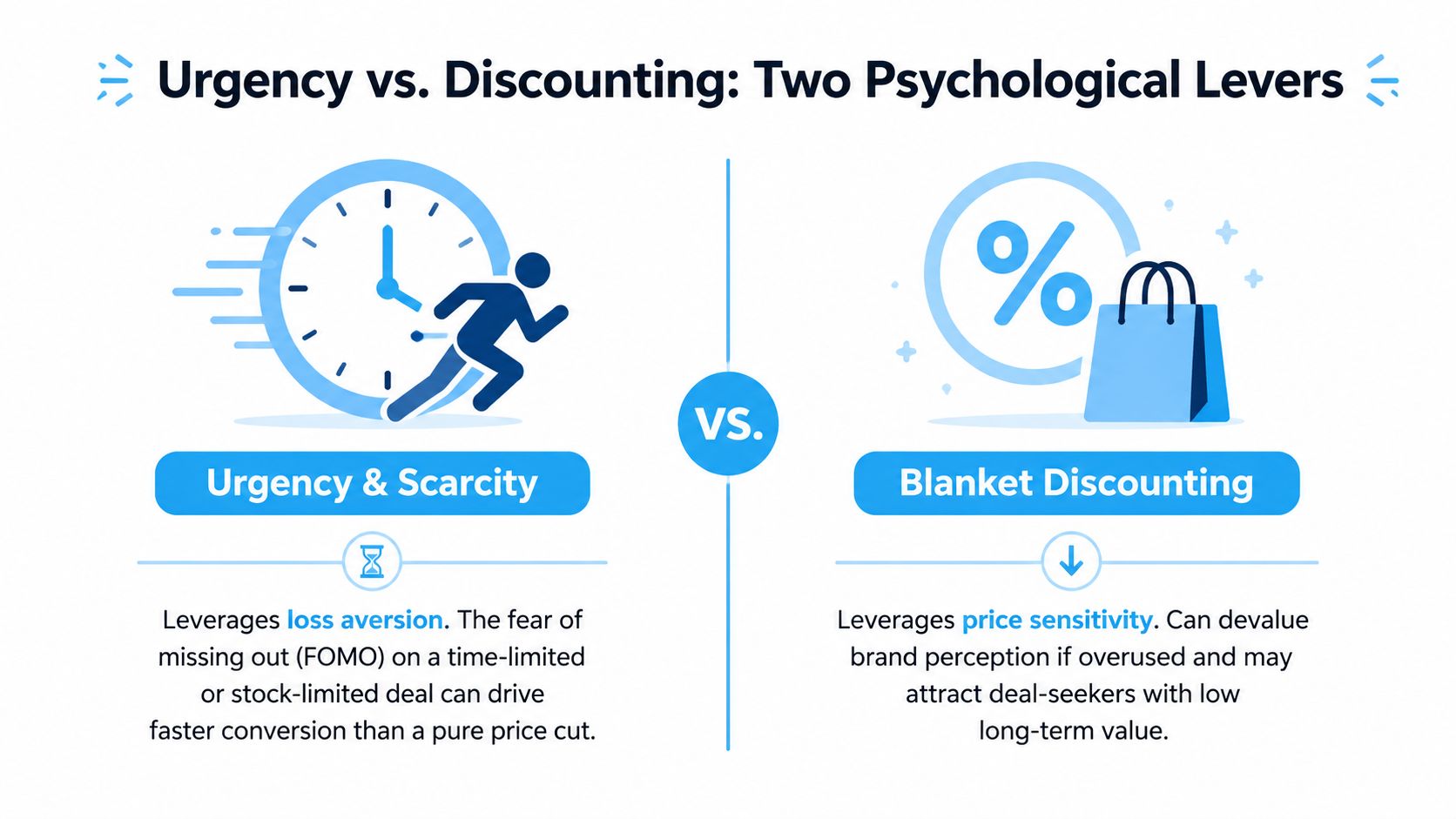
A controlled e-commerce study found that messages such as “Only 2 items left!” and “Offer ends in 5 minutes!” increased impulse buying, perceived product value, and purchase intention. The effect varied with consumer anxiety, product involvement, and trust. That result supports a strict rule: use urgency to clarify a genuine constraint, never to manufacture pressure. The findings appear in this controlled study of scarcity and urgency messaging.
| Promotional structure | Primary lever | Margin effect | Brand effect | Best fit |
|---|---|---|---|---|
| Blanket percentage discount | Price sensitivity | Reduces contribution on every eligible order | Can reset reference price | Broad clearance or planned value positioning |
| Time-bound offer | Loss aversion and temporal urgency | Limits exposure to a defined window | Preserves the regular price outside the event | Launches, seasonal drops, reactivation |
| Quantity-limited reward | Scarcity and participation | Caps the number of discounted claims | Makes early action part of the experience | Inventory constraints and exclusive access |
| Timed bundle | Value framing and commitment | Can protect unit economics through product mix | Keeps attention on the set, not only the markdown | AOV growth and complementary products |
For Shopify merchants, the structure matters more than the app’s feature count. An urgency campaign can still use a discount code, bundle, free shipping, or BOGO rule, while the customer experiences a defined event rather than an always-available price reduction. Quikly supports behavior-driven promotional experiences across storefront, email, social, and SMS, with rewards constrained by time, quantity, or both.
Choosing the Right Promotional Approach
Choose the promotional mechanic after answering four commercial questions. Feature count comes later. A Shopify discount app should fit the economics and positioning of the campaign, not dictate them.
Start with the margin floor
Calculate the lowest contribution you’re willing to accept per order. If the product can’t absorb a meaningful percentage reduction, make urgency, exclusivity, bundles, or gifts the primary structure. A discount may still exist, but it shouldn’t be the entire reason to buy.
The margin floor also needs to account for fulfillment, payment costs, returns, shipping subsidies, and acquisition costs. A percentage discount that looks manageable against gross margin can become unattractive after those costs are included.
Match the mechanic to the brand
Premium and emerging direct-to-consumer brands usually pay a higher perception cost for visible, repetitive markdowns. Value-oriented and commodity categories can tolerate more explicit price competition because customers already compare on price. That doesn’t make constant discounting safe, but it changes the tradeoff.
For an emerging brand, a timed reward or member-only exclusive can create movement without making the regular price look fictional. For a value-led catalog, tiered pricing or a quantity break may make more sense because the customer understands the economic exchange.
Respect audience and category norms
Apparel and beauty shoppers often expect seasonal promotions. Furniture, electronics, and luxury shoppers may interpret repeated discounts differently, especially when product quality, design, or durability carries the purchase decision.
Campaign timing should follow the category’s buying rhythm. A seasonal drop can support a clear window. A perpetual discount attached to every product page gives customers no reason to decide today.
Check execution readiness
Urgency only works when the business can keep the promise. Inventory, landing pages, Shopify discount configuration, email and SMS sends, Klaviyo segments, customer support, and fulfillment all need the same start and end conditions. Shopify Functions also impose hard execution limits. For carts up to 200 line items, a function gets 11 million instructions, 128 kB input, 20 kB output, a 256 kB compiled binary cap, and a 30-point maximum query cost, with input queries capped at 3,000 bytes, according to Shopify Functions technical limits.
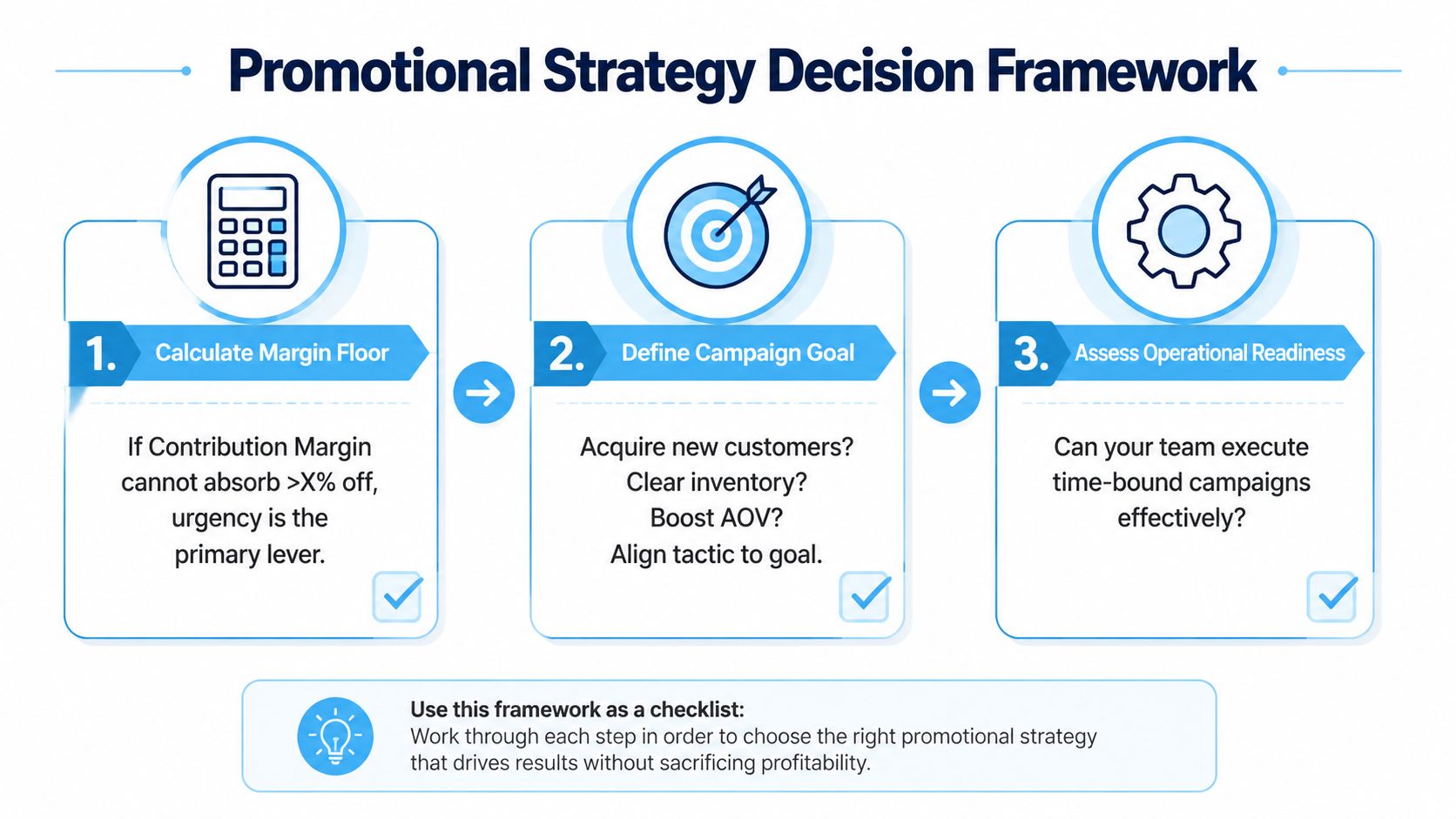
Use this quick filter:
- Protect the floor: If the campaign can’t tolerate a deeper markdown, use a time, quantity, access, bundle, or gift condition.
- Name the goal: Acquisition, inventory movement, AOV growth, reactivation, and loyalty need different mechanics.
- Check the promise: Don’t claim scarcity unless inventory or eligibility is constrained.
- Test the stack: Confirm Shopify, theme, checkout, Klaviyo, email, SMS, and reporting behave consistently.
- Plan the event: A useful DTC Black Friday playbook can help structure timing, channel coordination, and campaign intent before you configure the offer.
A Sharper Question to Bring to Your Next Promotion
The next promotion shouldn’t begin with “How much off can we afford?” That question assumes a discount is the only available lever. Ask instead: At what minimum discount depth does incremental conversion stop paying for itself in contribution margin and brand equity?
That question forces the team to evaluate three outcomes together. Did the campaign create enough additional orders to preserve contribution? Did it protect average order value and future full-price behavior? Did customers respond because the offer was timely, or because the brand taught them to wait for another markdown?
A one-quarter test can answer more than another app comparison. Hold the line on broad, repetitive percentage discounts. Route the promotional budget into a defined urgency campaign, such as a flash drop, waitlist signup, timed bundle, or quantity-capped reward. Keep the audience, product group, and channel logic clear enough that the team can compare the result against the prior discount-heavy quarter.
Track the measures that expose the tradeoff:
- Repeat purchase rate: Are customers returning after the event, or only waiting for the next sale?
- Average order value: Did the structure encourage a larger basket without requiring a deeper unit discount?
- Gross margin retention: How much contribution remained after the promotion and its fulfillment costs?
- Full-price behavior: Do exposed shoppers continue buying when the event ends?
- Channel quality: Did email, SMS, organic, and paid audiences respond differently to the same structure?
A campaign platform should support those questions. Quikly’s approach turns a promotion into a time- or quantity-bound experience, with rewards that can step down as shoppers claim them and storefront creative styled to match the brand. The mechanics have been refined across more than 60 million consumer interactions, and an approved client proof point reports roughly a 20% lift in profit for Jordan Craig, with incremental lift visible immediately on activation.
When evaluating a Shopify discount app, stop ranking tools by the number of rules they can execute. Rank them by whether they help you stay inside the margin floor, give customers a credible reason to act now, and preserve the perceived value of the product after the campaign closes.
Quikly helps Shopify brands run on-brand urgency and scarcity promotions across their storefront, email, social, and SMS, using time- and quantity-bound rewards instead of relying only on deeper discounts. Visit Quikly to evaluate a promotional structure designed to increase urgency while protecting margin and brand value.
Topics: shopify discount app, shopify promotions, ecommerce margins, urgency marketing, discount strategy