Most Shopify stores don’t have a discount problem. They have a discount habit problem.
The calendar fills up with sale dates, the team leans on the same promo again, and the next campaign has to cut deeper just to get the same lift. That’s where margin, conversion, and brand perception start pulling against each other. If you’re shopping for discount apps Shopify merchants use, the question isn’t “which app has the most features,” it’s “which app keeps promotions from becoming a permanent crutch.”
A better lens is simple. Good promotion tooling should help you sell without teaching customers to wait, and without making every campaign more expensive than the last. If you’re also thinking about broader automation around that same problem, Samuel Woods’ AI agents for ecommerce brands guide is a useful companion read because it frames how operators should think about systems, not just tactics.
The Discount Habit Most Shopify Stores Are Stuck In
The pattern is usually obvious from the inside. A merchant runs a sale, sees a clean bump, then repeats it with a slightly bigger cut the next time because the audience got used to the last one. By the third or fourth round, the promotion is doing less work, but it still costs more.
That’s the part most guides skip. The issue isn’t that discounts never work. The issue is that predictable discounts start shaping customer expectations, and expectations are expensive to reset.
The three pressures that matter
The first pressure is shrinking margins. The second is flat or falling conversion, even when traffic is still coming in. The third is brand perception, because constant markdowns train people to see your product as something they should never buy at full price.
Practical rule: if a promotion only works when you make it deeper, it’s not a growth system. It’s a short-term buy.
That’s why discount apps should be evaluated as decision tools, not just code generators. The best ones help you control timing, eligibility, and visibility so the offer feels earned instead of automatic. That shift matters if you’re trying to move customers now without poisoning the next sale cycle.
The same logic applies if your team is also thinking about automation around timing, segmentation, or campaign orchestration. Good promotion systems should make the next offer smarter than the last one, not just cheaper.
What Counts as a Shopify Discount App in 2026
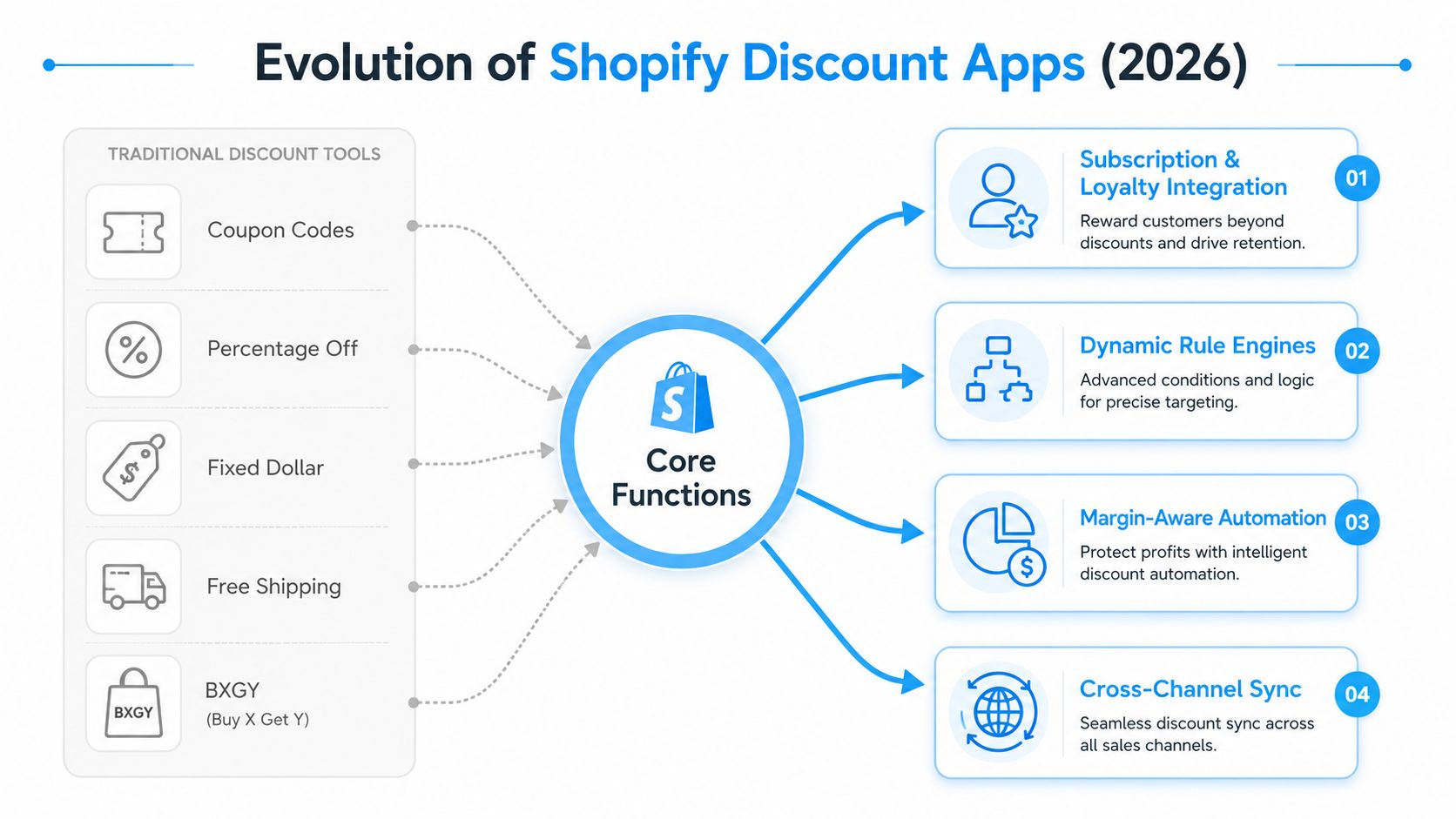
A few years ago, the category was easy to define. A discount app on Shopify was a tool for codes, percentage-off deals, fixed-dollar promos, free shipping, or Buy X Get Y mechanics. That still matters, but it’s not the full picture anymore.
Shopify now treats discount apps as a first-class extension point. Its own documentation shows merchants can use the GraphQL Admin API to create and manage native discounts, and Shopify Functions to add custom discount logic at checkout. In plain English, that means apps can do more than attach a code, they can shape how a promotion behaves inside checkout itself. Shopify also notes that merchants can configure these experiences through admin UI extensions or React Router App UI, which shows how far the platform has moved toward app-based promotion infrastructure. Shopify’s discount app documentation lays out that foundation clearly.
What that means for merchants
The practical effect is bigger than it sounds. An app developer can now define eligibility, timing, and stacking behavior much more precisely than the old coupon-code model allowed. That’s why the category now includes advanced rule engines, checkout-aware offers, and promotion logic that changes based on what the shopper does.
Shopify’s own help docs also make the limitation obvious. Native discounts cover a useful but narrow set of mechanics, including amount-off, Buy X Get Y, free shipping, and scoping to orders, products, or collections. More advanced patterns, like tiered discounts and custom eligibility rules, need app logic or custom implementation. Shopify’s discount type guide spells out that boundary.
The App Store reflects the same reality. Shopify’s promotions and discounts category covers tools for free-shipping offers, buy-one-get-one deals, sale prices through compare-at pricing, and discount combinations, which tells you the space is broad, not a single feature bucket. Shopify’s promotions and discounts category confirms that merchants are choosing between very different mechanics.
The Main Types of Discount Apps and What Each One Does
The category gets clearer when you stop asking “which app is best” and ask “what job is this promotion supposed to do.” A percentage-off app is not solving the same problem as a volume pricing app, and neither behaves like a scarcity-based offer or a signup-driven discount tied to email or SMS.
When is Sale’s Black Friday timing page is handy for planning around retail moments, but the bigger point is simpler. Different app types work at different points in the purchase journey, and the wrong one can erode margin while looking productive on the surface.
| Common Shopify discount app categories at a glance | ||
|---|---|---|
| App type | Primary mechanic | Watch out for |
| Percentage-off and fixed-dollar | Simple price cut | Easy to overuse, and easy for shoppers to wait for |
| Buy X Get Y | Incentive tied to a threshold | Can distort basket composition if the free item is low value |
| Free shipping | Removes delivery friction | Often protects conversion better than deep price cuts, but still conditions behavior |
| Volume and tiered pricing | Lower unit price at higher quantities | Can compress margin on popular bundles |
| Flash sale and countdown tools | Time-based pressure | Can become background noise if every campaign looks the same |
| Urgency and scarcity experiences | Limited claim windows or capped rewards | Works only if the limit is real |
| Signup-driven discounts | Offer traded for email or SMS | Can fill lists with low-intent subscribers |
Match mechanic to intent
Shopify’s native system already covers the basics, including percentage off, fixed discounts, free shipping, and Buy X Get Y. Apps become necessary when you need tiered pricing, multi-logic step discounts, or custom rules based on quantity, customer segment, or timing. A community answer on Shopify also shows how merchants commonly use discount tools across variant, collection, store, or hand-picked-product scopes, which is a good reminder that the offer has to fit the catalog, not just the checkout. Shopify community guidance makes that scope issue tangible.
A clean promotion is one the shopper understands in two seconds and your margin team can live with for six months.
Operationally, the trade-off is never abstract. Volume tiers can move inventory, but they can also narrow margin on products that already sell. Blanket flash sales can spike short-term orders, but they can also train customers to delay purchase until the next campaign. Signup offers can grow your list, but if the incentive is too easy, you attract bargain hunters instead of buyers.
Shopify’s own built-in discount tools support unique coupon codes, dates, usage limits, product or collection restrictions, percentage-off, fixed-dollar, free shipping, Buy X Get Y, and compare-at sale pricing. Shopify’s discount app overview is useful because it shows what you can already do before adding another app to the stack.
Why Flat Discounts Quietly Train Customers to Wait
Flat discounts work. That’s exactly why they’re dangerous when they become the default.
The behavioral problem is straightforward. Temporal discounting means a known future deal feels more valuable than an uncertain purchase today. If shoppers expect another sale soon, today’s full-price offer loses urgency. Reference price effects then reset what “normal” feels like, because every deeper cut nudges the customer’s anchor lower. Loss aversion kicks in once the audience starts expecting the discount, because missing the next sale feels like a loss, not just a missed bonus.
Why the cycle gets worse over time
That’s how the discount spiral starts. You cut prices to move volume, the customer learns to wait, and your next campaign has to work harder just to restore the same behavior. The brand thinks it’s stimulating demand, but it’s also teaching patience.
This is why predictable markdowns stop being a growth lever. They convert some shoppers now, but they also reprogram future demand by making your offer feel optional until the next event. Once that pattern is set, “more discount” often becomes the default answer to a conversion problem that should have been solved with better timing or better offer structure.
The fix is not to stop promoting. It’s to stop making the promotion easy to ignore.
Practical rule: if the shopper can safely wait and still expect the same deal, you’ve built a waiting habit.
Urgency works when it changes the shopper’s decision math. If the offer is limited, the customer has to decide now or risk losing access. That’s a very different behavior than seeing a permanent banner and filing it away for later.
Behavior-Driven Urgency Versus Countdown Timers
Countdown timers create pressure, but they don’t always create participation. A timer can make a page feel busy while the offer underneath stays completely static. That’s why many merchants see interest without enough commitment.
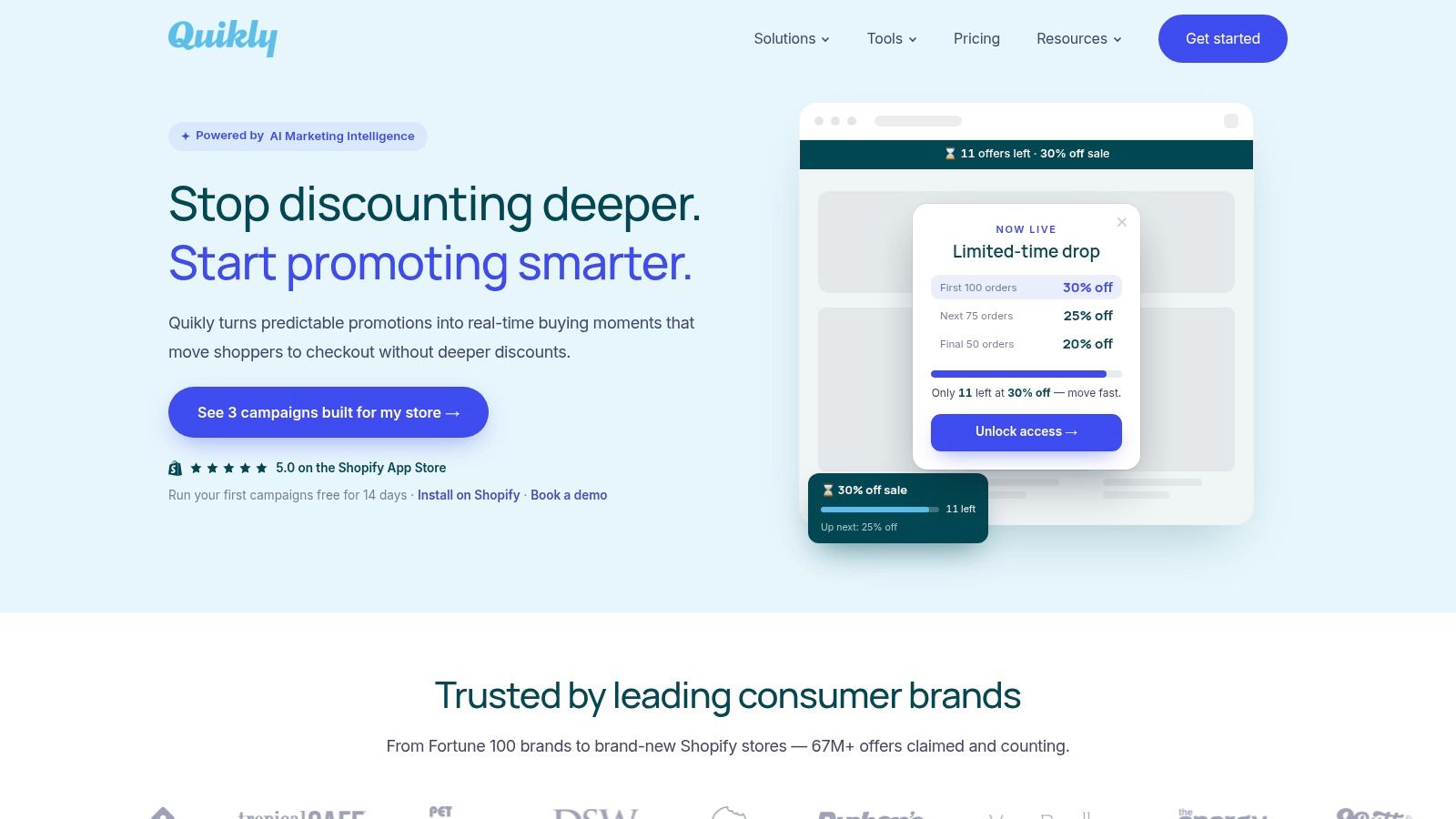
Behavior-driven urgency is different. The reward is capped by how many people claim it, how long the campaign stays open, or both, so acting early changes what the shopper gets. That aligns with loss aversion, commitment and consistency, and social proof when claim counts are visible. It also feels more honest, because the customer isn’t being told the clock matters if the offer never changes.
Why this mechanic matters on Shopify
On Shopify, the distinction matters because the app is only half the job. The other half is whether the experience fits the store, checkout, and messaging flow without looking bolted on. Quikly is built around that behavior-driven model, and its approach has been refined across more than 60 million consumer interactions. It can run a single reward or descending tiers across storefront, email, social, and SMS, and it’s designed to match the store rather than sit on top of it.
That matters if you care about more than conversion at any cost. A timed, capped reward can drive action without training the audience to expect permanent markdowns. Quikly’s own Shopify materials also frame its discount mechanics around threshold-based rewards, tiered quantity offers, and short-window reserved access, which are the kinds of structures that change behavior without turning your brand into a clearance rack.
The most relevant proof point is operational, not flashy. Jordan Craig saw roughly a 20% lift in profit with incremental lift visible immediately on activation. That’s the kind of outcome merchants care about because it speaks to profit, not just clicks.
For merchants comparing mechanics, a good primer is Quikly’s countdown timer guide for Shopify, especially if you want to understand where timer-based urgency ends and behavior-driven urgency begins.
A Selection Checklist That Reduces Real Risk
Most app reviews obsess over feature lists. That misses the core failure modes. The hard part isn’t finding an app that can discount. It’s finding one that won’t break checkout, flatten margins, or create a weird customer experience the support team has to explain later.
Test the offer, not just the interface
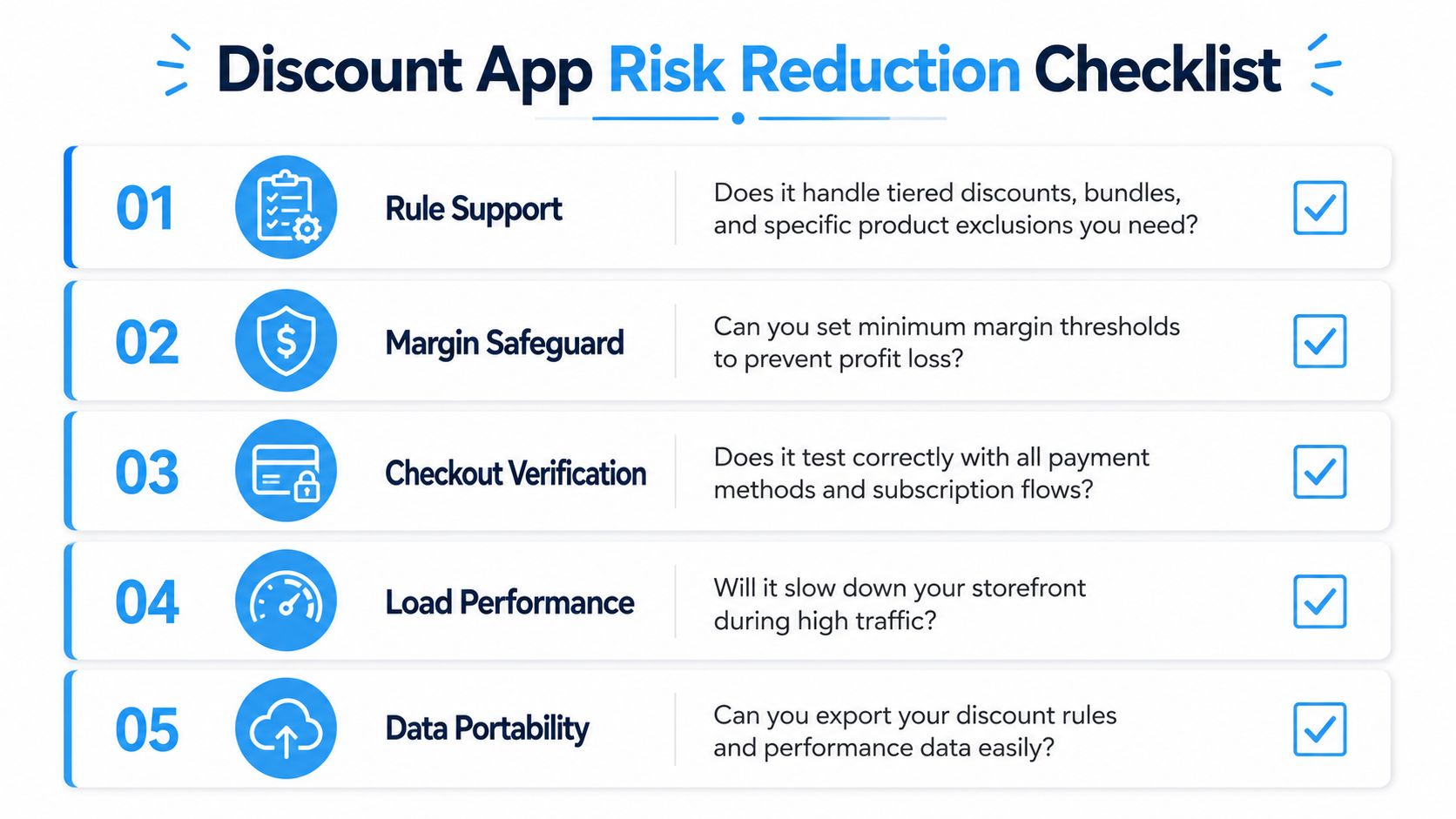
Start with mechanics and fit. If you need tiered pricing, step-down offers, bundle logic, or product exclusions, confirm the app can express that rule cleanly. Then test it on a staging theme before launch so you’re not discovering rule conflicts in live traffic.
Check the parts that break first
Checkout behavior matters more than the sales page. Shopify’s newer architecture uses Functions and checkout extensions, so you want to know whether the app is modern or relying on older workaround logic that can create mismatches. Subscriptions need the same scrutiny, because an offer that works on one-time purchases can fail or misprice on recurring products.
You also need to verify stacking rules. If another discount is already active, does the app behave predictably or create a silent override? That’s one of the easiest places for margin leakage to hide.
- Rule Support: Confirm the app can handle the exact offer structure you need, including exclusions and tiers.
- Checkout Verification: Test payment methods, subscription flows, and cart behavior on staging.
- Load Performance: Watch for theme slowdown or visual shifts that make the storefront feel unstable.
- Brand Fit: Make sure the experience can match the store, not look like a generic third-party prompt.
- Data Access: Check whether you can export rules and performance data without friction.
The other risk is integration. If your campaigns rely on Klaviyo or SMS, the discount should connect to the message flow cleanly rather than living in a silo. CartBoss’s urgency playbook is useful here because it reinforces a simple idea, urgency only works when the mechanics and the message are aligned.
Implementation Steps and Metrics Worth Watching
A promotion launch should start with guardrails, not excitement. Set the goal in terms of margin and conversion, not just revenue, because a promotion that sells more but earns less can still be the wrong move. Then build it on a staging theme first and verify the behavior on desktop, mobile, checkout, and subscriptions before anyone sees it.
Launch in a way your support team can defend
Brief support before rollout. They need to know what the shopper is supposed to see, what happens when the reward is claimed, and what should happen if the customer stacks another offer. If the team can’t explain the mechanic in plain language, the campaign isn’t ready.
Staged rollout is smarter than a full-store blast. Start with a segment, confirm the offer behaves the way you expect, and then expand once the mechanics are clean. If you want a useful framework for measurement language inside the broader ecommerce stack, Quikly’s analytics guide is worth a look.
Watch the right signals
The metrics that matter are the ones that tell you whether the promotion is healthy, not just busy.
- Incremental conversion lift: Compare against a holdout when you can.
- Average order value movement: Check whether the offer is lifting basket size or just discounting the same orders.
- Discount depth as a share of revenue: Make sure the campaign isn’t eating too much of the sale.
- Repeat purchase behavior: Watch the next 60 days for signs the offer created durable demand.
- Email and SMS sentiment: Track unsubscribes and reply quality, not just send volume.
If you only watch orders, you’ll miss the damage. Profit per visitor is the cleaner metric because it forces you to weigh conversion against what you gave away to get it.
Choosing Discount Apps With Margin, Conversion, and Brand in Mind
The right discount app should make your store less dependent on deeper markdowns over time, not more. It should lift conversion on traffic you already paid for, and it should protect perceived value instead of teaching shoppers to wait for the next sale. If an app can’t do all three, it’s probably just making the problem look more organized.
That’s the cleaner way to evaluate the category. A good tool gives you control over timing, eligibility, and urgency so the promotion feels like a reason to act now. A bad one checks a feature box and conditions the next cohort of customers to sit on their hands.
If you want a broader perspective on alternatives, Quikly’s guide to alternatives to discounting for Shopify is useful because it pushes the thinking beyond blanket price cuts. The merchants who win here won’t be the ones who discount the most. They’ll be the ones who make acting early feel natural, while keeping margin and brand value intact.
If you want to run promotions that reward action instead of training delay, Quikly gives Shopify merchants a behavior-driven way to do it. It builds urgency-based offers that fit the store, not a bolted-on popup or a generic timer. Visit Quikly to see how that approach changes the discount conversation.
Topics: discount apps shopify, shopify promotions, shopify urgency, conversion lift, margin protection