Beyond the Coupon Code: Why Your Next Promotion Shouldn’t Be a Discount
You know the cycle. Sales are flat, so you plan a promotion. You send the email, post on social, and watch the orders come in. But when the dust settles, you see the trade-off. Margins are thinner, and your best customers now know to wait for the next sale.
That pattern is why so many Shopify brands are looking for better alternatives to discounting for Shopify. Repeating the same markdowns chips away at profit, weakens perceived value, and makes every future promotion harder to win with. If you also need to reduce cart abandonment, a lower price isn’t your only option.
The better move is to use promotions that change behavior without automatically cutting price. Some tools remove friction. Some build value into the cart. Some create urgency that feels real instead of manufactured. All seven below can help you grow sales without turning your store into a permanent sale rack.
1. Quikly
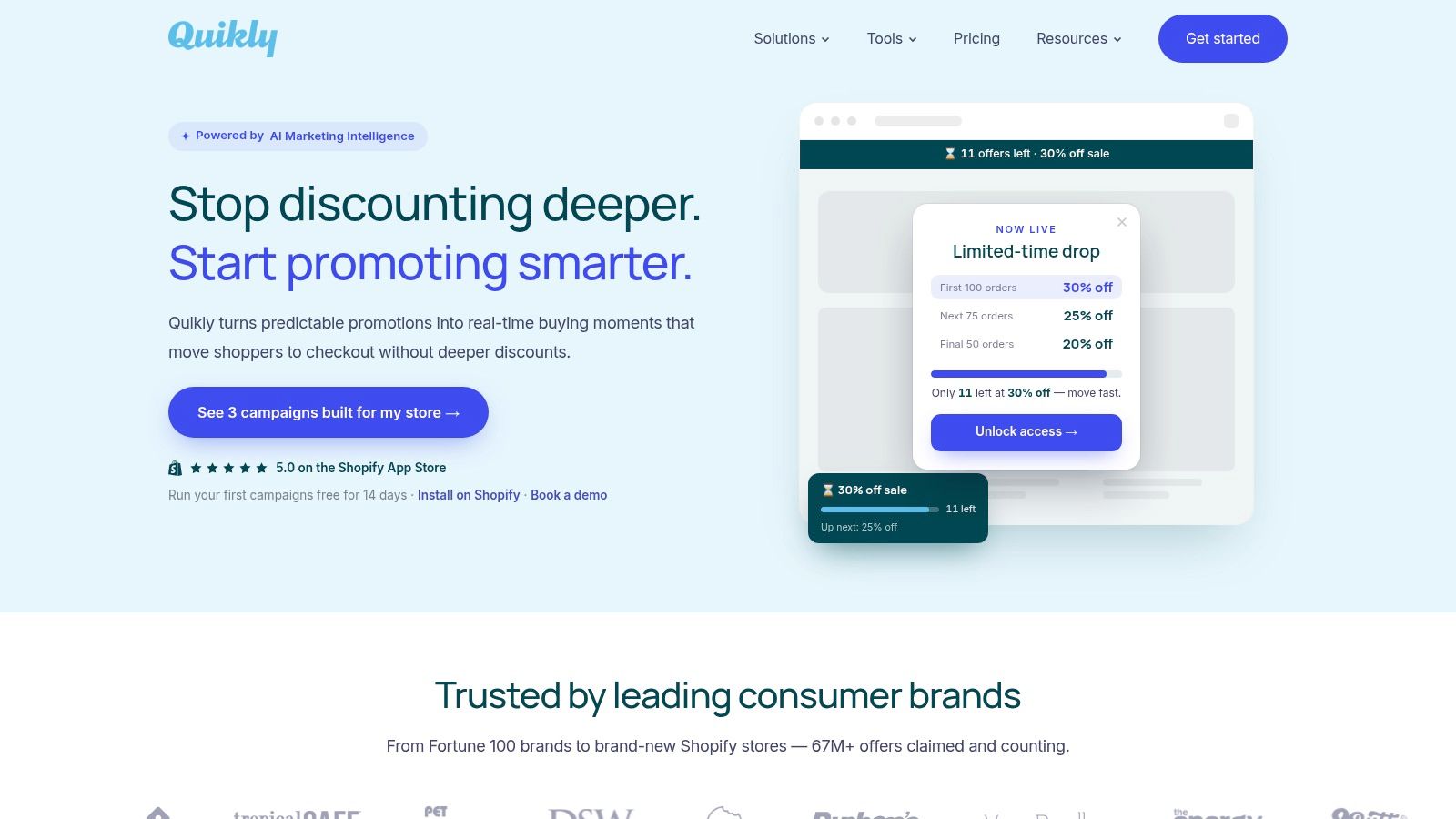
Sales slow down. The default response is another storewide code. Orders spike for a day, then margins shrink and customers learn to wait. Quikly is a better fit when that cycle is the problem.
Quikly is built for brands that still want a promotional moment, but do not want to train shoppers to expect the same flat offer every time. Its core mechanic is simple. Rewards are tied to speed or limited availability, so the best outcome goes to people who act early instead of people who hold out for the next markdown.
Why it solves more than conversion
This matters because discounting usually fails in two places at once. It cuts margin, and it weakens the signal your brand sends about value. Quikly addresses a different tension. It can improve response rates without dropping price across the board or making the storefront feel like a clearance rack.
The practical upside is control. Teams can run capped offers or descending reward tiers across email, SMS, social, and onsite placements, while keeping the creative aligned with the brand. If you want the broader AOV angle too, Quikly’s guide on how to increase average order value is a useful companion.
Operator view: Urgency works when the shopper believes timing matters. It falls apart when every campaign looks fake or endlessly repeatable.
Quikly also tends to be easier to test than heavier merchandising tools. That matters for lean ecommerce teams that need to learn fast, not spend a month in implementation before the first campaign goes live.
What works and what doesn’t
Quikly works well when demand already exists, but your promotion structure is too blunt. Product launches, seasonal pushes, list growth campaigns, and win-back sends are strong use cases because the offer creates a reason to act now without handing the same discount to everyone.
It is less effective when the underlying issue is weak product-market fit, poor merchandising, or low trust. Scarcity cannot fix a confusing offer. It also loses impact if a brand uses it too often or manufactures pressure that shoppers can see through.
A few trade-offs matter:
- Strong answer to margin erosion: It gives early buyers the better reward, which can lower the average discount compared with a blanket code.
- Useful for brand-sensitive stores: Campaigns can match the storefront instead of looking like a generic popup layered on top.
- Limited if your stack is broader than Shopify: It is built for Shopify, so multi-platform operators may need a different setup.
- Expect a sales process: Public pricing is not the main entry point, so larger teams may need a demo and internal review before buying.
If your current promos still produce revenue but leave you with weaker margins and a more price-trained customer base, Quikly is one of the clearest alternatives on this list.
2. Rebuy
Rebuy is a better answer when your issue isn’t weak demand, it’s weak cart construction. If shoppers are buying one item when they could reasonably buy two, or if they need help finding the right add-on, discounting is often the lazy substitute for merchandising.
Rebuy gives Shopify brands more control over product discovery, cart upsells, bundles, checkout offers, and post-purchase recommendations. Done well, that increases order value at full or near-full price.
Where Rebuy earns its keep
The best Rebuy setups are specific. A supplement brand can recommend replenishment products in cart. A skincare brand can pair a cleanser with a moisturizer. An apparel brand can add matching accessories or build looks. That’s a more durable growth lever than couponing because the shopper gets more value, not just a lower price.
This is also where average order value strategy gets more interesting than simple discount math. Quikly’s post on how to increase average order value complements this well because it frames AOV growth around behavior, not blanket markdowns.
The mistake is stuffing every possible widget onto the page. Rebuy works best when it answers one buying question at a time.
The trade-offs
Rebuy can get heavy fast if a team treats every placement as free inventory. Smart Cart, bundle blocks, PDP recommendations, checkout extensions, and post-purchase offers can all help, but too many competing prompts create friction and visual noise.
A few points matter in practice:
- Strongest use case: Lifting AOV without lowering list price.
- Good fit for Shopify teams: It integrates strongly with Shopify and supports no-code deployment plus deeper rules and API work.
- Real downside: Overuse can add front-end weight and hurt clarity.
- Plan around Plus: Some checkout features depend on Shopify Plus.
If margin is under pressure because your orders are too small, Rebuy is one of the cleanest alternatives to discounting for Shopify. It monetizes intent you already have instead of paying shoppers to buy.
3. Recharge
Recharge solves a different problem. It doesn’t just try to improve a single transaction. It tries to turn the right products into repeat transactions by design.
For categories with natural replenishment, subscriptions are one of the most credible alternatives to discounting for Shopify because they shift the value proposition from “buy now because it’s cheaper” to “stay because it’s easier.” Convenience, continuity, and customer control are stronger retention hooks than endless promo codes.
Why subscriptions can protect the brand
Recharge is strong when your products already fit a recurring cadence. Coffee, supplements, pet products, skincare refills, household basics, and consumables all make sense. The customer portal, skips, swaps, failed payment recovery, and analytics matter because recurring revenue breaks when operational friction piles up.
This approach also changes your relationship with demand. Instead of trying to pull customers back every month with an offer, you lock in expected reorders through service and routine.
Practical rule: Don’t force subscriptions onto products people buy irregularly. If the reorder rhythm isn’t natural, the discount habit comes back in another form through churn and support load.
Where brands get this wrong
A weak subscription strategy usually has one of two flaws. Either the merchant uses a subscription app on products that don’t deserve one, or the team underestimates the operational work behind inventory planning, customer support, and retention flows.
Recharge is powerful, but it isn’t passive. It affects merchandising, logistics, lifecycle email and SMS, and customer experience. Its integrations with Shopify and common marketing tools help, but your operations team still has to carry the model.
Use Recharge if your tension is long-term retention and repeat purchase predictability. Don’t use it as a cosmetic replacement for discounting on products that are still one-off purchases.
4. Shop Pay Installments (Affirm)
A shopper gets all the way to checkout, sees the total, and pauses. That moment does not always signal weak demand. Often, it means the customer wants the product but does not want the cash hit all at once.
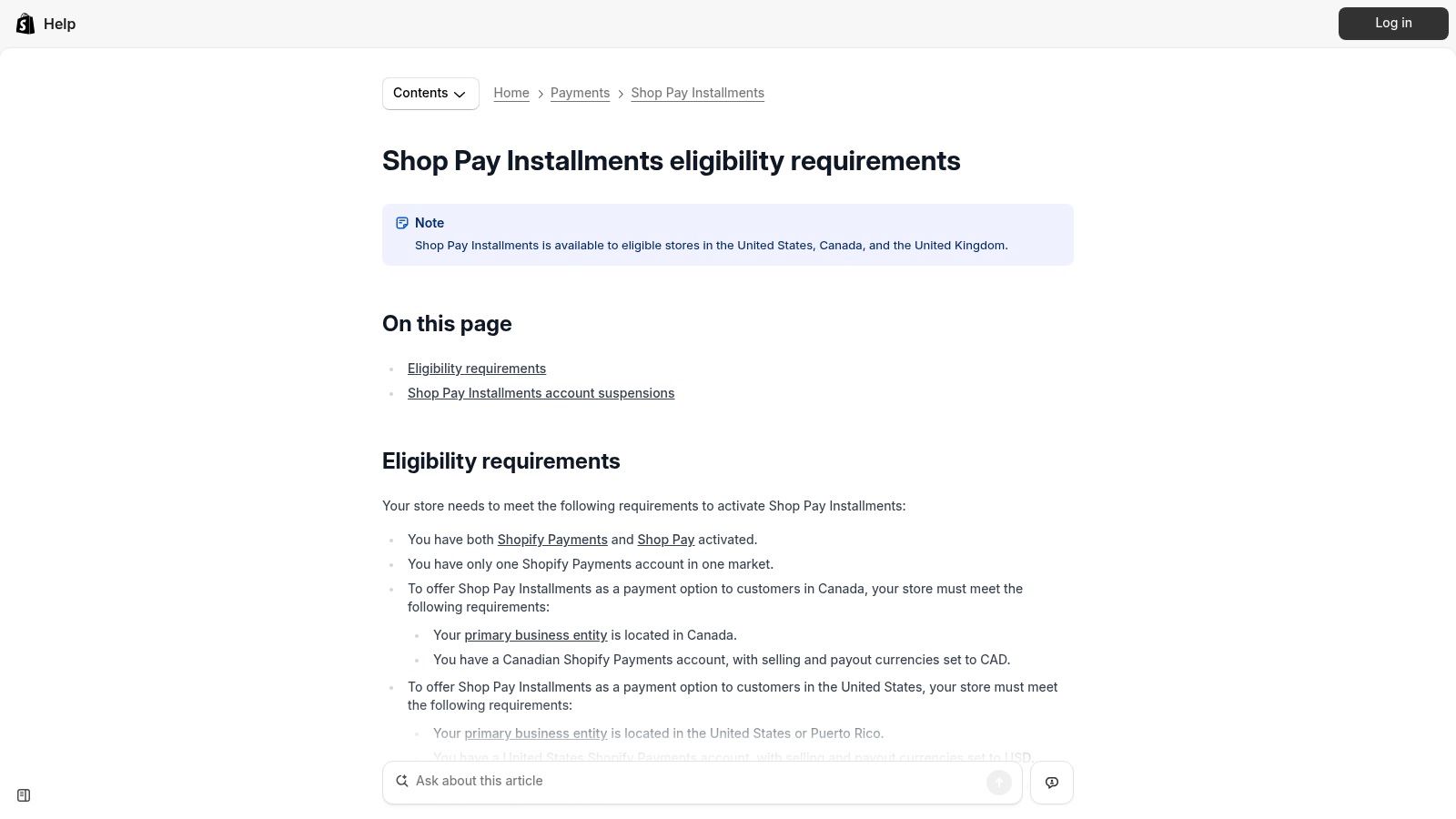
Shop Pay Installments eligibility details matter in that situation because installments solve a pricing friction problem without forcing a lower selling price. That is a better trade in many cases. You protect margin, keep the premium position of the product, and still give the buyer a way through.
Best fit for higher-ticket friction
Shop Pay Installments works best when conversion stalls late in the funnel. Furniture, premium beauty tools, fitness equipment, larger apparel carts, and gift-heavy orders are common fits because the objection is often timing, not value.
That distinction matters.
If shoppers are browsing but not engaging, installments will not fix weak merchandising or low product trust. If shoppers are adding to cart and reaching checkout, payment structure may be the actual bottleneck. In those cases, financing can do more for revenue than another 10% off banner that chips away at margin and trains customers to wait for the next promo.
The Shopify-native checkout is part of the appeal. Keeping the pay-over-time option inside Shop Pay creates a smoother path than pushing people into an awkward third-party flow. Less friction at the finish line usually matters more than another top-of-funnel offer.
The trade-off is real
Installments come with costs. Merchant fees apply. Customer qualification is not guaranteed. Finance and support teams also need to understand payout timing, reporting, and how declined installment applications affect the checkout experience.
Still, this is often a cleaner compromise than discounting. A financing fee is easier to defend than a permanent hit to price integrity. One helps customers manage cash flow. The other can lower perceived value and make full-price selling harder next month.
There is also a brand angle here. Premium brands usually want to preserve price while reducing buying friction. Installments help do that. If your broader retention plan also needs non-discount incentives after the first purchase, these loyalty program examples from top ecommerce brands show how brands add value without defaulting to markdowns.
Use Shop Pay Installments when your core tension is conversion versus margin on higher-priced orders. Skip it when the underlying issue is low trust, poor product-market fit, or weak demand.
5. Smile.io
A customer buys once at full price, likes the product, and then hears from the brand again only when a discount goes out. That is how stores train repeat buyers to wait for promos instead of building habit. Smile.io fits brands that need retention infrastructure, not another short-term conversion push.
Smile.io gives Shopify brands a way to reward repeat behavior through points, VIP tiers, and referrals. The strategic value is not the feature list. It is the ability to shift incentives away from constant markdowns and toward actions that raise lifetime value, such as second purchases, reviews, referrals, and account creation.
That distinction matters. A weak loyalty setup becomes a delayed discount program. A good one protects margin while giving customers a reason to stay engaged between purchases.
The best programs use status and access as much as savings. Early product access, member-only gifts, surprise rewards, and referral benefits usually strengthen brand perception more than turning every point into store credit. For brands looking for stronger loyalty program structures, these loyalty program ideas from top ecommerce brands show the difference between transactional rewards and programs customers actually care about.
Smile.io also helps with a trust problem that discounting does not fix. Reviews, referrals, and user-generated content improve conversion because they reduce purchase anxiety. Product pages with 50 or more verified customer reviews convert 15% better, according to Red Stag Fulfillment’s Shopify conversion data. Rewarding post-purchase actions can help create that review base without cutting price.
What to watch
The trade-off is configuration.
- Set reward economics carefully: If points work like cash on every order, customers start pricing your brand net of rewards.
- Prioritize non-discount incentives: VIP perks, gifts, review requests, and referral rewards usually preserve margin better than straight money-off offers.
- Check plan limits: Advanced segmentation and customization often require higher-tier pricing.
- Connect it to the rest of your stack: Smile.io gets more useful when it feeds email, subscription, and retention workflows instead of running in isolation.
Smile.io makes sense when your core tension is retention versus margin. Use it if your products have real repeat purchase or community potential. Skip it if the business still has a basic conversion problem, weak product-market fit, or too little customer demand to support a loyalty loop.
6. Govalo
Govalo is the most overlooked tool on this list because gift cards and store credit rarely get framed as promotional strategy. They should. Both can capture demand without forcing you to lower product price.
That’s especially useful during holiday periods, launch windows, out-of-stock moments, and corporate gifting cycles. A gift card preserves full-price positioning while still giving the customer a reason to act now.
The strategic use case most brands miss
Govalo expands Shopify’s native gift card experience with stronger branding, better merchandising, analytics, and gifting workflows. That matters when gifting isn’t an afterthought, but a meaningful sales channel.
It also helps with a common margin problem. When an item is unavailable, many brands default to a discount on a substitute or a future-purchase coupon. Store credit and gifting flows can recover that demand without introducing a lower reference price.
Brands often discount to solve timing problems. Gift cards and store credit solve many of the same timing problems without repricing the product.
Where it fits best
Govalo makes the most sense if your catalog has seasonal gifting appeal, strong brand affinity, or products people buy for others. It also pairs well with subscription businesses that want giftable continuity instead of one-off holiday spikes.
The downside is straightforward. It’s another app to manage, and some advanced features are tier-dependent. But unlike a discount tool, it doesn’t train customers to anchor on markdowns.
If your brand gets traffic from gift buyers, late buyers, or customers shopping around inventory gaps, Govalo is a smarter commercial tool than another temporary sale.
7. TryNow
A shopper lands on a product page, likes what they see, then hesitates for one reason. They are not sure it will work once it arrives. In that situation, a discount cuts margin without fixing the underlying objection.
TryNow is built for that problem. It gives customers a try-before-you-buy path, which matters most in categories where fit, feel, shade, or comfort drive returns and abandoned carts.
A better answer to trust friction
This works best in apparel, beauty, footwear, and other categories where the first purchase carries real uncertainty. If the customer is unsure about size or outcome, a lower price only softens the risk. A trial window addresses the source of the hesitation.
That is the strategic value. TryNow is not another conversion app layered on top of a weak offer. It is a way to protect full-price positioning while reducing the trust barrier that often pushes brands into discounting.
The operational trade-off
Try-before-you-buy changes the economics of the order, so the setup needs discipline. Returns workflows, inventory allocation, reserve logic, eligibility rules, and cash timing all need to be handled up front.
That makes TryNow a poor fit for every store. Low-margin catalogs, consumables, and products with messy reverse logistics can lose money fast if the program is too broad. Brands with healthy margins, predictable return handling, and products customers need to experience before committing usually get the clearest benefit.
If discounting is covering up a confidence problem, TryNow is one of the few alternatives that solves the problem directly instead of training customers to wait for a sale.
7 Shopify Alternatives to Discounts: Side-by-Side Comparison
| Product | Implementation complexity | Resource requirements | Expected outcomes | Ideal use cases | Key advantages |
|---|---|---|---|---|---|
| Quikly | Low, fast (~2 min) install, simple campaign creation | Low–Medium, marketing time; app subscription; Shopify-only | Boosts conversion & AOV, grows email/SMS signups, clears inventory with shallower discounts | DTC Shopify stores needing urgency-driven promotions and inventory clearance | Branded, multi-channel urgency drops backed by AI/data |
| Rebuy | Medium, no-code blocks plus optional custom rules/APIs; some checkout features need Plus | Medium, design/ops for placements; possible Shopify Plus requirements | Increases AOV and conversion via personalization, bundles, upsells | Merchants focused on personalization, cross-sell/upsell and bundle strategies | Deep Shopify integration across PDP/cart/checkout with flexible controls |
| Recharge | Medium–High, subscription flows require operational planning & integrations | Medium–High, billing, customer support, inventory sync, platform fees | Higher recurring revenue, improved retention and LTV | Consumables, replenishment products, brands building subscription revenue | Proven subscription platform with strong automation and integrations |
| Shop Pay Installments (Affirm) | Low, native Shop Pay integration but merchant eligibility checks apply | Low–Medium, merchant fees; finance/payout timing adjustments | Raises conversion and AOV for higher-ticket orders by reducing sticker shock | US merchants selling higher-ticket items who use Shop Pay | Frictionless native checkout financing; merchants receive funds upfront |
| Smile.io | Low–Medium, set up points/tiers/referrals; integrations available | Medium, program management, higher tiers cost more | Boosts repeat purchases, referrals and customer retention | Brands prioritizing loyalty, repeat business, and referral programs | Unified loyalty/referral system with broad ecosystem integrations |
| Govalo | Low–Medium, enhances native gift card/credit flows with templates and analytics | Low–Medium, app fees; gift-card/account management | Captures gifting and store-credit revenue without discounting; aids peak seasons | Stores using gift cards, corporate gifting, or giftable subscriptions | Branded gift-card/credit experiences with analytics and POS/QR support |
| TryNow | High, complex try-at-home flows, policy and returns handling | High, inventory holds, returns processing, cash-flow and operations overhead | Converts hesitant shoppers at full price, reduces fit/feel anxiety | Apparel, beauty, and fit-sensitive categories where trials reduce friction | Risk-reversal try-before-you-pay model that improves first-purchase rates |
Build Your Promotion Strategy, Not Just Your Next Sale
Conversion slips for a few days, revenue looks light, and the team reaches for another 15% off code. The order count may recover. The cost shows up later in lower margins, weaker price integrity, and customers who learn to wait for the next sale.
A stronger promotion strategy starts with a clear diagnosis of the problem. Blanket discounts try to solve everything at once, which is why they often solve nothing well. Use urgency when the issue is timing. Use merchandising when the issue is basket size. Use financing when the issue is affordability. Use subscription, loyalty, gifting, or trial models when the issue is retention or purchase hesitation.
That is the core value of the tools in this list. Each one addresses a different ecommerce tension without defaulting to lower prices.
Quikly helps when shoppers need a reason to act now. Rebuy helps when the cart is too small. Shop Pay Installments reduces sticker shock on higher-ticket products while keeping the listed price intact. Recharge and Smile.io are better fits when the business needs more repeat revenue, not another one-time spike.
Brand risk matters here too. Temporary sales can work, but repeated discounting changes customer expectations and weakens pricing power. Scarcity and urgency can still lift conversion when they are credible. Analysts cited in Amra & Elma’s scarcity marketing statistics roundup found that believable urgency messaging was associated with stronger conversion and lower price sensitivity. If every product appears to be running out every day, that effect disappears.
Operators should judge promotions by job to be done. Is the campaign meant to improve first-purchase conversion, raise AOV, increase repeat rate, or reduce hesitation at checkout? Once that is clear, it becomes easier to replace unnecessary discounts with tools that protect margin and support healthier growth.
If you’re also working on basket growth, this Otter A/B AOV guide is a useful companion read.
Topics: alternatives to discounting for shopify, shopify promotions, increase shopify sales, ecommerce promotion strategy, shopify apps