Six weeks into a BFCM promotion, the dashboard looks healthy. Revenue is climbing, orders are moving, and the team is already planning the next campaign. Then the P&L arrives. Margin has fallen faster than order volume has grown, repeat customers are waiting for the next code, and the brand is defending its regular price across every channel.
That pattern is common on Shopify because a percentage-off discount is easy to launch and easy to measure. It’s also blunt. A Shopify scarcity app gives operators another lever: keep the listed price intact, limit access by time or quantity, and give high-intent shoppers a reason to act now instead of waiting.
The Promotion Problem Most Shopify Stores Hit
The trouble usually starts with a reasonable decision. A merchant wants to create demand, so the team launches a sitewide offer. Customers respond. The campaign gets called a success, and the same approach returns for the next seasonal event, product push, or acquisition burst.
Over time, shoppers learn the pattern. If a promotion appears whenever sales need help, there’s little reason to buy at full price today. They can wait for the next email, search for a code, or leave the item in the cart until the brand creates a stronger incentive. The promotion still produces activity, but it also changes customer expectations.
That’s the tension behind any serious holiday marketing strategy. Seasonal planning should create a compelling buying moment without making the brand’s regular price feel temporary.
The dependency loop
Flat discounts move the decision toward price. Scarcity moves it toward timing, access, or participation. Those are different mechanisms.
A blanket offer says the same thing to every visitor, regardless of intent, inventory, or customer value. A capped reward can recognize the shopper who acts early, the customer who reaches a basket threshold, or the buyer who joins a limited restock window. The brand controls the exposure instead of giving away margin to everyone.
A promotion can also create demand without making the product look permanently cheaper. That matters for premium positioning, repeat purchase behavior, and future launches. The objective isn’t just more orders. It’s more useful orders at a margin and price structure the business can defend.
Operator’s rule: If the only way to improve a promotion is to make the discount deeper, the mechanic is doing too little work.
For Shopify merchants evaluating alternatives, the practical distinction is explained in Alternatives to discounting for Shopify. Scarcity isn’t a replacement for every promotion, but it’s a sharper starting point when the brand needs urgency without another automatic markdown.
Why Flat Discounts Quietly Cost More Than They Return
More revenue doesn’t automatically mean better economics. A discount reduces the revenue collected on every qualifying order, while many fulfillment, staffing, platform, and operating costs continue unchanged.
Consider a product with a 50% gross margin. A 20% discount reduces profitability to 37.5%, which represents a 25% decline in profit, according to Hycos’ analysis of ecommerce discount-rate impact. The same analysis reports that average discounting runs at 12% to 18% of revenue, while the realized margin impact can be 2 to 3 times the discount rate because the reduction hits revenue more directly than fixed operating costs.
The break-even requirement is often misunderstood. If a promotion removes a meaningful share of contribution from each order, the store must generate substantially more volume just to reach the same contribution profit. The campaign may look strong in Shopify Analytics while weakening the economics underneath.
Discount Margin Math at a Glance
| Discount Depth | Required Volume Lift to Break Even | Typical Realized Lift |
|---|---|---|
| 10% | Materially above the baseline | Varies by audience, product, and offer |
| 20% | Substantially above the baseline | Often insufficient to offset margin loss |
| 30% | Very high incremental volume required | Must be tested against contribution profit |
The table is a decision aid, not a universal benchmark. Product margin, shipping costs, returns, acquisition costs, and customer mix change the outcome. The important point is that discount depth and required volume don’t rise in a friendly one-to-one relationship.
Fatigue changes the customer, too
Repeated promotions create more than a financial cost. They can train shoppers to delay purchases, weaken full-price demand, and make every new campaign compete with the expectation of a better one.
A promotional-dependence summary describes a cycle where 60% to 70% of promotional gains can be followed by weakness in non-promotional periods, while deal-dependent brands may see baseline sales fall 30% to 50% between promotions, as documented by User Intuition’s promotion-dependence guide. Those figures shouldn’t be treated as a forecast for every store, but they show why promotion cadence deserves the same scrutiny as conversion rate.
Discount codes also leak value through stacking, public code sites, and customers who would have purchased without an incentive. A scarcity campaign can be narrower by design. It can reserve a reward for a limited claim count, a particular behavior, or a verified campaign window.
For a practical comparison with conventional discount tooling, see Shopify discount app options. The question isn’t whether discounts ever work. It’s whether a blanket discount is the least expensive way to create the next purchase.
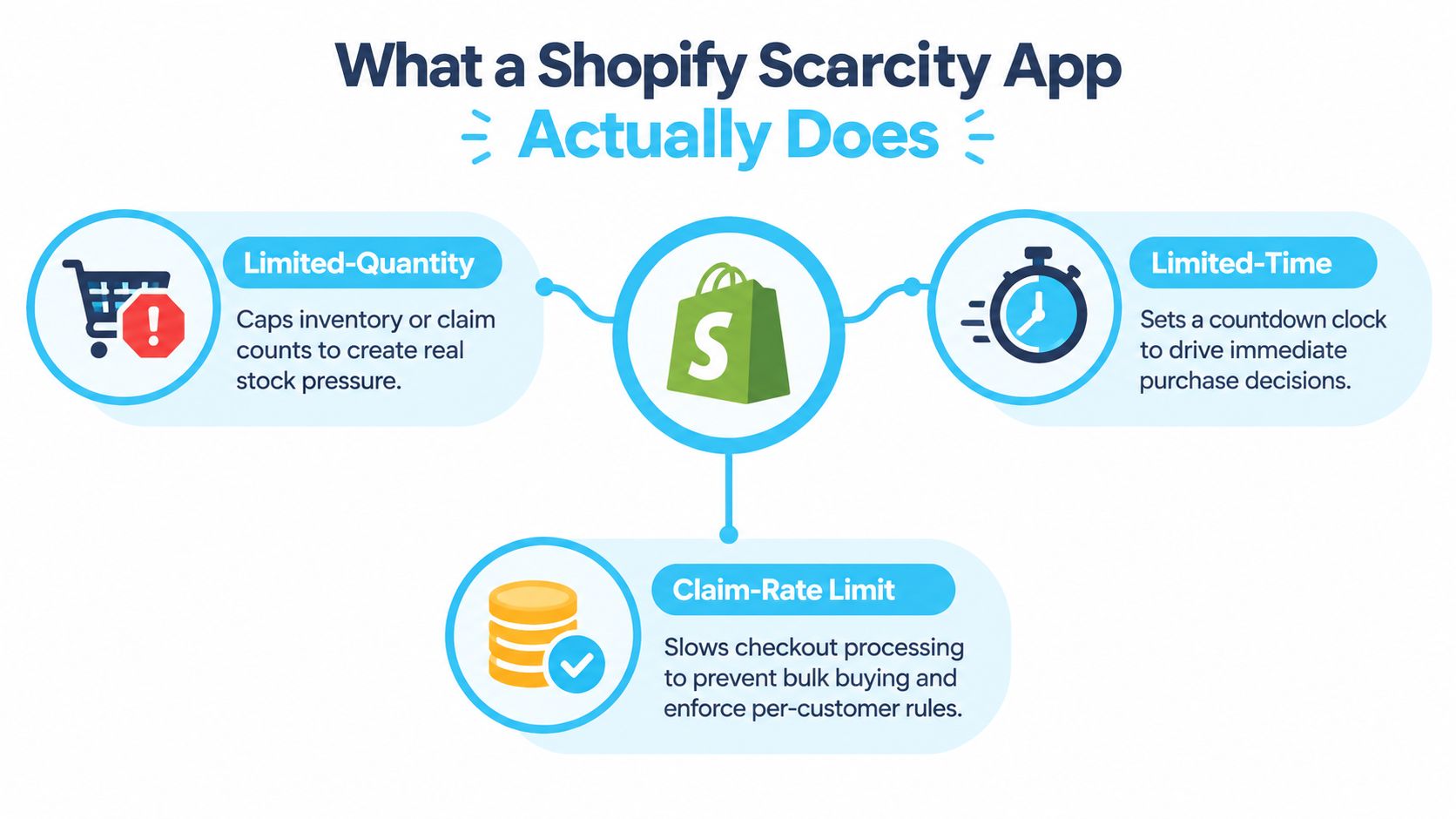
What a Shopify Scarcity App Actually Does
A Shopify scarcity app structures access so shoppers have a reason to act before an offer, product, or reward changes. The strongest implementations use real campaign rules, not decorative warnings added to a product page.
There are three core mechanics.
Limited quantity creates access pressure
A limited-quantity offer caps inventory, reward availability, or total claims. A collection drop might reserve a defined batch for early buyers. A restock window might make a product available while the replenished inventory lasts.
This works through perceived scarcity and loss aversion. The shopper isn’t merely comparing the product with alternatives. They’re deciding whether waiting could mean losing access.
The cap must be enforceable. If the store displays a low number while unlimited customers can still claim the reward, the visual signal becomes theater.
Limited time compresses the decision
A time-bound offer closes at a deadline tied to a real event, such as a shipping cutoff, product launch, restock window, or founder-pricing period. The deadline should remain consistent across the storefront, email, and SMS.
Limited-time and limited-quantity offers don’t affect every product category in the same way. Research in the Journal of Consumer Behaviour found that choice-set preferences differed between the two mechanics and varied by product type. That supports a practical rule: match the mechanic to the product instead of placing the same timer on every SKU.
Tier mechanics turn buying into participation
Tiered scarcity offers different rewards as customers act or reach a threshold. A brand might offer founder pricing to the earliest claimers, add a bonus at a basket threshold, or reduce the available reward as a campaign progresses.
This structure can protect margin better than giving every buyer the maximum discount. It also supports higher average order value by rewarding bundling or a larger commitment rather than shaving the same amount from every order.
For merchants evaluating how these mechanics fit into Shopify, Shopify urgency app guidance provides useful context on time-bound promotional experiences.
A merchant can use a low-friction visual layer alongside other store improvements. For example, a team refining product discovery may also review the LunaBloom AI app, but the scarcity mechanic should still be judged by whether it changes access and purchase timing, not whether it adds another badge.
Features That Separate Real Scarcity From Fake Urgency
Most scarcity apps can display a timer or low-stock message. That isn’t enough. The distinction is whether the system can enforce the condition it communicates.
A useful evaluation takes less than a full implementation cycle. Ask what happens when the customer refreshes, opens a second tab, checks out from a different device, or receives the same offer through email and SMS.
1. Claim-rate limits and hard caps
A serious system controls how many units or rewards each customer can claim and how many claims the campaign can accept overall. Per-customer limits help prevent bulk buying. Total caps protect the promise made to shoppers.
A visual counter without checkout enforcement is a label, not scarcity.
2. Real-time inventory synchronization
The app should read actual inventory and order status. If an item sells through Shopify checkout, the availability signal must update. If inventory changes in another channel, the campaign shouldn’t continue advertising stock that no longer exists.
Inventory synchronization matters most for drops, restocks, and products with multiple variants. A single product-level counter can mislead shoppers when one size is sold out and another remains available.
3. Tier logic that protects contribution
Tiered rewards should encourage valuable behavior, such as larger baskets, early participation, or a first purchase. The system must show which rule grants which reward, then apply the correct result at checkout.
This gives the operator control over the cost of the incentive. Instead of discounting every visitor equally, the campaign can reserve the strongest reward for a defined behavior.
4. Multi-channel continuity
The message needs to follow intent. A customer who joins a waitlist or receives an early-access email shouldn’t encounter a different deadline on the product page.
Connect the campaign to Klaviyo, email, or SMS flows where appropriate. Keep the language and rules synchronized, especially for abandoned-cart recovery and launch reminders. A channel-specific promise that doesn’t match checkout creates support tickets and damages trust.
5. Styling and measurement
The experience should fit the theme, cart drawer, mobile layout, and brand voice. A badge that looks bolted on can make a premium store feel like a discount site.
Analytics must connect claims to outcomes that matter: conversion, average order value, revenue, and margin contribution. Clicks and timer views are secondary. If the app can’t help answer whether the campaign improved profitable demand, it’s measuring attention rather than business value.
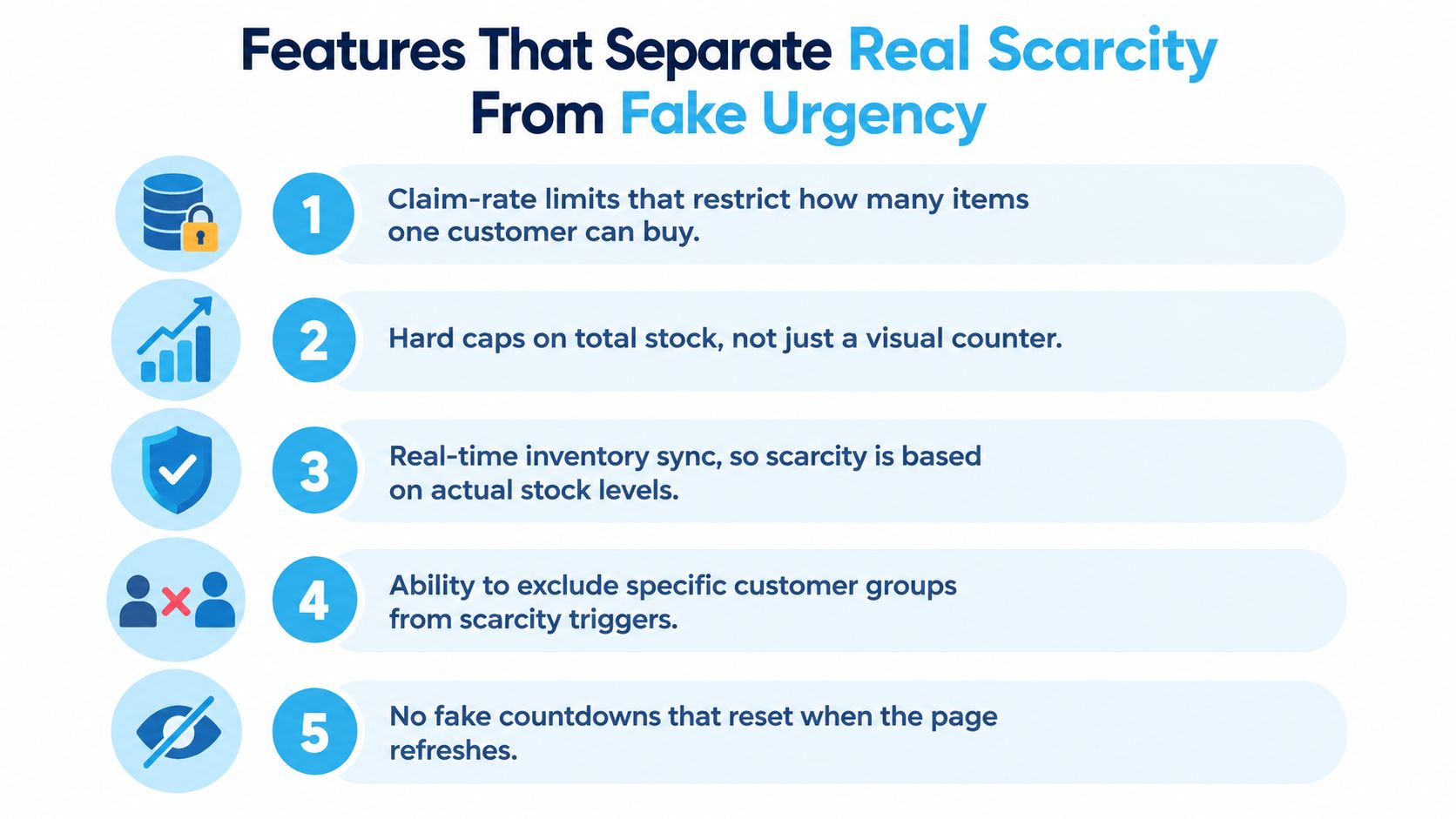
A guide to authentic Shopify urgency makes the operational point clearly: shoppers can test a timer by refreshing the page. If the offer resets, the campaign loses credibility, and future urgency becomes easier to ignore.
Setting Up a Scarcity Promotion Inside Shopify
Start with the economics, not the widget. Decide what behavior the campaign should create and what incentive the business can afford before placing anything in the theme.
Audit existing discounts first
Review active Shopify discount codes, automatic discounts, bundles, free-shipping rules, and marketplace offers. Check whether an old sitewide promotion can stack with the new scarcity reward.
Write the campaign rule in plain language. For example: the first approved claims receive the reward, one per customer, until the cap is reached. If the team can’t explain the rule without opening the app, shoppers won’t understand it either.
Fit the experience into the theme
Map the message to the product page, collection page, cart drawer, and checkout handoff. Test mobile spacing, variant selection, sticky elements, and accelerated checkout. The urgency signal should help the customer decide, not obstruct the purchase path.
Use the store’s existing typography, colors, and tone. A hard-coded badge that clashes with the theme makes a real offer look less credible.
Verify inventory and checkout behavior
Run test orders across variants. Confirm that claims reduce availability, customer limits hold, and counters update after checkout. Test refreshes, multiple tabs, and unsuccessful payments.
If the campaign uses real inventory, confirm that the app receives updates from every relevant sales channel. If it uses a claim cap, verify that the claim count changes only when the defined action is complete.
Connect the follow-up flow
Wire the campaign to Klaviyo or SMS where the customer’s behavior justifies follow-up. A waitlist member who missed a capped offer needs different messaging from a buyer who claimed it.
Keep the deadline, reward, and eligibility rules identical across every message. Don’t send an email promising access that the checkout can’t honor.
Soft launch before scaling
Start with one SKU, collection, or restock window. Watch claim behavior, fulfillment capacity, customer questions, failed payments, and inventory discrepancies.
Only expand after the operational path works. A small test can expose an unclear rule or checkout edge case before the campaign touches the full catalog.
Scarcity Versus Discounting, and Why One Protects the Brand
Flat discounting and behavior-driven scarcity answer different customer questions. A sitewide markdown asks, “How much can I save?” A scarcity campaign asks, “What do I need to do, and when do I need to do it, to secure this reward?”
That difference affects how the brand communicates value. A capped bonus can reward early action without changing the public price of every product. A tier can encourage a larger basket. A limited drop can make a launch feel distinct from the everyday catalog.
Scarcity vs Flat Discounting: Brand and Margin Impact
| Outcome | Flat Discounting | Scarcity Mechanics |
|---|---|---|
| Price perception | Conditions shoppers to expect a lower price | Keeps the listed price and limits the incentive |
| Purchase timing | Encourages waiting for the next code | Gives early action a defined advantage |
| Margin control | Applies cost broadly across qualifying orders | Caps exposure through quantity, time, or eligibility |
| Average order value | Often rewards the same behavior at any basket size | Can tie rewards to bundling or spend thresholds |
| Brand experience | Makes promotions feel routine when repeated | Creates an event when the rule is credible |
| Operational risk | Can over-redeem through broad distribution | Requires precise inventory and claim controls |
The distinction isn’t cosmetic. Research on scarcity appeals found that shoppers who failed to obtain the product could show stronger intentions to switch brands, with anger mediating that response, as reported in this marketing study on scarcity and brand switching. A capped campaign must therefore be honest about supply and prepared for the moment availability ends.
Protecting repeat demand
Flat discounts can create a purchase spike while weakening the next full-price moment. A scarcity mechanic gives the store more control over who receives the incentive and why.
That doesn’t mean scarcity automatically improves retention. The customer still needs accurate stock, clear delivery expectations, and a product worth buying again. The advantage is structural: the brand can create immediacy without teaching every visitor that the regular price is negotiable.
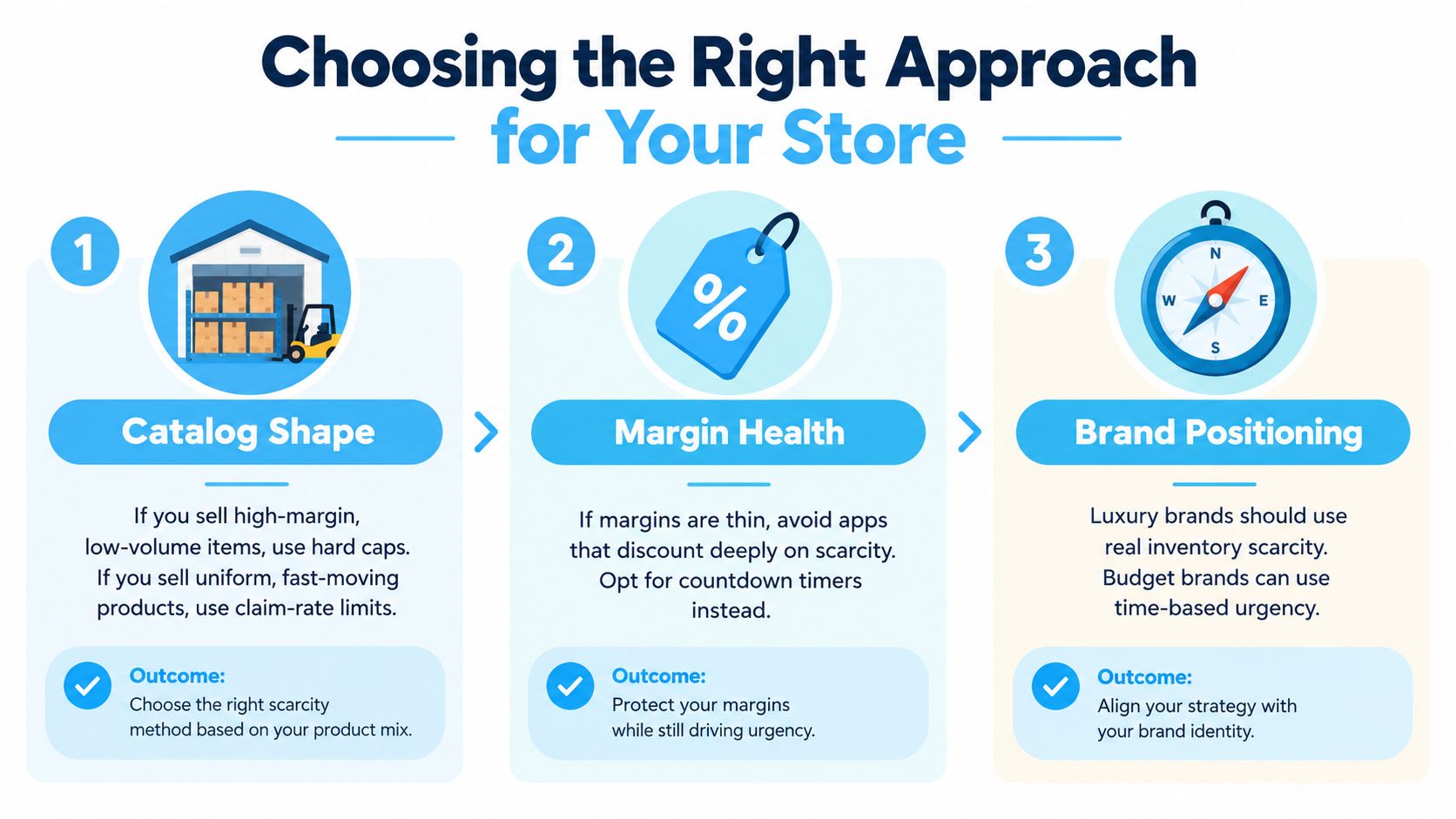
Choosing the Right Approach for Your Store
The right Shopify scarcity app depends on the store’s catalog, margin headroom, brand position, and ability to coordinate campaigns beyond the product page. Don’t choose a tool because it has the most visible timer. Choose the smallest system that can enforce the promise you want to make.
Start with catalog shape
A store built around hero SKUs and limited launches can use hard quantity caps, early access, or controlled drops. A catalog of uniform, fast-moving consumables may fit claim-rate limits and time-bound replenishment windows better.
Long-tail catalogs need careful targeting. Applying one scarcity message across slow-moving and high-demand products makes the signal less meaningful.
Check margin health
Thin-margin stores shouldn’t rely on deeper discounts disguised as urgency. Use timing, capped rewards, shipping deadlines, or access rules to create a reason to act while preserving contribution.
Higher-margin brands can experiment with tiered incentives, but every tier still needs a cost limit. Measure profit, not just conversion.
Match the brand position
Premium brands should anchor urgency to real inventory, a genuine launch window, or restricted access. A generic timer that resets on refresh is especially damaging when the brand’s promise depends on trust and craftsmanship.
Value-oriented brands can use time-based promotions, but the rules still need to be clear. Repetition turns any mechanic into background noise.
Decide how much operational complexity you can support
A lightweight limited-stock message is suitable for an initial test if it reflects actual availability. Tiered releases make sense when the catalog has clear basket-building opportunities. Multi-channel campaigns tied to Klaviyo or SMS require stronger coordination, but they can carry the same offer logic into the moments when customer intent is highest.
The Shopify App Store had more than 16,000 apps available in September 2026, and independent trackers reported even higher counts, including 26,520 total apps and 1,694 added in the prior 30 days as of September 11, 2026, according to the Shopify App Store and the verified industry context provided above. Discovery is crowded, so judge an app by enforceable mechanics, reporting, theme fit, and checkout behavior.
Scarcity is a system, not a widget. If the offer can reset, over-redeem, or contradict the inventory source, it isn’t protecting margin or trust.
Quikly lets Shopify brands run quantity-limited, time-bound, and tiered promotional experiences across the storefront, email, social, and SMS, with campaigns styled to match the store. Visit Quikly to evaluate whether capped, behavior-driven rewards can replace your next blanket markdown.
Topics: shopify scarcity app, scarcity marketing, conversion optimization, shopify apps, urgency