Most ecommerce advice treats brand value protection as a defensive legal exercise. File the trademark, monitor counterfeit listings, send cease-and-desist notices, and assume the brand itself is safe.
That misses the threat sitting inside your Shopify admin. A sitewide discount can convert today while teaching customers that your regular price is negotiable, your next promotion is predictable, and waiting is financially sensible. The operational challenge is to improve conversion without sacrificing margin, perceived quality, or the willingness to pay that made the brand valuable in the first place.
Why Your Own Promotions Are the Biggest Threat to Brand Value
More promotions don’t automatically create more growth. They can increase short-term sales, but repeated price reductions also change the customer’s frame of reference. A buyer who first sees a product at full price may regard that price as normal. After repeated markdowns, the promotional price becomes the anchor, and the original price starts to look inflated.
That’s the behavioral economics problem behind brand value protection. Anchoring and reference pricing shape what customers consider reasonable before they decide whether to buy. Each unprompted discount gives shoppers another reason to postpone a purchase, especially when your email, SMS, and homepage communicate that another offer will probably arrive soon.
A review of the brand consequences of heavy discounting should sit beside every promotion calendar. The relevant question isn’t only whether a campaign generated revenue. It’s whether the campaign strengthened the customer’s connection to the product or trained the customer to negotiate with the brand.
Short-term lift can hide long-term cost
A 2017 analysis of 126 national brands across four product categories, using five years of German panel data, found that frequent price promotions and intensive discount-store distribution negatively influenced brand equity. The harm was stronger for brands with higher initial equity levels, according to the study manuscript.
That finding changes how operators should read a promotion report. Revenue can rise while perceived quality, loyalty, awareness, and image weaken. Research summarized by Duke University describes the same trade-off, promotions can lift sales in the short term while shifting investment away from advertising, innovation, and distribution that support brand equity over time. The Duke summary of Carl Mela’s research makes the practical point clear, immediate profit isn’t a complete measure of promotion health.
Operator rule: Before approving a discount, define what customer behavior you want to create. If the answer is only “buy now because the price is lower,” the campaign is probably borrowing from future willingness to pay.
Brand value protection starts with internal governance. Trademarks and counterfeit enforcement still matter, but your own discount habits reach every visitor, subscriber, and returning customer. A brand that repeatedly teaches customers to wait can weaken its pricing power without a competitor or counterfeit seller doing anything at all.
The Four Forces That Erode Brand Equity in Ecommerce
Brand equity rarely declines for one reason. In a Shopify business, the dashboard often shows several symptoms at once, a weaker full-price conversion rate, more price objections in support tickets, inconsistent campaign performance, and lower repeat purchasing. Those symptoms usually trace back to four connected forces.
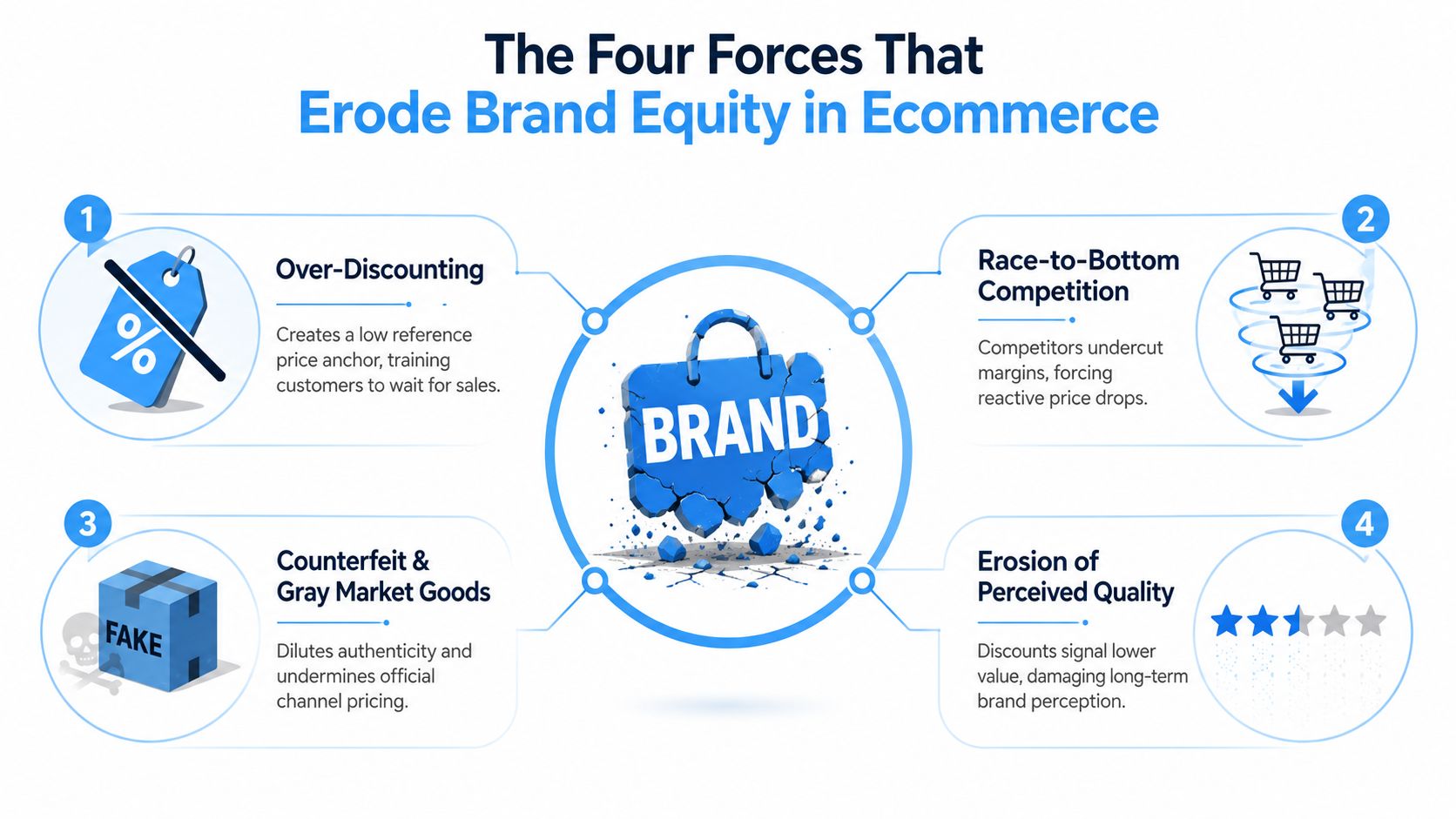
Over-discounting resets the reference price
Frequent markdowns give customers a lower comparison point. Over time, shoppers may evaluate the product against the sale price rather than the advertised regular price. The academic repository summary describes this mechanism as consumers updating reference prices downward and associating the brand with a lower-value tier.
For Shopify merchants, watch the relationship between discount exposure and full-price behavior. Review full-price conversion, the share of orders using codes, discount depth, and the time between promotions. A falling willingness to purchase without an offer is a stronger warning than a single campaign’s revenue.
Channel inconsistency creates cognitive dissonance
A loyalty email can promise access and recognition while a homepage banner presents a broad clearance message. Customers then receive conflicting signals about who the brand serves and what its products are worth. That tension creates cognitive dissonance, particularly for premium brands that rely on careful positioning.
Audit your homepage, product pages, Klaviyo flows, SMS campaigns, paid social creative, affiliate placements, and marketplace listings together. Brand value protection requires one commercial story across channels, not separate teams optimizing isolated conversion moments.
Competition and unauthorized sellers weaken trust
Competitors can undercut your price, while counterfeit and gray market sellers can create confusion around authenticity and authorized pricing. The resulting issue isn’t limited to lost sales. Buyers may question warranty coverage, product quality, delivery expectations, and whether the official store is charging too much.
Track price-comparison exits, customer questions about authenticity, marketplace listing changes, and support tickets tied to unauthorized sellers. These aren’t perfect equity measurements, but they help identify where trust heuristics are breaking down. Customers often use simple signals, official availability, consistent pricing, clear returns, and recognizable presentation, to decide whether a purchase feels safe.
Poor experience removes the premium justification
A premium price needs operational support. Slow fulfillment, unclear returns, inconsistent packaging, or a support experience that feels careless can make a higher price seem unjustified, even when the product itself hasn’t changed.
Monitor repeat purchase behavior, refund reasons, product reviews, support themes, and customer sentiment. Discounting can’t repair a trust problem caused by poor delivery or confusing policies. It may only make the next transaction cheaper while leaving the underlying reason for dissatisfaction untouched.
Why Stronger Brands Lose More From Discount Dependency
The brands with the most pricing power often have the most to lose from habitual promotions. Their customers are buying more than the physical product. They are paying for expected quality, design confidence, social meaning, service, and the conviction that the item deserves a place above cheaper alternatives.
A repeated markdown changes that decision. A brand can claim distinctiveness, then train shoppers to wait for a lower price. Each campaign makes the regular price harder to interpret. Over time, customers may treat the promotion as the true price and the listed price as a temporary obstacle.
Research on national brands found that stronger promotion intensity and intensive discount-store distribution weakened brand equity, with the negative effect more pronounced among brands that began with higher equity. The research record relates this pattern to lower reference prices and movement toward a lower-value tier.
Equity debt accumulates through shortcuts
Equity debt is the accumulated cost of promotional decisions that solve a weekly target while making the next target harder. Shopify analytics will not show it as a separate expense. It appears through weaker full-price demand, higher price sensitivity, less merchandising flexibility, and a campaign calendar that requires increasingly attractive offers to create urgency.
The operating trade-off is immediate. A percentage-off code may improve today’s conversion rate, yet teach returning customers to delay their purchase. That behavior makes forecasting harder and can force the team to use margin to recreate demand that earlier promotions helped weaken.
Deep discounting can also make product differences seem less meaningful against the market’s reference price. The Journal of Economics & Management Strategy research connects this pattern with reduced brand value, weaker manufacturer bargaining power, lower profits, and possible delisting risk in some circumstances.
Use the comparison below to define a store-specific baseline rather than importing generic benchmarks.
| Brand tier | Discount frequency | Margin erosion | Full-price conversion | LTV impact |
|---|---|---|---|---|
| Premium | Measure by campaign and customer exposure | Often more sensitive because the discount conflicts with the promise | Track against an unpromoted cohort | Review repeat purchasing by offer exposure |
| Mid-market | Compare with category and channel norms | Monitor contribution margin after fulfillment and acquisition costs | Separate new and returning customers | Compare customers acquired with and without discounts |
| Value-led | Assess whether offers reinforce or merely replace the core proposition | Track unit economics by SKU | Watch dependence on promotional traffic | Measure repeat rate after the first discounted order |
Strong brands should protect the reason customers pay
The answer is not to remove every promotion. Set rules that stop a broad price cut from becoming the default response to weak demand. On Shopify, that can mean separating new-customer incentives from returning-customer offers, limiting eligibility by product or customer segment, and reviewing exposure before another campaign is approved.
Premium brands can preserve more meaning through early access, limited availability, useful bundles, member recognition, and product education that makes the benefit easier to understand. These mechanics still give shoppers a reason to act without making the flagship item’s regular price look arbitrary.
Every promotion should fit the brand’s identity. A craftsmanship-led brand can frame a campaign around access to a considered collection. A performance brand can connect an offer to a product routine or use case. The customer should understand why the opportunity exists and still regard the regular price as credible.
Strategic Levers for Protecting Brand Value
Brand value protection becomes practical when it changes how the team plans prices, campaigns, channels, and measurement. Shopify merchants don’t need to eliminate commercial activity. They need rules that prevent every conversion problem from becoming a discount problem.
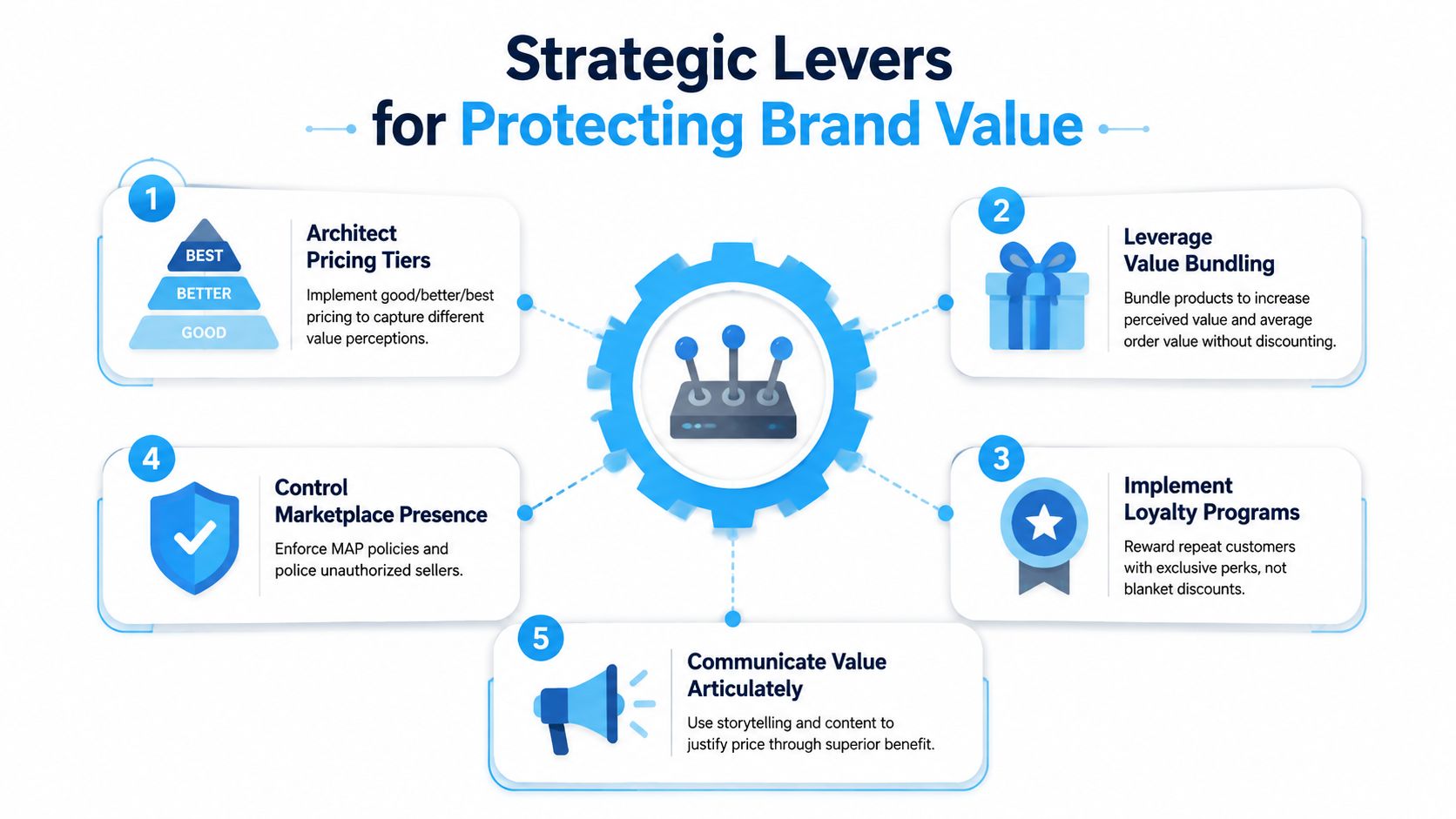
Architect pricing tiers
Give different customer needs a clear place in your assortment. A good, better, best structure lets shoppers trade up or down without forcing the entire catalog into a sale. Use Shopify product organization, variants, bundles, and merchandising blocks to explain the distinction between tiers.
Set a documented discount ceiling by category, but don’t treat the ceiling as an entitlement. Keep hero products closer to full price, use bundles to increase perceived value, and reserve direct reductions for inventory or customer situations that justify them.
Use bundles before percentage-off codes
A bundle can improve the customer’s value perception without visibly lowering the price of the flagship item. Pair a core product with a complementary item, a sample, a service, or an educational experience. Shopify’s native discount infrastructure can support bundle logic, while dedicated bundle apps can handle more complex SKU relationships.
The finance test is contribution margin after product cost, fulfillment, payment fees, and acquisition cost. A higher order value isn’t automatically healthier if the bundle contains products customers would have bought separately anyway.
Reward loyalty with access
Loyalty should feel like recognition, not a permanent coupon. Offer members early access, exclusive colors, limited products, bonus samples, or priority service. Klaviyo and SMS segments can identify eligible customers, while Shopify customer tags and discount eligibility rules can restrict access.
Brand consistency matters here because a premium experience can lose credibility when one channel uses refined language and another uses generic sale graphics. Teams that need a practical reference can review how brand consistency software works for fashion when building approval workflows across campaigns and collections.
Govern channels and marketplaces
Document who may sell the product, which assets they may use, how prices should be displayed, and what happens after a violation. MAP enforcement, reseller audits, affiliate review, trademark monitoring, and marketplace takedown processes belong in one operating policy, even if different teams own each task.
Shopify Plus merchants may have more advanced automation and organization controls, but smaller stores can still begin with shared listing audits, partner terms, and a recurring review of unauthorized price claims.
Measure equity, not just orders
Build a promotion report that includes discount depth, promotion frequency, full-price sell-through, contribution margin, repeat purchase behavior, and customer lifetime value by acquisition source. Compare customers exposed to offers with customers who purchased without them, while accounting for product, season, and channel differences.
Measurement standard: A promotion worked only when the incremental contribution justifies the margin given up and the customer behavior it teaches.
For campaigns that need stronger urgency without broad markdowns, review alternatives to discounting. The useful alternative isn’t a vague “add value” instruction. It’s a defined offer, clear eligibility, controlled availability, and a measurement plan that tells you whether the customer acted because of relevance or merely because the price dropped.
Behavior-Driven Promotions Versus Flat Discounting
Flat discounting asks every shopper to respond to the same price reduction. That makes implementation easy, but it also gives full-price customers little reason to buy now and gives deal-seeking customers a reason to wait for the next event.
Behavior-driven promotions set a different exchange. The customer receives a benefit for taking a defined action, joining early access, reaching a cart threshold, choosing a bundle, purchasing within a real availability window, or returning as a recognized member. The reward can be financial, but it doesn’t have to reduce the perceived value of the hero product.
Compare the mechanics before choosing the offer
| Approach | Margin impact | Customer behavior | Brand perception | Implementation complexity |
|---|---|---|---|---|
| Sitewide percentage discount | Reduces contribution on every eligible order | Encourages waiting for broad sale events | Can make regular pricing feel provisional | Low |
| Cart-threshold reward | Concentrates the incentive on larger baskets | Encourages considered add-ons and trade-up | Frames the benefit around basket value | Moderate |
| Bundle value | Protects the visible price of the core SKU | Encourages complementary purchases | Supports product education and use cases | Moderate |
| Loyalty access | Limits the reward to recognized customers | Encourages return behavior and membership | Signals recognition rather than desperation | Moderate |
| Scarcity-based offer | Controls exposure through real time or quantity limits | Encourages earlier decisions | Can preserve price integrity when honestly presented | Moderate to high |
Scarcity works because it changes the cost of waiting. A 2023 review of flash sales, coupons, and countdown timers describes urgency, scarcity perception, and decision fatigue as mechanisms that can move shoppers toward quicker, more impulsive decisions. Limited-time and limited-quantity offers aren’t identical, either. A PMC article on scarcity promotions distinguishes offers that end when the deadline restores the original price from offers that end when capped inventory is claimed.
The distinction matters for trust. A timer that resets without consequence is theater. A quantity limit that never changes is manufactured pressure. Real scarcity requires an operational rule your merchandising and customer support teams can defend.
Build effort into the reward
Effort justification helps explain why earned rewards can feel more valuable than automatic reductions. A customer who reaches a threshold, joins a loyalty tier, or claims a limited opportunity has participated in the promotion. That participation can strengthen the perception that the reward was earned rather than handed out.
Shopify implementation can remain straightforward. Use automatic discounts for threshold logic, unique codes for controlled segments, Shopify Flow where available for tagging and routing, and Klaviyo or SMS for eligible access windows. Keep exclusions explicit, especially for new launches, replenishment items, and products already carrying a bundle benefit.
A study of scarcity-based promotional strategies in ecommerce reported a positive effect on purchase intention, with R² = 0.554, β = 0.876, and p < 0.001, and also found that scarcity directly influenced impulsive purchasing. See the study PDF. Use that mechanism carefully. The goal is to align urgency with a genuine opportunity, not to pressure customers into a purchase that conflicts with the product’s value.
For merchants managing several active campaigns, real-time offer management provides a useful way to think about changing eligibility, availability, and messaging without treating every promotion as a permanent storewide rule.
How DTC Brands Implement Brand Value Protection
The strongest implementation examples don’t remove promotions. They change what the promotion asks customers to do and what the brand gives up in return.
Consider a premium skincare merchant preparing for Black Friday. The familiar approach would be a sitewide percentage reduction, including hero SKUs that already convert at full price. A value-protection approach could keep those products at their established price while offering a tiered gifting structure, such as a complementary product or sample provided at defined basket levels. The Shopify configuration would combine bundle or gift logic with customer-facing merchandising that explains the routine, not just the saving.
The team should judge that campaign by contribution margin, average order value, full-price hero-SKU sales, repeat purchasing, and the percentage of orders that qualified for the gift. Don’t claim the structure worked because total revenue rose. Isolate the incremental contribution and compare it with the previous promotional pattern.
Replace channel leakage with governance
An apparel brand facing unauthorized wholesale markdowns needs a different response. The operating work includes listing audits, reseller terms, MAP policy enforcement, affiliate review, and a documented escalation path. Shopify remains the source of truth for authorized product information, while marketplace monitoring identifies where customers encounter conflicting prices or incomplete product claims.
A brand team can connect enforcement activity to authorized-channel sales, price complaints, returns, and support contacts. A D2C brand tracking solution can also help teams connect campaign and channel signals when they need a broader view than Shopify’s order report alone.
Shift replenishment businesses toward continuity
A supplement merchant may be tempted to use flash sales whenever acquisition slows. A more durable structure could make subscription the central value proposition, using predictable replenishment, educational content, member access, or complementary product benefits instead of repeatedly cutting the first order price.
The decision points are commercial, not cosmetic. Define the customer action, the benefit, the eligibility rule, the margin floor, the cancellation experience, and the reporting window before launching. Shopify subscription infrastructure, Klaviyo flows, and customer tags can support the journey, but no app can compensate for an offer that lacks a clear reason to exist.
These scenarios share one principle. Brand value protection isn’t the absence of promotion. It’s the discipline of making each incentive earn its place in the customer relationship.
Your Brand Value Protection Checklist
Use this checklist before approving a campaign, updating a discount code, or onboarding a new channel. A simple yes or no answer is useful because it exposes decisions that usually remain buried in a launch brief.
- Pricing architecture: Can the customer understand the difference between your product tiers without a discount? Use Shopify collections, variants, and merchandising content.
- Discount boundaries: Is the discount ceiling documented by category and product role? Record it in the campaign brief and Shopify discount rules.
- Bundle-first logic: Did you test a relevant bundle, gift, or service benefit before reducing the hero SKU’s price?
- Behavior gating: Does the customer need to meet a meaningful condition to receive the reward? Use customer segments, cart thresholds, or loyalty eligibility.
- Scarcity integrity: Is the time or quantity limit real, visible, and operationally enforceable?
- Loyalty value: Does the offer reward recognition, access, or useful benefits instead of training every shopper to wait?
- Channel control: Have authorized sellers, marketplace listings, affiliates, and MAP compliance been reviewed?
- Message consistency: Do the homepage, product pages, email, SMS, paid media, and post-purchase messages communicate the same value proposition?
- Customer experience: Do fulfillment, returns, support, and packaging justify the price you’re asking customers to pay?
- Measurement: Will you review contribution margin, full-price sell-through, repeat purchase behavior, and customer lifetime value after launch?
Brands that institutionalize these checks compound trust and pricing power. Brands that use promotions reflexively keep teaching their best customers to wait.
Quikly helps Shopify merchants create behavior-driven promotional experiences with rewards limited by time, quantity, or both, including fully on-brand access and scarcity mechanics refined across more than 60 million consumer interactions. Visit Quikly to explore how controlled urgency can improve conversion without making deeper blanket discounts your default.
Topics: brand value protection, ecommerce branding, margin protection, Shopify strategy, discount strategy