Most brands still treat loss aversion like a blunt conversion trick, frame the offer as a missed loss, add urgency, and expect shoppers to click. That shortcut misses the part that matters in ecommerce. Loss aversion psychology isn’t a universal switch, it’s a conditional response, and if the loss doesn’t feel concrete, material, and immediate, the message just becomes another piece of promo noise.
That distinction matters because Shopify brands are under pressure on three fronts at once. Margins are thinner, standard discounts keep getting less effective, and constant urgency can train customers to wait for the next markdown instead of buying now.
Why the Standard Loss Aversion Story Falls Short
The popular version of loss aversion is tidy, memorable, and incomplete. People repeat the “losses hurt about twice as much as gains feel good” line as if it applied the same way in every checkout flow, category, and customer segment, but the research is more conditional than that.
Context defines the boundary
A 2024 meta-analysis across more than 150 studies found an average loss aversion coefficient of about 1.96, with a 95% credible interval of [1.824, 2.104] (loss aversion meta-analysis). That is a strong benchmark, and it still does not mean every shopper, every category, or every promotion will respond the same way.
The more useful takeaway is straightforward. Loss aversion is real, but it depends on stake size, framing, attention, and choice context. A symbolic urgency cue can fall flat when the consequence of waiting feels abstract. A concrete consequence, like losing access to a limited reward or watching a meaningful offer disappear, lands differently. For a broader discussion of how ownership and perceived value shape response, see this endowment effect example.
Practical rule: If the downside does not feel real, the urgency will not either.
That explains why so many “last chance” messages underperform. They create motion without consequence. The shopper sees pressure, but not enough reason to act.
People also vary a lot more than the old story suggests
A 2025 U.S. population study found that roughly 50% of adults were loss tolerant, with representative samples at 57%, 47%, and 55%, while earlier student samples in the same line of research were much lower, at 32%, 22%, and 16% (U.S. population study on gain-loss attitudes). Across eleven prior studies, the average proportion of loss-tolerant participants was only 33% in that research line.
That matters for marketers because the same message can motivate one segment and irritate another. If a brand assumes everyone reacts the same way, it ends up using urgency as a blunt instrument instead of a decision trigger.
Loss aversion works best when it is treated as a tool for specific moments, not a default setting for every campaign. That is the difference between promotions that move inventory and promotions that just add noise.
The Core Mechanism Behind Loss Aversion Psychology
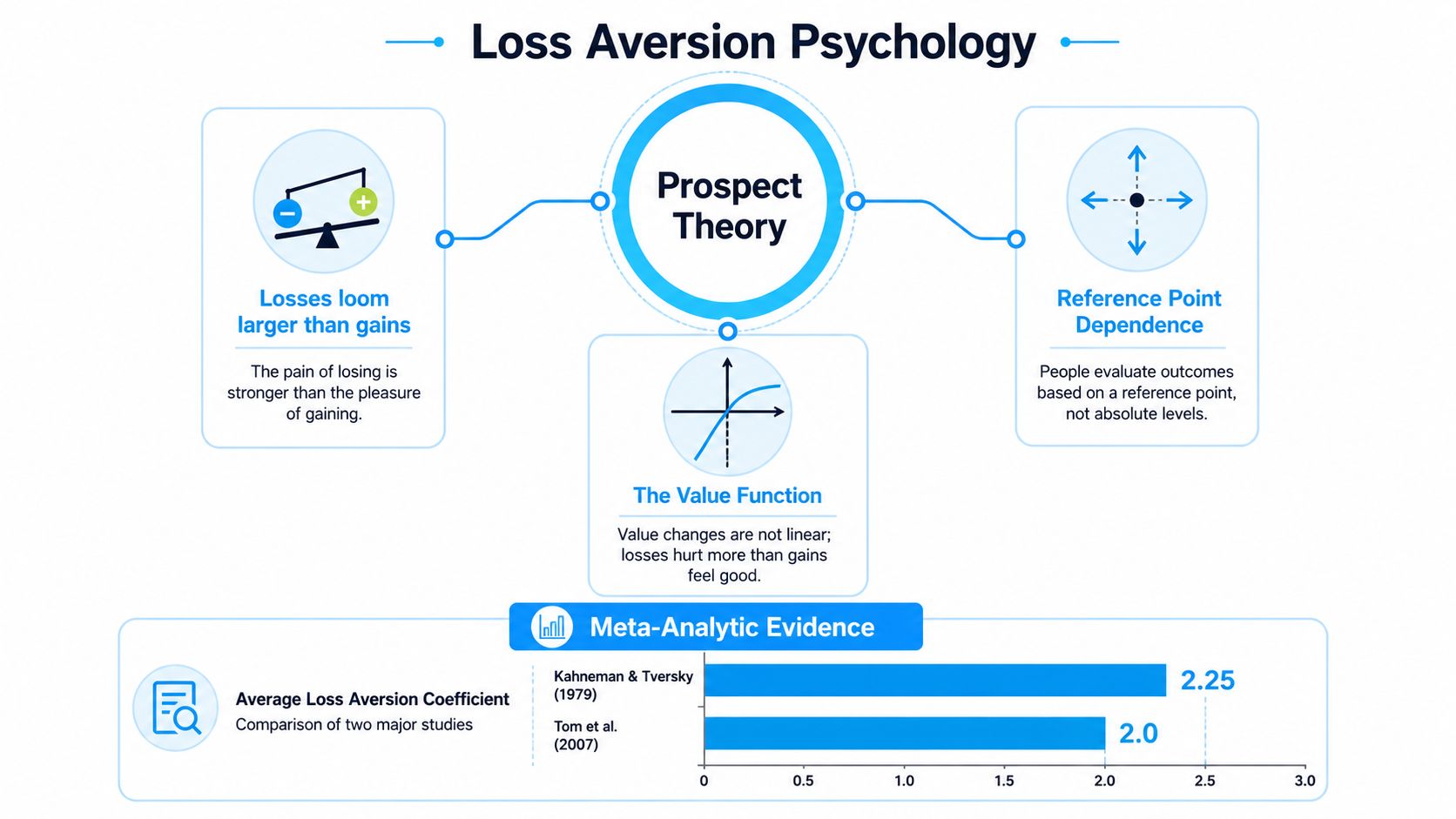
Loss aversion comes out of prospect theory, the idea that people evaluate outcomes relative to a reference point, then weigh losses more heavily than equal-sized gains. In practical terms, the mind doesn’t treat a gain and a loss as mirror images. The loss usually hits harder.
What the coefficient means for marketers
The modern benchmark matters because it tells you how the effect behaves across many studies, not just one lab setup. The average coefficient of 1.96 means that, for many decisions, a loss carries nearly twice the psychological weight of an equal gain (loss aversion meta-analysis). Earlier and related work reported a preferred mean of 1.955, which reinforces that the “about 2-to-1” idea isn’t just classroom shorthand.
For ecommerce, that shows up in a familiar pattern. A shopper often reacts more sharply to a price increase than to an equivalent price decrease. That’s why discount mechanics matter as much as discount size. A shallow, generic markdown can feel weak, while a smaller but more salient offer can create a stronger response because it changes what the shopper thinks they stand to lose by waiting.
The mechanism isn’t magic. It’s reference-point math in human form.
A promotion works better when the shopper feels they’re giving something up by hesitating.
Why this differs from a simple “more urgency equals more sales” rule
Loss aversion doesn’t reward loudness. It rewards relevance. If the shopper never mentally owned the deal, then there’s no loss to avoid, only a message to ignore.
That’s also why older ecommerce advice often misses. It focuses on persuasion volume, more banners, more timers, more calls to action, when the actual issue is whether the customer feels a meaningful downside to inaction. The behavioral change happens when waiting carries a cost they can picture, not when the page is merely crowded with urgency cues.
For a useful adjacent explanation of how ownership changes response, see this note on the endowment effect. It helps clarify why people protect what they feel is already theirs.
How Loss Aversion Interacts with Scarcity and Urgency
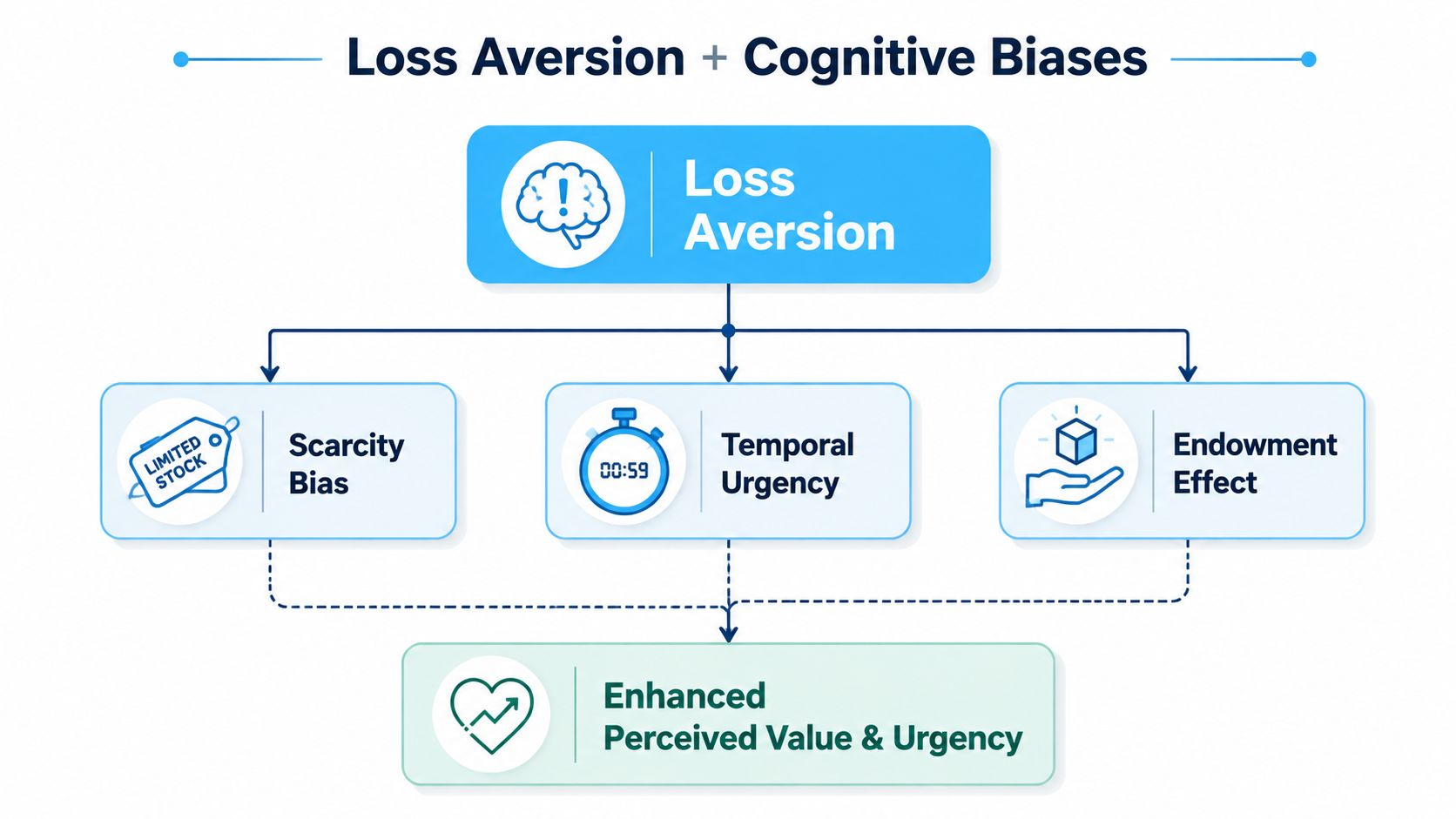
Loss aversion gets stronger when it is paired with related biases, especially scarcity bias and temporal discounting. A shopper who believes an offer is limited does not just see a deal, they see a smaller window to claim it. That changes the emotional math, because delay starts to feel like a measurable cost.
Scarcity has to be believable
A limited-quantity offer creates a different kind of pressure than a countdown timer. Quantity scarcity says that if the shopper waits, someone else can claim what they wanted. Time scarcity says that if they wait, the opportunity itself disappears. Both can work, but they do not work equally well in every category.
The key is that the loss has to feel concrete. Manufactured pressure often fails because the shopper senses the offer will probably still be there later. Real scarcity changes behavior because it changes the expected outcome of delay.
That distinction is why the best scarcity campaigns do not feel like generic overlays bolted onto a storefront. They feel native to the product and to the moment. If the offer is tied to something limited, the psychology is cleaner and the brand risk is lower.
Where urgency becomes useful, and where it just becomes noise
designing high-converting offers with Wojo Media is a practical example of how marketers think about limited-time mechanics when they are trying to align message and offer rather than just shout “act fast.” The useful lens is not pressure for its own sake. It is whether the delay changes the shopper’s outcome.
That is also where scarcity marketing deserves a careful read. The point is not to create false pressure. The point is to shape the choice so that acting now is the rational path, not just the emotional one.
In practice, the strongest urgency cues are the ones that reflect a real constraint. A restock window, a limited bundle, or a promo tied to a specific event all carry more weight than a timer that resets the next day. When the constraint is real, urgency supports conversion. When it is decorative, shoppers learn to ignore it, and the offer loses credibility.
Brands that handle this well protect three things at once. They support conversion, avoid margin-eroding blanket discounts, and keep the promotion from training customers to wait for the next offer.
Real Ecommerce Examples of Loss Aversion Done Right
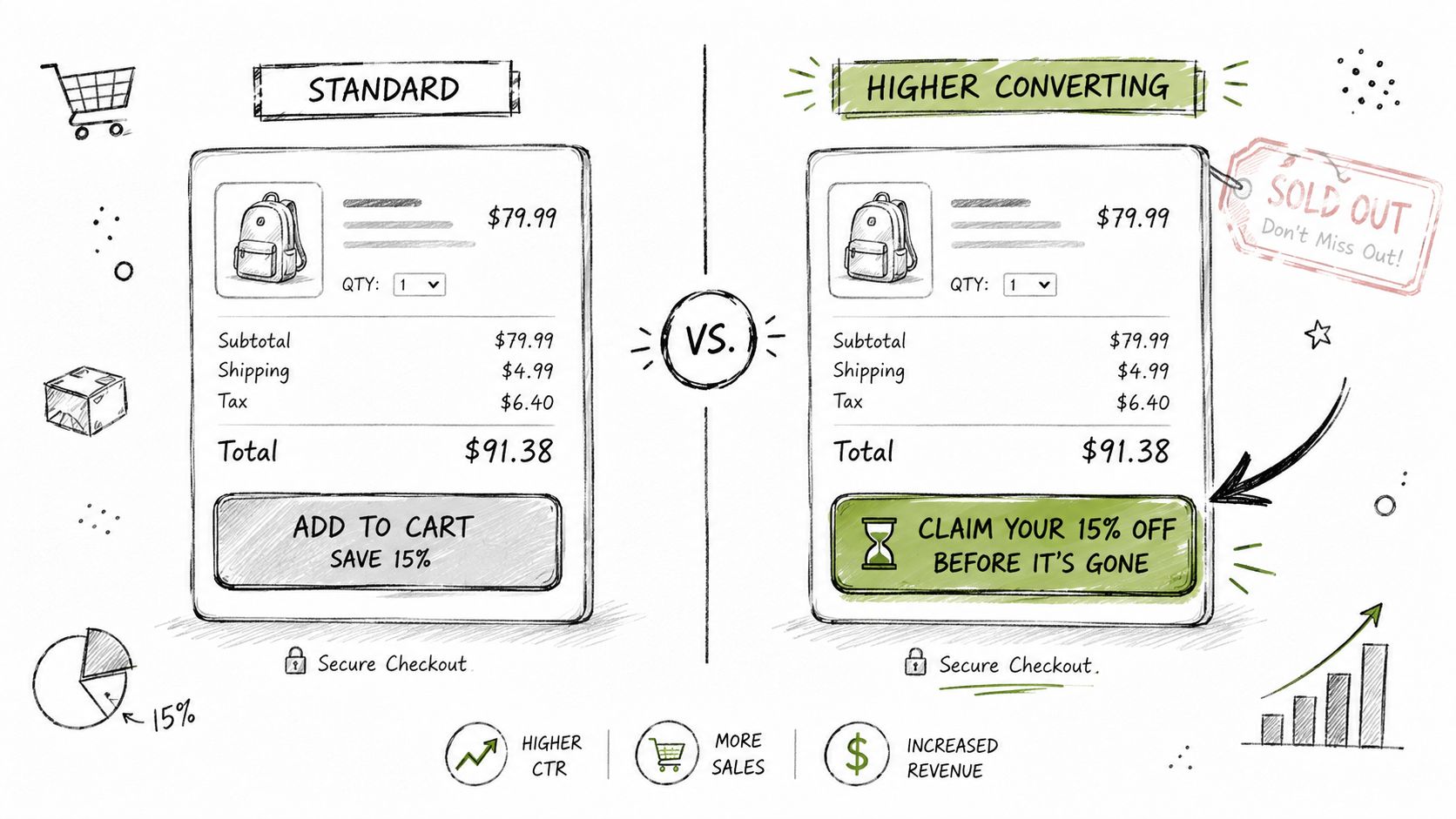
The cleanest way to see loss aversion psychology in ecommerce is to compare what happens when the offer itself carries a consequence versus when the discount is just sitting there waiting to be used. Flat codes tell shoppers they can buy whenever. Behavior-driven offers tell them timing matters.
The weak version, a discount that asks for patience
A generic promo code often does the opposite of what the brand wants. It teaches shoppers that waiting is safe. If the same code, or a better one, is likely to show up again, there’s no loss to avoid. The rational move is to delay.
That’s why the most common discount setup can erode brand perception. Customers stop seeing the offer as special and start treating it as a baseline. Margin takes the hit first, then urgency loses credibility.
The stronger version, a limited reward that punishes hesitation
A better mechanic is a reward that’s capped by time, quantity, or both. When the shopper knows the offer steps down as others claim it, or disappears when the window closes, the psychological frame shifts. Waiting now carries a cost.
That’s especially useful for Shopify brands trying to move traffic that already has intent. You’re not trying to “convince” someone from zero. You’re trying to convert a shopper who’s already close, but still hesitating. A concrete loss, like missing a tier or losing access to a specific reward, often does that job better than a bigger blanket discount.
For a practical example of this kind of promotion architecture, Quikly is one option among others. It turns a storefront offer into a time- or quantity-bound experience, and brands can style it so it feels native to the shop instead of tacked on.
Where this shows up in practice
A launch promotion can reward early buyers without giving everyone the same price. A clearance event can use descending rewards so the most decisive shoppers get the strongest offer. A cart recovery flow can remind someone what they’re about to leave behind, instead of just repeating a generic nudge.
The common thread is simple. The shopper sees an actual loss if they hesitate, not an abstract promise of savings later. That’s the difference between a promotion people participate in and a promotion they mentally file away.
If you want a deeper operational view of this idea, email automation guidance is useful for thinking about how timing, sequence, and message order affect response.
A/B Test Ideas and Implementation Guidance for Shopify Brands
The safest way to use loss aversion psychology is to test for materiality, not just wording. A message can sound urgent and still fail if the shopper does not believe the consequence. On Shopify, that means testing how the promotion feels inside the storefront, in email, and in SMS, not just whether the copy includes a deadline.
Test the frame, not just the offer
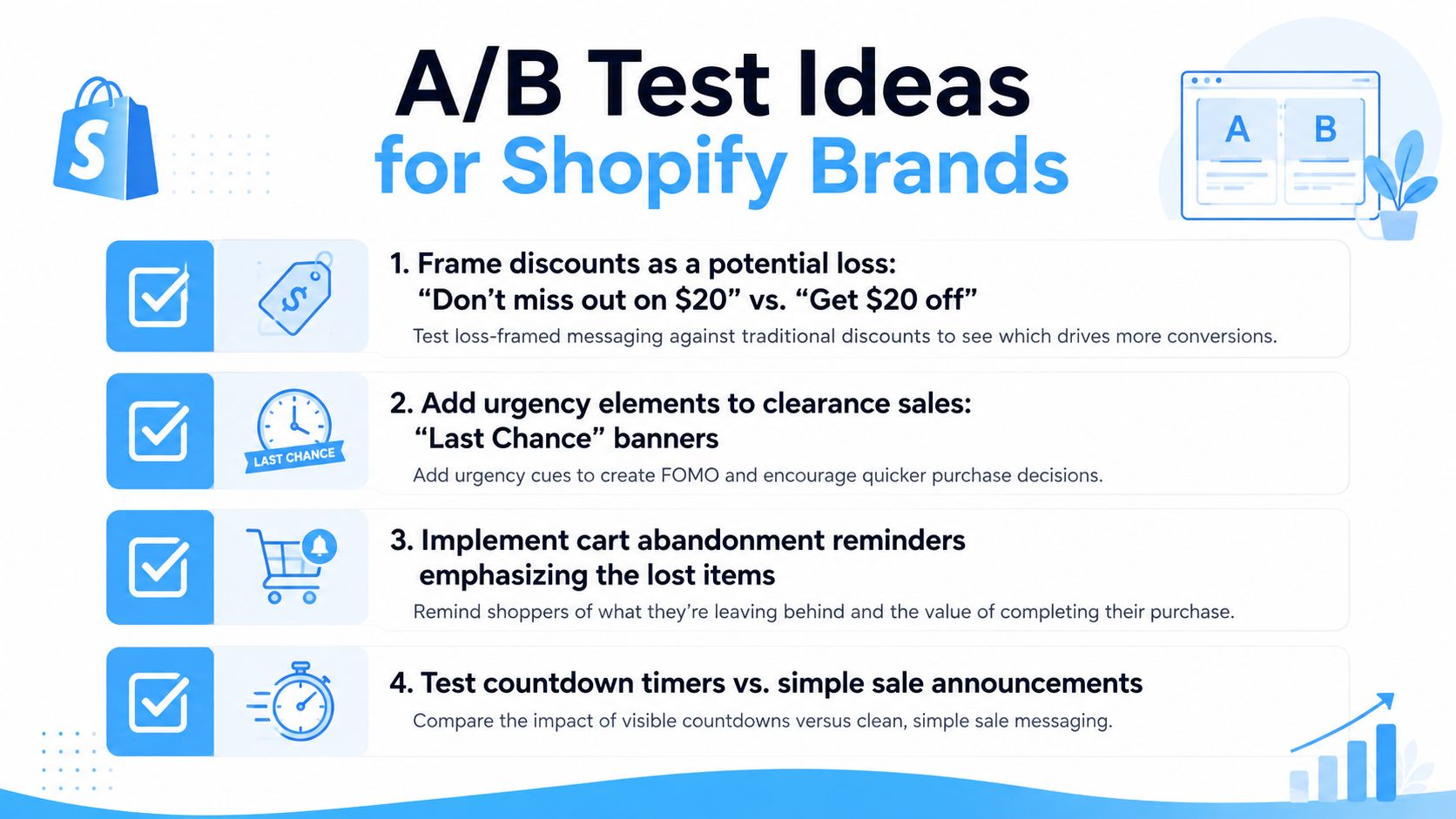
Start by comparing gain-framed and loss-framed copy. “Get $20 off” is familiar. “Don’t miss out on $20” changes the decision frame by making inaction feel like a forfeited benefit.
Then test whether quantity limits or time limits do more work for your category. Some products respond better to inventory scarcity, while others need a deadline to create enough pressure. The right choice depends on how replaceable the item feels and how much effort the shopper already invested.
A brand that sells replenishable products may see more response from a deadline. A brand with limited-edition or highly differentiated items may get more from a quantity cap, because the loss feels concrete instead of abstract.
Practical rule: Test the message that makes waiting feel costly, not the one that sounds the loudest.
Measure the right outcome
Conversion rate matters, but it is not the only number that tells the truth. Watch average order value, margin impact, and repeat behavior after the campaign. If the offer lifts conversion but conditions shoppers to wait for the next sale, you have not solved the problem, you have just bought short-term revenue.
Look at what happens after the promotion ends. If redemption spikes while future full-price purchases soften, the test may be teaching the wrong habit. A good result creates incremental revenue without training the audience to delay action.
For teams setting up the lifecycle side of that test, this email automation guide is a useful reference point for sequencing reminders without making the brand feel frantic.
Keep the experience on-brand
The storefront should feel like part of the shop, not a generic interruption. Behavior-driven promotions work better when they match the look and tone of the brand. On Shopify, the more the promotion feels embedded in the store, the less it reads like a gimmick.
Use the campaign to support the product story, not to overpower it. The goal is to make acting early feel like the natural move. That usually means clear framing, restrained frequency, and an offer structure that customers can understand without effort.
When Loss Aversion Tactics Backfire and How to Stay Ethical
Loss aversion stops working when it turns into pressure without substance. The newer research makes that plain, because the effect is conditional, not universal. If the shopper doesn’t feel a real downside to waiting, the message looks forced.
Why some shoppers push back
The same urgency cue can motivate one person and irritate another. Individual differences matter, and so do emotional states. A recent review found the literature around loss aversion and mental health is still thin and fragmented, with only a small number of topic clusters and very little work connecting depression, anxiety, suicide, and personality together (review on loss aversion and mental health).
That doesn’t mean marketers need to diagnose people. It does mean they should stop pretending urgency is psychologically neutral. For some shoppers, scarcity cues feel energizing. For others, they feel stressful or manipulative, especially when the offer doesn’t seem real.
Real scarcity is not fake pressure
A fake countdown timer is a fast way to lose trust. If the shopper sees the same “last chance” message tomorrow, your brand has taught them that urgency is theater. Once that happens, every future promotion gets less believable.
Keep the mechanism tied to something actual. Limited inventory, an expiring reward, or a clear participation cap can all support the message without crossing the line. The moment the tactic becomes a performance, it stops being a behavioral cue and starts being brand damage.
Responsible use matters because ecommerce buyers are sharp. They notice repeat patterns quickly. Brands that respect that intelligence build more durable response over time than brands that rely on manufactured panic.
Rethinking Promotions Around Behavior Instead of Discounts
The core problem in ecommerce promotions isn’t that promotions don’t work. It’s that flat, repetitive discounting trains patience, compresses margin, and weakens the brand’s price story. Once shoppers expect every offer to be available later, urgency gets harder to earn.
The better model is behavior-driven promotion, where the reward goes to the shopper who acts, not the shopper who waits. That’s the logic behind the strongest applications of loss aversion psychology, and it’s also why timing and scarcity have to be real. If you want a broader comparison of this approach, alternatives to discounting for Shopify is a useful lens for thinking about promotion design without defaulting to deeper markdowns.
What works is simple. Make the consequence of delay concrete, keep the offer aligned with the brand, and measure whether the promotion protects margin as well as it converts traffic. That’s a more durable way to grow than teaching customers to sit on their hands until the next sale.
If you’re ready to run promotions that reward action instead of patience, Quikly gives Shopify brands a way to create time- and quantity-bound offers that fit the store’s look and timing. It’s built for teams that want to use loss aversion psychology without falling back on blunt discounts or fake urgency, and it’s worth a look if you want your next campaign to move shoppers without training them to wait.
Topics: loss aversion psychology, ecommerce promotions, behavioral marketing, conversion optimization, Shopify strategy