Flat discounts are easy to launch and hard to stop. They clear inventory, but they also train shoppers to wait, which is a bad habit to build when you’re trying to protect margin and keep full-price demand alive.
That tension is everywhere on Shopify right now. Acquisition costs stay high, average order values need help, and too many promotions still rely on the same blunt tools, blanket codes, endless countdowns, and repeat sales that lose force the second customers expect them.
The better move is to use promotion techniques that create a reason to act now without turning your brand into a permanent clearance rack. The list below is built for Shopify merchants who need immediate response, but also need to think about profit, trust, and repeat buying, not just this week’s conversion spike.
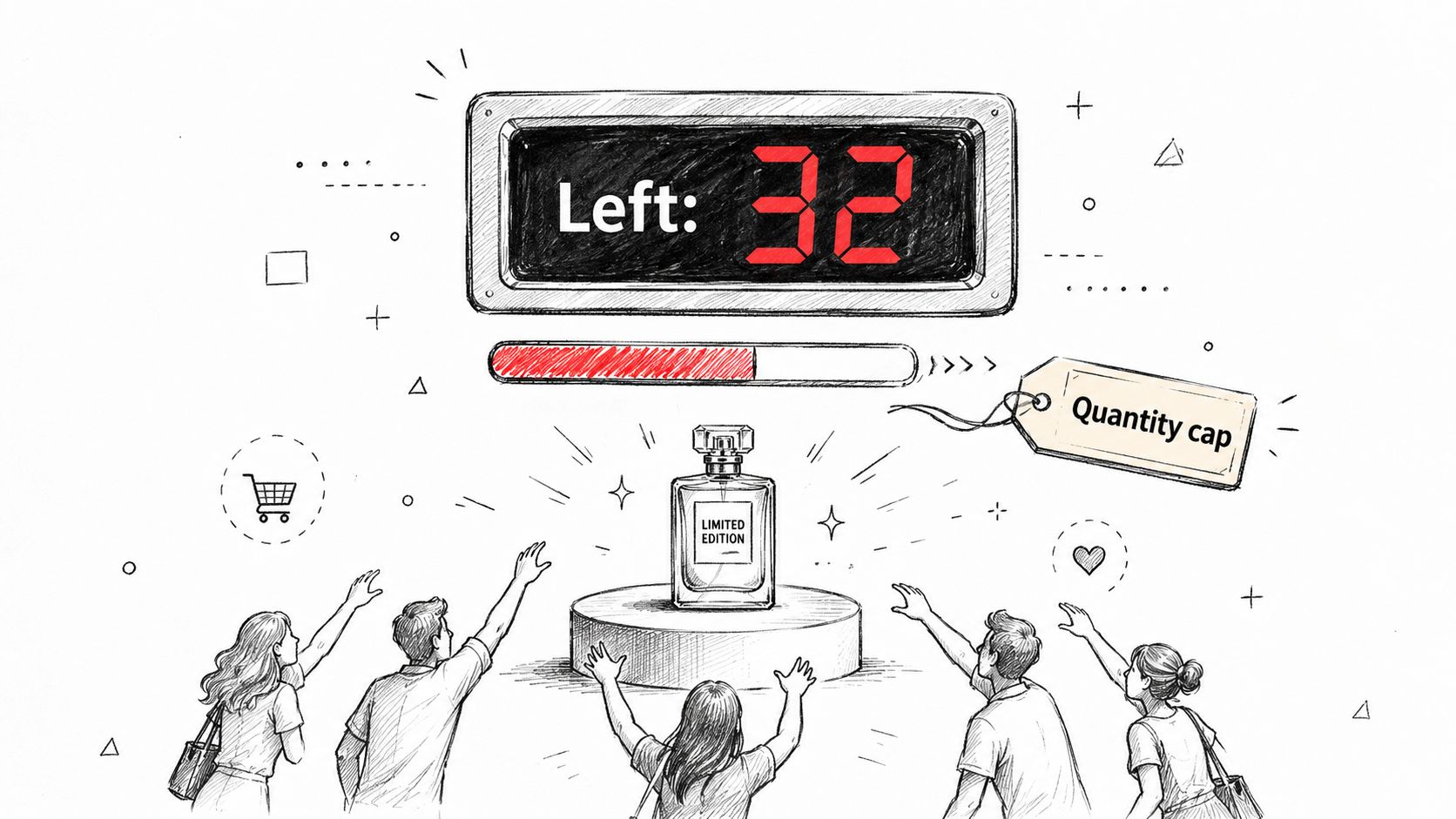
1. Scarcity-Driven Offers with Quantity Caps
Scarcity works best when it is real. A hard cap tells shoppers there are only so many claims available, which shifts the decision from “maybe later” to “buy now or miss out.”
Scarcity-based promotion has strong empirical support in e-commerce. A study of flash-sale shoppers found that scarcity score significantly predicted purchase intention with β = 0.876, t = 14.862, p < 0.001, and the model explained 55.4% of the variance in purchase intention study PDF. The takeaway for Shopify merchants is simple, a finite offer changes buying intent, not just attention.
How to use it without sounding fake
A capped promotion needs clear rules. If you say the first 200 claims get the offer, the counter has to move in a way shoppers can trust.
Practical rule: start with a conservative cap and show the remaining claims openly. If the offer is gone, it is gone.
A footwear brand can cap a 15% off reward at a fixed claim limit and close the offer when it fills. A beauty retailer can use the same cap across email, SMS, and storefront, so each audience feels like it is entering the same event, not a recycled discount.
- Announce the cap upfront: Shoppers respond better when the rules are clear.
- Show the remaining count: Visible scarcity usually works better than a vague promise.
- Keep the offer real: If shoppers see the cap reset later, trust drops fast.
- Use the same limit across channels: That keeps the promotion coherent across the store.
For Shopify merchants, this is one of the cleaner ways to create urgency without deeper markdowns. The offer can sit on your product page, in email, and in SMS, while still feeling like one finite opportunity. If you want the mechanics behind that approach, Quikly’s scarcity marketing guide is a useful companion.
2. Time-Bounded Promotional Windows with Clear Endpoints
A deadline only works if it ends. Many brands weaken urgency by extending the sale, rolling the window forward, or repackaging the same offer as if it were new.
A promotion threshold can change buying behavior, and time windows should do the same. Experimental evidence shows consumers often do not shift purchase intention until a discount crosses a category-specific threshold, then the effect levels off in an S-shaped pattern JCR PDF. A clear window gives shoppers a reason to act now instead of waiting for a better moment that never arrives.
The window has to close
A 48-hour offer, a 72-hour email-only window, or a weekend-only sale gives people a decision frame. The right window is specific enough to feel real and short enough to create pressure, but not so short that customers miss the chance to act.
A deadline you extend teaches customers to wait for the extension.
That is the trade-off. Once shoppers learn the clock is soft, they stop treating it as a reason to buy.
A fashion brand can run a weekend window that closes at midnight on Sunday. A DTC supplement brand can give subscribers a private 72-hour chance to buy, then move on without repeating the same discount. The window should tie to a real business reason, such as a product launch, seasonal shift, or inventory move.
- Announce the ending time early: People plan better when the close is visible.
- Use SMS for the final hours: That is where last-minute deciders are most reachable.
- Never roll the end date: Extensions damage trust and train delay.
- Match the window to a business reason: Real context makes urgency feel earned.
For a practical comparison of timed offers and deadline mechanics, Quikly’s guide to limited-time offers and how they differ from countdown timers is useful. If you track seasonal retail behavior, When is Sale’s Black Friday guide gives a clear reference point for how shoppers respond to event-driven selling.
3. Tiered Reward Levels That Step Down as Claims Increase
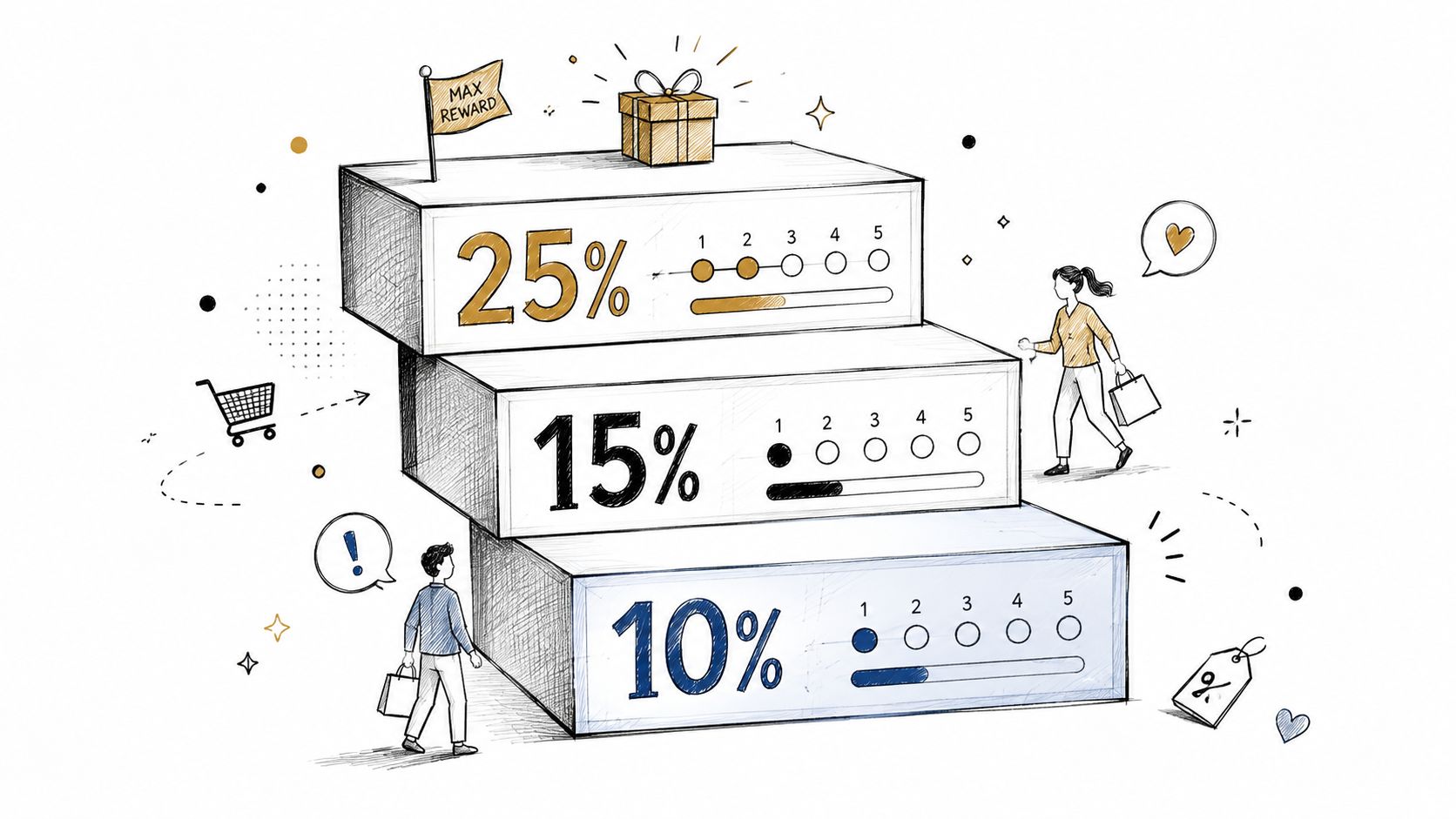
A tiered offer works well when you want speed without giving every shopper the same large discount. Early claimers get the strongest reward, later shoppers still receive an incentive, and the offer becomes less generous as demand rises.
That structure matches how people respond to scarcity and urgency. A study on scarcity and urgency messaging found increases in impulse buying, perceived product value, and purchase intention when those cues were present Canadian JMR. Tiered rewards make that pressure visible instead of hidden.
The strength of this format is fairness. If the first group gets 20% off, the next group gets 15% off, and the final group gets 10% off, shoppers can see the rule and decide whether waiting is worth it.
That matters in Shopify stores because people compare offers quickly. It also helps you avoid paying the same margin cost for every conversion.
A sportswear brand can start with a stronger first tier, then step the reward down as claims rise. A home goods retailer can show the tiers in email and SMS so subscribers know the value drops as the offer fills.
Practical rule: make the active tier visible at checkout. If shoppers can see the ladder, they understand why acting sooner pays more.
- Show live tier progress: Progress bars help shoppers see how close the offer is to the next drop.
- State the current tier clearly: No one should have to guess what discount applies.
- Use tiers to protect margin: Give the best reward early, then reduce it as demand builds.
- Keep the structure simple: Too many levels make the offer harder to trust.
This format fits brands that want urgency without turning the promotion into a clearance event. For a useful reference on tiered incentives and repeat behavior, Quikly’s loyalty program tactics shows how staged rewards can support ongoing participation.
4. Behavior-Triggered Offers Tied to Specific Customer Actions
A shopper abandons a cart, signs up for SMS, or submits a review, then sees an offer appear. That feels timely because the reward is tied to something they already did.
Behavior-triggered offers are cleaner than blanket discounts because the reward only appears after a customer does something meaningful. For Shopify brands, that matters because the action itself has value, and the offer can also collect a first-party signal you can use later.
Earned rewards outperform automatic ones
Customers usually value an offer more when the trigger is clear. The reward feels earned, and the brand gets a useful data point in the same step.
A skincare brand can offer 10% off after an SMS opt-in. A furniture retailer can raise the reward when a shopper adds two or more items to the cart, which supports average order value instead of discounting a single product.
The trigger should stay simple and relevant. A long quiz for a small reward adds friction. An email signup, a product review, or a social follow is easier to complete and easier to explain.
- Tie the reward to one obvious action: Email signup, SMS opt-in, social follow, or review completion.
- State the rule before checkout: Hidden requirements create friction and support tickets.
- Reuse the signal later: The next offer should reflect what the customer did.
- Track lifetime value: Some acquired shoppers will become stronger long-term buyers than others.
Channel choice changes the outcome. SMS works well for short, time-sensitive triggers. Email gives you more space to explain the rule and the payoff. On Shopify, the cleanest version usually fits into the normal customer journey, not a one-off campaign.
A practical test helps here. Compare a behavior-triggered offer against a plain discount, then watch opt-in rate, conversion rate, and average order value. If the triggered version converts less often but brings in better subscribers or bigger baskets, the trade is working.
5. Early-Bird and VIP Exclusive Access Windows
A VIP window works well when you want to reward loyal shoppers without giving the same deal to everyone. Give your best customers first access, then widen the offer only if you still need more volume.
The order matters. Early access lets your highest-intent audience act while urgency is still fresh, and it can produce a meaningful share of sales before the public release.
Make access the benefit
If the message is only “VIPs get 20% off,” it still sounds like a standard discount. Say subscribers or loyalty members get early access to a limited reward, and the offer feels tied to status as well as price.
A luxury beauty brand can give email subscribers a 24-hour window for the stronger reward, then open a lighter version to everyone else. A fashion retailer can let loyalty members claim the best tier first, then release the remaining inventory later with a lower incentive.
VIP access works best when the customer feels chosen, not just cheaper.
Keep the sequence clean. Send the VIP announcement through email and SMS so the right segment sees it quickly, then close that window on time so the public offer still feels separate. If the first group is left guessing, the exclusivity signal weakens.
- Lead with membership value: Frame the window as a privilege.
- Use email and SMS together: VIP windows need fast reach.
- Close the VIP window cleanly: That protects the second wave.
- Keep the public offer lighter: The early group should get the better deal.
For Shopify Plus brands with larger customer lists, this setup also gives you a controlled first wave before a broader rollout. That makes it easier to judge demand, margin, and inventory before you expand the promotion.
6. Limited-Edition or Exclusivity-Driven Promotions
A limited drop changes the offer immediately. The promotion no longer looks like a discount tactic, it looks like a chance to get something that will not stay available.
That shift matters for Shopify merchants. Buyers respond to rarity, especially when the item feels tied to a moment, a membership, or a specific brand identity.
A streetwear brand can release a limited collab and sell through at full price. A home wellness brand can launch a seasonal item with a fixed unit count and make availability the main message.
Limited editions also protect brand perception. Constant discounting teaches shoppers to wait for markdowns. Exclusivity does the opposite, it keeps the product positioned as distinct.
The execution should stay honest. If the supply is not limited, the message will backfire once customers notice. Waitlists, sold-out labels, and a clear release window help reinforce the signal because they show real activity, not fabricated urgency.
- Tell the truth about supply: Scarcity has to be real.
- Use waitlists and sold-out cues: They support the exclusivity message.
- Tie the release to a moment: Seasonal and cultural timing make the drop feel deliberate.
- Protect margin where possible: Full-price demand is the cleanest result here.
For Shopify brands, the main trade-off is clear. A smaller incentive, or none at all, can still drive action if the product is the event. That is a stronger position than training your audience to hold out for price cuts.
7. Social Proof and Real-Time Participation Signals
A live claim count, recent purchase feed, or participation counter changes how shoppers read an offer. The promotion stops looking static and starts looking active.
That matters on Shopify because people notice momentum. If others are acting now, delaying feels risky, especially when the offer is clearly tied to real demand.
A live counter works better than generic praise because it tracks the promotion itself. A testimonial block from last quarter says the product is good. A claim count shows the campaign is moving.
An electronics retailer can show how many units have been claimed. A food and beverage brand can display recent participants in a campaign feed so the offer feels alive.
Practical rule: the counter has to feel believable. If it starts at zero and suddenly jumps, shoppers notice.
Credibility comes first.
- Start with a realistic number: Early trust matters.
- Update at natural intervals: Smooth movement feels more authentic than jitter.
- Pair it with scarcity: Social proof works harder when the offer is finite.
- Use initials or anonymized names: You can show activity without exposing private data.
There’s also a behavioral angle worth using. A peer-reviewed review on sales promotion techniques notes that consumer promotion tactics include coupons, rebates, premiums, contests, point-of-purchase promotions, sweepstakes, and games, while trade promotion serves a different function Academia Nexus PDF. Live participation signals make those tactics feel current instead of decorative.
8. Gamified Reward Mechanics and Interactive Participation
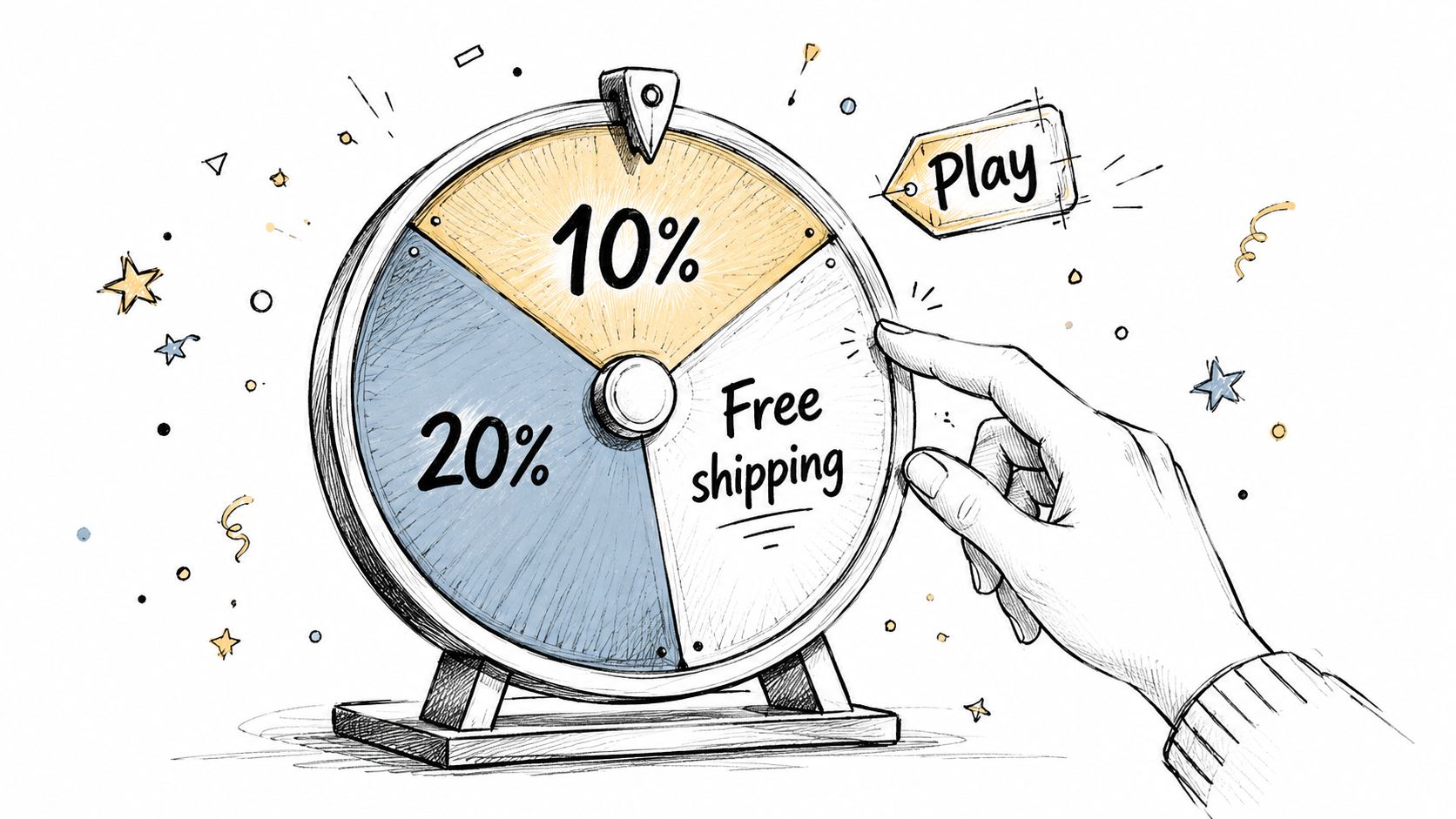
A shopper spins a wheel in email, lands on free shipping, and remembers the brand longer than the one who only saw a flat banner. That is the advantage of a small interaction. The promotion feels active, not just discounted.
Gamified mechanics work because they ask for a quick action before the reward appears. The interaction adds a bit of anticipation, and that often makes the offer feel more earned.
Keep the game simple and fair
The experience has to load fast, work well on mobile, and resolve immediately. If the interaction stutters or drags, the reward loses impact.
A fashion retailer can run a spin-to-win wheel with a few clear discount tiers. A snack brand can use a card-flip game in email that reveals an offer based on the result.
- Make the reward feel attainable: Keep the prize mix believable, not all-or-nothing.
- Tie the theme to the brand: The interaction should feel native to the store.
- Optimize for mobile first: Most shoppers will not wait for slow interaction.
- Let people share results: Screenshots and social posts can extend reach.
For Shopify merchants, the value shows up in recall and participation. Track completion rate, reward redemption, and email click-through, then test one variable at a time. Compare a wheel against a simple reveal, or test a stronger headline against a lighter one. If the mechanic lifts participation without hurting conversion quality, it is doing the job.
9. Contextual and Triggered Offers Based on Browsing or Cart Behavior
A shopper lingers on a high-ticket page, then opens the cart and hesitates. That is the moment contextual offers are meant for. They let you respond to what the shopper is doing instead of showing the same discount to everyone.
The point is practical. A browser comparing expensive items may only need a small nudge. A cart with multiple products may need free shipping, a bundle incentive, or a reward tied to order value.
Trigger the offer where hesitation shows up
A furniture brand can vary incentives by product price, while an electronics store can surface a shipping offer when someone spends time on a premium product page and does not add it to cart. The trigger matters more than the headline. If the offer appears too early, it can feel premature. If it appears too late, the shopper is gone.
Behavior data supports this approach. In an online FMCG study, percentage-off coupons increased both spending and basket size more effectively than dollar-off coupons, and a separate field study found that cart promotions increased the ratio of products added to cart by 0.41%, while coupon exposure increased it by 0.52% in the following month field study. That is not just a conversion effect, it is a change in shopping behavior.
Start simple. Use category, price tier, or time on page before you build more complex rules.
- Use product category first: It is easier to manage than a long list of micro-segments.
- Test timing carefully: Cart add, time on page, and exit intent do different jobs.
- Personalize with first-party data: Repeat customers should not get the same trigger as first-time visitors.
- Watch margin by segment: The cheapest audience is not always the right one to discount.
For Shopify merchants, the value is in reduced waste and better timing. You stop discounting shoppers who would have converted anyway, and spend the offer where hesitation is real. Track trigger rate, redemption rate, and conversion by segment, then A/B test one change at a time, such as timing or offer type.
10. Multi-Channel Coordinated Promotions with Channel-Specific Rewards
A Shopify promotion gets stronger when each channel carries a different part of the job. Email can explain the offer, SMS can drive the final nudge, social can create awareness, and the storefront can show the live mechanic. Channel-specific rewards keep that system from collapsing into one blunt discount.
Spreading one margin hit across more surfaces compounds the cost. A better setup gives each channel its own purpose and its own incentive. To unify your growth with cross-channel marketing, keep the message consistent while letting the reward vary by channel.
Make each channel do one job
Email works well for the full terms. SMS is better for urgency or a last reminder. Social can seed the promotion before launch, while the storefront carries the active offer or tier.
A beauty brand can run a 48-hour promotion with email delivering the main reward, SMS handling early access or the final reminder, and the storefront showing the limited-quantity mechanic. A sportswear retailer can tease the promotion on Instagram, explain it in email, and use SMS for last-minute conversion.
- Use one campaign ID: Attribution stays readable.
- Stagger the timing: Tease, explain, then close.
- Train support teams: Channel-specific questions will come in fast.
- Benchmark each channel separately: Email, SMS, social, and onsite should not be judged by the same yardstick.
For Shopify merchants, the payoff is cleaner control. You keep one campaign moving across multiple surfaces without forcing every audience into the same code or the same moment. Track trigger rate, redemption rate, and conversion by channel, then A/B test one variable at a time, such as reward type, timing, or the order of delivery.
10-Point Promotion Techniques Comparison
| Tactic | Implementation complexity | Resource requirements | Expected outcomes | Ideal use cases | Key advantages |
|---|---|---|---|---|---|
| Scarcity-Driven Offers with Quantity Caps | Medium, needs real-time counters and forecasting | Inventory tracking, UI counter, cross-channel sync, analytics | Immediate purchases until cap, preserved margin, finite conversions | Limited stock launches, margin-sensitive promotions | Authentic scarcity, prevents discount fatigue, margin control |
| Time-Bounded Promotional Windows with Clear Endpoints | Low–Medium, scheduling and countdown UI, timezone handling | Scheduling tools, countdown timers, clear comms across channels | Concentrated traffic, deadline-driven conversions, clear measurement windows | Flash sales, seasonal events, email/SMS blasts | Real deadline urgency, breaks perpetual-sale expectations |
| Tiered Reward Levels That Step Down as Claims Increase | Medium–High, tier logic, live updates, pricing controls | Dynamic pricing, tier UI, inventory/margin modeling, automation | Rapid early uptake, broader conversion across claimants, capped top-discount exposure | High-volume launches, promotions balancing fairness and urgency | Rewards speed, converts late-comers, transparent and fair structure |
| Behavior-Triggered Offers Tied to Specific Customer Actions | Medium, trigger logic and UX clarity required | First-party data, automation, UX changes, integration with email/SMS | Increased list growth/LTV, earned-perceived rewards, better targeting data | List building, cart recovery, onboarding flows | Builds owned channels, higher perceived value, data capture for personalization |
| Early-Bird and VIP Exclusive Access Windows | Medium, segmentation and staged timing management | CRM segmentation, targeted channels (email/SMS), timing coordination | Higher early conversion, two-wave sales, rewarded loyalty | Loyalty programs, subscriber exclusives, premium brand launches | Rewards repeat customers, premium perception, concentrated high-intent sales |
| Limited-Edition or Exclusivity-Driven Promotions | High, product development and supply-chain coordination | Product design, limited production, marketing storytelling, inventory control | Strong brand perception, social buzz, sell-through at higher margins | Collaborations, lifestyle/fashion drops, seasonal collections | Drives urgency without deep discounts, protects brand value |
| Social Proof and Real-Time Participation Signals | Medium, real-time data and accurate UI required | Real-time analytics, live counters/feeds, privacy considerations | Increased trust and urgency, momentum-driven conversions | High-visibility campaigns, new product drops, social promotions | Powerful behavioral trigger, validates offers, encourages sharing |
| Gamified Reward Mechanics and Interactive Participation | High, game design, UX and technical build | Frontend development, UX design, reward weighting, analytics | Higher engagement and dwell time, shareability, variable conversion lift | Engagement-focused campaigns, email activations, social campaigns | Memorable experience, increased engagement, richer data capture |
| Contextual and Triggered Offers Based on Browsing or Cart Behavior | High, personalization logic and integrations | Behavior tracking, product categorization, conditional offer engine | Reduced discount waste, higher AOV, targeted conversion lift at hesitation points | High-ticket items, cart abandonment recovery, personalized merchandising | Precision targeting, margin protection, highly relevant messaging |
| Multi-Channel Coordinated Promotions with Channel-Specific Rewards | High, cross-platform coordination and tracking | Cross-channel integration, creative variations, attribution/tracking | Broader reach with controlled margin exposure, measurable channel ROI | Major launches, omnichannel retailers, brand events | Amplified reach, channel-specific margin control, cohesive event perception |
Putting Behavior-Driven Promotions into Practice
The worst promotion strategy is the one that chases every sale with the same blunt discount. It feels active in the moment, but it conditions your customers to wait, and it leaves you with less margin each time you need to repeat it.
A better plan is to choose one promotion technique and test it against a clear baseline. Start with conversion rate, but don’t stop there. Track margin impact, average order value, and whether the offer is creating an immediate spike that disappears as soon as the campaign ends.
That last point matters because repeated promotion exposure can train bad behavior. If customers learn that every sale will come back, urgency collapses. If they see genuine scarcity, clean deadlines, or earned access, they have a reason to act without assuming they can always wait.
For Shopify merchants, the strongest next step is usually a controlled A/B test. Compare a flat discount against a quantity cap, a timed window, or a tiered reward. Keep the creative constant where you can, change only the mechanic, and watch what happens to both response and profit.
You don’t need to rebuild your whole promo calendar at once. A single behavior-driven campaign can show you whether urgency, scarcity, or earned access fits your category better than another blanket sale. If you want to make that test feel on-brand instead of bolted on, Quikly is one option built for time- and quantity-bound Shopify promotions that reward early action while keeping the experience inside the store’s own look and feel.
Quikly helps Shopify merchants run urgency and scarcity promotions that are time-bound, quantity-bound, or both, so shoppers have a reason to act now instead of waiting. If you want to test promotion techniques that protect margin while still driving immediate action, visit Quikly and see how those mechanics can fit your next campaign.
Topics: promotion techniques, ecommerce promotions, Shopify DTC, urgency scarcity, conversion optimization