The most popular product-description advice is also the least useful: list the features, add a keyword, paste in the specifications, and move on. That approach may fill a Shopify product page, but it leaves the shopper to do the hard work of deciding whether the product fits their life, solves their problem, and deserves its price.
Strong product descriptions work harder. They reduce uncertainty before a shopper reaches for a discount code, clarify fit before a return happens, and give an in-market visitor a reason to act while intent is high. For brands facing shrinking margins, weak conversion, and promotion fatigue, how to write product descriptions is a merchandising question, not a branding exercise.
Why Most Product Descriptions Fail to Convert
A product description isn’t SEO filler beneath the images. It’s part of the sales mechanism.
Unclear or incomplete product information causes 20% of failed purchases, according to CXL’s ecommerce copy guidance. That failure can show up as hesitation, a support question, an abandoned cart, or a purchase that later becomes a return. In each case, the page failed to answer a question the shopper needed answered.
Baymard’s benchmark makes the competitive standard clear. 90% of the largest ecommerce sites maintain a high standard of quality and consistency in product descriptions, while 10% still fail to provide consistently detailed copy (Baymard benchmark summary). Detailed copy is now a baseline expectation on leading storefronts. Sparse text doesn’t look minimalist when competitors provide clear comparisons, use cases, dimensions, and material information. It looks incomplete.
The cost of making shoppers wait
Weak descriptions create three commercial problems at once.
- Conversion remains insufficient: You can pay for qualified traffic through Meta, Google, email, or SMS, then lose the sale because the page doesn’t explain why this product is the right choice.
- Margins come under pressure: When copy fails to resolve hesitation, merchants often reach for a blanket discount. That may create movement, but it teaches shoppers to wait for the next offer.
- Brand perception softens: Generic manufacturer language makes a differentiated product sound interchangeable. Once products feel interchangeable, price becomes the easiest comparison.
Consumers already treat product content as a major purchase input. 87% rate product content as extremely or very important, and 50% have returned products because the item didn’t match its description, according to SmartCircuit’s product-description analysis. The practical lesson is simple: specificity protects both conversion and expectation-setting.
The role of copy has also expanded beyond support. In independent reporting on product-experience research involving 8,736 consumers across six countries, 52% said detailed product descriptions influence buying decisions, compared with 49% citing a discount or deal (the published research report). Reviews led at 53%, placing detailed descriptions near the top of the information shoppers use before purchase.
Operator’s rule: Before adding another promotion, check whether the page has answered the buyer’s primary objection.
A better description can’t solve poor pricing, weak product-market fit, or a broken checkout. It can prevent a preventable problem, the shopper never understanding the value well enough to buy without being bribed.
Research Your Buyer Before Writing a Single Word
The fastest way to write generic copy is to start with the product. Start with the buyer instead.
Demographics rarely tell you enough. A useful buyer snapshot captures the job the product performs, the situation that triggers the purchase, the alternatives under consideration, and the concern that could stop the order. A shopper buying a travel backpack may care less about “600D polyester” than whether it fits beneath a seat, protects a laptop, and stays comfortable during a long connection.
Build the snapshot from customer language
Use the evidence already inside your business. Reviews, support tickets, product questions, returns, social comments, and post-purchase surveys reveal the phrases customers use when they describe the problem in their own words.
Look for patterns such as:
- Repeated desired outcomes: Customers may say they want a jacket that “works for office and weekends,” not a jacket with “versatile styling.”
- Recurring objections: Questions about sizing, charging, cleaning, allergies, compatibility, delivery, or durability belong in the copy when they affect purchase confidence.
- Comparison language: Buyers often explain what they tried before and why it disappointed them. That contrast can become your most useful positioning.
- Usage moments: Note where and when people use the product. “For small kitchens” is more actionable than “space-saving design.”
Don’t copy every customer phrase into the page. Use the language to identify the underlying motivation, then write it in a way that fits your brand and remains factually defensible.
Separate page objections from supporting content
Not every question belongs in the main description. Put decision-critical information close to the value proposition, especially anything involving fit, compatibility, safety, performance, or intended use. Move secondary details into specifications, shipping information, care instructions, reviews, or a dedicated FAQ.
A practical workflow looks like this:
- Collect the evidence: Pull recurring phrases from reviews, tickets, and conversations.
- Group the friction: Sort them into fit, function, quality, price, maintenance, and trust.
- Choose the primary job: Complete the sentence, “This product helps this buyer ___.”
- Identify the alternative: Note the competing product, workaround, habit, or reason to postpone.
- Write the page priority: Select the benefit that resolves the strongest motivation or objection.
- Assign the rest: Decide what belongs in bullets, specifications, reviews, or FAQs.
The final snapshot should fit on a page your merchandising team can use. Include the buyer, primary job, desired result, proof available, biggest objection, and exact words worth testing.
For a deeper behavioral lens, this consumer psychology in marketing guide offers useful context for understanding why shoppers respond to reassurance, proof, and action cues.
This research phase also prevents a common margin mistake. If the page speaks to everyone, it persuades no one strongly enough. Clear qualification can reduce low-fit orders, protect customer expectations, and make your strongest buyers less dependent on a discount.
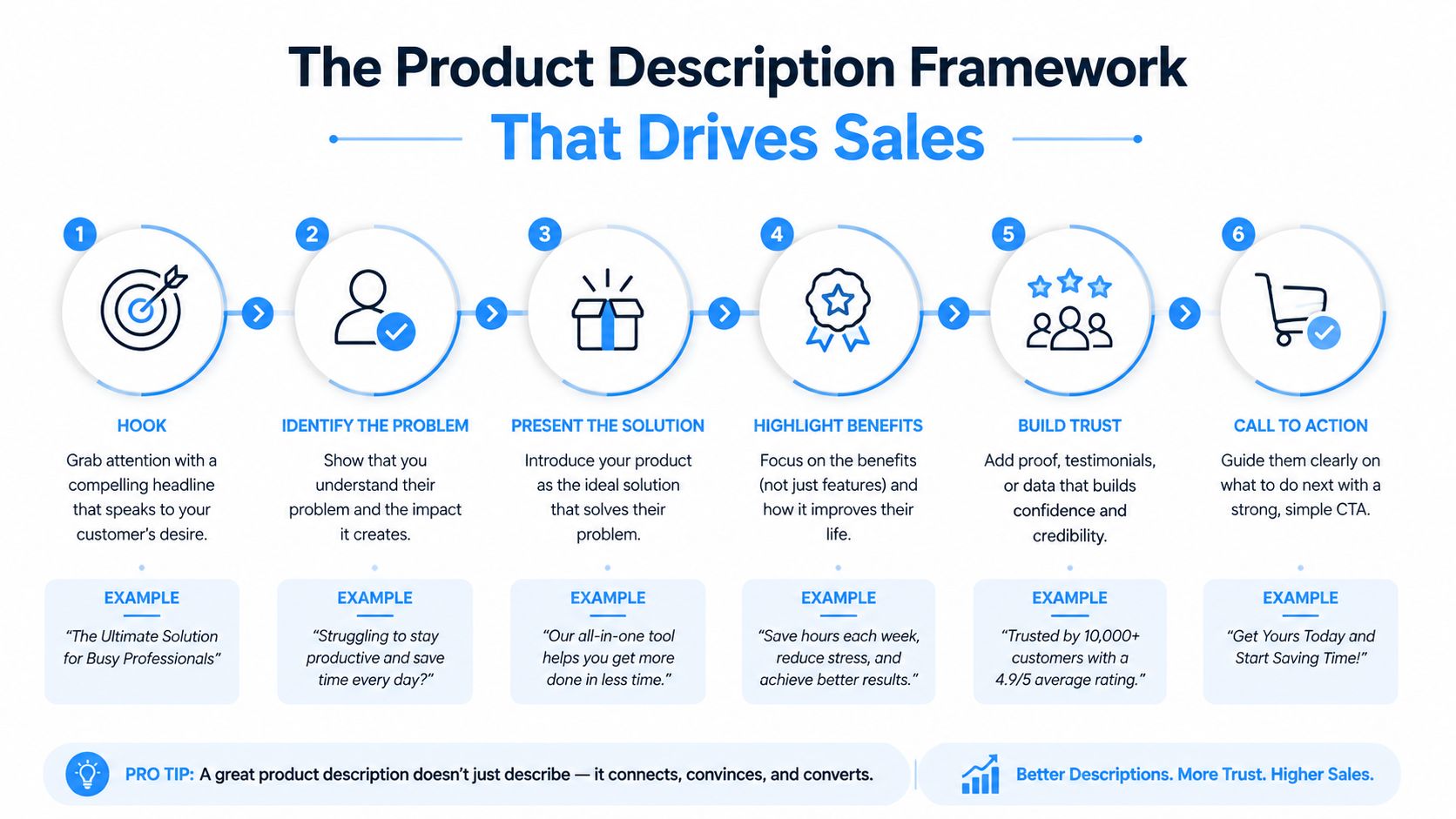
The Product Description Framework That Drives Sales
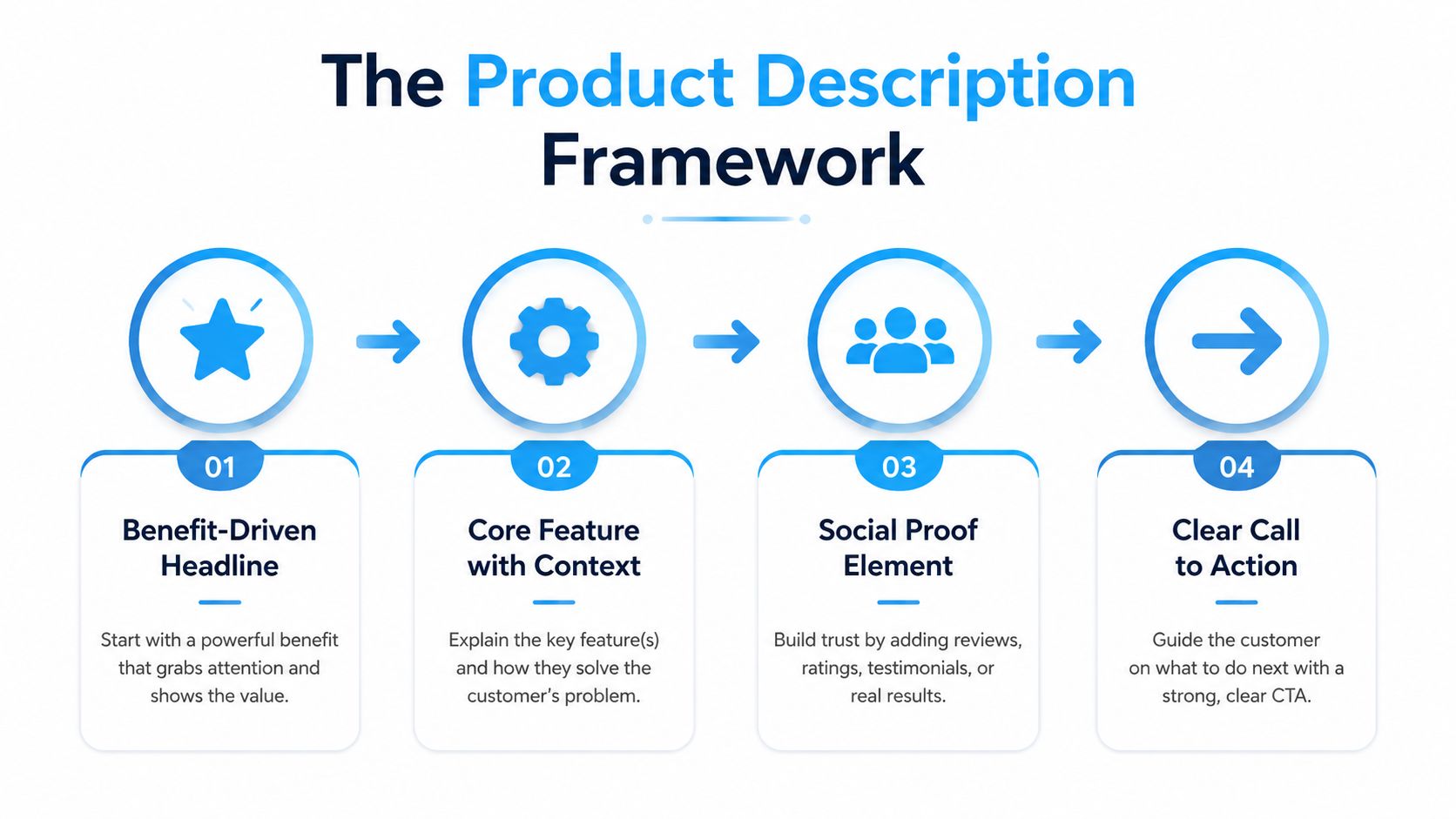
A reliable product description gives each block a distinct job. The headline earns attention, the opening establishes value, the bullets support scanning, the narrative builds context, and the specifications remove practical uncertainty.
Independent ecommerce guidance commonly recommends a structure of headline, short benefit statement, bullets, expanded story, and specifications. It also suggests keeping standard products around 150 to 300 words, with complex or high-ticket products around 300 to 500 words (the ecommerce description framework). Treat those ranges as working guidance, not a quota. The right length is whatever lets a qualified shopper decide confidently without forcing them through repetition.
Give every block one job
1. Benefit-driven headline
Name the product and connect it to the primary outcome. “Merino travel cardigan for cool cabins and late dinners” gives more direction than “The Classic Cardigan.” Keep the primary search phrase natural, but don’t turn the headline into a string of keywords.
2. Opening value statement
Answer “Why should I care?” immediately. State who the item is for, what it helps them do, and the most important outcome. The first sentence should earn the next sentence.
3. Scannable benefit bullets
Use bullets for the facts shoppers compare quickly. Pair a feature with its practical meaning:
- Temperature-regulating merino: Helps the wearer stay comfortable across changing indoor and outdoor conditions.
- Packable construction: Folds easily into a travel bag without taking up unnecessary room.
- Care details: Gives the buyer a clear view of washing and maintenance before purchase.
4. Expanded story
Use the paragraph section to explain the product in use. Show the context, sensory experience, design decision, or brand reason behind the item. You help the shopper imagine ownership, but every emotional claim should remain anchored in a real product detail.
5. Specifications block
Put dimensions, materials, compatibility, contents, care, and other technical information in a clearly labeled area. High-intent shoppers often look for these details after the benefit has captured attention. Hiding them in dense prose makes comparison harder.
6. Proof and objection handling
Use reviews, ratings, fit notes, guarantees, FAQs, or verified product evidence where they resolve doubt. Don’t use social proof as decoration. A review about comfort belongs near apparel fit concerns. A compatibility answer belongs near the relevant feature.
A feature dump fails because it forces the shopper to translate attributes into benefits. Pasted supplier copy fails because it doesn’t explain your product’s specific fit or differentiate your offer. Keyword stuffing fails because it makes the page sound written for a crawler rather than a person.
For merchants working across categories, the same benefit-first discipline applies beyond ecommerce. This guide to writing book summaries is a useful reference for turning raw information into a clear, engaging explanation without burying the central point.
On Shopify, keep the structure visible on mobile. Use short paragraphs, bolded key benefits, expandable specifications where appropriate, and a layout that lets a shopper understand the product without relying entirely on images. The description should support the theme, not disappear inside it.
Integrating Urgency and Scarcity Without Eroding Trust
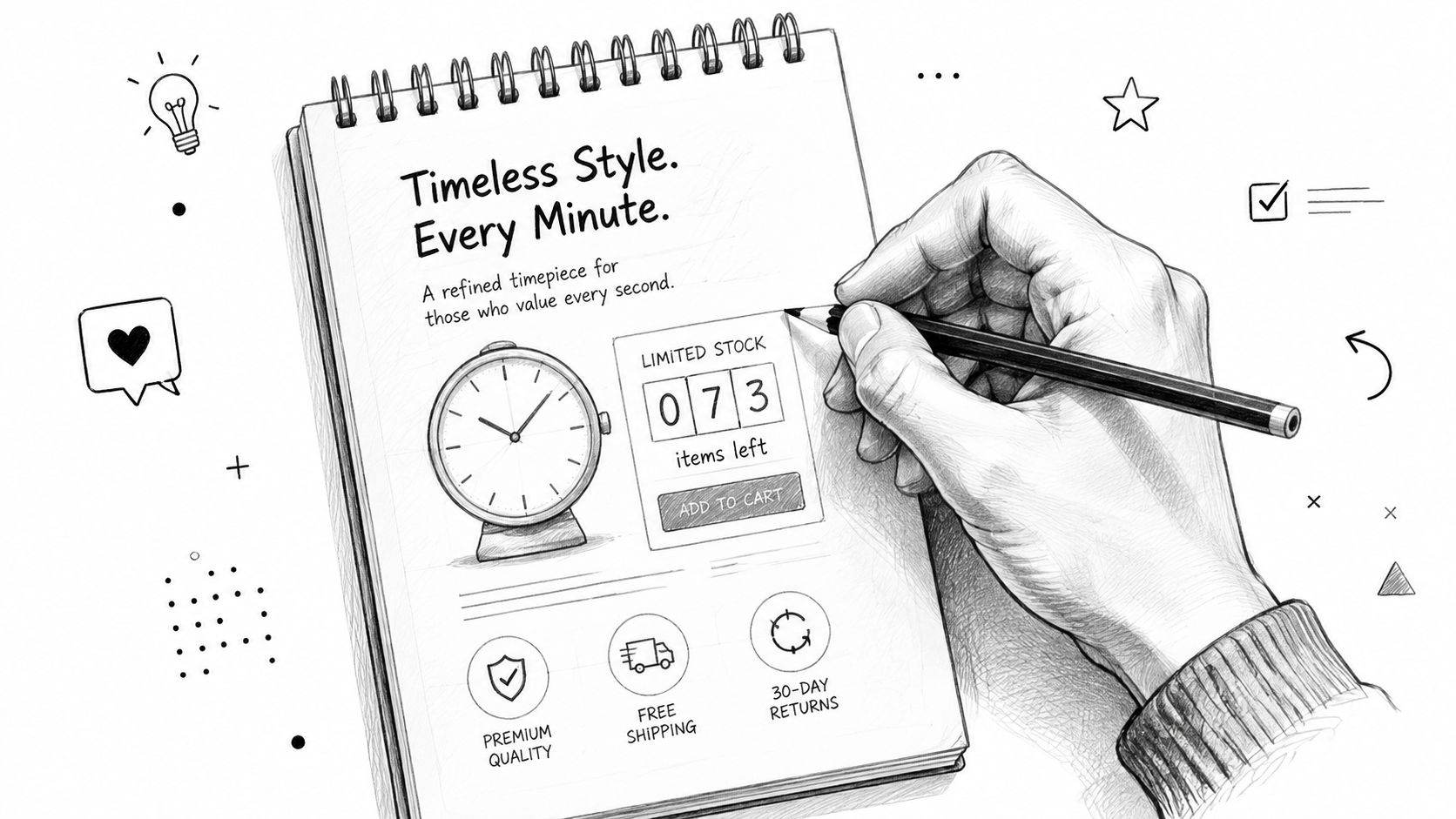
Urgency belongs in product merchandising when it reflects a real reason to act. It becomes corrosive when every page claims that the offer ends soon, every timer resets, and every product appears to be vanishing from inventory.
Scarcity bias explains why limited availability can increase attention. Loss aversion makes the possibility of missing a benefit feel more significant than an equivalent gain. Temporal discounting means shoppers often value an immediate benefit more than a comparable benefit delayed into an uncertain future. Those principles can inform copy, but they don’t excuse invented limits.
Translate real constraints into clear copy
Use language that tells shoppers what is limited and what action preserves access:
- Limited quantity: State that a particular stock allocation is available while supplies last.
- Time-bound access: Explain when an offer closes, provided the deadline is genuine and enforced.
- Exclusive eligibility: Clarify who can claim the offer, such as subscribers, members, or shoppers completing a specified action.
- Tiered reward: Tell customers that acting earlier provides access to a stronger reward when the promotion changes as claims are made.
The copy should answer three questions: What do I receive, why is it limited, and what happens if I wait? Avoid theatrical language that adds pressure without information. “Only a few left” is useful only when the inventory status supports it. A basic countdown that restarts for every visitor can damage trust even if it creates short-term clicks.
Research supports the underlying mechanics. One consumer-behavior study reported a positive effect for scarcity, β = 0.26, p < .001, and for urgency-based marketing, β = 0.19, p = .003 (the scarcity and urgency study). Separate research found that perceived scarcity can prompt urgency-driven behaviors such as hoarding and hiding, meaning limited availability can change how consumers behave, not merely how interested they feel (the perceived scarcity research).
Trust test: If a customer screenshots the offer and returns later, will the explanation still make sense?
Behavior-driven promotions differ from blanket discounting because they reward action rather than simply announcing a lower price. Quikly can turn an existing Shopify promotion into an experience constrained by time, quantity, or both, with rewards delivered across the storefront, email, social, and SMS. Its mechanics have been refined across more than 60 million consumer interactions, according to the publisher’s product information. The important copy implication is that the description can explain the reason to act without training every shopper to wait for a permanent markdown.
For more detail on applying the principle responsibly, see this scarcity marketing guide. Keep the promotional message subordinate to the product value. Urgency should help a ready buyer decide, not compensate for unclear merchandising.
Category-Specific Examples and Templates
The framework stays consistent, but the buyer’s uncertainty changes by category. Apparel shoppers need confidence about fit and context. Electronics buyers need compatibility and use-case clarity. Home-goods shoppers often need dimensions and care information, while consumable buyers look for ingredients, experience, and replenishment details.
| Product Category | Primary Focus | Key Elements | Typical Length |
|---|---|---|---|
| Apparel | Fit and lifestyle use | Fabric feel, cut, sizing, occasion, care | 150 to 300 words |
| Electronics | Function and compatibility | Core use case, setup, compatibility, battery or power details, included items | 300 to 500 words |
| Home goods | Size and practical ownership | Dimensions, materials, room context, assembly, care | 150 to 300 words |
| Consumables | Quality and repeat use | Ingredients, flavor or scent, preparation, intended use, replenishment details | 150 to 300 words |
Apparel
Weak: “High-quality cotton shirt with a relaxed fit and classic design.”
Stronger: “A breathable cotton shirt with room through the body for easy movement, designed to take you from workday layers to weekend wear. The relaxed cut keeps the silhouette comfortable without making it look oversized.”
The stronger version leads with use and fit. Add exact measurements, model sizing, fabric composition, and care instructions in bullets or specifications. Don’t call the fabric “premium” unless you can explain what makes it so.
Electronics
Weak: “Advanced wireless earbuds with great sound and long battery life.”
Stronger: “Compact wireless earbuds for commutes, calls, and focused listening. The charging case keeps the pair ready between uses, while the built-in microphone supports hands-free conversations. Check the compatibility details below before ordering.”
Follow with the exact device compatibility, connection method, controls, charging information, and what comes in the box. Technical shoppers punish vague claims because they can’t tell whether “wireless” means the same thing as the device they own.
Home goods
Weak: “Beautiful handmade ceramic vase for your home.”
Stronger: “A hand-finished ceramic vase sized for a small table, bedside surface, or narrow shelf. Its softly textured exterior gives a simple stem arrangement a finished look without overwhelming the room.”
Dimensions should appear early enough to prevent poor-fit orders. Include opening size, weight, materials, drainage details if relevant, and cleaning guidance.
Consumables
Weak: “Delicious small-batch coffee made from quality beans.”
Stronger: “A smooth, medium-roast coffee for everyday brewing, with a balanced profile suited to pour-over, drip, or French press. Use the tasting notes to choose the cup you prefer, then check the preparation guidance for the best starting point.”
List origin, roast or formulation details, ingredients, allergens, size, storage, and expected use. Don’t use “delicious” as proof. Give the shopper information they can evaluate.
A reusable template can stay simple:
- Headline: Product name plus primary outcome.
- Opening: Who it’s for and the job it performs.
- Benefits: Three to five feature-to-outcome bullets.
- Context: How it fits into the buyer’s routine.
- Proof: Review theme, material evidence, or product-specific reassurance.
- Specifications: Facts needed for comparison.
- Action cue: A clear next step that reflects the offer.
For a low-complexity product, condense the story. For an expensive or technically demanding item, expand the objections and specifications. More words don’t create more value unless each sentence removes uncertainty or strengthens the product’s case.
Testing and Measuring Description Performance
Writing product descriptions becomes a commercial discipline when you connect copy changes to business outcomes. The first metric to watch is product-page conversion, but it shouldn’t be the only one. A description that raises orders while increasing returns or forcing deeper discounts may be a poor trade.
Test one decision at a time
Start with the element closest to the shopper’s decision:
- Opening benefit: Compare a feature-led opening with a clear outcome-led statement.
- Bullet order: Put the most important buying criterion first, then assess whether shoppers progress further.
- Objection handling: Add fit, compatibility, care, or usage guidance where support questions recur.
- Urgency language: Test a truthful, specific constraint against no urgency message.
- Specifications placement: Compare visible details with an expandable block for secondary information.
Run a controlled comparison where possible, keep the rest of the page stable, and document the exact copy shown to each audience. If you change the headline, images, price, offer, and description simultaneously, you won’t know what caused the movement.
Use the sample size calculation guide before treating an early result as a decision. A test needs enough comparable exposure and a consistent measurement window to separate a meaningful pattern from normal variation. Avoid stopping just because one version looks better after a short period.
Measure the margin, not only the click
Track product-page conversion alongside average order value, return rate, discount usage, support questions, and gross margin contribution. A successful description should help the right shoppers buy with clearer expectations. If returns rise, inspect whether the copy overstates performance or buries constraints. If support questions remain high, identify the missing answer rather than adding more promotional language.
Heat maps and scroll-depth tools can show whether shoppers reach the narrative, bullets, and specifications. Treat those signals as diagnosis, not proof of persuasion. A shopper may scroll past a section because the answer was obvious above it, or because the page made the section difficult to read.
Measurement principle: The strongest product-page test improves the quality of the order, not merely the number of clicks.
Review results by product type and traffic source. Email shoppers may arrive with more context than paid social visitors. A technical product may need more specification engagement than an impulse-friendly accessory. Keep a change log, promote winning patterns into your Shopify template, and retest when your product, audience, or promotion changes.
The objective isn’t to make every page longer or more aggressive. It’s to make each page more useful at the point where a shopper decides whether the product deserves money, attention, and trust.
Quikly helps Shopify merchants add time- or quantity-bound promotional experiences to product-page journeys, email, social, and SMS without relying on another blanket markdown. Visit Quikly to see how behavior-driven offers can give ready shoppers a reason to act while your product description does the work of proving value.
Topics: product descriptions, ecommerce copywriting, Shopify product pages, conversion copywriting, SEO product copy