The most common SMS advice is to send more promotions and find a safe weekly frequency. That misses the harder question for a Shopify brand: did the message create profitable demand, or did it discount a purchase that would have happened anyway?
A sound SMS marketing strategy starts with permission and ends with margin. It uses texts when customers have a relevant reason to act, then measures orders against the cost of the offer, messaging and lost subscribers, not clicks alone.
What a Working SMS Strategy Covers
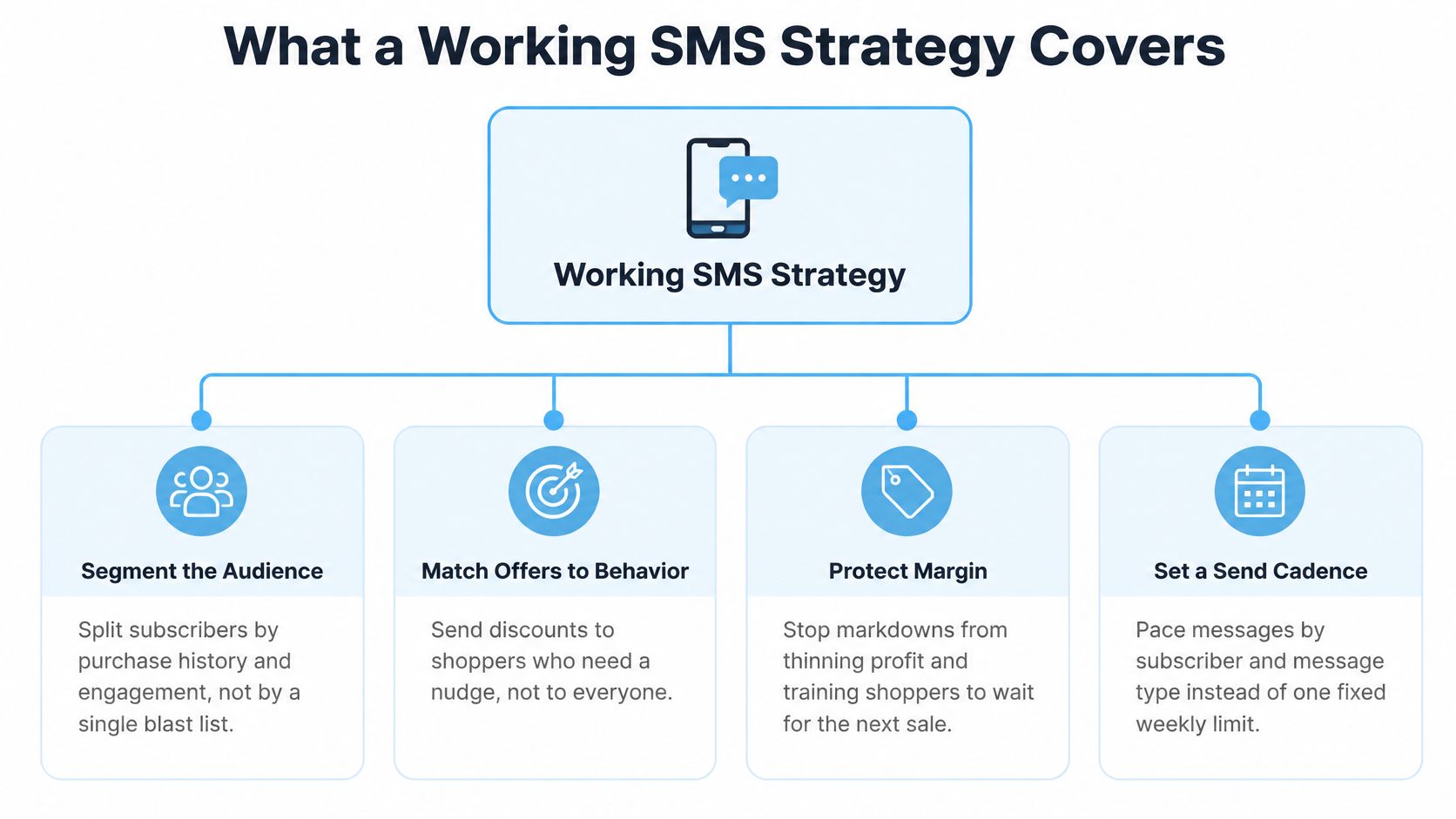
A discount sent to every subscriber can lift sales today and still make the program weaker tomorrow. It thins margin, teaches shoppers to wait for another markdown, and can turn a direct channel into a stream of clutter. SMS has a practical advantage: it doesn’t require an app, social account or mobile data connection, so a relevant message can reach customers across a wide range of devices. The channel’s reach is useful only when the recipient has agreed to hear from you and the message earns its place.
A working SMS marketing strategy is a connected set of decisions, not a tool for sending blasts. This map shows what each decision controls and where a Shopify operator can manage it.
| Program part | Decision it settles | Where it lives in Shopify |
|---|---|---|
| Consent and capture | Who may receive texts and how you prove it | Checkout and account opt-in, stored consent records |
| List growth | Which signups are worth adding | Checkout, order confirmation and shipping update opt-ins |
| Segmentation | Who receives which message | Customer tags, order history, lifecycle segments in your SMS app |
| Automated flows | Which messages fire without a manual send | Welcome, abandoned checkout, post-purchase and replenishment flows |
| Campaigns | Which one-time sends are worth making | Launches, restocks and time- or quantity-bound offers to opted-in shoppers |
| Frequency and timing | How often and at what local time to send | Frequency caps and send windows in your SMS app |
| Measurement | Whether a send made money after costs | Click rate, placed-order rate, net contribution after discount, messaging cost and opt-outs |
Build the foundation before the campaigns
Start with consent records and measurement design. Then build automated flows, followed by one-time campaigns. That order matters: a campaign is only as sound as the permission records underneath it, and a performance report is only useful if it measures a defined outcome.
Before sending, choose an attribution window and calculate net contribution consistently. A practical formula is attributed revenue minus discounts, messaging costs and refunds, with opt-outs tracked as a separate cost to list health. Later, compare those outcomes with a control group rather than assuming every order after a text was caused by it.
Consent Rules by Market Before You Capture a Number
The US rule that catches merchants off guard is that consent belongs to one seller at a time. Under the FCC’s one-to-one consent rule, prior express written consent for marketing robocalls or robotexts applies to a single seller, not a collection of sellers. The signup must identify your business, and the texts you send must be logically and topically related to the website or context where the shopper opted in.
That means a phone number collected on a brand’s Shopify checkout isn’t permission for a partner to promote its own products. Keep the signup language specific to the seller and the messages the subscriber will receive. If you can’t show that link later, the number sits on your list as a risk rather than a buyer.
| Market | Consent standard | What the signup must show |
|---|---|---|
| United States | Express written consent tied to one seller | Seller name, promotional nature, frequency, message and data rates notice, STOP opt-out, links to terms and privacy |
| European Union (GDPR) | Freely given, specific, informed, unambiguous | Separate unticked choice, withdrawal as easy as opt-in |
| Canada (CASL) | Express consent, or narrowly defined implied consent | Record of which consent type each subscriber gave |
| Australia (Spam Act) | Express consent, or inferred consent in limited cases | Stored proof of how and when consent was given |
Make the record usable across markets
One international signup form rarely satisfies every market it collects from. Wording that passes in the United States can still fail a GDPR-style requirement for an unticked, unambiguous choice, and a Canadian subscriber on implied consent needs a different record than one on express consent. Set the signup copy per market, or collect the strongest version everywhere.
Keep a separate record for each subscriber. If a customer changes country, don’t assume the original consent language still covers the texts you plan to send.
- Capture the number with its consent source, such as checkout or an account form.
- Timestamp the opt-in so the record shows when permission was given.
- Store the wording version displayed at signup.
- Record the country associated with the subscriber.
- Suppress opt-outs the same day across your sending tools.
- Recheck consent after a market change before sending promotions.
Growing a List That Stays Opted In
A bigger SMS list isn’t automatically a better list. Unclear permission can increase compliance and deliverability risk without adding customers who want to buy. The opportunity is still real: 86% of consumers said they opt in to receive business text messages in EZ Texting’s 2025 Consumer Texting Behavior Report, based on 1,074 respondents surveyed in November 2024 (EZ Texting’s report announcement). The practical challenge is asking clearly and at the right moment.
Use signup points where customers understand the exchange:
- Ask when the reason is obvious. Checkout, order confirmation and shipping updates give shoppers context. A prompt on arrival can feel like a toll before they’ve seen any value.
- Name the message type and frequency. Tell people whether they’re signing up for promotions, restock alerts or both, and how often you expect to text.
- Leave the choice unticked. The customer should actively select SMS consent rather than inherit it by default.
- Offer a concrete benefit. Early access to a restock or a claim window on a limited run gives the signup a clear purpose. Then deliver what you promised.
- Confirm the opt-in. Identify the brand and explain how to stop future messages.
- Never import purchased or scraped numbers. A phone number isn’t marketing permission.
- Review signup sources monthly. If one source repeatedly produces opt-outs, change or remove that prompt.
For more ways to make the exchange clear at signup, use this guide to growing SMS subscribers. Three subscribers who understand why they’re signing up are more valuable than ten who were collected through a vague prompt.
Segmenting Subscribers by What They Have Already Done
Segmentation decides whether a text feels relevant enough to click or irrelevant enough to unsubscribe. Build a few useful Shopify-native groups first, then add behavior from your SMS platform.
- New subscribers who haven’t bought: use the checkout opt-in tag on the customer record.
- First-time buyers: group them by product category from order history, so a follow-up reflects what they purchased.
- Repeat buyers: use their average time between orders to set a replenishment window.
- Lapsed customers: identify customers with no order in 90 days and send one reactivation message rather than the regular promotion.
Add a behavior layer in your SMS app. Subscribers who clicked one of their last three texts can receive a limited-claim offer; subscribers who never click should move to a lower frequency cap. A preference question at signup, such as restocks or new arrivals, gives you an especially direct signal because the subscriber has told you what they want.
Use these Shopify customer segmentation examples to shape groups around actions, not assumptions. A segment earns its place only when it changes the message, offer or send time. If it’s too small to produce a readable test, merge it with a similar group rather than drawing a conclusion from noise.
Where Each Earns Its Place
Automated flows and broadcasts do different jobs, and the performance gap between them is wide. Across more than 246 million campaign sends by over 27,000 brands, 2025 benchmark figures put the average SMS campaign click-through rate at 12.39%, against 20.34% for automated flows; conversion ran 0.12% for campaigns versus 0.78% for automated messages, and flows had the lower delivery rate at 92.8% against 96.6% (sms.to’s SMS marketing statistics).
Those averages are not targets for every Shopify category. What they show is why context changes what a send earns: a welcome, abandoned checkout, post-purchase or replenishment text arrives after the customer has acted, so the message has a reason to exist. A broadcast has to manufacture that reason with the offer itself, which is why the same subscribers treat the two types so differently.
| Metric | Broadcast campaign | Automated flow |
|---|---|---|
| Average click-through rate | 12.39% | 20.34% |
| Conversion rate | 0.12% | 0.78% |
| Delivery rate | 96.6% | 92.8% |
| Best use | Launches, restocks, time-bound offers | Welcome, abandoned checkout, post-purchase, replenishment |
Match the message to the moment
Build the core flows first: welcome, abandoned checkout, post-purchase and replenishment. Confirm each trigger is tied to a real customer event and that the copy reflects what happened. A cart reminder pointing at the wrong product throws away the contextual advantage the flow is built on.
Use broadcasts for launches, restocks and offers with a genuine time or quantity limit, sent to subscribers whose purchase history or engagement makes the offer relevant. Judge each send on net contribution: what it returns after the discount, the messaging cost and the opt-outs it causes. A blast that needs a deep discount to convert can lose money even while its click rate looks strong.
Texting also creates a service expectation. In a 2025 survey of 1,800 U.S. consumers, 53% reported that a business failed to reply after they contacted it by text, according to Textmagic’s consumer SMS survey. If your number accepts replies, assign a named owner, set an automated acknowledgment and establish a staffed handoff. A promotional channel that invites questions needs a path to answer them.
Why a Fixed Cadence Misleads
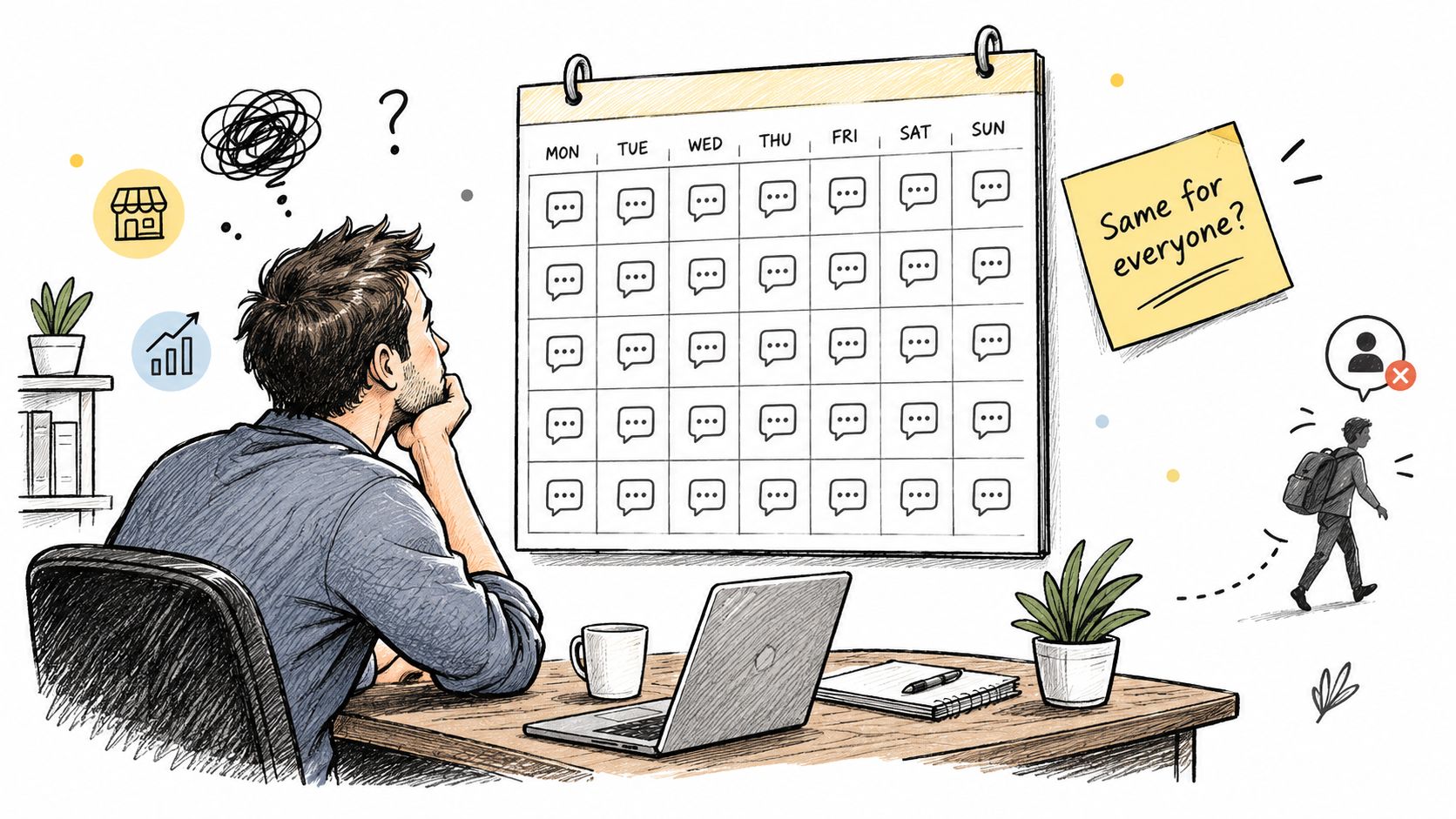
“How many texts can we send each week?” sounds like a useful planning question, but a fixed cadence treats every subscriber, message and send time alike. That’s how a helpful alert turns into noise. A 2025 benchmark cited a 22.5% unsubscribe rate for conversations initiated in the evening, while mid-afternoon produced the lowest unsubscribe volume (TrueDialog’s 2025 SMS benchmarks). A badly timed send costs you twice: once in weak contribution on the campaign itself, and again in a list you paid to build getting smaller.
Timing alone doesn’t decide whether a message is welcome. In Klaviyo research conducted with Recharge, 65% of consumers who made an SMS-attributed purchase during the previous year said they bought the item earlier than planned because of a promotional text message (Klaviyo’s SMS marketing research). A specific reason to act can move a purchase from later to now. A recurring blast with an always-available discount gives the customer less reason to decide and more reason to wait. You pay for the send either way.
Pace by relevance, not habit
Set frequency caps per subscriber, not just per campaign. Schedule messages in the customer’s local time, suppress people contacted in the last few days, and lower the cap for subscribers who never click. A customer waiting for a restock and a customer who ignored several unrelated offers shouldn’t receive the same sequence. The cap is a consent budget, and every message you send draws on it.
Scarcity bias can make a real limit more salient. It can’t make a fictional one trustworthy. If the text says the offer ends at a certain time or only a set number of claims are available, the storefront, email and SMS should agree. Real limits help customers act on a genuine choice; manufactured countdown pressure teaches them to doubt the next message. Judge each send on what it adds after the discount, the messaging cost and the opt-outs it risks, not on whether the calendar says a text is due.
How to Test an Urgency Offer and Read the Results
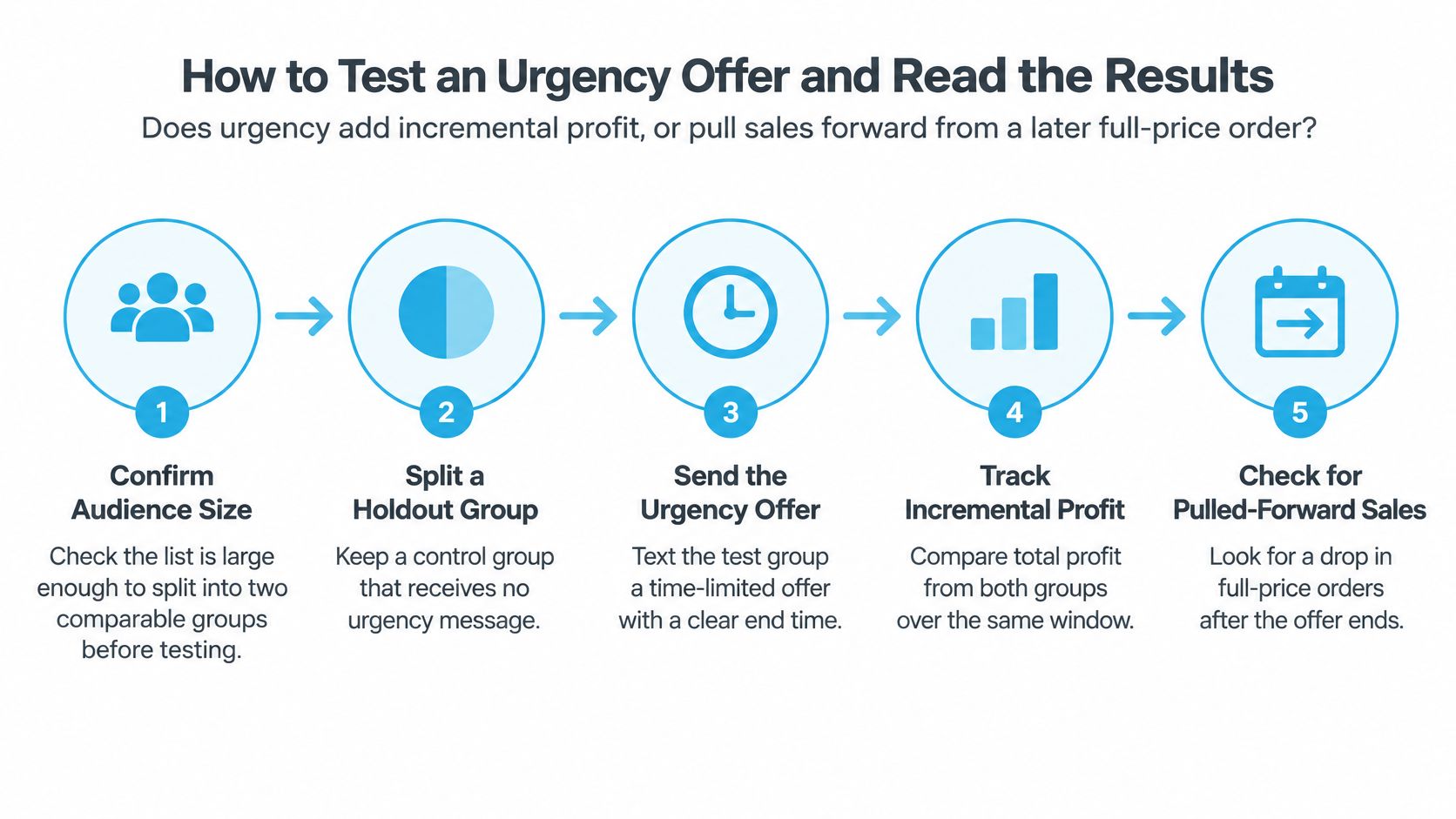
The test answers one commercial question: did the limit add incremental profit, or did it pull a purchase forward from a later full-price order? A higher click rate can’t settle that. Judge the offer on net contribution after discounts, messaging costs and opt-outs, measured against a control group.
Set up a fair test
- Check audience volume. Klaviyo requires at least 25 delivered SMS messages within the prior six months before industry benchmarks become available for an account (Klaviyo’s benchmark guidance). That threshold governs benchmark access, not statistical power. A small list split into test and control cells produces two samples too thin to read.
- Randomly assign eligible subscribers to a standard promotion or a time- or quantity-bound offer. For a lift test, keep a separate holdout that receives no urgency message.
- Hold the conditions constant. Use the same audience criteria, send time, product and landing page wherever the comparison allows. The offer mechanic should be the only meaningful difference.
- Set the attribution window before launch. Apply the same window to both groups.
- Compare more than clicks. Track incremental conversion, revenue per recipient, average order value, discount cost and unsubscribe rate against the control.
- Calculate net contribution. Subtract discounts, messaging cost and refunds, and weigh the opt-outs before deciding whether the result is worth repeating.
Read clicks and orders separately
Klaviyo defines click rate as the percentage of recipients who click a link in the message. Conversion rate is the percentage who place an order after interacting with the SMS, so the pair tells you whether the offer earned attention and whether the landing experience closed the sale. Klaviyo’s U.S. campaign bands classify click rates of 14.6% or higher as great, 8.9% to 14.5% as good, and below 5.9% as critical, and placed-order rates of 2.1% or higher as great, 1.0% to 2.0% as good, and below 0.5% as critical, according to Klaviyo’s SMS campaign benchmarks.
| Metric | Great | Good | Critical |
|---|---|---|---|
| Click rate | 14.6% or higher | 8.9% to 14.5% | Below 5.9% |
| Placed-order rate | 2.1% or higher | 1.0% to 2.0% | Below 0.5% |
| Unsubscribe rate | No benchmark set | No benchmark set | No benchmark set |
A high click rate with few orders points to one of three problems: a mismatch between the promise in the text and the landing page, friction at checkout, or a limit that doesn’t look credible. Fix those before touching the copy. Rewriting the message around clicks just sharpens a promise the rest of the funnel can’t keep.
Quikly can serve as the urgency treatment in a test. It runs a single reward or a descending tier capped by time, claims or both, with the experience styled to match the store so the limit reads as part of the shop. Run it as the treatment arm against your standard promotion, and the only variable left to explain the result is the mechanic itself.
Confirm the Test Before You Scale the Program
The next move for a Shopify store already sending SMS isn’t adding another recurring blast. Audit consent records against the market requirements, then pick one repeat broadcast and turn it into a controlled test. Choose one product with real stock, set a claim limit or end time that reflects an actual constraint, and make the landing page show the same offer and limit as the text.
Use a clear decision rule when the test ends. Scale when net contribution remains positive after discounts, messaging costs and opt-outs. Keep the offer narrow when lift is positive but opt-outs climb. Stop when clicks rise and orders don’t follow.
This approach keeps three pressures in view. Margin holds when the offer doesn’t have to be the deepest discount on the site. Conversion has a better chance when the reason to act is specific. Brand perception stays stronger when shoppers see a real limit rather than a countdown that resets. For the next test, use this guide to incrementality testing, then use Quikly’s Shopify app listing to build the treatment arm and explore the blog’s related guides on consent and flow setup.
Quikly helps Shopify brands run time- or quantity-bound promotions across storefront, email, social and SMS, with rewards that shoppers claim by acting early. If you’re ready to test whether a real limit can improve conversion without defaulting to a deeper discount, visit Quikly.
Topics: sms marketing strategy, shopify sms marketing, sms compliance, sms flows, sms campaign metrics