A Friday evening text lands with a familiar offer: “20% off everything today.” There’s no real limit, no meaningful reason to act now, and no consequence for waiting. The shopper learns that the same discount will probably return next week, so the message may create clicks without creating urgency.
That pattern costs more than a missed sale. Repeated blanket promotions erode margin, train customers to delay full-price purchases, and make a brand’s value feel negotiable. SMS can create immediate visibility, but attention alone won’t fix a weak offer.
The following SMS marketing examples focus on campaigns that reward action rather than passive waiting. They cover flash offers, tiered rewards, reactivation, product launches, cart recovery, loyalty upgrades, referrals, and post-purchase bundles. Each example explains the behavioral reason it can work, the customer habit it may create, and the copy or mechanics worth testing.
1. Flash sale urgency SMS with time-bound scarcity
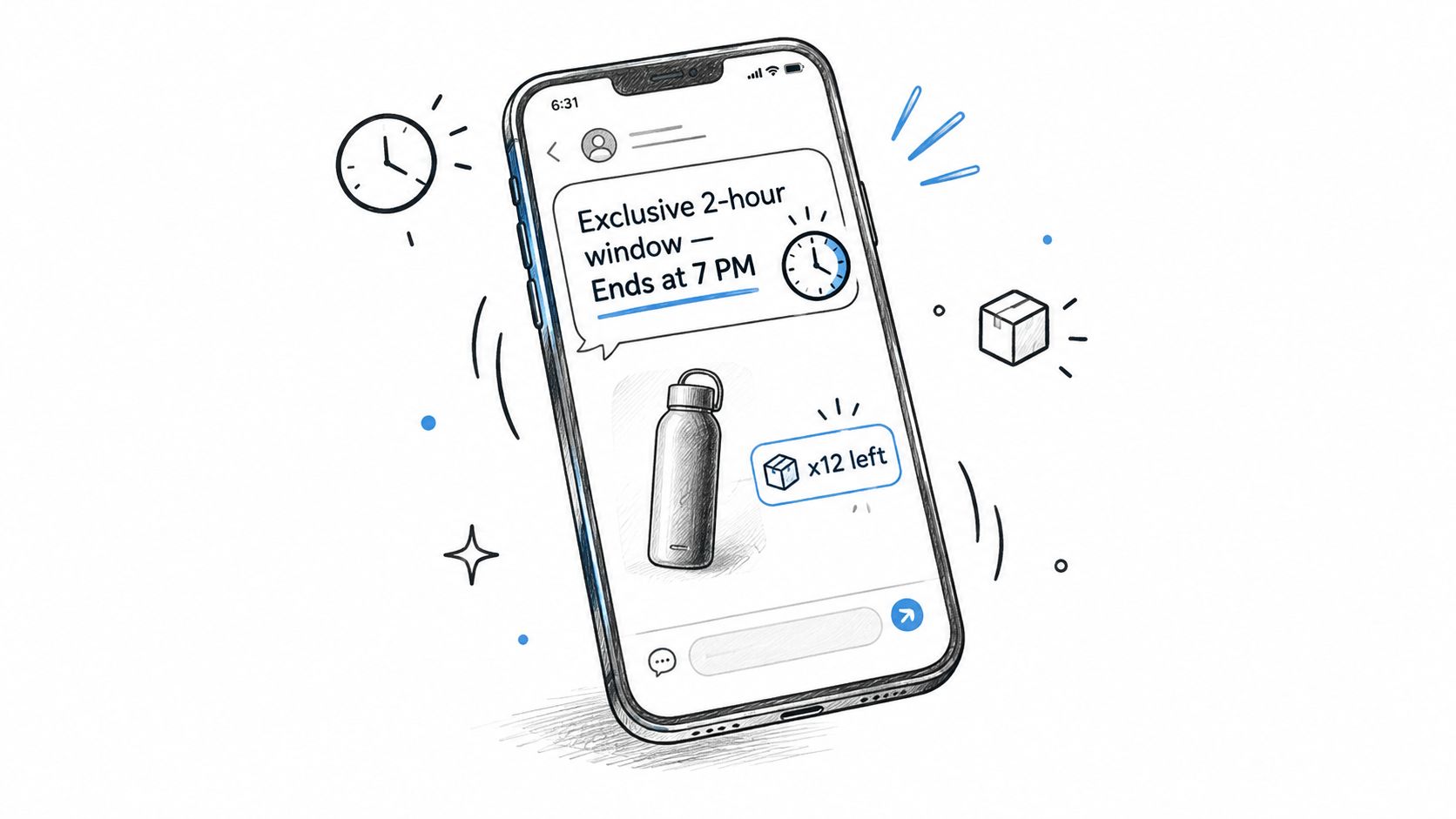
A flash sale works when the deadline or quantity limit is real. An athletic brand can use SMS to move seasonal stock before clearance, a beauty retailer can release a limited holiday set, and an apparel brand can alert opted-in shoppers that only the last sizes of a popular item remain.
The message should give the recipient one clear reason to act and one direct path to purchase. For example:
Last sizes available: The Ridge jacket closes at 8 PM. Shop your size before this release ends: [link]. Reply STOP to opt out.
The copy matters, but enforcement matters more. If the offer remains active after the stated deadline, the brand teaches customers that future deadlines are decorative. That weakens urgency and can increase dependence on deeper discounts.
What to test before scaling
- Window length: Match the promotion to inventory and fulfillment capacity. A short window that creates processing delays can produce support tickets and refund friction.
- Customer timing: Test delivery against local time zones and known purchasing behavior, rather than assuming every subscriber should receive the message simultaneously.
- Channel coordination: Reinforce the offer through email, but stagger the sends so customers don’t receive overlapping messages at the same moment.
- Profit measurement: Use an SMS-specific link or code and measure click-through, conversion, average order value, discount cost, and margin.
SMS has unusually broad reach. Research summarized by SMS marketing benchmark data says approximately 5 billion people send and receive SMS worldwide, representing about 65% of the global population in 2024. The same source compiles an average SMS open rate near 98% and cites research reporting that roughly 97% of messages are read within 15 minutes. High visibility makes relevance and restraint more important, not less.
For a more detailed approach to writing concise promotional copy, review these creative SMS messages. A short product video can also support the launch through this e-commerce sales video maker.
The trade-off is straightforward. A genuine flash sale can convert high intent without a permanent markdown, but fake scarcity damages trust faster than a conventional discount damages margin.
2. Tiered reward SMS based on order value
Tiered rewards give shoppers a reason to increase their basket instead of just applying the same discount to an order they already planned to place. A furniture brand might offer progressively better rewards for larger bundles, while a skincare retailer could connect higher-value routines with stronger but still controlled incentives.
The SMS shouldn’t try to explain every tier in a crowded message. It should create curiosity and send the recipient to a landing page where the thresholds, inventory, and terms are clear.
Build your reward: Choose a set, unlock the next tier, and shop the limited collection: [link]. Reply STOP to opt out.
This structure uses goal-gradient behavior. Once a shopper sees that a slightly larger basket earns a better reward, the next threshold becomes an immediate objective. The risk is margin leakage if the highest tier is too generous or if shoppers learn to add low-value items only to reach a discount.
Protecting the economics
- Start with conservative caps: It’s easier to expand a tier while inventory supports it than to remove a promised reward mid-campaign.
- Segment by buying history: Higher-spending customers can receive a higher starting threshold, while lower-spending shoppers can get a more accessible first step.
- Show live conditions: If time or quantity limits apply, the landing page should reflect the actual remaining availability.
- Track incremental basket value: Compare order value and gross margin with a holdout group, not only clicks and attributed revenue.
A useful benchmark comes from HOMAGE, an apparel brand that promoted an exclusive NFL Starter-jacket release through SMS. The campaign generated 100 orders in the first hour, an 87% click rate, a 9% purchase rate among SMS recipients, and $167 in revenue per recipient, as reported in Klaviyo’s ecommerce SMS examples. Those figures are tied to a specific launch, so they shouldn’t become a generic forecast. The stronger lesson is to report first-hour orders, unique clicks, recipient-level conversion, and revenue per recipient separately.
See this guide to tiered discounts for Shopify for ways to connect reward thresholds with the store experience.
The trade-off is a larger average basket versus a more complex offer. Tiering can increase order value, but only if the reward remains earned rather than becoming an expensive discount ladder.
3. SMS reactivation with behavior-triggered limited offers
A customer bought from you six months ago, clicked a few product pages last week, then went quiet again. That is the moment for a reactivation SMS. It should tie the message to what they bought, what they viewed, or where they dropped off. Generic win-back copy usually spends margin without changing the next behavior.
The message needs a clear reason to return and a limit the customer can understand:
“New linen arrivals are here, Maya. Your private reactivation offer closes Friday. See the collection: [link]. Reply STOP to opt out.”
That structure works because the trigger is behavioral, the reward is bounded, and the deadline is specific. For some brands, the right incentive is a discount. For others, free shipping, a gift, or first access protects margin better. Test reward type before raising discount depth. If your audience often leaves during checkout, you can also boost recovery with these examples and compare whether cart-focused follow-up or broader reactivation does more incremental work.
Keep win-back from training bad habits
The risk is not just lower margin. It is conditioning people to ignore the brand until a stronger offer appears. A reactivation SMS should bring them back for a relevant product, timely restock, or limited perk, not teach them that inactivity gets rewarded.
Use tight rules.
- Define the audience clearly: Base eligibility on purchase category, inactivity window, browse behavior, or prior engagement.
- Stagger channels: Email and SMS can support each other, but sending both at the same moment often feels like pressure rather than relevance.
- Control the expiry: Keep the offer open long enough to act, but short enough that it still feels earned and time-bound.
- Suppress buyers fast: The moment someone converts, remove them from the sequence so you do not spend extra messages on a solved job.
Measure the campaign like an operator, not a dashboard tourist. Attributed orders alone can flatter a weak program. A holdout group shows whether SMS created an incremental purchase or just intercepted a customer who was already on the way back. Compare conversion, average order value, gross margin, opt-outs, and delayed purchases against the control.
Use this guide to winning back lapsed customers to shape the audience and sequence.
The trade-off is reach versus list health. A narrower segment usually recovers demand with less brand damage. Sending the same win-back text to every inactive subscriber may lift short-term orders, but it can also raise opt-outs and train customers to wait.
4. Product launch SMS with an exclusive early-access window
Early access creates scarcity through status and timing rather than through a deep discount. An apparel brand can give subscribers the first chance to shop a collection, a cosmetics company can open limited seasonal shades early, and a tech accessories brand can alert its list before a restock reaches the broader audience.
The most effective message makes the advantage concrete:
“SMS early access is open. The Solstice carryall is available to subscribers before the public release: [link]. Reply STOP to opt out.”
Send the message before public availability, not after demand has already peaked. The precise timing depends on inventory, audience behavior, and fulfillment capacity, but the promise must be true. If everyone receives the same access at the same time, “exclusive” becomes ordinary promotional language.
Use access as the reward
Early access works particularly well for brands concerned about perceived value. The customer earns priority by subscribing or remaining engaged, while the brand protects price integrity. That makes the tactic different from a blanket discount, which can train shoppers to wait for a lower price.
Segmenting improves the experience:
- Recent buyers: Give them early notice when the new product complements their previous purchase.
- Category subscribers: Prioritize people who have shown interest in the relevant product type.
- High-intent visitors: Use waitlists or product views as eligibility signals where consent permits.
- General subscribers: Offer access without implying guaranteed inventory.
Use a product-specific link or code so the team can distinguish early-access demand from later public-launch demand. Watch sell-through, conversion, average order value, customer support volume, and opt-outs. A launch that sells quickly but creates fulfillment problems may damage repeat purchase behavior.
The trade-off is exclusivity versus inventory fairness. Early access can strengthen loyalty without lowering price, but a poorly managed window can frustrate customers who receive the message after the product is gone.
5. SMS cart abandonment recovery with an escalating sequence
Cart recovery begins with existing intent, so the first message doesn’t need to lead with a discount. A shopper may have been interrupted, lost confidence at checkout, or needed more time. The opening SMS should return them to the exact cart, not to the homepage.
“Your Harbor overshirt is still in your cart. Finish checkout here: [link]. Reply STOP to opt out.”
If the customer doesn’t purchase, the sequence can escalate from a service-oriented nudge to a controlled incentive. Free shipping may come before a small discount, and a stronger reward can remain reserved for higher-value carts or later steps. The purpose isn’t to reward abandonment. It’s to avoid spending margin before you know an incentive is necessary.
Design the sequence around intent
Dynamic content should show the specific products left behind, but the brand should suppress the flow immediately after purchase. The landing link should restore the cart with minimal friction, and the message should clearly explain any deadline.
- First touch: Remove friction and remind the customer what they selected.
- Second touch: Address a practical barrier, such as shipping or availability.
- Later touch: Use an incentive only when the expected margin supports it.
- High-value carts: Test stronger recovery treatment separately from low-value carts.
The sequence needs a control group. Compare incremental conversion and profit after message, carrier, platform, and discount costs. A high click rate can still produce weak economics if most recipients would’ve completed checkout without a reward.
A documented campaign from Answear sent SMS messages to 30,000 customers, with nearly 1,000 recipients clicking through and a reported 3% click-through rate, according to SMSAPI case studies. That result illustrates why click-through can be a useful first-stage metric, but it doesn’t establish profitability or incremental sales by itself.
The trade-off is recovery rate versus discount dependency. Escalation can save margin on easy recoveries, but a sequence that always ends with a larger discount teaches shoppers to abandon carts deliberately.
6. SMS VIP or loyalty tier upgrade with exclusive access
A loyalty upgrade message can motivate action without making price the headline. A customer who is close to a new tier might receive an SMS explaining what they need to do to qualify for early access, a private collection, or another member benefit.
“Gold access is within reach. Complete your qualifying order before the member window closes: [link]. Reply STOP to opt out.”
This campaign uses commitment and consistency. Customers who have already invested attention, purchases, or points are more likely to continue when the next benefit is clear and attainable. The offer feels earned, which helps protect brand perception.
Make progress visible
The message should link to a page showing current status and the remaining requirement. Avoid thresholds that require an unrealistic purchase during the stated window. If the customer can’t reasonably reach the tier, the campaign creates disappointment instead of momentum.
A strong loyalty SMS might include:
- Current status: Show the member’s tier or progress clearly.
- Specific benefit: Lead with access, service, or product priority rather than a generic price cut.
- Real deadline: Close the upgrade period when promised.
- Relevant product path: Recommend products that naturally help the customer qualify.
A luxury goods brand can use this structure to preserve exclusivity, while a subscription service can apply it to members approaching a higher benefit level. The mechanic should fit the economics of the business. A tier that gives away too much value can turn loyalty into a permanent liability.
The trade-off is retention versus complexity. Clear tiers can make repeat purchasing feel meaningful, but confusing rules, inaccessible thresholds, or frequent upgrade pushes can make the program feel transactional.
7. SMS referral campaign with tiered rewards
Referral SMS works best when the recipient already has a reason to recommend the product. A new-season launch, a replenishment moment, or a successful post-purchase experience can provide that context. The message should give both sides a clear benefit and make sharing possible from one tap.
Know someone who’d love the Coastline set? Share your personal link. Your friend gets the welcome reward, and you receive a member benefit after a successful order: [link]. Reply STOP to opt out.
Tiered rewards can increase participation by giving advocates another target after the first referral. The tiers should be based on completed, valid purchases rather than clicks or sent invitations. That protects the budget from low-quality traffic and self-referrals.
Reward quality, not just volume
The brand should evaluate referred customers by conversion, product fit, repeat behavior, returns, and margin. A referral that produces a low-margin order or a high-return customer may look successful in a dashboard while weakening the economics of acquisition.
Use these controls:
- Simple sharing: Put the referral link directly in the SMS or on the first landing screen.
- Two-sided value: Give the friend a reason to try the brand and the advocate a reason to share.
- Conservative tier caps: Open more reward capacity later rather than retracting a promised benefit.
- Fraud checks: Validate qualifying orders before issuing higher rewards.
Referral campaigns can strengthen community and reduce reliance on paid acquisition, but they can also cheapen the brand if every interaction sounds like a coupon request. Product enthusiasm should lead, with the incentive supporting the recommendation.
The trade-off is efficient acquisition versus reward cost and control. A strong referral program brings in trusted demand, but the brand must protect quality, margin, and customer experience as participation grows.
8. SMS cross-sell or bundled offer with a quantity-capped incentive
A post-purchase cross-sell should answer a practical need, not just ask the customer to buy again. Someone who purchased headphones may need a carrying case. A skincare customer may need a complementary moisturizer. A furniture buyer may be ready for a matching throw or pillow.
“Your Northline headphones are on the way. A limited number of matching cases are available as a bundle for customers who purchased this week: [link]. Reply STOP to opt out.”
The reference to the exact product makes the message useful. A small bundle is easier to understand than a catalog of recommendations, and a quantity cap can create urgency without changing the original product’s perceived value.
Time the second purchase carefully
The best send window depends on the category and the moment when the customer recognizes the complementary need. A case may make sense shortly after a headphone purchase, while replenishment products may work better after the customer has used the first item.
- Use category logic: Recommend products that solve an obvious adjacent problem.
- Keep the bundle focused: Present a small number of complementary items instead of a broad assortment.
- Cap the incentive: Make the remaining availability visible and enforce the limit.
- Exclude unsuitable buyers: Don’t promote an accessory to customers who already bought it.
Measure attach rate, average order value, gross margin, returns, support contacts, and opt-outs. A higher basket isn’t automatically better if the bundle requires a large discount or creates unnecessary purchases that later come back.
The trade-off is higher order value versus message relevance. A thoughtful bundle can increase customer utility and revenue, but a generic cross-sell makes the brand feel like it’s extracting another transaction immediately after checkout.
Comparison of 8 SMS Marketing Campaigns
| Example | Implementation complexity | Resource requirements | Expected outcomes | Ideal use cases | Key advantages |
|---|---|---|---|---|---|
| Flash Sale Urgency SMS with Time-Bound Scarcity | Medium, requires coordinated timing and fulfillment | Inventory sync, real-time caps, SMS platform, landing page | Immediate conversion spikes, short-term revenue lift | End-of-day clearance, launch-day offers, weekend flash sales | Drives immediate action; preserves margins; clear urgency |
| Tiered Reward SMS Offering Escalating Incentives Based on Order Value | High, real-time tier tracking and dynamic messaging | Backend tier enforcement, segmentation, creative assets, landing page | Higher AOV, controlled discounting, incremental revenue per order | Post-purchase upsells, cart recovery, seasonal AOV drives | Boosts AOV; maintains margins; customers “earn” rewards |
| SMS Reactivation Campaign with Behavior-Triggered Limited Offers | Low–Medium, triggered sends with personalization | Customer inactivity segments, simple codes/links, landing page | Recover lapsed customers, incremental revenue at lower CAC | 30–90 day winbacks, post-holiday recovery, churn prevention | Cost-efficient reactivation; targeted; prevents indefinite waiting |
| SMS Product Launch Announcement with Exclusive Early-Access Window | Medium, timing coordination and gating early access | Product/marketing sync, gating page, segmentation, tracking codes | Early traffic and conversions for new products, increased opt-ins | Limited-edition launches, restocks, seasonal collection debuts | Rewards subscribers without deep discounts; builds hype |
| SMS Cart Abandonment Recovery with Escalating Incentive Sequence | High, multi-step cadence plus cart integration | Cart system integration, sequencing engine, unique codes per step | Recovers abandoned carts (often 10–15%), incremental conversions | Mobile checkout recovery, high-AOV carts, seasonal spikes | Recovers lost revenue; controls margin via escalation; high catch rate |
| SMS VIP or Loyalty Program Tier Upgrade with Exclusive Early Access | High, loyalty system and progress tracking needed | Loyalty backend integration, personalized progress displays, perks setup | Increased repeat purchases, higher lifetime value, improved retention | Tier promotions, anniversaries, event-driven VIP access | Drives long-term loyalty; aspirational status benefits; reduces discounting |
| SMS Referral or Sharing Campaign with Tiered Rewards for Viral Growth | Medium–High, referral tracking and fraud checks required | Unique referral links, tracking system, social sharing UX, monitoring | New customer acquisition with lower CAC, viral growth potential | Launch day viral pushes, seasonal acquisition, community building | Leverages word-of-mouth; scalable acquisition; higher-quality leads |
| SMS Cross-Sell or Bundled Offer with Quantity-Capped Incentive | Medium, post-purchase triggers and product recommendation | Purchase history integration, dynamic content, inventory caps | Incremental AOV from existing customers, efficient upsell revenue | Post-purchase within 24–48h, category-based bundles, complementary pairings | Credible personalized offers; raises AOV; easier inventory control than time-only scarcity |
Choosing the next SMS campaign to test
Start with the largest economic problem, not the most attractive copy. If discounts are getting deeper without improving profit, test a real scarcity mechanic. If visitors are reaching checkout but failing to complete, start with cart recovery. If average order value is weak, test a tiered reward or a relevant bundle. If repeat demand has slowed, use behavior-triggered reactivation or a loyalty upgrade.
Set the time window and quantity cap from actual fulfillment capacity. A campaign promise must survive inventory changes, customer support questions, warehouse constraints, and the checkout experience. Copy can create urgency, but operations determine whether the urgency is credible.
Measure average order value and margin beside clicks and conversion. An attributed purchase may have happened without the text, especially in cart recovery and reactivation campaigns. Use a randomly withheld control group when possible, keep the offer and timing consistent, and calculate incremental revenue after message, carrier, platform, and discount costs.
Frequency deserves the same discipline. Research reported by MediaPost’s summary of Vibes consumer data says 13% wanted daily texts in 2025, compared with 6% in 2024, while 25% considered messages arriving too early or too late irritating or spammy. Separate 2025 consumer research cited by the same source identifies texting too often as a leading unsubscribe reason at 53%, followed by spam-like content at 21% and irrelevant messaging at 11%. These figures don’t justify sending more often. They show that preference depends on relevance, timing, consent, and cumulative channel load.
Practical rule: Suppress recent purchasers, apply recipient-local quiet hours, coordinate SMS with email and social, and distinguish transactional updates from promotional urgency messages.
Compliance is part of the campaign design. For U.S. promotional SMS sent with an automated telephone dialing system, TCPA guidance for text messages says marketers must obtain prior express written consent, identify the sender and program, honor reasonable opt-outs such as STOP, and generally limit commercial texting to 8 a.m. through 9 p.m. in the recipient’s local time zone. A compliant opt-in should use affirmative action and disclose the business, promotional nature, expected frequency, possible message-and-data rates, privacy and terms information, and STOP/HELP instructions, as outlined in SMS opt-in compliance guidance.
Judge every send by the habit it creates. The best SMS marketing examples don’t merely produce a short-term conversion. They teach customers to act when the offer is real, not to wait for the next predictable markdown.
Quikly can support that approach for Shopify merchants by turning standard promotions into time- or quantity-bound experiences across storefront, email, social, and SMS. Its mechanics have been refined across more than 60 million consumer interactions, and its campaigns are styled to match the store rather than appearing as a generic overlay. Use it when controlled urgency can improve conversion or order value without making deeper blanket discounts the default.
Quikly helps Shopify brands run urgency and scarcity promotions where rewards are limited by time, quantity, or both, so SMS campaigns can reward customers who act instead of customers who wait. Review your next campaign through that margin and customer-habit lens, then visit Quikly to see how the app can support your Shopify store.
Topics: sms marketing examples, ecommerce sms campaigns, sms cart recovery, shopify sms marketing, sms promotion strategy