A tiered discount on Shopify looks like a simple path to a higher average order value. Set a low threshold, add a better reward at the next level, and let customers “climb” toward the best deal. That advice is popular because the mechanic is easy to understand.
It’s also incomplete. A static discount ladder can raise basket size while giving away margin to shoppers who would have purchased anyway. Worse, predictable tiers can teach customers to delay their purchase until the next promotion appears. The stronger strategy combines threshold-based incentives with controlled urgency, so the customer has a reason to act now rather than wait.
Why Flat Discounts Are Eroding Your Margins
More tiers don’t automatically mean more revenue. They can create more opportunities for shoppers to claim a discount without creating enough additional demand to pay for it.
A familiar ladder with progressively deeper rewards often behaves like a public price schedule. Customers learn the pattern, compare the thresholds, and postpone the purchase when there’s no meaningful cost to waiting. That’s where temporal discounting matters. People tend to value an immediate benefit more highly than a delayed one, but a static Shopify discount gives them no compelling reason to choose today over next week.
Loss aversion creates another problem. Once customers become accustomed to receiving a discount, paying full price can feel like losing a benefit, even when the product’s value hasn’t changed. The brand then has to repeat the promotion, increase its visibility, or deepen the reward to recreate the same sense of value.
The broader discount environment makes this margin pressure difficult to ignore. Independent 2026 data covering 93,000 merchants found a median ecommerce discount rate of 15%, an average of 19.5%, and a Cyber Week peak of 23%. Those figures indicate how heavily merchants are already discounting, and why repeating static offers can contribute to promotion fatigue rather than sustainable lift. See Shopify’s discount guidance and discount-rate data for the underlying context.
The hidden cost of a predictable ladder
A tiered discount can subsidize three types of orders:
- Existing-intent orders: Customers who were already ready to buy receive a reward that didn’t change their decision.
- Threshold-chasing orders: Customers add low-margin or unnecessary items to reach a tier, increasing revenue without necessarily improving contribution profit.
- Delayed orders: Customers wait for a familiar promotion because the offer has become part of the expected price.
The answer isn’t to remove every promotion. It’s to stop treating the discount ladder as the strategy. A better approach uses a clear threshold, a controlled reward, and a reason for immediate action. Merchants looking beyond blanket markdowns can also review these alternatives to discounting for Shopify.
Margin rule: A higher AOV is useful only when the incremental profit from the larger basket exceeds the cost of the discount and any extra products you’re subsidizing.
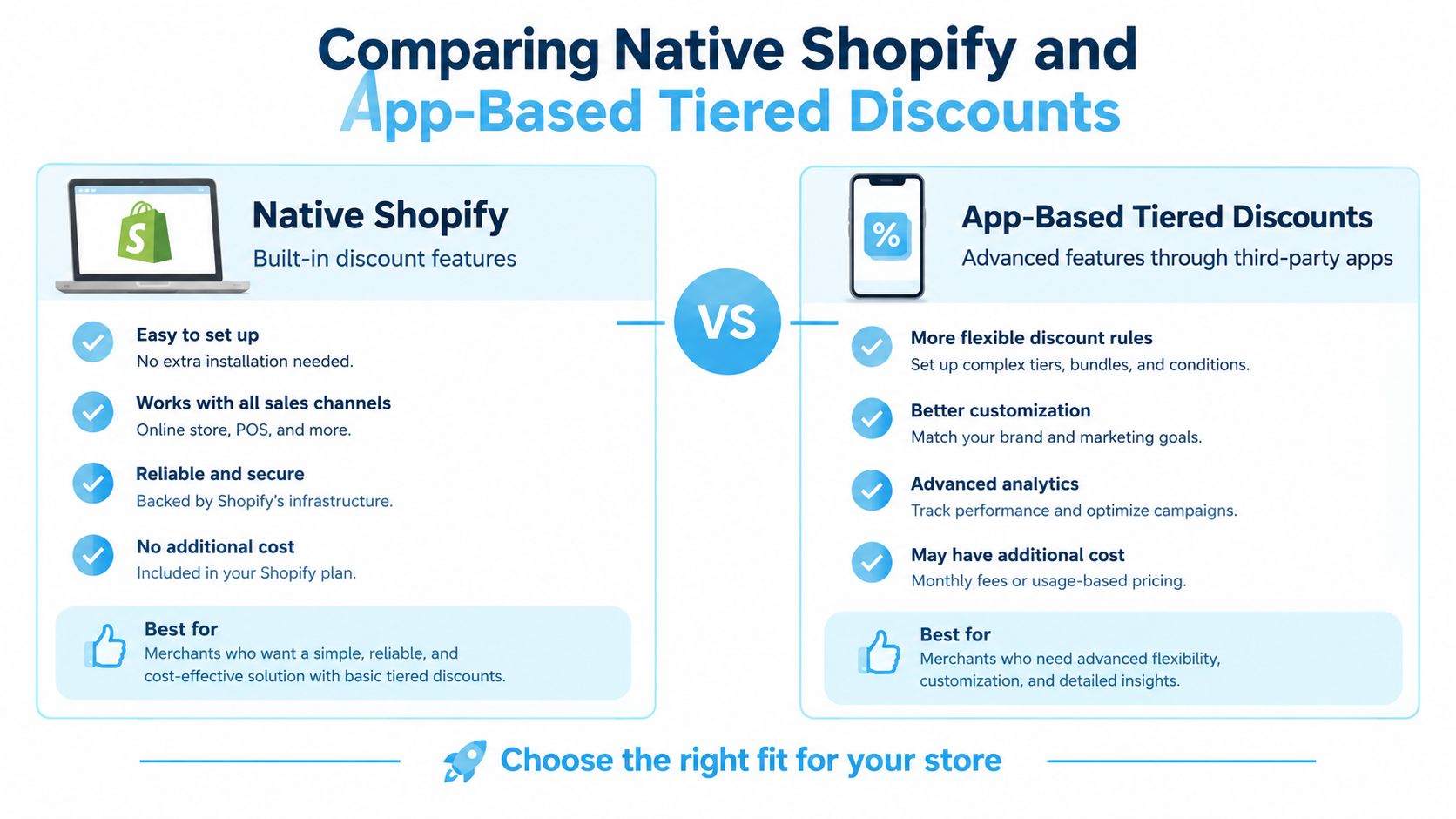
Comparing Native Shopify and App-Based Tiered Discounts
Shopify’s native discount infrastructure is usually sufficient for straightforward offers. You can create automatic discounts, product discounts, codes, and combinations with defined eligibility. That works well when the rule is simple, the reward is fixed, and one discount logic doesn’t need to interact with another.
The difficulty begins when the offer needs multiple thresholds, customer conditions, product groups, or dynamic eligibility. Shopify’s own documentation frames more advanced multi-logic step discounts and custom eligibility as use cases that often require apps. That implementation gap explains why merchants searching for a tiered discount Shopify setup frequently run into questions that aren’t about marketing at all.
Where native Shopify tools fit
Native functionality is a sensible starting point when:
- The offer has one clear rule: For example, a discount applies when a defined product or collection qualifies.
- The threshold is easy to explain: Customers can see what they need to add without calculating several conditions.
- Discount combinations are limited: You don’t need a product discount, order discount, customer tag, and code to interact.
- The checkout result is predictable: The price shown in the cart matches the intended reward without special treatment for variants or product groups.
The edge cases deserve testing before launch. Are thresholds entry points, or do they define separate ranges? Does the discount apply to qualifying line items, the entire order, or a particular collection? If automatic and product discounts don’t conflict, can they combine, and what happens when a code is added?
When an app becomes strategically useful
An app makes more sense when the merchant needs multi-logic discounting, category or tag awareness, advanced quantity rules, or a promotional experience that changes as shoppers engage. The value isn’t just “more discount types.” It’s control over eligibility, presentation, and the final calculation.
Stacking is the main margin risk. Two offers that look harmless in isolation can create an unintended combined discount when their rules overlap. Test the exact cart states that matter, including mixed eligible and ineligible products, multiple variants, discount codes, and carts sitting just below or above each threshold.
For a practical view of the app layer, see this guide to a Shopify discount app. Choose the smallest technical setup that can express the customer behavior you want. More configuration isn’t automatically better.
Designing a Tiered Discount Ladder That Protects Margin
Start with your current average order value, not an arbitrary discount template. The first threshold should feel reachable, but it should still require a meaningful basket expansion. Shopify enterprise guidance cites a ConvertCart 2026 recommendation to place the first tier 10% to 20% above current AOV, so the step feels achievable without merely rewarding the existing basket. The recommendation and related ladder examples appear in Shopify’s enterprise discount strategy guidance.
That range is a starting point, not a universal rule. If your products have sharply different margins, a single storewide threshold may be too blunt. Use contribution margin, product cost, shipping economics, and the products customers already buy together to decide whether the threshold should apply to the whole order, a collection, or a defined product family.
Build the ladder around goals
Customers respond better when each threshold looks like a clear next objective. A University of Delaware study found that smaller increments between thresholds induce higher spending than wider jumps, because shoppers treat each threshold as a motivational goal. The effect is stronger when the cart displays live progress. Review the University of Delaware research on tier spacing and cart progress before finalizing the ladder.
Use that finding operationally:
- Set the first threshold just beyond the current basket. The customer should understand what to add and why the reward is attainable.
- Keep the next threshold close enough to remain credible. A large jump can turn the next reward into an irrelevant aspiration.
- Show progress in the cart. “Add one item to reach your next reward” is more useful than displaying several discount percentages without context.
- Model the worst-case basket. Check what happens when a customer combines the highest discount with your lowest-margin products or an expensive shipping destination.
The 2026 Shopify discount benchmark analyzed 182 million unique discount codes across 1,348 Shopify stores. It found that percentage-off codes produced an average AOV of $95.75, compared with $67.35 for amount-off codes, a 42% difference. The same dataset identified 20% off as the most common and best-balanced discount depth, while amount-off codes with minimum-spend thresholds generated 2.6x higher AOV. These findings support testing percentage and threshold structures against each other, not assuming one format always wins. See the Shopify discount benchmark analysis for the full data.
Keep the structure understandable
Too many tiers turn a motivational ladder into a pricing puzzle. Shopify enterprise guidance warns that excessive tiers and aggressive jumps can dilute margin and make the offer harder to understand. A small number of distinct breakpoints usually gives merchandising teams better control than a dense schedule of minor changes.
A threshold should earn its place by changing behavior. If customers rarely move from one tier to the next, the threshold may be too distant, the reward may be weak, or the products shown to bridge the gap may be poorly chosen. If nearly everyone reaches the highest tier, the top reward may be acting as a blanket discount.
Implementing Scarcity and Urgency in Your Tiers
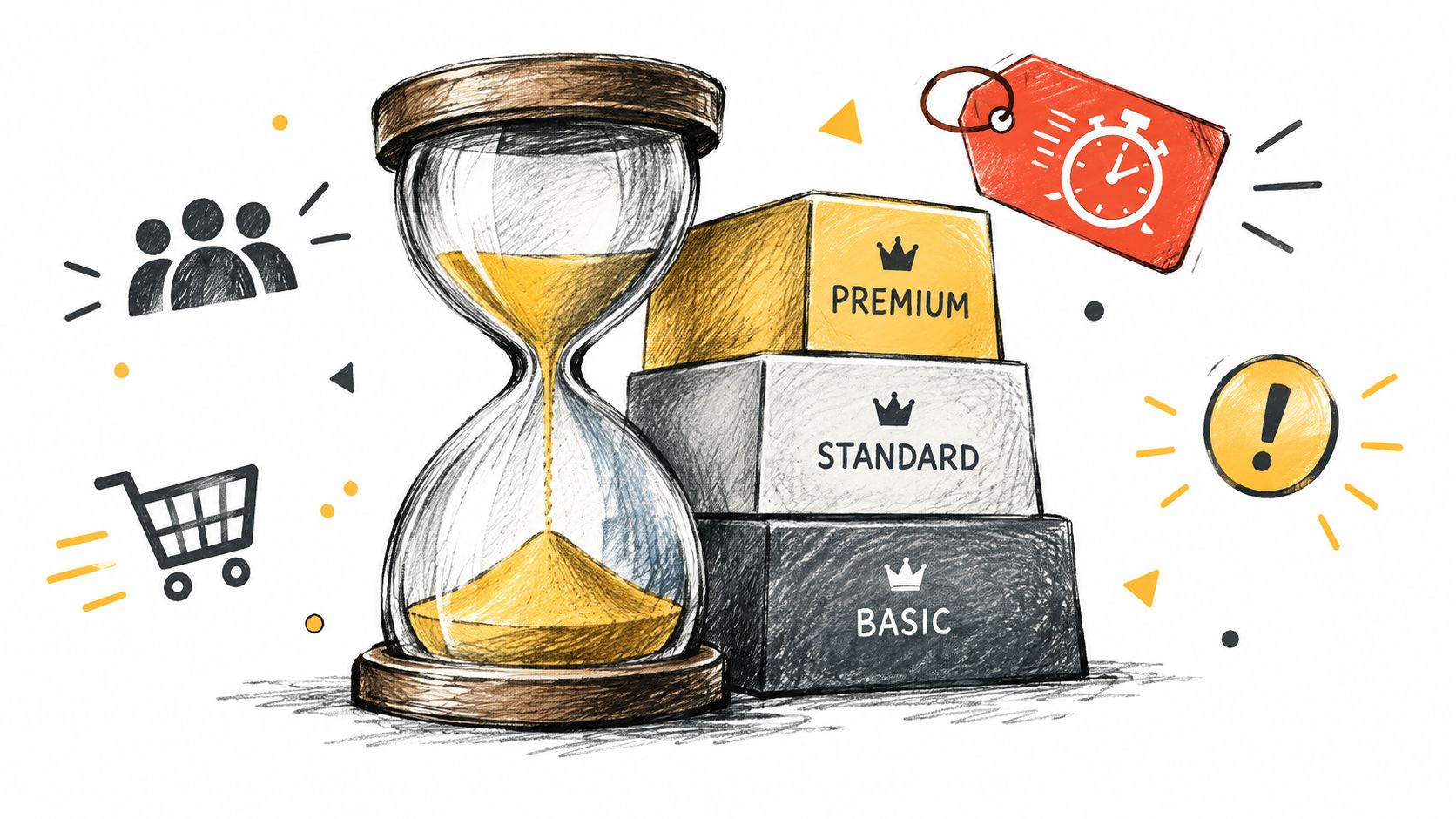
A static spend threshold tells the shopper, “Buy whenever you want.” That can increase basket size, but it doesn’t necessarily resolve hesitation. Adding a real time or quantity constraint changes the decision because the customer now has something to lose by waiting.
The useful combination is goal-based progression plus limited availability. The shopper still understands what to spend to reach a reward, but the reward is available only while the campaign window remains open or while the allocated claims remain. This turns the tier from a passive price table into an active promotional experience.
Use scarcity that the business can honor
Limited-time discount research reports stronger emotional arousal, shorter decision-making windows, and lower price sensitivity among consumers exposed to time-limited and scarce promotions. The same research warns that frequent or manipulative use can create fatigue and skepticism. The research on limited-time discounts and consumer response supports a disciplined approach, not permanent countdown pressure.
Good scarcity has a clear boundary:
- A real campaign window: The offer opens and closes at a stated time.
- A real allocation: A reward is available to a defined number of claimants or orders.
- A visible condition: The customer can see what remains available and what happens when it changes.
- A consistent outcome: The reward doesn’t reset just because the shopper refreshes the page.
A descending tier can be more protective than a permanent high discount. Early shoppers receive the strongest available reward, while later shoppers receive a lighter one as claims are used. Customers who value the product enough to act quickly earn the better price. Customers who wait don’t automatically receive the maximum discount.
That distinction matters for brand equity. A blanket promotion tells every shopper to expect the same markdown. An earned, time-bound reward gives customers a reason to act without declaring that the product is worth less at all times.
Avoid attaching fake scarcity to ordinary stock or using a timer that has no commercial consequence. Shoppers notice when urgency feels theatrical. Merchants exploring the mechanics can review this guide to a countdown timer for Shopify, while keeping the broader principle in mind: urgency should clarify the decision, not pressure people into distrusting the store.
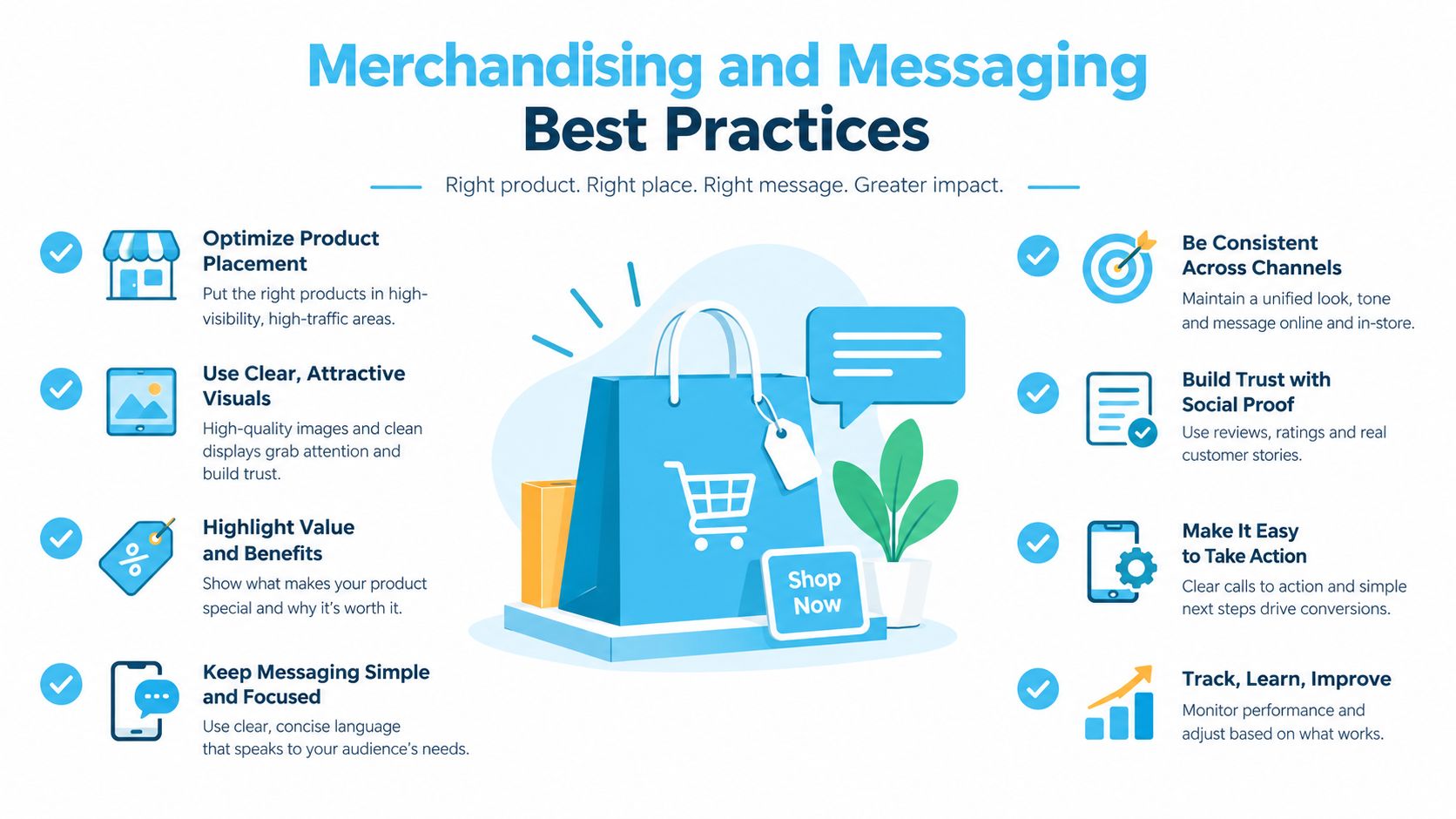
Merchandising and Messaging Best Practices
A well-designed tier can still fail if the shopper has to hunt for it. Put the offer where the purchase decision happens, then repeat the relevant progress or reward in the cart, email, and SMS. The message should answer three questions immediately: what do I get, what do I need to do, and why should I act now?
On a product page, show the qualifying products and the next attainable reward near the purchase controls. In the cart, replace a generic discount summary with progress toward the next threshold. If the customer is close, recommend products that complement the existing basket and have enough margin to support the incentive.
Make progress do the selling
Shopify enterprise guidance describes tiered discounts as thresholds that pull customers toward a higher-value cart. The appeal depends on the satisfaction of reaching the next tier outweighing the margin surrendered by the brand, as explained in Shopify’s guidance on threshold-based discounting. Your interface should make that trade-off legible.
Use copy such as:
- “You’re close to your next reward.” This frames the threshold as progress rather than a demand.
- “Add a matching item to qualify.” This gives the customer a practical action.
- “Your current reward is reserved until the offer closes.” Use this only when the campaign genuinely supports that condition.
- “Choose from these products to reach the next tier.” Curated recommendations reduce the chance that customers add unwanted filler.
The visual treatment should belong to the store. Match the brand’s typography, colors, photography, and voice instead of dropping an unrelated overlay into the theme. Merchants refining placement, product grouping, and in-store presentation can use these visual merchandising strategies as a broader reference.
Carry the logic across channels
Email and SMS should not merely announce the deepest tier. That trains recipients to wait for the largest reward. Communicate the current available incentive, the threshold, and the condition that makes timing relevant. If the shopper has already started a cart, personalize the message around the gap to the next reward rather than repeating the entire promotion.
Keep terms concise. Customers shouldn’t need to interpret nested conditions, exclusions, or competing codes before they can understand the offer. Test the experience on mobile, especially the cart progress display and the final discount line at checkout.
Testing and Optimizing Your Discount Strategy
Treat a tiered discount as a behavioral experiment, not a permanent pricing decision. Start with a control group that sees the regular offer or no promotion, then compare a simple tier ladder with a version that changes discount depth, spacing, or urgency. The purpose is to measure incremental behavior, not to celebrate revenue that would have arrived without the incentive.
Track the commercial outcome at order and customer level:
- Contribution margin per order: Include the discount, product cost, shipping impact, and any fulfillment changes.
- AOV and item count: A larger basket isn’t enough if customers add low-margin products or receive an excessive reward.
- Conversion quality: Compare completed purchases with cancellations, returns, and code abuse.
- Threshold movement: Measure how many shoppers stop below a tier, reach the next tier, or continue to the highest tier.
- Repeat behavior: Watch whether customers return at full price or wait for another promotion.
Test one major variable at a time. First compare percentage-off with amount-off or threshold-based rewards. Then test smaller versus wider threshold spacing. After that, test a static ladder against a time- or quantity-bound version. The Shopify benchmark cited earlier found stronger AOV for percentage-off codes and higher AOV for amount-off codes with minimum-spend thresholds, so both structures deserve a controlled test rather than a blanket assumption.
Stop a promotion when the extra orders no longer cover the cost of the reward. A falling margin per order, increasing dependence on codes, or customers clustering at the highest tier are warning signs that the ladder is subsidizing demand instead of creating it.
Quikly provides Shopify merchants with behavior-driven promotional experiences that can combine descending reward tiers with time or claim limits, across the storefront, email, social, and SMS. If your current ladder tells customers they can wait, visit Quikly to explore an approach that rewards timely action while keeping the promotion aligned with your brand.
Topics: tiered discount shopify, shopify discount strategy, ecommerce promotions, shopify AOV, scarcity marketing