Every Shopify brand feels this pressure. You pay to bring people in, traffic lands, product pages get views, carts fill, and then too many shoppers drift away without buying. When that happens for long enough, the default response is usually the same. Add another discount, run another flash sale, push another sitewide code.
That playbook gets expensive fast. Margins tighten, repeat buyers learn to wait, and the store starts to feel promotional even when the product itself deserves better. The issue isn’t that urgency tactics don’t work. It’s that weak urgency, fake urgency, and always-on urgency create short-term movement while eroding trust.
The better approach is more disciplined. The strongest urgency tactics to increase Shopify conversions give shoppers a real reason to act now, without teaching them that every visit will end in a markdown. Used well, urgency can lift conversion, protect margin, and keep your brand from looking like it’s permanently on sale. These eight tactics are the ones worth testing if you want urgency to work like a growth tool, not a margin leak.
1. Limited Quantity Offers
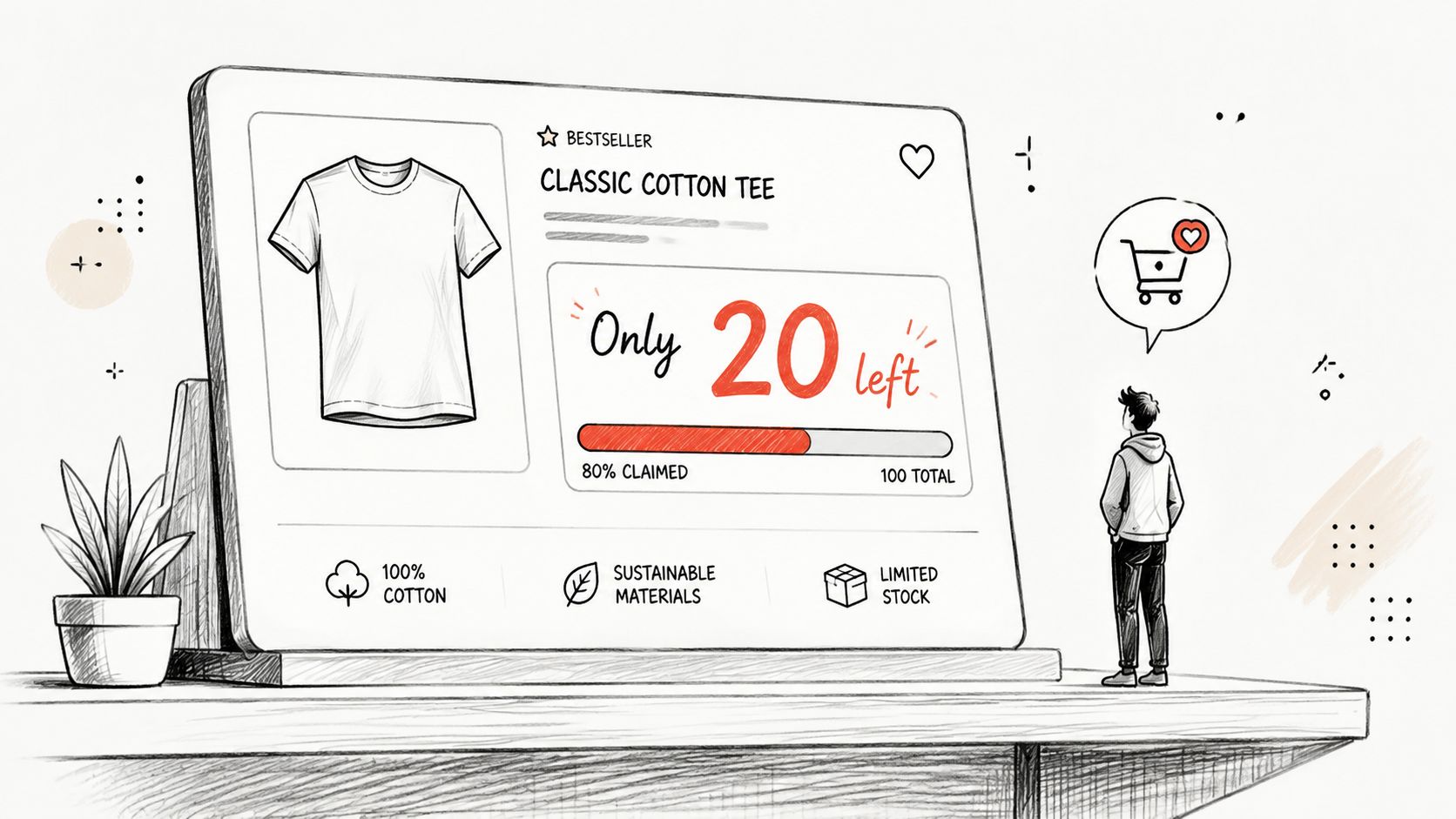
A limited quantity offer works because it makes the opportunity finite in a way shoppers can understand immediately. Not “sale ends soon,” which people have seen a thousand times. Something more concrete, like a free gift for the first set of qualifying orders, or an enhanced reward that disappears once the claim cap is reached.
That taps directly into scarcity bias. Buyers assign more value to something when availability is clearly limited, especially when the limit feels operationally real instead of invented.
Here’s how that can look on Shopify. A beauty brand can cap a gift-with-purchase so the giveaway cost stays controlled. A streetwear label can open an early-access discount to the first group of customers only, which keeps the reward from spreading across the whole customer base. A fashion store can move seasonal inventory with a fixed number of boosted offers rather than dropping prices across every SKU.
What makes quantity-based urgency work
The cap has to be set by margin tolerance, not by optimism. If your team can profitably fund a certain number of premium rewards, stop there. Don’t choose a claim limit because it “sounds big enough.”
A visible counter also matters. If shoppers can see claims moving, the stakes become real. That’s very different from a generic badge that says limited stock with no context.
Practical rule: Quantity caps work best when the reward is meaningful enough to motivate action, but controlled enough that you’re not subsidizing every buyer.
A few operating rules make this tactic cleaner:
- Set the cap from finance first: Decide what you can afford across gross margin, shipping cost, and expected redemption.
- Show live progress clearly: Place the counter near the product offer, cart incentive, or campaign landing page.
- Use stronger rewards selectively: Quantity limits are ideal for higher-value perks because the cap prevents runaway cost.
- Seed demand before launch: Email and SMS can drive the first wave of claims so the offer gains momentum quickly.
If you want a deeper view into how scarcity works without drifting into cheap pressure tactics, Quikly’s post on scarcity marketing for ecommerce is a useful reference point.
2. Time-Bound Offers with Visible Countdowns
Time pressure still works, but only when the deadline is real. Shopify’s enterprise research found that time-sensitive offers convert up to 332% more visitors than evergreen deals, which is why urgency keeps showing up in high-performing promotional strategy. The takeaway isn’t “put timers everywhere.” It’s that shoppers respond when the deadline changes the decision.
That response comes from loss aversion. Once a buyer sees a real cutoff, waiting feels like giving something up.
Where countdowns help, and where they hurt
A countdown can work well on a launch page, a cart incentive, or a short promotional window tied to an actual event. Electronics brands often use short windows on selected products during slower trading hours. Food and beverage brands can tie the countdown to seasonal sell-through. Apparel launches can use it to create a defined purchase window around a new drop.
What usually fails is the perpetual timer that resets every day. Shoppers notice. Once they do, the timer stops being persuasive and starts harming trust.
Use countdowns as evidence of a real deadline, not decoration.
A few implementation choices matter more than the timer design itself:
- Match the timer to buying behavior: Short windows suit impulse categories. Longer windows fit products with more consideration.
- Trigger reminders mid-campaign: Email or SMS reminders work best when they reinforce the same deadline the shopper already saw onsite.
- Pair time with another constraint: A real countdown gets stronger when shoppers also know availability is limited.
- Keep placement close to action: Product pages, cart drawers, and campaign landing pages usually outperform less visible placements.
If you’re evaluating this tactic specifically for Shopify, Quikly’s guide to a countdown timer for Shopify is worth reading because it focuses on the difference between real urgency and timer spam.
3. Tiered Rewards That Step Down as Claims Increase
This is one of the smartest urgency structures for brands that care about conversion and margin at the same time. Early buyers get the best reward. As more shoppers claim it, the offer steps down.
That changes the buyer’s calculation. Waiting doesn’t just risk missing out entirely. Waiting guarantees a worse outcome.
A common example is a descending reward ladder on a new collection or event campaign. The earliest group gets the strongest discount or most valuable gift. The next group gets a lighter version. The final group still gets an incentive, just not the best one. Streetwear and launch-driven brands often do this well because customers already understand first access as part of the brand experience.
Why descending tiers protect margin better
Flat discounts punish speed. The shopper who buys immediately gets the same deal as the shopper who hesitates until the end. Tiered rewards reverse that logic and reward action.
That creates a healthier promotional pattern. Your brand doesn’t need to fund the deepest incentive for every conversion, and shoppers can see that earlier participation makes a difference.
Consider a skincare brand offering a premium gift for the earliest claims, then stepping down to a smaller gift later. Or a furniture brand using a descending offer over a defined campaign window, where the strongest incentive is intentionally limited to the earliest demand spike. In both cases, the promotion feels dynamic, not lazy.
A few practical rules help:
- Make the top tier strong enough to matter: If the first tier looks weak, shoppers won’t feel urgency.
- Explain the structure upfront: Shoppers should understand instantly that the reward worsens as claims increase.
- Use tier changes as messaging moments: When the best tier closes, that’s a legitimate reason to send an update.
- Size tiers around realistic demand: The ladder has to move. If it stalls, the urgency disappears.
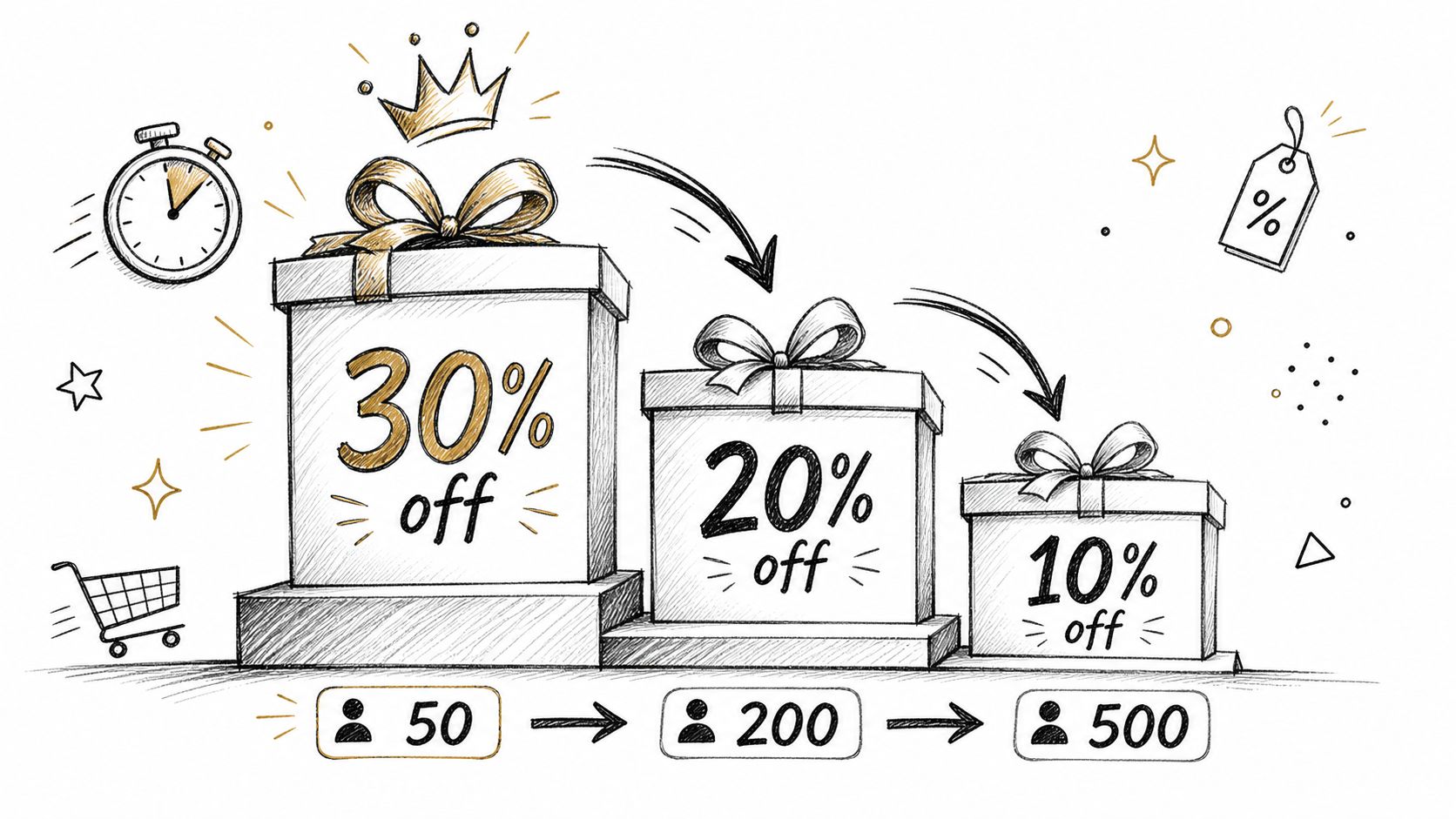
This structure works especially well when you want urgency tactics to increase Shopify conversions without defaulting to one blanket code that compresses margin across the entire order set.
4. Exclusive Access Windows for Specific Audiences
Not every urgency campaign should go to everyone at once. In many stores, the better move is to open the offer to a specific audience first. Email subscribers, SMS subscribers, loyalty members, and past buyers are the obvious groups.
This works because exclusivity changes the emotional frame. The offer feels earned, not dumped on the market. That’s good for conversion, and it’s good for brand perception.
A VIP early-access window for a new collection is a clean example. So is giving subscribers a first look at a seasonal promotion before paid social traffic sees it. Loyalty members can also get a private buying window before a wider rollout. In each case, urgency comes from access and timing, not just discount depth.
Why exclusivity feels stronger than a public sale
Commitment and consistency matter here. A customer who joined your list or bought before already has some relationship with the brand. When you reward that behavior with priority access, the promotion reinforces loyalty instead of cheapening the product.
It also gives you a better way to use your owned channels. Rather than sending one more generic “sale now live” message, you’re offering an advantage that the wider market doesn’t have yet.
Early-access windows are one of the few urgency plays that can lift conversion and make the brand feel more premium at the same time.
A few decisions make this tactic cleaner:
- Be explicit about who gets access: “Subscribers only” is stronger than vague VIP language.
- State the public rollout timing: Buyers should understand the advantage they’re getting.
- Use the private window to gather proof: Early purchasers, reviews, and UGC strengthen the wider release later.
- Keep the segment logic tight: Past buyers and engaged subscribers usually respond better than a broad, unqualified list.
This approach is especially useful for Shopify brands that want urgency without making the homepage look like a constant promotional zone.
5. Point-of-Decision Incentives at Cart or Checkout
Some urgency should wait until intent is already high. Cart and checkout are the best places to do that because the shopper has already done most of the work. They’ve chosen the product. They’ve accepted the price direction. What’s left is the final hesitation.
That’s where a tightly framed incentive can help. A free shipping threshold, a time-bound gift, or a limited checkout reward can convert the buyer without broadcasting a discount to every visitor upstream.
This tactic is powerful because it meets the customer at the moment where abandonment is most expensive. It also lets you reserve margin by exposing the incentive only to people who have already shown intent.
Keep the reward earned, not obvious
The mistake here is throwing a popup in front of everyone. If the same incentive is visible from homepage to checkout, it stops feeling discovered and starts feeling standard.
A better setup is more controlled. A fashion brand can reveal a cart-level shipping incentive once the shopper is close to purchase. A beauty brand can add a limited gift at the final step. An electronics merchant can present a short-window checkout reward on selected items where hesitation tends to be highest.
According to Popupsmart’s Shopify conversion rate analysis, reducing checkout friction alone can produce a +0.3-0.5% lift, and urgency layered onto an already optimized flow can compound that effect. The message for operators is simple. Fix friction first, then add urgency where it helps the decision instead of cluttering it.
Use a few guardrails:
- Auto-apply the reward when possible: Extra code-entry work kills momentum.
- Keep the offer simple: Cart-stage incentives should be understood in a glance.
- Limit the exposure: High-intent moments are more valuable than sitewide visibility.
- Review abandonment after launch: If completion drops, the message may be distracting rather than persuasive.
Good cart urgency feels like a nudge at the right moment, not another layer of promotional noise.
6. Social Proof Mechanics Showing Real-Time Participation
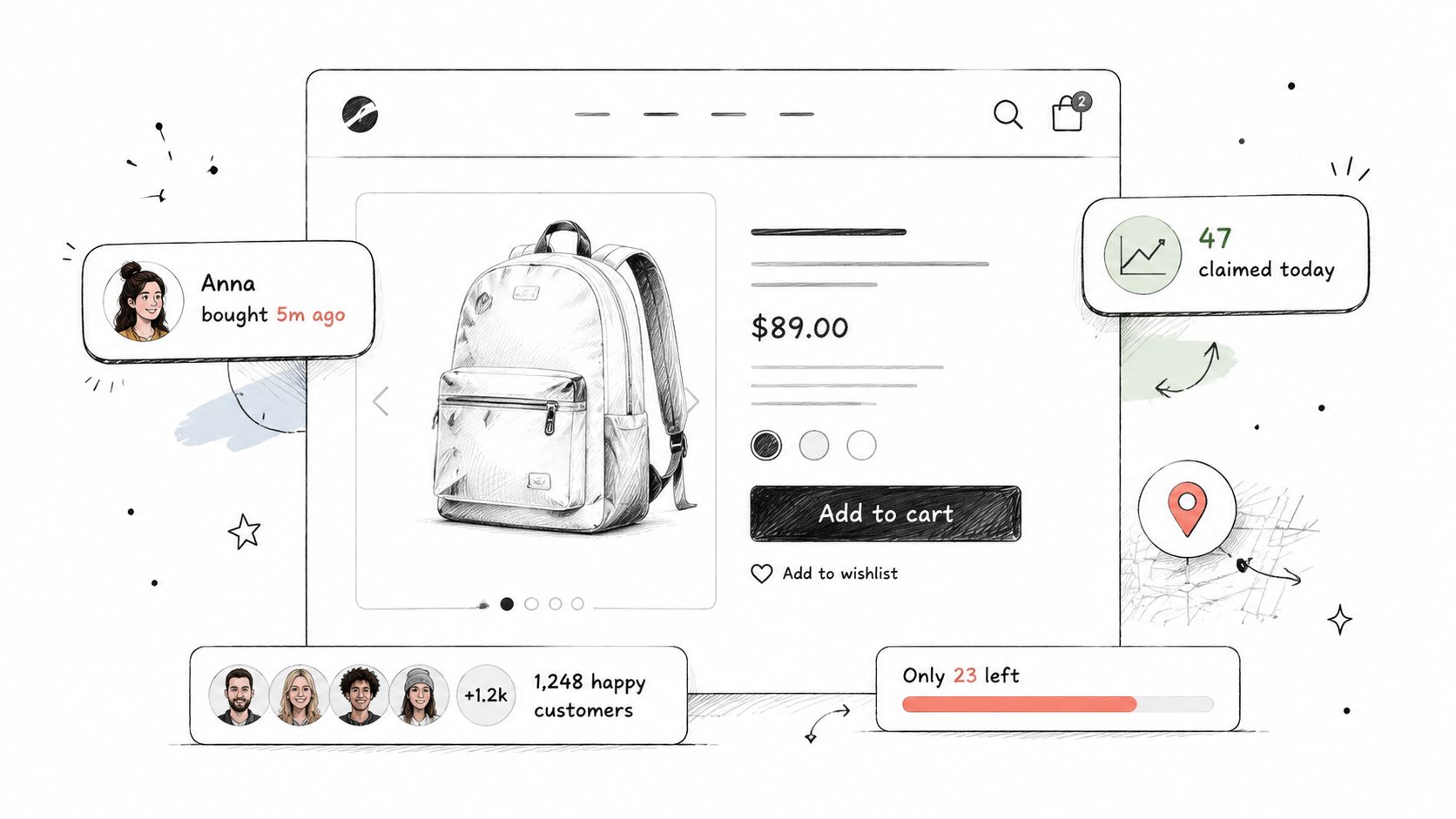
Urgency converts better when buyers believe other people are acting on it too. That’s where social proof helps. A claim counter, recent purchase signal, or visible participation feed can make the offer feel credible rather than isolated.
Urgency without validation can feel risky. If a shopper sees a deadline but no evidence that anyone else cares, the offer can look manufactured. Social proof reduces that hesitation.
One useful benchmark here is review density. Stores that display 50+ verified customer reviews alongside urgency cues see 15% higher conversion rates. That makes intuitive sense. Reviews tell the buyer the product is safe to buy. Urgency tells them now is the moment to do it.
Real participation beats fake motion
If you show claim counts, they need to be real or at least tied to recent, accurate activity. The same goes for purchase notifications and customer photos. Fabricated proof doesn’t just fail. It damages credibility the moment a shopper spots the pattern.
Apparel and beauty brands can do this especially well because they often have review content, visual UGC, and frequent order activity that can be surfaced naturally. If a promotion is moving, show that movement. If it isn’t, don’t fake it.
Some practical ways to handle it:
- Pair social proof with urgency, not instead of it: Reviews and participation cues strengthen the deadline or cap.
- Use verified sources of proof: Reviews, recent orders, and customer photos are stronger than generic badges.
- Place proof near the decision point: Product pages and cart surfaces tend to do the most work.
- Keep it believable: Shoppers trust proof that feels recent, specific, and grounded in actual store activity.
Quikly’s article on social proof marketing for ecommerce is a helpful read if you’re trying to tighten the connection between urgency and trust.
7. Urgency-Driven Email and SMS Sequencing
Urgency isn’t a single message. It’s a sequence.
Too many brands announce a promotion once, then hope the market catches up. That wastes the offer. A better system uses email and SMS as a timed progression. First message announces the opportunity. Follow-up messages reinforce the deadline, update the shopper on progress, and create a legitimate final-call moment before the promotion closes.
Build an arc, not a blast
This works because people rarely act on first exposure alone. They get distracted, compare options, leave the inbox, or intend to come back later. Sequencing keeps the promotion alive long enough for intent to convert.
Subscriber-only offers and launch campaigns are good fits here. A fashion brand might announce early access by email, then use SMS near the end of the window when urgency is highest. A beauty brand might lead with offer details in email and reserve text for the last-chance reminder.
The strongest sequences use channel roles clearly:
- Use email for context: Product details, landing pages, and social proof belong here.
- Use SMS for immediacy: Save text messages for moments where the deadline carries real weight.
- Update messages dynamically: Claim progress or remaining time makes follow-ups more believable.
- Respect deliverability: Poor authentication and list hygiene can weaken even a strong campaign.
If your team is leaning more heavily on email for launch and urgency campaigns, mastering SPF, DKIM, and DMARC is worth reviewing so the messages land where they’re intended.
One caution is important here. More messages don’t automatically mean more conversion. If the sequence feels repetitive, urgency turns into fatigue. Good sequencing creates momentum. Bad sequencing just repeats “ends soon” with slightly different subject lines.
8. Engagement-Earned Rewards Requiring Customer Participation
At this point, urgency starts doing more than forcing a faster purchase. It starts creating a better promotional experience.
Instead of handing every visitor the same discount, you ask the shopper to do something to earn the reward. That might be joining email, subscribing to SMS, referring a friend, entering a code, or interacting with an on-site mechanic that reveals the offer. The participation changes the psychology.
Once a shopper has taken an action, commitment and consistency kick in. They’ve invested a little effort, so completing the purchase feels more natural.
Why participation improves both conversion and brand feel
This approach can be much healthier than passive discounting. The reward feels earned. The campaign feels more like an experience. And your team often gets something useful in return, like first-party data or a referral action.
That’s especially valuable for Shopify brands trying to avoid the flat-discount trap. A hidden reward revealed after signup feels different from an always-visible coupon code sitting in the site header. It can still create urgency, but it doesn’t announce to every shopper that the brand’s baseline move is discounting.
There’s also a trust angle. Authenticity matters in urgency. One LinkedIn analysis notes that 72% of consumers distrust fake scarcity tactics, which is exactly why participation-based mechanics can work so well when they’re transparent. The urgency is attached to a real action and a real outcome, not a timer that resets forever.
The best earned-reward campaigns feel fair, fast, and clearly worth the effort.
Keep the execution disciplined:
- Reduce mobile friction: If the action takes too many taps, completion falls.
- Tie the action to a business goal: Email capture, SMS opt-in, or referral growth should be intentional.
- Make the reward reveal immediate: Shoppers should see the payoff right after participation.
- Avoid gimmicks that feel rigged: If there’s a game element, fairness matters.
These are some of the strongest urgency tactics to increase Shopify conversions when you want the promotion to generate more than just one order.
8-Point Urgency Tactics Comparison
| Tactic | Implementation Complexity | Resource Requirements | Expected Outcomes | Ideal Use Cases | Key Advantages |
|---|---|---|---|---|---|
| Limited Quantity Offers | Medium, real-time counters and disable logic | Inventory planning, real-time counter UI, cross-channel display | Conversion lift, controlled discount spend, perceived scarcity | Seasonal/limited-stock items, capped free gifts, early-access drops | Genuine scarcity, margin protection, transparent trust-building |
| Time-Bound Offers with Visible Countdowns | Low–Medium, timer UI and expiry handling | Timer UI, scheduling, mobile responsiveness, analytics | Immediate purchase acceleration, clear campaign windows | Short flash sales, product launches, time-limited promos | Clear deadline, reduces decision fatigue, easy measurement |
| Tiered Rewards That Step Down as Claims Increase | High, tier logic and automatic advancement | Backend claim tracking, dynamic UI, tier design, analytics | Higher AOV, margin control, staged urgency waves | High-margin launches, social-driven drops, staged promotions | Protects margins, incentivizes earliest buyers, transparent tiers |
| Exclusive Access Windows for Specific Audiences | Medium, gated access and timed rollout | Segmentation, email/SMS integration, access controls | Increased engagement among loyal segments, list growth | VIP launches, loyalty rewards, subscriber-only offers | Rewards subscribers, builds loyalty, controlled premium urgency |
| Point-of-Decision Incentives at Cart or Checkout | Medium, trigger-based offers in checkout flow | Checkout/discount integration, UX testing, real-time triggers | Reduced cart abandonment, higher checkout conversion, AOV lift | Cart recovery, last-step upsells, checkout friction points | Targets highest intent, immediate impact on conversion, surprise value |
| Social Proof Mechanics Showing Real-Time Participation | Low, notification/counter displays (needs accurate data) | Event tracking, live counters/notifications, privacy safeguards | Increased trust and FOMO, cost-effective conversion lift | New product pages, ongoing promotions, social-validated offers | Builds legitimacy, passive urgency, low incremental cost |
| Urgency-Driven Email and SMS Sequencing | Medium–High, automation, dynamic content, timing logic | ESP integration (Klaviyo), copy, deliverability setup, segmentation | Higher redemption, re-engagement, conversions without larger discounts | Multi-day campaigns, segmented audiences, cart/launch sequences | Narrative-driven urgency, multiple touchpoints, targeted reach |
| Engagement-Earned Rewards Requiring Participation | High, interactive mechanics and reward validation | Interactive UI (spin/share), backend validation, data capture, testing | Stronger commitment, list growth, viral sharing, better data | Acquisition with data capture, gamified campaigns, referrals | Builds brand experience, drives signups, increases purchase commitment |
From Urgency to Loyalty Your Next Move
Strategic urgency isn’t manipulation. It’s structure. Shoppers already make decisions through a mix of scarcity bias, loss aversion, social proof, and timing. The job is to turn those real behaviors into promotions that are credible, controlled, and commercially sound.
That’s the part many stores miss. They chase conversion with blanket discounts, constant flash sales, and generic countdowns, then wonder why margin gets thinner and brand perception starts slipping. The problem usually isn’t that the offer was too small. It’s that the promotion trained customers to wait, or made the brand feel easier to buy on discount than at full value.
The better path is selective urgency. Limited quantity offers keep cost under control. Countdowns work when the deadline is genuine. Tiered rewards let you reward speed without giving the deepest incentive to everyone. Exclusive access windows make urgency feel premium. Cart-stage incentives reserve your spend for high-intent shoppers. Social proof validates the decision. Email and SMS sequences create a real arc. Participation-based rewards turn promotions into something customers actively engage with.
If you only take one action from this list, start small and stay honest. Pick one tactic that matches your current problem. If your issue is margin pressure, test a limited-cap offer or descending tier instead of another sitewide discount. If your issue is cart abandonment, focus on a point-of-decision incentive. If your issue is list growth and repeatable owned-channel revenue, test an earned reward tied to email or SMS.
Then watch the right things. Don’t only ask whether conversion moved. Ask whether average discount stayed healthy, whether the campaign felt on-brand, and whether customers responded like the urgency was real. Those questions matter because a promotion that wins for a weekend and weakens the brand for a quarter isn’t really a win.
For Shopify teams that want a more controlled version of this approach, Quikly is one option to consider. It lets brands run time- and quantity-bound promotional experiences across storefront, email, social, and SMS, and the mechanics have been refined across more than 60 million consumer interactions. The appeal isn’t just urgency by itself. It’s the ability to create urgency without defaulting to another blanket markdown.
Urgency works best when it gives customers a clear reason to act now and a clear reason to trust the offer. That combination is what turns short-term conversion pressure into longer-term loyalty.
If you want to test urgency without turning your store into a permanent sale rack, Quikly is built for that. It helps Shopify brands run time- and quantity-bound promotions that feel on-brand, reward action, and give your team more control over conversion, margin, and customer perception.
Topics: urgency tactics, shopify conversion rate, ecommerce promotions, increase shopify sales, scarcity marketing