A Shopify brand launches another blanket 20% off promotion. The SMS goes to everyone, including recent buyers, high-value customers, cart abandoners, and people who haven’t purchased in months. The message gets seen quickly, but the list feels less responsive, margins tighten, and a few subscribers reply with the only word that matters in that moment: STOP.
That outcome doesn’t mean marketing bulk SMS has stopped working. It means a high-visibility channel is being used as a megaphone when it should be used as a decision system. The practical path is consent-first list growth, useful segmentation, behavior-based automation, credible urgency, and measurement that includes profit instead of treating every conversion as a win. For broader Shopify planning, the Shugert marketing playbook for Shopify is a useful resource for connecting channel tactics to the wider store strategy.
Why Bulk SMS Still Works When Discount Fatigue Sets In
SMS remains one of the few marketing channels that can put a message in front of an opted-in customer almost immediately. Promotional SMS open rates are consistently reported around 90% to 98%, with many messages read within minutes, and SMS campaigns commonly reach about 45% response rates versus roughly 6% for email (Project Broadcast’s SMS benchmark overview).
That visibility creates a useful advantage for a Shopify merchant running a same-day promotion, a back-in-stock alert, or a replenishment reminder. It also creates a temptation to send more often. When every message carries the same discount, subscribers learn the pattern. They don’t need to buy today because another offer will probably arrive soon.
The problem has three parts:
- Margins shrink: Repeated blanket discounts force the brand to give away more value to reach the same level of urgency.
- Conversion remains uneven: A general offer doesn’t answer the specific reason a shopper hasn’t bought.
- Brand perception weakens: Predictable markdowns can teach customers to wait rather than purchase when intent is highest.
Practical rule: Use SMS to clarify why someone should act now, not simply to announce that the store is cheaper again.
A broad campaign still has a place. Product launches, seasonal events, and time-bound inventory moments can justify a broadcast. But the campaign should sit inside a larger system. Build the list with explicit consent, separate customers by behavior and value, write messages around one action, protect quiet hours, and compare broadcast results with automated flow performance.
The best programs treat SMS as a retention channel with different jobs. A cart abandoner needs reassurance or a useful reminder. A VIP may need early access. A customer approaching a normal replenishment window may need convenience rather than a discount. Once those jobs are clear, the channel becomes more precise and less dependent on ever-larger promotions.
Building a Compliant Subscriber List and Segmenting It
List quality starts before the first send. Use keyword opt-ins, checkout consent, post-purchase enrollment, and signup forms that state what subscribers will receive and how frequently they should expect messages. A vague promise of “exclusive updates” attracts people who may not want promotional texts, while honest language filters for subscribers with a clearer expectation.
Consent also affects deliverability and response. One benchmark summary reports that 84% of consumers have opted in to receive business texts, while campaign click-through rates in 2025 varied seasonally from 3.47% in January to 23.92% in December, and unsubscribe rates stayed around 0.10% to 0.14% (Omnisend’s SMS marketing benchmarks). Those figures shouldn’t become a promise for your store. They do show why audience intent, timing, and list hygiene deserve as much attention as copy.
Build consent into the Shopify journey
A practical setup includes:
- A keyword entry point: Promote a keyword on packaging, social content, in-store signage, or a post-purchase page.
- A clear checkout option: Separate marketing consent from terms acceptance, and make the disclosure easy to read.
- A post-purchase invitation: Ask recent buyers to subscribe to useful product updates, replenishment reminders, or early access.
- A source record: Store when and where each subscriber opted in, then keep that record connected to the customer profile.
- A preference path: Let people reduce promotional contact without forcing them to abandon every useful message.
A single broadcast list fails because subscribers have different relationships with the brand. Create segments that map to a message job, not just a demographic label.
A workable segment map
| Segment | Message Job | Example Trigger |
|---|---|---|
| VIPs by lifetime spend | Reward loyalty with access, exclusivity, or useful previews | A new collection or private promotion is ready |
| Cart abandoners | Remove friction and recover existing intent | A shopper leaves checkout without purchasing |
| Replenishment-window customers | Make the next purchase convenient | The customer approaches the normal product-use cycle |
| First-time buyers | Reinforce the relationship and guide the next action | The first order is delivered or reviewed |
| Lapsed customers | Re-establish relevance without defaulting to a deeper discount | The customer has been inactive beyond the brand’s normal buying pattern |
For a focused list-building process, the guide to growing SMS subscribers fast offers additional ideas for turning existing site traffic and customer interactions into permission-based subscribers.
Start with the segments your Shopify data can support reliably. Lifetime spend, order history, product type, cart status, and purchase date are usually more useful than a long list of speculative attributes. A smaller set of accurate segments will outperform a complicated structure nobody maintains.
Writing SMS Templates That Earn the Reply
A strong promotional SMS has a simple architecture. Identify the brand, present one clear offer or action, include one link, and give the shopper a credible reason to act now. The message should feel complete without requiring the recipient to decode multiple products, conditions, and links.
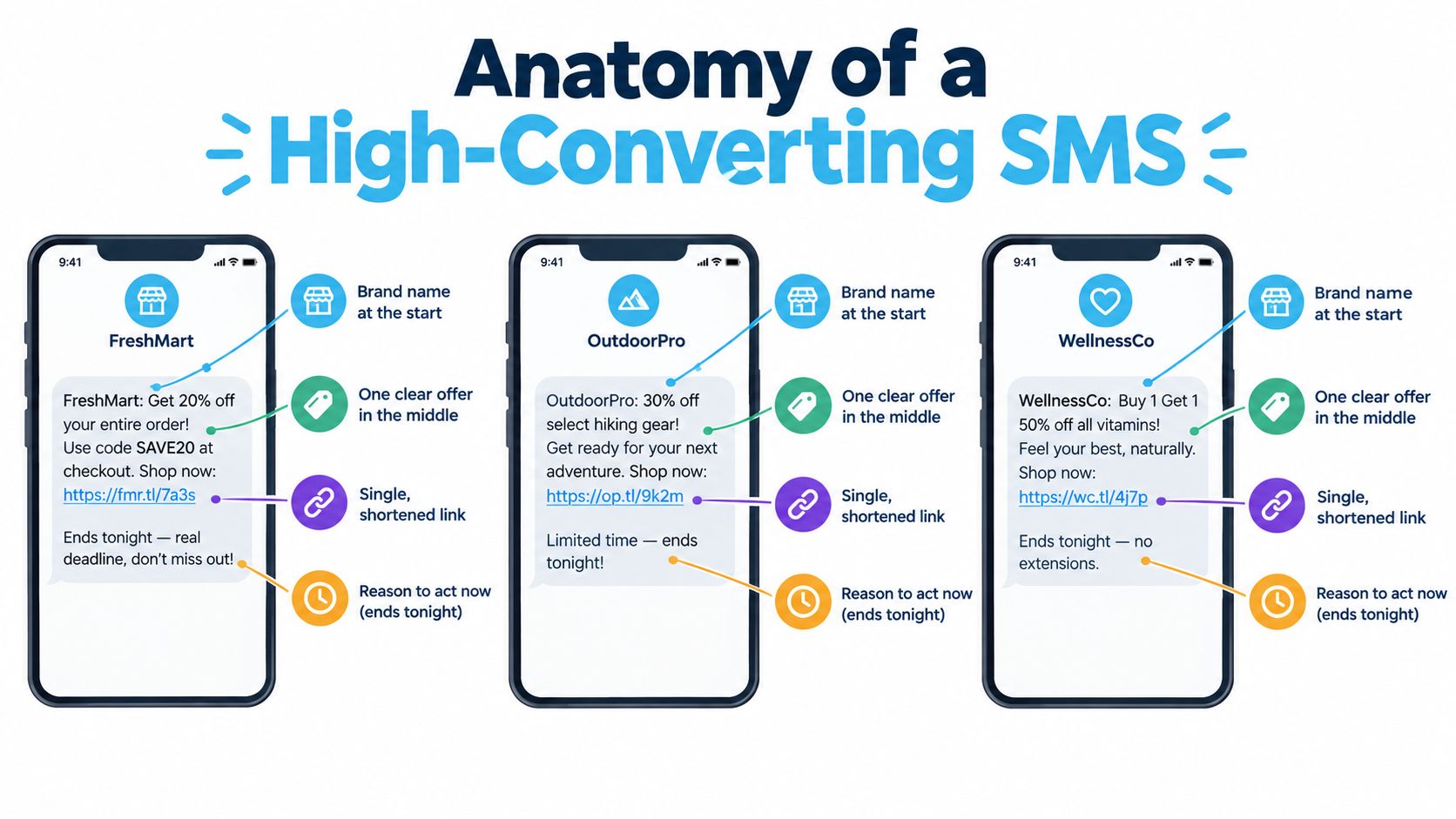
Use one message for one job
VIP early access
Northstar: VIP access is open. Shop the new linen collection before it reaches the full list: [short link]. Reply STOP to opt out.
This works because exclusivity replaces a routine markdown. It uses scarcity bias without pretending that inventory is disappearing if it isn’t. The subscriber receives a reason to care that reflects their relationship with the brand.
Cart recovery
Northstar: You left your selected items in your cart. They’re still waiting here: [short link]. Reply STOP to opt out.
A cart reminder doesn’t always need a discount. Loss aversion can make the cost of losing a considered purchase more salient, but the message should remain accurate. If stock, shipping, or a legitimate offer expires, say so. Don’t invent a deadline to force a click.
Replenishment reminder
Northstar: Running low on your daily cleanser? Reorder your usual product here: [short link]. Reply STOP to opt out.
This message aligns with a known customer need. It doesn’t ask the shopper to browse an entire catalog or accept an irrelevant promotion.
Ecommerce and retail SMS conversion benchmarks are typically reported at 11% to 20%, with automated SMS programs outperforming broadcasts when the message is tied to a specific shopper action (Business.com’s ecommerce SMS benchmarks). The practical implication is straightforward. Relevance should determine the send, and copy should make the next step obvious.
Set frequency around intent
Use stricter caps for broad promotional campaigns than for essential behavior-based flows. A recent buyer shouldn’t receive a replenishment reminder before the product could reasonably be used, and a cart abandoner shouldn’t remain in a recovery sequence after purchasing.
Schedule according to the recipient’s local time zone and the context of the offer. Quiet hours protect trust, while seasonal peaks can create stronger buying intent. The benchmark pattern noted earlier shows that response can vary sharply across the year, so review historical performance before assuming a single send time works for every month.
For abandoned-cart execution, the Carti abandoned cart tips are a useful complement to the broader segmentation approach. Keep the text short, make the link easy to tap, and suppress the message as soon as the customer completes the order.
Staying Compliant With TCPA and GDPR
Compliance isn’t a final checkbox before pressing Send. It shapes who enters the list, how carriers view your traffic, how quickly opt-outs are processed, and whether subscribers trust future messages. Treat customer consent data in Shopify and your SMS platform as operational infrastructure.
This is practical guidance, not legal advice. Have counsel review your forms, disclosures, message categories, and sending practices for the markets where you operate.
TCPA practices for United States sends
For US marketing messages, collect express written consent before sending promotional texts. The opt-in should identify the brand, explain that the person is agreeing to receive marketing messages, and disclose that consent isn’t a condition of purchase where applicable.
Use language that matches the actual program. For example:
By checking this box, I agree to receive recurring marketing text messages from Northstar at the number provided. Consent isn’t required to purchase. Message and data rates may apply. Reply STOP to opt out.
Your form should not use a preselected checkbox. Store the timestamp, source, phone number, and version of the disclosure. Configure STOP handling so the opt-out is processed immediately, and respect the recipient’s local quiet hours. The checklist below includes the operational controls a team should verify before every major campaign.
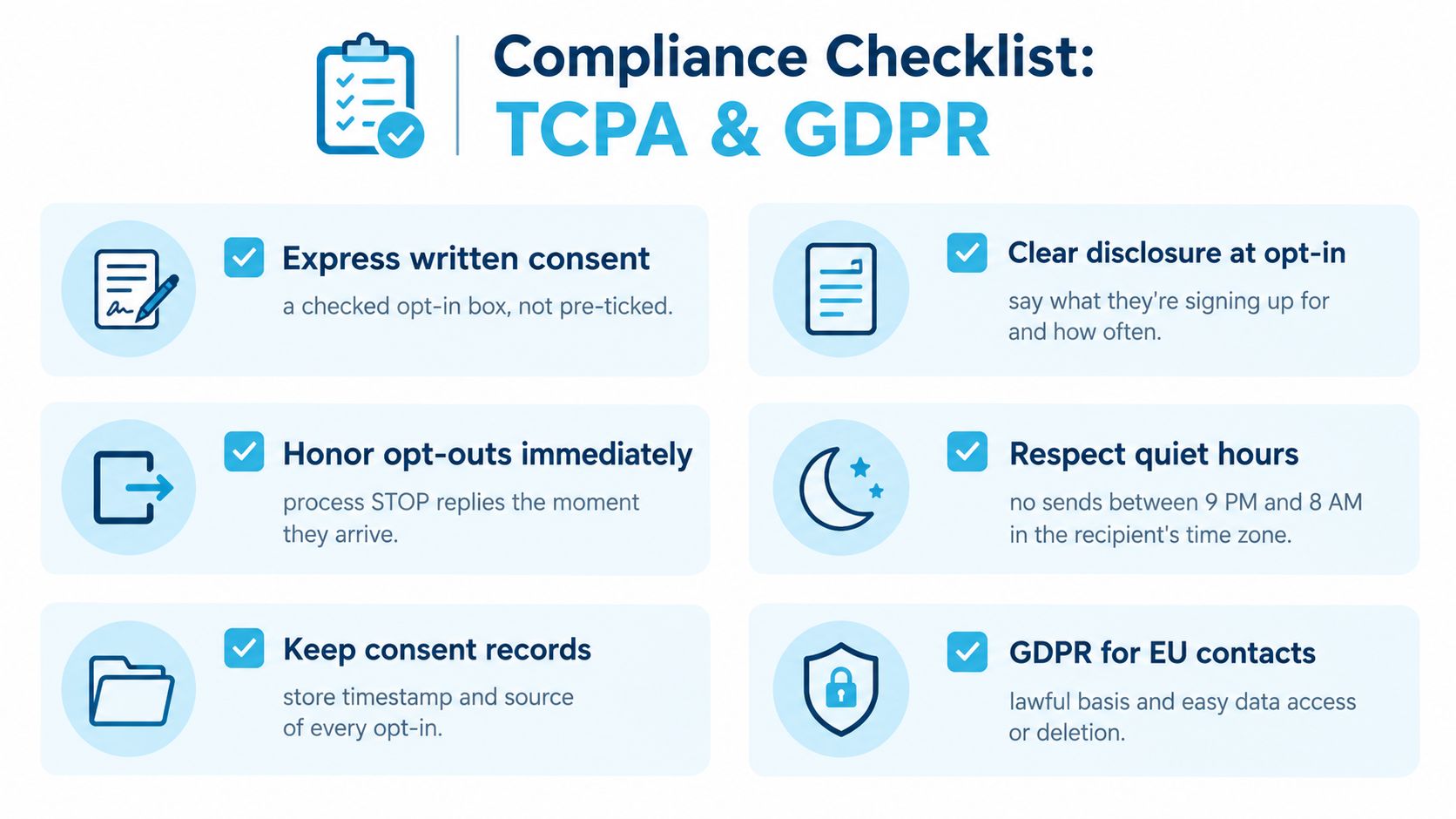
GDPR practices for European subscribers
For EU contacts, document the lawful basis for processing and make withdrawal easy. Keep consent records connected to the customer profile, explain the purpose of the messages, and provide a clear route for access or deletion requests.
Before sending, check:
- Consent status: The contact has a documented, appropriate opt-in for marketing SMS.
- Disclosure: The form accurately describes the program and expected frequency.
- Suppression: STOP replies and other opt-outs are excluded from every campaign and flow.
- Local timing: The send respects quiet hours in the recipient’s time zone.
- Data records: The source and timestamp of consent remain available for review.
- Platform settings: Your SMS app and Shopify customer fields reflect the current consent state.
First-party customer data is most useful when your team can activate it responsibly. The first-party data activation guide provides a helpful framework for connecting consented customer information to relevant experiences without treating every profile as a target for the same message.
Automations and Urgency Offers That Beat the Blast
The common assumption is that bulk SMS means sending one promotion to the largest possible audience. The stronger use case is often the opposite. The message should fire because a customer did something, reached a meaningful stage, or showed a need that the store can address now.
Recent ecommerce data reports that SMS volume grew 40% year over year in 2025, while automated SMS messages generated 5x more revenue per send than broadcast campaigns. Flows represented only 7.6% of sends but 45.2% of total SMS revenue (AudienceTap’s SMS marketing statistics). The gap points to a better optimization target: improve the trigger and audience before increasing send volume.
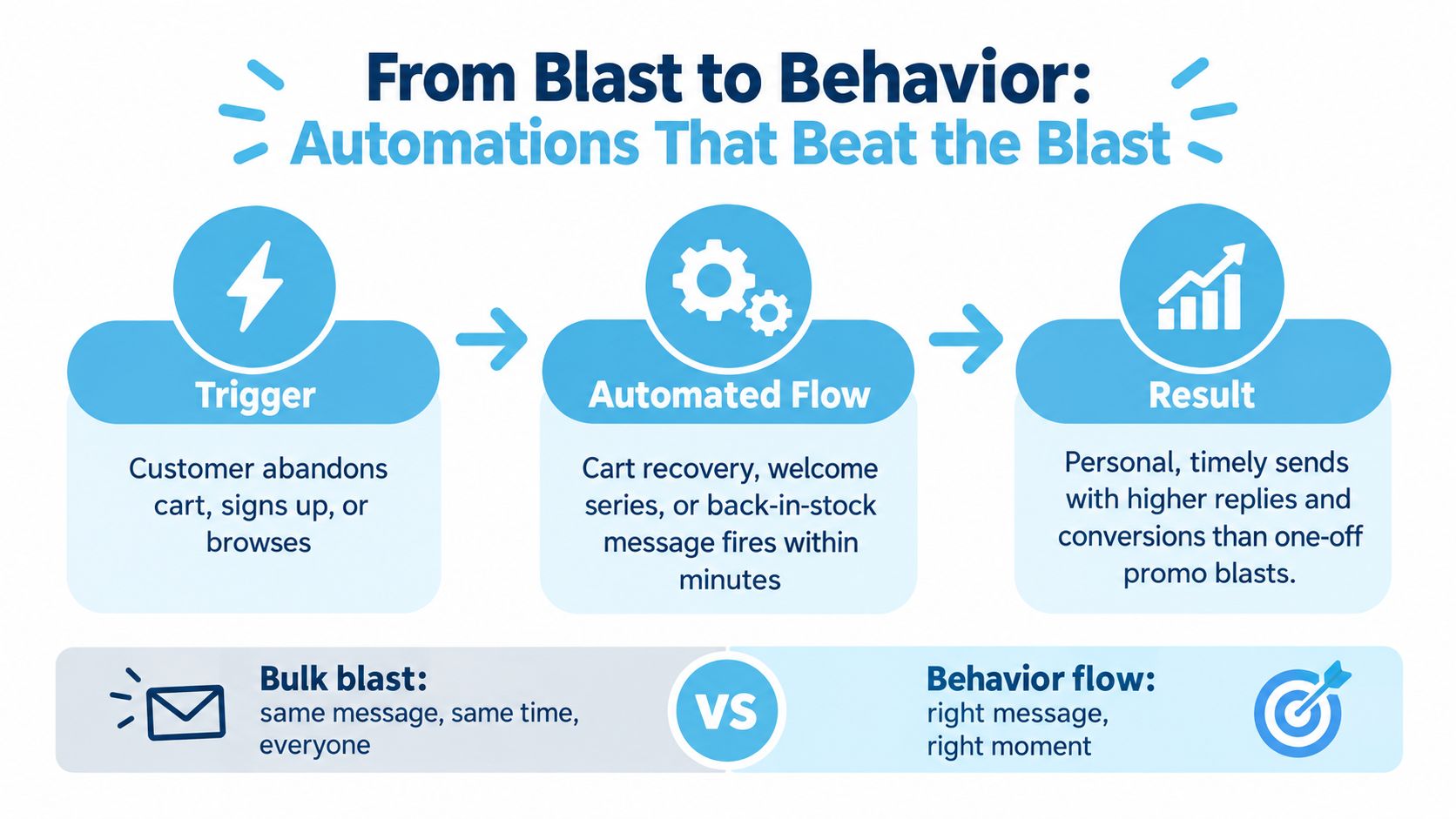
Build the flows that carry intent
A useful Shopify sequence might include:
- Welcome flow: Confirm the subscription, set expectations, and introduce the brand’s strongest first action.
- Cart recovery flow: Remind the shopper, answer a likely objection, and stop the sequence after purchase.
- Post-purchase flow: Provide usage guidance, request feedback, or introduce a product that fits the order.
- Back-in-stock flow: Alert only subscribers who showed interest in the unavailable product.
- Replenishment flow: Trigger from product history and a reasonable usage window, not from a generic calendar.
Klaviyo can coordinate email and SMS logic, while Shopify supplies order, customer, and cart events. The key isn’t the number of integrations. It’s whether the flow has a clear entry condition, an exit condition, and a message that changes based on what the shopper does next.
Replace automatic discounting with earned urgency
A flat discount says, “Buy whenever this code works.” A time- or quantity-bound offer says, “Act while this reward is available.” That distinction supports temporal discounting, because the immediate benefit becomes more valuable than a vague future saving, and it can use scarcity without relying on a fake countdown.
Quikly can run urgency and scarcity promotions across a storefront, email, and SMS, with rewards capped by claim count, time, or both. The offer can use a single reward or descending tiers, and its promotional experience can be styled to match the Shopify store. Jordan Craig reported a roughly 20% lift in profit, with incremental lift visible immediately on activation, while the mechanics have been refined across more than 60 million consumer interactions. Those results are context-specific, not a guarantee for every merchant.
A flash-sale example might work like this:
- Prepare the offer: Select a product with healthy inventory and define a real closing time or claim limit.
- Create the experience: Present a reward that improves for early claimants, then steps down as people claim it.
- Send to intent-rich subscribers: Use recent browsers, relevant product viewers, or customers whose purchase history fits the product.
- Coordinate channels: Let the storefront show the current reward while SMS announces access and email provides more detail.
- Stop accurately: Close the promotion when the time or quantity condition is met, then exclude claimants from conflicting offers.
The customer participates in a promotion rather than passively receiving another code. That gives the brand a reason to communicate immediately without making every subscriber wait for a permanent sale. More detail on connecting triggers across the customer journey is available in this guide to marketing automation workflows.
Measuring Performance and Protecting Your Margins
Open rate tells you that a message was visible. It doesn’t tell you whether the campaign created profitable demand. Track revenue per send, conversion rate by segment, unsubscribe rate, average discount depth, and contribution margin after the promotion.
In Shopify, use campaign-specific links and consistent attribution windows. Compare a broadcast with the relevant automated flow, then separate first-time orders from repeat purchases. A cart recovery message that receives credit for an order already likely to happen shouldn’t be judged the same way as a genuinely incremental offer.
Promotion fatigue deserves a place in the dashboard. One summary reports that after 4 to 6 exposures, cashback effectiveness can drop by up to 18% because of satiation and skepticism, while overly frequent promotions can train shoppers to delay purchases until a better deal appears (the cited promotion-fatigue summary). The answer isn’t automatically fewer promotions. It’s better reasons to act and tighter control over who receives them.
For a broader measurement framework, this marketing effectiveness guide for CEOs can help connect channel reporting to business outcomes.
Run a simple 30-day plan. Audit consent and suppress inactive or invalid contacts, launch one cart or replenishment flow, and test one genuine urgency-based offer against another blanket discount. Review profit, not just orders, then keep the mechanic that creates timely demand without teaching customers to wait.
Quikly helps Shopify brands turn standard promotions into time- and quantity-bound experiences that run across the storefront, email, and SMS. If you want to test urgency without defaulting to deeper blanket discounts, visit Quikly and explore a campaign built around real shopper action.
Topics: marketing bulk sms, shopify sms marketing, sms campaign guide, ecommerce text marketing, sms compliance