A Shopify brand can have steady traffic, decent creative, and a working discount code, then still end up with the same frustrating result, thin margins and almost no SMS list growth. That usually happens because the store treats SMS like a passive checkbox instead of a high-intent conversion moment. The smarter move is to make every useful touchpoint work harder, so the list grows faster without training shoppers to wait for deeper markdowns.
That matters because SMS isn’t just another channel. It’s a VIP channel when it’s done well, and shoppers should feel that immediately, not after they’ve ignored three generic popups. If your current flow feels like popup-and-pray, or if your promotions are doing all the heavy lifting, the fix starts with better capture design and clearer value exchange. For a broader view of how customers expect SMS to work, the current Quikly perspective on text message marketing expectations and future trends is a useful companion read.
Introduction
A lot of Shopify teams are in the same spot right now. Traffic comes in, discounts get pulled harder, and the store still isn’t turning enough visitors into SMS subscribers to build a channel it owns. That’s a bad trade, because every extra percentage point of margin given away to force a sale makes the next campaign harder to justify.
The good news is that how to grow SMS subscribers fast isn’t really a mystery. The brands that do it well treat sign-up like a conversion event, spread the ask across the customer journey, and give shoppers a reason to act now that feels specific, not generic. They also keep the offer honest, because the fastest list in the world isn’t useful if the subscribers churn or never engage.
The practical playbook is simple to describe and harder to execute. You need more capture points, smarter timing, stronger urgency, and clean consent mechanics, all while protecting brand perception and long-term list quality. The most useful setups don’t depend on one popup doing all the work, and they don’t assume that a bigger discount is always the answer.
Maximize On Site Capture Channels
Stop treating one popup like the whole strategy
Fast SMS growth comes from multiplying capture points, not from squeezing one form harder. Vibes recommends distributing opt-in across website popups and footer forms, checkout and account pages, email campaigns, social bios, in-store signage, and text-to-join keywords, and it also suggests running 2 to 4 dedicated email campaigns per year whose only job is growing the mobile list, while keeping SMS CTAs in regular promotional emails as well (Vibes). That approach works because email still reaches a lot of existing customers quickly, which makes it one of the fastest owned channels for moving people into SMS.
On Shopify, that means using the surfaces you already control. Add a footer embed to your theme, test a homepage banner, place an opt-in block on high-intent product pages, and add a checkbox or post-purchase prompt where checkout already has momentum. If you’re doing any kind of cross-channel capture, a useful outside reference is WhatsApp lead capture solutions, because it’s a good reminder that owned channel growth works best when the ask is embedded into real customer behavior.
A simple copy pattern helps all of these placements perform better:
- Tell people what they get now. Use an immediate promise like early access, VIP-only messages, or a launch alert.
- Keep the ask short. Long explanations kill momentum.
- Match the moment. Product pages should feel different from the homepage, and checkout should feel different from a blog CTA.
Practical rule: if a placement doesn’t clearly answer “why join now?”, it’s probably just adding clutter.
For stores that already use email aggressively, it’s often worth pairing SMS capture with a stronger email sign-up flow first, then inviting text later. The same logic appears in Quikly’s high-converting lead capture form blueprint, because lower-friction first steps tend to create more opportunities for the second ask to land.
Design Two Step Signup Workflows
Ask for one small action first
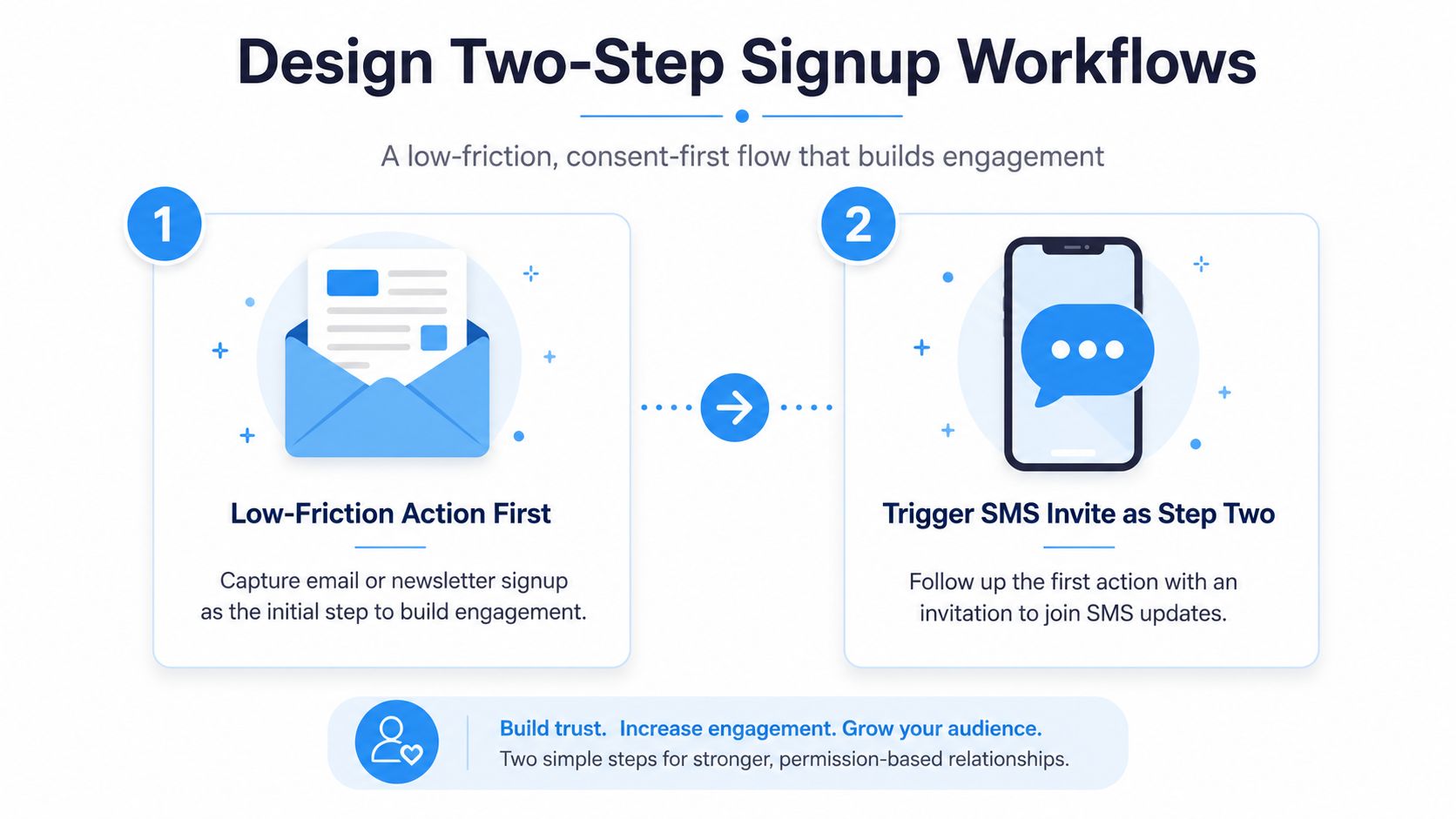
A single-step SMS form can feel too blunt, especially on mobile where shoppers are already deciding whether to keep scrolling. A two-step flow lowers friction by asking for one easy action first, then presenting the SMS invite as the second step with a stronger reason to say yes. That lines up with industry guidance that behavior-triggered and two-step capture can improve conversion when the offer gets stronger in the second step (Alia Popups).
The trigger matters as much as the form. Good timing points include a few seconds on page, meaningful scroll depth, or exit intent, because those moments suggest the visitor has engaged. Firing immediately usually creates resistance. Waiting until the shopper has shown interest gives the incentive a better chance of feeling earned.
A useful setup on Shopify looks like this:
- Start with email or newsletter capture. Keep it light and low commitment.
- Show the SMS invite next. Make the second step clearly stronger than the first.
- Use behavior triggers. Test time on page, scroll depth, and exit intent rather than showing the ask right away.
- Change one variable at a time. Offer, timing, copy, and placement should each be tested separately.
Short version: the second ask should feel like a better deal, not a repeated interruption.
If you’re building this in a Shopify app stack, the best tests are the boring ones. Swap in a stronger SMS incentive, move the trigger later, and compare the drop-off. A lot of teams try to diagnose too many things at once, then can’t tell whether the problem was the offer, the timing, or the form itself.
Craft Urgency Driven Incentives
Make the reason to act feel immediate
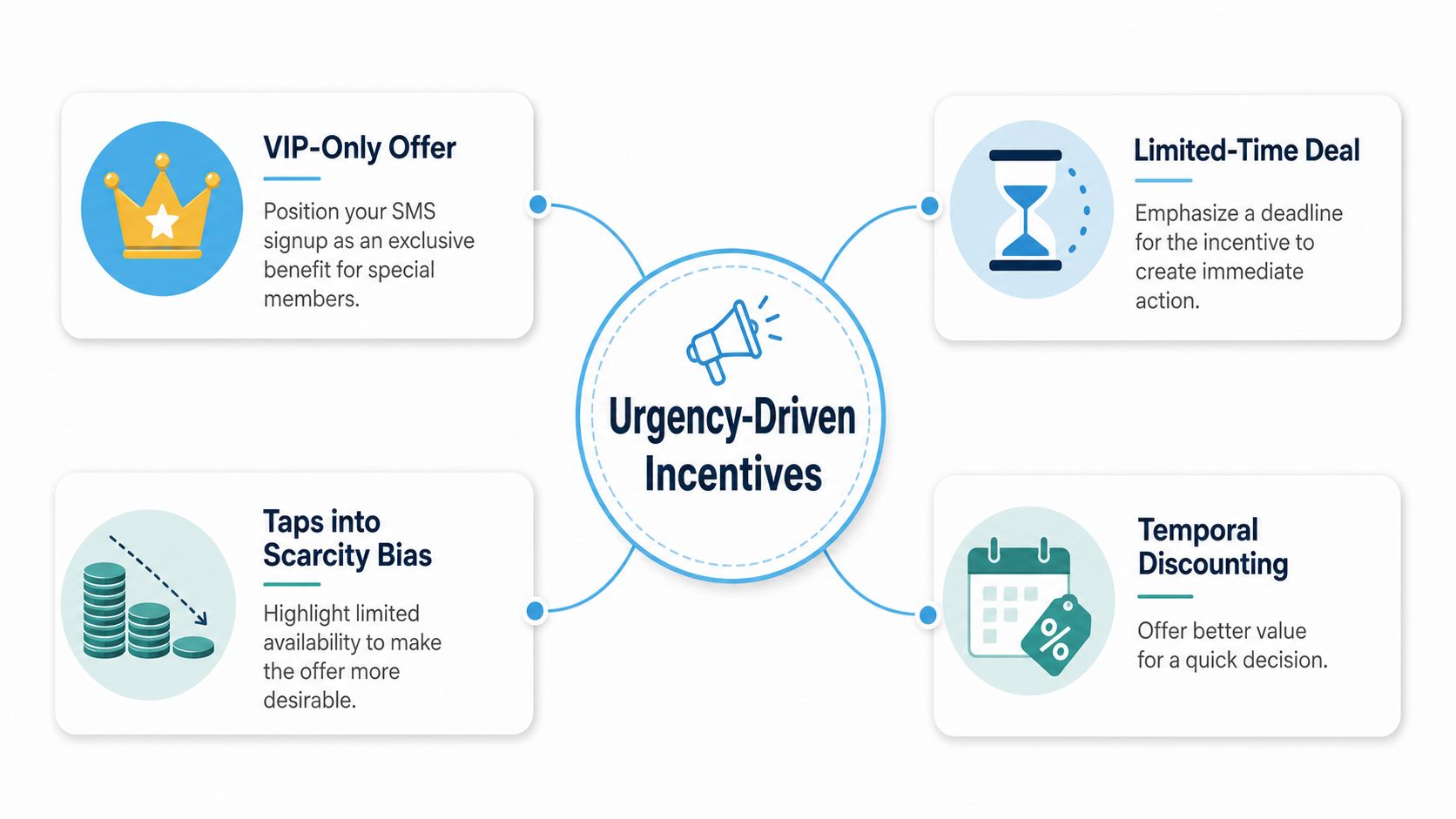
A shopper who is already comparing offers will respond faster when the SMS incentive feels timely and specific. Industry guidance points toward limited-time, text-only, or VIP-style offers because those prompts match how people decide in the moment, especially when they are already near a purchase (Infobip). The point is not to pressure people into signing up. It is to make the opt-in feel connected to a real benefit they can use right away.
The strongest incentive is not always the biggest one. Attentive recommends testing sign-up offers such as discounts, early access, or free shipping, and that lines up with what Shopify merchants see in practice. A smaller perk can outperform a broad percentage-off offer when the store already promotes discounts elsewhere, because subscribers are less likely to tune out a message that feels redundant.
Use urgency without collapsing margin
The trade-off is straightforward. A blanket discount may drive faster sign-ups, but it can also attract subscribers who only show up for the deal and then disappear. Community.com describes SMS as a VIP channel, which is a useful way to frame the list, because the goal is not to text everyone the same thing, it is to build a group that expects selective, high-value messages (Community.com).
A cleaner offer ladder usually looks like this:
- VIP-only access. Best when exclusivity matters more than price.
- Limited-time deal. Strong when the brand can support a short window.
- Free shipping or bonus perk. Often easier on margin than a bigger discount.
- Loyalty points or reward value. Useful when the goal is repeat behavior, not just the first opt-in.
For merchants who want tighter control over promotions, coupon management is worth a close look because the same issue shows up there, too. The question is how to give enough value to drive action without letting discounts bleed across every channel.
Practical insight: if your welcome offer is weaker than your public sale, the subscriber has little reason to act now.
A Quikly use case fits here as well. Its scarcity-based promotional setup gives a team a way to run urgency-driven campaigns without turning the store into a standing markdown engine, and that matters when the offer needs to feel tied to a live moment instead of a permanent discount.
For ideas on how scarcity can support text campaigns without sounding forced, see 3 ideas to use scarcity in text message marketing. The internal lesson is simple. Use urgency to create a decision, but keep the offer specific enough to protect the brand and the margin behind it.
Implement Compliance Best Practices
Make consent obvious from the first interaction
Fast list growth breaks down quickly if the signup language is vague. One guide advises stating how often subscribers will receive messages and making the opt-out method clear in the signup flow, while another recommends placing opt-in where traffic is already heavy, such as the homepage, checkout, and account creation flows (Dotdigital). That combination matters because shoppers need enough information to understand what they’re joining before they hand over a phone number.
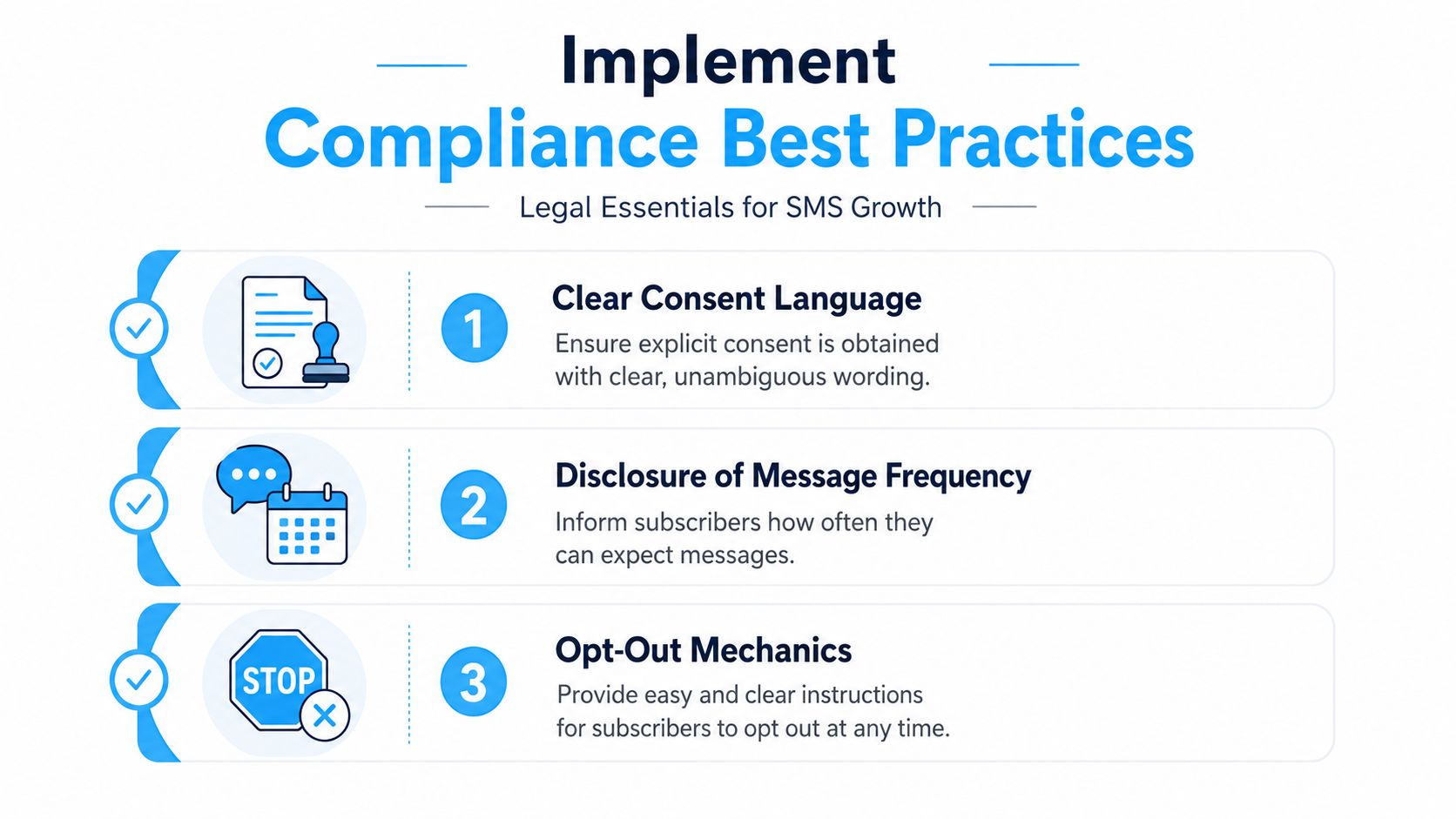
The cleanest Shopify forms do three things well. They make consent explicit, they set message expectations, and they keep the opt-out path visible. If any one of those is missing, you’re not just creating compliance risk, you’re also setting up early unsubscribes because the subscriber feels surprised later.
A practical compliance check on Shopify should look like this:
- Clear consent language. State exactly what the shopper is agreeing to.
- Message frequency disclosure. Tell them how often they’ll hear from you.
- Easy opt-out mechanics. Make the exit path obvious and simple.
- Immediate welcome value. Send the first message right away so the promise feels real.
That first send matters because it sets the tone. Community-style VIP positioning works only if the subscriber feels the channel is selective and useful from the start, not noisy a day later. Keep the early messages narrow, helpful, and consistent with what the form promised.
Measure and Optimize Subscriber Growth
Watch quality, not just volume
Subscriber quality and raw list growth pull in different directions, and Shopify teams feel that trade-off quickly. A bigger list can look healthy in a dashboard, but if those contacts do not open, click, or stay subscribed, the brand has bought volume without building a usable audience. Community-style SMS programs work better when the channel behaves like a VIP channel, with valuable sends and a cadence that matches engagement so the list does not wear out over time.
The better way to measure growth is to follow the full path, not just the sign-up count. Join source shows which placements are doing the work. Opt-out rate shows whether the offer oversold the channel. Subscriber engagement shows whether the people joining are likely to become repeat buyers, not just discount hunters.
A focused testing plan should include:
- Offer test. Compare discounts, early access, and non-discount incentives.
- Timing test. Move from immediate display to behavior-based triggers.
- Copy test. Tighten the value prop so it is specific, not vague.
- Placement test. Compare homepage, product page, checkout, and post-purchase capture.
Using Shopify reports together with your SMS platform dashboard lets you connect sign-ups back to specific touchpoints and see which ones deserve more traffic. The highest-volume source is not always the most valuable one. A smaller source can produce subscribers who buy again, while a larger source may bring in people who leave after the welcome offer.
The goal is not the biggest list. It is the list that stays valuable after the welcome offer is gone.
Once a flow is live, prune aggressively if you need to. If a placement brings in low-intent subscribers, or if a promotion attracts people who churn fast, adjust the incentive before you scale it wider. That trade-off matters more than chasing a higher sign-up count on its own.
Conclusion and Next Steps
The fastest way to grow SMS subscribers isn’t a single trick. It’s a system that captures people at more moments, asks in two steps when friction is high, uses urgency without normalizing constant discounting, and keeps consent language clean enough that subscribers know what they’re joining. That’s how Shopify brands grow the list without burning margin or teaching customers to wait for the next sale.
If you want a simple next move, pick one flow you’re not using today and run it for 14 days. Start with a checkout opt-in, an exit-intent second step, or a dedicated email campaign that invites SMS sign-up, then watch join source, opt-out rate, and early engagement together. The point isn’t to prove every tactic works. It’s to find the one that grows the list fast without cheapening the brand.
A CTA for Quikly.
Topics: sms marketing, sms subscribers, list growth, shopify ecommerce, sms opt-in