Shoppers often intend to buy, but a flat discount, a vague reminder, or another promotional blast may not give them a reason to choose this offer over the next one. For Shopify brands, more messages and deeper markdowns can bring short-term orders while adding pressure to margins and teaching customers to wait for a sale.
Strong SMS campaigns meet shoppers at a moment of existing intent. They make the reward clear, use a real limit or deadline, and respect the customer’s time. Cart abandonment shows why that moment matters: Baymard’s review of published studies puts average abandonment at 70.22%, while 42% of surveyed U.S. shoppers said they left a cart because they were just browsing or not ready to buy (Baymard’s cart abandonment research). Urgency can give an undecided shopper a reason to act, but it can’t fix checkout friction or justify a false deadline.
The example text messages below are practical starting points for welcomes, cart recovery, launches, restocks, VIP access, and closing reminders. Each pairs copy with the customer moment, a useful timing choice, and a way to assess whether the campaign helped without sacrificing trust. For a snapshot of Shopify SMS marketing technology, explore SMSBump store technology data.
1. First 100 Claimers Early Access Text
A product launch or restock already gives interested customers a reason to pay attention. A capped reward adds a second reason to act now: the offer is available to a limited number of claimants, and that limit is genuine. This uses scarcity bias without pretending the product itself is about to disappear.
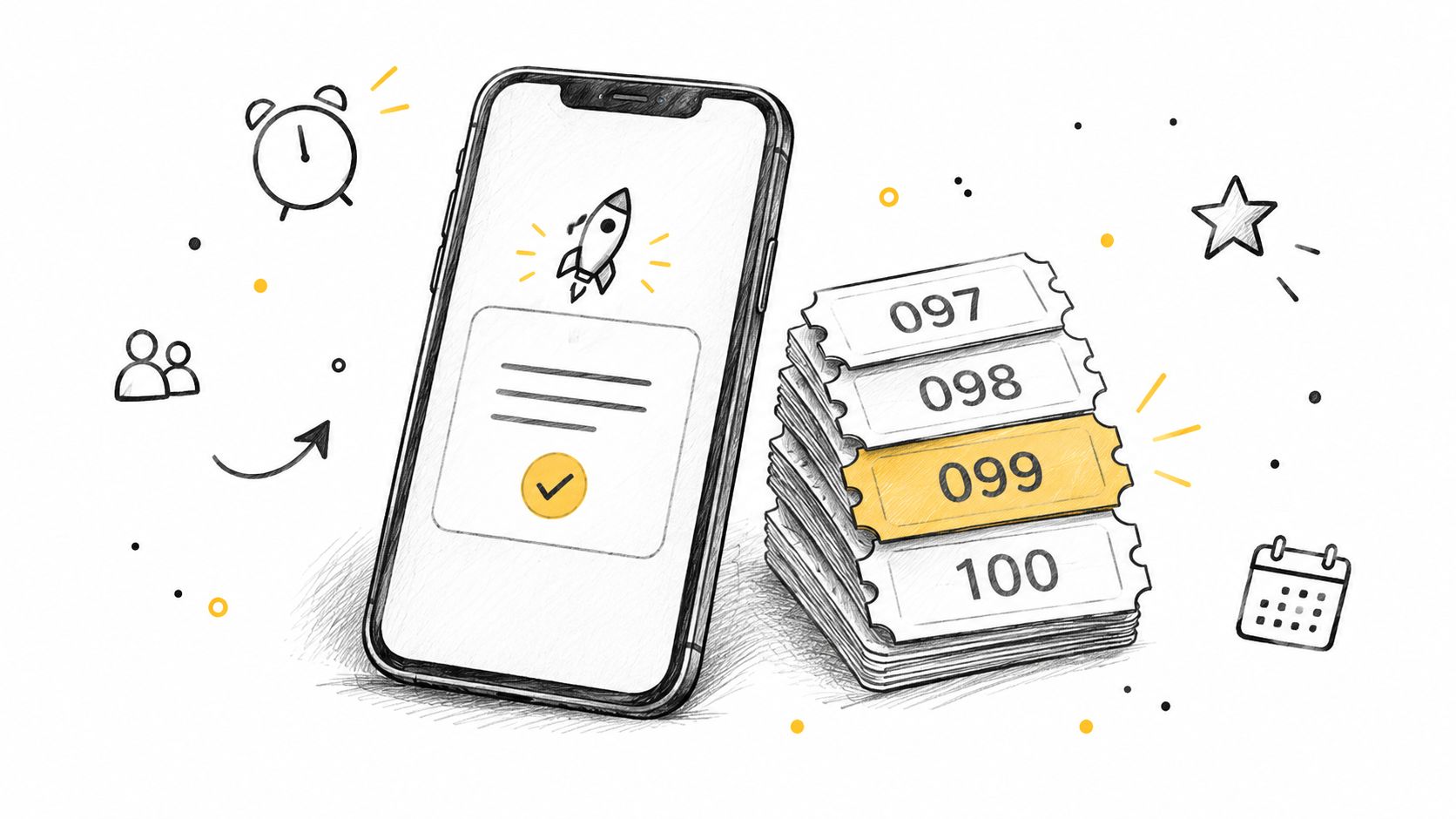
Example text: [Store]: The first 100 people to claim [reward] get it at [link]. Once the spots are gone, this offer closes. Reply STOP to opt out.
Put the claim cap and reward in the first sentence. A subscriber glancing at a lock screen should understand what’s available and why timing matters without opening a long message. Send it to customers who have explicitly consented to marketing texts, and link straight to the claim page rather than making them hunt for the offer.
This works best when the product itself has an audience: a requested restock, a bestseller, or a launch with established customer interest. If the reward has to carry the whole pitch, the campaign may be discounting a product shoppers don’t want. Keep the incentive attractive but controlled, and make sure the number of claims is capped.
Make the limit real
A visible limit only builds trust if the campaign enforces it. Don’t keep accepting claims after the stated spots are gone, and don’t restart the same “first 100” offer immediately with no explanation. Those shortcuts turn scarcity into a claim customers have reason to distrust.
Measure claims, purchases, and margin, not just link taps. Compare the campaign with a comparable launch or restock, and check whether the reward brought forward purchases or merely reduced the price for people who would have bought anyway.
2. Offer Closes Tonight Reminder
A reminder can help subscribers who noticed an offer but postponed deciding. It works when the closing time is real, was set in advance, and gives recipients enough time to act. A deadline that repeatedly slips doesn’t create useful urgency. It teaches customers that the stated end time can be ignored.
Example text: Last call from [Store]: [reward] closes at 11:59 pm tonight. Claim it here: [link]
Send the reminder a few hours before the offer ends, not in the final minutes, so shoppers have a practical chance to open the page and complete checkout. Repeat the reward from the original message. Recognition matters: a reminder that says only “last chance” makes the customer work to remember what’s ending.
Don’t send this to everyone by default. Target subscribers who received the initial offer and haven’t claimed it. That keeps the follow-up relevant and avoids telling recent claimants to act on something they’ve already completed. For more ways to use real limits in SMS promotions, see three scarcity ideas for text message marketing.
Track the reminder separately
Look at claims and purchases after the reminder, then compare them with the campaign’s earlier response. A late-stage spike in clicks doesn’t necessarily mean incremental orders; some recipients may have acted when they first saw the offer. Test reminder timing and wording while keeping the reward and closing time fixed.
3. Cart Recovery With a Claimable Reward
A cart message reaches someone who has already shown interest in a product. That makes the moment different from a broad promotional send: the shopper may need a nudge, but an automatic discount after every abandonment can also teach customers that leaving the checkout is how to get a better price.
Example text: You left [product] in your cart. Claim [reward] before [time] and check out here: [link]. Reply STOP to opt out.
Wait a reasonable interval after abandonment. A message that arrives immediately can feel like surveillance rather than assistance; a thoughtful delay gives the shopper time to complete the purchase independently. Keep the sequence restrained, and check that the mobile link restores the right cart and applies the reward as described.
Cart intent is worth addressing, but it’s not proof that every abandoned shopper needs a discount. Baymard reports that some shoppers leave because they’re browsing or not ready, and other barriers such as checkout friction can also intervene. A reward won’t fix unexpected costs, a confusing checkout, or an unavailable delivery option.
Make the path back simple
The message should point to the cart or product page, not a general home page. If the reward needs a claim step, keep that step clear and test the flow on a phone before sending. For further ideas on recovering shoppers without turning every abandoned cart into an automatic markdown, see Quikly’s cart abandonment recovery guide and Exerta’s abandoned-cart SMS guide.
Measure orders, not just clicks. A four-store SMS report found abandoned-cart flow conversion rates ranging from 6% to 14.7%, defining conversion as orders divided by messages sent (SMS report on four client stores). Treat those results as context, not a forecast for your store. Compare delivered-message conversion, revenue per message, opt-outs, and incremental orders against a holdout where possible.
4. Welcome Text With a Dated Reward
A welcome text follows a deliberate action: the customer chose to subscribe. A modest first-purchase reward can build on that commitment, while a clear expiry gives the offer a defined window instead of leaving it open indefinitely.
Example text: Thanks for joining [Store] texts. Your [reward] is open until [date]: [link]. We text about drops and offers. Reply STOP to opt out.
Send the message after the signup flow confirms the subscriber’s choice, and make it clear which brand is texting. State what kind of messages the subscriber can expect, then keep to that cadence. If your SMS provider or compliance process requires double opt-in, build that confirmation into the flow before sending marketing messages.
The reward should fit the economics of a first order. A deep discount may create an initial purchase while setting an unhelpful expectation for the next one. Promotions can encourage trial, but repeated markdowns can also influence how shoppers judge a brand’s quality and price fairness. Research on discount effects describes shoppers as comparing an offer with an internal reference price shaped by past experience and perceived brand quality (analysis of discount effects and reference prices).
Welcome with a reason, not a habit
Use the welcome message to introduce one relevant product or collection alongside the reward. Don’t promise a message cadence you can’t maintain, and don’t imply an offer is time-limited if it will remain available unchanged. Track first purchases and unsubscribe behavior alongside revenue so a strong initial response doesn’t mask a poor subscriber experience.
5. Descending Tier Step-Down Alert
A tiered promotion makes the changing reward visible. Shoppers who claim early receive the stronger current tier; as claims accumulate, the next tier offers less. That rewards timing rather than giving the same discount to every subscriber whenever they decide to buy.
Example text: The [current reward] tier is live now at [link]. When it steps down to [next reward], the early claim price stays where it is. Reply STOP to opt out.
Explain the mechanics on the landing page, where customers can see how tiers change and whether a claim locks in the reward. The SMS can stay brief, but the offer itself must be easy to understand. Send a step-down notice only after the tier has changed. If a message says the reward has moved when it hasn’t, subscribers have little reason to trust the next update.
Attribute orders to the right tier
Record the tier associated with each claim and order. Then compare conversion, order value, and margin across tiers. Early claimers may differ from later shoppers in purchase intent, so avoid treating differences between groups as proof that the message alone caused them.
This format needs a product and incentive that can support a visible progression. If the reward is too small to matter, tier changes may add complexity without giving shoppers a reason to act. If each step only deepens a discount, the campaign can recreate the margin problem it was meant to manage. Set the steps before launch and make sure the landing page, checkout, and SMS all show the same current offer.
6. Back-in-Stock Plus Launch Window
A back-in-stock subscriber has already asked to hear about a specific product. The alert should lead with that product, not bury it beneath a general sale message. A limited reward can add a reason to complete the purchase while the item is available, without requiring a blanket markdown on every unit.
Example text: [Product] is back in stock at [Store]. Limited units, and [reward] is open until [time] for the first orders: [link]
Use “limited units” only when live inventory supports it. Send the restock alert first, and consider a later reward reminder only if stock remains and the offer is still open. If the product sells out, pause or close the reward. Otherwise, the message may promise an opportunity customers can’t use.
Keep the product page ready
Restock clicks often come from shoppers who already know what they want. Send them directly to the product page, check that it loads properly on mobile, and confirm that the reward appears in the cart or checkout as promised. Don’t make customers search through a collection or enter an unrelated code to access the offer.
The reward is optional. If demand is already strong and inventory is tight, access to available stock may be enough. An incentive should solve a real conversion or margin problem, not become a reflex attached to every restock. Track purchases and sell-through against the inventory available when the alert went out, and distinguish the effect of the restock notification from any added reward.
7. VIP Early Access for Past Buyers
Early access can recognize a customer’s history without immediately reaching for a percentage-off offer. For a returning buyer, getting to shop a new collection before its public release may be valuable on its own. That makes access a possible alternative to price reduction when the brand wants to reward loyalty and protect perceived value.

Example text: As a [Store] customer, you get early access to [collection] before it goes live tomorrow. Shop here until [time]: [link]
Define the audience from purchase history in Shopify or a connected platform such as Klaviyo. Keep the eligibility criteria consistent, and make the access window real. If the public launch starts before the promised early-access period ends, customers may feel that the recognition was only a label.
Give customers a benefit they can understand before adding a discount they don’t need.
Use an incentive only if the collection needs additional help to convert. Early access can provide status and timing; a reward may be useful when the product or business objective calls for it, but layering discounts onto every loyalty message can make full price feel less credible. For ideas on reaching subscribers who’ve gone quiet, explore tips for reactivating dormant text subscribers.
Measure purchases during the access window, revenue and margin, and any difference in response between eligible past buyers and the broader audience. The point isn’t to declare every returning customer a VIP. It’s to send a relevant offer to a group whose relationship with the brand gives them a reason to care.
8. Final Hours Honest Countdown
A last-chance message is the clearest use of a deadline and the easiest one to misuse. When an offer is genuinely ending, the time remaining helps a subscriber judge whether to act. When the deadline moves without explanation, the message becomes pressure without credibility.
Example text: Two hours left on [reward] at [Store]. After [time], the offer closes. Claim it here: [link]
Send it only if the offer will close at the stated time. If the deadline changes, correct the message rather than letting the old claim stand. Avoid late-night or early-morning sends, and follow applicable quiet-hour, carrier, provider, and local SMS requirements.
Make the last call count
Use this message sparingly, for an offer important enough to justify the interruption. Suppress subscribers who have already claimed or purchased, and link directly to the live offer. If the deadline is close enough that a customer can’t reasonably read the message and complete checkout, the reminder may frustrate more than it helps.
For practical guidance on building urgency into sales messages, see how to boost conversions with urgency. Judge the campaign by completed orders, margin, and opt-outs, not by clicks alone. The objective is to help an interested shopper make a timely decision, not to manufacture anxiety.
8 Example Text Messages Comparison Matrix
| Example | Implementation Complexity | Resource Requirements | Expected Outcome | Ideal Use Case | Key Advantage |
|---|---|---|---|---|---|
| First 100 Claimers Early Access Text | Medium | Real claim cap, landing page, SMS consent | Fast claims with a measurable order cap | Product launches or planned restocks | Creates urgency while limiting reward costs |
| Offer Closes Tonight Reminder | Low | Accurate deadline, scheduled SMS, direct claim link | Recovers subscribers who delayed claiming | A compelling offer with a genuine end time | Easy to schedule and reinforces existing intent |
| Cart Recovery With a Claimable Reward | High | Cart data sync, claimable reward, tested cart link | Recovers abandoned-cart sales without automatic discounts | High-intent shoppers who left items in their carts | Ties an incentive to a specific purchase |
| Welcome Text With a Dated Reward | Medium | Opt-in flow, expiration rules, coordinated welcome messaging | Encourages a first purchase and sets messaging expectations | New SMS subscribers | Engages subscribers soon after sign-up |
| Descending Tier Step-Down Alert | High | Claim-tracking system, tier rules, updated landing page | Encourages earlier claims as rewards decrease | Launches or seasonal promotions with an engaged audience | Rewards early action while limiting deeper incentives |
| Back-in-Stock Plus Launch Window | High | Accurate inventory sync, restock list, product link | Converts high-intent subscribers while stock is available | Requested restocks with limited inventory | Combines existing product interest with a real availability window |
| VIP Early Access for Past Buyers | Medium | Purchase-history segmentation, timed access window | Supports repeat purchases and customer loyalty | New collections or promotions for returning customers | Offers recognition and access without relying on discounts |
| Final Hours Honest Countdown | Low | Verified end time, timing checks, direct offer link | Prompts action from shoppers who need a final reminder | Important offers that genuinely end soon | Makes the cost of delaying clear |
Build Messages Shoppers Trust and Act On
A useful SMS starts with a customer moment, not a discount. Identify what the person has done or asked for: joined the list, left a product in the cart, requested a restock alert, or bought from the brand before. Then choose a constraint that applies, such as a fixed end time, available inventory, or a capped number of rewards.
Make the benefit clear in the message and take the customer directly to the action. If the offer requires a claim, explain what happens after the click. If it’s VIP access, say when access ends. If the item is back in stock, ensure the product is still available before sending follow-up messages. Accuracy is part of the customer experience, not an administrative detail.
Test one variable at a time where possible. Compare message length, send timing, reward value, or offer type while holding the rest of the campaign steady. A claim rate can show whether people took up the offer, but it doesn’t tell you whether they purchased profitably. Measure conversions, average order value, claim rate, unsubscribe rate, and margin together. Where practical, use a randomized holdout to separate the message’s incremental effect from purchases that would have happened anyway.
Keep the economics in view. A higher conversion rate doesn’t automatically mean a better promotion if the discount erases contribution margin or trains regular customers to wait for the next offer. Research on discount strategy finds that perceived value depends on how the offer interacts with shoppers’ reference prices and their perception of brand quality (peer-reviewed analysis of discount strategy). Treat incentive design as a pricing and brand decision, not just a copywriting choice.
Consent and execution matter as much as the message. Send marketing texts only to subscribers with the required consent, identify the sender clearly, honor opt-outs, respect quiet hours, and check local SMS rules as well as your provider’s requirements. State real deadlines and stock conditions, and correct errors promptly. A customer who can get a useful answer when they reply is more likely to trust the next message than one who receives silence or an irrelevant promotion.
The sharper principle is simple: SMS works best when it makes a timely decision easier, without training customers to wait for deeper discounts. Build each message around a genuine reason to act, then measure whether it creates profitable action and a customer experience worth repeating.
Quikly helps Shopify merchants run on-brand promotions with rewards capped by time, claim quantity, or both, including offers that step down as shoppers claim. If you’re looking to make SMS promotions more actionable without relying only on deeper discounts, visit Quikly to see how it can support your campaigns.
Topics: example text messages, SMS marketing, ecommerce SMS, SMS templates, text message campaigns