Cart abandonment recovery starts with an uncomfortable number. Baymard Institute’s 2025 meta-analysis of 50 studies puts the global average cart abandonment rate at 70.19%, which means roughly 7 in 10 shoppers who add items to a cart never finish the purchase, and industry reporting repeats that benchmark as 70.22% in 2026 (cart abandonment statistics and benchmark summary). That’s not a small checkout issue, it’s a persistent revenue leak sitting inside every Shopify store.
The mistake most brands make is treating that leak like a reminder problem. They send a generic email, add a discount, then wonder why margin gets thinner and shoppers keep waiting for the next offer. A better playbook is closer to how to grow online store sales, because recovery sits at the intersection of conversion, timing, and promotion quality.
If the cart is already warm, the job is to respond in a way that matches intent instead of flattening it. That means cleaner detection, sharper timing, and incentives that feel earned rather than automatic. It also means knowing when to stop talking, because constant recovery blasts can train customers to ignore the brand.
Introduction
The reason cart abandonment recovery matters so much is simple. The pool of recoverable demand is enormous, and sources tied to Baymard estimate about $18 billion in annual global lost revenue from cart abandonment, with another benchmark putting recoverable revenue at roughly $260 billion annually in the US and EU and merchandise left in carts at $4.6 trillion globally (global cart abandonment statistics). That’s why abandoned checkout isn’t just a UX issue, it’s one of ecommerce’s biggest revenue leaks.
Shopify merchants feel the downside twice. First, they pay to bring the shopper to the cart. Then the default fix often becomes a deeper discount, which can erode margin and condition buyers to wait for promotions. A recovery program that only pushes harder on price solves the symptom and creates a second problem.
The smarter frame is behavioral. People don’t always need more persuasion, they need the right nudge at the right moment, with enough friction removed to make the next step easy. That’s where a recovery flow becomes more than a reminder sequence, it becomes a controlled decision path that protects both conversion and brand value.
Detect Abandoned Carts and Set Triggers
Abandoned cart recovery starts in the plumbing, not the copy. If your store can’t reliably tell the difference between a cart that stalled and a cart that converted, every message downstream gets messy. On Shopify, that means using event-based detection, not loose assumptions about someone being idle long enough to count as “gone.”
Build the trigger around real abandonment events
The cleanest setup is webhook-based detection tied to checkout activity, then a suppression check before every send. That matters because a customer can complete a purchase from another tab, on mobile, or after a delayed decision, and you don’t want a recovery message firing after the order is already in. Connect that event stream into Klaviyo or whichever flow tool you use, then make purchase completion the stop condition.
Practical rule: if the order exists, the recovery flow stops. Every later step should check status again before it sends.
The first touch should be timed from abandonment, not from a fixed nightly batch. The industry guidance you can use is to trigger the first message inside the first hour, while intent is still high, rather than waiting until the next day when the shopper has already moved on. That’s where a clean event trigger matters most, because the best timing in the world is useless if the signal arrives late.
Segment at the trigger, not after the campaign launches
Cart value should shape the flow from the start. High-value carts can justify SMS later in the sequence, while smaller carts can stay email-only and avoid over-messaging that doesn’t pay back. If you wait until the message body to decide this, you’ve already created a generic flow that will be too broad for some shoppers and too aggressive for others.
One practical way to keep the stack tidy is to map Shopify cart data into fields your automation tool can read immediately. That includes cart total, item count, and whether the shopper has already opted into SMS. The deeper your trigger logic, the less you need to rescue bad setup with heavier discounts later.
For merchants building the infrastructure side, the flow architecture in this marketing automation workflow guide is a useful reference point for how event logic, suppression, and channel handoff fit together.
Sequence Email SMS and Onsite Channels
Single-channel recovery leaves money on the table. Email works well for longer explanations, SMS is useful when you need fast visibility, and onsite reminders help while the shopper is still in the buying mindset. The point isn’t to blast every channel, it’s to match each one to the level of intent that exists at that moment.
Match the channel to the job it does best
A published 7-step recovery system sequences push at 1 hour, SMS at 3 hours, WhatsApp at 6 and 24 hours, email at 48 hours, SMS at 72 hours, and a final WhatsApp outreach at 7 days, and it reports recovering 8-12% of abandoned carts (multi-channel cart recovery framework). The value of that ladder isn’t the exact channel list, it’s the intent matching. Push catches immediate attention, SMS is strong for direct follow-up, WhatsApp can carry richer product context, and email gives room for objections and detail.
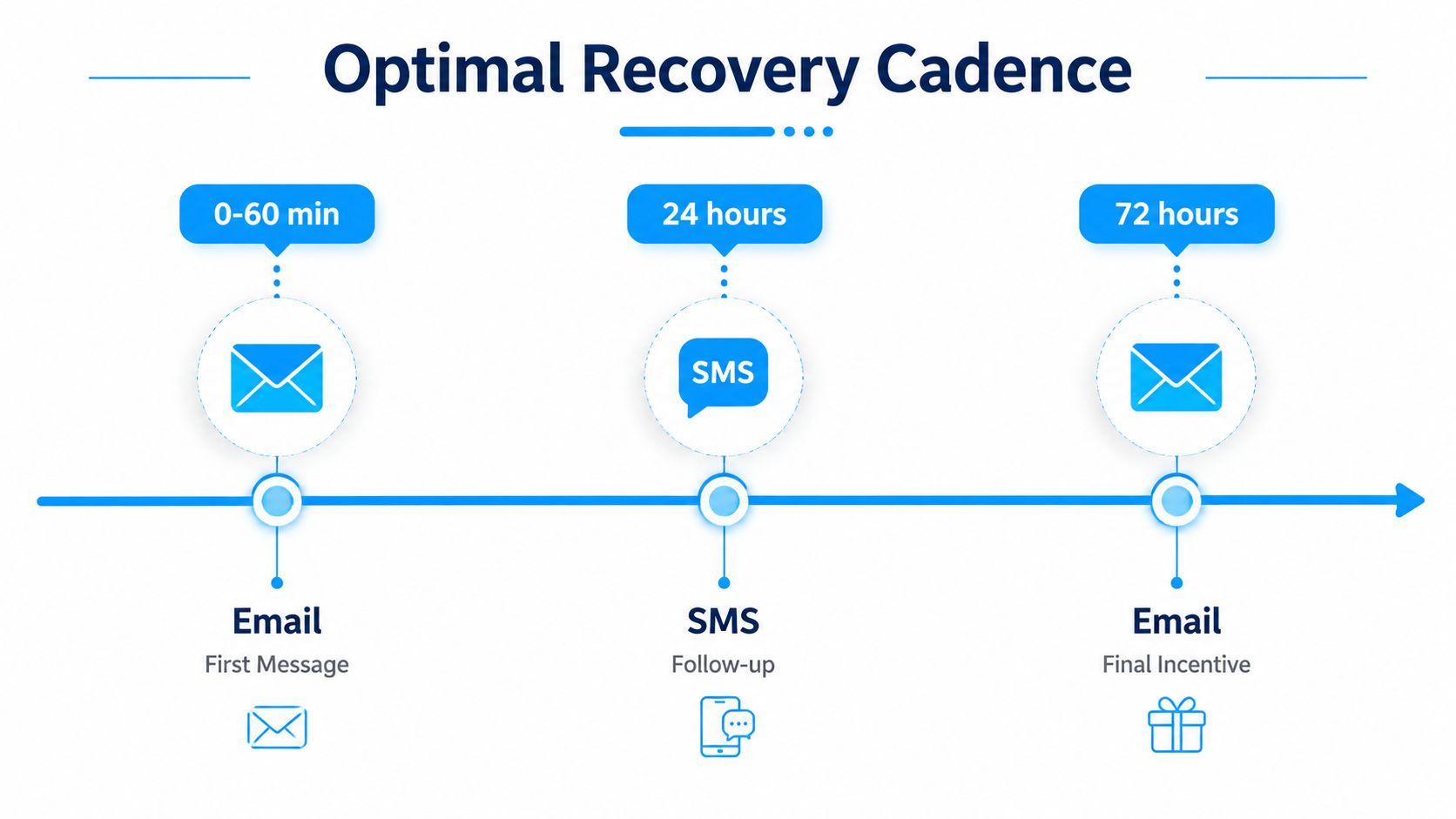
That same idea shows up in simpler 5-step flows as well, where the sequence is abandonment trigger, 1-hour email, 24-hour email, 48-hour SMS, and 72-hour final offer. The common thread is that each touch has a different job. The first reminds, the second handles hesitation, and the last one can introduce a modest incentive if the shopper still hasn’t acted.
The best recovery ladder changes the message, not just the timestamp.
Avoid static discount ladders
What doesn’t work is treating every channel as a delivery mechanism for the same coupon. When the copy is identical across email, SMS, and onsite surfaces, shoppers learn the pattern fast and stop responding. A static discount ladder also makes it harder to know which touchpoint earned the sale.
For Shopify merchants, the app ecosystem helps. Email and SMS can live in Klaviyo, onsite prompts can live in the theme or app layer, and each touch can be suppressed once the order closes. If you’re also using a service layer for email and SMS coordination, this email and SMS service overview is worth comparing against your current stack.
Set the Right Timing and Cadence
Timing decides whether recovery feels useful or pushy. The benchmark sequence that keeps showing up is the first message inside 30 to 60 minutes, followed by additional touches at 24 hours and 72 hours, with a 3-message email baseline before you add more channels or retargeting. That cadence respects how people decide, because the shopper who just left is still near the purchase, while the shopper who comes back three days later needs more context.
Lead with service, not urgency
The first reminder should read like help, not pressure. At that point, the shopper may have gotten distracted, run into a checkout issue, or wanted to compare shipping and payment details. A low-friction note that brings the cart back into view fits the moment better than a hard-sell pitch.
The second touch should answer objections. Social proof, product detail, shipping reassurance, and a clear return path all make more sense here than another generic “come back” line. By this stage, you’re not trying to create interest, you’re trying to remove the reason the shopper paused.
The final message is the only place where a modest incentive makes sense if earlier nudges failed. That keeps you from training customers to wait for a deal every time they leave a cart. Discounts used too early become a habit, and habits are expensive.
Suppress aggressively and cap paid retargeting
Every send should re-check order status before it goes out. That sounds basic, but it’s one of the easiest places for recovery systems to leak goodwill, especially when a shopper converts on another device after the initial trigger. Suppression should also include people who unsubscribed, opted out of SMS, or never consented to that channel in the first place.
Cart value should still shape the path. Higher-value carts can justify SMS follow-up, while lower-value carts often don’t need the extra pressure. If you add retargeting ads on top, keep the exposure controlled, because benchmark guidance recommends 3-5 impressions per day to avoid ad fatigue (cart recovery cadence and suppression guidance).
Build Message Templates and Creative
The message is where good recovery flows either become sales or become opt-outs. A shopper who’s already on the fence does not need a long explanation. They need a clear next action, a reason to trust it, and a tone that feels like it belongs to the store.
Write for the channel, not just the brand voice
Email can carry more context, so the first email should stay simple and service-oriented. A subject line that references the cart, a visible product thumbnail, and a single CTA are usually enough to reopen the loop. The body should stay short and scannable, because a recovery email isn’t a newsletter.
SMS has a different constraint. The text needs to be blunt, brief, and easy to act on from a phone screen, which means the CTA has to be obvious and the tone should avoid overexplaining. If the shopper needs to read three paragraphs to understand the offer, the channel is already working against you.
Practical rule: one message, one action, one reason to click.
Match content to the stage of hesitation
The first touch should sound like a reminder that helps the shopper finish. The second can introduce social proof or product reassurance. The third can use urgency, but only in a restrained way, because if every send screams urgency, none of them do.
Creative also matters. The best recovery emails and texts look like part of the store, not a bolted-on promo. On Shopify, that means keeping the visual style consistent with the brand, using the same product images the shopper already saw, and avoiding a generic coupon aesthetic that makes the message feel disposable.
A simple way to think about it is this. The first message reduces effort, the second reduces doubt, and the third reduces delay. If your creative doesn’t do one of those things, it’s probably adding noise instead of recovering revenue.
Segment Personalize and Add Scarcity Incentives
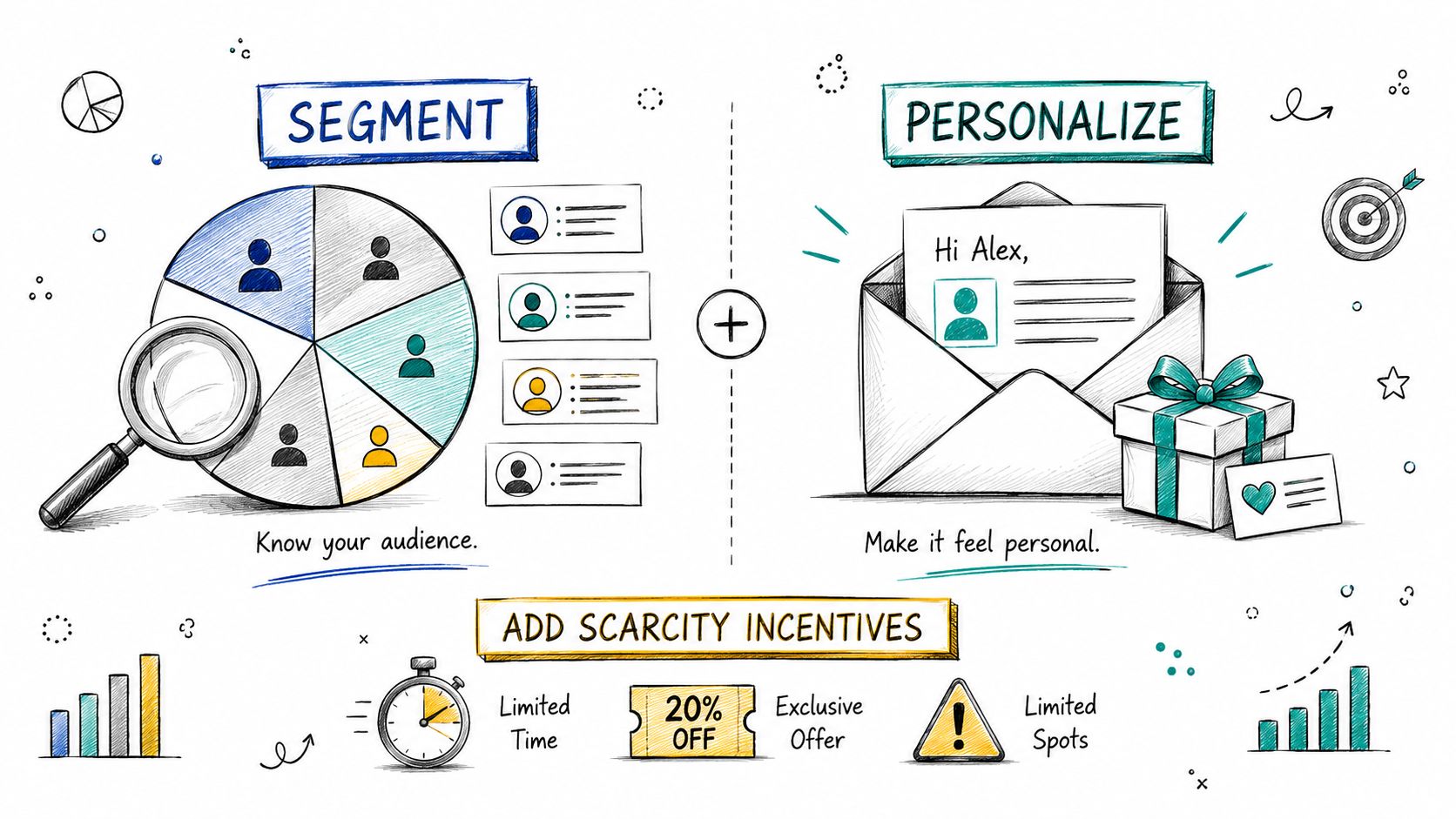
Not every abandoned cart deserves the same treatment. A mobile shopper buying a fast-moving category doesn’t behave like someone browsing a higher-consideration item on desktop, and the recovery path should reflect that. Some current guidance argues that the channel should match how fast a category buys, and that brands should measure per-channel performance instead of defaulting to a fixed email-first ladder (segment-aware cart abandonment strategy).
Segment by device, category speed, and cart value
Device tells you something about context. Mobile shoppers often move faster and respond better to short, direct messages, while desktop shoppers may tolerate more detail before they decide. Category speed matters too, because a refill item, a trend-driven product, and a considered purchase do not all deserve the same recovery tempo.
Cart value still matters because not every recovery touch is worth the same amount of pressure. Lower-value carts can often be handled with email only, while higher-value carts may justify a richer channel mix. That lets you protect margin by reserving more expensive touches for the carts where they make economic sense.
Use scarcity as a controlled reward, not a blunt discount
Most recovery programs get lazy. They offer a blanket discount and hope the shopper moves, which works for a while and then teaches the audience to stall. Controlled scarcity does something different, it gives the shopper a reason to act now without normalizing markdowns across the entire list.
That logic is where behavior-driven promotions fit naturally. A Quikly-style offer caps the reward by quantity or time, so only a limited number of shoppers can claim it, or only a limited window stays open. The shopper is responding to a real constraint, not a fake countdown, which helps preserve both margin and brand perception while still creating urgency.
The underlying psychology is straightforward. Scarcity bias makes limited availability feel more valuable. Loss aversion makes missing a real reward feel worse than waiting for a generic coupon. Commitment and consistency work because the shopper already showed intent by adding to cart, so the message is about helping them follow through, not pushing them into a new behavior.
For a deeper take on the mechanics behind that approach, this scarcity marketing guide maps well to recovery flows that need urgency without blanket discounting. The goal isn’t to discount more. It’s to reward action selectively enough that the offer still means something.
Measure Test and Launch Your Recovery Plan
Recovery flows look good in draft and fail in production when no one measures the right thing. The main trap is crediting the final discount for every recovered sale, even when the first email or SMS did the actual work. If you want a recovery program that holds up over time, you need touchpoint-level measurement.
Track the metrics that show where recovery really happens
| Recovery Metrics to Track | What it tells you |
|---|---|
| Recovery rate by touchpoint | Which message actually drives the sale |
| Suppression rate | Whether completed orders are being filtered out correctly |
| Opt-out frequency | Whether messaging is causing fatigue |
| Channel mix performance | Which channel fits the cart segment |
| Incentive dependency | Whether discounts are doing too much of the work |
That table is where teams should start. If the final SMS seems to drive most of the wins, check whether the earlier messages were weak, the cadence was too slow, or the audience only responds when an offer gets more specific. If opt-outs rise after a new sequence, the problem may be message density, not channel choice.
Launch with consent and suppression built in
Consent fatigue is a real problem in recovery flows. Recent guidance warns against over-messaging because it can drive opt-outs, and it also recommends capping retargeting to avoid ad fatigue (channel saturation and consent fatigue guidance). That means your Shopify launch checklist should include webhook-based abandonment detection, Klaviyo or similar integration, explicit SMS opt-in compliance, and purchase-based suppression before every send.
A clean rollout usually looks like this:
- Verify the trigger: Confirm abandoned-cart events fire only after real abandonment, not on partial checkout progress.
- Check suppression logic: Stop every sequence the moment the order completes.
- Limit channel reach: Keep SMS tied to consent and reserve it for carts where the economics make sense.
- Test touchpoints separately: Measure which send contributes to recovery instead of assuming the last offer deserves all the credit.
The deeper point is that urgency works best when it feels like part of the shopping experience, not an interruption pasted on top. Brands that manage timing, consent, and scarcity carefully can recover more carts without sliding into repetitive markdown behavior. That’s the difference between a flow that prints short-term wins and one that stays healthy after the novelty wears off.
If you want a cart recovery approach that uses urgency without turning every follow-up into a discount race, Quikly can help you build time- and quantity-bound offers that fit inside your Shopify flows. It’s a practical way to reward action, protect margin, and keep recovery messages from looking like the same tired promo the shopper has already learned to ignore.
Topics: cart abandonment recovery, Shopify recovery, abandoned cart email, scarcity promotions, SMS retargeting