If your win-back file is starting to feel like a discount graveyard, you’re not alone. A lot of Shopify teams keep reaching for the same fix, a bigger code sent to more people, because it feels safe and measurable in the short term. The problem is that it often buys back revenue by borrowing from margin, brand perception, and future full-price behavior.
The better question isn’t whether lapsed customers should come back. It’s how to win them back without teaching everyone else to wait for the next markdown. That changes the job from blasting a coupon to sequencing timing, offer depth, and channel mix with enough discipline that the reactivation pays back.
The Real Cost of a Discount-First Win-Back
A mid-sized Shopify brand usually sees this pattern first in the numbers that look healthy. Reactivation revenue ticks up, email click-through improves, and the team calls the campaign a win. Then contribution margin starts thinning out because the easiest customers to recover were the ones who would’ve come back with less incentive, or no incentive at all.
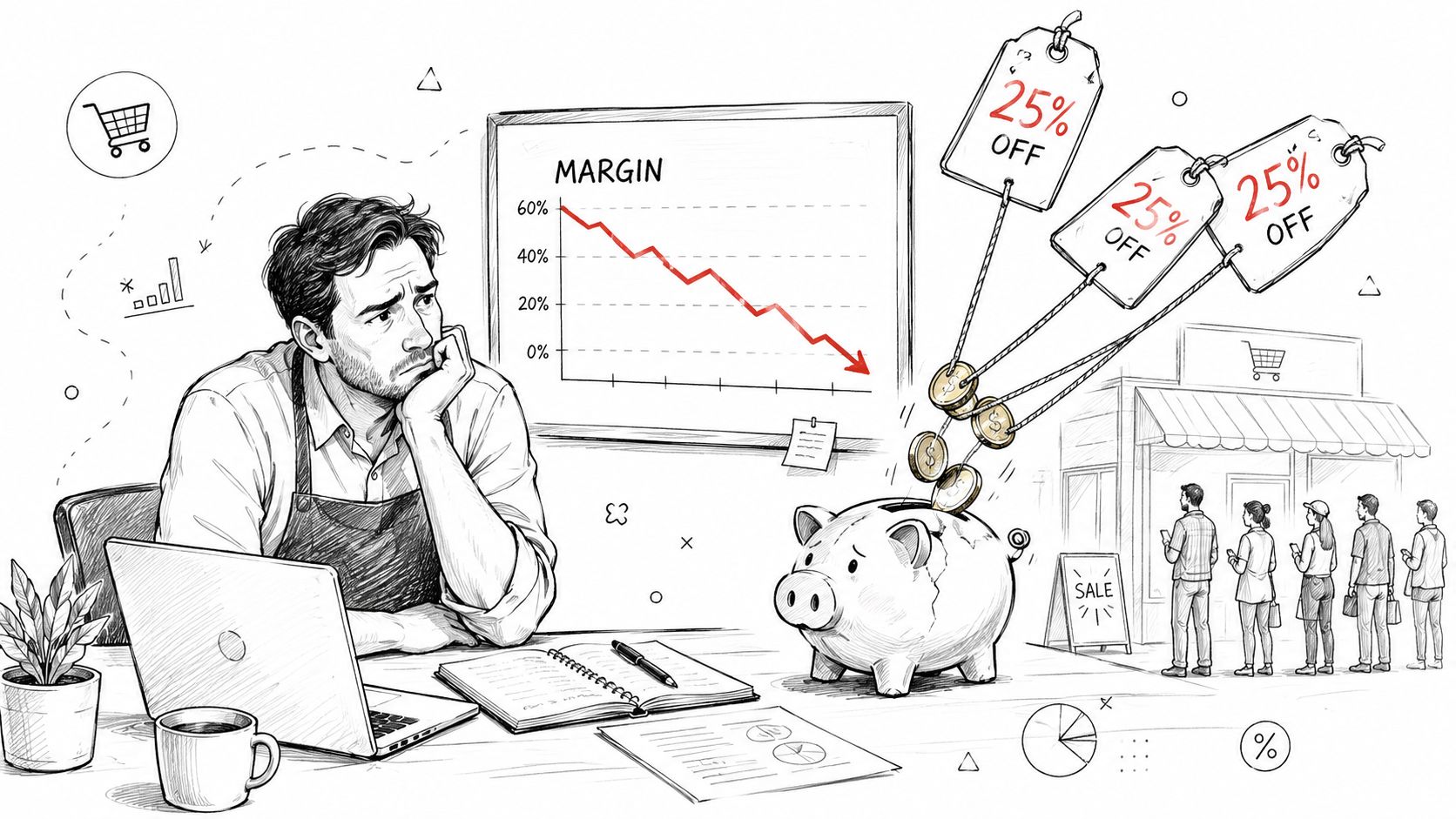
A discount-first motion also rewires customer expectation. If the first thing a shopper sees after going quiet is 25% off, the store has taught them that patience gets rewarded more than loyalty does. That’s how brands end up with shrinking margins, weaker conversion on ordinary campaigns, and a slower erosion of trust that doesn’t show up as a single bad week.
What a Flat Code Actually Does
The strongest win-back programs don’t confuse “more incentive” with “better incentive.” They start with timing and segmentation, because a customer who’s merely drifting should be handled differently from one who’s truly gone. The issue is not whether discounts work, it’s that they’re too blunt to use as the first move across an entire lapsed file.
A cleaner way to think about it is this: reactivation should feel earned, not automatic. That’s why teams that rely on blanket codes often see a short-term spike and a longer-term training problem.
Practical rule: if every lapsed customer gets the same code, you’re not running a win-back program, you’re running a delayed sale.
That’s also where the brand risk gets real. Customers start associating the store with wait-and-see pricing behavior, while the team keeps paying for the privilege of training that behavior. For a broader store strategy, the logic overlaps with retention and post-purchase hygiene, which is why resources like AI returns app for Shopify and the internal guide on alternatives to discounting for Shopify are worth keeping close when you’re tightening the lifecycle.
Defining What Lapsed Actually Means for Your Store
The generic 90-day lapse rule is too crude for most catalogs. A customer who buys supplements every few weeks and a customer who buys a mattress every few years should not enter the same recovery workflow on the same day. The better trigger comes from the customer’s own buying rhythm, not a calendar default.
Industry guidance recommends calculating the median time between the first and second purchase, then setting the win-back trigger at about 1.5x that interval, with a common starting point of 120 to 150 days of inactivity for general ecommerce stores. That matters because the right customer is being contacted at the moment they’re drifting, not after the relationship has already cooled off completely. Top Growth Marketing’s 2026 win-back guide lays out that timing logic clearly.
A Simple Store-Level Definition
Pull first and second order dates from Shopify, or from Klaviyo if that’s where your lifecycle data lives. Then find the median gap between those purchases for your main repeat-buying cohort. That gives you the number that matters, because it’s tied to how your customers behave.
From there, split the file into two practical states.
- Drift: the customer is past the expected repurchase point, but not far enough out that the relationship is clearly dead.
- Dormant: the customer has gone well beyond that rhythm and needs lower-cost treatment or a stop rule, not endless chasing.
Consumables usually need faster reactivation than durable goods. Slower-repeat categories can tolerate a longer silence before the customer should be treated as at risk, because their natural purchase cycle is already stretched out.
A useful internal question is simple. If this customer came back today, would it feel early, on time, or late? That answer should determine when the first message goes out, and it’s a better planning conversation than arguing over a fixed 90-day template.
Segmenting Lapsed Customers by Value and Churn Cause
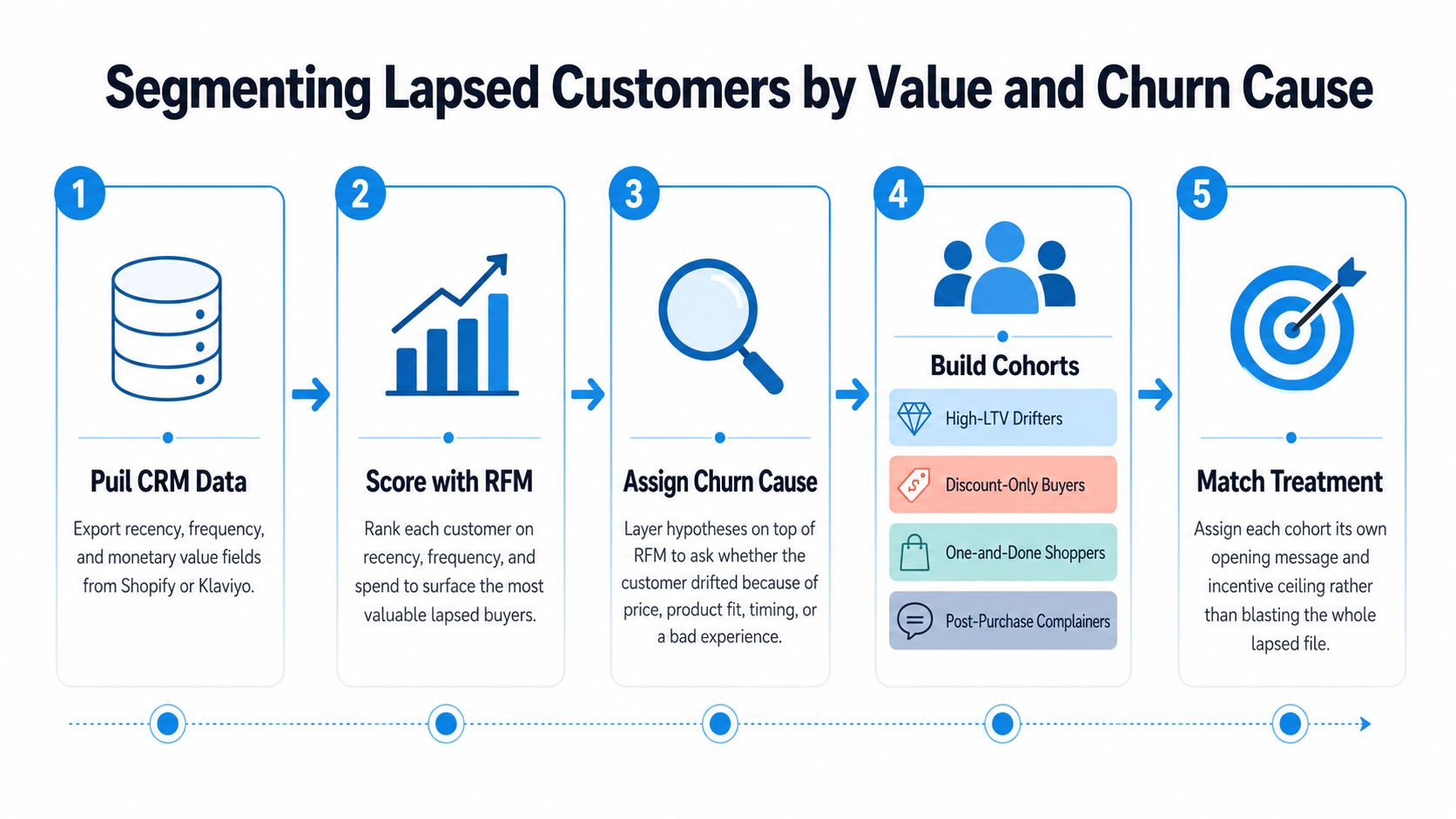
One message to all lapsed customers is where most win-back programs break down. It treats a high-value repeat buyer the same way it treats a one-time bargain hunter, and that’s where margin leaks start. The fix is to build cohorts from CRM data using recency, frequency, and monetary value, then overlay a churn hypothesis on top.
SigOS’s client churn analysis is a useful reference point for the broader logic of reading churn signals before you spend to recover them. The principle is straightforward, don’t ask every customer to accept the same recovery path when the reason for leaving may be very different.
How to Build the Cohorts
Start with the lapsed file, then score it by RFM. High recent value and high historical spend deserve earlier, stronger attention. Low-value one-timers usually don’t.
Then add a cause hypothesis. Was the customer likely drifted by price, product fit, timing, or a bad experience? You won’t know every reason with certainty, but you can get close enough to make the offer smarter.
| Cohort | Defining Behavior | Opening Message | Incentive Ceiling |
|---|---|---|---|
| High-LTV drifters | Repeated past purchases, now inactive | New arrivals, restocks, or brand updates | Reserved for clear resistance |
| Discount-only buyers | Bought during promotions, respond to markdowns | Value reminder with selective urgency | Keep offers modest at first |
| One-and-done shoppers | Single historical order, low repeat signal | Product education or best-seller reminder | Very limited, if any |
| Post-purchase complainers | Negative feedback or support history | Service recovery and feedback request | Avoid defaulting to deep discount |
Budget discipline begins here. A team that knows which cohort is worth saving can reserve stronger incentives for the few segments that justify them, instead of subsidizing the whole file. That’s also the logic behind customer retention programs, because the recovery motion only works when value and treatment are linked.
Practical rule: if you can’t say why a cohort went quiet, you’re not ready to assign offer depth yet.
Sequencing Offers So Discounts Stay Earned
The strongest instinct in ecommerce is often the most expensive one, lead with the deepest discount and hope the market responds. That’s backwards. A phased ladder protects margin because it lets the lighter, cheaper touches do the early work before you pay for attention.
A good sequence starts with no discount in the first 30 to 45 days of drift, then moves to moderate value between days 60 and 75, then escalates to a stronger recovery attempt between days 90 and 120. That cadence lines up with the phased reactivation window in Rework’s ecommerce win-back guidance, which treats the last stage as the final recovery push before the customer becomes effectively unrecoverable.
Why the Ladder Works
Behaviorally, this taps loss aversion and temporal discounting. Customers are more likely to act when they feel they might miss something, but they’re also more sensitive to immediate reward once the lapse has grown. A stepped sequence keeps the strongest incentive for the point where resistance is obvious.
It also respects commitment and consistency. The customer’s first non-response tells you something different from the third. If they ignored the light reminders, they’ve signaled that they need a stronger reason to return, and that’s when the deeper offer becomes justified.
For a consumables brand, the first touch might be a reminder of the reorder cycle, then free shipping or a small credit, then a stronger offer only if the customer still doesn’t move. For a durable goods brand, the same ladder stretches out because the natural repurchase rhythm is slower. The structure stays the same, the pacing changes.
If you want the simplest rule of thumb, use this. Escalate only after a customer has shown clear resistance to a lighter offer. That keeps the program from becoming stingy, but it also stops you from paying for conversions you didn’t need to buy.
Running the Three-Touch Reactivation Sequence
A win-back campaign works better as a sequence than as a blast. The timing is part of the message, because each touch gives the customer a different reason to come back without making the whole program feel like a clearance event. The practical setup is simple enough to build in Shopify and Klaviyo in one sitting.
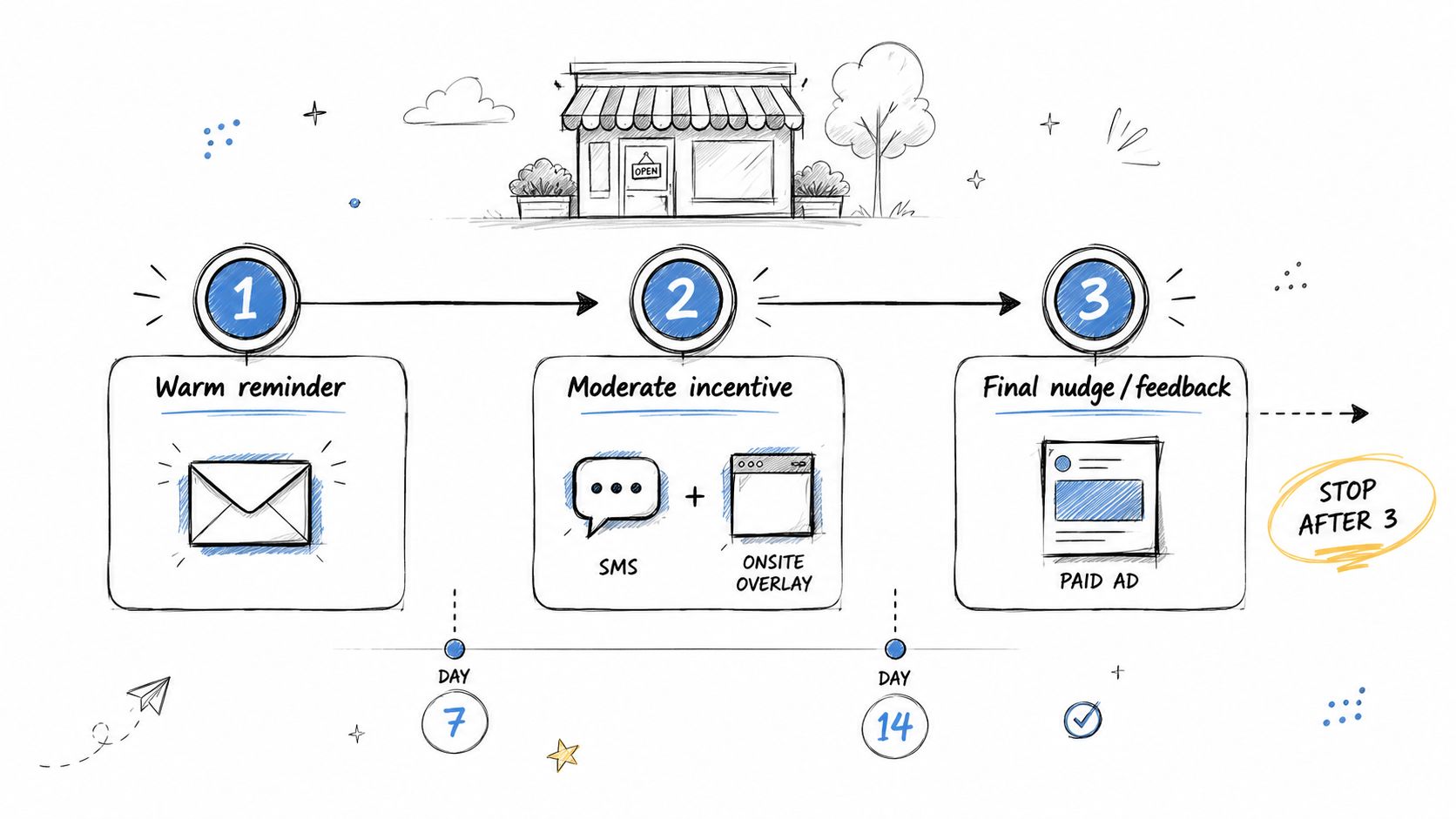
Start with a warm reminder within 1 to 2 weeks of the lapse threshold. That first message should acknowledge what’s changed since the last purchase, mention a restock or a new arrival, and ask for nothing. Five to seven days later, send a second touch that changes the angle and introduces a moderate incentive if the customer hasn’t responded. Then send a final nudge or a short feedback request 10 to 14 days after that.
The channel roles are distinct. Email carries the narrative. SMS delivers urgency when the customer has opted in. Onsite overlays catch people if they return organically. Paid retargeting keeps the message in view after the inbox goes quiet.
What to Put in Each Touch
- First touch: short subject line, plain language, no discount, and a reminder of what’s new.
- Second touch: a more direct subject line, a moderate incentive, and a low-friction path back to purchase.
- Third touch: last nudge, feedback request, or a final offer with a clear stop point.
This guide on reactivating dormant text subscribers is useful if SMS is part of your stack and you need sharper copy discipline for the second and third touches.
The stop rule matters as much as the flow. After three touches with no response, stop pushing. One sourced guideline also recommends moving customers to a dormant list after 180 days of lapse because the economics usually no longer justify active outreach for most local businesses, and that same boundary protects deliverability as well as sanity. The cadence should feel deliberate, not needy.
Adding Behavior-Driven Urgency Without the Discount Trap
Once the segmentation and sequence are in place, the offer itself becomes the main lever. Many teams default to a flat percentage off because it’s simple to explain. The better move is to make urgency feel earned, not forced.
A capped or descending reward structure works because the customer has something to lose by waiting. That’s basic scarcity bias, and it pairs neatly with loss aversion. When the reward is limited by time, claim count, or both, the shopper is participating in an event rather than passively receiving another coupon.
That’s also where on-brand execution matters. A generic popup or a blunt banner can feel detached from the store experience, while a promotion that visually matches the brand reads like part of the shop itself. For Shopify merchants, that difference matters because the customer experience should feel coherent across email, SMS, onsite, and social.
Where This Fits in a Win-Back Stack
Behavior-driven urgency doesn’t replace the earlier steps. It sits on top of them.
- Email: use it to explain the offer and remind the customer what they missed.
- SMS: use it for the short, time-sensitive nudge.
- Direct mail: if you run offline recovery, this direct mail win-back guide is a useful companion for coordinating a physical touch with the rest of the sequence.
- Onsite: let the customer encounter the urgency only when they return, not every time they browse.
The reason this matters is margin. A capped reward means you’re not paying the same discount to everyone, and you’re not handing away incentive value to customers who would’ve bought without it. Quikly’s approach is one example of that model in practice, it uses capped, participation-based promotions rather than blanket discounts, and its mechanics have been refined across more than 60 million consumer interactions. The publisher also points to a roughly 20% profit lift in the Jordan Craig example, with incremental lift visible immediately on activation.
The takeaway is simple. Urgency doesn’t have to be manufactured with a permanent markdown habit. It can be structured so the customer acts because the reward is real, limited, and worth claiming now.
Measuring What Matters and Knowing When to Stop
A win-back program without measurement is just a guess with better copy. The first metric to watch is reactivation rate, but that’s only the top line of the story. The true test is whether the recovered customer creates enough value to justify what you spent to bring them back.
Track four things by segment, not just across the full file. Reactivation rate, incremental revenue, average discount paid per reactivated customer, and reactivation payback against predicted lifetime value. That last one is the guardrail, because a recovered order that breaks even on paper but never repeats isn’t really recovered business.
A Simple Measurement Setup
Use a holdout group so you can see the difference between campaign-driven lift and natural return. Without a control, you’ll over-credit the campaign for customers who were already coming back. With a control, you can see what the message actually changed.
Read the results by segment as well as by channel. A cohort that responds well to email might ignore SMS, while another may need the opposite. The right decision is often not “what won overall,” but “what won for this cohort at this stage.”
Practical rule: if acquisition or incentive cost is above projected lifetime value, stop spending on that customer and move them to a lower-cost path.
That’s the profitability ceiling. It keeps the program from becoming a slow leak of expensive optimism. It also creates a clean stop point after 180 days of no response, when dormant customers should move out of active sends and into a low-cost list for future reactivation or compliance handling.
The monthly optimization loop can stay tight. Test copy angle, send time, channel mix, and offer depth. Keep the test focused on one variable at a time so you can tell what moved the result. For Shopify teams, that’s usually enough to turn a messy reactivation flow into a controlled lifecycle system that protects margin while it recovers revenue.
A CTA for Quikly.
Topics: win back customers, lapsed customer strategy, Shopify retention, reactivation campaigns, customer segmentation