You didn’t set out to become a discount brand. You ran a welcome offer to lift first orders, then a sale to clear a slow week, then another sale because the last one worked. At some point full price stopped feeling like the true price to your customers, and probably to you.
Two tier pricing is worth understanding because it changes the structure, not just the percentage. Instead of giving everyone the same break for doing nothing extra, you separate a baseline reward from a stronger one that shoppers earn by acting sooner, spending more, or claiming before a cap runs out.
The Discount Treadmill Most Shopify Brands Are Already On
The pattern starts innocently. A popup offers a small code for an email address. It lifts list growth, so you keep it. A few months later the same code isn’t moving shoppers, so you raise it. Then you add a weekend sale on top, and shoppers start asking in chat whether the codes stack.
Soon your marketing calendar is a chain of exceptions. Launch week has one offer, slow inventory has another, and your best customers have learned to screenshot the banner and wait. You’ve conditioned the exact behavior you complain about. Temporal discounting works in reverse here, because shoppers believe a better price later is worth more than buying now.
Why deeper stops working
Each promotion resets the reference price in a shopper’s head. If she bought during the last sale, list price feels like overpaying. If she missed the sale, waiting feels rational. You’re no longer competing on product. You’re competing against your own last promotion.
That’s why a smarter structure beats a larger percentage. A capped, tiered reward gives shoppers a reason to move without making every order subsidized. If you’re rethinking the math behind your calendar, start with a smarter approach to discount strategy and margin control before you set the next code live.
Stop asking what discount will be big enough. Ask what behavior the discount is paying for.
Most flat codes pay for nothing. A shopper who was already checking out gets the same reward as the hesitant visitor you meant to convert. That waste is quiet, but it compounds in your contribution margin every single week.
What Two Tier Pricing Actually Means
At its simplest, two tier pricing gives a customer two distinct economic terms instead of one uniform price. In its classic form, two distinct price components or levels instead of one uniform unit price describes the structure, with a fixed charge up front plus a variable fee per unit consumed. Utilities have used versions of this for decades, separating the cost of access from the cost of how much you use.
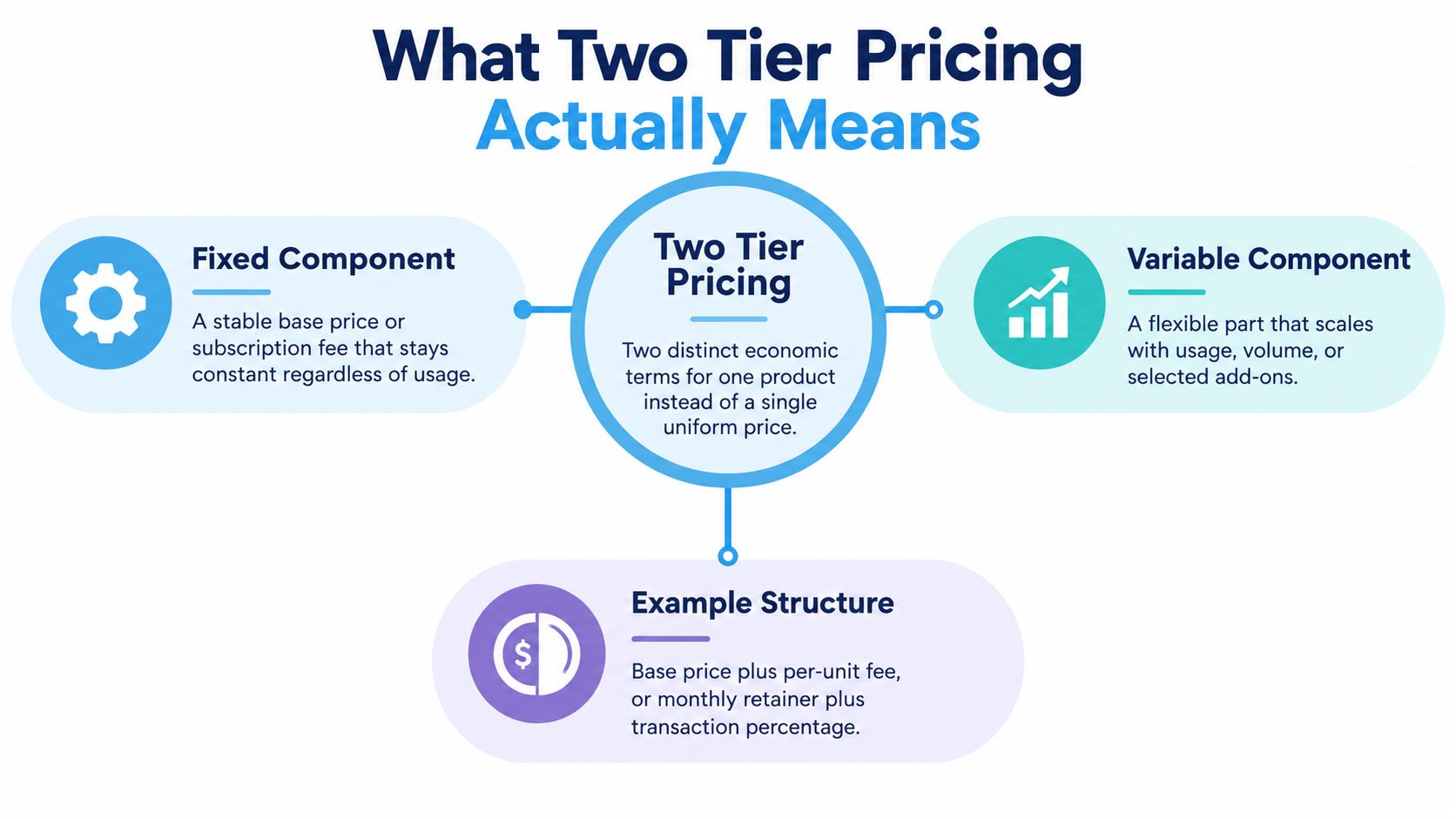
Translate that to Shopify. Tier one is the baseline offer any shopper can obtain, perhaps a modest reward for joining your list or buying today. Tier two is stronger, but it’s gated. It might require clearing a spend threshold, claiming within a window, or being among a limited number of claims. The product price stays intact. What changes is the reward for a specific action.
What it isn’t
Don’t confuse this with two nearby ideas.
- Loyalty pricing: Members pay one price, nonmembers pay another, based on identity rather than behavior in the moment.
- Volume tiers: The unit price drops as quantity rises, based on basket size alone.
- Blanket discounting: Everyone gets the same percentage, whether they needed it or not.
Two tier pricing is closer to self-selection. You present a clear tradeoff and let shoppers sort themselves. The price-sensitive buyer takes the baseline. The high-intent buyer earns the upper tier by doing something valuable to you. That distinction is the whole point. You’re designing a menu, not printing a coupon.
Keep it to two clear levels at first. Shoppers should grasp the difference in one read, on mobile, mid-scroll. If they need a FAQ to figure out what they’ll save, you’ve built homework, not an incentive.
How Two Tier Offers Affect AOV and Conversion
The mechanism is separation. A fixed component captures willingness to participate while a variable component aligns payment with quantity or consumption, and a promotional version does parallel work. The lower tier keeps participation broad, so cautious shoppers still have a reason to buy. The upper tier captures extra willingness to act now or spend a little more, without paying that stronger reward to everyone.
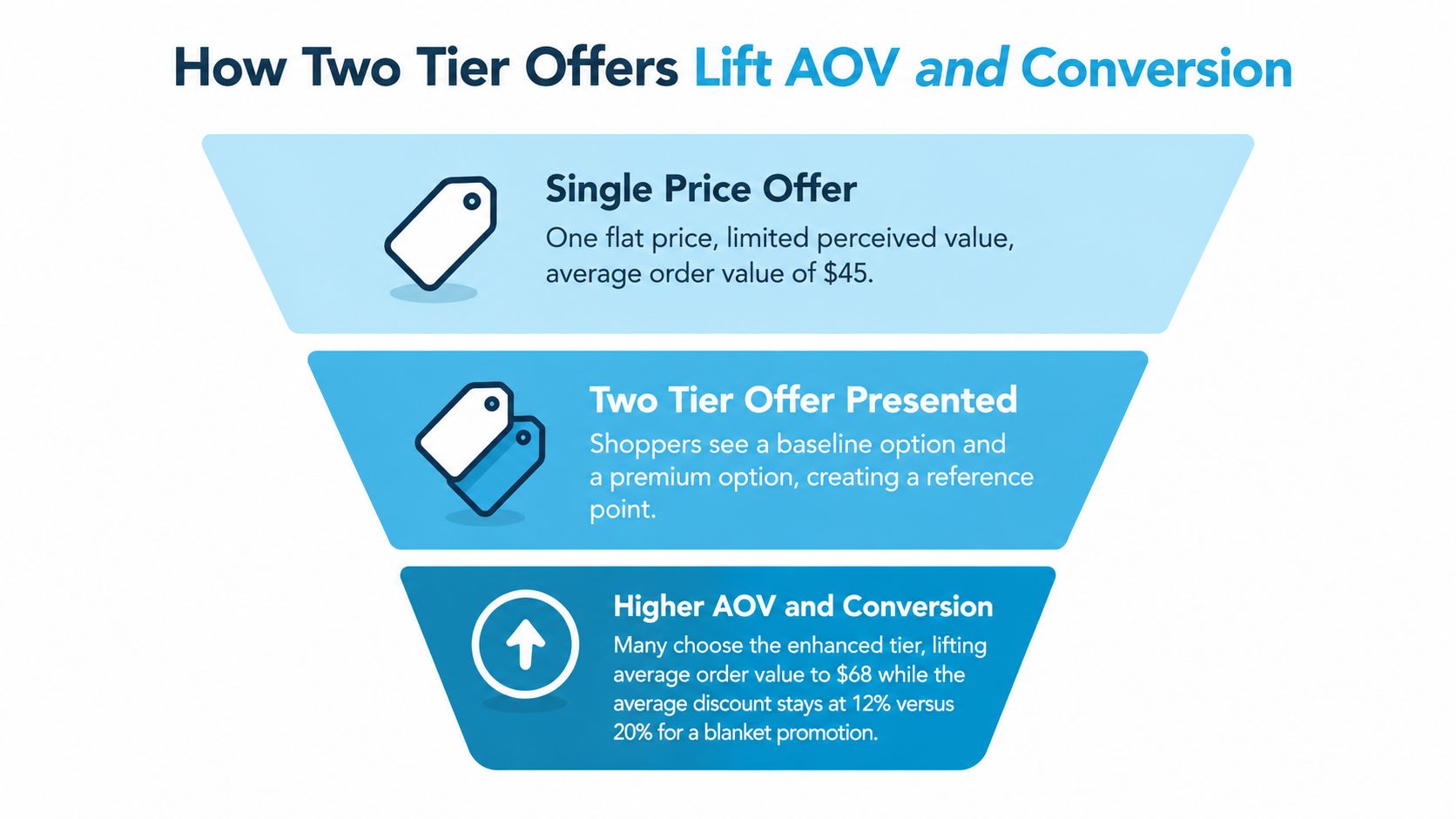
That split attacks two metrics at once. Conversion rises when the baseline removes hesitation for shoppers who were close. Average order value rises when the upper threshold sits just above your typical basket, close enough that adding one item feels sensible. If you’re working on the wider funnel around the offer, this high-converting website guide covers page elements that support that decision rather than distract from it.
The metric that actually matters
Don’t judge this on conversion rate alone. A campaign can convert beautifully and still lose money if the subsidy exceeds the extra contribution it creates. Watch these instead:
- Contribution margin per visitor: Your north star, because it captures both conversion and cost.
- Share of orders in each tier: If almost nobody reaches tier two, the gap is too hard. If everyone does instantly, the cap is too generous.
- Incremental conversion versus a flat control: The cleanest test of whether structure beat size.
For a deeper grounding in the basket side, review how average order value works as a marketing lever before you set thresholds by gut feel. Set the upper bar from your real order distribution, not from the AOV you wish you had. Shoppers stretch a little. They rarely rebuild their cart for you.
The Strategic Shopper Problem Most Tiered Promotions Miss
A deeper second tier isn’t automatically better. It can train the same waiting behavior you’re trying to escape. Anticipated future prices influence when shoppers buy, and profit can fall when they strategically wait for a later price. If your better reward reliably appears later, rational customers will hold out for it.
Most tiered promotions are designed backwards. Merchants put the generous tier at the end of a sale, or make it predictable every month, then wonder why early demand softened. The first tier starts to feel like a penalty for being impatient. Loss aversion only helps you when acting early protects something. If waiting protects the shopper’s wallet, waiting wins.
Make the upper tier earned, not scheduled
Flip the logic. The stronger reward should belong to early action, limited claims, or a higher basket, and it should be uncertain whether it’ll still be there tomorrow. That’s real scarcity bias doing useful work. A claim cap means the reward can run out because other shoppers took it, which is a reason to decide now that has nothing to do with a fake deadline.
Design rule: If a shopper can predict your best price and wait for it safely, your tiers are teaching delay.
Spacing matters too. If tier two dwarfs tier one, tier one feels like a consolation prize and shoppers either chase the top or leave. If the gap is trivial, nobody stretches. Aim for a difference that feels worth an extra item or a faster decision, not worth gaming the calendar. And measure time to purchase and tier migration, not just redemption. If customers are drifting toward later, cheaper behavior over successive campaigns, the structure is leaking even while individual promotions look fine.
Comparing Two Tier Pricing to Flat Discounts and Loyalty Pricing
Each pricing mechanism buys a different behavior, and each carries a different cost. Matching the mechanism to the goal matters more than finding a clever percentage. Before you default to what’s familiar, it helps to see the tradeoffs side by side, and a broader view of Shopify pricing strategy choices gives useful context for where each one belongs.
| Mechanism | Best for | Main risk |
|---|---|---|
| Flat discount | Clearing inventory fast with a simple message | Trains waiting and subsidizes buyers who didn’t need it |
| Bulk or quantity tiers | Raising basket size on replenishable products | Requires shoppers to plan a larger purchase upfront |
| Loyalty pricing | Rewarding repeat buyers and driving enrollment | Visible member gap can alienate nonmembers |
| Two tier offer | Rewarding early action at a controlled average cost | Poor spacing teaches shoppers to chase only the top tier |
Loyalty pricing deserves a closer look because it’s often confused with tiering. Membership status can create a regular price and a member price, producing a dual pricing dilemma where programs pull in joiners while retailers raise the base price nonmembers pay. That gap is identity based, and shoppers who don’t join feel it as a wall.
The deciding question
Ask what you’re separating. Flat discounts separate nothing. Bulk tiers separate basket sizes. Loyalty separates people. A well built two tier offer separates timing and participation from the product price itself, which is why it tends to protect perceived value better. The product was never cheaper. Acting earlier was worth more.
Implementing Two Tier Offers on Shopify
Start in Shopify’s native discount infrastructure. Create the baseline as a standard code or automatic discount, then build the enhanced tier with its own code, threshold, or eligibility rule. Keep the naming clean in your admin so you can read performance later without decoding cryptic labels. If you’re exploring quantity based setups specifically, these tiered discount strategies for merchants walk through threshold mechanics that pair well with a two tier structure.
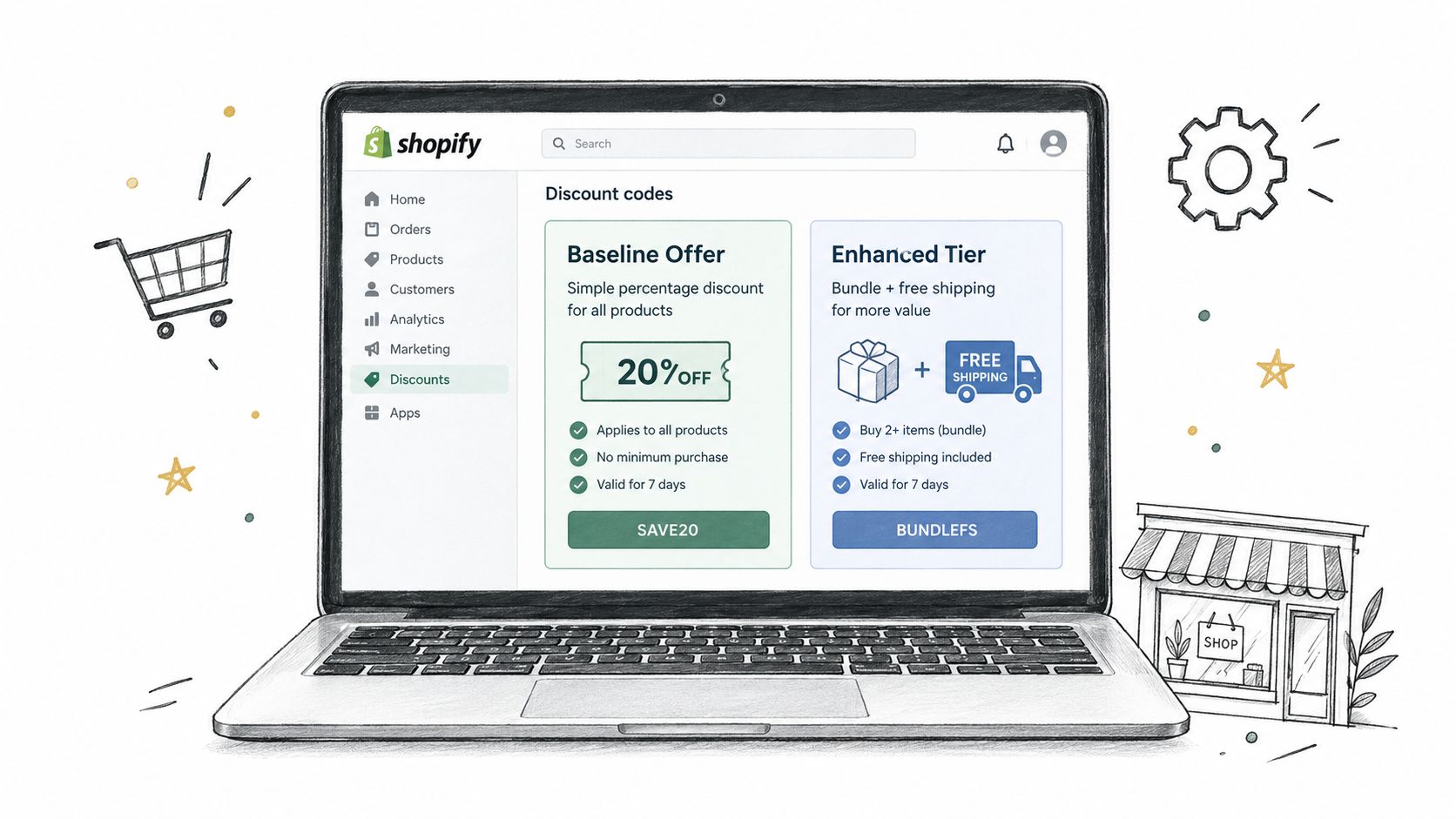
Surface both tiers where the decision happens. That usually means product page messaging through theme customization, a clear line in the cart drawer showing how close the shopper is to the upper tier, and consistent copy at checkout. Don’t announce the top tier on the homepage and then go silent in the cart. The gap between promise and basket is where these offers die.
Where native tools run out
Shopify handles codes and thresholds well. It doesn’t natively run claim counts that step a reward down as shoppers buy, and stacking rules get fiddly fast. Shopify Plus gives you more control through Functions and checkout extensibility, but you’ll still need logic for caps, sequencing, and cross channel consistency. This is the gap Quikly fills, running tiered rewards capped by claim count or time across your storefront, email, and SMS, styled to match your store.
Coordinate the channels through Klaviyo or your SMS tool so the email, the text, and the onsite experience describe the same two tiers with the same rules. Commitment and consistency only works if shoppers hear one story. Test the full path on mobile before launch, including what happens when tier two runs out mid session.
Fairness, Disclosure, and When Tiered Scarcity Crosses a Line
Tiered scarcity reads as legitimate or manipulative depending on execution, and shoppers decide quickly. Framing alone shifts that judgment. Participants judged a 5% price increase significantly fairer than a 5% surcharge added on, which tells you the same money can feel honest or sneaky based on how you present it. A tier framed as a reward for acting early lands differently than one framed as a penalty for being late.
What transparent execution looks like
- Plain language rules: State exactly what moves a shopper between tiers, in words a first time visitor understands.
- Consistent eligibility: Apply the same rules to every shopper in the campaign, with no hidden segments.
- Honest scarcity: If you claim a limited number of top tier rewards, enforce that number and keep records showing you did.
- Visible end times: Put deadlines where shoppers can find them without hunting through fine print.
Keep the boundary clear between consumer promotions and business to business pricing. Competition rules can treat price differences between business buyers differently, depending on the product and the effect on competition. If you sell wholesale alongside DTC, don’t assume your consumer playbook transfers. Get advice before mirroring tiers across channels.
Transparency isn’t just compliance. It’s social proof protection. One screenshot of a scarcity claim that turned out to be fiction travels further than your campaign did. Real caps, stated plainly, let you run urgency you can defend in public.
Deciding Whether Two Tier Pricing Fits Your Store
Start by naming your actual problem, because each one points to a different design. If conversion is weak, your baseline tier does the heavy lifting and the upper tier is a bonus. If AOV is the constraint, threshold spacing matters most. If promo fatigue is the disease, the cap and the early action logic matter more than either percentage.
A quick fit check
- You run sales constantly and margin keeps thinning: Strong fit. Structure replaces depth.
- Your basket clusters just below free shipping or a round spend level: Strong fit. Shoppers will stretch for tier two.
- Your product is a considered, infrequent purchase: Weaker fit for spend thresholds. Lean on claim based tiers instead.
- You can’t enforce a real cap: Don’t fake one. Fix the operations first.
Judge the result on incremental gross profit and contribution margin per visitor, compared against a flat discount control. Redemption rate alone will flatter bad campaigns. A two tier offer earns its place when it pulls decisions forward, lifts the basket a little, and costs less on average than the blanket sale it replaced.
The sharper way to think about promotions from here is simple. You’re not choosing a discount. You’re choosing which customer behavior you’re willing to pay for, and refusing to pay for the rest.
If your promotions keep getting deeper while margin keeps getting thinner, Quikly lets you run capped, tiered rewards that pay shoppers for acting early instead of waiting you out, across your storefront, email, and SMS. See how a two tier structure could replace your next blanket sale at Quikly.
Topics: two tier pricing, tiered pricing, ecommerce promotions, Shopify conversion, average order value