A Shopify merchant can watch paid social traffic climb while orders barely move. The ad account reports more visitors, the agency recommends another audience, and the store responds by adding a deeper discount. Revenue may rise briefly, but margin gets tighter and customers learn to wait for the next promotion.
That pattern usually means conversion is the constraint, not traffic. Understanding what is conversion rate optimization gives you a better operating question: how can the existing store make more qualified visitors act, while protecting contribution margin and brand value?
Why More Traffic Stopped Fixing the Store
More visitors don’t automatically create more buyers. Traffic brings attention, but the store experience determines whether that attention turns into a product view, an add-to-cart event, a checkout, or an order.
A Shopify brand might attract shoppers with a compelling paid-social creative, then lose them on a product page that hides delivery information. Another brand may offer a relevant product, but make shoppers calculate shipping only after they reach checkout. A third may have a clear offer but require account creation before purchase. In each case, acquisition did its job. The store failed to convert the intent that acquisition created.
This is why deeper discounting often feels like the only available answer. A price reduction can compensate for uncertainty, hesitation, or weak urgency, but it also reduces the value captured from each order. Repeating that pattern produces promo fatigue, shrinking margins, and a customer base that expects to wait for the next markdown.
Operating rule: Before buying more traffic, find the point where current visitors lose confidence or momentum.
CRO treats the store as an experience that can be diagnosed and improved. The work may involve product-page clarity, navigation, mobile usability, checkout friction, offer framing, trust signals, or the timing of an incentive. It also requires testing, because a change that looks persuasive to a merchant can confuse shoppers.
The rest of this guide builds from the definition of CRO to its behavioral foundations, testing methodology, commercial guardrails, and a practical Shopify roadmap. The central idea is simple: better conversion should create profitable, incremental behavior, not merely a larger order count produced by heavier discounts.
What Conversion Rate Optimization Actually Means
Start with the measurement. Ecommerce conversion rate is calculated by dividing orders by website visits, then multiplying by 100, as explained in Shopify’s guide to ecommerce conversion rate.
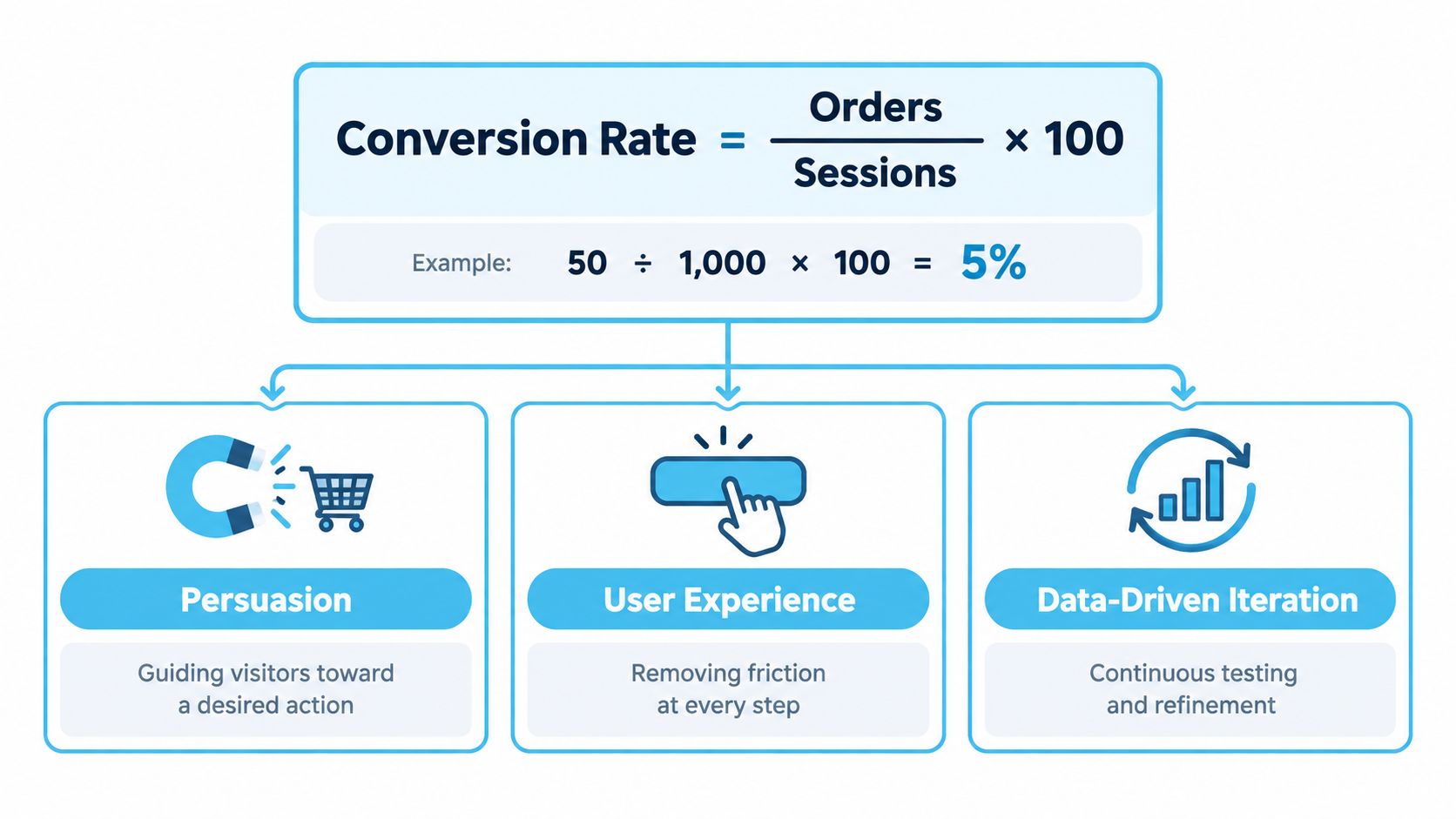
That formula gives a Shopify merchant a baseline. Conversion Rate = (Orders ÷ Sessions) × 100. If 50 orders come from 1,000 sessions, the conversion rate is 5%. The number tells you what proportion of visits completed the chosen action, but it doesn’t explain why the remaining visitors didn’t.
That is where conversion rate optimization begins. CRO is the systematic improvement of a digital experience to increase the share of visitors who complete a desired action, such as purchasing, submitting a form, or subscribing. It can include copy, layout, navigation, product information, checkout design, incentives, and trust signals. It isn’t a synonym for changing a button color or adding a popup.
Think of a physical shop. More people entering the building won’t solve a confusing layout, unclear prices, or a checkout queue that makes customers leave. A good store operator observes where shoppers hesitate, changes one part of the journey, and compares the result with the previous experience.
What counts as CRO
A disciplined CRO activity has four parts:
- A defined goal: The team chooses a primary action, such as completed purchase, and identifies guardrails such as average order value or refund rate.
- A behavioral problem: Evidence from Shopify analytics, search behavior, surveys, or session replays points to a specific obstacle.
- A falsifiable hypothesis: The team predicts what will change and why, such as showing delivery timing earlier to reduce uncertainty.
- A controlled comparison: Visitors see a control or treatment experience, and the team evaluates the outcome against a baseline.
A redesign launched without measurement may improve the store, but it isn’t a CRO test by itself. A discount sent to the entire audience may increase sales, but without a comparison group you can’t tell whether it created incremental demand or subsidized shoppers who were already ready to buy.
For a broader explanation of how teams connect research, testing, and commercial outcomes, see Cleffex Digital’s CRO advice. The useful distinction is between marketing that attracts or activates demand and CRO that learns which store experience converts that demand more effectively.
The Behavioral Principles That Drive Conversion
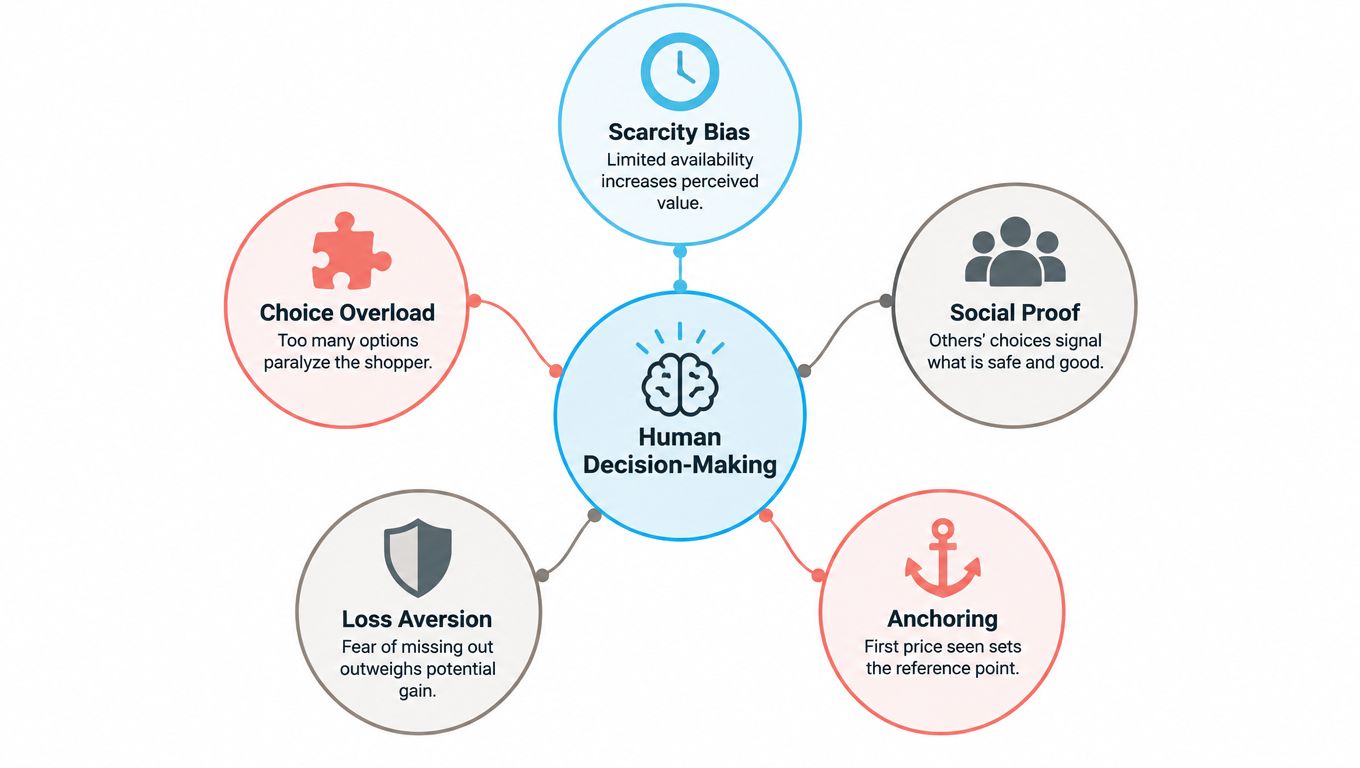
CRO becomes easier to teach when teams can name the behavior behind a tactic. A progress bar, a customer count, and a limited reward may all influence action, but they work through different decision shortcuts.
Scarcity bias
Scarcity bias makes limited availability feel more valuable. On Shopify, a genuinely limited product quantity, a reward with a real claim cap, or an offer that closes at a stated time can help a shopper resolve indecision. The constraint must be real and understandable. Manufactured countdown pressure may produce a click, but it teaches customers to distrust future urgency.
Loss aversion
Loss aversion describes the tendency to feel the pain of missing something more strongly than the pleasure of gaining an equivalent benefit. A message such as “claim the available reward before it closes” frames the decision around avoiding a missed opportunity. Used responsibly, this clarifies timing. Used constantly, it makes every visit feel like a pressure tactic.
Social proof
Social proof lets shoppers use other people’s behavior as a shortcut when they aren’t sure what is safe or worthwhile. Reviews, verified purchase signals, product popularity, and relevant customer counts can reduce uncertainty near a product-page or checkout decision. Social proof works best when it answers a specific doubt, rather than appearing as decorative praise.
Commitment and consistency
Commitment and consistency explains why small actions can make a larger action feel more natural. A shopper who selects a size, saves an item, joins a waitlist, or adds a product to cart has already invested attention. Clear progress indicators and a predictable next step respect that momentum. They don’t guarantee a purchase, but they reduce the cognitive cost of continuing.
Temporal discounting
Temporal discounting means people tend to value a benefit available now more than an equivalent benefit delayed into the future. This is why a relevant reward that is available during the current shopping moment can influence action more effectively than a vague promise of future savings. The offer still needs to preserve margin and fit the shopper’s intent.
A useful companion to these principles is this practical guide for leaders shaping organizations from Kushan Business Solutions LLC. For ecommerce teams, the lesson is operational: behavioral design should make a decision clearer, not disguise a weak offer.
You can also explore Quikly’s behavioral design principles for a deeper treatment of how urgency, scarcity, and participation shape promotional experiences.
The principles are double-edged. If a store repeatedly creates false scarcity, exaggerates popularity, or trains customers to wait for discounts, shoppers become more skeptical. That damages the same trust CRO is meant to build.
The Four-Phase CRO Methodology
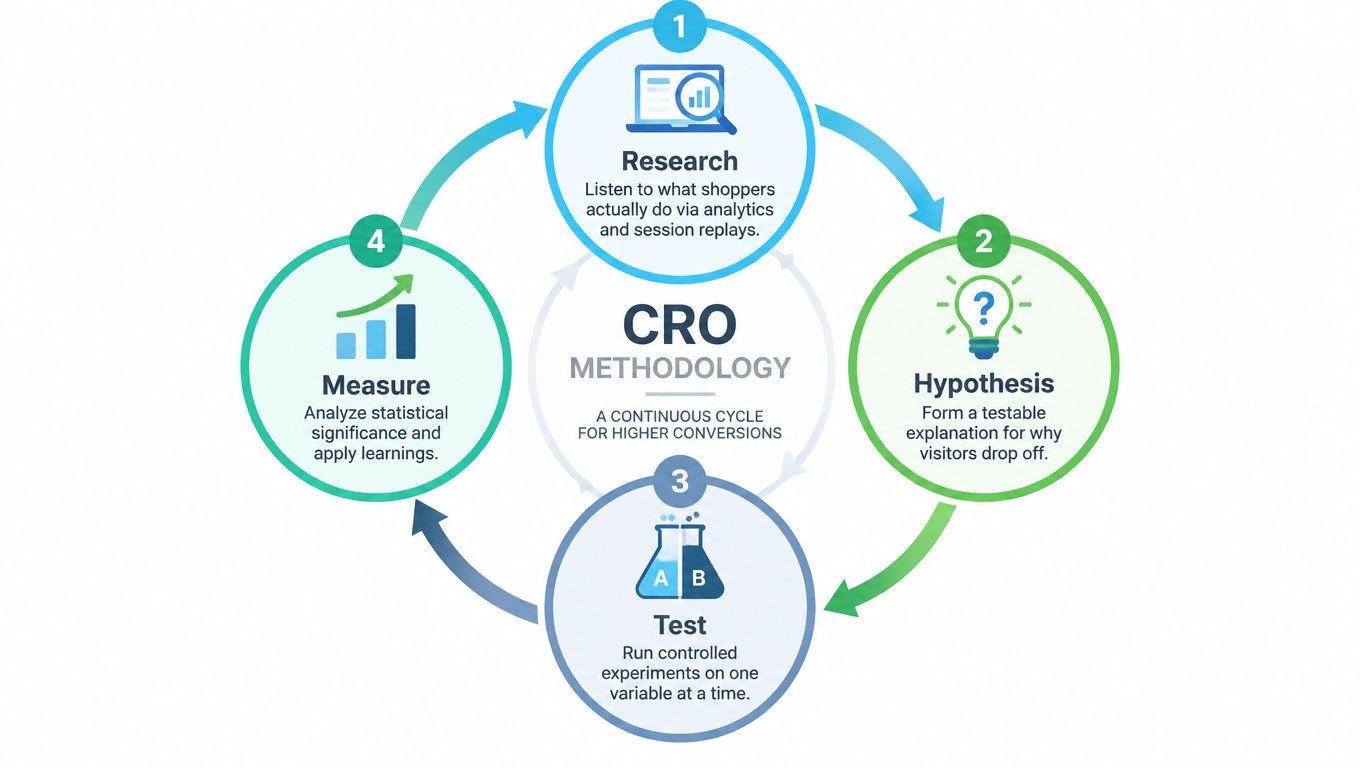
A reliable CRO program is a loop, not a collection of isolated tactics. Research supplies the problem, the hypothesis gives the test a reason, the experiment creates a comparison, and measurement determines what the team should do next.
Research finds the friction
Start with behavior rather than opinions. Review Shopify analytics for product-page exits, cart creation, checkout completion, device differences, and traffic-source quality. Pair those patterns with session replays, on-site search terms, customer-service tickets, post-purchase surveys, and short intercept questions.
The output should be a prioritized problem statement. “Mobile conversion is weak” is a starting signal. “Mobile shoppers reach shipping information late and leave after opening the delivery accordion” is closer to a usable research finding.
Hypothesis makes the idea testable
A hypothesis connects a problem to a controllable change. For example: “If delivery timing appears beside the add-to-cart action, more qualified shoppers will continue because uncertainty is resolved earlier.”
Keep one main change attached to one explanation. If you rewrite the product description, move the CTA, add reviews, and change the offer in the same variant, a winning result won’t tell you which mechanism worked.
Test creates a fair comparison
Random assignment lets a control group and treatment group experience the store concurrently. Stable exposure matters because device mix, returning visitors, campaign traffic, and audience quality can create apparent lifts unrelated to the page change.
Define the primary conversion metric and guardrails before launch. A commonly used planning target is 80% statistical power at a 5% significance threshold, although the required sample size depends on baseline conversion rate, traffic allocation, variance, and the economically meaningful lift the team wants to detect, as described in guidance on effective Bayesian A/B tests.
Measure the commercial result
Purchase conversion is important, but Shopify merchants should also review revenue per visitor, average order value, margin per visitor, refund rate, and signup quality. A treatment that increases orders while reducing contribution margin may be a poor decision.
The loop fails when a team launches a change and stops there. A result needs documentation, a decision, and a next question. Conversion funnel analysis can help teams locate where shoppers progress, hesitate, and exit before choosing the next experiment.
When Higher Conversion Is Not Better Business
A higher conversion rate is a useful signal, not the destination. The commercial question is whether the treatment creates profitable, incremental customer behavior.
Consider a time-bound discount campaign. Conversion may rise during the campaign because shoppers who planned to buy later purchase sooner. Order volume can look healthy while average discount cost increases, contribution margin falls, and customers learn to wait for the next promotion. The campaign won its headline metric but weakened the business underneath it.
That is why a serious CRO dashboard needs more than orders and sessions. Track the outcome that matters for the economics of the store:
- Contribution margin per visitor: Did the experience create more profit from each visit after product costs, discounts, and relevant fulfillment costs?
- Incrementality: Did the treatment produce purchases that wouldn’t have happened under ordinary merchandising?
- Average order value: Did the experience encourage a stronger basket, or did it reduce the price of the same basket?
- Refund rate: Did urgency or offer framing create mismatched expectations?
- Repeat purchase: Did new customers return with healthy behavior, or did they only respond to a one-time incentive?
- Consent and signup quality: Did email or SMS growth produce engaged subscribers who fit the brand’s customer base?
Baymard Institute’s synthesis of cart-abandonment studies reports an average abandonment rate of 70.22%, with roughly 48% of surveyed users leaving because extra costs such as shipping, taxes, or fees were too high and 24% leaving because the site required account creation, as reported in Baymard’s cart-abandonment research. Those findings point to a practical distinction: some lost orders need clearer pricing or less checkout friction, not a larger discount.
Shopify Analytics and Shopify Reports can establish the onsite picture. Klaviyo can help evaluate email and SMS engagement after the initial conversion, while post-purchase flows can reveal repeat behavior, refund patterns, and whether a campaign attracts customers who remain valuable.
Commercial test: A conversion win that lowers contribution margin or weakens repeat behavior isn’t automatically a win.
The strongest CRO work makes the experience clearer, more credible, and easier to act on. It removes unnecessary effort and resolves uncertainty before asking for the purchase. That approach protects margin and brand perception because it doesn’t depend on escalating promotional depth every time performance softens.
A 30-60-90 Day Roadmap for Shopify Merchants
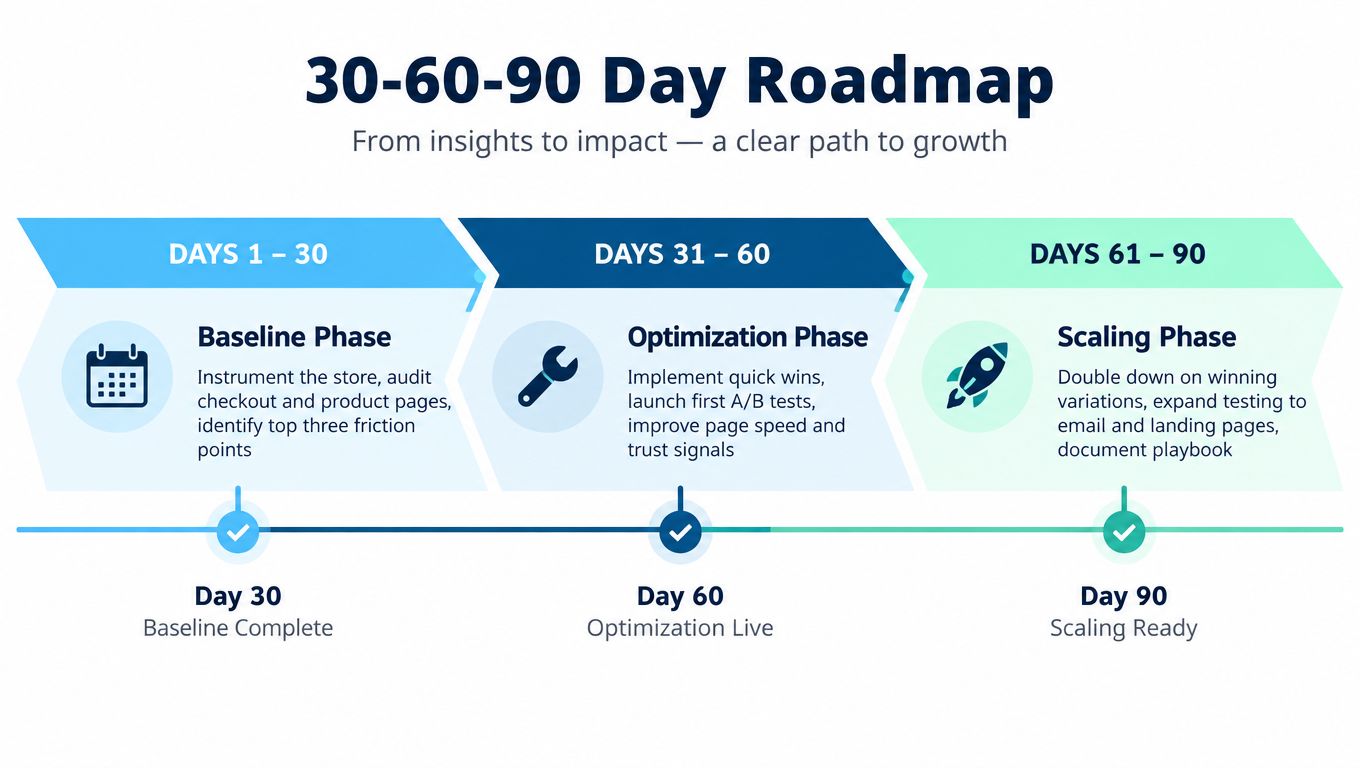
A small Shopify team can start without rebuilding the entire storefront. The calendar below creates a baseline, one controlled action, and a documented learning cycle.
Days 1 to 30 establish the baseline
Instrument the key events across product pages, cart, checkout, purchase, email signup, and SMS signup. Audit the highest-visited product pages and checkout on mobile and desktop. Use Shopify analytics, customer-service conversations, search terms, and session evidence to identify the top three friction points, then choose one based on likely commercial impact and practical effort.
Days 31 to 60 run the first test
Turn the chosen issue into a single hypothesis. Build the variant in the theme, app ecosystem, or testing setup, confirm that tracking works, allocate traffic consistently, and let the test reach its planned stopping rule. Don’t call the result early because the first days look encouraging.
Days 61 to 90 convert results into a playbook
Review the primary metric alongside average order value, contribution margin, refund rate, and relevant retention signals. Document what the team learned even if neither version produces a clear decision. Then queue the next hypothesis, using this Shopify conversion rate optimization guide as a practical reference for continuing the program.
The aim isn’t to fill a testing calendar. It’s to build a repeatable habit of finding meaningful friction, testing a focused response, and making decisions that improve the business rather than a single dashboard number.
Common Questions About Conversion Rate Optimization
How does CRO differ from SEO?
SEO improves who finds the store and what queries bring them there. CRO improves what qualified visitors do after arrival. Shopify brands need both, but they answer different constraints.
How long should a meaningful test run?
Run it long enough to reach the planned sample size and a stable decision point. In practice, that often means weeks rather than days, especially when traffic fluctuates or purchases take time.
When is CRO the wrong move?
CRO isn’t the first fix when the offer, fulfillment, inventory, or customer experience can’t support the promise. It also becomes difficult to power reliable experiments when traffic is too limited, so qualitative research and basic usability fixes may come first.
What does a non-significant result mean?
It means the test hasn’t established a reliable difference. Treat it as no decision yet, not automatically as a loss. Rerun with a sharper hypothesis, improve the design, or choose a more meaningful change.
Quikly gives Shopify merchants a way to run time-bound and quantity-bound promotional experiences across the storefront, email, social, and SMS, with rewards customers can claim while they remain available. If your CRO program needs to test urgency without defaulting to deeper blanket discounts, visit Quikly to explore the approach.
Topics: conversion rate optimization, CRO guide, ecommerce CRO, Shopify conversion, CRO methodology