A Shopify promotion goes out by email, then the same offer lands by SMS for the same subscribers. The text may bring a quick burst of traffic, but it can also feel like an interruption, especially to shoppers who’ve already seen the offer or bought. Sending twice doesn’t automatically mean reaching twice as many people.
That’s the practical question behind SMS messaging and email: which job belongs to which channel, and when does the second send earn its place? For DTC teams dealing with margin pressure, weak conversion, and the brand cost of constant discounting, the answer isn’t to pick a winner. It’s to make each message useful enough to deserve attention.
The Real Question Behind SMS Messaging vs Email
A common Shopify pattern looks efficient on a campaign calendar: send a promotional email, then repeat its subject line and offer in a text. The problem is that the second message often adds frequency, not value. If shoppers see the same promotion twice, or receive an urgent text after they’ve already ordered, the brand has spent attention without creating a better reason to buy.
That trade-off matters when acquisition is expensive and discounting is already doing too much work. A deeper markdown can prompt a purchase, but repeated blanket promotions teach customers to wait for the next one. When a campaign also interrupts people across channels without distinguishing who needs what, it risks weakening trust along with margin.
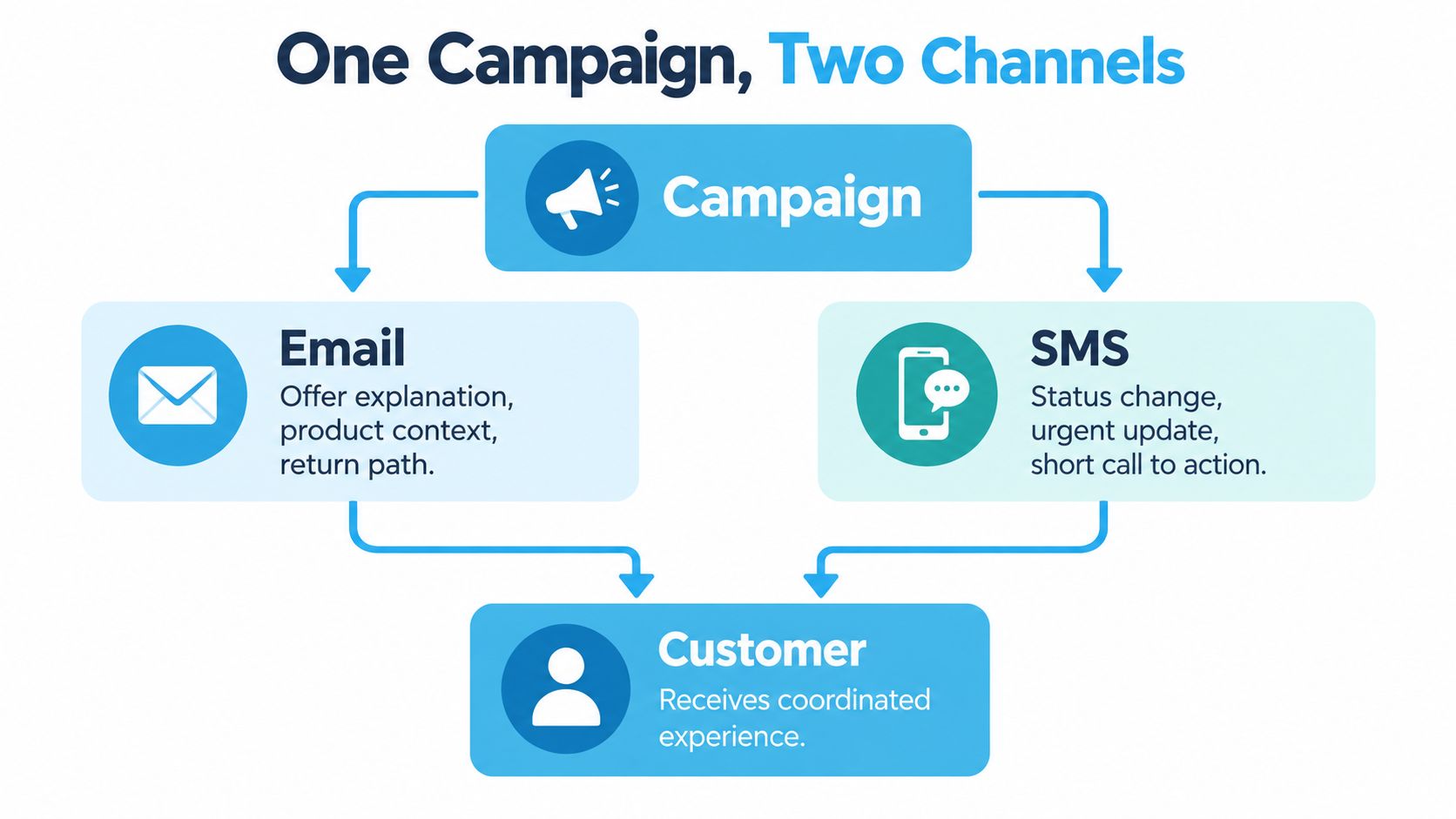
Email and SMS should have different jobs. Email gives a brand room to explain an offer, show products, and create a path back to the store. SMS has a stronger case when a customer needs a timely update, such as a reward tier changing or a genuine deadline approaching. The aim isn’t to make every campaign louder. It’s to match the message to the moment.
That requires more than a channel comparison chart. Operators need to understand how the channels behave, what their metrics can and can’t tell them, how customers prefer to receive different kinds of messages, and how consent works when a Shopify signup collects more than an email address. The useful question isn’t “Which channel gets more opens?” It’s “What should this channel do, and what result would prove it did that job?”
What Each Channel Is Actually Built to Do
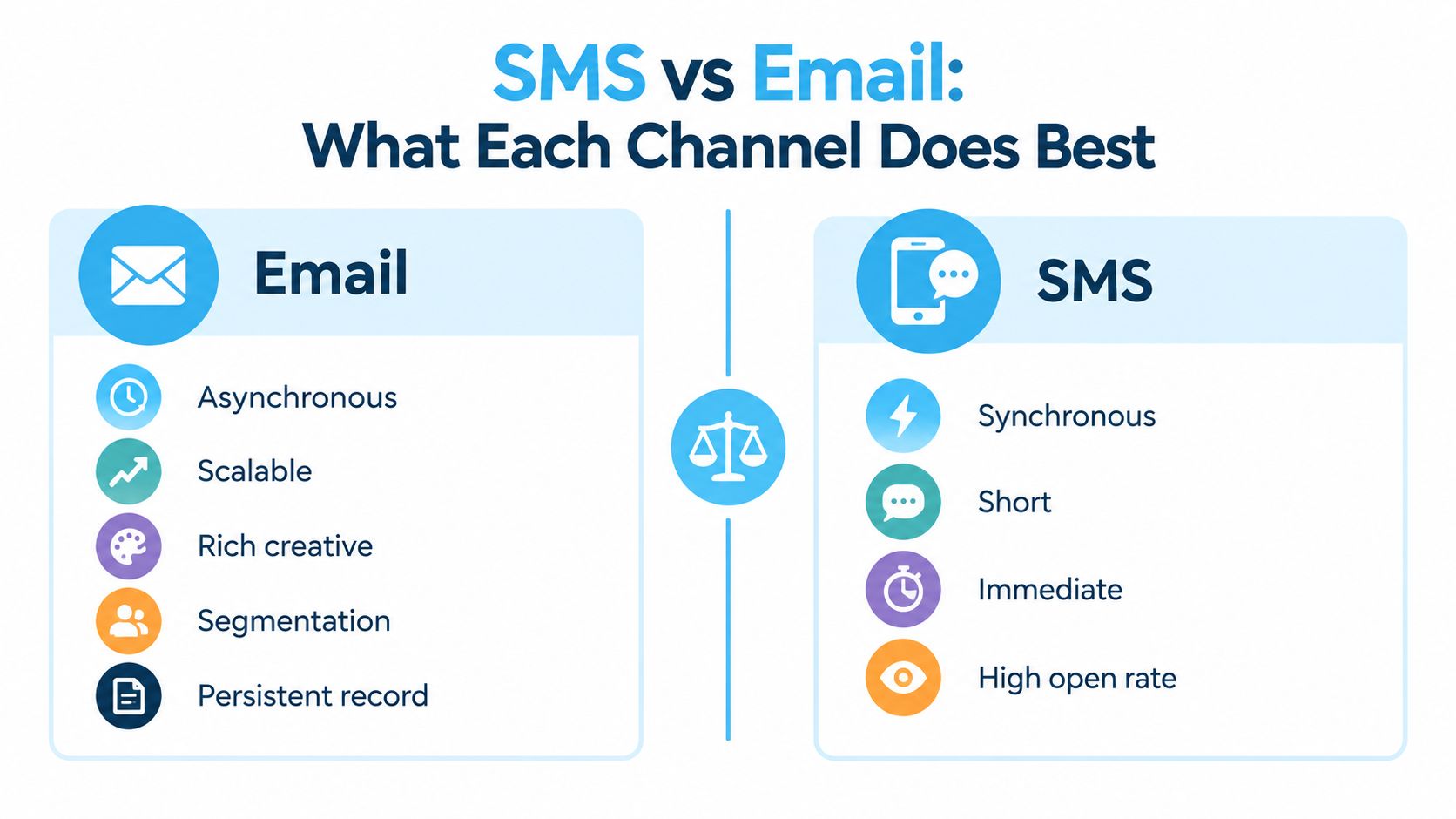
Email is asynchronous and expandable. A shopper can open it now, save it for later, compare products, and return through a link. Merchants can use images, longer copy, merchandising blocks, and segmentation. It’s a practical format for telling a fuller story, though a crowded inbox means the message still has to compete for attention.
Email also functions as reach infrastructure at global scale. The Radicati Group projected 4.037 billion worldwide business and consumer email users in 2020, rising to 4.481 billion in 2024, an increase of roughly 444 million users across the period (Radicati’s email statistics report). That scale makes email useful for broad product discovery and repeat communication, but it doesn’t make every send relevant.
SMS sits in a different context. It’s short, phone-native, and easy to notice, which makes it a better fit for concise, timely updates than for a detailed product story. Texting moved quickly from a niche mobile behavior toward mainstream use: in Pew Research Center’s 2005 survey, 27% of American adult cell-phone owners had texted in the previous month, while 73% of U.S. adult cell-phone owners used texting at least occasionally by 2011 (Pew Research Center’s texting research). The behavior is established; the marketer’s challenge is using it with permission and restraint.
| Channel | Natural strengths | Practical trade-off |
|---|---|---|
| Rich creative, longer explanations, segmentation, and a message shoppers can revisit | Competes in the inbox and may need a clear return path | |
| SMS | Short, immediate updates tied to a timely event | Interrupts more directly and leaves little room for context |
For a Shopify team, cost per send and creative limits should shape the plan, not just audience size. A long explanation in a text is a poor use of the channel; a bare email with no useful context can be just as weak. Think job versus job, not feature versus feature.
Deliverability, Open Rates, and the Metrics That Actually Matter
Open rates make for an easy comparison, but they don’t provide a reliable common yardstick. SMS platforms generally don’t receive a universal technical read receipt. They infer visibility from signals such as delivery, clicks, replies, and device behavior, so a quoted SMS open rate shouldn’t be treated as a directly measured equivalent of an email open.
For ecommerce planning, click and order benchmarks are more useful. Klaviyo-derived benchmarks put SMS campaign click-through rates commonly at 8.9%–14.5%, with top-tier performance beginning at approximately 14.6%. The same benchmark places SMS placed-order rates around 1.0%–2.0% and revenue per recipient around $0.66–$2.41 (SMS marketing benchmark analysis). Treat those figures as planning references, not promises. A click is a visit, not a completed order.
Email open rates vary with audience, platform mix, geography, and measurement conventions. One 2025 benchmark reports a 27.20% overall industry-average open rate, while another reports 36.59% for its sent email population; a regional benchmark reports 33.2% opens and 4.05% clicks for EMEA (2025 email benchmark report). That spread is a reason to avoid treating one open-rate target as a universal standard. For inbox placement concerns, a team can run a quick email deliverability test as one diagnostic alongside its own campaign data.
| Metric | SMS typical range | Email typical range | What it tells you |
|---|---|---|---|
| Click-through rate | 8.9%–14.5% | EMEA benchmark: 4.05% | Whether delivered messages brought shoppers to the store |
| Placed-order rate | 1.0%–2.0% | Not stated as a comparable range here | Whether the campaign led to completed orders |
| Revenue per recipient | $0.66–$2.41 | Not stated as a comparable range here | How much revenue each recipient generated |
| Open rate | Not a universal technical read receipt | Varies by benchmark and market | A directional signal, not a complete performance measure |
In Shopify and Klaviyo reporting, compare delivered-email clicks, placed orders, revenue per recipient, margin per recipient, and unsubscribes. For a broader framework on evaluating email performance, see Quikly’s email evaluation guide. The honest comparison isn’t SMS open rate against email open rate. It’s the result each channel was meant to produce.
Where Each Channel Earns Its Send in Ecommerce
Start with the message, then choose the channel. If the shopper needs product detail, comparisons, an explanation of the promotion, or a reason to return later, email usually gives the message enough room. Product launches, educational sequences, and previews benefit from images and context. An email can also show how a reward works without cramming every condition into a short text.
Customers’ stated preferences support that split. In a 2025 UK consumer report, 55% preferred email for brand news, compared with 17% for SMS; 56% preferred email for product previews, compared with 16% for SMS (Attentive’s UK SMS and email report). Those preferences don’t dictate every campaign, but they’re a useful check against the assumption that a text is always the stronger promotional format.
SMS earns its send when something has changed and the shopper can act on it now. A limited restock, an expiring reward, a closing offer, or a reward tier nearing exhaustion may justify a concise text. The scarcity needs to be real: if availability hasn’t changed and no meaningful deadline exists, urgency can turn into pressure rather than useful information.
Cart recovery needs the same judgment. A text can make sense when the customer has given SMS consent and there’s a relevant, timely reason to follow up. But sending both an email and a text with identical copy merely because the automation allows it isn’t a strategy. It can train shoppers to ignore the channel that once felt more personal.
Practical rule: Use email to explain the opportunity. Use SMS to report a meaningful change that makes acting now different from acting later.
In scarcity campaigns, this distinction is especially important. A capped or descending reward can give shoppers a real reason to act sooner, but repeated messages that don’t correspond to a change in availability weaken the signal. The channel should support the promotion’s mechanics, not manufacture urgency on its behalf.
The Overlap Trap and the Consent Problem
An SMS subscriber isn’t automatically a new person beyond the email list. In a 2025 UK consumer report, 97% of consumers subscribed to a brand’s SMS program also engaged with that brand’s email; only 19% said they read all of those emails (Sinch’s consumer messaging report). SMS may reach someone at a different moment, but that overlap means it shouldn’t be counted as guaranteed incremental reach.
The more important distinction is permission. In the U.S., marketing texts covered by TCPA rules generally require prior express written consent, and email permission doesn’t automatically authorize SMS marketing. The consent should identify the number and the marketing authorization, and it shouldn’t be made a condition of purchase. Reported TCPA damages are generally $500 per violation and may reach $1,500 per willful violation (LeadCompliant’s TCPA compliance guidance).
Global Shopify brands also need to account for GDPR requirements for European subscribers, including affirmative consent and data-erasure rights. A signup flow that works for one market shouldn’t be assumed to meet another market’s requirements. Consent records need to preserve what a person agreed to, how they agreed, and which channel that permission covers.
The operational rule is straightforward: grow and govern email and SMS permissions separately. Keep channel-specific opt-in records, make opt-outs clear, and don’t mistake a large combined list for a qualified one. More subscribers are useful only when they’ve chosen to hear from you in that way.
How to Orchestrate Both Channels Inside One Campaign
Treat the campaign as a sequence of decisions, not a schedule of duplicate sends. Email can introduce the promotion, show the products, explain how the reward works, and give shoppers a path back to the store. SMS should enter only when a meaningful event makes a phone interruption useful.
That’s the logic of using text as an escalation layer. The Sinch research cited above shows how much the audiences overlap, so a second channel should add something the first message didn’t. A scheduled copy of the email doesn’t do that.
A practical scarcity campaign might run this way:
- Email the offer context. Explain the products, reward rules, and how shoppers can claim. Link directly to the relevant Shopify collection or campaign experience.
- Watch for real movement. Tie an SMS trigger to a meaningful change, such as a reward tier approaching exhaustion or an offer entering its final window.
- Suppress people who no longer need the nudge. If a shopper has already placed an order, don’t send the promotional text. If the shopper has clicked the email and the offer hasn’t changed, avoid treating that click alone as a reason to interrupt.
- Send a concise status update. State what changed, what the shopper can do, and where to act. Don’t turn the text into a second explainer.
- Review the result against a holdout. Measure whether the SMS created additional orders rather than claiming every attributed click as incremental impact.
This kind of coordination is easier to maintain when the team defines triggers and suppression rules before launch. Shopify’s discount and cart infrastructure, plus a Klaviyo flow or other messaging integration, can support the operational pieces, but the campaign still needs a clear decision about what event justifies each send. For a wider view of triggered messaging, see Quikly’s guide to marketing automation workflows.
Quikly is one option for Shopify brands running time- or quantity-limited promotions across storefront, email, and SMS; its campaigns can use capped rewards or descending tiers to make early action matter without sending the same promotion everywhere.
Building the Combined List the Right Way
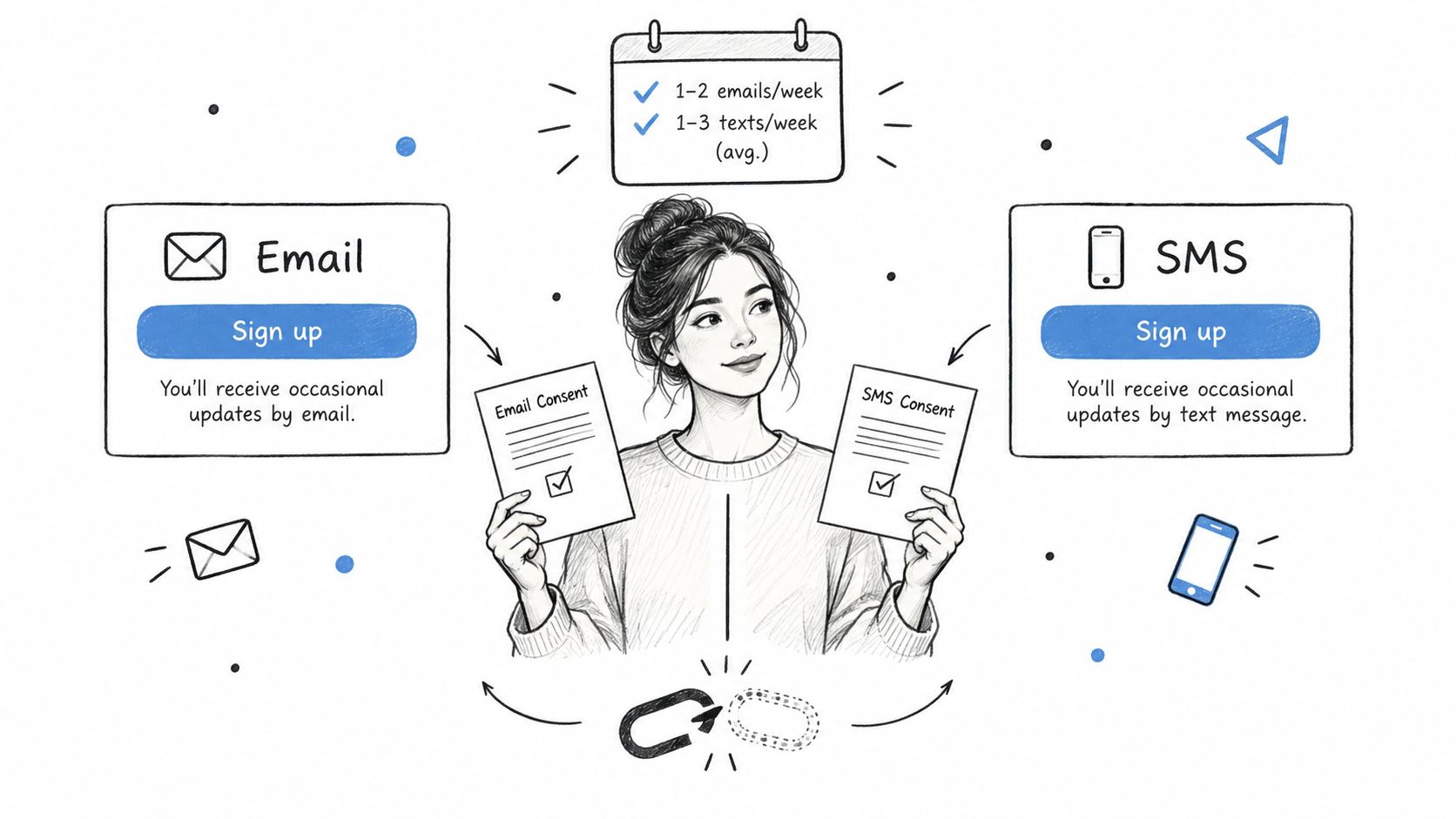
A combined signup form can make it easy for shoppers to choose how they want to hear from a brand. It shouldn’t treat one choice as permission for both channels. Use separate, unchecked permissions with plain-language disclosures about the message purpose and expected frequency, and let customers revoke SMS without losing email access, or vice versa.
A Shopify form may also need to route signups differently by country. U.S. SMS marketing consent has TCPA considerations, while European subscribers need GDPR-aware consent practices. Store the channel, disclosure, timestamp, and collection method so a retention lead can verify what each subscriber authorized. A fast promotional signup is not a reason to skip that recordkeeping.
A practical Monday-morning checklist for a Shopify retention team:
- Separate permissions: Capture email and SMS consent as distinct actions, and preserve the disclosure shown at signup.
- Set expectations: State what kinds of promotional messages subscribers can expect and how to stop them.
- Apply suppression: Exclude shoppers who opted out, have just purchased, or haven’t engaged within the team’s defined window.
- Respect geography: Route forms and campaigns according to subscriber location and applicable consent requirements.
- Measure by channel: Report delivered-email click rate, placed-order rate, revenue per recipient, margin per recipient, and unsubscribe rate.
- Test incrementality: Compare SMS recipients with a randomized holdout so the team can tell whether the text added orders rather than merely claiming conversions already in motion.
Cross-enrollment can be useful when customers actively choose it, but don’t infer text permission from an email signup. For a practical discussion of inviting email subscribers to opt into SMS, see Quikly’s cross-enrollment guide. The standard should be clear consent and a relevant reason to subscribe, not maximum list size.
Measuring Incrementality and Protecting Margin
A Shopify brand doesn’t need more messages by default. It needs messages that earn their send. Track whether each channel contributes to placed orders, average order value, and margin per recipient, then compare those outcomes with unsubscribes and other signs of fatigue. Opens and clicks can help diagnose a campaign, but neither proves that a discount created profitable incremental demand.
That distinction matters when brands are under pressure to convert more acquisition traffic. If every shortfall leads to a deeper discount and another reminder, the store may close more orders while weakening its margins and teaching shoppers to wait. A real, bounded reward can give customers a reason to act early; the promotion still needs to be evaluated on what it costs and what it adds.
Plan the next campaign around one question: What event would make a second message useful? Let email carry the explanation and return path. Reserve SMS for the moments that warrant a phone interruption, then check a holdout to see whether it contributed incremental orders. That gives the team a way to pursue conversion without defaulting to a deeper discount or a louder campaign.
If your Shopify team is planning a promotion, Quikly offers on-brand, time- or quantity-limited reward experiences that can run across your storefront, email, and SMS. Explore how a real change in reward availability can give each channel a distinct job without turning every offer into another blanket discount.
Topics: sms messaging email, ecommerce marketing, sms vs email, omnichannel campaigns, shopify marketing