Promotions are not failing. Flat discounting is. The most repeated advice on sales promotion techniques is still to cut deeper, blast a sitewide code, and treat the spike as proof. That advice is why the next campaign needs a worse margin to match the last one.
You already know the loop. Offers get more frequent. Shoppers who used to buy on a Tuesday now wait for Friday’s code. Acquisition spend still shows up, and the visit still doesn’t decide. A standing markdown is not a reason to act today. It is a reason to hesitate until the price looks familiar. Brand value slips in the same motion, because the store starts to look like it is always on sale.
I don’t grade an offer on conversion alone. I look at whether it moves a decision, what it costs in margin, and which habit it teaches. A technique that lifts orders while paying people who were going to buy anyway is a loss, even when the revenue screenshot looks loud. The ten techniques below are specific enough to run on Shopify. Some reward shoppers for acting. Some train them to wait. That difference is the whole list.
1. Flash Sales (Time-Limited Offers)
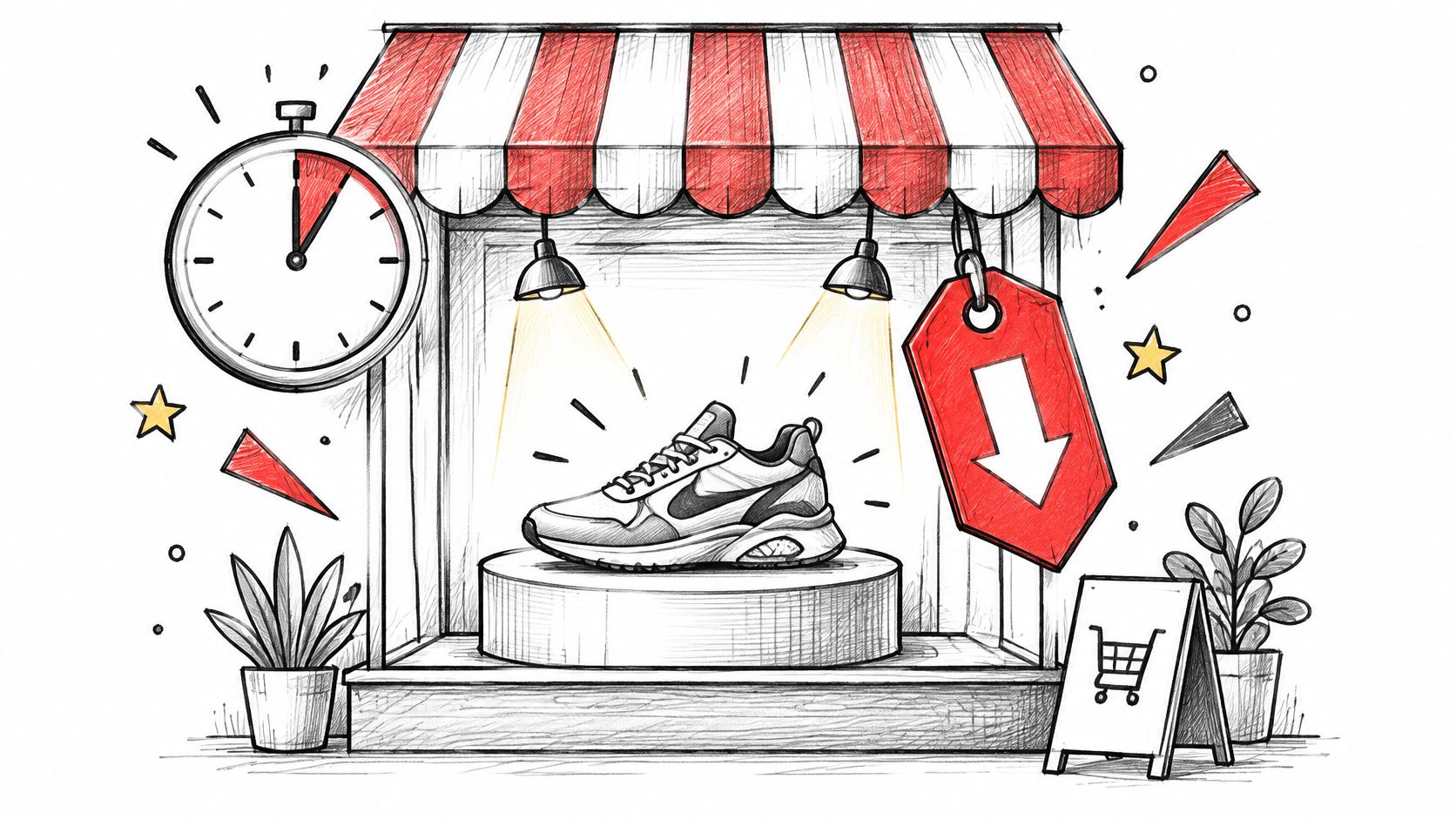
A flash sale is a fixed window, often a few hours or a single day. Scarcity bias and temporal discounting explain the pull. A reward that disappears soon feels larger than the same reward with no end date.
Depth and repetition change the result. In a field experiment across 10 Chilean supermarkets and 170 products, customers exposed to the deeper promotional treatment were 22.4% more likely to buy promoted items than the control group, and prior exposure to deeper promotions accounted for 61% of the impact of moving from shallow to deep discounts, according to the Springer field study. Shoppers learn the pattern. Run the same flash with no reason and they wait for the next one.
Amazon Prime Day works because the date means something. Woot built a catalog around deals that expire. A fragrance restock can carry the same logic, which is the point of Gotham Fragrances’ cologne sale guide. I tie each window to a launch, a restock, or a season, then I read margin per order, not just revenue. A short set of flash sale ideas is enough. More events make the deadline cheaper.
2. Limited-Quantity Offers and Capped Drops
Supreme doesn’t need a percent off to clear a drop. The cap is the offer. On Shopify, the useful version is often smaller: a bonus for the first 200 orders, or a gift that ends when the pool is gone, while the hero product keeps selling.
Scarcity bias moves “maybe later” to “now” only while the number is believable. An APEC paper on misleading pricing calls out sellers who claim products are “almost out of stock” to rush the purchase. I won’t show a remaining count unless it is true and updates live.
Practical rule: Cap the reward, not the product you can still sell at full price. A limited bonus pool creates urgency without marking down every unit.
Say you launch a serum. Bottles stay available. The travel-size gift stops at 200 redemptions. Say that in plain language on the product page. Set the cap from what the gift costs, then test a tighter number only if claims stall. A fake “only 3 left” fails the second time someone sees it.
3. Descending Tier Rewards (Progressive Claim Offers)
A descending tier makes the cost of waiting visible. The reward starts high, then steps down as shoppers claim it. Early buyers get the best deal; later buyers get a smaller one. Unlike a flat code that stays available, each step gives shoppers a reason to act sooner.
Product scarcity and time distance both shape online purchase decisions, while fear of missing out raises motivation, according to Springer E-Business research. For example, start with 100 claims at the top reward, then offer a smaller reward for the next 200. Show the next step down clearly, and make the difference meaningful enough to change the decision. Set claim limits the business can honor.
Quikly campaigns can run as a single reward or a descending tier, with rewards limited by claim quantity, time, or both. The format gives early shoppers the strongest incentive, while later shoppers receive less. That can make the average discount lighter than a sitewide markdown, but the margin still depends on the value of each tier and how many shoppers claim it. Quikly’s approach has been refined across more than 60 million consumer interactions. Style the campaign to match the store, then check the margin at every tier before increasing the top reward.
4. Spend Threshold Rewards (Free Shipping and Tiered Savings)
Free shipping above a set cart value is the most familiar spend threshold. Tiered perks use the same principle: a larger cart earns a larger benefit. The shopper adds an item to qualify, so the reward is tied to a purchase rather than a code available to everyone. That can protect list price, though a threshold set too high may leave shoppers unwilling to add more.
Cart abandonment has several causes a deeper discount may not address. Baymard’s checkout research reports average cart abandonment at 70.19%, while 42% of U.S. online shoppers said they left because they were just browsing or not ready to buy. A clear threshold gives shoppers with an open cart a specific goal, but it cannot replace a straightforward checkout or terms they can read before payment.
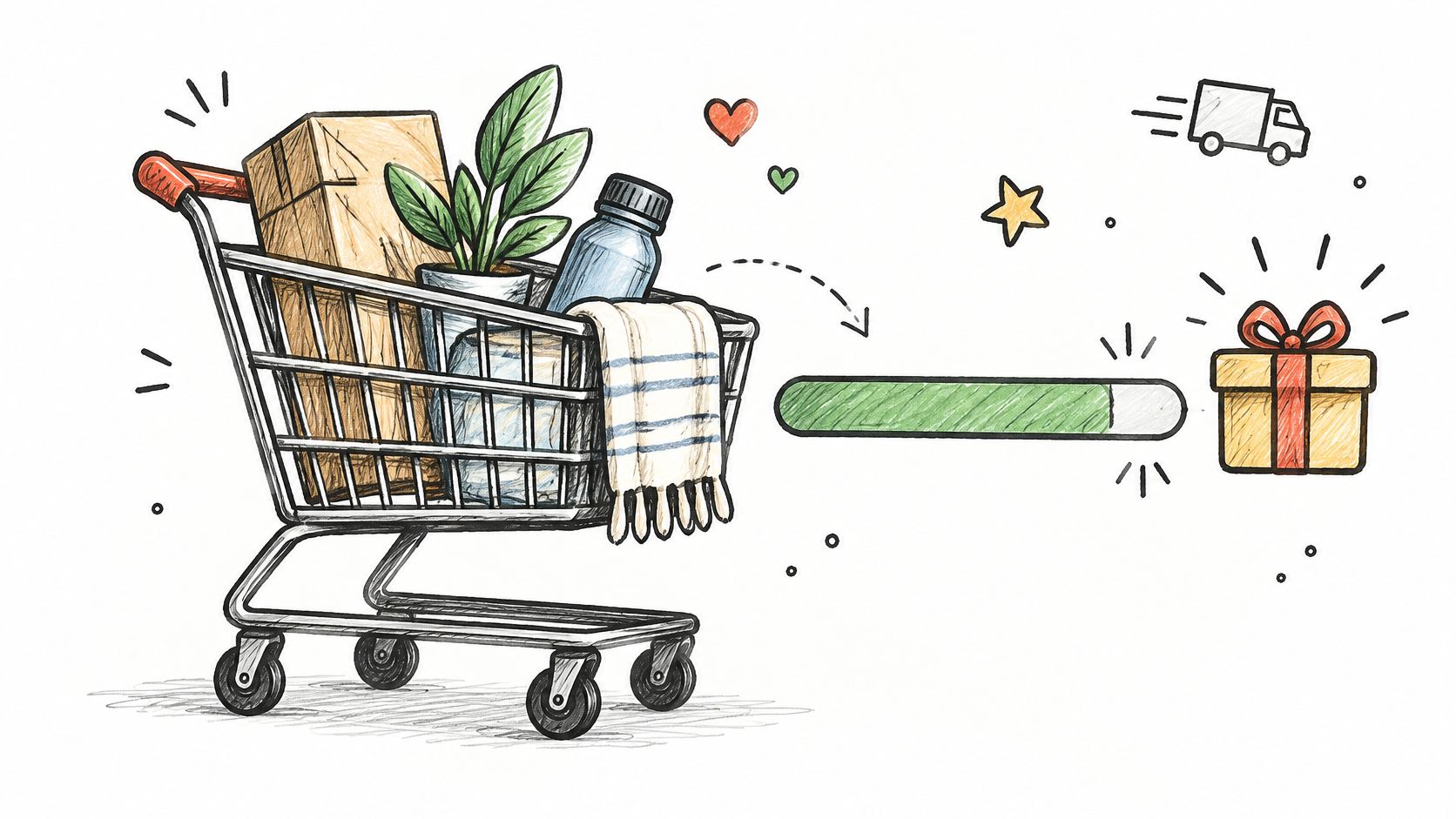
Show shipping progress in the cart, and don’t present a reduced total as guaranteed until the shopper meets the threshold. Set the line near the median cart, then test one step higher and compare shipping costs with the extra units sold. A threshold can raise order value without a blanket markdown, but if shoppers see it as out of reach, it may do little to change behavior. For practical setup considerations, see this guide to the free shipping threshold.
5. Gift with Purchase (GWP)
A gift with purchase leaves the list price alone and adds something the shopper can use. Sephora and Clinique made the pattern familiar in beauty. A smaller brand can copy the constraint, not the budget: a travel size once the order clears a set spend.
Commitment and consistency shows up when the gift finishes a routine the buyer already started. A random trinket doesn’t. The gift has to fit the product and the person, or it reads as leftover inventory.
Aggressive price cuts carry a brand cost. A 2025 U.S. shopper study reported by Business Wire found that 20.7% of respondents had stopped buying from a brand because of misleading offers, and 10.6% said aggressive markdowns made a brand feel cheap. A useful gift avoids that cheapening better than another sitewide banner.
- Pick a related gift: Sample the next product you want tried, not a leftover with no story.
- Show the spend level early: Put it on the product page, not at the last checkout step.
- Test a step-up gift: A better gift at a higher cart is still a bonus, not a cut on every SKU.
6. Product Bundles
A bundle turns three decisions into one. Anchoring does part of the work. The shopper sees each price, then a combined price that is lower, and the set feels like the sensible buy. You also move a slower item beside a hero without putting that hero on a permanent markdown.
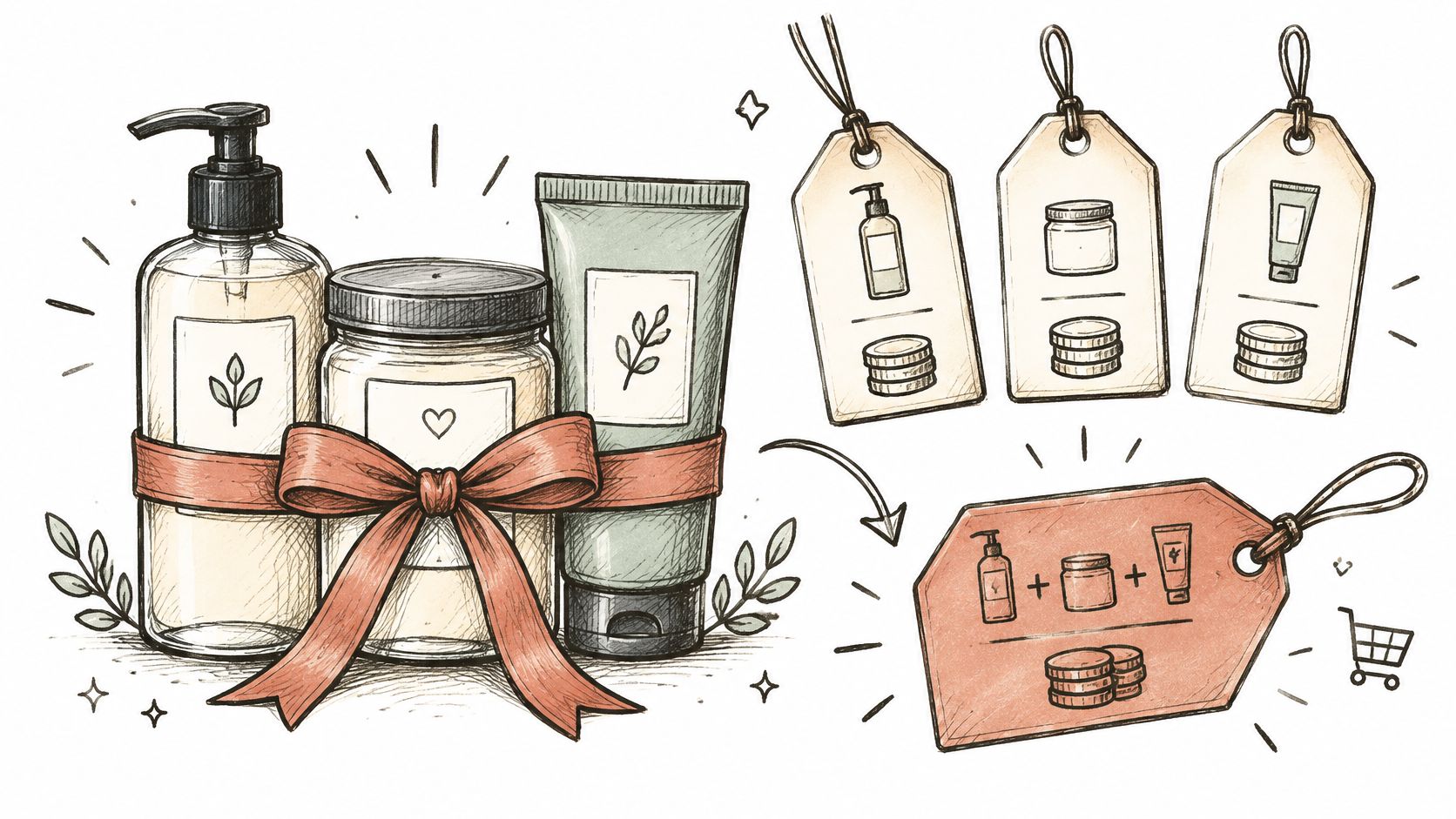
How you frame the saving changes the basket. A 2026 benchmark covered by My Total Retail found percentage-off offers associated with a $95.75 average order value, versus $67.35 for amount-off offers, a 42% difference. A flat dollar off can buy redemptions and still shrink the cart. A bundle frames a complete offer, so the saving sits on the set, not on every individual product you hope to sell at full price later.
A cleanser, serum, and moisturizer kit is the clean version. A three-bag coffee bundle with a small saving is the same idea. Set a minimum margin before launch, show both prices side by side, and test a free add-on before you default to a percent off the kit. Shopify-ready structures are in these product bundle ideas for Shopify.
7. Loyalty and Points Programs
Points and tiers move the prize off this order and onto the relationship. Commitment and consistency is the mechanism. Once someone holds a balance or a status, they keep buying to protect it. Sephora Beauty Insider and Starbucks Rewards are the familiar shapes: perks and earlier access, not a new public code every week.
Repeated price promotions get tired. Across 589 consumer packaged-goods brands in 117 categories, tracked for 13 years, about 75% saw promotional sales response decline, with an average annual drop of about 4%, according to Tuck at Dartmouth. Brand loyalty was one of the factors tied to that change. A points program can cut how often you need a public markdown. A program that only redeems into deeper discounts rebuilds the dependency it was meant to replace.
If earning and redemption need a chart, people will ignore the program and wait for the sale email. One sentence should be enough.
Reward repeat purchases and reviews. Keep pure discounts off the top tier and offer early access or exclusive products instead. The same care that goes into building subscriber relationships through email belongs here. Status should feel like a relationship, not a coupon drawer.
8. Early Access and VIP Previews
Early access sells belonging, not a fake reference price. Nordstrom’s Anniversary Sale gives cardholders a real head start. A smaller brand can open a new collection to subscribers 24 hours before the public launch. The window has to be earlier. If everyone gets it, the VIP line is costume.
The FTC Guides Against Deceptive Pricing say a former price in a comparison has to be a genuine price, offered to the public regularly for a reasonably substantial period. A brief markup before a “VIP sale” fails that test, and it makes the access feel like a trick. I would rather give the list a first look at a new product at the true price than invent a crossed-out number. A countdown that restarts tomorrow is the same kind of fiction.
- Keep the group small: Exclusivity dies when the preview is a blast to the whole file.
- Use an invitation: Eligibility should feel earned through purchases or a real signup.
- Tell everyone else later: A public launch after the window keeps the broader audience in the brand, just not in the head start.
9. Sign-Up Incentives for Email and SMS
Most stores trade a generic percent off for an email, then wonder why the list only buys on code. Loss aversion can help when a reward is already on the table and it expires. The subscriber you get is still the one the reward selects. A cheap blanket code selects bargain hunters.
Quantum Metric’s peak-season benchmark reports that 63% of surveyed U.S. and U.K. consumers preferred personalized deals over blanket discounts, and 79% said they would use promotional codes received directly from a brand. That supports a direct, specific offer. It doesn’t support pasting the same code on every visit.
Say the welcome flow delivers the reward in the first message, timed to the opt-in, and the reward is early access or a gift with the first order. SMS can carry a launch preview instead of another percent off. Track revenue and repeat rate by source. List size is the vanity number. I drop the sitewide popup for a moment that matches the visit, such as a first-order gift after a second product view.
10. Referral Programs
A referral pays a customer to bring someone who already trusts them. That trust is social proof you didn’t buy as another ad. Dropbox grew storage for both people without teaching a storewide sale habit. A skincare brand can offer store credit to the referrer and a small first-order gift to the new buyer.
The margin risk is paying both sides a deep percent. I give the referrer credit or access, and I give the new customer a reason to try one product, not a markdown that stacks with whatever sale is already live. Cap the rewards. If both codes stack on a sitewide event, you have subsidized the same order twice.
Put sharing on the order confirmation and in the post-purchase email, where the buyer is already paying attention. A referral program and how to start a brand ambassador program are cousins, but ambassadors are a smaller, recruited group. Don’t give every referrer ambassador economics. Set the cap from contribution margin on a first order, and stop the offer when that cap is hit.
10 Sales Promotion Techniques at a Glance
| Technique | Primary Goal | Margin Impact | Brand Perception Risk | Best For |
|---|---|---|---|---|
| Flash Sales (Time-Limited Offers) | Create urgency and drive immediate purchases | Discounts reduce margin; can clear overstock | Frequent sales can train customers to wait and weaken perceived value | Seasonal events, launches, or clearing aged inventory |
| Limited-Quantity Offers and Capped Drops | Prompt action through genuine scarcity | Hard caps limit total reward costs | Fake or inaccurate scarcity damages trust | Limited releases or capped bonuses |
| Descending Tier Rewards (Progressive Claim Offers) | Reward early action with progressively smaller offers | Keeps average discount lighter than a blanket sale | Low risk when tiers feel earned and are clearly explained | Motivating early purchases while managing discount depth |
| Spend Threshold Rewards (Free Shipping and Tiered Savings) | Increase cart size by unlocking a reward at a spend level | Can raise order value; thresholds that are too low may cut into margin | Low risk when the threshold and reward feel fair | Encouraging shoppers to add items to their carts |
| Gift with Purchase (GWP) | Add value and encourage purchase without reducing list price | Gift and fulfillment costs reduce margin | Gift quality can affect perception of the core product | Sampling, complementary products, and protecting list prices |
| Product Bundles | Increase order value and move complementary or slower-selling items | Savings can thin bundle margins | Bundles may seem like a way to clear stock if poorly chosen | Curated product pairings and basket building |
| Loyalty and Points Programs | Encourage repeat purchases and build long-term value | Program costs and points liability can accumulate | Discount-heavy or complex programs can weaken value and frustrate customers | Retention, recognition, and reducing reliance on blanket discounts |
| Early Access and VIP Previews | Reward selected customers with exclusive first access | Protects public pricing; setup costs may apply | Exclusion can frustrate customers if eligibility or exclusivity is unclear | Loyal customers, subscribers, and new product launches |
| Sign-Up Incentives for Email and SMS | Grow the owned audience and convert first purchases | Discounts reduce margin; low-engagement signups add cost | Aggressive pop-ups or generic discounts can harm the experience | Building email and SMS lists with relevant prospective buyers |
| Referral Programs | Acquire customers through trusted recommendations | Rewards on both sides can erode margin | Low risk when rewards are balanced; fraud can undermine trust | Word-of-mouth growth and lowering reliance on paid ads |
Rewards for Shoppers Who Act, Not Those Who Wait
The split in this list is not clever versus basic. It is who gets paid. A flat code pays the shopper who was going to buy, and it pays the shopper who learned to wait. A cap, a threshold, a gift, a bundle, a status perk, a real preview, a specific signup reward, or a capped referral pays a behavior you can name. Conversion still matters. It doesn’t outrank margin, and it doesn’t outrank the habit you leave behind.
Flash sales and public markdowns aren’t banned. They are easy to overuse. Once the calendar is predictable, full-price weeks go quiet and the next event has to shout louder. Quantity caps and earned perks fail differently. They fail when the limit is fake, the gift is irrelevant, or the points only cash out as another sitewide cut. Those are design errors, not proof that urgency itself is a trick. Urgency works when the limit is the actual offer.
Turn the offer you already run into a bound one
The descending tier in the third technique is the cleanest fix I know for the “deeper every time” loop. You don’t invent a new discount. You take an offer the team already runs and bind it to claims, to time, or to both. Early intent gets the strong reward. Everyone else doesn’t inherit that same subsidy. Average discount falls even when participation rises, which is the margin conversation most promotion recaps skip.
Quikly turns any offer into a scarce, act-now campaign for Shopify stores. Campaigns are designed to match the store’s colors, type, and storefront, so the experience reads as part of the shop rather than an overlay people have learned to close. You can run one reward or a step-down, on the storefront or through the email and SMS you already send. The point is participation. Shoppers see what is left and what waiting costs.
Pilot before you rewrite the calendar
Don’t rebuild a quarter of promotions in one week. Pick one or two goals, such as profit per order on a hero product, or signup quality instead of list size. Use two or three offer types against each goal, with a holdout if your volume allows it. Watch redemption, average order value, and contribution margin, not clicks alone. If full-price demand dips the week after, the offer was too easy to anticipate.
Enter a store URL at hello.quikly.com and you’ll get a free urgency campaign matched to that store and its goals. Run it as a limited pilot. Keep what protects margin. Drop what only flatters the conversion rate. That is a sharper way to plan the next month than adding another blanket code to the calendar.
Quikly turns the promotions you already run into claim-capped or time-bound rewards, so the best offer goes to shoppers who act instead of everyone who waits. That is the margin-safe version of the sales promotion techniques above, styled to your Shopify store rather than bolted on as a generic timer. Visit Quikly and start with a campaign built around your store and the goal you need to move.
Topics: sales promotion techniques, ecommerce promotions, urgency marketing, Shopify marketing, discount strategy