Most advice about product bundle ideas for Shopify starts with the same playbook. Bundle more products, add a discount, put a badge on the product page, and hope average order value goes up. Sometimes it does. But plenty of bundles become margin giveaways that teach shoppers to hold out for the next promo.
That’s the core issue. The bundle itself isn’t the problem. Weak mechanics are. Shopify merchants already know bundling can work, and Shopify-linked research cites a consistent 20% to 30% increase in average order value from bundling when it’s structured well, not just slapped on as a markdown (Shopify bundle study summary). The mistake is treating bundles like a prettier discount code instead of a controlled buying decision.
The better approach is to build bundles that increase urgency, protect price integrity, and make the shopper feel like they’re earning something, not just waiting for your next sale. That matters when margins are tight, conversion is soft, and brand perception starts slipping under constant promotions. If you’re trying to calculate business profit margins, you already know a higher cart value only helps if the promotion doesn’t eat the gain.
Here are ten strategic product bundle ideas for Shopify that do more than push units. Each one is built around how people buy.
1. Tiered Discount Bundle with Quantity Caps
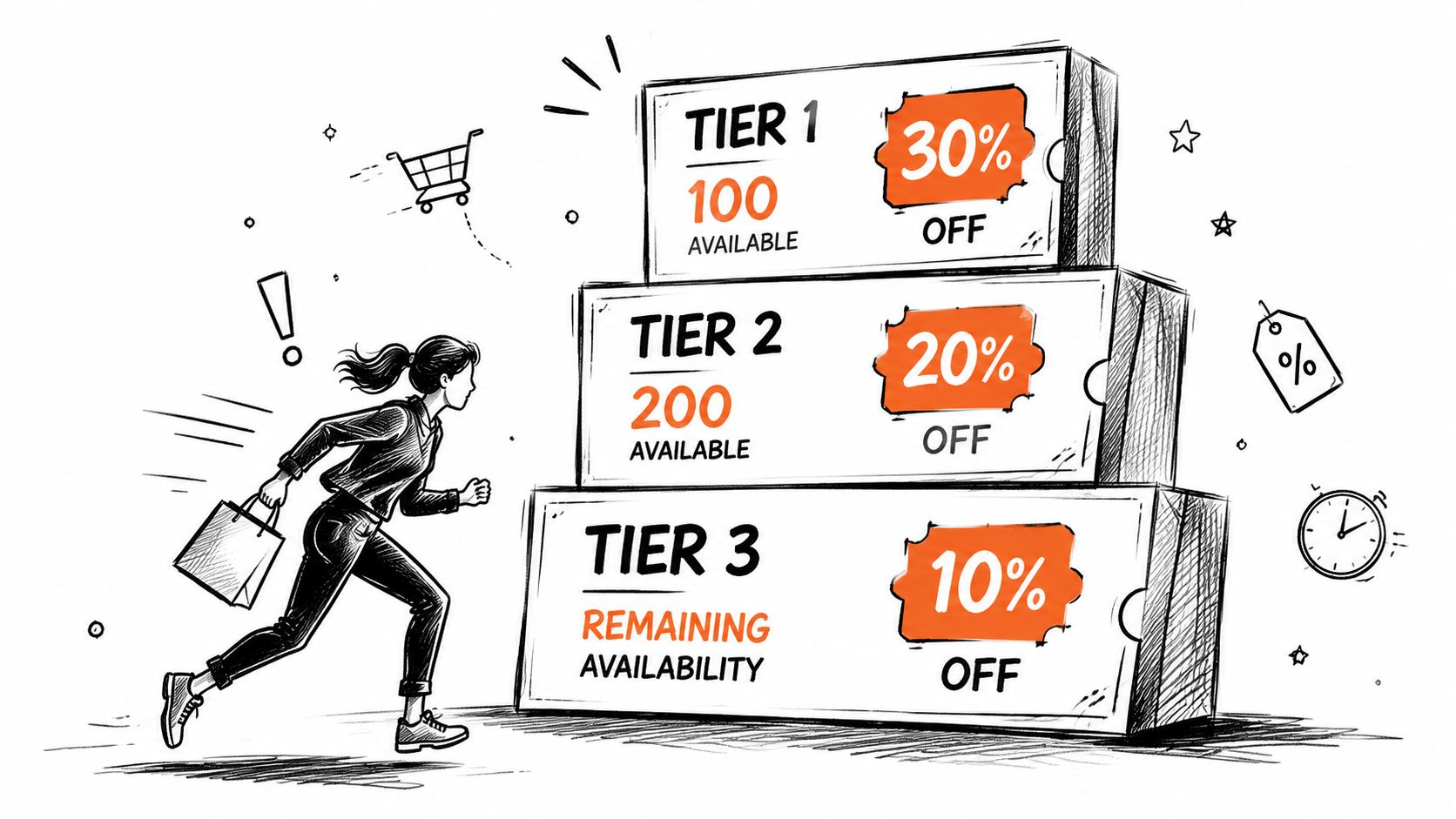
A flat bundle discount tells shoppers they can come back later. A capped tiered bundle tells them the best version of the offer belongs to early action.
That difference matters. If you run a fashion store selling denim, tees, and accessories, a stronger structure is a descending reward. Early shoppers get the best bundle incentive, the next group gets a lighter version, and late buyers still get something, just not the best reward. You’re not discounting everyone equally. You’re rewarding speed.
Why it works
This structure taps scarcity bias and loss aversion. Shoppers don’t just evaluate the value of the bundle. They react to the possibility of missing the best tier.
For an apparel brand, that might look like a bundle built around jeans, a tee, and a belt. The first reward tier could include the strongest savings or a bonus accessory bundle. The next tier gets a lighter reward. The final tier might drop to free shipping. The bundle still sells, but your average discount rate stays under control.
Practical rule: Put the best reward in the smallest allocation. That’s what creates real urgency instead of fake urgency.
How to set it up in Shopify
Use your historical traffic and conversion patterns, not wishful thinking. If the top tier is too large, the urgency disappears. If it’s too small for your audience, shoppers miss it too quickly and the campaign feels frustrating.
A few implementation rules help:
- Anchor the bundle to a clear use case: “Weekend Outfit Bundle” converts better than a random three-item combo.
- Show remaining claims clearly: The shopper should understand that access is limited, not just the calendar.
- Push the structure across channels: Email and SMS should explain the descending reward, not just announce “sale live.”
- Keep the pricing logic clean: If you need a framework, this guide to bundle pricing strategy is useful.
This is one of the strongest product bundle ideas for Shopify when your brand wants urgency without defaulting to blanket markdowns.
2. Time-Bound Flash Bundle with Hourly Resets
Some bundles fail because they sit on the store too long. Once a shopper believes the offer will still be there tonight, tomorrow, or next week, urgency disappears.
A flash bundle with scheduled resets fixes that. Beauty brands do this especially well during peak evening browsing hours. Instead of one all-day promotion, they release a limited bundle window, close it, then reopen a fresh round later. Each reset feels like a new event, not the same old promo hanging around the site.
Why resets beat always-on bundles
Shoppers respond to temporal pressure when it feels credible. An hourly or short-cycle bundle window creates a decision boundary. They know the reward won’t just sit there indefinitely.
This also helps with promo fatigue. If your audience sees the same skincare bundle every day, it blends into the furniture. If the “Night Routine Bundle” opens for a tight window, resets later, and is tied to available inventory, it feels active and worth paying attention to.
A bundle should create a buying moment, not just occupy a slot on the product page.
What to watch operationally
This works best when the reset schedule matches your traffic rhythm. If your best traffic arrives in the evening, don’t run the strongest bundle window in the afternoon. If you use Klaviyo or SMS, sync the send schedule with the reset window so the message and the offer land together.
A practical setup for Shopify stores looks like this:
- Match resets to traffic peaks: Evening shoppers often respond better to tighter windows than daytime browsers.
- Keep inventory honest: If nothing sells through, the reset mechanic starts feeling fake.
- Use cart reminders near the window close: Shoppers who already engaged need a nudge tied to the active cycle, not a generic abandon flow.
- Avoid overdoing it: Too many resets train shoppers to wait for the next one.
This format is especially useful for food and beverage, beauty, and electronics brands where purchase windows cluster around predictable traffic patterns.
3. Bundled Incentive Ladder with Social Proof
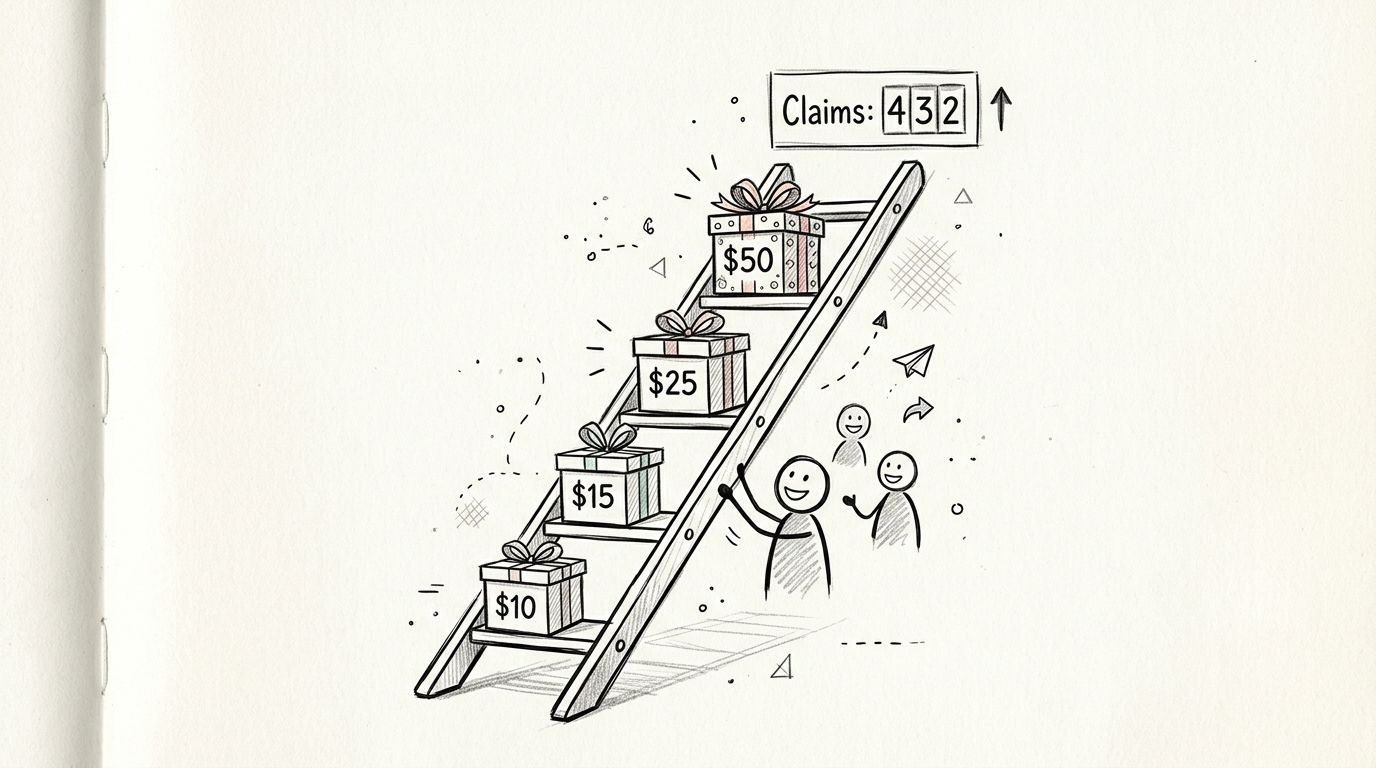
Most bundle offers are individual. You buy, you save, end of story. A bundled incentive ladder changes the frame. The reward improves as more shoppers participate.
That shared progress creates social proof without cheapening the offer. A coffee brand, for example, can launch a starter bundle where early claims grant a better reward for everyone who joined. People don’t just buy the bundle. They start watching the campaign.
The psychology behind the ladder
This structure combines commitment and consistency with social proof. Once a shopper joins, they’re more likely to care about the campaign’s progress. If you celebrate achievements visibly on the storefront, the bundle starts behaving more like a live event than a static promotion.
It can also encourage sharing. When shoppers know the next reward tier depends on more participation, they have a reason to tell friends or repost the campaign. That’s much healthier than asking customers to share a generic discount that anyone can ignore.
Where brands get this wrong
The thresholds have to feel achievable. If the ladder is too ambitious, the campaign stalls and confidence drops. If it’s too easy, there’s no tension.
A few practical cues matter:
- Show the full ladder upfront: New visitors should see the upside, not just the current reward.
- Celebrate each milestone: Use a storefront update, on-site banner, or post-purchase message.
- Tie the bundle to community identity: Coffee, beauty, and lifestyle brands usually have the strongest fit here.
- Pair it with referral behavior: If the campaign is shareable, the ladder has a reason to move.
This is one of the more underused product bundle ideas for Shopify because it asks merchants to think beyond “discount amount” and into participation mechanics.
4. Bundle Product Combinations with Earned Incentives
Merchants lose margin when bundles reward any cart, regardless of what goes into it. Earned-incentive bundles fix that by making the reward conditional on the right combination.
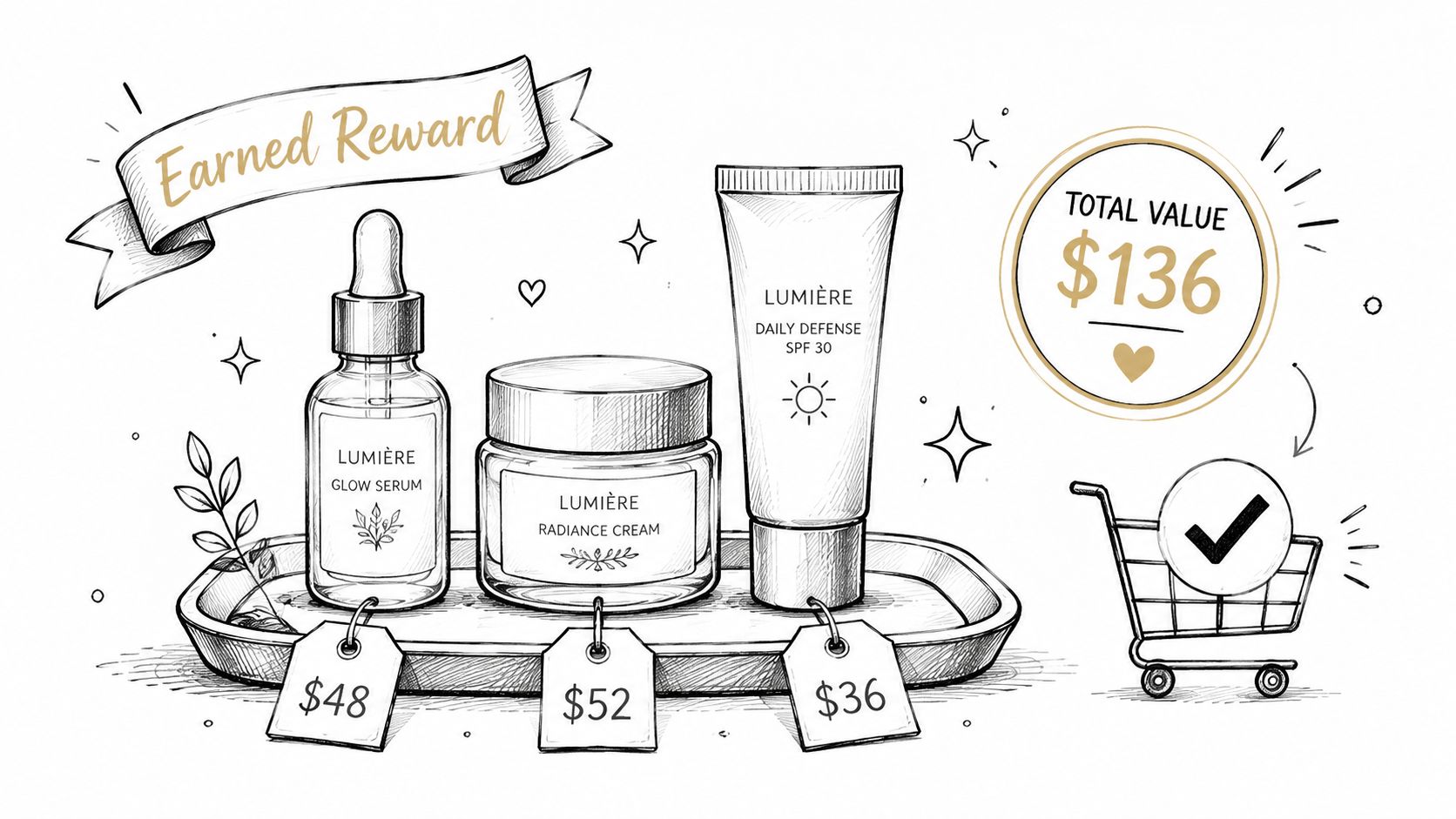
A skincare store is a clean example. Pair cleanser, toner, moisturizer, and SPF, then attach the incentive only when all four products are in cart. The reward can be a lower-priced add-on, free shipping, sample pack, or members-only gift. What matters is the rule. Complete the routine, then get the benefit.
Why this structure works
Shoppers respond well to completion mechanics. A partial cart feels unfinished. A complete system feels safer, more rational, and easier to justify. That is especially true in categories where customers worry about using products correctly, including skincare, supplements, pet care, and specialty food.
This also gives the merchant more control than a blanket percentage-off bundle. Instead of handing out margin on products the customer already intended to buy, you use the incentive to steer basket composition. Shopify’s guidance on product bundles highlights that bundles can increase average order value and improve product discovery when the grouping is built around products that naturally fit together (Shopify’s product bundling guide).
How to build combinations that hold margin
Start with combinations that solve one job. Morning routine. Weekend travel kit. New customer starter set. Refill pair plus accessory. Functional logic usually converts better than a merchandiser’s favorite assortment.
Then pressure-test the economics. The strongest earned incentives usually protect margin in one of three ways:
- Use a low-cost, high-perceived-value reward: Samples, accessories, and trial sizes often feel generous without crushing contribution margin.
- Attach the incentive to slow-moving or high-margin SKUs: That helps inventory flow without teaching customers to wait for sitewide promos.
- Set the threshold at natural completion points: The customer should feel one item away from finishing the set, not three items away from a forced upsell.
On Shopify, execution matters as much as the concept. The bundle builder has to show progress clearly. If the shopper cannot tell which item is missing, completion rates drop. If the reward only appears at checkout, trust drops.
A practical setup looks like this:
- Display each item’s standalone price and the earned reward in the same module: The value exchange needs to be obvious.
- Use collection or PDP logic tied to a use case: “Clear Skin Routine” usually performs better than a vague “Bundle and Save.”
- Trigger the incentive in-cart, not after payment: Immediate feedback reinforces the completion behavior.
- Track attach rate, AOV, and bundle margin by combination: Revenue lift without profit lift is a bad trade.
The trap is over-discounting the hero product to force bundle adoption. That trains existing customers to buy the set only when the deal appears. A better approach is to keep the core item close to full price and make the earned reward carry the persuasion. That protects brand position and gives the shopper a reason to add the extra products you’d like in the basket.
5. Email-Exclusive Tiered Access Bundle
Email-exclusive bundles can work, but only when exclusivity is real. If the same offer appears on the site two days later, subscribers learn the lesson fast and stop caring.
The smarter setup gives email subscribers access to a gated bundle with layered rewards based on engagement. Open the message and you see the offer. Click through and the better version becomes available. That adds a light commitment ladder without turning the whole thing into gimmicky automation theater.
Why this structure fits email
Email is still strong for controlled access because it creates a clear in-group. The subscriber isn’t just getting another discount. They’re getting entry to a curated offer that non-subscribers don’t see first.
This works especially well for fashion drops, limited beauty kits, and seasonal outdoor bundles. A subscriber-only capsule collection bundle feels premium. A public “subscribe for a discount” banner rarely does.
Operator note: If the reward for subscribing is too aggressive, you’ll grow the list and weaken the brand at the same time.
How to keep it from backfiring
The main risk is list quality. If the only reason to join is the deal, the relationship stays shallow and unsubscribe pressure climbs.
A few guardrails help:
- Keep non-subscriber access meaningfully weaker: The subscriber needs a reason to care.
- Make the email subject line do the work: Don’t hide the offer deep in the body copy.
- Retarget non-clickers through SMS carefully: The reminder should feel like access, not harassment.
- Use bundles tied to launches or seasonal edits: That preserves brand perception better than endless discount-led emails.
This is one of the best product bundle ideas for Shopify stores that already have a healthy owned audience and want to monetize attention without training everyone to wait for public markdowns.
6. SMS-First Limited-Quantity Bundle Drop
SMS is a sharp tool. Used well, it creates fast response and strong sell-through. Used badly, it feels intrusive and cheap.
That’s why the bundle drop model works better than generic SMS discounting. A streetwear brand can text opted-in subscribers about a tightly capped accessory and apparel bundle. A beauty brand can use the same format to move a limited set of overstock items without advertising the promotion to the entire market.
Why SMS bundles convert differently
SMS has immediacy built in. You don’t need long copy, and you don’t need to overexplain the offer. The bundle only needs three things to be clear: what it is, why it’s limited, and how to claim it.
That channel also fits scarcity naturally. If the quantity cap is honest and the claim window is short, the shopper reads the message as a timely opportunity rather than another evergreen promo.
Guardrails for brand-safe execution
The mistake is blasting too often or writing SMS like an email. Short, direct copy works better. So does sending outside your standard email windows so the drop feels distinct.
A strong setup usually includes:
- A tight quantity cap: If scarcity isn’t real, SMS will expose that quickly.
- A unique code or linked experience: That helps tracking and preserves the exclusivity.
- A short follow-up for non-clickers: Keep it brief and tied to remaining availability.
- A bundle with obvious value density: Snacks, supplements, beauty sets, and accessories all fit.
If your brand sits at a premium price point, this can outperform broad promo blasts because it rewards your most engaged audience first, instead of pushing a lower price to everyone.
7. Loyalty Tier Unlock Bundle with Progressive Access
A lot of loyalty programs hand out points and hope customers care. Most don’t, at least not enough to change behavior. A tier-activated bundle gives the customer a clearer reason to come back.
Instead of abstract rewards, the shopper earns access to better bundles as the relationship deepens. A supplement brand might offer a simple starter stack to first-time buyers, then offer premium bundles or early-access kits for repeat purchasers. The incentive improves because the customer has demonstrated value, not because the brand got desperate.
Why this works better than generic loyalty perks
This is commitment and consistency in action. People like seeing progress they’ve earned. A loyalty tier that offers a better curated bundle feels more tangible than another points balance sitting in an account page nobody visits.
It also aligns discounting with lifetime value. Your best bundle terms go to customers who’ve already shown buying intent. That protects margin much better than handing the biggest incentives to the least committed traffic.
Practical setup for Shopify stores
Keep the path visible. If shoppers can’t tell how close they are to reaching the next level, the system loses force.
Useful execution rules:
- Make the early milestone reachable: The second step can’t feel impossible.
- Message progress through email or SMS: Don’t rely on the customer to remember.
- Use bundle names that signal status: “VIP Recovery Kit” lands differently than “Bundle 3.”
- Combine with time-limited access: Repeat customers still need a reason to act now.
This structure works especially well for beauty, wellness, and replenishment brands where customer value compounds across multiple orders.
8. Abandoned Cart Recovery Bundle with Escalating Incentive
Most cart recovery flows waste margin because they jump too quickly to a discount. That’s lazy recovery logic. Not every abandoner needs the same push.
A better sequence starts with a lighter offer and only escalates for the shoppers who still hesitate. That could mean free shipping first, then a modest bundle incentive by email, then a stronger final nudge through SMS. The key is that the best offer is reserved for the hardest-to-convert segment, not handed out immediately.
Why staggered incentives protect margin
This structure recognizes that abandoned carts are not all equal. Some shoppers got distracted. Some needed reassurance. Some only move when the economics improve. If you start with the deepest concession, you overpay for recoveries you likely would have won anyway.
The framing also matters. When the customer sees that the offer improves based on continued inactivity, the promotion feels responsive rather than random. Used carefully, that can create urgency without turning your recovery flow into a coupon machine.
For merchants refining this sequence, these abandoned cart email examples are a useful reference point.
Don’t hand your best recovery incentive to the shopper who just needed ten more minutes.
What to track
A healthy product bundle attach rate typically sits above 5%, and a lower result after a 2-to-4-week test usually signals a visibility, pricing, or product-fit problem, not just weak traffic (bundle attach rate benchmark). That benchmark is useful here because recovery bundles often fail for the same reasons. The offer exists, but it doesn’t feel worth taking.
For abandoned cart bundles, watch:
- Attach rate on the recovered offer: Are people accepting the bundle or just finishing the original cart?
- AOV lift relative to standard recovery: The bundle should deepen the purchase, not just save it.
- Margin by recovery tier: Your strongest offer should be the least-used one.
- Product fit: The recovery bundle should complete the cart, not distract from it.
9. Referral Bundle Incentive Structure
Referral offers often feel transactional in the worst way. “Give this code, get a reward” works, but it rarely feels like part of the brand. A bundle-based referral incentive is stronger because it rewards advocacy with a curated experience instead of a plain coupon.
For example, a beauty brand can give referred shoppers a first-purchase routine bundle incentive while the referrer earns credit toward a higher-value curated set. That creates a cleaner story than a generic discount exchange.
Why bundle rewards improve referrals
Referrals run on trust and social proof. The friend making the recommendation is lending credibility. If the reward feels thoughtful and product-led, it reinforces that trust. If it feels like an aggressive coupon funnel, it weakens it.
Bundles also give you more room to shape economics. You can build the referred shopper’s first purchase around products with healthy contribution margin, while the advocate earns toward a future bundle that encourages repeat purchase rather than one-off redemption.
How to make the program actually usable
The referral path has to be easy on mobile. That sounds obvious, but a lot of referral mechanics still feel clumsy in the moment a customer might share them.
A strong setup includes:
- A simple share flow: Copy, text, or DM should take almost no effort.
- A first-purchase bundle that introduces the brand well: The referred customer should experience your best entry point.
- Milestone-based rewards for advocates: This keeps the program engaging after the first referral.
- Owned-channel reminders: Email and SMS can prompt happy customers to share after a good delivery or replenishment point.
This approach is especially effective for categories with strong word-of-mouth behavior, including skincare, supplements, coffee, and lifestyle products.
10. Limited-Edition Seasonal Bundle with Scarcity Messaging
Seasonal bundles are common. Most are forgettable because they’re just themed packaging wrapped around a standard discount. The better version uses real constraints. Limited production, limited timing, and a clear reason the bundle exists now.
That’s what makes a “Summer Glow Bundle” different from a generic warm-weather sale. It’s curated for a seasonal use case, available for a defined period, and honest about quantity. When done right, the bundle feels collectible, not promotional.
Why authentic scarcity matters
The power here comes from scarcity bias, but only if the scarcity is believable. Customers can tell when “limited edition” really means “we’ll keep this live until inventory drags.” If the bundle is tied to a season, campaign, or production run, urgency feels earned.
This is also where message framing matters. FoxEcom’s bundling guidance highlights the rule of 25%, which says shoppers are much more likely to add an extra item when that additional cost feels below 25% of the original item’s price. It also notes that a “Save 25%” framing tends to land better on lower-priced bundles, while an absolute-dollar framing resonates better on higher-priced ones (rule of 25% in bundle messaging). That’s useful when positioning seasonal bundles across price points.
Seasonal bundles that don’t cheapen the brand
You don’t need a heavy markdown to make these move. In fact, over-discounting usually weakens the seasonal story.
Use these rules:
- Curate around a seasonal job: Holiday gifting, summer travel, back-to-school setup, winter repair.
- Set quantity caps conservatively: A sellout is better than dragging the bundle into clearance.
- Show both time and inventory closure points when relevant: The ending should feel natural.
- Study authentic scarcity execution: This breakdown of scarcity marketing is worth reviewing.
Merchants also tend to overlook the broader strategic gap here. Time-bound and quantity-capped bundles are still underused compared with flat, repetitive promotions, even though urgency-led mechanics can reduce the need for blanket markdowning and help preserve brand presentation (Shopify bundling discussion).
Top 10 Shopify Product Bundle Ideas Comparison
| Bundle Approach | Implementation complexity | Resource requirements | Expected outcomes | Ideal use cases | Key advantages |
|---|---|---|---|---|---|
| Tiered Discount Bundle with Quantity Caps | Medium, real-time tier logic and counters | Moderate, dev work, inventory planning, email/SMS integration | Immediate conversion lift with controlled incentive spend | High-traffic promotions and product launches | Protects margin; authentic scarcity; urgency for first movers |
| Time-Bound Flash Bundle with Hourly Resets | High, scheduling, frequent resets and timers | High, monitoring, fulfillment capacity, campaign ops | Multiple daily urgency moments; repeated conversion opportunities | Brands with steady intra-day traffic or flash-event cadence | Recurrent urgency; combats promo fatigue; aligns sends to windows |
| Bundled Incentive Ladder with Social Proof | High, cumulative counters and sharing integration | Moderate–High, traffic volume, social tools, comms | Viral sharing potential; momentum-driven conversion increases | Community-driven brands and viral-growth campaigns | Leverages social proof; encourages sharing and collective action |
| Bundle Product Combinations with Earned Incentives | Medium, bundle config and cart-trigger logic | Moderate, merchandising, inventory alignment, cart rules | AOV lift through curated purchases; clearer value perception | Cross-sell, starter kits, product discovery promotions | Feels earned; reduces decision paralysis; protects margin |
| Email-Exclusive Tiered Access Bundle | Medium–High, dynamic offers by open/click tracking | Moderate, ESP integration, segmentation, creative assets | List growth, higher open/click rates, targeted conversions | List-building, subscriber retention, early-access offers | Drives email signups; limits broad discounting; increases engagement |
| SMS-First Limited-Quantity Bundle Drop | Medium, SMS workflow and tight landing controls | High, sizable SMS list, rapid fulfillment, timezone handling | Fast sell-through and high conversion from engaged list | Limited editions, clearance drops, high-engagement launches | Very high open/click rates; exclusivity; authentic scarcity |
| Loyalty Tier Unlock Bundle with Progressive Access | High, customer tracking, dashboards, account integration | High, CRM, data infrastructure, program management | Increased repeat purchases and higher customer LTV | Brands focused on retention and repeat purchase growth | Encourages loyalty; aligns rewards to lifetime value; retention moat |
| Abandoned Cart Recovery Bundle with Escalating Incentive | High, multi-step automation and unique code tracking | Moderate–High, automation platform, cross-channel messaging | Recovered revenue from high-intent shoppers; margin-efficient recovery | Stores with high cart abandonment or high-ticket items | Targets high intent; escalates only when needed; recovers lost sales |
| Referral Bundle Incentive Structure | Medium–High, referral tracking and fraud prevention | Moderate, program ops, tracking systems, creative assets | Lower CAC over time; higher-quality referred customers | Long-term growth and community-driven acquisition | Cost-effective acquisition; network effects; dual-sided rewards |
| Limited-Edition Seasonal Bundle with Scarcity Messaging | Medium, production planning and time/quantity controls | High upfront, production, forecasting, seasonal marketing | Strong seasonal demand and storytelling-driven sales | Holiday, seasonal campaigns, limited-run product launches | Authentic scarcity; seasonal relevance; strong promotional narrative |
From Bundles to Behavior-Driven Promotions
The best product bundle ideas for Shopify start with customer behavior, not discount size. The question is simple. What action should this offer trigger right now?
That framing changes how bundles perform. A strong bundle can raise average order value, reduce choice friction, and guide shoppers toward a higher-margin purchase path. A weak one does the opposite. It trains customers to wait for the next markdown, chips away at perceived value, and forces the brand to give up more margin every time it wants a sales spike.
The difference usually comes down to psychology and structure. Scarcity pushes faster decisions when a reward is capped. Loss aversion makes shoppers pay attention when a better offer can disappear. Social proof helps referral bundles and claimed-tier promotions feel active instead of fabricated. Commitment bias makes loyalty ladders and earned incentives more persuasive than another generic percentage-off banner.
Shopify brands also need to handle the mechanics well. Fixed bundles are useful for simple kits and starter sets. Many stores hit limits fast once they want channel-specific access, rolling resets, inventory-gated rewards, or promotions that feel like events rather than static product packaging. At that point, bundle strategy stops being a merchandising question and becomes an operational one.
That matters because generic “buy more, save more” promotions have a short half-life. Shoppers learn the cadence. They delay purchases, wait for the next drop, and only convert when the discount is deep enough to feel different. That pattern creates promo fatigue and margin erosion at the same time. If you are already investing in acquisition through content like faster weekly e-commerce reels, blunt discounts are an expensive way to finish the job.
A behavior-driven platform like Quikly makes more sense in that environment. It lets Shopify brands run promotions with real limits tied to time, quantity, or both, which gives customers a concrete reason to act instead of postpone. The format also feels closer to an experience than a popup or standard coupon field. That distinction matters for brands trying to protect pricing power while still creating urgency. Quikly highlights results from brands such as Jordan Craig on its Shopify promotion examples page, showing the kind of profit-focused use case operators care about.
Start with one audit. Find any bundle that acts like a disguised sitewide sale. Then rebuild it around a behavior you want to reinforce: faster first purchase, higher cart depth, referral participation, repeat purchase cadence, or list growth through gated access.
That is the shift. Bundles work best when they reward action, not waiting.
Topics: product bundle ideas for shopify, shopify bundling, ecommerce promotions, increase aov, margin protection