A Shopify operator sets a $75 free shipping threshold because a competitor uses it. For two weeks, average order value appears to improve. Then carts below $50 begin converting less often because the shipping charge now feels punitive. Another brand sets its threshold at $49, protects conversion, and discovers that the extra orders don’t create enough margin to cover fulfillment.
Both decisions can look reasonable in Shopify admin. Neither is necessarily profitable.
A free shipping threshold is a behavioral lever disguised as a shipping policy. Set it too low and you absorb delivery costs customers would’ve paid. Set it too high and shoppers don’t add enough to qualify, or they abandon the cart altogether. The right number comes from unit economics, basket distribution, customer behavior, and controlled testing, not from copying a competitor’s banner.
The Threshold Decision Every Shopify Brand Eventually Faces
The most common threshold mistake happens before anyone opens the analytics dashboard. A team sees familiar numbers such as $49, $59, $75, or $100, picks one that feels plausible, and moves on to the next promotion.
That approach ignores the trade-off. A higher threshold can encourage basket expansion, but it can also make shipping feel like a penalty for shoppers who aren’t close to the line. A lower threshold can reduce checkout friction, yet it may give away delivery on orders that would’ve qualified at a higher level.
Industry benchmarking gives merchants a useful reference point, but not an answer. The average free-shipping threshold among a major U.S. ecommerce benchmark was reported at $64 in 2023, which was 23.1% higher than in 2019. The same benchmark reported that 47.1% of retailers offer free shipping only after customers reach a payment threshold, confirming that conditional shipping is a mainstream pricing tactic, not a niche experiment. The ecommerce benchmark and threshold context can help frame the decision, but your own margins still determine whether that benchmark makes sense.
The two ways the decision fails
The first failure is margin erosion. Your AOV rises, but the additional gross margin from the larger basket doesn’t cover shipping, packaging, dimensional-weight charges, residential fees, and fuel surcharges.
The second is conversion suppression. Customers who would’ve completed a smaller order now see a shipping fee that changes their perception of the total price. A threshold can motivate shoppers near the line while discouraging everyone else.
Operator’s rule: Treat the threshold as a trade between contribution margin and completed orders. Don’t approve it because the number looks familiar.
That leaves the practical question: how do you choose a threshold that gives shoppers a reachable reason to add products without turning shipping into a conversion tax?
What a Free Shipping Threshold Actually Is
A free shipping threshold is the minimum eligible cart subtotal at which a merchant waives the shipping fee the customer would otherwise pay. If the threshold is $60, a qualifying cart receives free shipping, while a cart below $60 follows the store’s standard shipping policy.
That differs from three Shopify setups that often get mixed together:
- Flat free shipping: Shipping is waived for every eligible order, regardless of cart value.
- Flat-rate shipping discount: The customer receives a fixed dollar amount or percentage off shipping, without needing to reach a minimum subtotal.
- Cart-value discount: The product subtotal is reduced after a customer reaches a spending level. The customer isn’t necessarily receiving free shipping.
The clean internal definition is simple: free shipping is earned when an eligible cart reaches a stated subtotal, while product prices remain unchanged. That wording helps merchandising, finance, and lifecycle teams discuss the same mechanic.
In Shopify, the exact configuration depends on your shipping setup and plan. The relevant concepts usually appear under shipping rates, free-shipping conditions, or discount settings. A shipping-rate rule controls what the customer pays for delivery. A discount code or automatic discount can control a promotional incentive, but it shouldn’t be confused with the underlying shipping policy.
The distinction matters operationally. A shipping threshold needs clear eligibility rules for markets, products, rates, and exclusions. It also needs messaging that updates as the cart changes. Merchants reviewing carrier zones, fulfillment costs, and delivery promises may find this practical guide to ecommerce logistics for Twin Cities merchants useful when documenting the logistics assumptions behind the policy.
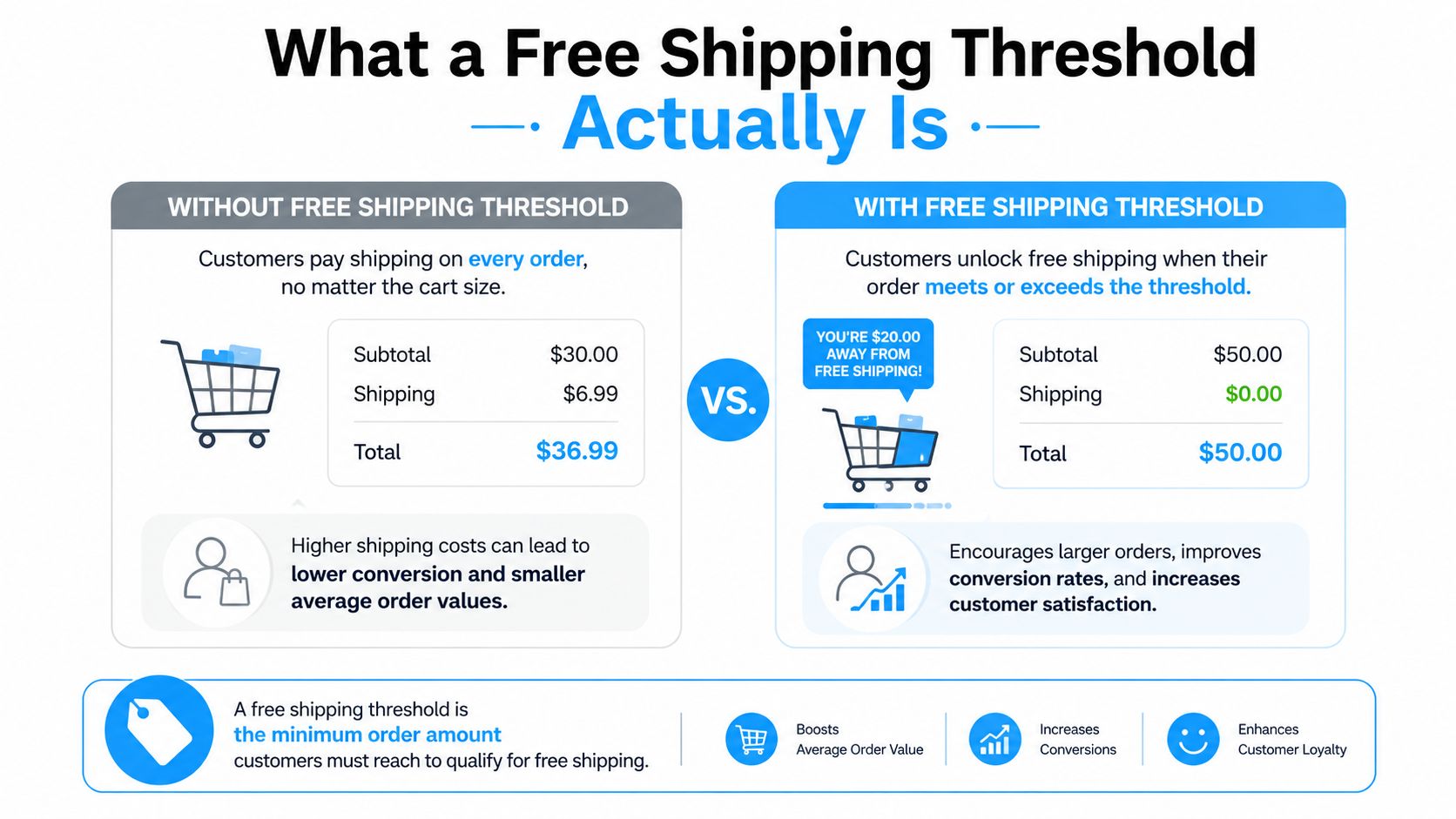
A customer should understand three things without opening a support ticket: how far they are from free shipping, which products count, and what happens if they don’t qualify. Put the rule in the announcement bar, product detail pages, cart drawer, cart page, and shipping information page. Consistency prevents the checkout from becoming the first place where the customer learns the cost.
Calculating the Right Threshold From Unit Economics
The starting point is break-even math, not a percentage copied from another store.
A practical floor is:
Minimum threshold = AOV + all-in shipping cost ÷ gross margin percentage
Written more precisely, the incremental gross margin created by the additional basket value needs to cover the shipping cost you absorb. The fully loaded shipping cost should include the carrier base rate plus dimensional-weight, residential, and fuel surcharges. One ecommerce playbook notes that those additions can push the actual cost well above an approximate $8 base, so using only the headline carrier rate can make a threshold look safer than it is. The unit-economics framework and modal-order-value guidance explains why the result is a floor, not automatically the target.
The threshold should usually sit roughly 15% to 30% above current AOV, provided that range remains reachable for the dominant basket cluster. Independent benchmark guidance places many brands around $60 to $70, with an average threshold near $64, and reports that clear threshold messaging can produce about a 15% to 30% AOV increase. This free-shipping threshold benchmark is useful as a test range, not as a guarantee.
Category economics provide another reference point. A published ecommerce growth guide lists typical ranges for several categories, but it doesn’t provide typical AOV, average shipping cost, or calculated break-even values for each category. Those fields should come from your store’s data rather than invented benchmarks.
| Category | Typical AOV | Avg Shipping Cost | Break-Even Threshold | 15-30% Above AOV |
|---|---|---|---|---|
| Fashion/Apparel | Use store data | Use fully loaded cost | Calculate from margin | Test 15% to 30% above AOV |
| Beauty/Cosmetics | Use store data | Use fully loaded cost | Calculate from margin | Test 15% to 30% above AOV |
| Home Goods | Use store data | Use fully loaded cost | Calculate from margin | Test 15% to 30% above AOV |
| Electronics | Use store data | Use fully loaded cost | Calculate from margin | Test 15% to 30% above AOV |
| Specialty Food | Use store data | Use fully loaded cost | Calculate from margin | Test 15% to 30% above AOV |
The published category guidance places Fashion/Apparel at $50 to $75, Beauty/Cosmetics at $35 to $50, Home Goods at $75 to $100, Electronics at $50 to $100, and Specialty Food at $40 to $60. The category benchmark and formula reference makes clear that these ranges are anchors, not substitutes for contribution-margin analysis.
A worked apparel example
Suppose an apparel store has a $60 AOV and a 55% gross margin. If its fully loaded shipping cost is $8, the incremental basket value needed to cover shipping is:
- $8 ÷ 55% = $14.55
- $60 + $14.55 = $74.55
That produces a break-even floor of approximately $74.55, so a working threshold might be rounded to $75. The store should then test whether the additional basket value occurs, whether conversion falls, and whether the threshold remains profitable after refunds, fulfillment variation, and customer mix are included.
Use the modal order value, the most common basket value, alongside AOV. A few large orders can pull the mean upward and make a threshold seem more reachable than it is for most shoppers.
When Raising the Threshold Quietly Backfires
A higher threshold can improve the economics of qualifying orders and still reduce total profit.
Research on an online retailer found that raising the free-shipping threshold from $80 to $100 led to a 19.4% decline in consumer spending. The reduction came mainly from lower average cart value and, to a lesser extent, lower purchase frequency. Shoppers also bought fewer distinct products and shifted toward lower-priced items. The published research summary shows why threshold lifts need a demand-side analysis, not only a shipping-cost calculation.
The mechanism is reference-point psychology. Customers remember the old threshold. Once the new line appears, the original amount becomes an anchor for what used to feel attainable. A shopper who previously saw $80 as the finish line may interpret $100 as a much larger task, especially when finding a suitable add-on requires effort.
Device behavior makes the result less uniform. Desktop shoppers were more likely to add new products or substitutes, while mobile shoppers more often increased the quantity of the same item. The study on device-specific basket padding supports a practical conclusion: a threshold that works on desktop may underperform on mobile when browsing, comparing, and adding products takes more effort.
Three signals that deserve attention
| Metric to Watch | Healthy Lift | Warning Sign |
|---|---|---|
| Add-to-cart rate and checkout conversion | Both remain stable or improve | Add-to-cart rises while checkout conversion falls |
| Blended AOV and qualification rate | AOV rises with a stable qualification rate | AOV stays flat while fewer carts qualify |
| Contribution margin after delivery costs | Margin improves after real shipping costs | Carrier-cost inflation consumes the apparent gain |
Hold the line when the new threshold pushes well beyond the dominant order cluster, qualification falls, and checkout conversion weakens. Test a lift when many existing orders already qualify comfortably, the modal basket sits near the proposed line, and the incremental gross margin clearly covers all-in shipping.
Customer mix matters too. A returning, high-value customer may tolerate a higher target because the brand relationship already carries trust. A first-time mobile shopper arriving from a paid channel may have less patience for a difficult top-up task.
The original threshold should remain the control in any test. Segment by device, customer status, market, and cart value. A blended average can hide the exact cohort that stopped buying.
Segmentation and Promotional Alternatives Worth Considering
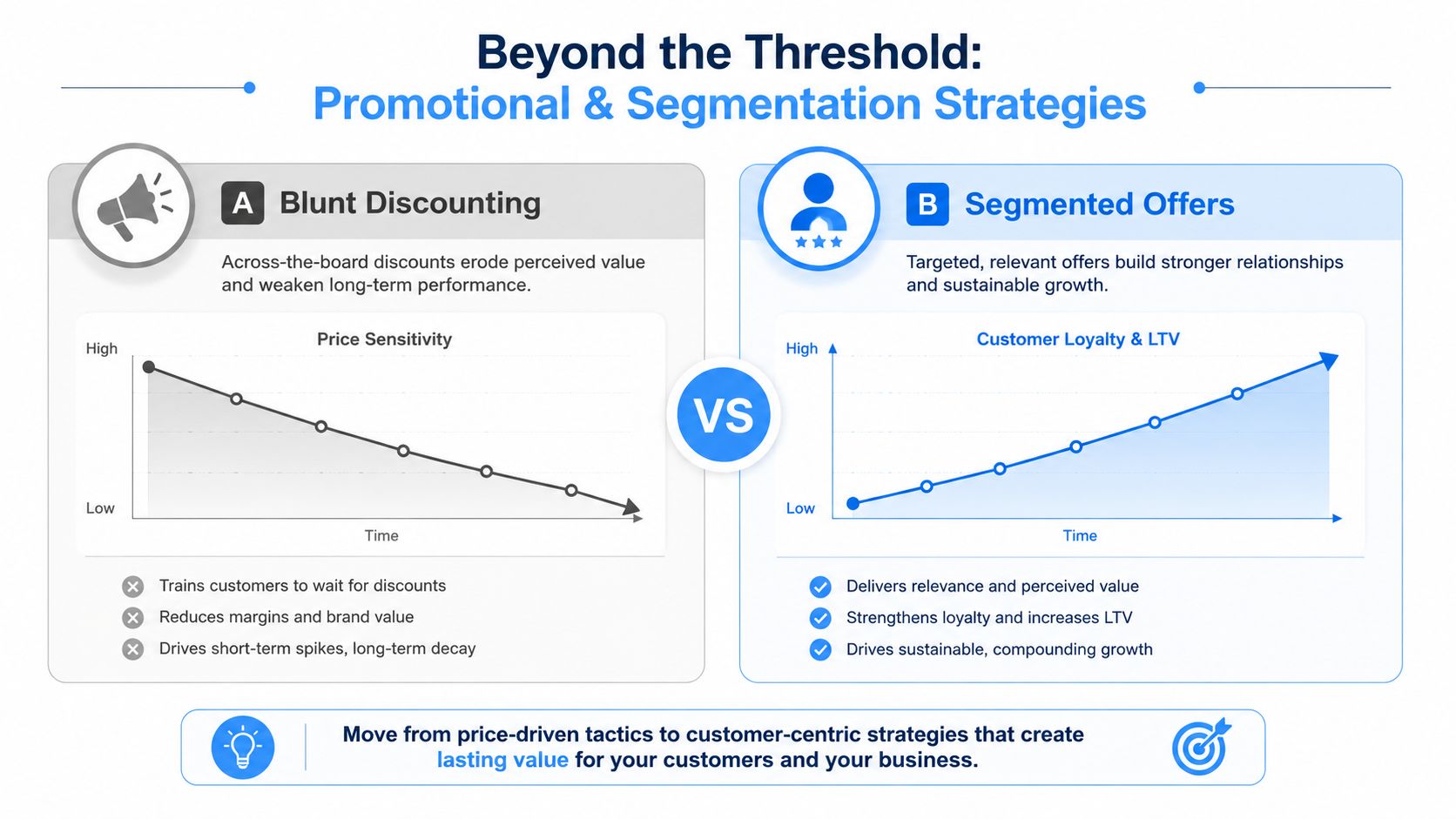
A single free shipping threshold forces very different customers into the same policy. A first-time visitor, a returning subscriber, an international customer, and a high-lifetime-value member don’t carry the same margin profile or shipping expectation.
Blunt discounting also creates a long-term problem. Automatic discounts teach customers that waiting is rational. Rewarded behavior works differently because the customer earns the benefit through a specific action, such as joining a program, adding a complementary product, or purchasing within a defined window.
Policies that protect the economics
Member-only free shipping can reserve the strongest shipping benefit for customers who have already created an account or joined a loyalty program. That can support retention without exposing every low-value order to the same subsidy.
Newsletter or SMS signup exchanges permission for a shipping incentive. The value isn’t limited to the first order, because the brand gains a channel for future product education and replenishment messaging.
Loyalty-tier perks can give higher-value cohorts a lower threshold or broader eligibility. Keep the rule explicit. Confusing exceptions create support tickets and undermine trust.
Carrier-cutoff urgency can make a shipping message useful rather than theatrical. A countdown tied to the actual dispatch or carrier cutoff helps a shopper decide when to order, while a manufactured timer that resets on refresh can damage credibility.
Regional shipping windows can connect an offer to a real operational constraint, such as a local event or weather-related demand period. The promotion should follow fulfillment reality, not create promises the warehouse can’t keep.
Raise the basket without relying on a higher line
Bundling can make the target feel natural. An anchor kit, routine bundle, or complementary pack gives shoppers a coherent reason to add products instead of asking them to search for filler.
A light buy-one-get-one structure can also increase quantity while keeping the effective discount controlled. Review the bundle’s gross margin, shipping weight, and return behavior together. A bundle that raises revenue but adds dimensional-weight charges may not improve contribution.
For a deeper set of tactics, see how to increase average order value without discounts.
A practical segmentation matrix
| Customer segment | Shipping policy to consider | Why it can work |
|---|---|---|
| New customers | Reachable standard threshold, clearly shown before checkout | Reduces surprise while preserving a basket-building prompt |
| Returning customers | Lower threshold or loyalty benefit | Recognizes relationship value without making it universal |
| Domestic customers | Standard domestic threshold based on local shipping cost | Keeps the offer tied to familiar delivery economics |
| International customers | Market-specific rate or threshold | Avoids applying domestic assumptions to higher delivery costs |
| High-LTV cohorts | Member-only free shipping or expanded eligibility | Protects retention where repeat value can justify the benefit |
The policy should match both the shopper and the parcel. Segmentation is useful only when the customer sees a clear, credible offer and the business can fulfill it profitably.
Setting Up and Testing a Threshold in Shopify
Shopify implementation has two jobs. The first is enforcing the shipping rule accurately. The second is showing progress early enough that the customer can act on it.
Start with Shopify’s native shipping configuration and available discount infrastructure. For more advanced eligibility logic, review the Shipping Discount APIs and the capabilities available on your plan. Native discount codes can support controlled campaigns, while shipping-rate conditions handle the evergreen policy. Don’t build a complicated promotion in theme code when the checkout still needs a reliable server-side rule.
Put the message where the decision happens
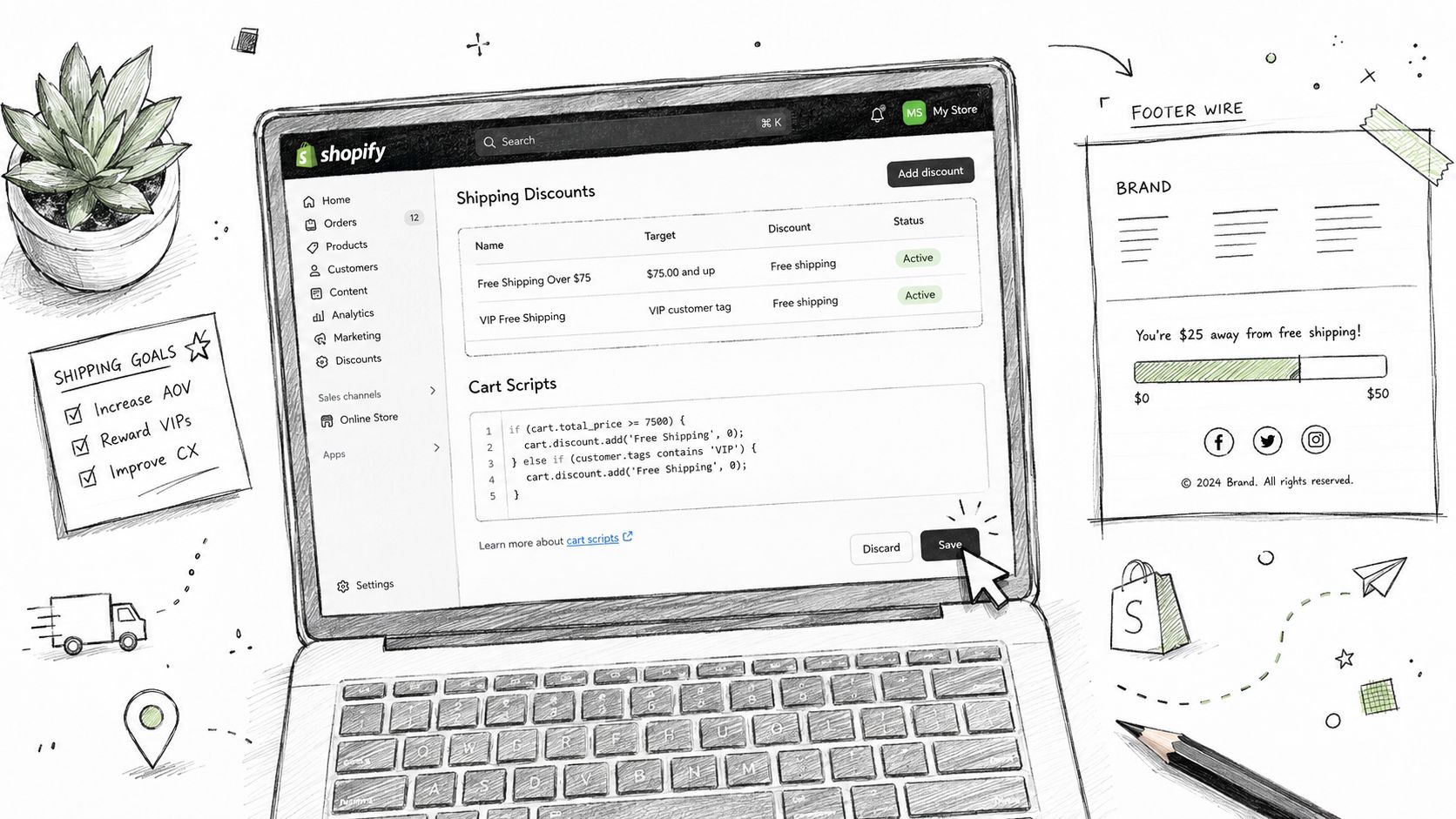
Add a progress message to the product page when the offer affects product selection. In the cart drawer, show the remaining amount dynamically, for example, “You’re $12 away from free shipping.” On the cart page, repeat the threshold, eligible products, and exclusions. At checkout, the shipping option should confirm the rule rather than reveal it for the first time.
A theme-level cart script or app block can calculate progress from the cart subtotal. Make sure the calculation handles discounts, gift cards, subscription items, excluded products, and multiple currencies consistently. A progress bar that says a shopper qualifies when the checkout engine disagrees will create more damage than no progress bar.
Shopify Plus merchants should be careful with legacy checkout customizations such as checkout.liquid. Shopify’s checkout architecture and extensibility options determine which changes are appropriate. Stores that aren’t on Plus should use Checkout Extensibility-compatible methods rather than assuming they can edit checkout templates directly. For shipping-cost logic and implementation considerations, this guide to calculating shipping in Shopify offers a useful operational reference.
Build a clean test
Track at least three events:
- Threshold progress: The cart enters a defined distance from the threshold.
- Qualified rate: The cart reaches the free-shipping condition.
- Incremental margin per session: Contribution after product cost, shipping, discounts, and relevant variable costs.
Use Shopify Analytics or GA4 with consistent event names and variant assignment. Keep the control and variant split clean. If Klaviyo or SMS campaigns include different shipping language, either exclude those sessions or pass the variant through the campaign attribution so one audience doesn’t contaminate the other.
Run the test through Shopify Audiences where appropriate, or use a Shopify Plus Script A/B split if your implementation supports it. A minimum sample size should be established before launch, and the test should run for at least two weeks. The primary decision metric should be incremental margin per session, not raw AOV.
Before rollout, verify eligibility, rates, mobile behavior, discount stacking, analytics events, and customer-facing copy. Keep the previous threshold configuration available so you can roll back without changing live checkout logic during a traffic peak.
Margin, Brand, and the Operating Principle Behind the Number
A higher AOV does not prove that a threshold worked. The policy works when the contribution from larger baskets exceeds the contribution lost through lower conversion and absorbed delivery costs.
The supplied comparison makes the trade-off clear. A $75 free shipping threshold that produces an 8% AOV increase and a 2.3% conversion increase can still result in a 4.1-point margin loss once carrier costs are absorbed. A flat 15% discount with a similar AOV outcome can lose 11 margin points. Revenue movement alone cannot distinguish these outcomes. Use this ecommerce margin resource to connect top-line changes with contribution.
| Metric | $75 Free Shipping Threshold | Flat 15% Discount |
|---|---|---|
| AOV movement | 8% increase | Similar AOV outcome |
| Conversion movement | 2.3% increase | Not provided |
| Margin outcome | 4.1-point loss | 11-point loss |
These figures are an editorial comparison for the supplied scenario, not a forecast for every store. Your result will vary with product margin, shipping zones, discount use, returns, customer acquisition cost, and the share of carts close enough to the threshold to respond.
The threshold also shapes brand behavior. Set it too low, and customers may start treating delivery as an entitlement, which can weaken pricing power. Set it too high, and the store may appear unwilling to meet reasonable delivery expectations. The supplied brief indicates that many shoppers expect free shipping above $50, but it does not provide a separate source for that estimate. Treat that expectation as a qualitative input, then validate it against device, product, and customer data rather than allowing it to override unit economics.
The operating principle is direct: choose the threshold that maximizes contribution margin per visitor under steady-state conditions. Review it quarterly and whenever carrier costs, product mix, or acquisition channels change. A temporary promotion should not conceal a shipping policy that loses money structurally.
Quikly offers Shopify merchants on-brand, time- and quantity-bound promotional experiences. Its mechanics have been refined across more than 60 million consumer interactions, and a shipping-related campaign can give shoppers a timely reason to complete a basket without making every order permanently discounted.
Map the modal basket in Shopify, calculate fully loaded shipping cost, and select the threshold that protects contribution without creating unnecessary friction. Test it against a clear control, then visit Quikly to explore urgency campaigns that support, rather than replace, a sound shipping strategy.
Topics: free shipping threshold, Shopify AOV, ecommerce conversion, shipping strategy, average order value