You’ve probably felt this on your Shopify store already. You run a sale, top-line revenue moves, and then you look at contribution after shipping, payment fees, and ad spend. The order count looks fine. The economics don’t.
That’s why average order value matters so much right now. If your only growth move is “discount harder,” you’re buying revenue at the expense of margin and training customers to hold out for the next offer. A healthier path is learning how to increase average order value without discounts, so each order does more work for the business without lowering perceived value.
The tactics that help aren’t random add-ons shoved into the cart. They’re structured. They respect shopper intent, reduce friction, and make the next purchase decision feel obvious. If you want another useful perspective on non-discount AOV plays, Grumspot tips for increasing AOV offers a solid companion read. It’s also worth revisiting the longer-term cost of always promoting, especially around the brand consequences of heavy discounting.
The Real Reason Your AOV Matters More Than Ever
AOV isn’t just a dashboard metric. It’s one of the clearest signals of whether your store can grow without getting squeezed from both sides.
Customer acquisition rarely gets cheaper on its own. Shipping doesn’t get simpler. And once a brand starts relying on repeated markdowns, the next campaign often has to work harder just to get the same response. That cycle creates a false sense of growth. Revenue rises, but margin quality falls.
A higher AOV at full or near-full price usually gives you more room to absorb acquisition and fulfillment costs than a lower AOV propped up by blanket discounts.
For Shopify merchants, this shifts the question from “How do I sell more units?” to “How do I make each order more valuable without making the experience worse?” That’s a better operating question because it forces discipline. You stop treating conversion as the only outcome that matters and start looking at basket composition, shipping economics, and product mix.
Why discount-led growth becomes fragile
Discounting works fast, which is exactly why brands overuse it. But it comes with trade-offs:
- Margin compression: Every percentage point off price reduces what you keep.
- Customer conditioning: Shoppers learn your timing and wait.
- Brand dilution: Premium positioning gets harder to defend when price is always negotiable.
- Planning instability: Forecasting gets messy when demand depends on the next promo blast.
What stronger AOV really buys you
When a shopper buys one more useful item, upgrades to a better version, or completes a set, you’re not just lifting order value. You’re often improving order economics without relying on a public markdown. That gives you more control over growth, and control matters when the market gets noisy.
Smart Upsells and Product Bundles That Add Value
The best upsells don’t feel like upsells. They feel like good merchandising.
A customer who has already decided to buy is telling you something important. Intent is present. The mistake many stores make is answering that intent with generic recommendation blocks that look automated and detached from the item in the cart. That’s how you get ignored.
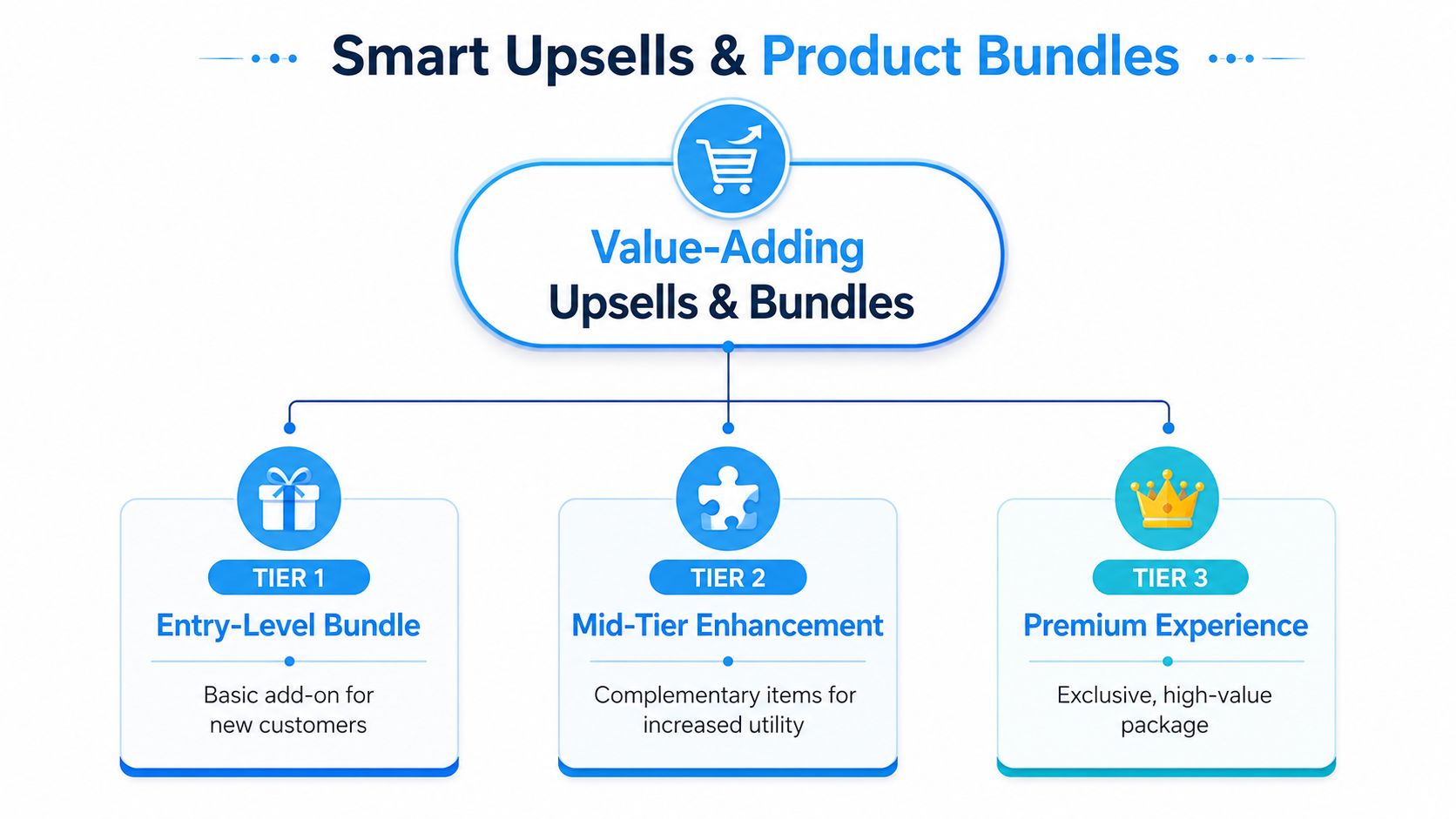
A better structure is a three-tier upsell architecture: primary upsells at the add-to-cart moment, secondary upsells at checkout, and post-purchase upsells during the fulfillment window. When executed with one-click acceptance, this setup can drive a 15-22% increase in AOV. The same data also shows that “Complete the Set” framing increases bundle acceptance by 40% because it solves a complete problem rather than a partial one, according to Attn Agency’s AOV strategy breakdown.
Use the right offer at the right moment
Here’s how this works in practice on Shopify:
-
At add to cart: Show a premium or larger variant.
If someone adds a basic skincare serum, offer the larger size or a more complete version of the routine before they move on. -
At checkout: Suggest a complementary product.
Accessories, refills, or use-case enhancers are ideal additions at this stage. Keep it relevant to what’s already in the cart. -
Post-purchase: Present one related item with one-click acceptance.
Don’t reopen the entire catalog. Offer the next logical product while the original purchase decision is still fresh.
“Complete the Set” beats “You might also like”
Framing matters because people don’t buy products in isolation. They buy outcomes.
A generic “You might also like” carousel asks the customer to do extra thinking. A “Complete the Set” message reduces decision effort because it explains why the added item belongs with the original purchase. That’s not just better copy. It’s better psychology.
Practical rule: Bundle around a job to be done, not around inventory you want to move.
A few examples:
- A coffee brand pairs beans with filters or a grinder.
- A bedding brand pairs sheets with pillowcases or a mattress protector.
- A haircare brand pairs shampoo with the matching mask or heat protectant.
If you want more examples of stores trying to increase average order value, that roundup is useful for pattern-spotting. For bundle construction specifically, this bundle pricing strategy guide is worth a read because pricing logic matters as much as product selection.
What doesn’t work
A few patterns usually underperform:
- Too many choices: Five add-on options create friction.
- Weak relevance: Accessories that don’t clearly fit the original item get skipped.
- Aggressive interruption: If the upsell slows checkout, it can hurt more than it helps.
- Discount-first bundles: If the only reason to buy the bundle is the markdown, you’re solving AOV by sacrificing margin.
Good bundles make the purchase more complete. Bad bundles make it more complicated.
Mastering the Free Shipping Threshold
Free shipping is powerful, but only when the threshold is disciplined. Many stores either set it too low and give away margin, or too high and make the goal feel unrealistic.
The reason this tactic works is simple. Shoppers see a shipping fee as a loss. If adding one more product feels better than paying for shipping, many will choose the extra product instead. That’s loss aversion in action.
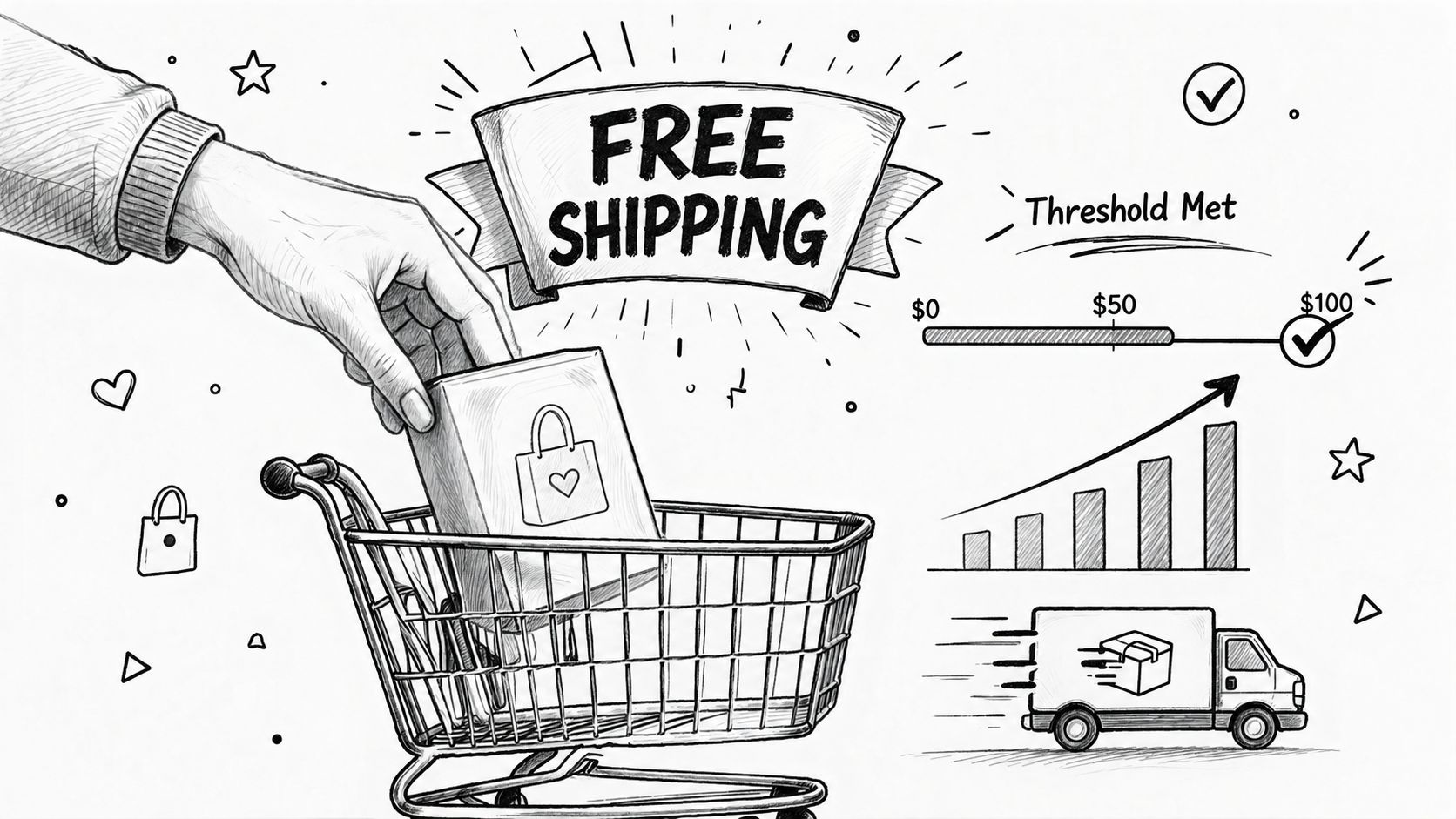
Data from Attn Agency’s guide on increasing AOV without discounting shows that free shipping thresholds set 20-25% above current AOV are an effective non-discount tactic. The same source notes that performance improves when the gap between current AOV and the threshold matches the price of a popular add-on product.
How to set the threshold
Many merchants get sloppy. The threshold should feel reachable, not arbitrary.
If your current AOV is around a certain level, the threshold should typically sit just above that point, close enough that one sensible product closes the gap. That means your cart merchandising has to support the threshold. If customers are a small amount away from free shipping, they should immediately see products priced near that gap.
On Shopify, that usually means pairing the threshold with:
- A cart progress bar: Show the exact amount remaining.
- Suggested add-ons: Surface products that naturally fill the gap.
- One-click cart add: Remove friction between seeing and adding.
What a good threshold looks like
A good threshold has three traits:
| Element | What it looks like |
|---|---|
| Reachable | One relevant product gets the shopper there |
| Visible | The cart clearly shows how close they are |
| Economic | The added revenue offsets the shipping cost |
The biggest mistake is assuming “higher threshold equals higher AOV.” It doesn’t always. If the jump feels too steep, shoppers can abandon instead of stretching.
When the threshold feels attainable, it motivates. When it feels unrealistic, it punishes.
Make the message specific
“Free shipping on orders over X” is fine on a banner. In-cart, specificity wins.
Use messaging tied to the shopper’s live cart value. “Add a little more for free shipping” is vague. Showing the exact remaining amount is more actionable because it turns an abstract incentive into a clear next step. That’s especially effective when your recommendation engine or cart drawer can surface one or two products that fit the amount cleanly.
Leverage Personalization in the Cart and Checkout
Personalization gets overcomplicated. Most Shopify brands don’t need an elaborate AI layer to improve AOV. They need relevance.
If a customer adds a product for dry skin, don’t show a random bestseller. Show the matching moisturizer, refill, or routine step that fits the purchase. If someone returns to buy a consumable they’ve ordered before, show the larger size or companion item that reduces future friction. That kind of personalization feels helpful because it is.
Start with the data you already have
For most Shopify stores, useful signals already exist inside the stack:
- Purchase history from Shopify customer profiles
- Browse behavior from your storefront and recommendation app
- Email and SMS engagement in Klaviyo
- Cart contents in real time
That’s enough to make better decisions in the cart drawer, on the product page, and during checkout. You don’t need to predict everything. You need to avoid irrelevant suggestions.
Where personalization pays off most
The strongest placements are usually the simplest ones:
- Slide-out cart recommendations: Good for accessories, refills, and routine-based add-ons.
- Checkout complements: Best when the suggestion removes a known use gap.
- Returning-customer offers: Ideal for larger formats or replenishment-adjacent items.
A beauty brand, for example, can recommend the matching cleanser when a serum is in the cart. A supplements brand can suggest a shaker or organizer when a powdered product is selected. A home brand can recommend the care kit that helps the main product last longer.
Personalization should answer, “What’s the next most useful thing for this shopper right now?”
Randomness kills trust. Over-personalization can feel invasive. The middle ground is to use observable intent and stay close to the purchase context. If you’re exploring more personalized cart experiences, this piece on real-time personalization is a practical place to start.
Create Purchase Urgency with Experiential Promotions
Most brands understand bundling and shipping thresholds. Fewer know how to create urgency without falling back on the same storewide discount.
That matters because urgency is often the difference between a shopper acting today and postponing the decision. The problem is that basic urgency cues can feel manufactured if they aren’t tied to anything real. Shoppers have seen enough fake countdowns to know the pattern.
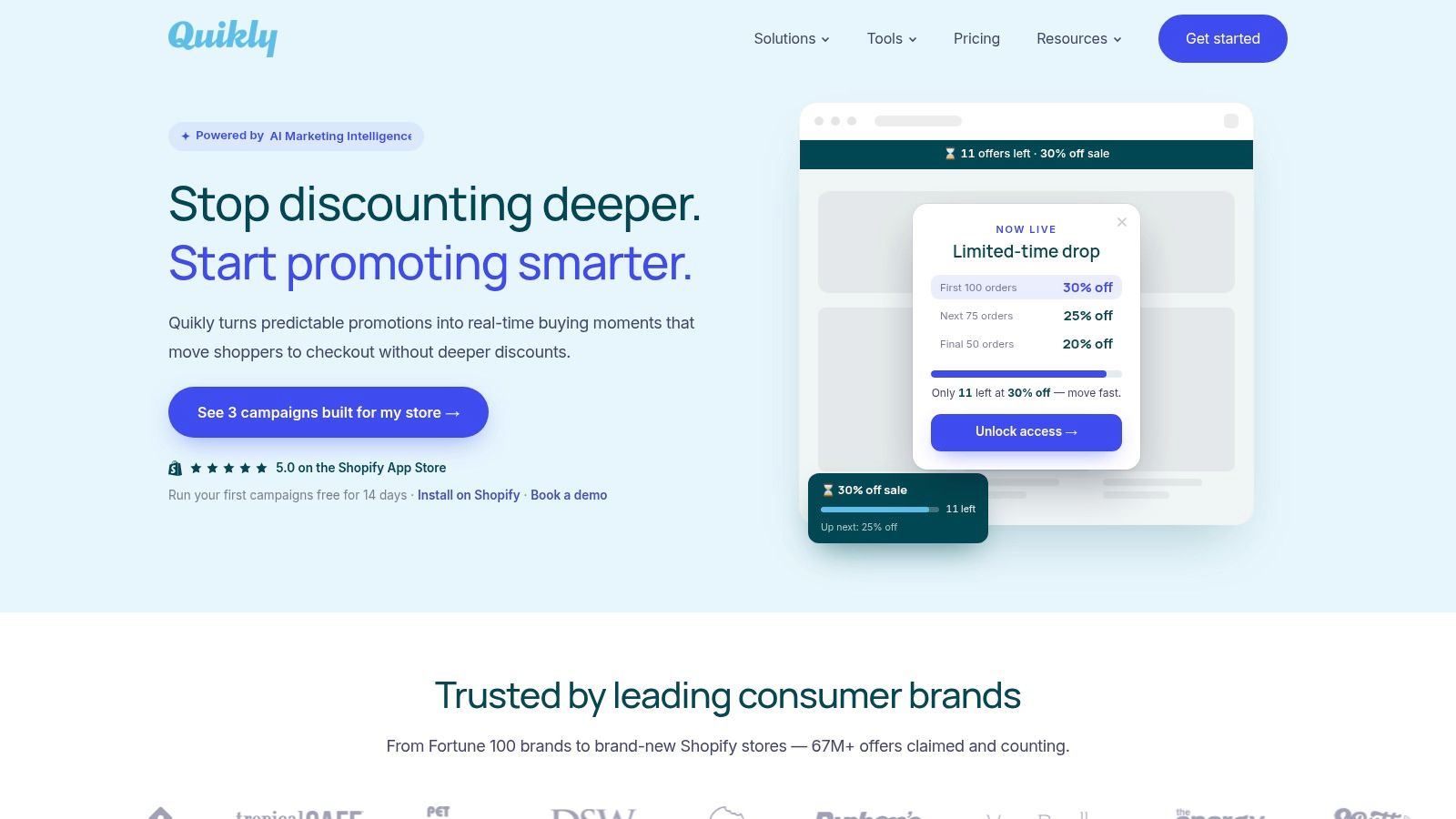
The more durable approach is urgency-driven scarcity. Instead of training customers to expect another blanket code next week, you create an offer with a real participation boundary. That can mean rewards capped by claim count, by time, or by both. According to this analysis of Quikly’s scarcity model, the mechanism is grounded in 60M+ consumer interactions, and it lifts conversion and AOV at lighter average discounts while avoiding the usual discount-training effect.
Why this works better than flat promotions
A flat discount says the same thing to everyone: buy whenever. Scarcity-based mechanics change the timing calculus.
They work because they align with how people naturally decide:
- Scarcity bias: Limited availability increases attention and perceived importance.
- Temporal discounting: Immediate rewards feel more compelling than future possibilities.
- Commitment and consistency: Once someone starts participating in an offer, they’re more likely to finish the purchase.
The key is that the urgency has to be credible. If every campaign feels permanent, shoppers stop believing you.
Make urgency part of the experience
Many brands often miss the AOV angle. Urgency doesn’t have to mean lower prices. It can be attached to access, tiers, limited claims, or earned rewards that encourage a larger basket.
Examples that fit a margin-aware brand:
- Claim-capped rewards that run out after a set number of redemptions
- Descending tiers where earlier action earns the strongest outcome
- Time-bound cart completion incentives that feel event-based, not automatic
- On-brand campaign styling so the offer feels native to the storefront
Used well, urgency helps customers act while intent is high. Used poorly, it becomes noise. The distinction is whether the offer feels earned and finite, or generic and endless.
How to Measure and Test Your AOV Strategies
AOV strategy gets expensive when brands make changes based on instinct alone. If you want margin-friendly growth, test like an operator, not like a gambler.
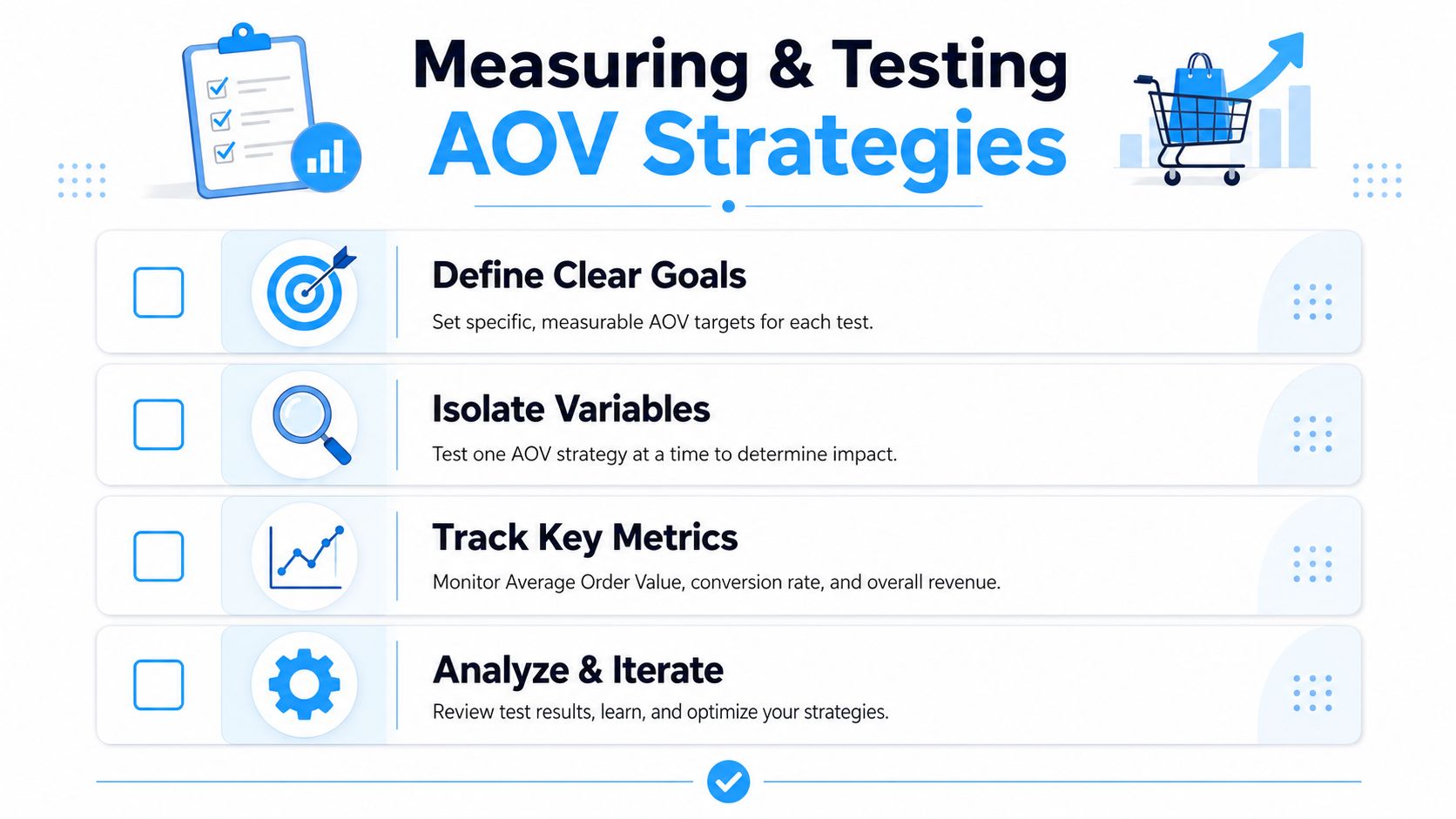
That means isolating one variable, giving it enough time to gather signal, and judging success by more than the AOV number itself. AOV can rise for the wrong reasons. If conversion softens or fulfillment costs climb, the apparent win can disappear.
Test one thing at a time
If you change your bundle offer, free shipping threshold, and cart messaging all at once, you won’t know what caused the result.
A cleaner approach:
-
Pick one tactic
Example: a new bundle on your PDP, or a revised free shipping threshold. -
Define the primary metric
Usually AOV, but not in isolation. -
Watch the supporting metrics
Conversion rate, revenue per visitor, gross margin, and fulfillment impact all matter. -
Review by segment
New vs returning customers, paid vs owned traffic, and mobile vs desktop can behave differently.
What to look at inside Shopify
Shopify Analytics gives you the basics. For most merchants, that’s enough to start making smarter decisions.
Track these consistently:
- Average order value: Did basket size increase?
- Conversion rate: Did the tactic create friction?
- Revenue mix: Are higher-value products or bundles moving?
- Margin quality: Did the bigger order remain worth it after costs?
- Take rate by placement: Which upsell or recommendation slot gets accepted?
A good testing mindset borrows from broader conversion work. If your team wants a simple framework for experiment hygiene, practical strategies for marketing teams can help tighten how you structure tests and read outcomes.
The most common measurement mistakes
Don’t keep an AOV tactic just because the headline number went up. Keep it if the business got healthier.
Three mistakes show up constantly:
-
Judging success by AOV alone
Higher basket value doesn’t automatically mean higher profit. -
Ending tests too early
Short bursts can mislead, especially around promo periods or channel mix changes. -
Ignoring operational side effects
Bigger bundles can change pick-pack complexity, shipping cost, and return patterns.
The strongest brands treat AOV as part of a system. They test, keep what improves the economics, and remove what adds noise or friction. That discipline is how you stop relying on markdowns as the default growth answer.
If you want to create urgency that increases conversion and AOV without defaulting to deeper discounts, Quikly is built for that job. It helps Shopify brands run fully on-brand, scarcity-driven promotional experiences shaped by mechanics refined across more than 60 million consumer interactions, so shoppers have a reason to act now without turning every campaign into another race to the bottom.
Topics: increase average order value, shopify aov, ecommerce strategy, without discounts, margin growth